
Guyana Travel Guide — Rainforest, Rum & the Waterfall Four Times Taller Than Niagara
I still meet people who think Guyana is an island. It is not. It is the only English-speaking country in South America, wedged between Venezuela and Suriname with the Atlantic at its back, and roughly 90% of it is still unbroken rainforest. For most of my travel-writing life it barely registered on anyone’s list — then oil money started reshaping Georgetown’s skyline, and suddenly this quiet, waterlogged, wildly biodiverse country became the fastest-changing place I’ve covered all year. None of that changes what the interior actually offers: a 226-metre single-drop waterfall you can have almost entirely to yourself, jaguar country, giant river otters, and a capital city built below sea level by Dutch engineers three centuries ago. It is not an easy country to visit on a whim — flights are pricier than the distance suggests, the interior runs on cash and small planes, and the US State Department currently rates it a reconsider-travel destination over crime. But if you want rainforest without the Amazon-tourism crowds, this is where I’d send you first.
In This Guide
- Overview — South America’s English-Speaking Outlier
- Mashramani — Republic Day Carnival on February 23
- Best Time to Visit Guyana (Season by Season)
- Getting There — GEO, Interior Airstrips & Border Crossings
- Getting Around — Bush Planes, Minibuses & Boats
- Top Regions — Coast, Rainforest & Rupununi Savannah
- Culture & People — the Land of Six Peoples
- A Food Lover’s Guide to Guyana
- Off the Beaten Path
- Practical Information
- Budget Breakdown — What Guyana Actually Costs in 2026
- Frequently Asked Questions
Overview — South America’s English-Speaking Outlier
Guyana is the only country on the South American mainland where English is the official language, a legacy of British colonial rule that ended with independence in 1966 and full republic status in 1970. Culturally and politically it often gets grouped with the Caribbean instead — it’s a founding member of CARICOM and its coastal population, cuisine, and cricket obsession feel far more Port-of-Spain than Bogotá. Geography tells the real story: it borders Venezuela to the west, Brazil to the south and southwest, Suriname to the east, and the Atlantic to the north, with the Essequibo, Courantyne, Berbice and Demerara rivers cutting the country into distinct worlds.
Roughly 90% of Guyana is Amazonian rainforest and savannah, home to jaguars, giant river otters, harpy eagles and the enormous arapaima fish — and almost none of it has roads. Nearly all interior travel happens by small aircraft or river boat, which keeps the wilderness genuinely wild but also keeps it expensive. Since 2015, offshore oil discoveries in the Stabroek Block have transformed the economy so fast that Guyana now posts one of the highest GDP-per-capita figures in the Americas, and Georgetown’s skyline is visibly mid-transition between colonial timber and new construction. None of that oil money has trickled down into budget-friendly tourism infrastructure yet — this is still a country for travelers who want their rainforest served without a paved trail to it.
Mashramani — Republic Day Carnival on February 23
If you can time a trip around one date, make it 23 February, Guyana’s Republic Day, celebrated nationwide as Mashramani — a word borrowed from an Amerindian language meaning roughly “celebration after cooperative work.” It marks the day in 1970 Guyana became a republic, and it plays out as a full carnival: costumed bands, steel pan and soca floats, a costume-and-float competition, and street parties that pull in every one of the country’s ethnic communities at once. Georgetown hosts the biggest parade, but smaller towns run their own versions the same week.
It’s a genuinely good problem that Mashramani lands in the shoulder-dry stretch of February — good weather, one of the year’s best cultural events, and hotel rates that haven’t yet caught up to how good the timing is. Book Georgetown rooms a few weeks ahead; this is the one week locals will tell you the capital actually fills up.
Best Time to Visit Guyana (Season by Season)
February – April · First dry(ish) window
Guyana doesn’t have a crisp dry season the way Belize or Costa Rica do — the coast sees its lowest rainfall roughly February through April, averaging well under half of what falls in the wettest months. Pair it with Mashramani in late February for the best single stretch of the year.
May – August · Main wet season
This is Guyana’s heaviest rain, peaking around June with well over 300mm falling on the coast in a single month. Interior rivers rise, which is actually good for some lodge access (higher water = easier boat travel to Iwokrama and Rewa) but rougher for savannah roads out to the Rupununi.
September – October · Second dry stretch
The lesser-known good window: rainfall eases again, savannah roads dry out, and this is prime time for wildlife-watching in the Rupununi as animals concentrate around shrinking waterholes.
November – January · Second wet season
Rains pick back up, lighter than May–August but still frequent. Christmas and New Year bring good energy to Georgetown but book ahead — it’s also when the Guyanese diaspora comes home.
The honest summary: there’s no month in Guyana without real rain, humidity sits high year-round around 27°C (81°F) on the coast, and a good poncho matters more than a specific month choice.
Getting There — GEO, Interior Airstrips & Border Crossings
Cheddi Jagan International Airport (GEO), on the Demerara River about 41km south of Georgetown, is the country’s only real international gateway, with regular service from Miami, New York (JFK), Toronto, Port of Spain, Panama City and other Caribbean and US hubs via American, JetBlue, Caribbean Airlines, Copa and others. There are no direct long-haul flights from Europe; most European travelers connect through the US, Panama or Trinidad.
From GEO, interior travel means small-plane transfers: light aircraft to Kaieteur, Karanambu, Lethem and other airstrips run out of Ogle Airport near Georgetown rather than the international terminal. Overland border crossings exist into Brazil (Lethem–Bonfim, a long but scenic route into the Rupununi and onward to Boa Vista) and, less commonly used by tourists right now, into Suriname via the Corentyne River ferry. The land border with Venezuela is not a route to plan a tourist crossing through given the ongoing territorial dispute — more on that in Practical Information below.
Getting Around — Bush Planes, Minibuses & Boats
Guyana’s interior has almost no paved road network, so small aircraft do the job long-haul buses do elsewhere — flights from Ogle to Rupununi airstrips or Kaieteur run a few hundred US dollars and turn a multi-day overland slog into an hour in the air over unbroken canopy. On the coast, it’s a different country entirely: shared minibuses run the coastal highway between Georgetown, New Amsterdam and the Suriname border cheaply and often erratically, and hired cars with drivers are the more comfortable option for visitors.
Once inside the rainforest or savannah, movement is by 4×4 on red-dirt tracks (dry season only, in practice) or by river boat — dugout canoes and motorized boats reach lodges along the Essequibo, Rupununi and Rewa rivers that no road will ever touch. Almost all interior transport is arranged through your lodge or tour operator rather than booked independently; this is not a self-drive destination once you leave the coast.
Top Regions — Coast, Rainforest & Rupununi Savannah
Georgetown
The capital sits about a metre below high-tide level, kept dry by a Dutch-engineered seawall and a network of canals and kokers (sluice gates) that has drained the city for centuries. Walk the grid downtown for the towering wooden St. George’s Cathedral and the cast-iron-clocktowered Stabroek Market, then work the seawall at sunset the way half the city does. It’s charming and visibly under-invested at once — go in with realistic expectations and stick to well-trafficked areas after dark.
Kaieteur National Park
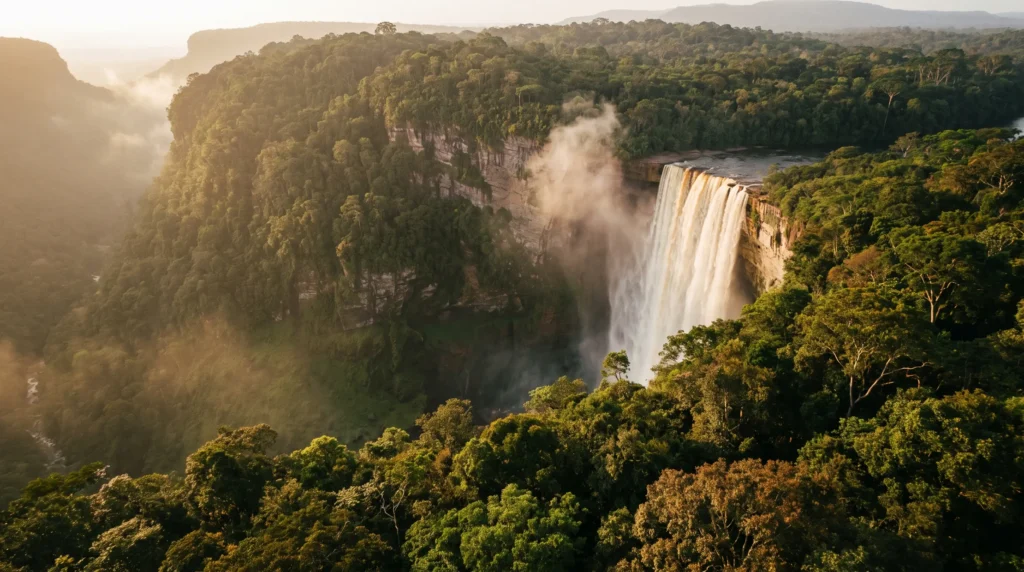
Home to Kaieteur Falls on the Potaro River — a single, sheer 226-metre drop (251m including cascades), about four and a half times the height of Niagara Falls and roughly double Victoria Falls. Most visitors fly in on a day trip from Georgetown; there’s an airstrip a short walk from the viewpoints, and — unusually for a natural wonder this scale — you may well have it to yourself.
Iwokrama Rainforest
A roughly 371,000-hectare protected rainforest set aside for sustainable-forestry research, centered on the Iwokrama River Lodge on the Essequibo River. The signature outing is a night or dawn climb up Turtle Mountain for a canopy-level view, plus a 30-metre elevated canopy walkway strung through the forest for wildlife-watching — howler monkeys, macaws, and if you’re extremely lucky, harpy eagles.
The Rupununi Savannah
Open grassland dotted with ranches and Indigenous villages around Lethem, near the Brazilian border — Guyana’s answer to the Pantanal. Eco-lodges like Karanambu (giant river otter research), Rock View, Surama and Rewa put you in genuinely remote wildlife country, and this is prime territory for spotting giant anteaters, capybara and, with real patience, jaguar.
Essequibo Islands & Bartica
At the mouth of the Essequibo River sit hundreds of river islands; Bartica, the self-styled “gateway to the interior,” is a scrappy gold- and diamond-mining river town with a frontier feel — an easy day or overnight trip from Georgetown by road and river.
Shell Beach
A remote stretch of Atlantic coast near the Venezuela border known for nesting sea turtles (leatherback, green, hawksbill and olive ridley). Access is difficult and infrastructure is minimal — worth it only if wildlife, not comfort, is the point of your trip.
Berbice & New Amsterdam
The quieter eastern coast toward Suriname, with a strong Indo-Guyanese cultural presence, sugar and rice country, and the colonial river town of New Amsterdam as its hub.
Culture & People — the Land of Six Peoples
Guyana’s national motto describes it as “One People, One Nation, One Destiny,” but the tourist-board shorthand is the “Land of Six Peoples” — Indigenous, African, Indian (Indo-Guyanese make up the largest single group at roughly 40% of the population), European, Chinese and Portuguese, plus a large mixed population. That Indian-heritage majority is unusual for the Caribbean/Guiana region and traces to 19th-century indentured labor migration — it shows up everywhere from roti shops to Diwali being a full public holiday alongside Christmas and Eid. Guyana’s religious makeup reflects the same mix: roughly 55% Christian, 31% Hindu and 9.5% Muslim as of the most recent count.
Nine distinct Indigenous nations — including the Wapishana, Macushi and Arawak — live mostly in the interior, with their own languages, crafts and land-based traditions still very much active rather than performed for tourists. Phagwah (Holi), Diwali, Eid, Emancipation Day (1 August) and Mashramani round out a public-holiday calendar that essentially guarantees a festival is happening whenever you land.
A Food Lover’s Guide to Guyana
The national dish is pepperpot — meat slow-cooked for hours in cassareep, a dark, tangy cassava-root reduction, traditionally served at Christmas but available year-round in Georgetown. Curry and roti show up constantly thanks to the Indo-Guyanese majority, alongside cook-up rice (rice, beans and meat cooked together in coconut milk) and metemgee, a hearty ground-provision stew. Chinese-Guyanese food is its own institution — chow mein and chop suey turn up on menus as comfortably as curry does.
Guyana is also serious rum country: Demerara sugar gave the world its name for dark raw sugar, and the local distillers behind El Dorado rum age blends for decades in the tropical heat. Pair a plate of pepperpot with homemade ginger beer or a Banks beer, and save room for black cake, a dense, rum-and-fruit Christmas cake eaten well beyond December.
Off the Beaten Path
Orinduik Falls
A wide, tiered waterfall on the Ireng River right on the Brazil border, tumbling over natural jasper rock formations — a common add-on to a Kaieteur flight and far less visited than the headline falls.
Kanuku Mountains
A rugged, largely unexplored range in the southern Rupununi considered one of the most biodiverse forest blocks in South America — access is minimal and that’s exactly the appeal for serious wildlife travelers.
Rewa Eco-Lodge
A community-run lodge deep in the Rupununi’s river country built specifically around finding the giant, prehistoric-looking arapaima fish and giant river otters — about as far off-grid as organized ecotourism gets in this hemisphere.
Bartica & the Mining Interior
Frontier river towns feeding Guyana’s gold and diamond mining economy — atmospheric, unpolished, and a genuinely different side of the country from the eco-lodge circuit, though best visited with a local guide rather than independently.
Practical Information
Money. The Guyanese dollar floats loosely around 208–209 to the US dollar. Use banks or licensed cambios to exchange cash; cards and ATMs work in Georgetown but the interior runs almost entirely on cash.
Safety. Be honest with yourself about this one: the US State Department currently rates Guyana Level 3, “Reconsider Travel,” citing violent crime including armed robbery, concentrated in specific Georgetown neighborhoods (Agricola, Tiger Bay, Albouystown, Stabroek Market) and around banks/ATMs after dark. Separately, there’s a long-running territorial dispute with Venezuela over the Essequibo region, which the advisory notes has caused assaults and robberies in border towns and mining camps where security forces have limited reach. None of that touches the standard eco-lodge and Kaieteur circuit most travelers actually book, but skip independent travel near the Venezuela border and check current advisories before you go.
Health. Yellow fever vaccination is recommended for all travelers over nine months old, and malaria is present countrywide outside Georgetown and New Amsterdam, with chloroquine-resistant strains reported — talk to a travel clinic about prophylaxis before an interior trip. Avoid swimming in untreated rivers and lakes (leptospirosis risk), drink treated water, and pack strong repellent.
Connectivity. Local SIMs from Digicel or GTT cover Georgetown and larger towns reasonably well; interior lodges typically run on limited satellite Wi-Fi at best. Power: mostly 240V, though both UK-style and US-style sockets show up depending on the building, so bring a universal adapter. Time zone: UTC-4, no daylight saving.
Budget Breakdown — What Guyana Actually Costs in 2026
Guyana isn’t a backpacker-cheap destination the way its GDP-per-capita ranking might suggest — flights are pricey and the interior’s small-plane, boat-and-lodge logistics push costs up fast.
Budget (US$70–120/day): Georgetown guesthouse, local roti shops and cook-up rice, minibus transport, one or two day trips rather than deep interior travel.
Mid-range (US$180–320/day): Georgetown mid-tier hotel plus a Kaieteur Falls day flight (commonly a few hundred dollars including the charter), a couple of nights at an entry-level Rupununi or Iwokrama-adjacent lodge.
Luxury (US$450+/day): Multi-night stays at Iwokrama River Lodge, Karanambu or Rewa, with all interior flights, guiding and full board bundled — this is the realistic price of Guyana’s best wildlife experiences, and it’s genuinely the way most visitors do it.
Build in a buffer for domestic charter flights, which are priced individually by lodge or operator rather than as a fixed fare, and tip guides directly in cash — interior communities depend on it more directly than a service charge line ever suggests.
Planning Your First Trip to Guyana
The realistic first-timer split is Georgetown + Kaieteur + one interior lodge: land at GEO, spend a day or two in the capital (Stabroek Market, the seawall, a pepperpot dinner), fly to Kaieteur Falls for a half-day, then commit three to four nights to a single Rupununi or Iwokrama lodge rather than trying to string several together — the flight logistics punish over-ambitious itineraries. Travelers extending south into the Amazon proper often continue overland from Lethem into Brazil, and the Indo-Guyanese food and festival calendar here pairs surprisingly well as a cultural counterpoint if you’ve already covered our India guide. If your appetite is more classic Caribbean beach-and-carnival, our Jamaica guide and Barbados guide make an easy add-on given Guyana’s CARICOM ties and regional flight connections.
Frequently Asked Questions
Is Guyana safe for tourists in 2026?
The organized eco-lodge and Kaieteur circuit is generally fine, but the US State Department currently rates the country Level 3, “Reconsider Travel,” citing violent crime in specific Georgetown neighborhoods and unrest tied to the Venezuela border dispute in interior border zones. Stick to reputable tour operators, avoid Georgetown’s flagged neighborhoods after dark, and check current advisories before booking.
Do I need a visa?
US, UK, Canadian, most EU and Commonwealth passport holders generally enter visa-free, with non-CARICOM nationals typically permitted stays of up to 90 days — confirm current rules with a Guyanese embassy or consulate before you travel, since policy specifics do change.
Is Guyana in the Caribbean or South America?
Geographically it’s mainland South America, bordering Venezuela, Brazil and Suriname — but culturally, politically (it’s a CARICOM member) and linguistically it runs Caribbean, which is exactly the split that makes it interesting.
What’s the deal with Venezuela and the Essequibo region?
Venezuela claims the Essequibo region, roughly two-thirds of Guyana’s territory, in a long-running dispute that has recently intensified and caused documented safety incidents in border and mining areas. It has essentially no bearing on a standard Georgetown–Kaieteur–Rupununi itinerary, but it’s worth understanding before you go, and it rules out casual overland travel near that border.
How do I actually get to Kaieteur Falls?
Almost everyone flies — small charter and scheduled flights leave from Ogle Airport near Georgetown and land on an airstrip a short walk from the falls, usually as a half-day or full-day round trip. There’s no practical road route for a casual visit.
What language do people speak?
English is the sole official language — the only one on the South American mainland — layered with Guyanese Creole in everyday speech and nine Indigenous languages in the interior.
Ready to Explore Guyana?
A waterfall four and a half times the height of Niagara that you might have entirely to yourself, jaguar country reached only by bush plane and river boat, and a capital city that’s been quietly rewriting its own skyline — Guyana rewards travelers willing to do a bit of homework on logistics and safety before they land. It won’t be this uncrowded forever.
Explore More
- Brazil Travel Guide — the Amazon and the Rupununi’s southern neighbor
- India Travel Guide — trace the roots of Guyana’s Indo-Guyanese majority
- Jamaica Travel Guide — more Caribbean culture and CARICOM connections
- Barbados Travel Guide — an easy regional add-on by air
How this guide was built
Published as part of Facts From Upstairs’ country guide series. Built from authoritative sources — Wikipedia entity pages for Guyana, Kaieteur Falls, Georgetown, Cheddi Jagan International Airport and Mashramani; the US State Department’s Guyana travel advisory; the UK FCDO Guyana travel advice; the US CDC traveler page for Guyana; UNESCO’s World Heritage tentative-list records for Guyana; the Iwokrama International Centre; the official Guyana Tourism Authority FAQ; and current exchange-rate data from The Global Economy. Numeric claims carry inline citations.
Sources cited on this page
- Wikipedia — Guyana
- Wikipedia — Kaieteur Falls
- Wikipedia — Georgetown, Guyana
- Wikipedia — Cheddi Jagan International Airport
- Wikipedia — Mashramani
- US State Department — Guyana
- UK FCDO — Guyana
- US CDC — Guyana traveler page
- UNESCO — Guyana Tentative List
- Iwokrama International Centre
- Guyana Tourism Authority — FAQ
- Climates to Travel — Georgetown, Guyana
- The Global Economy — Guyana Dollar Exchange Rate
More country guides you might like
Plan your trip to Guyana
The booking tools we use ourselves. FFU may earn a commission at no extra cost to you.
Plan & book your trip to Guyana
Booking through these searches supports our guides at no extra cost to you.