
Nauru Travel Guide — Inside the World’s Smallest Island Republic (and Why Almost No One Goes)
I’ll say this up front, because it’s the honest way to start: Nauru is not an easy trip, and if you’re chasing postcard beaches or turquoise reef days, this isn’t your island. What it is, is the third-smallest country on Earth — a single oval of coral rock, 21 square kilometres total , that you can drive around in about half an hour, with a population under 13,000 and a story more strange and sobering than almost anywhere else I’ve written about for this site. This was once the richest country per capita in the world, stripped of nearly everything valuable it had, and today it’s rebuilding on tuna royalties and an Australian detention contract that most visitors will hear about within an hour of landing. There’s one flight route in. There’s no visa on arrival. There’s essentially no tourism industry to speak of. And yet — if you’re the kind of traveler who wants to see a place before it becomes an anecdote everyone half-remembers, Nauru rewards exactly that kind of curiosity, with WWII gun emplacements reclaimed by jungle, a jagged moonscape called Topside that used to be the whole island, and a level of raw hospitality that only shows up in places tourists genuinely don’t reach.
In This Guide
- Overview — The World’s Smallest Island Republic
- Angam Day — Nauru’s National Story, Every October 26
- Best Time to Visit Nauru (Season by Season)
- Getting There — One Airport, One Airline, One Route In
- Getting Around — The Ring Road Is the Whole Map
- Top Regions — Yaren, Anibare, Buada & Topside
- Culture & People — Nauruan Identity After Phosphate
- A Food Lover’s (Realistic) Guide to Nauru
- Off the Beaten Path
- Practical Information
- Budget Breakdown — What Nauru Actually Costs in 2026
- Frequently Asked Questions
Overview — The World’s Smallest Island Republic
Nauru sits alone in the Central Pacific, roughly 300 kilometres from its nearest neighbor, Banaba Island in Kiribati, and closer to nowhere else that matters for travel logistics. It’s an oval of raised coral limestone ringed by a narrow fertile coastal strip, and it became independent from Australian-administered UN trusteeship on 31 January 1968. There’s no official capital — government offices, the parliament and most embassies cluster in Yaren District on the south side of the island, but nothing is formally designated the seat of government.
The story that shapes everything here is phosphate. For most of the 20th century, Nauru’s interior — a plateau locals call Topside — was mined for bird-guano phosphate rock, first by a British-run consortium and later by the Nauruan government itself, and for a stretch in the 1970s this tiny nation had, per capita, one of the highest incomes on the planet. The reserves were exhausted by the end of the 2010s, and roughly 80% of the island’s land was left an uninhabitable moonscape of jagged limestone pinnacles. Today the economy runs on tuna-fishing licence fees paid by foreign fleets, revenue from hosting an Australian-run regional immigration processing centre, and foreign aid, mostly from Australia.
None of that makes Nauru a depressing trip — it makes it a genuinely unusual one. This is a place where you can stand on a WWII gun emplacement overlooking the entire country at once, snorkel a quiet reef with almost nobody else in the water, and talk with locals who will tell you, unprompted and without bitterness, exactly what happened to their island and what they’re trying to rebuild. Go with that framing and Nauru delivers something no beach resort ever will.
Angam Day — Nauru’s National Story, Every October 26
Nauru doesn’t run on a tourist festival calendar, but it has one date worth building a trip around if you can: 26 October, Angam Day. “Angam” translates roughly as jubilation, or coming home, and it commemorates the moment — twice in Nauru’s history — that the ethnic Nauruan population, driven close to extinction by disease and the aftermath of WWII occupation, recovered back above 1,500 people, the threshold an Australian administrator once set as the line for the population’s survival.
It’s a quieter, more communal affair than a lobster festival or a carnival — family gatherings, church services, and a genuine sense of collective relief passed down through generations — but as a window into how Nauruans see themselves, it beats any museum. The government also marks 31 January (Independence Day), 17 May (Constitution Day, with inter-district athletics), and 1 July (the handover of phosphate operations from colonial administration to Nauruan control) as national days. Time any of these into your visit and you’ll see a side of the island that never makes the “least visited country” headlines.
Best Time to Visit Nauru (Season by Season)
May – October · Drier, cooler trade-wind season
This is the window locals and the UK Foreign Office both point to as calmer: steadier trade winds, less rain, and lower risk of the tropical cyclones and heavy sea swells that build up later in the year. It’s the closest thing Nauru has to a “peak” season, though with only a handful of flights a week, “peak” mostly just means “you should book earlier.”
November – April · Monsoon and cyclone season
Nauru sits in a part of the Pacific where the wet season brings heavier rain, stronger winds, and elevated cyclone risk; both the FCDO and US State Department flag this window and recommend monitoring regional weather services before and during a trip. Flights can be disrupted with little notice — build slack into any connecting itinerary.
Year-round heat
Nauru sits almost on the equator and stays hot and humid all year, with the wet season simply adding heavier rain on top of the same baseline heat and humidity. There isn’t really a “cool” season to plan around — pack for heat regardless of month.
Getting There — One Airport, One Airline, One Route In
Nauru International Airport (INU) sits in Yaren District, next to the ring road, and it is the island’s only airport and only port of entry — there’s no seaport, since the fringing coral reef prevents ships from docking, and all freight and passengers move through the runway. Nauru Airlines, the state-owned flag carrier, runs the only scheduled international service to the island: nonstop flights from Brisbane, Australia, roughly 3,300 kilometres and about four hours and forty-five minutes away.
Here’s the catch worth planning around: as of the schedule effective March 2026, that Brisbane route runs three times a week rather than the previous four, and it operates on a rotating weekly pattern rather than fixed daily departures, so you need to check the actual calendar rather than assume a flight exists on your preferred day. Runway resurfacing works are also expected between June and September 2026, which may further reshuffle the schedule — check directly with Nauru Airlines close to your travel dates rather than relying on any advance booking as fixed. Nauru Airlines flies other Pacific routes too — Fiji, Kiribati, the Marshall Islands, Pohnpei, Palau and Clark in the Philippines — but none of those currently connect onward to Nauru itself; Brisbane is genuinely the only door in and out.
Your visa needs to be sorted before any of this — see Practical Information below. Don’t book a non-refundable Brisbane hotel around a tight layover; give yourself buffer nights on both ends.
Getting Around — The Ring Road Is the Whole Map
Nauru has a single coastal ring road circling the island, plus a short network of interior roads serving the mined-out Topside plateau and Buada Lagoon — around 30 kilometres of paved road in total is genuinely all there is. There’s no public bus network built for visitors and no ride-hailing apps; getting around means a rental car, a hire arranged through your hotel, or a taxi organised informally — ask at your accommodation rather than expecting a taxi rank.
Because the island is so small, distances are trivial by any normal travel standard: you can circuit the entire ring road in under an hour without stopping, and every attraction on this page is a short drive from every other one. The practical challenge isn’t distance, it’s arranging the vehicle in the first place — sort this out before you land, ideally through your hotel, since Nauru has no walk-up car rental counter at the airport in the way larger destinations do.
Top Regions — Yaren, Anibare, Buada & Topside
Yaren District
The de facto seat of government, home to Nauru International Airport, parliament, and most of the diplomatic presence the island has. There’s no skyline or downtown in any conventional sense — Yaren reads more like a scattered administrative campus than a capital.
Anibare Bay
The island’s best beach and the closest thing Nauru has to a resort strip: a curve of sand on the eastern coast with a small boat harbour, calmer water than much of the exposed coastline, and the most reliable spot for a swim or snorkel. It’s unglamorous by Pacific-island beach standards elsewhere, and that’s rather the point — you’ll likely have long stretches of it to yourself.
Buada Lagoon
A freshwater lagoon sitting in a natural depression inland, ringed by some of the greenest, most garden-like land left on the island — a genuine contrast to the stripped plateau just beyond it, and one of the few spots that still gives a sense of what pre-mining Nauru looked like.
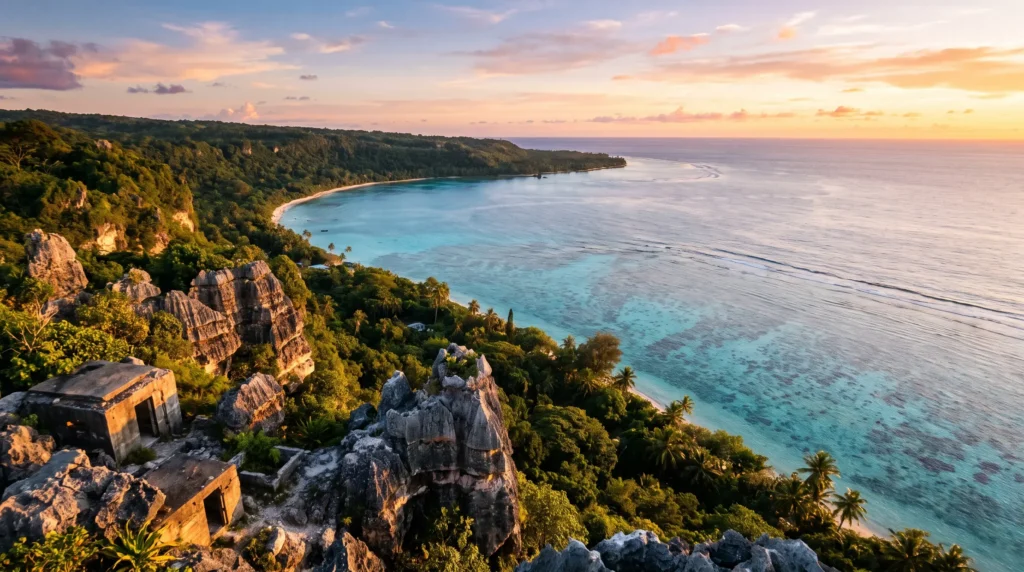
Topside & the Phosphate Pinnacles
The mined-out central plateau, roughly 80 metres above sea level, where decades of phosphate extraction stripped away everything but jagged coral limestone spires standing like a fossilized forest. It’s stark, strange, and the single most memorable landscape on the island — budget two to three hours to properly walk it with a local guide, since the terrain is uneven and there’s no signage.
Command Ridge
The island’s highest point, roughly 65–71 metres above sea level depending on the source, and a WWII Japanese fortification site where rusting bunkers and at least a few original artillery guns remain in place, reclaimed by scrub. The view from the top takes in essentially the whole country at once — on a clear day you can see most of the ring road and both coastlines simultaneously, a perspective that does more to explain Nauru’s scale than any map.
Denigomodu & the Western Districts
Nauru’s most densely populated district, and the closest thing to a commercial centre, with the island’s shopping and the Nauru Bond Store/duty-free strip nearby. Useful for supplies and a sense of everyday Nauruan life rather than as a sightseeing stop in itself.
Culture & People — Nauruan Identity After Phosphate
Nauruans are Micronesian, traditionally organised into twelve clans, and the island’s roughly 12,000 residents speak Nauruan as their first language, with English used widely in government, schooling and business. Christianity dominates religious life — the Nauru Congregational Church and the Catholic Church are the two largest denominations, followed by the Assemblies of God.
What’s most striking as a visitor is how openly Nauruans discuss the phosphate era and its aftermath — the wealth, the environmental cost, and the ongoing effort to rehabilitate Topside and diversify the economy beyond fishing royalties and the regional processing centre. Nauru is also a socially conservative society: same-sex relationships are legal, but public displays of affection between same-sex partners may cause offence, and visitors should generally dress and behave modestly. Handshakes and a genuine willingness to ask questions about local life go a long way further here than in almost any more touristed Pacific destination — there simply aren’t enough visitors for hospitality fatigue to have set in.
A Food Lover’s (Realistic) Guide to Nauru
Set expectations honestly: almost all food on Nauru is imported, since so little arable land survived the phosphate era, and the local diet leans heavily on tinned and packaged goods, rice, and imported meat and fish. Fresh reef fish and coconut remain genuine local staples where available, and a handful of small restaurants and hotel dining rooms — the Menen Hotel among them — serve the closest thing to a formal dining scene the island has.
Don’t arrive expecting a food-tourism destination; do arrive open to simple, home-style meals and fish caught that morning, often the best thing on any menu you’ll find. Bring snacks for gaps between meals, and expect limited choice rather than limited quality — what’s fresh here is usually very good.
Off the Beaten Path
The Whole Island, Frankly
Nauru is already off almost anyone’s beaten path — it’s regularly cited as among the least-visited countries on Earth, with only a few thousand foreign arrivals in a typical year, most of them officials, aid workers or airline crew rather than holidaymakers. Simply landing here puts you somewhere very few leisure travelers ever go.
Japanese WWII Relics Beyond Command Ridge
Command Ridge gets the attention, but scattered bunkers, gun emplacements and wartime infrastructure sit elsewhere around the island too, remnants of the Japanese occupation from 1942 to 1945. A local guide will know where to find the ones tour buses (such as they are here) don’t stop at.
The Cantilever Structure
The rusting phosphate-loading cantilever that once swung bagged phosphate out to bulk carriers moored offshore still stands near the coast — an industrial relic that tells the economic story of the island more plainly than any museum plaque could.
Anabar & the Northern Coast
Quieter, less-visited stretches of coastline north of Anibare, worth a slow drive with stops wherever the reef looks inviting — there’s no crowd to compete with anywhere on this island, but the north edges out even Nauru’s own baseline for solitude.
Practical Information
Visa. Every nationality needs a visa arranged before arrival — there is no visa-on-arrival option, and requirements typically include a passport valid at least three months beyond your visit, proof of onward/return travel, and evidence of accommodation or a local sponsor. Start the process well ahead of travel through the Nauruan government or its nearest diplomatic mission.
Money. The Australian Dollar is legal tender and the only currency used; Nauru has no independent central bank or national currency of its own. Banking infrastructure is thin and in transition, ATM access is unreliable, and credit card acceptance is limited outside a few larger establishments — bring enough Australian dollars in cash to cover your whole trip rather than counting on cards or ATMs working when you need them.
Safety. The US State Department rates Nauru at its lowest risk tier, Level 1 (Exercise Normal Precautions), and crime rates are low. The bigger practical risks are logistical rather than criminal: minimal tourism infrastructure, no British consular presence on-island, and very limited options if a flight is cancelled or delayed — medical evacuation insurance is strongly recommended given how basic on-island healthcare is.
Health. Routine vaccinations should be current, and hepatitis A and B, typhoid, and (for some travelers) rabies pre-exposure vaccination are commonly recommended before visiting; use strong repellent against mosquito-borne dengue risk and avoid wading in potentially contaminated fresh water because of leptospirosis risk. Serious medical cases are typically evacuated to Australia, so travel insurance with medevac coverage isn’t optional here.
Connectivity & practicalities. Mobile data and Wi-Fi exist but are limited compared to larger Pacific destinations; download maps and anything else you need offline before arrival. Time zone: UTC+12, no daylight saving. Emergency number: 110.
Budget Breakdown — What Nauru Actually Costs in 2026
Forget the usual budget/mid-range/luxury ladder — Nauru’s accommodation stock is so limited that price mostly reflects scarcity, not comfort tier. A small number of hotels (the Menen Hotel is the best-known) serve almost the entire visiting population, from aid workers and officials to the rare tourist, and rates sit well above what the room quality alone would suggest anywhere else in the Pacific.
Realistic daily range: roughly USD $130–300+. That covers a hotel room, simple restaurant or hotel-dining meals, a rental car or arranged local transport, and incidentals. There isn’t a hostel scene or a backpacker circuit to bring costs down, and there isn’t an ultra-luxury tier to push them dramatically higher either — most visitors land somewhere in this single, fairly narrow band regardless of how much they’d like to spend more or less.
Fixed costs to expect: your visa processing fee, a rental car or driver arranged through your hotel, and food markups that reflect everything being shipped in. Bring more cash than you think you’ll need — card and ATM access cannot be relied on to bail you out.
Planning Your First Trip to Nauru
Nauru works best as a two- to four-night stopover rather than a standalone long-haul destination, simply because the Brisbane flight schedule dictates your dates far more than your own preferences will. Fly in from Brisbane, confirm your visa and accommodation well before departure, and use your time to circuit the ring road, walk Topside’s pinnacles with a local guide, climb Command Ridge for the WWII relics and the view, and spend an afternoon at Anibare Bay. Because Brisbane is the gateway, this pairs naturally with a broader Australia or South Pacific itinerary — see our Australia guide for the Brisbane end, or our Fiji guide if you’re routing through the wider Pacific on the same trip.
Frequently Asked Questions
Is Nauru safe to visit in 2026?
Yes, in terms of crime — the US State Department rates it Level 1, its lowest risk category, and crime rates are low. The real risks are logistical: minimal tourism infrastructure, thin healthcare, and a fragile flight schedule, so medevac insurance and flexible plans matter more here than personal safety does.
Do I need a visa for Nauru?
Yes — every nationality needs a visa arranged in advance, and there is no visa-on-arrival. Start the process through the Nauruan government or its nearest mission well before you plan to fly.
How do I actually get to Nauru?
Nauru Airlines’ Brisbane–Nauru service is currently the only scheduled route to the island, running a few times a week on a rotating schedule — check the airline’s own site close to your dates rather than trusting an older schedule.
Is Nauru worth visiting if it’s not a beach destination?
If you want turquoise-water luxury, look elsewhere in the Pacific. If you’re drawn to genuinely rare destinations, unfiltered history, and a landscape that tells an entire economic and environmental story in one afternoon at Topside, Nauru delivers something very few countries can.
What currency should I bring?
Australian dollars in cash. Nauru uses AUD as its legal tender with no local currency of its own, and card/ATM access is unreliable enough that cash is the only dependable option.
Can I dive or snorkel in Nauru?
Anibare Bay is the most reliable spot for a swim and casual snorkel, but there is no established dive-operator scene like you’d find in Fiji or Palau — bring your own gear and manage expectations around infrastructure rather than the underwater scenery itself, which can be excellent given how little pressure the reef is under.
Ready to Explore Nauru?
A WWII gun still aimed out over a coastline you can see from end to end, a moonscape of coral pinnacles where an entire island’s fortune was mined away, and a welcome that only exists where almost nobody else shows up. Nauru isn’t a place you stumble into — it’s a place you deliberately choose, visa paperwork and all, and that deliberateness is exactly what makes it stick with you.
Explore More
- Australia Travel Guide — the gateway city for every Nauru trip
- Fiji Travel Guide — the wider Pacific done at a more visited pace
- Samoa Travel Guide — more Pacific island culture and coastline
- Philippines Travel Guide — reachable via the same Nauru Airlines network
How this guide was built
Published as part of Facts From Upstairs’ country guide series. Built from authoritative sources — Wikipedia’s entity pages for Nauru, Nauru Airlines, Economy of Nauru and Angam Day; the UK Foreign, Commonwealth & Development Office’s Nauru travel advice; the US State Department’s Nauru international travel information page; the US CDC traveler health page for Nauru; the Government of the Republic of Nauru’s official currency and national-days pages; and Nauru Airlines’ own published flight schedule. Numeric and checkable claims carry inline citations; where a specific figure (such as hotel room rates) could not be verified against an authoritative source, this guide describes it qualitatively instead of guessing.
Sources cited on this page
- Wikipedia — Nauru
- Wikipedia — Nauru Airlines
- Wikipedia — Economy of Nauru
- Wikipedia — Angam Day
- UK FCDO — Nauru travel advice
- US State Department — Nauru
- US CDC — Nauru traveler page
- Government of the Republic of Nauru — Currency
- Government of the Republic of Nauru — National Days
- Nauru Airlines — Flight Schedule
More country guides you might like
Plan your trip to Nauru
The booking tools we use ourselves. FFU may earn a commission at no extra cost to you.
Plan & book your trip to Nauru
Booking through these searches supports our guides at no extra cost to you.