
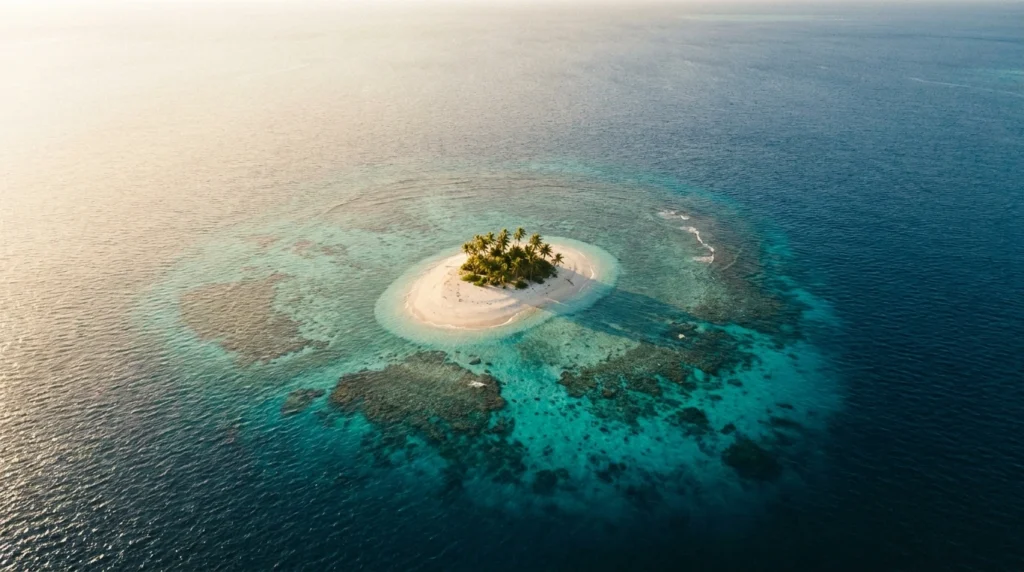
Languages of Fiji
All languages of Melanesia →fluent beta classical · classes by phone with Maya at ranas.ai/maya
Fiji Travel Guide — 332 Islands, the Bula Spirit & a Cyclone Calendar That Decides Everything
I have flown into Nadi five times now, and on every single approach the same scene rewires my expectations of what a tropical archipelago is supposed to look like: the Boeing tilts over the Mamanuca chain, a curl of white reef cuts the navy of the Pacific into watercolour, and at the carousel a six-foot iTaukei man in a sulu shouts “Bula!” loud enough that you understand “hello” and “life” are genuinely the same word here. My favourite Fiji argument with travel friends is whether the Yasawas or Taveuni’s Rainbow Reef is the better second stop after Viti Levu — I always argue Taveuni, because nothing reorders my sense of how a coral reef can look quite like soft-coral curtains breathing in a four-knot tide on the Somosomo Strait — and my second-favourite is whether the country’s signature dish is kokoda from a Suva market lunch counter or the lovo pork unwrapped on a banana leaf at a Yasawa village welcome. Treat this guide as the brief I would hand my own sister before she boarded her first flight into Nadi, with a sevusevu kava bundle in her bag and a reef-safe sunscreen in her hand luggage.

In This Guide
- Overview — Why Fiji Belongs at the Top of Every Pacific Bucket List
- From Lapita Voyagers to Republic — A Pocket History of Fiji
- Best Time to Visit Fiji (Season by Season)
- Cyclone & Dry-Season Calendar 2026 — Bula & Hibiscus Festival Window
- Getting There — Nadi (NAN) & Suva Nausori (SUV)
- Getting Around — Fiji Link, Yasawa Flyer & Coral-Coast Buses
- Top Cities & Regions — Viti Levu, the Yasawas, Vanua Levu, Taveuni & Beqa
- Culture & Customs — iTaukei, Indo-Fijian, Kava & the Bula Spirit
- A Food Lover’s Guide to Fiji
- Off the Beaten Path — Levuka, the Sand Dunes & the Lau Group
- Practical Information
- Budget Breakdown
- Planning Your First Trip to Fiji
- Frequently Asked Questions
Overview — Why Fiji Belongs at the Top of Every Pacific Bucket List
Fiji is a Pacific archipelago of 332 islands and 540 islets — about 110 of them permanently inhabited — strung across roughly 1.3 million square kilometres of South Pacific Ocean east of Vanuatu, west of Tonga and south of Tuvalu, with a total land area of just 18,272 km². The Fiji Bureau of Statistics projects a 2026 population of 902,623 people, with a recorded 986,367 international visitors in 2025 — more than one tourist for every resident — and provisional 2025 tourism earnings of F$2,813.8 million. About 87% of Fijians live on the two largest islands, Viti Levu (10,388 km², roughly 70% of the population) and Vanua Levu (5,587 km², about 160,000 residents). The capital, Suva, sits on the rainy southeastern coast of Viti Levu in Rewa Province; the Greater Suva metropolitan area is home to 185,913 people as of the 2017 census, and the city has been Fiji’s administrative capital since the move from Levuka was officially completed in 1882.
The first story of Fiji is dual identity. According to the 2017 census reported in the country profile, indigenous iTaukei Fijians make up 56.8% of the population, Indo-Fijians 37.5%, Rotumans 1.2% and other groups 4.5%; the Indo-Fijian community traces its lineage almost entirely to the indenture period of 1879–1916, when the British colonial government brought 61,000 South Asian labourers to work the sugar plantations. Religion follows the same fault-line: 69.2% Christian (overwhelmingly iTaukei Methodist and Catholic), 24.0% Hindu, 5.75% Muslim and 1.04% other or none, per the 2017 census recorded in the religious-composition profile. The 2013 constitution names three official languages — English, iTaukei Fijian and Standard Hindi — and protects religious liberty for every citizen regardless of community.
The second story is colonial inheritance. Dutch navigator Abel Tasman sighted the eastern islands in 1643; James Cook called at Vatoa in 1774; the mutinous HMS Bounty captain William Bligh sailed between Viti Levu and Vanua Levu in his open longboat in 1789, naming what is still called the Bligh Water. The high chiefs of Bau, led by Ratu Seru Epenisa Cakobau, signed the Deed of Cession to Queen Victoria at Levuka on 10 October 1874 — and almost immediately a measles epidemic carried by a returning royal delegation killed roughly a third of the indigenous population, between 40,000 and 50,000 people. Britain governed for 96 years; Fiji finally raised its own flag on 10 October 1970 — exactly 96 years to the day after Cession. The post-independence story is uglier than the brochures suggest, with military coups in 1987, 2000 and 2006 driving roughly 100,000 Indo-Fijians into diaspora communities in Australia, New Zealand, the United States and Canada. The current parliamentary republic operates under the 2013 constitution, with Sitiveni Rabuka returning as Prime Minister on 24 December 2022 (ending Frank Bainimarama’s nine-year tenure) and President Naiqama Lalabalavu sworn in on 12 November 2024.
The third story is rugby and ritual, and it is the one that should change how you think about Fijian “tourist culture.” Rugby is not a hobby here; it is a national religion. The Flying Fijians men’s sevens team won Olympic gold at Rio 2016 — Fiji’s first ever Olympic medal of any colour — and defended it at Tokyo 2020, while the country supports more than 600 clubs and 37,570 registered players for a population under a million. The signature ritual you will encounter is yaqona — kava — prepared from the pulped root of Piper methysticum, served from a communal tanoa bowl in a coconut-shell bilo and accompanied by three claps before and after each shell. A formal sevusevu — a presentation of dried kava root to the village headman — is still the social key that opens any iTaukei village to outsiders, and you should never enter a remote bure community without one.
The fourth story is climate, and it is the one that quietly decides every booking. Fiji has a tropical maritime climate split between a “wet” cyclone season from November to April and a cool “dry” season from May to October, with the southeastern (windward) sides of Viti Levu and Vanua Levu drawing up to 3,000 mm of rain a year while the leeward Nadi side runs sunny and dry — which is exactly why every major resort is on the western coast. Tropical Cyclone Winston made landfall in the Rakiraki District on Viti Levu on 20 February 2016 with sustained winds of 282 km/h — the most intense Southern Hemisphere cyclone on record at landfall — and killed 44 people, damaged or destroyed 40,000 homes, and caused F$2.98 billion (US$1.4 billion) in losses. The 2026 cyclone risk profile is no different in principle: book travel insurance with a named-storm clause, and read this guide’s seasonal calendar section before locking dates.
Practically, Fiji in 2026 is the most accessible South Pacific archipelago for a first-time visitor. English is universal in tourism settings, the Fijian dollar (FJD) trades at roughly F$2.20 to USD $1, the country drives on the left, plugs are Australian Type I at 240 V / 50 Hz, and Nadi International Airport (NAN) handles roughly 97% of international arrivals — a single five-and-a-bit-hour flight from Los Angeles, Sydney or Auckland. Tourism Fiji markets the destination under the line “where happiness comes naturally,” and the World Bank’s most recent country dataset puts 2024 GDP at US$5.97 billion and per-capita GDP at US$6,425.70 — middle-income for the Pacific, but with one of the most developed tourism sectors in Oceania. Foreign-affairs and traveller-protection desks at gov.uk, travel.state.gov, smartraveller.gov.au, the New Zealand Safe Travel portal, the Canadian travel.gc.ca page and the CDC Travel Health portal all maintain current Fiji entries with daily-updated cyclone and health advice.

From Lapita Voyagers to Republic — A Pocket History of Fiji
Fijian prehistory begins where most Pacific archipelagoes’ do — with the Lapita people, the seafaring Austronesians whose distinctive dentate-stamped pottery first appears in the archaeological record around 1500–1000 BCE. iTaukei oral tradition and DNA studies both place the original landing at Vuda Point on Viti Levu’s western coast, with subsequent dispersal east to Tonga and Samoa over the following millennium. The pre-contact iTaukei society Europeans eventually encountered was complex, hierarchical and at times brutally martial — a confederation of chiefdoms organised around the vanua (clan land), the matai (chief) and a notorious tradition of inter-clan warfare that gave Fiji its early colonial nickname, the “Cannibal Isles.”
European contact came late and patchily. Dutch navigator Abel Tasman reached the eastern Lau group in February 1643, charted enough reef to scare himself off, and sailed on for Tonga. James Cook touched at Vatoa in 1774 during his second Pacific voyage but never anchored. The dramatic moment is 1789: William Bligh, set adrift after the Bounty mutiny in a 23-foot launch with 18 loyal crew and almost no provisions, sailed straight through the Fijian archipelago between Viti Levu and Vanua Levu, fending off pursuit canoes and naming the strait the Bligh Water — a name still on Admiralty charts. The first sustained European presence came with sandalwood traders in the 1810s and bêche-de-mer (sea cucumber) merchants in the 1820s, followed by Methodist missionaries who landed at Lakeba in 1835 and converted the powerful Bauan high chief Cakobau in 1854.
The colonial sequence is short but decisive. Cakobau and twelve other high chiefs signed the Deed of Cession to Queen Victoria in Levuka harbour on 10 October 1874, transferring sovereignty to Britain in exchange for a £200,000 debt-write-off and a guarantee that iTaukei communal land would never be alienated to settlers — a clause Fiji still honours, with about 86% of land held inalienably by indigenous mataqali clans. The first colonial governor, Sir Arthur Gordon, made two moves that shaped everything that came next: he moved the capital from cliff-bound Levuka to flatter Suva in 1877–82, and he banned the recruitment of iTaukei for plantation labour. To staff the sugar industry the Colonial Sugar Refining Company instead imported indentured South Asian labour under the “girmit” system: between 1879 and 1916, 60,965 men and women — roughly half from Awadh and Bhojpur in northern India, the rest from Tamil Nadu, Bengal, Kerala and what is now Pakistan and Bangladesh — arrived to work five-year contracts in cane fields. The girmit ended in 1916; the descendants stayed and built the modern Indo-Fijian community.
The post-independence story is the part the brochures skip. Fiji raised its own flag at midnight on 9–10 October 1970, exactly 96 years after Cession, with Ratu Sir Kamisese Mara as the founding Prime Minister of a Westminster-style democracy. Seventeen years of stable government ended on 14 May 1987, when then-Lieutenant-Colonel Sitiveni Rabuka — the same man currently serving as Prime Minister in 2026 — overthrew the Indo-Fijian-supported Bavadra government in Fiji’s first coup, declared a republic in October 1987, and triggered the first wave of Indo-Fijian emigration. A second coup in May 2000 (the Speight putsch) and a third in December 2006 under Frank Bainimarama kept the country off the international diplomatic register for the better part of two decades. The 2013 constitution, drafted under Bainimarama’s military-backed government, finally introduced one-person-one-vote elections, abolished the racially-segregated electoral roll, and established the unicameral 50-seat parliament with party-list proportional representation that still operates today. The September 2014 election was internationally validated as free and fair, Bainimarama’s FijiFirst won the next two cycles, and in December 2022 a coalition led by Rabuka’s People’s Alliance returned the country to opposition-led democracy for the first time since the 1987 coups.
For deeper historical reading, the South Pacific Commission archives, the National Archives of Fiji in Suva, the Fiji Museum at Thurston Gardens, the University of the South Pacific’s Pacific Collection (Laucala Bay), the Pacific Manuscripts Bureau at the Australian National University, and the open-access JSTOR Pacific-studies portal all hold the documentary record from the Cession year forward. The Fiji Times (founded 1869), Fiji Sun, Fiji Village and the regional Pacific Islands Times all maintain searchable digital archives going back well into the 1990s, and the BBC, Al Jazeera, the Guardian, the New York Times and Reuters maintain dedicated Fiji desks for current affairs.

Best Time to Visit Fiji (Season by Season)
The honest one-line answer is “May through October,” and the second-honest answer is “but the shoulders pay for themselves.” Fiji has a tropical maritime climate split into two crisp halves: a cool, dry season from May to October (the southern-hemisphere winter) and a warm, wet “cyclone season” from November to April that brings the bulk of the year’s rainfall, the lion’s share of the cyclones, and significantly cheaper accommodation. The windward southeastern coasts of Viti Levu and Vanua Levu — including Suva — average around 3,000 mm of rainfall annually with no truly dry month, while the leeward Nadi side records closer to 1,800 mm with a sharp dry season; this is exactly why every flagship resort sits on the western or northern coast. Coastal temperatures stay between 22°C and 30°C year-round, with sea-surface temperatures rarely dropping below 24°C even in July.
May to July — Cool Dry, Peak Diving
Fijian winter is genuinely pleasant: daytime highs of 26–28°C on the western coast, lows of 20–22°C overnight, low humidity, and southeasterly trade winds steady enough to keep the lagoons mosquito-light and the surf clean on Cloudbreak. Visibility on the Rainbow Reef in the Somosomo Strait pushes 30 metres in June and July, and water temperatures of 25–26°C make a 3 mm shorty wetsuit comfortable for a 60-minute dive. This is also peak season for Australian and New Zealand school holidays in late June and early July, so the Mamanucas and the Coral Coast book out four to six months ahead — flights from Sydney and Auckland double in price across the school break. The reward is the most reliable weather window of the year, and the visibility data alone is worth the price hike if you have come for diving.
August to October — Warm Dry, Festival Season
August through October is the second peak. Trade winds back off slightly, the southeastern coast finally dries down, and the festival calendar wakes up. The Bula Festival fills the Nadi seafront with parades, masi-cloth markets and meke performances over an extended August weekend; the Hibiscus Festival turns Albert Park in Suva into a week-long carnival in late August or early September; the Sugar Festival runs at the same time in Lautoka, the Coral Coast Festival in Sigatoka, and the Friendly North Festival in Labasa on Vanua Levu. Manta-ray season at Naviti and Drawaqa in the Yasawas runs May through October as well, so an August arrival lets you combine festival programming on Viti Levu with a manta snorkel up the chain. The big calendar pivot is 10 October — Fiji Day, marking both the 1874 Cession and the 1970 independence — when every village green flies the national flag and the Suva foreshore hosts an evening fireworks display.
November to December — Early Wet, Lower Prices
November is the genuinely interesting shoulder. The cyclone season technically begins on 1 November, but climatology says the first half of the month is essentially dry-season weather at wet-season prices; the Coral Coast and the Yasawas often discount 25–35% for early-November stays, and the resorts that offer cyclone-clause insurance start building it into the rate. Diwali — the Hindu festival of lights, observed by Fiji’s 24% Hindu population — falls in late October or early November and turns Indo-Fijian neighbourhoods of Lautoka, Nadi, Ba and Labasa into nightly fireworks displays for a fortnight. By the second half of December the wet season has set in properly: short, sharp afternoon downpours, water temperatures climbing to 28°C, and Christmas-week prices spiking to peak-season levels for a 10-day Australasian school-holiday window before crashing again in mid-January.
January to April — Cyclone Wet, Monsoon Photography
This is the period most travel guides simply tell you to avoid, and they are not entirely wrong. January through March is statistically the most active stretch of the South Pacific cyclone season, with two to three named storms passing within 400 km of Fiji in an average year and a roughly one-in-three chance of a named storm making direct landfall in any given season. But the wet season is also when Fiji photographs at its most cinematic: emerald cane-fields, mountain rivers running brown to the sea, low cloud catching on the Nausori Highlands, and rainforest interiors at their greenest in Bouma National Heritage Park. Domestic Indo-Fijian wedding season runs January–March, the surf season on Cloudbreak peaks April–October but starts seriously firing in late March, and shoulder-season pricing in the Yasawas can bring an overwater bungalow under USD $300 a night. The trade-off is real cyclone risk, occasional ferry cancellations, and a non-trivial probability that one of your three planned dive days will be blown out by an active low. Buy named-storm travel insurance, build flexibility into the itinerary, and you can have a perfectly good March trip for half the August price.

Cyclone & Dry-Season Calendar 2026 — When the Pacific Lets You In
Every Fijian itinerary really is decided by the cyclone calendar, and the calendar in turn is decided by the regional Tropical Cyclone Warning Centre at Nadi (RSMC Nadi) — one of seven Regional Specialised Meteorological Centres designated by the World Meteorological Organization, with responsibility for the entire South Pacific basin from the equator down to 25°S, between 160°E and 120°W. The Fiji Meteorological Service issues warnings in four escalating stages — Tropical Cyclone Alert (within 48 hours), Tropical Cyclone Warning (within 24 hours), Hurricane Warning (gale or hurricane-force winds expected) and Storm Warning — and every Fijian resort, ferry and domestic airline is legally required to obey those warnings. If you are travelling between November and April, the single most useful bookmark on your phone is the official Fiji Met Service portal — refresh it every morning before you commit to a ferry or charter flight.
The benchmark event is Tropical Cyclone Winston, which made landfall in the Rakiraki District on Viti Levu’s northern coast on 20 February 2016 with sustained ten-minute winds of 233 km/h (peak one-minute winds of 282 km/h, central pressure 884 hPa) — the most intense Southern Hemisphere tropical cyclone on record at landfall and the only known Category 5 to strike Fiji directly. Forty-four people died, 40,000 homes were damaged or destroyed, and roughly 350,000 Fijians — about 40% of the population — were significantly affected. Total damage of F$2.98 billion (US$1.4 billion) made Winston the third-costliest cyclone in South Pacific history, surpassed only by the 2020 Cyclone Harold and the 2023 Cyclone Gabrielle in New Zealand. Most resorts on Viti Levu were operating again within four to six weeks; the Coral Coast was substantially repaired before the next dry season opened. As recently as Cyclone Vaianu in early 2026, the FCDO has issued live travel-advice updates with named-storm and flooding alerts, so seasonal risk has not gone away.
The 2026 dry-season programme is built around three festival anchors that run during the August–October sweet spot. The Bula Festival in Nadi is traditionally a long-weekend carnival of meke dance, masi-cloth markets and Pacific food stalls along Queens Road, scheduled to coincide with the school-term break in late August. The Hibiscus Carnival on Suva’s Albert Park runs the same fortnight, with a Hibiscus Queen pageant whose contestants raise charity funds in the months leading up. The third anchor is Fiji Day on 10 October, the only Fijian holiday that simultaneously commemorates the 1874 Cession (when 13 chiefs signed sovereignty over to Queen Victoria at Levuka) and the 1970 independence (when the British flag came down over Albert Park) — every village green flies the national flag, primary schools march, and the Suva foreshore hosts the year’s biggest fireworks display.
The shoulder months of November and April are the genuine value plays. November weather, statistically, is essentially indistinguishable from October in the first ten days; the cyclone-clause insurance premium is small relative to the 25–35% accommodation discount, and Diwali — the Hindu Festival of Lights — falls in this window, illuminating Indo-Fijian neighbourhoods across Lautoka, Nadi, Ba and Labasa for two weeks. April is the mirror image: cyclone risk drops sharply by the third week, the south-east trades begin to set, and resorts that have spent the wet season half-empty start running surprise upgrades and complimentary-night offers to fill rooms before the May high-season rate-card kicks in. The standard cyclone-insurance test for whether you should consider a wet-season trip is simple: would the trip still feel worthwhile if you lost two of your seven days to a named storm and a cancelled ferry? If yes, book; if no, push to May.

Getting There — Nadi International (NAN) & Nausori (SUV)
Nearly all international visitors arrive at Nadi International Airport (NAN), the country’s main hub on the western coast of Viti Levu, about 10 km from Nadi town and 20 km south of Lautoka. NAN handles roughly 97% of international visitor traffic and 86% of all tourist arrivals; the most recent published full year (2019) recorded 2,485,319 passengers across international and domestic operations, with 2,166,584 of those on international flights. The airport has two bituminous runways — the main 02/20 runway at 3,206 m supports widebody operations as far as Hong Kong and San Francisco non-stop — and was rebuilt in a F$130 million terminal modernisation programme that completed in April 2017 and reopened in June 2018. The state-owned Airports Fiji Limited (AFL) has run the airport since 1999.
The flag carrier is Fiji Airways, founded in 1947 (commencing operations on 1 September 1951) and headquartered at NAN. The 2026 fleet stands at 14 aircraft — Airbus A350-900s, A330s and Boeing 737s — flying to 28 direct destinations and connecting through codeshare partners to a 108-airport network. Ownership is split between the Fiji government (50%), the Fiji National Provident Fund (30%), Qantas (16%) and Air New Zealand (4%). The carrier joined the Oneworld global alliance as a full member in April 2025, partners with American Airlines on AAdvantage frequent-flyer accruals, and was named Skytrax’s “2024 Best Airline in Australia/Pacific” — a useful peg if you’re fishing for points-redemption upgrades. Domestic and inter-island flying is operated by the wholly-owned subsidiary Fiji Link, which serves smaller airstrips at Suva-Nausori, Savusavu, Labasa, Taveuni-Matei, Kadavu (Vunisea) and Rotuma with ATR-72 turboprops and DHC-6 Twin Otters.
The route map for 2026 runs as follows. From the United States, Fiji Airways operates daily Los Angeles–Nadi and several-times-weekly San Francisco–Nadi services on the A350, plus Honolulu–Nadi on the A330. From Australia, daily flights link Sydney, Brisbane and Melbourne to Nadi, with seasonal Adelaide and Perth services through Qantas codeshare. From New Zealand, daily Auckland–Nadi and Wellington/Christchurch services run year-round. From Asia, three weekly Hong Kong, Tokyo (Narita) and Singapore (codeshare with Singapore Airlines) flights serve the Asian transit market. London-bound passengers connect through Singapore or Hong Kong on a 25–28-hour total elapsed time. The shortest London-to-Nadi total transit currently runs roughly 24 hours via Doha and Sydney with Qatar/Qantas. Air New Zealand, Qantas, Virgin Australia, Korean Air, Solomon Airlines and Aircalin (New Caledonia) round out the foreign-carrier list serving NAN.
The secondary airport is Nausori International (SUV), located 23 km north-east of Suva, which handles a tiny fraction of international traffic — primarily Solomon Airlines, Air Vanuatu and Aircalin connections to neighbouring Pacific states — but the bulk of Fiji Link’s domestic feeder flying. Nadi is the airport you fly into; Nausori is the one you connect through if your itinerary is Suva-based or if you’re heading on to Vanua Levu, Taveuni or Kadavu. Cruise arrivals dock at Suva Harbour or Port Denarau (with smaller calls at Levuka and Savusavu); the South Pacific cruise calendar peaks in the dry-season window between May and October, with P&O Australia, Carnival, Royal Caribbean and Holland America all running sailings out of Sydney, Brisbane or Auckland. The official Fiji Airports Limited site lists every scheduled commercial movement at NAN, while the Civil Aviation Authority of Fiji (CAAF) publishes the regulatory and safety record. Visitor data and arrival statistics are compiled by the Fiji Bureau of Statistics, with summary tables refreshed monthly.

Getting Around — Fiji Link, Yasawa Flyer & Driving on the Left
Fiji’s transport problem is interesting precisely because the country is an archipelago: the two big islands carry 87% of the population on a road network you can drive in a day, but the other 110 inhabited islands are reachable only by ferry, catamaran or Twin-Otter turboprop. The good news: the tourism logistics network is the densest in the South Pacific, with daily catamaran sailings, multiple weekly inter-island ferries, six domestic airfields, and a bus system that costs a single Fijian dollar for a long ride if you have a Bula transit card. The bad news: any storm in the cyclone window can shut all of it down for 48 hours, so build buffers into the itinerary.
For inter-island flying, Fiji Link — the wholly-owned domestic subsidiary of Fiji Airways — is the only operator that matters. The fleet of ATR-72 turboprops and DHC-6 Twin Otters covers the airfields at Suva-Nausori (SUV), Savusavu (SVU), Labasa (LBS), Taveuni-Matei (TVU), Kadavu-Vunisea (KDV) and Rotuma (RTA), plus a handful of grass strips on the Yasawa and Mamanuca chains served by chartered seaplane. Fares are reasonable by Pacific standards — Nadi to Taveuni one-way is typically FJD 200–350 (USD 90–160) on a 75-minute hop — but luggage allowances are strict (15 kg checked, 7 kg carry-on) and weather cancellations are common in the wet season; always book a flexible fare on the Vunisea (Kadavu) or Rotuma sectors, where wind cancellations can run 25–30% of scheduled departures in February. Pacific Island Air and Turtle Airways operate seaplane charters from Nadi/Denarau out to Yasawa and Mamanuca resorts; expect FJD 600–900 per person one-way for a guaranteed-departure resort transfer.
The signature ferry is the Yasawa Flyer, an Awesome Adventures-operated catamaran that departs Port Denarau at 0830 daily and runs the entire length of the Yasawa chain to Naviti and Nacula, allowing hop-on-hop-off island stays via the “Bula Pass” multi-day ticket — a backpacker rite of passage for two decades. South Sea Cruises runs day trips and overnighters in the Mamanucas (Beachcomber, Mana, Malolo Lailai); Goundar Shipping’s Lomaiviti Princess and Spirit of Harmony car ferries link Suva to Vanua Levu’s Savusavu and Taveuni’s Lomaloma overnight, sailing twice weekly in either direction at typical rates of FJD 90–140 per adult deck-class for the 12-hour crossing. Bula Beach Bus, Patterson Brothers Shipping and the smaller Lomaiviti Express round out the ferry network. For the remote Lau group, the only access is on the government-subsidised charter Lomaiviti Express, sailing once or twice a month from Suva on schedules that cyclone weather can disrupt by weeks.
For driving, Fiji is on the left, and steering wheels are on the right. The Queens Road wraps around the southern coast of Viti Levu from Nadi through Sigatoka and Pacific Harbour to Suva (about 200 km, allow 4 hours including a lunch stop), and the Kings Road runs the northern coast from Lautoka through Rakiraki and back down to Suva (about 290 km, allow 5–6 hours). The whole Viti Levu loop is sealed asphalt, but rural and outer-island roads are gravel; the US State Department specifically warns that “roads in urban areas are paved but poorly maintained” and that night driving is dangerous owing to insufficient lighting, free-roaming livestock and pedestrians. International driving permits are accepted; major rental brands (Avis, Budget, Europcar, Thrifty) and Fijian operators (Carpenters, Easy Car) maintain depots at NAN. Daily rates run FJD 90–160 (USD 40–70) for a compact, FJD 180–280 for a 4×4 — booking ahead saves substantially during the August–October peak.
For local transport, the iconic mode is the un-airconditioned wooden-bench bus run by Sunbeam Transport, Pacific Transport and Vatukoula Express across Viti Levu, with fares of FJD 1.50–8 across most journeys; the Bula transit card (about FJD 5 for the card plus pre-loaded credit) cuts the cash fare by 25% and is the standard way locals pay. Share-taxis (15-seat minivans on fixed routes) cost slightly more than the bus and run the same routes faster. Inside Suva and Nadi, regular meter-taxis are abundant and cheap (FJD 8–18 for a typical inner-city ride), and rideshare apps such as inDrive and Uber-style local Beep have established footprints since 2023, particularly in Suva. The single hardest sector to budget is the Yasawa or Mamanuca high-end resort transfer, which can quietly add USD 200–400 per person each way to your trip cost.

Top Cities & Regions — Viti Levu, the Yasawas, Vanua Levu, Taveuni & Beqa
📍 Map of Fiji: Every Place in This Guide
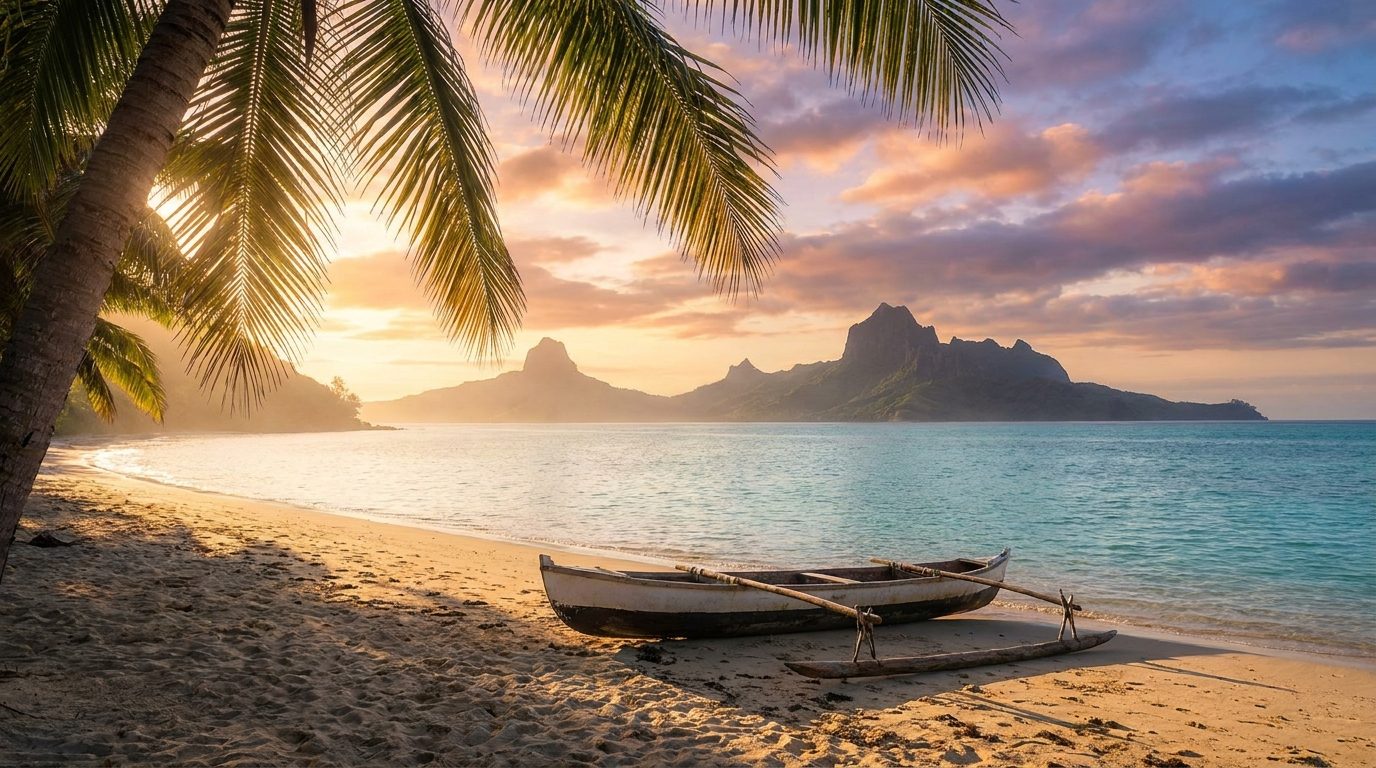
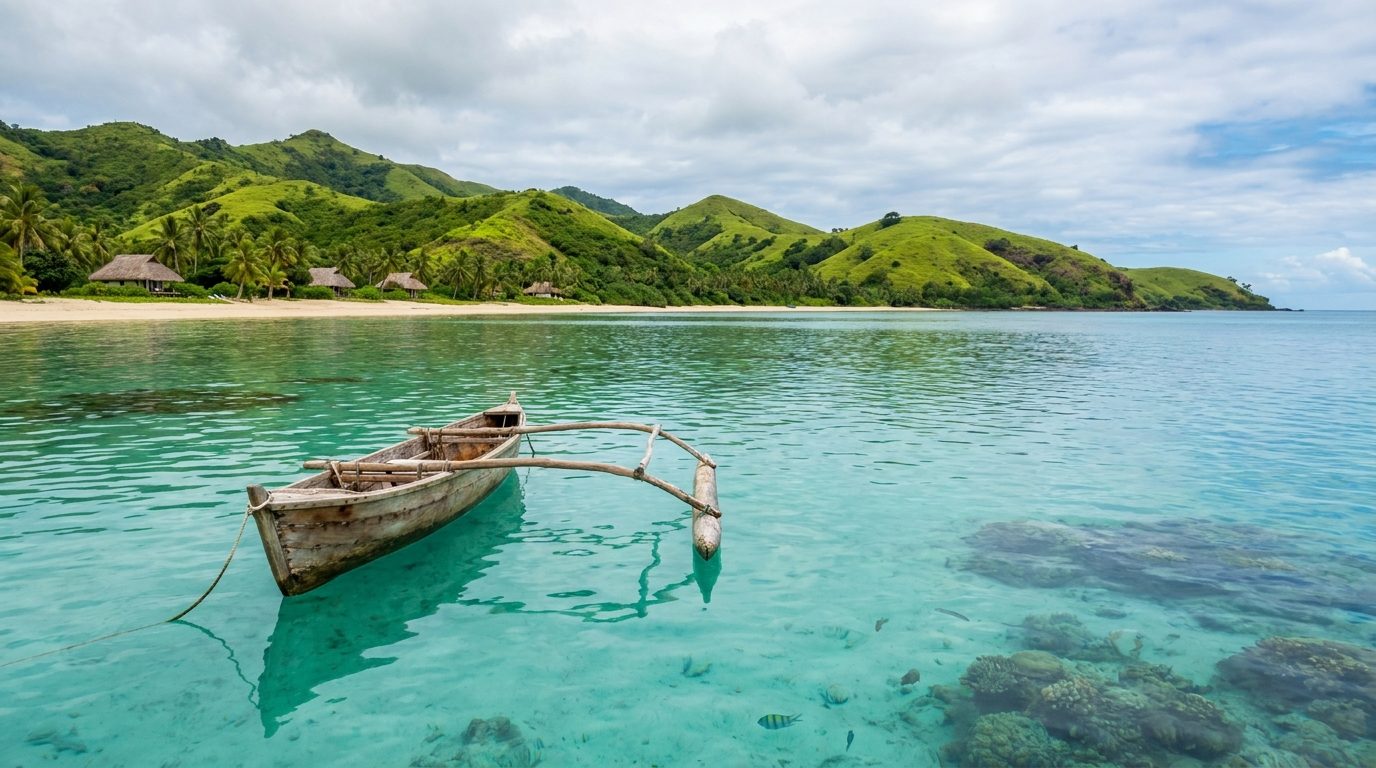
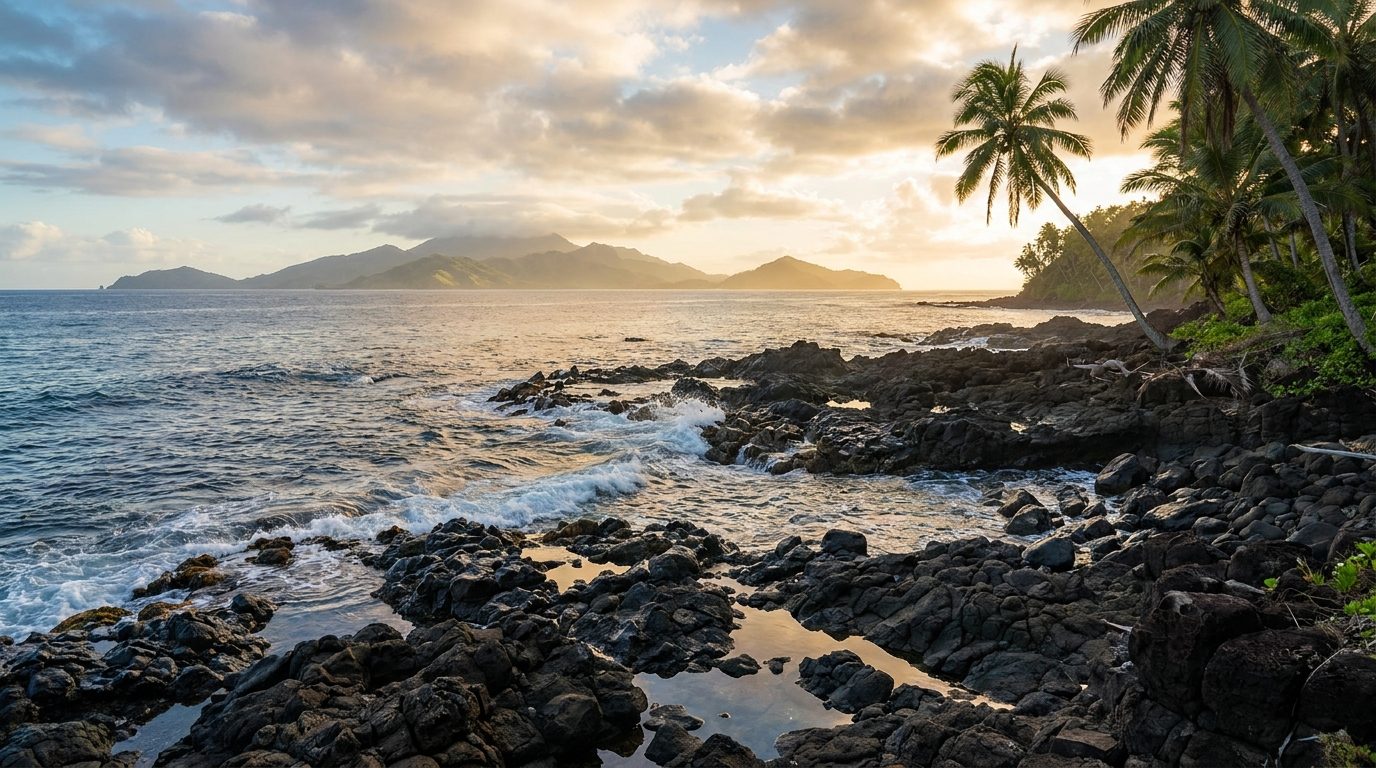
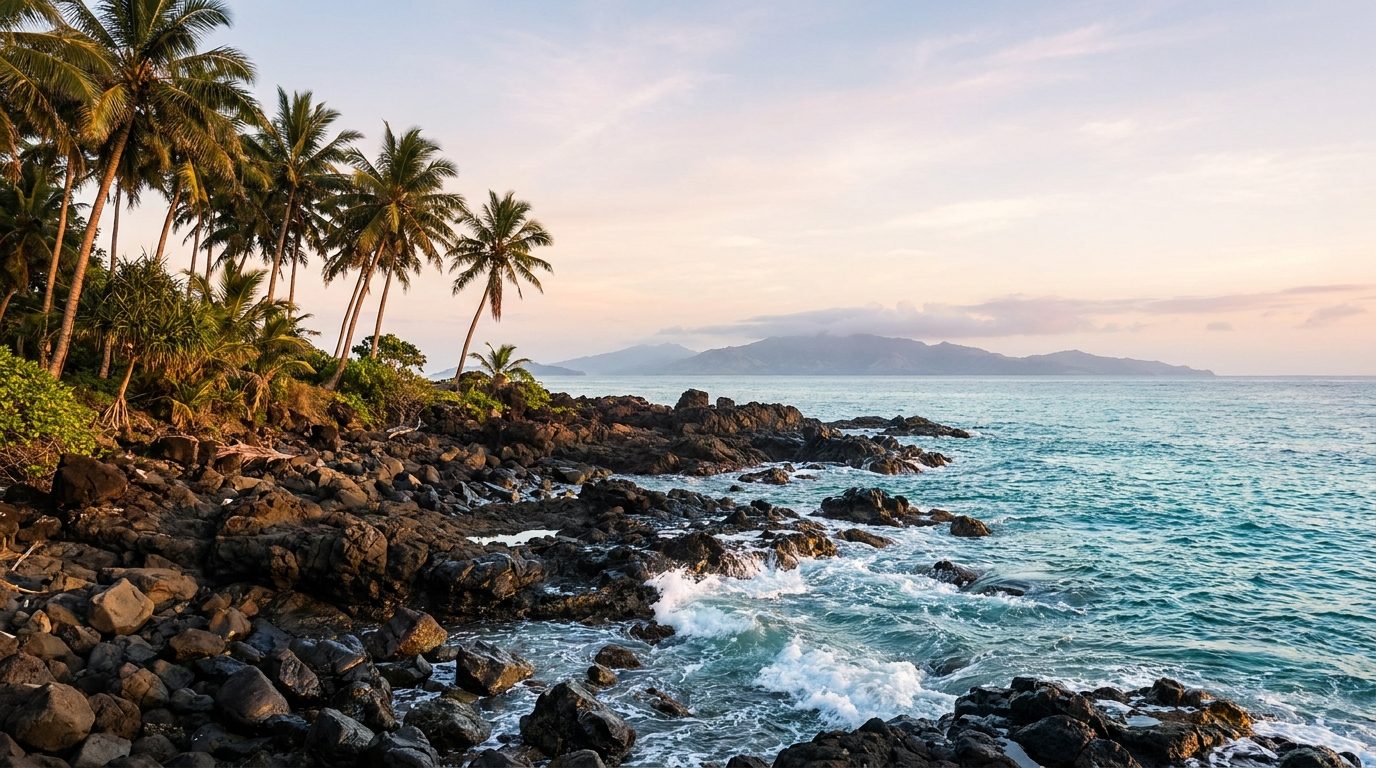
The standard first-trip mistake is to try to see all 332 islands in 10 days. Don’t. Pick two or three regions that contrast with each other — one big-island base for culture and infrastructure, one outer-island stay for the brochure photograph — and let the Yasawa Flyer or Fiji Link fill in the gaps. Here is the working shortlist, in roughly the order most first-trippers should consider them.
Viti Levu — Suva, Nadi & the Coral Coast
Viti Levu (“Great Fiji”) is the central island and the only one almost every first-time visitor touches: 10,388 km², 740,000 people, 70% of the national population, and a north–south mountain spine that splits the island into a wet eastern half (Suva) and a dry western half (Nadi). The capital, Suva, has 93,970 residents in the city proper and 185,913 across the wider metropolitan area, plus a remarkable concentration of regional Pacific institutions: the University of the South Pacific’s Laucala Bay campus (founded 1968, owned by 12 Pacific island nations), the Pacific Community headquarters, and most foreign embassies. Nadi (population about 13,000 in the town itself, with the metro spilling out to the airport and Denarau Island) is the tourism gateway. Between them, the Coral Coast — a 50 km stretch of sealed Queens Road from Sigatoka through Korotogo and Korolevu to Pacific Harbour — is where most first-time mid-range travellers actually base, with resorts at Outrigger, Shangri-La, Warwick and the Pearl. Don’t miss: a guided walk through the Sigatoka Sand Dunes (Fiji’s first national park, with 6 km of windblown dunes and a Lapita-era archaeological record), Suva’s Fiji Museum, and the Highland village of Navala in the Nausori interior — the last village in Fiji where every household still lives in a thatched bure.
Mamanuca Islands — Cast Away, Survivor & the Day-Trip Lagoons
The Mamanucas are the volcanic chain off Nadi that you can see from the airport runway. About 28 islands, of which roughly seven are submerged at high tide, the chain hosts the highest density of beach resorts in Fiji — Beachcomber, Mana, Malolo Lailai, Castaway, Treasure, Tokoriki, Vomo and Likuliku — and is the standard one-night honeymoon stop. Two pop-culture facts justify the entire trip on their own: tiny uninhabited Monuriki was the filming location for Tom Hanks’s “Cast Away” (2000), and the Mamanucas have served since 2016 as the permanent filming home of the American “Survivor” television franchise (production March–June each year). Don’t miss: a half-day Cast Away cruise from Port Denarau, swim-with-reef-sharks at Kuata, an overnight at Tom Hanks’s actual beach on Monuriki (a permitted day-tour with locked-in sunset and sunrise photography slots), and the world-class left at Cloudbreak — a Fiji surfing pilgrimage roughly 30 minutes south of Tavarua.
Yasawa Islands — Blue Lagoon & the Bula Pass Backpacker Loop
North-west of the Mamanucas, the Yasawas are 20 volcanic islands stretched across 80 km of the Bligh Water, with peaks topping 600 m and a tropical climate of 25–31°C and roughly 1,551 mm annual rainfall. Six islands carry the bulk of accommodation: Yasawa, Nacula, Yaqeta, Matacawa Levu, Naviti and Waya. Until 1987 the chain was closed to foreign land-based tourism by request of the local king; since the lifting of the ban, dozens of small resorts and hostels have opened, particularly on Tavewa, and the Yasawas are now the South Pacific’s most accessible budget archipelago. The 1980 film “The Blue Lagoon” was shot at Sawa-i-Lau cave, where you can swim through the limestone chambers between sets of basalt cliffs. Don’t miss: manta-ray snorkelling at Naviti and Drawaqa (May–October), a sevusevu welcome at Nacula village, the Sawa-i-Lau cave, and a sunset on Long Beach at Nanuya Lailai — the prototype Pacific honeymoon shot.
Vanua Levu — Savusavu, Labasa & the Hidden Northern Coast
Vanua Levu (“Great Land”) is Fiji’s second island — 5,587 km², roughly 160,000 residents, 64 km north of Viti Levu — and is genuinely under-touristed compared with its sibling. The two main towns, Savusavu (a small yacht-y harbour town on the southern coast) and Labasa (a sugar-industry town with a 22,204 population and a strong Indo-Fijian community), bookend the island’s two distinct economies. The diving infrastructure on the southern coast — Jean-Michel Cousteau Resort, Namale, Koro Sun — is among the best in the Pacific, and Savusavu has hot springs you can boil eggs in. The 2020 Cyclone Yasa caused major damage here and displaced 24,000 residents, so the recovery story is still ongoing — most resorts have rebuilt to a higher cyclone code than they had pre-Yasa. Don’t miss: the Savusavu hot springs, a Hidden Paradise waterfall hike, the Cousteau resort’s snorkel site, and the Friendly North Festival in Labasa (August–September).
Taveuni — The Garden Island & the Rainbow Reef
Taveuni is the third-largest island, a 434 km² volcanic ridge straddling the 180th meridian (where a famous “Between Yesterday and Today” sign lets you photograph yourself in two days at once, even though the actual International Date Line dog-legs east to keep Fiji in a single time zone). The 2017 census recorded 13,774 residents, but estimates run as high as 20,000. The “Garden Island” nickname is earned: nearly every plant and animal indigenous to Fiji lives here, including the rare red-and-white Tagimaucia flower at Lake Tagimaucia (an 800 m crater lake) and a healthy population of orange dove and silktail. The Bouma National Heritage Park on the eastern coast contains Fiji’s most famous waterfalls — the three-tiered Tavoro/Bouma Falls and the Lavena Coastal Walk to Wainibau Falls. Off the southern coast, the Rainbow Reef in the Somosomo Strait is “one of the world’s premier soft-coral dive areas.” Don’t miss: a full-day Bouma Falls hike with cliff jumps, Rainbow Reef diving, the Tagimaucia Lake trek, and an overnight at Paradise Taveuni.
Kadavu & the Great Astrolabe Reef
Kadavu is Fiji’s fourth-largest island, the southernmost of the populated archipelago, with about 10,869 residents (2017 census) spread across the main island plus the smaller Ono, Dravuni, Galoa and Nagigia. The headline attraction is the Great Astrolabe Reef — a barrier-reef system that wraps the eastern flank of the island for 100 km, with manta-ray cleaning stations at Naiqoro, drift dives along the outer wall, and a pristine soft-coral inner lagoon. Kadavu is significantly less developed than Taveuni and feels deliberately remote: there’s a single airstrip at Vunisea, no road links between coastal settlements, and accommodation runs to a handful of dedicated dive resorts (Matava, Papageno, Tiliva). For divers and birders — Kadavu has four endemic bird species including the Kadavu honeyeater and the Kadavu fantail — this is the island the Pacific specialists pick. Don’t miss: drift diving the Astrolabe outer wall, a half-day kayak through the inner lagoon, and the Kadavu honeyeater hide at Lawaki.
Beqa Island — Firewalking & the Lagoon Sharks
Beqa is a 36.3 km² volcanic island 10 km south of Viti Levu, just off Pacific Harbour, with a 2017 population of 1,356 spread across nine villages in two districts (Sawau and Raviravi). Five of those villages still practise the vilavilairevo firewalking ceremony — a tradition exclusive to the Sawau clan, in which initiates walk barefoot across white-hot stones in a stone-lined pit. The first tourist demonstration was recorded as early as 1902. Beqa Lagoon, separating the island from Viti Levu, is also one of the world’s premier shark-dive destinations, with eight species reliably observed including bull, tiger and lemon sharks at the Aqua-Trek and Beqa Adventure Divers feeding sites. Don’t miss: a guided firewalking ceremony at Beqa Lagoon Resort (or via the Pacific Harbour Arts Village), an Aqua-Trek bull shark dive, and a stay at Lalati or Kulu Bay for the all-inclusive boutique experience.
Lau Group & Lomaiviti — The Far East & Levuka
The Lau group is Fiji’s far-eastern frontier — about 60 islands and islets stretched from Vanua Balavu in the north to Vatoa in the south, with a 2007 population of 10,683. Cricket dominates here uniquely (a Tongan-influenced legacy), masi tapa-cloth painting reaches its highest expression, and the only realistic way in is via the irregular government-subsidised cargo charter or by yacht through the cruising-permit programme administered from Suva. The Lomaiviti group, off Viti Levu’s eastern coast, is more accessible: Ovalau Island hosts Levuka, Fiji’s first colonial capital from 1871 to 1882 and a UNESCO World Heritage site (inscribed June 2013) recognised as “exceptional testimony to the late colonial port towns in the Pacific.” Levuka had Fiji’s first bank, post office, school, newspaper, public electricity system, and is where Cakobau signed the Deed of Cession on the foreshore in 1874. Don’t miss: a UNESCO walking tour of Levuka’s Beach Street, an overnight at Royal Hotel (Fiji’s oldest), and — for blue-water sailors — a charter through the Bay of Islands at Vanua Balavu.
Culture & Customs — iTaukei, Indo-Fijian, Kava & the Bula Spirit
Fijian culture is, structurally, a duet. The 56.8% iTaukei majority — Austronesian-descended Pacific Islanders whose ancestors arrived from western Melanesia roughly 3,500 years ago — and the 37.5% Indo-Fijian community whose forebears were brought as girmit indentured labour from northern India, Tamil Nadu, Bengal and Kerala between 1879 and 1916, share a country, a parliament, an economy and very little else in the way of religion, language at home, or daily food. A third minority — the 1.2% Rotuman population on Rotuma Island, 600 km north of the main archipelago — speaks a Polynesian language and identifies separately from iTaukei. Understanding the duet is the single highest-leverage thing you can do as a visitor; it changes how you read Suva neighbourhoods, why some restaurants serve curry and others serve lovo, and why kava and Diwali are equally Fijian holidays.
The iTaukei half of the country is organised around the vanua — literally “land,” but in practice the bundled concept of clan, ancestral territory, and chiefly authority. Until it was disbanded after the 2006 coup, the Bose Levu Vakaturaga (Great Council of Chiefs) brought together 55 chiefs from the country’s 14 provinces to advise the President on indigenous matters. About 86% of all Fijian land — the second-highest indigenous land-tenure ratio in the world after Papua New Guinea — remains in inalienable communal ownership through mataqali clans, a status protected by the 1874 Deed of Cession and reaffirmed in every constitution since. Religion among iTaukei is overwhelmingly Christian — 66.6% Methodist and 13.3% Catholic — a legacy of the 1835 Lakeba mission and Cakobau’s 1854 conversion. Sunday in iTaukei villages still means church, no commercial activity, and a long lunch.
The Indo-Fijian half is a Hindi-speaking, predominantly Hindu-and-Muslim community concentrated in the dry-side cities of the western Viti Levu coast — Lautoka, Ba, Tavua, Rakiraki — and around Labasa on Vanua Levu, the historic sugar belt. Religion is 76.7% Hindu, 15.9% Muslim and 6.1% Christian within the community, and Fiji Hindi — a koiné of Awadhi and Bhojpuri dialects — is the everyday tongue at home, even though Standard Hindi is the constitutional reference language. Diwali, observed in late October or early November and a national public holiday since the 1970s, is the single biggest Indo-Fijian celebration of the year — every Hindu home strings fairy lights and clay diyas across the verandah, and the streets of Lautoka and Labasa become five-night fireworks displays.
The cultural ritual you will absolutely encounter as a visitor is the yaqona (kava) ceremony. Kava is brewed from the pulped root of Piper methysticum, mixed with water in a wooden tanoa bowl, and served in a coconut-shell bilo. The protocol is fixed and easy: when offered a bilo, clap your hands once, say “Bula!”, drink the entire shell in one go (no sipping), hand the empty shell back, and clap three more times. A formal sevusevu — the presentation of a bundle of dried kava root, usually 0.5 to 1 kg, to the village turaga ni koro (headman) — is still the customary way to enter any iTaukei village as a guest, and any reputable guide will brief you on this before you set foot ashore. Two pieces of broader village etiquette: dress modestly (knees and shoulders covered for both sexes — most resorts loan a sulu, the Fijian sarong, on village trips), and remove your hat and sunglasses inside a bure or church.
Beyond the kava bowl, three traditions deserve attention. Meke is the umbrella term for traditional iTaukei dance and song — historically gender-segregated, with men performing spear-and-club routines and women fan dances, accompanied by the booming hollowed-log lali drum. The cibi, a pre-match war-dance performed by the national rugby team, is a meke variant that pre-dates contact and has been performed before Fijian rugby internationals continuously since 1939. Tabua — polished sperm-whale teeth — are the highest-status traditional gift in iTaukei society, presented at weddings, funerals and apologies; you cannot buy or export them as a tourist. Bure architecture — the thatched, post-and-beam village house with a steeply pitched roof — survives in the Highland village of Navala in central Viti Levu, where every household still lives in one, and at heritage reconstructions like the Pacific Harbour Arts Village.
For deeper cultural reading, the Fiji Museum at Thurston Gardens, the iTaukei Trust Fund Board (Suva), the Indo-Fijian Cultural Centre (Lautoka), the British Museum’s Pacific collection, the Te Papa Tongarewa Pacific gallery in Wellington, and the Pacific Community (SPC) heritage programme are the standard scholarly references. The University of the South Pacific publishes the open-access “Fijian Studies” journal, and the SPC’s regional cultural mapping covers every chiefdom in the country. National Geographic, the Smithsonian, the BBC and the Pacific Islands Times maintain ongoing Fiji cultural coverage.

A Food Lover’s Guide to Fiji — Kokoda, Lovo & Indo-Fijian Curry
Fijian food is, like Fijian culture, two distinct traditions plated next to each other. iTaukei cuisine is built on root vegetables — taro (dalo), cassava (kassava/manioc) and yam — coconut cream, reef fish, and the lovo earth-oven; Indo-Fijian cuisine is built on rice, dal, roti and a spice palette that came directly from Awadh and Bhojpur in 1879 and never left. Most Fijian families eat both interchangeably; most resorts host a weekly lovo-and-meke night plus a separate Indo-Fijian curry night, and the best food on the islands is found at Suva’s Fish Market, the Lautoka roti shops, the Sigatoka produce market, and any village welcome you stumble into uninvited.
Three iTaukei dishes belong on every first-time menu. Kokoda is Fiji’s national dish — diced raw mahi-mahi or wahoo cured in fresh lime or lemon juice, mixed with coconut cream, finely chopped tomato, onion, chilli and spring onion, and served chilled in a half-coconut shell. (It is essentially Fiji’s answer to Tahitian poisson cru or Peruvian ceviche, but the coconut cream gives it a softer, sweeter mouthfeel.) Lovo is the underground earth-oven feast: hot stones are buried in a pit, food is wrapped in banana or palolo leaves, layered onto the stones, covered with leaves and earth, and steamed for two to four hours. A typical lovo includes whole pork or chicken, reef fish, dalo, kassava and palusami (taro leaves wrapped around corned beef and coconut cream). Palusami and rourou — the same taro leaves treated differently — are the iTaukei staple greens; rourou is a stew of taro leaves cooked in coconut milk, palusami the leaf parcels around a meat-and-coconut filling.
The Indo-Fijian half of the menu is curry — but a particular branch of curry that ties to the indenture diaspora. The signature dish is fish-head curry, made with red snapper or mullet heads simmered in tomato-based gravy with mustard seeds, curry leaves, and grated coconut; goat curry with roti is the standard Indo-Fijian Sunday lunch; and dhal soup with rice is the everyday weekday staple. Sweet treats include gulab jamun, jalebi and halwa, all sold by the kilo at Diwali. Across both communities, fresh tropical fruit dominates breakfast: papaya, pineapple, soursop, breadfruit, and the king of all Fijian fruits, the tama (or “Fiji apple,” Syzygium malaccense) — a pink-skinned, crisp-fleshed fruit unique to Pacific markets.
| Dish | What it is | Where to find it |
|---|---|---|
| Kokoda | Raw fish “ceviche” cured in citrus and coconut cream — Fiji’s national dish | Tu’s Place (Suva), Bavu (Coral Coast), every resort lunch buffet |
| Lovo feast | Whole pork, chicken, fish, dalo and palusami steamed in an underground stone oven | Resort cultural nights; village home stays in Naviti, Nacula and Navala |
| Palusami | Taro leaves wrapped around corned beef + coconut cream, baked or steamed | Sunday lunch at any iTaukei home; Suva Municipal Market food stalls |
| Rourou | Stewed taro leaves in coconut milk — the everyday spinach equivalent | Suva Curry House; Bula Bites (Nadi) |
| Fish-head curry | Snapper or mullet head in tomato-coconut curry, served with roti | Mama’s Pizza (Nadi back streets); Curry Hut (Lautoka); Nadi Bazaar curry shops |
| Goat curry & roti | Slow-simmered goat in cardamom-fenugreek gravy with hot wheat roti | Maya Dhaba (Suva); R Bombay (Lautoka) |
| Yaqona / kava | Mildly sedative root drink, served from a tanoa bowl in a coconut bilo | Every iTaukei village welcome; Pacific Harbour Arts Village; resort kava sessions |
| Tama (Fiji apple) | Pink-skinned, crisp tropical fruit — Syzygium malaccense | Sigatoka produce market (Saturdays); Suva Municipal Market |
| Fiji Bitter / Fiji Gold | Local lager, brewed by Paradise Beverages in Suva — your everyday resort beer | Anywhere with a fridge |
For drinks, kava is the cultural drink (see Culture section above). For everyday liquid refreshment, the local lagers Fiji Bitter and Fiji Gold are brewed by Paradise Beverages (a Coca-Cola Amatil subsidiary) in Suva and are universally cheap (FJD 6–9 in resorts, FJD 4–6 in town). Fiji Water — sourced from the Yaqara artesian aquifer in central Viti Levu — is the country’s largest non-tourism export and ironically more expensive at home than in the States. Coffee is decent (Fijian arabica is grown in the Sigatoka and Nausori highlands and sold under the Bula Coffee and Coffee Tree labels), and tea is universally PG Tips, drunk with sweet condensed milk in the iTaukei “Fijian-style” preparation.

Off the Beaten Path — Levuka, Sigatoka Sand Dunes & the Lau Group
The brochure version of Fiji is the Mamanuca-Yasawa-Coral-Coast triangle. The off-piste version of Fiji is everything else — the southern surf reefs, the Levuka heritage town, the high-country bure villages, the eastern Lau atolls, and the Tagimaucia flower hike up Lake Tagimaucia. Each of the following can be added to a standard 7–10 day itinerary without huge logistics drama.
Levuka — Fiji’s First Capital, UNESCO Inscribed
Levuka, on Ovalau Island in the Lomaiviti group, was Fiji’s capital from 1871 to 1882 and is the only UNESCO World Heritage town in the country, inscribed in June 2013 as “exceptional testimony to the late colonial port towns in the Pacific.” The town’s long, narrow Beach Street still has the wooden colonial-era shopfronts; King Cakobau was crowned here, and the Deed of Cession was signed on the foreshore on 10 October 1874. Levuka had Fiji’s first bank, post office, school (Levuka Public School, 1879), newspaper (The Fiji Times, 1869) and public electricity system. Access is by Patterson Brothers ferry from Suva (4 hours, daily) or Fiji Link air from Nausori (12 minutes, daily). The Royal Hotel (Fiji’s oldest, in continuous operation since 1860) is the obvious overnight; budget for one full walking-tour day plus an early-morning Mount Tomuna scramble.
Sigatoka Sand Dunes — Fiji’s First National Park
The Sigatoka Sand Dunes, on the south coast of Viti Levu just west of Sigatoka town, were declared Fiji’s first national park in 1989. Some of the dunes reach 60 m in height and stretch 5 km along the coast, where the Sigatoka River meets the Pacific. The site is also one of the Pacific’s most significant Lapita archaeological sites, with pottery shards continuously eroding out of the dune face — most are catalogued by the Fiji Museum, but you’ll see fragments on any guided walk. The park visitor centre runs a 1-hour guided trail to the dune crest (FJD 25 entry, FJD 15 guide tip) and a longer 3-hour beach circuit. Combine with a stop at the Sigatoka produce market on Saturday mornings — the largest in western Viti Levu — for a half-day cultural break from the Coral Coast resort strip.
Navala & the Highland Bure Villages
About 90 minutes’ drive inland from Ba on Viti Levu’s northern coast — through the Nausori Highlands — sits the village of Navala, the last fully-traditional iTaukei community where every household still lives in a thatched bure. Around 200 bures arranged on a regular grid, banana palms, taro patches, and a slate-roofed Catholic church anchor a community that has chosen — explicitly — to maintain bure architecture as a living heritage rather than a museum piece. Visits are by appointment through licensed Ba and Nadi tour operators (Talanoa Treks, Bula Bus, Tropic Tours), and require a sevusevu kava bundle and modest dress. The drive in is along an unsealed gravel road and not advisable in heavy rain; the standard programme is a half-day tour combining Navala with the Bilo Falls and a Highland kava welcome.
Cloudbreak & Tavarua — Fiji’s Surf Pilgrimage
For surfers, Cloudbreak is the reason you book Fiji at all. The wave breaks on a reef pass roughly 3 km south of Tavarua Island in the Mamanucas, generating a heavy left-hander that holds 2–10 metres on a south-west swell and is consistently rated among the world’s top three reef breaks. Until 2010 the wave was effectively the private property of guests at Tavarua Island Resort under a Decree-protected exclusive arrangement; the 2010 Surfing Decree opened it to the public, and Cloudbreak now hosts an annual stop on the World Surf League’s Championship Tour. Restaurants — the secondary right-hander on the same reef — and Wilkes Pass round out the Mamanuca surf trifecta. Tavarua Island Resort and Namotu Island Resort still hold “first-priority” booking lanes for guests; everyone else can boat-charter from Port Denarau or stay on Malolo Lailai and surf via guided pangas.
Lake Tagimaucia & the Bouma Falls — Taveuni’s Inland Hike
For hikers, the highest-impact off-piste day in the country is the climb to Lake Tagimaucia, the 800 m crater lake at the centre of Taveuni Island. The lake is the only natural habitat of the rare red-and-white Tagimaucia flower (Medinilla waterhousei), which blooms September to December, and the lake itself sits inside an active volcanic caldera. The walk is a hard 6–8 hour return from Somosomo village; guides are mandatory (FJD 80–120 per group through the village turaga ni koro), and rain — pretty much guaranteed — turns the upper trail into volcanic mud. Pair with a half-day at the Bouma National Heritage Park’s three Tavoro Falls and the Lavena Coastal Walk for a full Taveuni “Garden Island” experience that nobody at your Coral Coast resort will have done.

Practical Information
The 10-row practical-info table below resolves the questions every first-time Fiji visitor asks in the same order on the cab ride from NAN to the Coral Coast. Each row is sourced; cross-check the foreign-affairs portal for your own nationality before you fly.
| Topic | What you need to know |
|---|---|
| Visa (UK) | Visa-free for up to 4 months on arrival; passport must be valid 6 months beyond entry; onward ticket required at the gate. |
| Visa (US, EU, Canada, Australia, NZ, Japan) | Visa-free entry for up to 4 months for citizens of 80+ countries; total stay capped at 6 months. |
| Currency | Fijian dollar (FJD, F$); ATMs ubiquitous in Suva, Nadi, Lautoka, Labasa, Savusavu; outer islands often cash-only; declare cash over F$10,000 at customs. |
| Language | Three official languages — English, iTaukei (Fijian) and Standard Hindi; Fiji Hindi is the everyday Indo-Fijian tongue. English universal in tourism. |
| Tap water | Treated and safe in Suva, Nadi, Lautoka, Denarau and major resorts; outer-island lodges supply filtered water. Avoid for 14 days after any cyclone-induced flooding (leptospirosis risk). |
| Plug type | Type I (Australian/NZ three-pin), 240 V / 50 Hz; bring an Australasian-compatible adapter. |
| Drives on | Left side; right-hand-drive cars; international permit accepted; major rentals at NAN. |
| Calling code | +679; no area codes; mobile penetration ~120%; eSIMs from Vodafone Fiji and Digicel sold at NAN arrivals (~F$30 for 7-day data pack). |
| Time zone | UTC+12 (FJT); Fiji Daylight Time UTC+13 historically observed Nov–Jan but suspended since 2021. |
| Health | No malaria; dengue and Zika present, especially wet season; standard CDC vaccines (hep A/B, typhoid, MMR) recommended; yellow fever cert required only if arriving from a YF-endemic country. |
| Tipping | Not customary or expected; resorts include service. A “Christmas Fund” tip box at reception is the polite all-staff option. |
| Emergency numbers | 911 (police, fire, ambulance — works on all networks); UK British High Commission +679 322 9100; US Embassy Suva +679 331 4466. |
For detailed daily-updated traveller advice, consult the UK FCDO Fiji page, the US State Department Fiji entry, the Australian Smartraveller Fiji page, the New Zealand SafeTravel Fiji entry, and Canada’s travel.gc.ca Fiji file. The OECD-published “Travel Restrictions” portal and the WHO’s Pacific regional office maintain ongoing health-advisory updates. The Ministry of Foreign Affairs & International Cooperation, Fiji Immigration, the Reserve Bank of Fiji and the Fiji Revenue and Customs Service publish authoritative entry, currency, customs and tax information.

Budget Breakdown — Backpacker, Mid-Range & Overwater Luxury
Fiji’s reputation as “expensive” is half right. The island-hopping pricing structure is real and resort fees are genuinely high — but a Yasawa Bula Pass plus dorm beds is one of the cheapest tropical-island holidays in the Pacific, and the mid-range Coral Coast resorts are competitive with Hawaii or Bali on a per-night basis once flights are baked in. The numbers below are 2026 working budgets in USD per person per day, assuming you fly long-haul to NAN on your own ticket and price the in-country trip from there. World Bank country data places GDP per capita at US$6,425.70 (2024), with the Fiji Bureau of Statistics giving a parallel local-currency reading of F$13,827.50 — both useful for sanity-checking what locals earn vs what visitors spend.
Backpacker — USD $55–95 per person per day
The cheapest way to do Fiji is the Yasawa Flyer Bula Pass plus dorm beds. A 7-day Bula Pass (Awesome Adventures) costs about FJD 575 (USD 260) and gives unlimited hop-on-hop-off on the catamaran network up the Yasawa chain; backpacker dorms at Octopus Resort, Coral View, Wayalailai Eco-Haven and Long Beach Backpackers run FJD 70–110 (USD 32–50) per night including basic meal plan. Add FJD 20–35 (USD 9–16) for lunch at a roti shop or village home stay, FJD 5–8 for a Fiji Bitter, and a couple of paid activities (manta-ray snorkel FJD 80, village tour FJD 50). On Viti Levu the per-day cost drops further: a Suva guesthouse runs USD 25–40, a curry-house meal USD 5–8, and the un-airconditioned wooden-bench bus from Nadi to Suva is FJD 22 (USD 10) on a Bula transit card. The catch: the Yasawa Flyer schedule is rigid, and an unexpected cyclone watch can strand you on the wrong island for two days.
Mid-Range — USD $180–320 per person per day
The mid-range Coral Coast or Denarau Island programme is what most first-time couples and families end up booking. A four-star Coral Coast property (Outrigger, Shangri-La Yanuca, Warwick, the Pearl, the Naviti) prices at FJD 380–650 (USD 170–290) per room per night including breakfast, plus FJD 50–80 dinner and FJD 40–80 in lunch and drinks per day. Add a hire-car day (FJD 90–160), a half-day shark-feeding dive at Beqa (FJD 280–360), and a guided Sigatoka-Pacific Harbour day-trip (FJD 150). Two adults sharing a Coral Coast resort comfortably land in this band; the Mamanuca four-star island resorts (Castaway, Mana, Malolo) sit at the upper end once you factor in the FJD 250–400 boat transfer each way from Port Denarau. The headline number to watch: at this tier, alcohol can quietly add USD 30–60 per person per day if you order resort cocktails freely.
Luxury & Overwater — USD $750+ per person per day
The high-end Mamanuca and Vanua Levu programme is genuinely luxurious and genuinely expensive. Likuliku Lagoon Resort (Fiji’s only resort with overwater bures, 38 rooms total), Vomo Island Resort, Wakaya Club, Turtle Island and the Yasawas-end Yasawa Island Resort all cluster around USD 1,200–2,400 per couple per night including all meals, premium drinks and house activities. Laucala Island Resort, owned by the Red Bull family, is the country’s no-question top-tier property at USD 5,500–13,500 per night — Hollywood honeymoons and corporate retreats. Jean-Michel Cousteau Resort on Vanua Levu and the Six Senses Fiji on Malolo are the conservation-leaning luxury picks, both with marine-protected-area programmes for guests. Heli-transfers from NAN to outer Yasawas typically run USD 800–1,400 each way. At this tier, Fiji is competitive with French Polynesia on per-night spend but cheaper on the underlying flight.
| Tier | Accommodation | Food & drink | Activities & transport | Total / day |
|---|---|---|---|---|
| Backpacker (Yasawa Bula Pass + dorms) | $30–50 | $15–25 | $10–20 | $55–95 |
| Mid-range (Coral Coast 4★) | $120–200 | $40–70 | $20–50 | $180–320 |
| Luxury overwater (Mamanuca) | $550+ | $120+ | $80+ | $750+ |
For currency, the Reserve Bank of Fiji publishes daily reference rates; the Fijian dollar trades at roughly FJD 2.20 to USD 1 and FJD 1.45 to AUD 1 in mid-2026. Most major resorts price in USD then convert at a 5% above-spot exchange margin, so paying in FJD with a debit card typically saves 3–7%. The IMF Article IV mission, the Asian Development Bank’s Pacific reports, the OECD Economic Outlook and the Bank for International Settlements’ regional summaries all carry up-to-date Fijian macro data if you need to fact-check rate movements before booking.

Planning Your First Trip to Fiji — Five Steps
The standard first-trip mistake is to book your flight and your resort, treat everything else as last-minute, and discover on Day 2 that the Yasawa Flyer has been sold out for weeks. The five-step framework below — drilled into me by a Suva-based fixer over a too-many-shells kava session in 2023 — gets the whole sequence right. Total planning lead time: 10–14 weeks for August–October peak, 6–8 weeks for shoulder.
-
Step 1 — Book NAN flights first, then choose dates around them
Fiji Airways and the Oneworld + Star Alliance partners (Qantas, American, Air New Zealand, Korean Air) only release deep-discount premium-economy and business fares roughly 290 days out, and the LAX/SYD/AKL/HNL feeders sell out four months ahead in school-holiday windows. Book the international ticket first — pinpoint the cheapest week in your target month — and only then start choosing islands. Tag your itinerary “FJI” in any travel-tracking app so the right cyclone alerts route to you.
-
Step 2 — Pick a 2- or 3-island combo, not a 5-island sprint
The maths only works for two or three regions in a 7–10 day trip. The most common combos: Coral Coast + Yasawas (mid-range couples and families), Denarau + Mamanucas (short honeymoons and Sydney long weekends), Suva + Taveuni (divers and culture-first travellers), or Coral Coast + Beqa + Yasawas (adventure-leaning families). Lock the combo before you book accommodation; the geography of the Yasawa Flyer and Fiji Link domestic schedules drives every other decision.
-
Step 3 — Book the Yasawa Flyer / Fiji Link inter-island sectors
Inter-island legs sell out long before resort rooms do. The Yasawa Flyer’s Bula Pass (Awesome Adventures) sells flexible-date passes you can lock without confirming exact resort nights, and the Fiji Link domestic flights to Taveuni, Kadavu and Vanua Levu need to be ticketed before you commit to outer-island accommodation. Shoulder-season Awesome Combo passes typically include a one-way Yasawa-to-Mamanuca speedboat upgrade — ask. The standard insurance trap is to book a non-flexible inter-island sector in cyclone season; pay the small premium for refundable fares.
-
Step 4 — Buy named-storm travel insurance & medical evacuation cover
Any November–April booking should include travel insurance with explicit “named storm” cancellation cover and a medical-evacuation rider that pays out for evacuation to Auckland or Brisbane (the nearest tertiary hospitals). The CDC and FCDO both flag dengue, Zika and post-cyclone leptospirosis as live concerns, so make sure the medical cover includes outpatient visits and tropical-disease treatment, not just hospital admission. Recommended insurers: World Nomads (under 70), Allianz Global Assistance, AXA Pacific, and (for divers) DAN Asia-Pacific dive insurance for any below-30 m diving.
-
Step 5 — Pack reef-safe sunscreen, a sulu, a head torch & a kava bundle
The non-obvious packing essentials are: a 50 SPF reef-safe sunscreen (oxybenzone-free; banned at most coral-reef-adjacent resorts since 2024), a microfibre travel towel, a head torch (outer-island generators run dawn-to-dusk only), and a 0.5–1 kg dried-kava bundle wrapped in newspaper for sevusevu (FJD 30–60 at Sigatoka or Suva markets). Bring a long-sleeve UPF 50 rashguard if you plan to snorkel — the Pacific tropical sun is brutal at noon. A sulu (sarong) is provided by most resorts, but bringing your own keeps you covered for unannounced village walks. Wash bag, modest knee-length skirt or trousers, and one collared shirt for Sunday church or formal kava are the social must-haves.

Frequently Asked Questions
Do I need a visa to visit Fiji in 2026?
If you hold a passport from the UK, US, EU, Canada, Australia, New Zealand, Japan or any of about 80 other listed nationalities, no — you receive a free 4-month visitor permit on arrival, with the only requirements being a passport valid 6 months beyond your entry date, an onward or return ticket, and a valid visa for your next destination. The total stay across renewals is capped at 6 months in any 12-month window. Citizens not on the visa-exemption list can apply for a Fijian online visa or visit a Fijian diplomatic mission. Stays beyond 4 months for any nationality require a Fiji Immigration application before arrival, and business visitors need a 21-day Business Visitor Permit.
What’s the best month to visit Fiji?
July through September is the statistical sweet spot. The southeasterly trade winds are steady, daytime highs sit at 26–28°C on the western coast, the cyclone risk is at its annual minimum, and dive visibility on the Rainbow Reef and the Great Astrolabe Reef pushes 30 m. The Bula Festival, Hibiscus Carnival and Fiji Day (10 October) cluster in this window, and manta-ray season at Naviti and Drawaqa runs May to October. The trade-off is that Australian and New Zealand school holidays (late June, early July, late September) push prices up and book the Mamanucas out four to six months ahead. The best-value shoulder months are early November and mid-April, when the weather is statistically still dry-season-like and resort discounts of 25–35% are routine.
Should I base in Nadi or Suva?
For a first trip, neither — base on the Coral Coast and use Nadi as the airport gateway. Nadi (population about 13,000) is functional rather than scenic; the airport, the resort strip on Denarau Island, and a handful of curry-house dinner streets are essentially the whole town. Suva (population 93,970 city / 185,913 metro) is genuinely interesting — Pacific regional capital, wet-coast colonial architecture, the Fiji Museum and the University of the South Pacific Laucala Bay campus — but it rains on average 270 days a year and you cannot snorkel within an hour of the centre. The Coral Coast strip between Sigatoka and Pacific Harbour gives you reef-edge resorts within a 90-minute drive of NAN, plus the option to day-trip into Suva or out to the Mamanucas. Use Suva for one or two nights of urban culture; do not base your whole trip there.
Is the kava ceremony safe? What’s the etiquette?
Yes, kava is safe in moderation — the active compounds are kavalactones in the root of Piper methysticum, which produce mild sedation and a slight numbing of the lips and tongue but no intoxication. Long-term excessive use has been linked to skin (kani) and liver issues; the World Health Organization advises against habitual heavy consumption but considers occasional ceremonial use unproblematic. Etiquette: when offered a coconut-shell bilo, clap once, say “Bula!”, drink the shell in one go (do not sip), hand it back empty, and clap three more times. Sit cross-legged in the kava circle, do not stand or step over the tanoa bowl, do not photograph without permission, and keep your feet pointing away from the chief or the bowl. A formal sevusevu — presenting a 0.5–1 kg dried-kava bundle to the village headman — is required for any iTaukei village visit.
Cyclone Winston was 2016 — should I avoid the wet season entirely?
Not entirely. The cyclone window runs 1 November to 30 April, with the highest-activity months January–March, but in an average year only two to three named storms pass within 400 km of Fiji and the probability of a direct landfall in any given season is roughly one in three. Tropical Cyclone Winston in February 2016 was the worst direct hit on record (Category 5, sustained 233 km/h ten-minute winds, 44 deaths, F$2.98 billion damage), but most years pass without major Fijian impact. The pragmatic approach is to book the wet season only if (a) you have travel insurance with a named-storm clause, (b) you have flexibility to swap accommodation between wet and dry coasts of Viti Levu, and (c) you treat any inter-island sector as cancellable. The 2026 cyclone season has already produced Tropical Cyclone Vaianu and Cyclone Urmil; FCDO advisories update daily.
Is malaria a risk? What about dengue and Zika?
No — Fiji has no malaria transmission anywhere in the country, which is why the CDC does not recommend malaria prophylaxis for Fiji travellers. Dengue and Zika are present, however, with peak transmission during the wet season; the CDC recommends 20%+ DEET repellent, long sleeves at dawn and dusk, and accommodation with screened windows or air conditioning. After major cyclones the post-flooding leptospirosis and typhoid risk rises sharply for 4–6 weeks; the CDC’s standing recommendation for Fiji is the typhoid vaccine for travellers visiting rural areas or staying with relatives, plus up-to-date hepatitis A and B vaccines. Yellow-fever vaccination is required only if you arrive from a yellow-fever-endemic country.
Can I drink the tap water?
In Suva, Nadi, Lautoka, Denarau Island and the major resort towns, yes — municipal supply is treated and meets World Health Organization potability standards. In rural Viti Levu and Vanua Levu, on the outer islands, and during or immediately after cyclone-induced flooding (which raises leptospirosis and bacterial-contamination risk for several weeks), drink bottled or filtered water. Most resorts on the Yasawa and Mamanuca chains supply filtered water in glass carafes; backpacker hostels typically do not, so a SteriPEN or LifeStraw is a sensible cabin-bag investment.
Is an all-inclusive resort better value than island-hopping?
It depends on your appetite for logistics and the islands you most want to see. The all-inclusive maths works strongly in favour of resort packages at Likuliku, Vomo, Castaway and Tokoriki in the Mamanucas, where boat transfers, three meals a day, premium drinks and most water-sports are bundled into a single nightly rate that compares favourably with à la carte equivalents. The island-hopping maths works strongly in favour of the Yasawa Flyer Bula Pass + dorm-bed combination, where 7 nights across three or four islands costs less than a single luxury night at Laucala. The middle band — Coral Coast resorts at Outrigger, Shangri-La, the Pearl, Naviti — is best done semi-package, with bed-and-breakfast accommodation plus à la carte dinners at off-resort venues like Bedarra, Salt and Eatuah. Mid-range travellers usually overpay for full-board on the Coral Coast; backpackers and luxury travellers usually underpay by going package.
Is Fiji a good destination for kids?
Yes — among the most child-friendly destinations in the South Pacific. Most Coral Coast and Mamanuca resorts run dedicated kids’ clubs (Bula Buddies at Outrigger, Coconut Kids at Shangri-La, the Mana Marketplace), included free with the room rate; the Yasawa Flyer admits children from any age (under-3s free); the lagoon depths at most resort beaches stay under chest height for 50 metres out, making them genuinely safe for unsupervised paddling. Family rooms and connecting suites are standard at four-star properties. Cultural programmes — meke nights, palm-weaving classes, kids’ kava (made with watered-down ginger ale and theatrically presented in a coconut shell) — are universal. The CDC’s standing recommendation is that children’s routine vaccines be up-to-date, plus hep A and typhoid for kids over one. The single risk to flag is jellyfish stings during the November–March warm-water season; reef-safe stinger suits are FJD 25 at any resort gift shop.

Ready to Explore Fiji?
You now have the brief — 332 islands, 110 inhabited, an 18,272 km² archipelago that stretches from Rotuma in the north to Ono-i-Lau in the south. The Bula spirit at the door of every village, the Yasawa Flyer at the dock of Port Denarau every morning at 0830, the Rainbow Reef breathing in the Somosomo Strait, and the Cyclone Winston scar still visible at Rakiraki. Pick your two islands, book the inter-island sector before the resort, build a 36-hour buffer at the back of the trip, and wear a sulu to dinner. Bula vinaka — see you on the lagoon.
Explore More — Pacific & Asia Country Guides
City guides worth a detour on the way
- Tokyo City Guide — the classic Pacific-crossing layover
- London City Guide — for the long-haul European routing
- Paris City Guide — pair Fiji with a Northern-Hemisphere week
- Rome City Guide — a contrasting old-world stop
- Barcelona City Guide — beach-city energy of a different kind
- Istanbul City Guide — the great East-meets-West crossroads
More country guides
- Japan — Tokyo, Kyoto & the Shinkansen
- Australia — Reef, Outback & Wine Country
- New Zealand — Aotearoa Self-Drive Loop
- Thailand — Bangkok, Chiang Mai & the Andaman
- Vietnam — Hanoi to Ho Chi Minh by Train
- Philippines — Palawan, Cebu & the Visayan Reefs
- Cambodia — Angkor Wat & the Mekong
- Maldives — Atoll-Hopping & Overwater Bures
- Seychelles — Granitic Beaches & the Aldabra Atoll
- Sri Lanka — Hill Country, Tea & Whales
An interactive Leaflet + OpenStreetMap map of Fiji loads here at runtime, centred on Suva (-17.7134, 178.0650).
More country guides you might like
Plan your trip to Fiji
The booking tools we use ourselves. FFU may earn a commission at no extra cost to you.
Plan & book your trip to Fiji
Booking through these searches supports our guides at no extra cost to you.