
Languages of Samoa
All languages of Polynesia →fluent beta classical · classes by phone with Maya at ranas.ai/maya
Samoa Travel Guide — Two Volcanic Islands, 205,557 People and the Pacific’s Last Genuinely Village-Owned Coastline
The moment Samoa makes sense is somewhere around 6:30 p.m. on your second evening, when a conch shell or a hand-struck bell sounds in the village you are driving through and every single person on the road sits down. That is sa — ten to twenty minutes of evening prayer — and you are expected to pull over and wait it out. Nobody will be rude about it; someone will probably wave you into their shade. But it tells you what kind of country this is: a place where the coastline is owned by villages rather than resorts, where the famous turquoise swimming hole charges a family-collected entry fee in cash, and where the beach hut you sleep in costs less than a mid-range hotel breakfast in Auckland. The honest catch is that Samoa asks more of you than Fiji does — the roads are rough, the dengue outbreak that began in 2025 is still running, and Sunday closes almost everything. Get those three things right and this is the best-value week in the South Pacific.
In This Guide
- Overview — Why Samoa Is Not Just “Fiji, But Quieter”
- Navigators, Empires & the Mau — A Pocket History of Samoa
- Sept–Dec 2026 — Festival Season, Palolo & the Rains
- Best Time to Visit Samoa (Season by Season)
- Getting There — Faleolo (APW) & the Airlines
- Getting Around — Ferries, Buses & Driving
- Where to Go — Upolu, Savai’i & the Small Islands
- Fa’a Samoa — Culture & Etiquette
- A Food Lover’s Guide to Samoa
- Off the Beaten Path — Lava Fields & Canopy Walks
- Day Trips from Apia
- Practical Information
- Budget Breakdown — What Samoa Actually Costs
- Planning Your First Trip to Samoa
- Frequently Asked Questions
Overview — Why Samoa Is Not Just “Fiji, But Quieter”
Samoa is an independent country of nine islands in the central South Pacific, roughly halfway between Hawai’i and New Zealand, with a total land area of about 2,842 km² — a little smaller than the US state of Rhode Island, a little larger than Luxembourg. Two islands carry almost the entire story. Upolu holds the capital, Apia, the international airport and roughly three-quarters of the population across 1,125 km². Savai’i, an hour’s ferry ride west, is bigger, higher, emptier and far more geologically dramatic; Mount Silisili, its central peak, tops out at 1,858 m and is the highest point in the country. Both are shield volcanoes, both are ringed by a coastal road, and both are — this is the crucial part — divided into villages that own their own coastline, waterfalls and swimming holes outright.
The 2021 census counted 205,557 people, up 4.9% on the 195,979 recorded in 2016, with 78% of them living on Upolu. That number is deceptive, because the Samoan world is far larger than the Samoan state: substantially more people of Samoan descent live in New Zealand, Australia and the United States than live in Samoa itself, and remittances from that diaspora were worth roughly a quarter of national GDP in 2024. You will feel this on the ground: half the rental-car counter staff have a cousin in South Auckland, and the Christmas season sees the airport queue triple.
Economically Samoa is an upper-middle-income country with a GDP of about USD $1.07 billion in 2024, after a post-pandemic rebound of roughly 9% growth in each of FY2023 and FY2024 driven almost entirely by tourism. Services dominate output and tourism is the largest formal employer. The scale is tiny by Pacific standards, though: around 183,000 visitors in 2025 against total arrivals of about 251,000 including returning residents, where Fiji clears close to a million. That gap is the whole reason to come: at Lalomanu in July you might share a two-kilometre beach with forty other travellers.
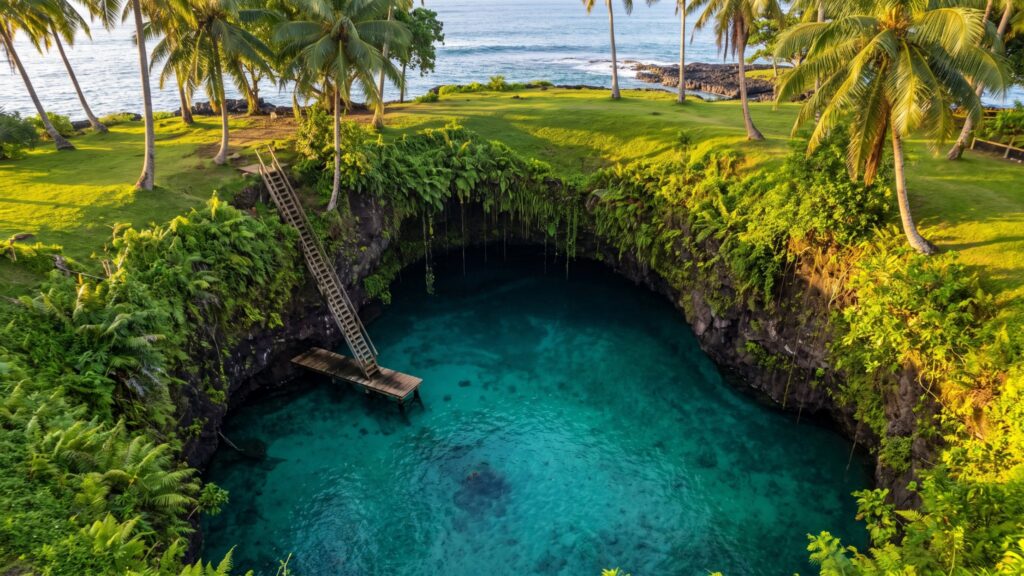
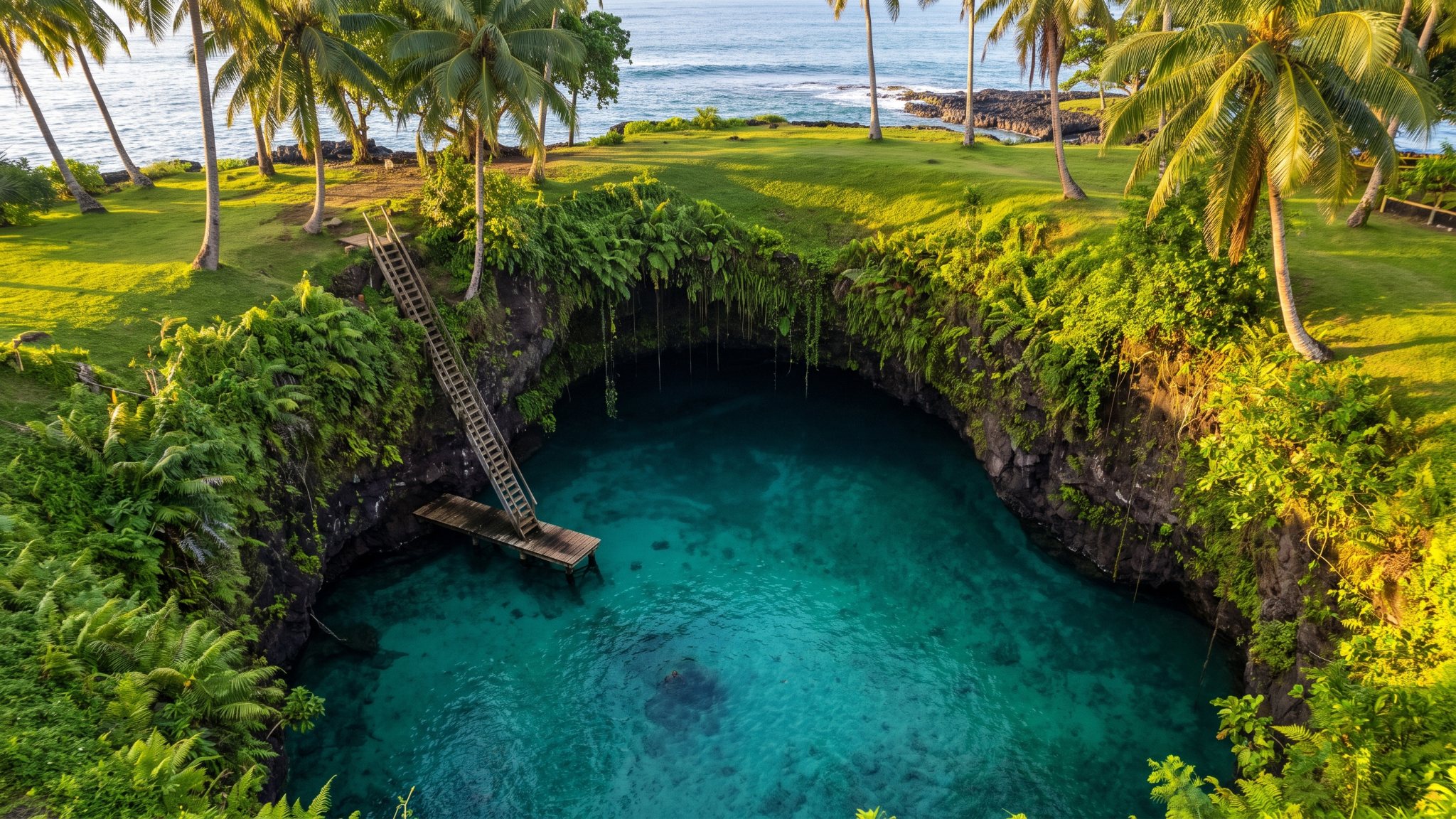
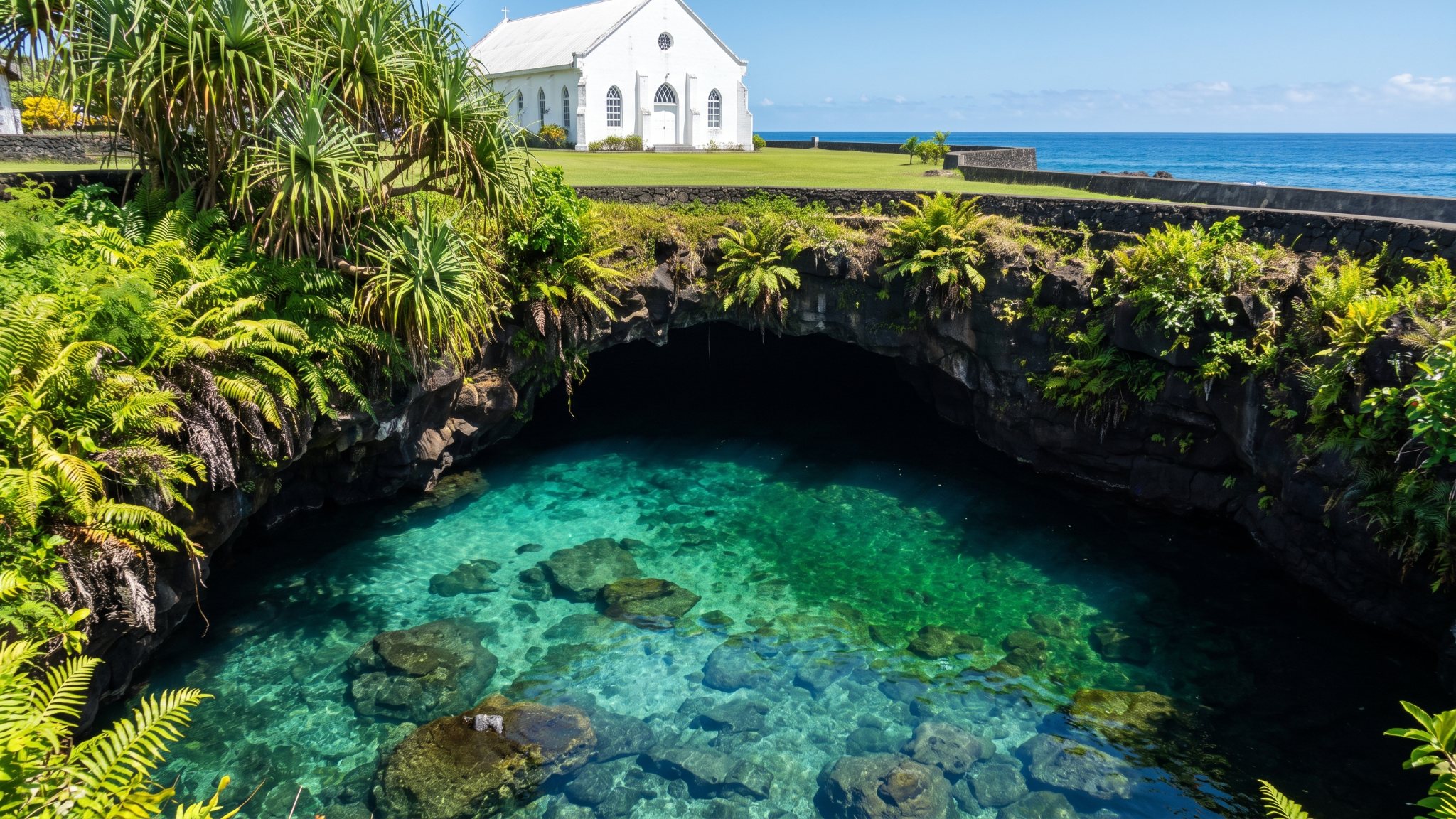
The physical draw is easy to summarise. Upolu’s south coast has the To Sua Ocean Trench — a 30-metre-deep collapsed lava tube filled with clear seawater, linked to the ocean by a tunnel, entered by a wooden ladder that is genuinely intimidating the first time. Savai’i has the Alofaaga Blowholes at Taga, where a lava shelf funnels the swell into vertical geysers and local men throw coconuts into the vents to watch them fired skyward. In between: waterfalls you swim under, freshwater cave pools, a rainforest canopy walkway, and 3,000 years of continuous Polynesian settlement behind all of it.
What genuinely sets Samoa apart from every other Pacific destination is the survival of fa’a Samoa, the Samoan way, as a functioning legal and social system rather than a heritage performance. Roughly four-fifths of the country’s land is customary land held by extended families (aiga) under titled chiefs (matai), and it cannot be sold. The practical consequence is the custom fee: at almost every beach, waterfall and swimming hole you pay WST 5–30 in cash to a family member at a small hut, and it goes to the village rather than a parks agency. It feels transactional for two days, then it clicks: you are a guest on someone’s land.
The country is also unusually safe: the United States rates Samoa at Level 1, “exercise normal precautions,” its lowest advisory tier, and violent crime against visitors is rare. The realistic hazards are mosquitoes, sunburn, rough road surfaces, unfenced drops at waterfalls, and rip currents at reef passages — plus the driving, which is on the left.

Navigators, Empires & the Mau — A Pocket History of Samoa
Samoa sits at the heart of the Polynesian triangle and is one of the oldest continuously settled places in it. Lapita pottery from the site at Mulifanua, on Upolu’s western tip beside today’s ferry terminal, dates the first arrivals to roughly 3,000 years ago, and Samoan oral tradition treats the archipelago as the cradle from which later voyages reached Tonga, the Cook Islands, Tahiti and eventually Aotearoa. By the time Europeans arrived, Samoa had a sophisticated chiefly polity, monumental architecture (the Pulemelei mound on Savai’i is the largest ancient structure in Polynesia) and a highly developed oratorical culture.
Jacob Roggeveen sighted the islands in 1722 and Bougainville named them the Navigator Islands in 1768, for the skill of the canoe crews that came out to meet him. London Missionary Society missionaries landed in 1830 and Christianity spread with remarkable completeness; the church remains the central institution of village life.
The nineteenth century brought a three-way imperial squabble between Germany, Britain and the United States, which nearly ended in a naval battle in Apia harbour in March 1889 before a cyclone destroyed six of the seven warships anchored there. Partition settled it in 1899: Germany took the western islands, the United States the eastern ones — the split that still separates independent Samoa from American Samoa.
New Zealand troops seized German Samoa without a shot in August 1914 and administered the territory until 1962, first under a League of Nations mandate and later a UN trusteeship. That administration produced the single darkest episode in modern Samoan history. In November 1918 the New Zealand-registered steamer Talune arrived from Auckland carrying influenza and was allowed to dock without quarantine; the resulting epidemic killed roughly a fifth of Samoa’s population within two months, including a large share of the titled chiefs. American Samoa, under strict quarantine a few dozen kilometres away, recorded no deaths at all. New Zealand formally apologised in 2002.
The grief and anger hardened into the Mau — a disciplined non-violent independence movement whose slogan was Samoa mo Samoa, Samoa for Samoans. On 28 December 1929, at a peaceful demonstration in Apia, New Zealand military police opened fire and killed at least nine Samoans, among them the paramount chief Tupua Tamasese Lealofi III, who was shot in the back while calling on his own people to keep the peace. The day is remembered as Black Saturday. The Mau was recognised as a legitimate political organisation in 1936, and on 1 January 1962 Samoa became the first Pacific island nation of the twentieth century to regain independence, signing a Treaty of Friendship with New Zealand the same year.
Two more recent events shape the country you will visit. On 29 September 2009 an offshore magnitude-8.1 earthquake sent a tsunami with run-ups measured up to 22 m into Upolu’s south-eastern coast; 143 people died in Samoa, with Lalomanu village suffering the heaviest losses. Many south-coast villages relocated their houses inland and rebuilt only their fales and gardens on the beach; the blue-and-white evacuation-route signs you will see everywhere date from this. Then in 2019 a measles epidemic, fuelled by a collapse in vaccination coverage after a botched immunisation incident, killed 83 people in a nation of 200,000, most of them children under five. That memory is precisely why Samoa now asks arriving visitors to be vaccinated.

September–December 2026 — Festival Season, Palolo and the Turn of the Rains
If you are reading this in the last quarter of 2026, you have arrived at the most interesting and most misunderstood stretch of the Samoan calendar. Three things are happening at once: the country’s flagship cultural festival has just wrapped, the dry season is ending, and the rains are coming back.
The festival. Samoa’s national culture week ran 30 August – 5 September 2026 in Apia. After 35 years under the name Teuila Festival — teuila being the red ginger flower that is the national bloom — the 2026 edition was staged as the Measina Festival, under the theme “Celebrations of Arts and Culture.” The programme is unusually participatory rather than staged-for-tourists: longboat (fautasi) and paopao canoe races in the harbour, the national kilikiti competition — Samoan cricket, played with a three-sided bat and a hard rubber ball, and considerably more fun to watch than the English version — school cultural competitions run by the Ministry of Education, nightly variety shows on the lawn in front of the government building, and the Miss Samoa pageant as the closer. If you missed the week itself, the momentum lingers through September in fiafia nights at hotels and village halls across Upolu.
The weather window is closing — slowly. September is still a dry-season month in Apia, averaging around 180 mm of rain; October jumps to roughly 257 mm, November to 270 mm and December to about 372 mm. That is a real change but not a washout: Samoan wet-season rain is typically a heavy afternoon or overnight burst rather than all-day drizzle, and the trade-off is that the waterfalls — Afu Aau, Papapapaitai, Togitogiga — go from photogenic to genuinely thunderous. Cyclone season officially runs November to April, with the historical peak in January–March, so a November or December trip needs flexible tickets and real travel insurance.
Two dates worth planning around. Lotu a Tamaiti — White Sunday — falls on 11 October 2026, with the following Monday a public holiday. It is a children’s festival: the kids lead the church service, recite scripture, wear white, and are then served first at the family meal, inverting the usual Samoan order of precedence for one day a year. Villages are at their most photogenic and most closed; ask permission before pointing a camera at anyone. The second date is the palolo rising, when the reproductive segments of a coral-reef worm swarm to the surface for a few hours after midnight, typically on the seventh night after the third-quarter moon in October and again in November. Half the coastal population wades out with lanterns and fine-mesh nets; the catch is eaten raw, fried in butter, or on toast, and sells for extraordinary prices. It is the single most Samoan night of the year.
And the shoulder-season economics are good. Rates on Upolu’s south coast soften from mid-October once the Australian and New Zealand school holidays pass. If you can tolerate an afternoon downpour, October and November buy the same coastline for less, at its greenest.

Best Time to Visit Samoa (Season by Season)
Samoa sits ten degrees south of the equator and has almost no temperature seasonality at all: Apia averages about 28 °C in January and 27 °C in July, and the sea sits in the high twenties year-round. What changes is rain and humidity. Annual rainfall in Apia is roughly 2,900 mm, and the year splits cleanly into a drier May–October and a wetter November–April.
Dry season peak (June–August)
The reliable window and the reason most people come. July is the driest month in Apia at roughly 133 mm, August around 155 mm, and the south-east trade winds keep humidity tolerable. Southern-hemisphere swells are at their most consistent, which makes this the prime season for the reef breaks along Upolu’s and Savai’i’s south coasts. It is also the busiest and priciest stretch, overlapping the Australian and New Zealand winter school holidays; June is typically the most expensive month for accommodation. Book beach fales at Lalomanu and Manase four to six weeks ahead. Independence celebrations run in the first week of June.
Late dry & festival shoulder (September–October)
My personal pick, and the one I would send a first-timer to. September is still dry at around 180 mm, the crowds thin out after the August peak, the national culture festival lands at the start of the month, and White Sunday follows on the second Sunday of October. October rain climbs to roughly 257 mm but usually arrives in short heavy bursts. The palolo rising in October and November is the cultural bonus. Bring a light rain shell and stop worrying about it.
Wet season / cyclone season (November–April)
Hotter, considerably wetter and cyclone-exposed. January is the wettest month at around 370–420 mm depending on the station, and the cyclone risk peaks January to March. The upside is real: prices bottom out in January, the interior is spectacularly green, waterfalls run at full volume, and the northerly swells from February to April produce glassy conditions on the north coasts for surfers who know where to look. Take out insurance that explicitly covers cyclone disruption, and do not book non-refundable domestic connections tightly.
Early dry / green shoulder (May)
The other underrated month. Rainfall drops to around 205 mm as the trades re-establish, the landscape still carries wet-season lushness, rates have not yet climbed to June levels, and the tourist infrastructure is fully open. If your dates are flexible and you want the dry-season experience without the dry-season crowd or price, aim for the second half of May.
Shoulder-season tip: whatever month you pick, the single most useful scheduling decision is to arrive on a weekday. Sunday in Samoa is genuinely observed — buses barely run, most shops and many attractions close, and villages expect quiet. A Sunday arrival means a wasted first day. A Sunday in the middle of a trip, spent at a resort or a beach fale with a book and a long to’ona’i lunch, is a pleasure.
Getting There — Faleolo (APW) and the Four Airlines That Matter
Samoa has one international gateway: Faleolo International Airport (IATA APW, ICAO NSFA), on Upolu’s north-west coast about 35 km — 40 to 50 minutes — west of Apia. Its single runway is 3,000 m long, which is enough for the widebodies that occasionally operate the Auckland run, and the terminal was substantially rebuilt with Chinese and Japanese funding in the late 2010s.
- Air New Zealand — the backbone carrier, with the most frequent Auckland–Apia service (about 4 h 15 min) and connections onward across its network.
- Fiji Airways — Nadi–Apia, the key routing for anyone combining Samoa with Fiji or arriving from Los Angeles, Hong Kong or Singapore via Nadi.
- Qantas and Virgin Australia — the Australian services, with Brisbane the main direct gateway (about 5 h 30 min); Sydney and Melbourne travellers usually connect through Brisbane or Auckland.
- Talofa Airways — the small Samoan carrier running the short hop to Pago Pago in American Samoa, plus limited regional services; base is Faleolo.
A word on Samoa Airways. The national carrier suspended international operations in 2021 and has spent the years since announcing relaunches. Do not build an itinerary around a Samoa Airways long-haul seat until you can actually buy a ticket for a dated flight on it; treat any announced Apia–Honolulu or Apia–Los Angeles service as aspirational rather than bookable.
Typical flight times: Auckland ~4 h · Nadi ~2 h · Brisbane ~5 h 30 min · Sydney ~5 h 45 min (usually via Brisbane or Auckland) · Honolulu ~5 h 30 min (connecting) · Los Angeles ~13–17 h via Nadi or Auckland · London 26 h+ with two stops. There is no direct service from North America or Europe, and this is the single biggest practical obstacle to visiting.
Entry rules. Most nationalities — including the UK, US, Canada, Australia, New Zealand, the EU and Japan — receive a free visitor permit valid for up to 90 days on arrival, with no advance application. You need a passport valid at least six months beyond arrival, a confirmed onward or return ticket, and proof of accommodation or sufficient funds; immigration does sometimes ask. Stays beyond 90 days require a visa arranged before travel.
The one entry rule people miss: since 3 November 2025 the Samoan Ministry of Health has advised that all travellers aged 12 months and over should have had at least one measles-containing vaccine dose no later than 14 days before arrival, and should carry documentary proof. After 2019, Samoa takes this extremely seriously. Photograph your immunisation record before you fly.
From the airport: there is no train and no organised airport bus for visitors. Metered-by-regulation taxis and pre-booked hotel shuttles cover the run into Apia; budget roughly WST 80–120 for a taxi to central Apia and considerably more to the south coast. If you are heading straight to Savai’i, note that the Mulifanua ferry terminal is only about 10 minutes further west from the airport — an efficient move if the sailing times line up.
Getting Around — Ferries, Buses and Driving on the Left
Samoa has no railway, no metro and — for practical purposes — no domestic scheduled air service worth planning around. Everything runs on three things: the coastal ring roads, the inter-island ferry, and an anarchic, wonderful bus network.
The Savai’i ferry
The Samoa Shipping Corporation runs the car-and-passenger crossing between Mulifanua on Upolu’s western tip and Salelologa on Savai’i, using the MV Lady Samoa III and the faster MV Samoa Express. The crossing takes roughly 60–90 minutes depending on vessel and sea state. Weekday departures are typically around 6 a.m., 10 a.m. and 2 p.m. from Mulifanua, and 8 a.m., noon and 4 p.m. from Salelologa, with a reduced Sunday service. Foot-passenger fares are cheap — around WST 10 for an adult and WST 5 for a child, with a small premium for the air-conditioned VIP lounge — while taking a car costs substantially more.
Two hard-won points. Timetables change monthly and the published schedule is a statement of intent — check current sailings the day before. And if you are taking a rental car across, arrive an hour early: loading is first-come, and being bumped costs you four hours.
Driving
A rental car is the single best investment of the trip. Both main islands have a sealed coastal loop, and having your own vehicle turns Samoa from a resort holiday into a road trip. Samoa drives on the left, and you must convert your home licence into a temporary Samoan driving licence — currently around WST 20 for one month and WST 40 for two — issued by the Land Transport Authority, Samoa Post outlets, and most rental agencies including at the airport. Learner, restricted or provisional licences are not accepted. Speed limits are low — commonly 40 km/h through villages and 56 km/h elsewhere — and they are enforced, not least because pigs, dogs, chickens, children and touch-rugby games all use the road. Take the 4WD or high-clearance option if you plan to reach Aganoa, Falealupo or the Pulemelei track.
Buses and taxis
The village buses are hand-built wooden bodies on truck chassis, painted in extraordinary colours, fitted with a non-optional sound system, and packed to a density that involves sitting on strangers’ laps — normal, expected, and younger passengers will give up seats for you. Fares are a couple of tala. The catch: no published timetable, buses run into Apia early and back out in the afternoon, most stop by mid-afternoon, and they barely run on Sundays. A wonderful cultural experience and a poor primary transport plan.
Taxis are plentiful in Apia, unmetered but government-tariffed, with a minimum fare around WST 3 for short hops. Agree the price before you get in, especially for the south coast or airport, and carry small notes.

Where to Go — Upolu, Savai’i and the Small Islands
📍 Map of Samoa: Every Place in This Guide
Apia & northern Upolu
Apia is a low-rise harbour town of roughly 36,000 people rather than a city in any conventional sense, strung along Beach Road between the Vaisigano river and the port. Most visitors give it a day and are surprised to want two.
- Robert Louis Stevenson Museum, Vailima — the author’s restored 1890s house about 5 km above town, with guided tours of roughly 20–30 minutes through rooms furnished to period. Entry is modest, typically in the WST 15–20 range for adults. The trail up Mount Vaea to his tomb takes 45–60 minutes on the steeper route; go early, take water.
- Maketi Fou and Fugalei Market — the produce and craft markets: a lavalava, a carved ’ava bowl, a bag of koko beans, and lunch for WST 10.
- Palolo Deep Marine Reserve — a community-managed reef reserve five minutes’ walk from central Apia, where a shallow lagoon drops abruptly into a coral-rimmed blue hole. Gear rental on site; go at high tide.
- Cathedral of the Immaculate Conception — the twin-towered waterfront landmark, reconsecrated in 2014, with a strikingly Samoan interior.
- Papase’ea Sliding Rocks — natural rock waterslides twenty minutes from town. Water levels vary hugely: underwhelming in a dry September, excellent in November.
The south coast & Aleipata (eastern Upolu)
This is where most of the postcard imagery comes from, and where I would spend the majority of a first trip. From Siumu and Maninoa in the centre-south, past Lotofaga and the To Sua Ocean Trench, round to Lalomanu at the island’s eastern tip, the coast is a chain of village-owned beaches with fales on the sand. Lalomanu is the classic — a long white crescent facing the Aleipata islets, comprehensively destroyed by the 2009 tsunami and rebuilt by the same families. The same stretch holds the country’s upmarket resorts at Maninoa, Saletoga and Siumu, so a mixed itinerary of two nights in a fale and two in a resort is easy to build.
- To Sua Ocean Trench (Lotofaga) — entry is in the WST 15–25 range per adult depending on the year and whether you are counted as a swimmer. The ladder is steep and wet, there is no lifeguard, and the current through the connecting tunnel is real at certain tides. Go before 10 a.m. to have it close to yourself.
- Lalomanu Beach — beach fales from roughly WST 100–180 per person with two meals; a day-use fee of WST 10–20 applies if you are just visiting for a swim.
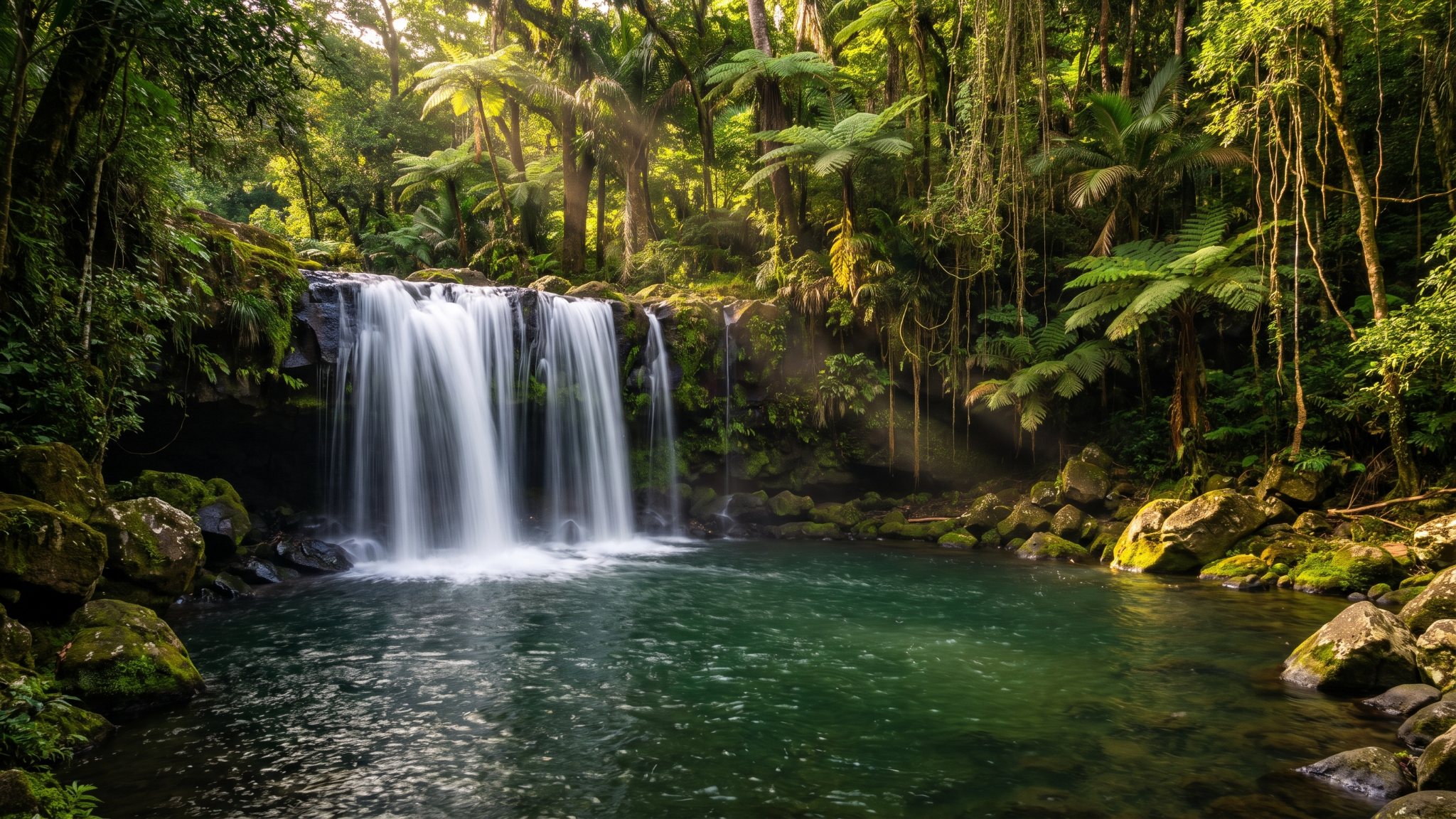
- Sopo’aga and Fuipisia Falls — two roadside viewpoint waterfalls on the cross-island route to the east, both with small custom fees and immaculate garden lookouts.
- Togitogiga Falls & O Le Pupu-Pu’e National Park — Samoa’s oldest national park, established in 1978, covering 5,019 hectares from the central ridge down to the lava coast.
Savai’i
The larger island, and the one people wish they had given more time. Savai’i is a young shield volcano — its last major eruptions were as recent as 1905–11 — and it feels it: black lava coast, huge lava tubes, a rainforest interior that includes the Central Savai’i Rainforest, the largest continuous tract of tropical rainforest left in Polynesia. The population is roughly a fifth of the national total, spread around a single coastal road, and the pace is a full gear slower than Upolu’s.
- Salelologa — the ferry town and only real service centre: market, banks, fuel, the domestic airstrip at Maota, and the place to stock up before circling the island.
- Manase — the north-coast beach-fale strip, Savai’i’s answer to Lalomanu, with excellent shallow snorkelling straight off the sand.
- Alofaaga Blowholes, Taga — the island’s signature sight, entry around WST 5–10 per adult; tipping the coconut-thrower is customary and worth it.
- Falealupo & the west — the far north-west peninsula, the last inhabited land before the date line, with a canopy walkway, a fine white beach and the “Rock House” lava formation.
- Afu Aau (Olemoe) Falls — the best swimming waterfall in the country, entry around WST 10 per adult, with a deep cold pool and a rope swing.
The small islands
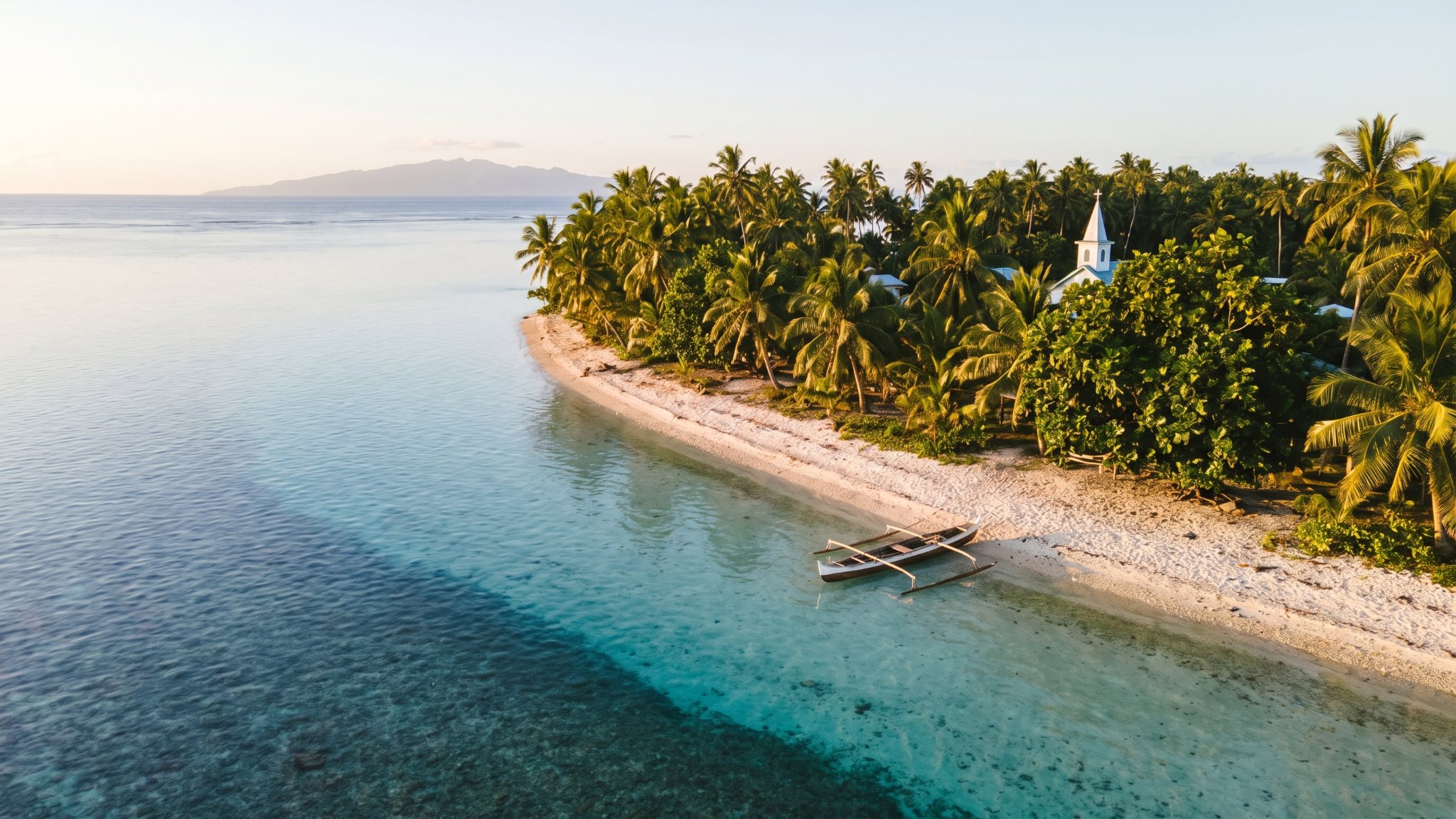
Manono, in the Apolima Strait, has no cars, no dogs and no roads — just a footpath circling the island in ninety minutes past four villages and a hilltop star mound; boats leave from Manono-uta near the Mulifanua ferry terminal. Apolima, further out, sits inside a breached crater and needs a charter and calm seas. Off Lalomanu, the Aleipata islets — Namua, Nu’utele, Nu’ulua and Fanuatapu — are ten minutes by boat; Namua has simple fales and is the easiest castaway overnight in Samoa.
Fa’a Samoa — Culture, Etiquette and the Rules That Actually Matter

Samoan society is organised around the aiga, the extended family, and the matai — the titled head of each aiga, elected by family consensus and holding a name that is attached to specific land. Matai titles come in two broad classes: ali’i (chiefs, who embody the dignity of the title) and tulafale (talking chiefs or orators, who speak on their behalf and whose skill with formal Samoan is a genuine art form). The village council of matai, the fono, still governs day-to-day village life, sets bylaws, and administers custom land — which is most of the country. None of this is folklore. It is the operating system.
The five rules that will keep you welcome
- Stop for sa. Evening prayer curfew is usually somewhere between 6 and 7 p.m., signalled by a bell or conch and lasting ten to twenty minutes; a second signal ends it. Do not walk or drive through a village during sa. Pull over, switch off the engine, sit quietly, and wait. Timing varies village to village.
- Sunday is genuinely observed. Church in the morning, to’ona’i family lunch after, rest in the afternoon. Shops close, buses barely run, many attractions shut. Swimming and noisy activity in front of a village on Sunday reads as rude.
- Cover up away from the beach. Swimwear is for the water and the immediate sand. In villages, at markets and anywhere near a church, both men and women should cover shoulders and knees — a lavalava over your swimsuit solves this permanently and costs about WST 25. Samoan women commonly swim in a T-shirt and lavalava rather than a bikini.
- Ask before you cross, photograph, or swim. Beaches, waterfalls and pools belong to villages. If there is a hut, pay the fee; if nobody is there, ask at the nearest house. Photographing people, especially children and church services, needs permission every time.
- Sit down, and don’t point your feet. Inside a fale you sit cross-legged on the mat; stretching your legs so your feet point at someone is a real offence. If you cannot manage it, cover your legs with a mat and apologise — the apology is what matters.
Tatau — the tattoo
Samoa gave the world the word “tattoo,” from the Samoan tatau, and the practice never died out under missionary pressure the way it did across much of Polynesia. The male pe’a runs from waist to knees in dense geometric bands, applied by hand with a comb-like au over multiple painful sittings; the female malu is finer and covers the thighs. Both are marks of service and status within the aiga, applied by hereditary tufuga tatatau families, and abandoning a pe’a unfinished carries lasting shame. Admire, ask politely, do not touch, and do not treat it as a souvenir.
’Ava, oratory and the fine mat
The ’ava ceremony — kava elsewhere in the Pacific — opens formal occasions. The root of Piper methysticum is pounded, mixed with water in a carved tanoa bowl, and served in a coconut-shell cup in an order dictated precisely by rank, with a called salutation before each cup. It is mildly sedative, tastes like peppery muddy water, and refusing the cup offered to you is worse than drinking it. Spill a few drops before you drink and say manuia.
The other great Samoan currency is the ’ie tōga, the fine mat: a hand-woven pandanus textile that can take months or years to make, presented at weddings, funerals, title bestowals and formal apologies. Fine mats have names and histories; exchanging them at a ceremony is closer to a treaty than a gift.
Language
Samoan and English are both official, and Samoan is spoken by essentially the whole population — one of the healthiest Polynesian languages, with an unusual formal/colloquial register split. Four words carry you a long way: talofa (hello), fa’afetai (thank you), fa’amolemole (please) and tulou — “excuse me,” said whenever you pass in front of a seated person, which in a fale is constantly.
A Food Lover’s Guide to Samoa

Samoan cooking is built on three things: root crops, coconut cream, and the sea. It is not a spice cuisine and it is not trying to be. What it does exceptionally well is the slow, smoky, coconut-rich food of the umu, and the raw fish that comes off the reef an hour before you eat it. Restaurant culture is concentrated almost entirely in Apia and the resorts; outside those, you eat what your fale or guesthouse cooks, and that is usually the better meal.
Must-Try Dishes
| Dish | Description |
|---|---|
| Palusami / lu’au | Young taro leaves layered with coconut cream, wrapped in more leaves or breadfruit leaf, and baked in the umu until it collapses into something between spinach and custard. The single best thing in Samoan cooking. |
| Oka i’a | Raw reef fish or tuna cubed and marinated in lime juice, then dressed with coconut cream, onion, cucumber and chilli. Samoa’s answer to ceviche and poisson cru; ubiquitous at markets and hotel buffets. |
| Umu-baked taro & breadfruit | The starch backbone of every meal. Breadfruit (ulu) roasted whole in the coals until the skin blackens is a revelation; taro is denser and more potato-like than you expect. |
| Sua fa’i / suafa’i | A hot dessert-soup of mashed ripe banana, coconut cream and a little sago or arrowroot. Breakfast food, comfort food, and the thing Samoans abroad miss most. |
| Fa’ausi | Grated taro or breadfruit baked, cut into squares and drowned in caramelised coconut-cream syrup. Dangerously good and usually reserved for a to’ona’i. |
| Panipopo | Soft sweet buns baked sitting in sweetened coconut cream so that the bottom half becomes pudding. Sold from roadside stalls and bakeries for a couple of tala. |
| Palolo | The seasonal reef-worm spawn harvested on a handful of October and November nights, eaten raw, fried with butter and onion, or spread on toast. Sells for extraordinary prices and is treated as the Samoan caviar. |
| Sapasui | Samoan chop suey — glass noodles, soy, ginger and beef, a nineteenth-century Chinese-Samoan hybrid that has become an absolutely core party dish. Every family has a version and every family’s is best. |
Drinks
The national beer is Vailima, a crisp German-style lager named after Stevenson’s estate. Its recent history is a small national saga: production moved offshore to Fiji in 2022, public outrage forced a reversal within weeks, and a new brewery worth around USD $17 million opened in Samoa in December 2024. Order the Export for more body.
Koko Samoa is the other essential: local cacao roasted, ground with the fat still in it and boiled into a thick, unsweetened, faintly smoky cocoa, drunk with sugar and sometimes with rice (koko alaisa) at breakfast. A bag of the pressed balls from Fugalei market is the best souvenir in the country. Fresh niu — drinking coconuts machete-opened at the roadside for a couple of tala — are both sports drink and snack, and ’ava is drunk socially as well as ceremonially.
Where to eat
- Maketi Fou and Fugalei, Apia — cooked-food stalls: oka, sapasui, taro, barbecued chicken, panipopo. Lunch for WST 10–15.
- Apia’s Beach Road — the country’s only real restaurant strip, plus a good modern café scene serving Samoan-grown coffee.
- Your beach fale — breakfast and dinner are almost always included, cooked by the family, served communally, and better than the equivalent restaurant meal.
- Fiafia night buffets — a weekly cultural evening at most large hotels with an umu buffet and dance show. Touristy, and the easiest way to try eight dishes at once.
- Sunday to’ona’i — if you are invited to a family lunch after church, cancel everything else.
Off the Beaten Path — Lava Fields, Canopy Walks and a Pyramid in the Bush

Saleaula Lava Fields (northern Savai’i)
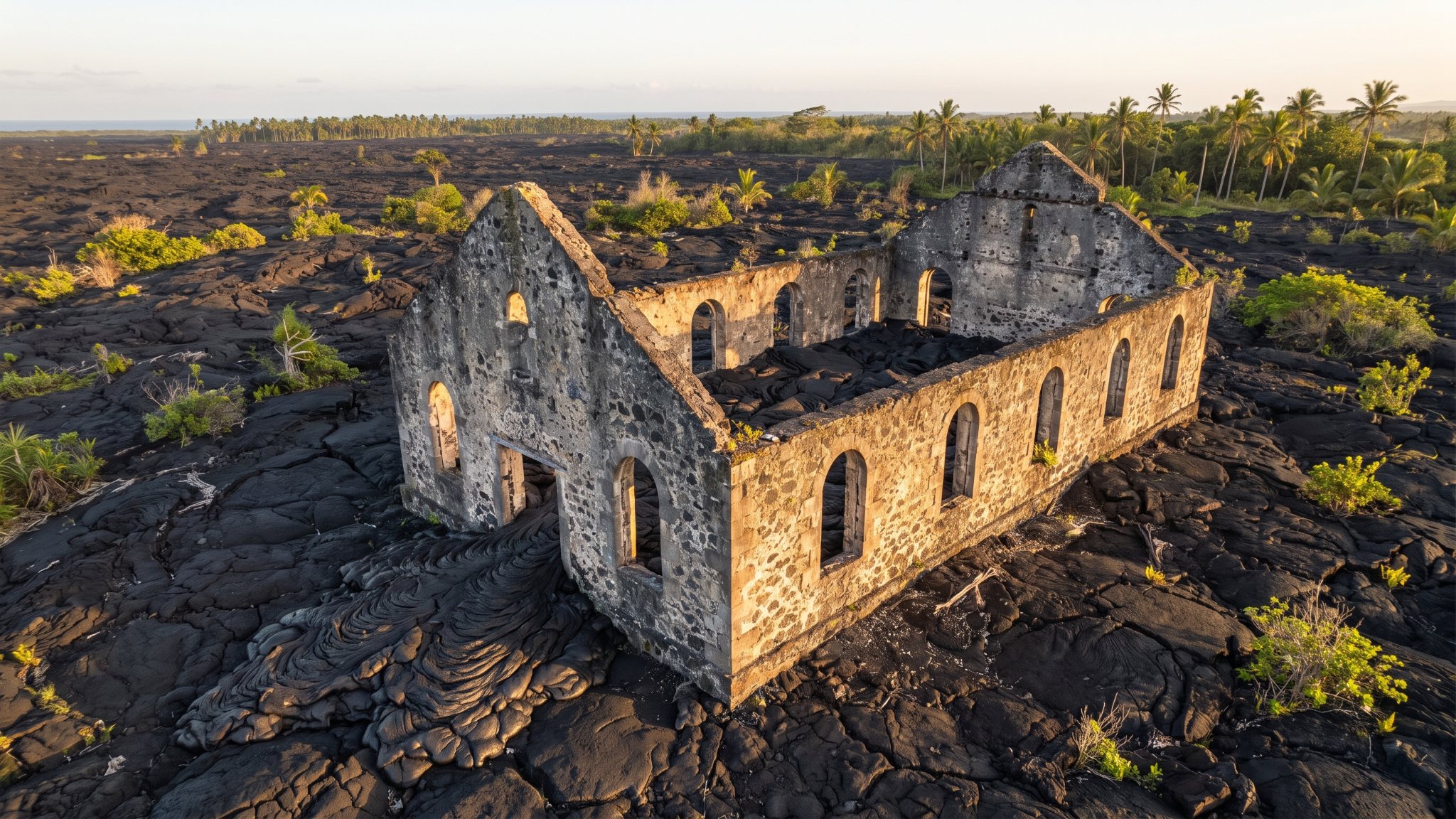
Between 1905 and 1911 Mount Matavanu erupted continuously, sending lava north across roughly 50 km² of Savai’i and burying five villages. What remains at Saleaula is one of the strangest sites in the Pacific: a black crusted plain of pahoehoe lava with the roofless shell of a mission church standing in it, filled to window height with solidified rock. Nearby is the “Virgin’s Grave,” where the flow parted around a nun’s burial plot and left a clean rectangular hollow — the kind of thing that sounds invented until you are standing over it. Small custom fee; take the guide.
Pulemelei Mound (southern Savai’i)
The largest ancient structure in the whole of Polynesia sits, largely unvisited, in the bush above Palauli: a stepped stone platform roughly 61 by 50 metres at the base and about 12 metres high, built of basalt boulders and thought to date from around 1100–1400 CE. Its purpose is genuinely unresolved — star mound, chiefly platform, ceremonial site, all have been argued. Access depends entirely on the current state of the track and on the landowners, and it has been closed to visitors in some periods; ask at Afu Aau or at your Savai’i accommodation before driving out, and take a guide.
Falealupo Canopy Walkway & the far west
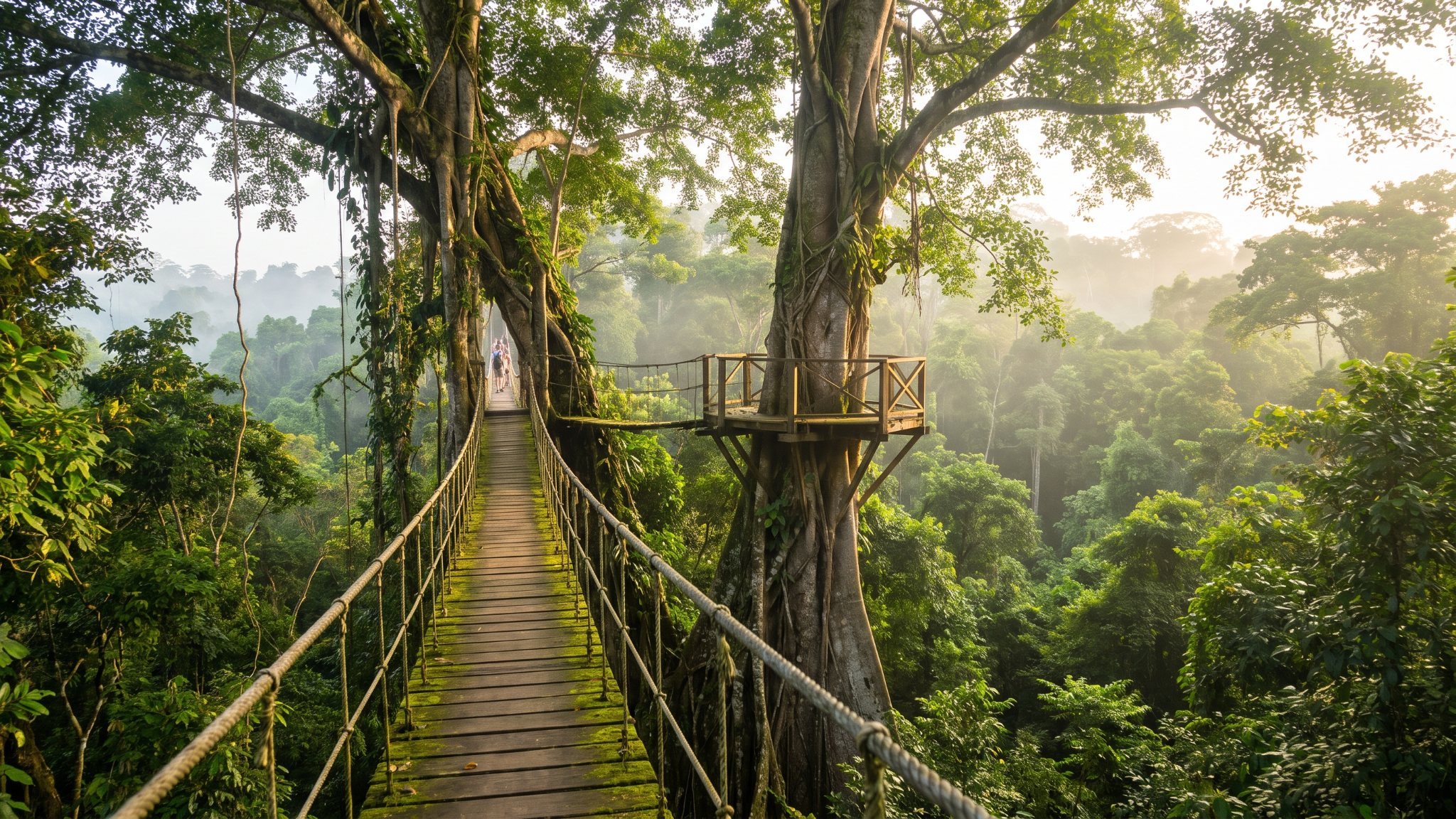
Falealupo, on Savai’i’s north-western tip, is the last village before the date line and the setting for the traditional entrance to Pulotu, the Samoan afterworld. The village’s rainforest preserve — famously saved from logging in the 1990s in a conservation deal that traded forest protection for a village school — carries a suspension walkway and platform built into a giant banyan, reached by a ladder up the trunk. Expect a custom fee in the region of WST 20 per person, expect the structure to feel homemade, and expect the view over unbroken canopy to be worth both. Nearby are the Falealupo “Rock House” lava arch and a long, almost always empty beach.
Piula Cave Pool (northern Upolu)
Beneath the Piula Methodist Theological College on Upolu’s north coast, a freshwater spring fills a lava cave that opens directly onto the sea. You swim in cold, startlingly clear water inside the cave mouth, and a submerged passage — about five metres, for confident swimmers only — links the front chamber to a second one. Entry is a small fee at the college gate; it closes on Sundays. It is fifteen minutes off the road from Apia and almost nobody stops.
Mata o le Alelo, Matavai (Savai’i)
The spring-fed pool at Matavai on Savai’i’s north coast is bound up with the legend of Sina and the Eel — the story that explains, in Samoan telling, why the coconut carries three marks like a face. Clear, cool, village-managed, small entry fee, and gloriously unhurried.
Aganoa Beach and the surf coasts
Samoa’s reef breaks are legitimately world-class and legitimately dangerous: shallow, sharp coral, and almost all accessible only by boat or with village permission. Southern swells run May to October; February to April brings north-coast waves with lighter winds. Go through an established surf camp rather than freelancing: they hold the village arrangements and know which tides make each pass survivable.
The cross-island road & Lake Lanoto’o
The road climbing from Apia over Upolu’s spine passes the Papapapaitai Falls lookout — a 100-metre-plus ribbon dropping into a forested crater, best after rain — and reaches the trailhead for Lake Lanoto’o, a highland crater lake of strange opaque green, home to feral goldfish descended from a colonial-era introduction. The trail is muddy and easy to lose; take a guide from Apia.
Day Trips from Apia
Upolu is small — roughly 75 km end to end — so nothing on the island is more than about two hours from the capital. These are the five that justify a full day and a rental car.
- The south-east loop: To Sua, Lalomanu and back over the cross-island road (full day, ~150 km). Leave Apia by 7 a.m., east along the north coast, stop at Piula Cave Pool, cut south past Fuipisia and Sopo’aga falls, swim at To Sua before the tour vans arrive, lunch at Lalomanu, and return over the interior. This is the single best day in Samoa.
- Manono Island (half to full day). Drive west to Manono-uta, take a village boat across the strait, and walk the circumference in ninety minutes past four villages, a church and the Mount Tulimanuiva star mound. No cars, no dogs, no roads, and a lagoon that is all shades of blue at once. Boats are chartered rather than scheduled; agree a return time and a price up front.
- Namua and the Aleipata islets (half day). Ten minutes offshore from Lalomanu, Namua has a beach, a handful of fales, a hill walk with a spectacular view back to Upolu, and excellent snorkelling. Day-trip fees are collected at the mainland launch point; overnighting is easy to arrange on the spot.
- Vailima, Mount Vaea and the Botanical Garden (half day, no car needed). Stevenson’s house, the climb to his tomb, and the adjacent Vailima National Reserve trails, all within 5 km of Apia.
- Savai’i as a day trip — technically possible on the 6 a.m. ferry back on the 4 p.m., realistically a mistake: five hours on an island that needs three days. If your schedule is that tight, do Salelologa market, Afu Aau and the Alofaaga Blowholes and accept you have seen a tenth of it.
One further trip suits a specific traveller: Pago Pago, American Samoa, a short flight from Faleolo on Talofa Airways. It is a genuinely different country — US territory, US dollars, separate entry rules you must check before booking, and the National Park of American Samoa. Budget two nights minimum.
Practical Information
| Currency | Samoan tala (WST or SAT, symbol $ or T). Roughly WST 1 = USD $0.37, or USD $1 ≈ WST 2.7, through 2026. |
| Cash needs | High. Cards work in Apia hotels, supermarkets and resorts; almost nowhere else. Custom fees, buses, markets, beach fales and roadside stalls are cash-only. Carry WST 200–300 in small notes when you leave town. |
| ATMs | Reliable in Apia and at Faleolo airport; scarce on Savai’i outside Salelologa, and prone to running dry over weekends and public holidays. Withdraw before you cross to Savai’i. |
| Tipping | Not traditional and not expected — Samoan custom treats hospitality as an obligation, not a service. It is increasingly accepted in resorts and for guides; round up rather than calculate a percentage. Where a hotel has a staff tip box, use that. |
| Language | Samoan and English are both official; English is used in government, business and tourism. |
| Safety | US advisory Level 1, “exercise normal precautions” — the lowest tier. Petty theft from unlocked rooms and unattended beach bags is the realistic risk; violent crime against visitors is rare. Read the UK and Australian advisories too, which flag village-boundary disputes and road conditions. |
| Connectivity | Digicel and Vodafone Samoa both sell tourist SIMs at Faleolo arrivals and in Apia; typical data bundles run from a few tala for a day pass to around WST 50 for 30 GB over a fortnight. Travel eSIMs on the same networks start around USD $5–19. Coverage is good along both coastal roads and patchy in the interior. |
| Power | 230 V / 50 Hz, Type I plugs (the angled three-pin used in Australia and New Zealand). US, UK and EU travellers all need an adapter. |
| Tap water | Not reliably potable outside resorts. Drink bottled, filtered or boiled water; bottled is cheap and universal. Official advice is to boil for at least two minutes if in doubt. |
| Health | Tupua Tamasese Meaole Hospital in Apia is the main referral hospital, with a smaller facility at Tuasivi on Savai’i; serious cases are evacuated to New Zealand. Emergency number is 911. Comprehensive travel insurance with medical evacuation cover is close to mandatory. |
| Mosquito-borne disease | A dengue outbreak declared in April 2025 has continued into 2026, with well over 17,000 clinically diagnosed cases and several deaths reported nationally; children under 15 account for the majority. Use DEET or picaridin repellent day and night, sleep under a net in open fales, and see a doctor for any fever. |
Sustainability & Responsible Travel
Samoa’s tourism model is unusually well-distributed by Pacific standards, because so much of the accommodation stock and virtually all of the natural attractions are village-owned. Choosing a beach fale over an international resort for part of your trip sends money directly into an aiga rather than to an offshore balance sheet. Pay the custom fees without haggling; they are the mechanism. Beyond that: Samoa banned single-use plastic bags, straws and styrofoam containers in 2019, so bring a refillable bottle and a tote. Do not stand on coral, do not buy turtle-shell or coral products, and take reef-safe sunscreen — mineral, not oxybenzone — because the lagoons you are swimming in are also the reefs the villages fish. And on a country with a rainforest interior that includes the largest remaining tract in Polynesia, guided walks booked through village enterprises are the mechanism that keeps that forest worth more standing than logged.
Budget Breakdown — What Samoa Actually Costs
Samoa is meaningfully cheaper than Fiji at the mid-range and dramatically cheaper at the bottom, because of one institution: the beach fale. The oddity is the middle — there is little three-star stock, so the jump from fale to resort is abrupt.
💚 Budget traveller — USD $65–95/day
A beach fale at Lalomanu, Manase, Saleapaga or Namua runs roughly WST 100–180 per person per night, and that price almost always includes breakfast and dinner cooked by the family. Add a market lunch at WST 10–15, a couple of custom fees at WST 10–25 each, a Vailima at WST 6–10, and bus fares of a few tala, and USD $65–95 covers a genuinely good day. Sleeping in an open-sided fale on the sand is not a compromise you are making for money — most people who do it end up rating it the best part of the trip. Bring a headtorch, a sarong and earplugs for the roosters.
💙 Mid-range — USD $150–230/day
A comfortable hotel or self-contained beach bungalow on Upolu’s south coast sits at roughly USD $90–175 a night, and this is the tier where you add a rental car at around USD $55–75 a day plus the WST 20 temporary licence. Restaurant dinners in Apia run WST 45–90, the Savai’i ferry is trivial on foot and moderate with a car, and a guided full-day tour is USD $90–140. This is the sweet spot for a first trip: car, one resort splurge, and fales for the rest.
💜 Luxury — USD $400+/day
Samoa’s top tier is small and characterful rather than branded — there are no international five-star chains. Sinalei Reef Resort and Coconuts at Maninoa, Seabreeze at Aufaga, Saletoga Sands, Return to Paradise at Lefaga and Le Vasa on the west coast are the names to know, with rates ranging from around USD $150 at the entry end of a resort room to USD $700+ for the adults-only villas. Add a private driver-guide at USD $150–200 a day, a chartered boat to the Aleipata islets, and spa treatments, and USD $400–600 a day is comfortable. Note that June is typically the most expensive month and January the cheapest, with swings of 30%+ either side of the annual average.
For context, Samoa’s general cost of living sits well below Australia and New Zealand for services and labour but noticeably above them for imported goods — almost everything in a supermarket that is not taro, fish or coconut has crossed an ocean, and the price reflects it. Sunscreen, insect repellent, and any specific medication are all cheaper packed than bought.
| Tier | Daily (USD) | Accommodation | Food | Transport |
|---|---|---|---|---|
| Budget | $65–95 | Beach fale WST 100–180 pp, 2 meals included | $10–20 (market lunch + included meals) | $5–10 (buses, foot-passenger ferry, custom fees) |
| Mid-Range | $150–230 | Hotel or beach bungalow $90–175 | $35–60 (one restaurant dinner daily) | $55–75/day rental car + fuel |
| Luxury | $400+ | Resort room or villa $250–700+ | $80–160 (resort dining, wine) | $150–200/day private driver-guide |
Planning Your First Trip to Samoa
- Decide how you are getting there before anything else. There is no direct service from North America or Europe, so your realistic routings are via Auckland, Nadi or Brisbane. Price the whole journey first; the Samoa leg is usually the cheap part.
- Sort the measles documentation. The Ministry of Health advisory in force since November 2025 asks all arrivals aged 12 months and over to have had a measles-containing vaccine at least 14 days before arrival and to carry proof. Do this the moment you book.
- Split the trip between the two islands, and give Savai’i more than you think. The standard mistake is six nights on Upolu and one on Savai’i. Aim for a 4:3 or 5:3 split. The ferry is easy; the regret is not.
- Book a car for the middle of the trip, not the whole trip. You do not need a vehicle for the days you spend at a fale on one beach. Rent for the exploring days, get the WST 20 temporary licence at the rental desk, and hand it back.
- Plan around Sunday deliberately. Put your beach day, your resort night or your long lunch on the Sunday. Do not schedule a travel day, a ferry crossing, a big drive or a market visit.
- Carry cash from day one. Withdraw WST 400–600 at the airport. Almost every memorable thing you will do in Samoa is paid for in small notes to a person sitting in a hut.
Classic 7-day itinerary. Day 1 — arrive Faleolo, transfer to Apia, Beach Road and an early night. Day 2 — Apia: Maketi Fou, Palolo Deep snorkel, Vailima and the Mount Vaea climb, dinner on the waterfront. Day 3 — pick up the car, drive the north-east coast, Piula Cave Pool, cut south, overnight in a Lalomanu beach fale. Day 4 — To Sua Ocean Trench at opening, Sopo’aga and Fuipisia falls, second fale night or move to a south-coast resort. Day 5 — cross-island road, morning ferry from Mulifanua to Savai’i, drive to Manase. Day 6 — Savai’i loop: Saleaula lava fields, Falealupo canopy walk and beach, sunset on the north coast. Day 7 — Alofaaga Blowholes and Afu Aau falls, afternoon ferry back, night near the airport for a small-hours departure.
If you only have 5 days: skip Savai’i entirely rather than rushing it. Two nights in Apia, three on Upolu’s south coast with a car, To Sua and Lalomanu, one long lazy Sunday. You will see less and enjoy it more.
If you have 10 days: add three nights on Savai’i’s south and west (Satuiatua, Falealupo), a night on Namua or Manono, and a genuine rest day. Ten days is where Samoa stops being a destination and becomes a place you know.
Frequently Asked Questions
Do I need a visa for Samoa?
Almost certainly not for a normal holiday. Citizens of most countries — including the UK, US, Canada, Australia, New Zealand, EU states and Japan — are issued a free visitor permit valid up to 90 days on arrival, with no advance application and no fee. You will need a passport valid for at least six months beyond arrival, a confirmed onward or return ticket, and enough evidence of funds or accommodation to satisfy an immigration officer if asked. Anything longer than 90 days, or any work or volunteering, needs a visa arranged before you fly. Always check the official entry page close to departure, because Pacific entry rules change with little notice.
Is Samoa expensive?
No, by Pacific standards it is one of the better-value destinations, mainly because of the beach fale. A fale bed with breakfast and dinner included runs roughly WST 100–180 per person, which is USD $37–67, and a full day on the budget tier lands at USD $65–95. Mid-range with a rental car is USD $150–230. Where Samoa gets expensive is the flight — there is no cheap way in from outside Australasia — and imported goods in supermarkets. Custom fees at attractions are small, typically WST 5–30.
Is Samoa safe for solo and female travellers?
Broadly yes. Samoa carries the lowest US travel-advisory rating, Level 1, and violent crime against visitors is uncommon. The practical advice is conservative rather than fearful: dress modestly away from beaches and resorts, avoid walking alone in unlit areas at night, do not leave valuables in an unlocked fale, and be aware that unwanted attention is more likely if you are visibly ignoring local dress norms. The UK and Australian advisories both note that road conditions and rural driving are the more realistic hazard.
Should I worry about dengue fever?
Take it seriously and prepare, rather than cancel over it. Samoa declared a dengue outbreak in April 2025 that has continued into 2026, with more than 17,000 clinically diagnosed cases and a small number of deaths, disproportionately among children. The mosquito that carries it bites during the day. Pack DEET or picaridin repellent, cover up at dawn and dusk, sleep under the net your fale provides, and see a doctor for any fever with severe headache or joint pain.
What is a beach fale actually like?
A raised wooden platform with a thatched or corrugated roof, no walls, and woven blinds you roll down at night. You get a mattress, bedding, a mosquito net and a padlockable box or a shared locker; bathrooms are shared and a short walk away. Breakfast and dinner are almost always included and eaten communally with the family who own it. You will hear the reef all night, roosters from 4:30 a.m., and possibly a church choir practising. It is not luxury and it is not roughing it; it is the single most characteristic Samoan travel experience and it costs about a third of a hotel room.
Do I need a rental car, and how bad are the roads?
You do not strictly need one, but a car transforms the trip. Both islands have a sealed coastal loop in generally reasonable condition; the problems are potholes after heavy rain, unlit stretches at night, and the fact that roads run through the middle of villages where children, dogs and pigs have right of way in practice if not in law. Drive on the left, keep well under the low posted limits, and avoid driving after dark outside Apia. You will need a temporary Samoan licence, issued on the spot for about WST 20 for a month.
Can I drink the tap water?
Not reliably. Resorts and better hotels filter their supply and will tell you if their water is safe; elsewhere, drink bottled or boiled water, and boil for at least two minutes if you are treating it yourself. Bottled water is cheap and available everywhere, which makes this a minor inconvenience rather than a real problem. Avoid ice from roadside stalls, and be a little careful with unpeeled salads outside established restaurants.
Is Samoa the same as American Samoa?
No, and the distinction matters practically as well as politically. Samoa is a fully independent country of about 205,000 people, a UN member since 1976, using the tala and driving on the left. American Samoa is an unincorporated US territory of about 45,000 people, roughly 100 km to the east, using US dollars, driving on the right and operating entirely separate entry rules — a US visa or ESTA-equivalent situation applies, and your Samoan 90-day permit means nothing there. The split dates to the 1899 partition between Germany and the United States. This guide covers independent Samoa.
Ready to Explore Samoa?
Two volcanic islands, a coastline owned by the villages that live on it, and a beach hut on the sand for the price of an airport sandwich. Book via Auckland or Nadi, sort your measles documentation the same week, split your nights between Upolu and Savai’i, and let the 6:30 p.m. conch set the pace.
Explore More
Pacific & Australasia guides
- Fiji Travel Guide — the obvious Pacific pairing and likeliest connecting hub
- Tonga Travel Guide — Samoa’s nearest Polynesian neighbour, and humpback country
- Vanuatu Travel Guide — Melanesian contrast and active volcanoes
- New Zealand Travel Guide — the main gateway, and home to the largest Samoan community abroad
- Australia Travel Guide — the other realistic stopover, via Brisbane
- Apia City Guide — the capital in detail
- Auckland City Guide — your most likely connection point
- Sydney City Guide — anchor for a longer South Pacific loop
- Nadi City Guide — the Fijian hub you will probably transit
- Bora Bora City Guide — the luxury end of Polynesia
- All Country Guides
More country guides you might like
Plan your trip to Samoa
The booking tools we use ourselves. FFU may earn a commission at no extra cost to you.
Plan & book your trip to Samoa
Booking through these searches supports our guides at no extra cost to you.