
Languages of Cuba
All languages of Caribbean →fluent beta classical · classes by phone with Maya at ranas.ai/maya
Cuba Travel Guide — Classic Cars, Colonial Plazas & the Rhythm of the Caribbean
Cuba Travel Guide
📋 In This Guide
- Overview — Why Cuba Belongs on Every Bucket List
- 🎷 Havana International Jazz Festival 2026
- Best Time to Visit Cuba (Season by Season)
- Getting There — Flights & Arrival
- Getting Around
- Top Cities & Regions
- Cuban Culture & Etiquette
- A Food Lover’s Guide to Cuba
- Off the Beaten Path
- Practical Information
- Budget Breakdown
- Planning Your First Trip to Cuba
- Frequently Asked Questions
Overview — Why Cuba Belongs on Every Bucket List
Cuba is not a country you visit so much as a country you feel. It is the largest island in the Caribbean, a 1,250-km stretch of baroque plazas, tobacco valleys, coral cays, and salt-weathered boulevards where a 1955 Chevy idles at every corner and a trumpet line drifts out of every second doorway. Travellers arrive expecting rum, cigars, and a postcard Havana. They leave understanding that Cuba is the most culturally generous, logistically challenging, and emotionally unforgettable country in the region.
The scale is deceptive. Eleven million Cubans live across 1,250 km of island that lies only 150 km from Florida and 210 km from Mexico’s Yucatán, yet the country feels geographically isolated from both. Nine UNESCO World Heritage Sites — seven cultural, two natural — are spread from the Viñales Valley in the west through Habana Vieja, Trinidad, Cienfuegos, and Camagüey to the Castillo del Morro above Santiago Bay in the east. A single road trip can cross five of them.
The contrasts are the point. Cuba runs one of the best universal healthcare systems in the developing world and sends doctors across the Global South, yet tourists queue for toilet paper in pharmacies. The country exports world-class classical ballet and conservatoire-trained jazz musicians, while a rural guajiro on an ox-cart still delivers milk in glass bottles. Afro-Cuban santería drumming echoes out of the same neighbourhoods where colonial-era Spanish cathedrals stand. US trade sanctions have held since 1962 and shape almost every transaction — which is part of what has preserved the classic cars, the mid-century architecture, and the cash-only economy tourists now fly in to experience.
This is a country where a mojito on the roof of a Havana paladar costs less than the taxi home; where the best meal of your life might come out of a family kitchen rebranded as a restaurant in 2011; where you will walk out of a reggaetón club onto a street that was cobbled in the 1600s; and where Ernest Hemingway’s preferred daiquiri recipe is still served at El Floridita by staff who act as though he just stepped out. Pack cash, lower your expectations of the Wi-Fi, learn fifty words of Spanish, and let the island set the pace. Cuba rewards patient travellers more than any other country in the Caribbean.
🎷 Havana International Jazz Festival 2026 — Book Your Vedado Room Now
If you time a Cuba trip to a single event, make it the Havana International Jazz Festival — the Jazz Plaza, held every January in Havana and anchored at the Teatro Nacional de Cuba and the Casa de la Cultura de Plaza in Vedado. The festival brings together conservatoire-trained Cuban pianists, international jazz royalty, and the Afro-Cuban rhythm tradition that produced Chucho Valdés, Irakere, and Buena Vista Social Club. January is also the peak of Cuba’s dry season, with Havana temperatures at 18–26°C, clear skies, and the best light photographers will find all year. Casas particulares in Vedado and Habana Vieja book out six to eight weeks before the festival.
- Festival month: January 2026, typical run around two weeks
- Main venues: Teatro Nacional de Cuba (Plaza de la Revolución), Casa de la Cultura de Plaza, Fábrica de Arte Cubano (FAC)
- Vedado: most festival fringe shows, jam sessions at La Zorra y el Cuervo and Café Jazz Miramar
- Habana Vieja: rooftop bars and plazas programme parallel concerts; Plaza de la Catedral hosts free outdoor shows
- Santiago de Cuba: a secondary festival leg in some editions — check the programme before booking eastern flights
- After-parties: Fábrica de Arte Cubano (FAC) in Vedado runs programmed nights that stretch past 3 AM during the festival
Best Time to Visit Cuba (Season by Season)
Spring (Mar–May)
The tail of the dry season and arguably the sweet spot. Havana sits at 20–29°C, humidity is manageable, and the winter high-season crowds have thinned out of Varadero and Viñales. Rains begin creeping back in late May. May itself brings the Cubadisco music-industry awards in Havana — Cuba’s answer to the Grammys, with concerts across Vedado. Beaches along the southern cays (Cayo Largo, Cayo Coco) have their clearest water of the year from March through early May, and inland valleys are green from the early showers without being waterlogged.
Summer (Jun–Aug)
Hot, humid, and the start of the Atlantic hurricane season on June 1. Havana climbs to 24–32°C and the afternoon thunderstorms are dramatic, sometimes day-long. This is when Cubans themselves take beach holidays — prices drop outside Varadero’s all-inclusives, and the Fiesta del Fuego in Santiago de Cuba (early July) plus the Santiago Carnaval (late July — the island’s oldest and largest) bring east-coast travel to its cultural peak. Expect mosquitoes inland and bring rain gear plus insurance that covers hurricane disruption.
Autumn (Sep–Nov)
The trickiest window. September and October carry the highest hurricane probability of the year, especially along the north coast from Havana east to Holguín. By mid-November the risk drops sharply and weather stabilises for the winter high season. Temperatures moderate to 22–30°C in Havana and humidity eases. November is an excellent value month — prices are still shoulder-season, rains taper, and the Festival de Cine Latinoamericano in Havana (early December) previews the film calendar. Book flexible tickets through October.
Winter (Dec–Feb)
The peak tourist season. Dry, mild, and the country at its postcard best — Havana 18–26°C with clear skies and sea-breeze nights; Varadero 20–28°C and ideal for swimming. The Havana International Jazz Festival lands in January and the Havana Biennial (typically running in alternate years) has historically fallen in this window. Christmas and New Year double hotel rates in Varadero and Havana; book casas particulares six to eight months ahead for January–February. Eastern provinces stay warmer and often drier than the north coast.
Shoulder-season tip: Late March through early May and mid-November through early December offer the best balance of prices, weather, and thin crowds. Avoid Semana Santa (Holy Week) in the first-week-of-April range if you want cheap flights, and skip September entirely unless you track hurricane forecasts closely.
Getting There — Flights & Arrival
Most visitors arrive by air, with José Martí International in Havana handling the overwhelming majority of international traffic. Direct flights from Canada, Mexico, and Europe are frequent; US travellers face licensing requirements discussed below.
- José Martí International (HAV) — Cuba’s primary gateway, 15 km south of central Havana; authorised taxis to Habana Vieja run 25–30 CUC/USD equivalent.
- Juan Gualberto Gómez International (VRA) — Varadero’s beach-resort gateway, 30 km from the peninsula; served by direct charter flights from Canada, the UK, and Europe.
- Antonio Maceo International (SCU) — Santiago de Cuba, primary eastern gateway with limited international service, mostly via Havana.
- Secondary airports: Holguín (HOG) for the east, Santa Clara (SNU) for Cayo Santa María
Flight times: 3.5 hours from Toronto or Montreal, 1 hour from Cancún, 9–10 hours from London or Madrid, and around 4 hours from Mexico City. Cubana de Aviación is the flag carrier and operates the domestic network; Air Canada, Copa, Iberia, Air France, and Aeroméxico fly the main international routes.
Visa & entry: most non-US travellers enter with a tarjeta del turista (tourist card) valid for 30 days, extendable once to 60. US travellers must qualify under one of the 12 OFAC general-license categories — tourism is not permitted. All visitors must file a D’Viajeros electronic declaration within 72 hours before arrival.
Getting Around — Víazul, Almendrones & the Rhythm of Cuban Transit
Cuba does not have a high-speed rail network, and domestic flights are limited and schedule-volatile. Intercity travel is Víazul long-haul coaches or private taxi-colectivos; inside cities, the iconic almendrones (shared American classics) run fixed routes for pennies, and private taxis are bargained per ride.
- Víazul coach network: the tourist-class long-haul bus operator connecting Havana with Viñales, Varadero, Cienfuegos, Trinidad, Santa Clara, Camagüey, Holguín, and Santiago de Cuba.
- Havana → Viñales (Víazul): 3h 30m through Pinar del Río tobacco country
- Havana → Varadero (Víazul): 3h, roughly 10 USD one-way
- Havana → Trinidad (Víazul): 6h via Cienfuegos
- Havana → Santiago de Cuba (Víazul): 15–16h overnight, the east-west spine run
- Trinidad → Cienfuegos (Víazul): 1h 30m, an easy half-day hop
Cubana de Aviación: the national flag carrier operates domestic routes Havana–Santiago, Havana–Holguín, and Havana–Baracoa, though fleet and schedule issues make advance booking risky. Pay cash at the airport counter and confirm 24 hours ahead.
Taxi-colectivos and almendrones: pre-1960 American cars converted to shared taxis run fixed routes in Havana for 50–100 CUP a seat. For intercity travel, private taxi-colectivos match Víazul times at roughly 15–25 USD per seat and run door-to-door from casas particulares. Pre-arrange through your host the night before.
Apps: there is no Uber or DiDi. Maps.me is the offline-map default most travellers use. La Nave is a Cuban ride-hail app with limited Havana coverage. Cash is king; phone payments are not standard.
Top Cities & Regions
📍 Map of Cuba: Every Place in This Guide
🏛️ Havana
The capital and cultural engine of the Caribbean — a 500-year-old city of baroque plazas, Art Deco apartments, and salt-weathered seafront boulevards where 1955 Buicks idle at every light. Habana Vieja was inscribed by UNESCO in 1982.
- Habana Vieja — Plaza de la Catedral, Plaza Vieja, Plaza de Armas, and the 16th-century Castillo de la Real Fuerza
- The Malecón — a 7-km seawall promenade from Habana Vieja to the Almendares River, best at sunset with a bottle of rum
- Museo de la Revolución, Gran Teatro de La Habana Alicia Alonso, and the Fábrica de Arte Cubano contemporary arts space in Vedado
Must eat: ropa vieja at a Vedado paladar, a mojito at La Bodeguita del Medio, and a daiquiri at El Floridita.
🏘️ Trinidad
A UNESCO colonial time capsule on the southern coast, founded 1514 and inscribed in 1988 — cobblestone streets, pastel single-storey houses, and the sugar-wealth Valle de los Ingenios on its doorstep.
- Plaza Mayor and the Museo Romántico inside the Palacio Brunet
- Valle de los Ingenios — the sugar-mill valley with the 45-m Manaca Iznaga tower you can climb for a valley panorama
- Playa Ancón, 12 km south — the best beach on Cuba’s southern coast, reachable by taxi or bicycle
Must eat: lechón asado in a courtyard paladar and a canchánchara (rum-honey-lime cocktail) at the Taberna La Canchánchara.
🏖️ Varadero
Cuba’s flagship beach resort — a 20-km white-sand peninsula east of Havana, wall-to-wall all-inclusives, and the country’s highest concentration of international tourists. Best paired with Havana, not visited alone.
- Playa Varadero — 20 km of continuous white sand with gentle north-facing surf
- Parque Natural Varahicacos — a protected headland with the Cueva de Ambrosio indigenous cave paintings
- Day-boats to Cayo Blanco and the Cueva Saturno freshwater cenote for snorkelling
Must eat: grilled lobster at a beachside paladar and a piña colada at Calle 62.
🌄 Viñales Valley
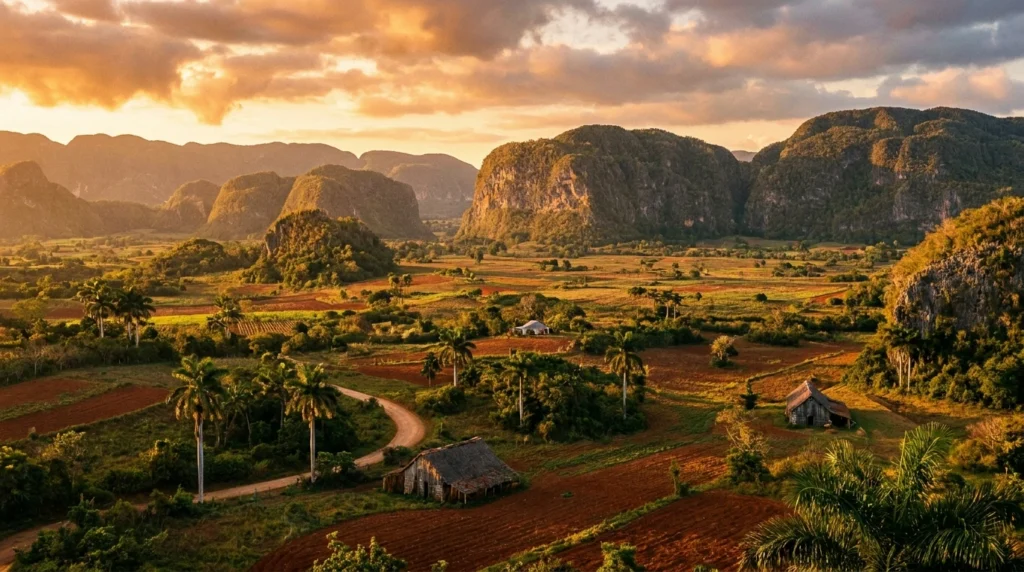
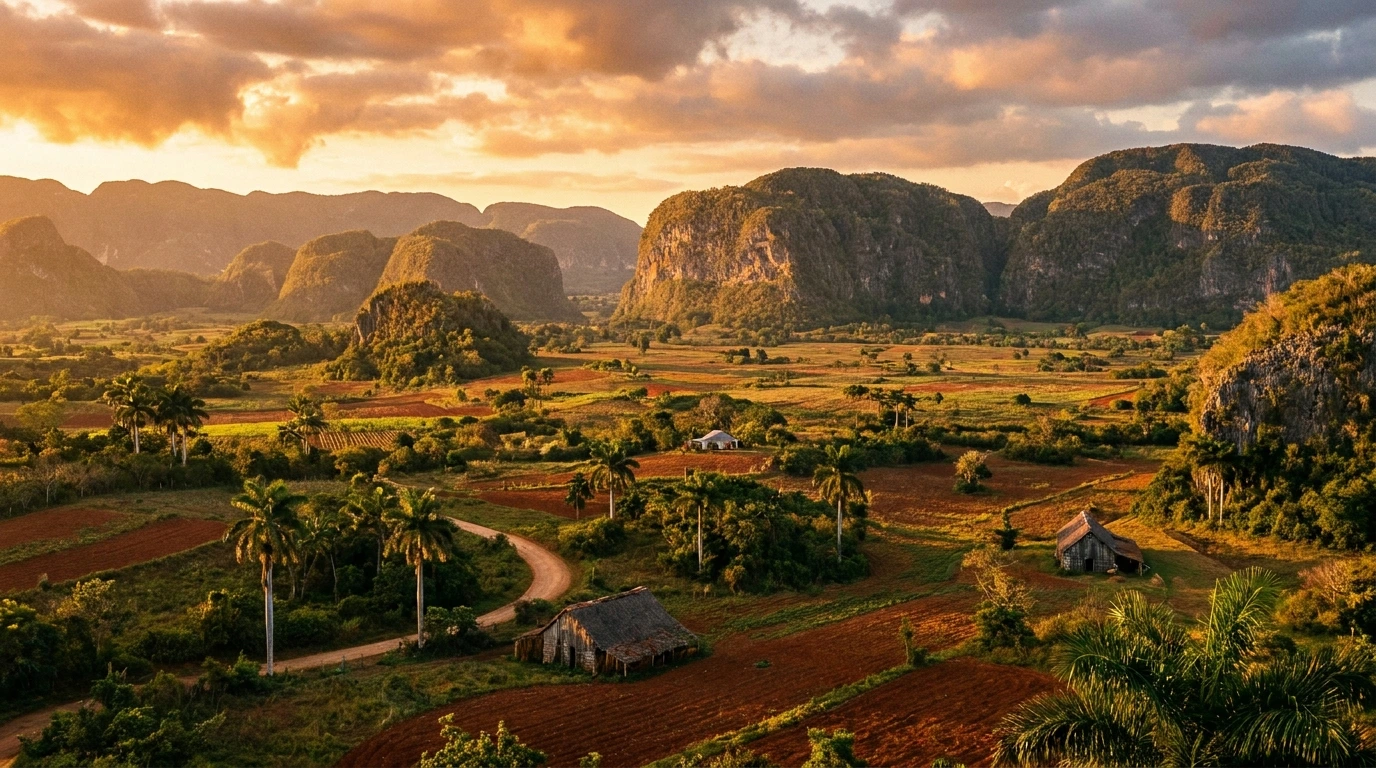
A UNESCO cultural landscape in Pinar del Río, inscribed 1999 — limestone mogotes above red-earth tobacco fields, ox-drawn ploughs, and the guajiro countryside most visitors come to find.
- The mogotes of the Valle de Viñales — karst formations best seen on horseback at sunset
- Cueva del Indio and the Gran Caverna de Santo Tomás, one of Latin America’s largest cave systems
- Veguero (tobacco-farm) visits where farmers roll cigars by hand and serve their own coffee
Must eat: a farmhouse lunch of lechón asado, moros y cristianos, and farm tomatoes at any roadside finca.
🎺 Santiago de Cuba
The Afro-Caribbean soul of the island — Cuba’s second city, cradle of son cubano, and crucible where the Revolution was declared on July 26, 1953. The Castillo del Morro was inscribed by UNESCO in 1997.
- Castillo del Morro San Pedro de la Roca — a Spanish colonial fortress over Santiago Bay
- Cuartel Moncada (the barracks stormed in 1953, now a museum) and the Santa Ifigenia cemetery where José Martí and Fidel Castro are buried
- Casa de la Trova, Tivolí district, and the late-July Carnaval — Cuba’s oldest and largest
Must eat: congrí oriental (the eastern variant of moros y cristianos) and a Cuban sandwich at a Plaza Marte paladar.
🌊 Cienfuegos
The ‘Pearl of the South’ — a UNESCO-listed city founded 1819 by French émigrés from Louisiana, with the most harmonious neoclassical urban core in the Caribbean. Inscribed in 2005.
- Historic Centre — Parque José Martí, the 1895 Teatro Tomás Terry, and the Palacio Ferrer
- Palacio de Valle, a 1917 Moorish-Gothic mansion at the tip of the Punta Gorda peninsula
- El Nicho waterfalls in the Escambray mountains, 45 km north-east
Must eat: seafood paella at a Punta Gorda paladar — the French-Spanish-Caribbean fusion that distinguishes Cienfuegos kitchens.
Cuban Culture & Etiquette — What to Know Before You Go
The Essentials
- Greet warmly. Handshakes for new acquaintances; a single cheek-kiss is common between women, and between a man and a woman once introduced. A smiling “buenas” or “buenos días” walking into any shop is expected.
- Tipping is expected and matters. State-sector wages are low; tips (paid in hard currency where possible) go directly to workers. 10% in paladares, 1 USD equivalent per bag for porters, 20–50 CUP for musicians and bathroom attendants, and small-denomination USD or EUR to hotel housekeeping.
- Do not haggle on food or in paladares. Cuban prices in tourist zones are quoted to foreigners and are generally fair. Bargaining is appropriate in artisan markets and with private taxis, not with restaurants or casas particulares.
- Photographing people requires consent. Classic-car owners and musicians in Plaza de la Catedral will pose for photographs and expect a small tip. Do not photograph military installations, airports, or anyone in uniform.
- Politics is a conversation not a debate. Cubans have nuanced views of the government, the revolution, and the US embargo. Listen more than you opine; never lead with a strong political position, and never publish quotes that could identify a host.
Afro-Cuban & Spanish Colonial Heritage
- Cuba is a cultural fusion, not a monolith. The population is a blend of Spanish colonial settlers, Afro-Cuban descendants of enslaved West Africans, and smaller Chinese, French (from Haiti), and Taíno influences — visible in music, santería, and daily cooking.
- Santería (Regla de Ocha) is a living Afro-Cuban religion. Practitioners (babalawos and santeros) may wear white for a year after initiation. Treat any altar, drumming circle, or rumba observance you witness with respect; do not photograph ceremonies without explicit permission.
- Son, rumba, danzón, mambo, cha-cha-cha, and reggaetón are all Cuban. Credit the Afro-Cuban percussion tradition — clave, batá drums, congas — when you discuss Cuban music.
- Colonial architecture sits on earlier foundations. Habana Vieja’s Plaza de Armas occupies the original 16th-century settlement; Trinidad’s stone was quarried from the Sierra del Escambray.
A Food Lover’s Guide to Cuba
Cuban cuisine is a criollo blend — Spanish colonial foundations layered with African, Taíno indigenous, and Caribbean techniques, refined in the home kitchen rather than the restaurant. For decades after the revolution, private dining was illegal; the paladar (licensed family-run restaurant) was legalised in the 1990s and freed from size restrictions in 2011. Paladares now host the island’s best cooking. State-run restaurants are cheaper in Cuban pesos but inconsistent, and a few — El Aljibe, 1830 — punch above their reputation. Ingredient scarcity shapes menus: expect pork, chicken, beef, rice, beans, plantains, yuca, and tropical fruit, with fish and lobster strong along the coasts.
Must-Try Dishes
| Dish | Description |
|---|---|
| Ropa vieja | The national dish — slow-braised shredded beef flank (the name means “old clothes”) simmered with onions, peppers, tomato, garlic, and cumin. Always served with rice, black beans, and sweet fried plantains. |
| Moros y cristianos | “Moors and Christians” — black beans and white rice cooked in a single pot with garlic, onion, bell pepper, bay leaf, and pork fat. The foundation starch on every Cuban plate; congrí is the eastern variant. |
| Lechón asado | Whole spit-roasted pork marinated in mojo (sour orange, garlic, oregano, cumin) and cooked over open fire. The centrepiece of Christmas Eve dinners (Nochebuena) and Sunday guajiro lunches. |
| Cuban sandwich | Roast pork, glazed ham, Swiss cheese, yellow mustard, and dill pickles pressed on Cuban bread. A Havana-Tampa-Miami creation refined through decades of Cuban immigration to Florida. |
| Ajiaco | A dense criollo stew of beef, chicken, pork, and half a dozen tubers (malanga, yuca, ñame, boniato) with corn, plantain, and sour orange. Cuba’s oldest recorded dish, with Taíno indigenous roots. |
| Picadillo a la habanera | Ground beef hash simmered with sofrito, tomato, olives, raisins, and capers — a sweet-savoury home-kitchen staple served over rice with fried eggs on top. |
| Tostones | Twice-fried green plantain disks, smashed and crisped in hot oil, salted, and served with garlic-lime mojo. The ubiquitous side across every Cuban meal. |
Paladares, Mojitos & the Havana Cocktail Triangle
The fine-dining end of the island is concentrated in Havana paladares — La Guarida in a crumbling Centro Habana mansion, Doña Eutimia off Plaza de la Catedral, Starbien in Vedado, San Cristóbal in Centro. Mid-range paladares across Trinidad, Viñales, and Cienfuegos serve three-course set menus for 15–25 USD equivalent per person. State-run venues are cheaper still (sometimes under 100 CUP in Cuban pesos for a full meal) but erratic. Havana is also the birthplace of three world-famous cocktails: the mojito (credited to La Bodeguita del Medio), the daiquiri (El Floridita, championed by Ernest Hemingway), and the Cuba libre (Havana, early 1900s, Bacardí rum with Coca-Cola and lime).
- Tier-1 Havana paladares: La Guarida (Centro Habana fine-dining), San Cristóbal (Centro), Starbien (Vedado), El Cocinero (next to Fábrica de Arte Cubano), Doña Eutimia (Habana Vieja)
- Signature street items: cafecito espresso 10–25 CUP at any stand, guarapo (sugar-cane juice) from roadside mills, frita cubana burgers, tres leches cake from bakery counters, and grilled-corn carts along the Malecón
- Cocktail pilgrimage: mojito at La Bodeguita del Medio, daiquiri at El Floridita, canchánchara in Trinidad, and a rum-and-coffee at the Casa de la Cultura de Plaza during the Jazz Festival
Off the Beaten Path — Cuba Beyond the Guidebook
Baracoa, Guantánamo
Cuba’s oldest Spanish settlement, founded 1511 in the island’s far east and isolated from the rest of the country until the La Farola highway opened in 1965. Baracoa sits under the flat-topped El Yunque mountain, surrounded by cacao plantations and Cuba’s densest rainforest. Regional cuisine (cucurucho, bacán, coconut-milk fish) is unlike anywhere else on the island. Reach it via a 14-hour Víazul from Havana or a connecting flight through Santiago de Cuba. Sleep in a family casa particular above the bay and spend three days hiking, swimming, and eating.
Camagüey
A UNESCO-listed colonial labyrinth inscribed in 2008, famously designed with tangled streets to confuse pirates. Terracotta tinajones (giant water jars) are the city’s symbol, and more than 100 Catholic churches punctuate the old centre. Camagüey is under-touristed relative to Havana and Trinidad and makes the ideal stop-over on the long haul east to Santiago or Holguín. Stay in a casa particular on Plaza San Juan de Dios and eat at Restaurante 1800.
Playa Larga & the Bay of Pigs
The Bay of Pigs (Bahía de Cochinos) is now a world-class shore-diving destination, with a vertical reef drop-off accessible directly from the beach at Punta Perdiz. The adjacent Ciénaga de Zapata national park is Cuba’s largest wetland — flamingos, crocodiles, and over 150 bird species. Overnight in a Playa Larga casa particular, dive the Cueva de los Peces cenote, and treat the historical museum on the 1961 invasion as context rather than headline.
Gibara, Holguín
A sleepy colonial fishing town on the Atlantic coast of Holguín province where Columbus is believed to have first landed in Cuba in October 1492. The town is the venue for the annual Festival Internacional de Cine Pobre (Low-Budget Film Festival), held every April since 2003. Gibara’s malecón, La Caleta beach, and the colonial mansions along Calle Independencia make it an ideal one-night diversion on the way east from Holguín to Santiago.
Las Terrazas, Artemisa
The Sierra del Rosario UNESCO Biosphere Reserve, 75 km west of Havana — a 1960s reforestation project turned eco-community with zip-lines over the canopy, ruins of 19th-century French-Haitian coffee plantations, and the canopy-level Hotel Moka. A perfect day trip from Havana, or a serene 24-hour stop-over between Havana and Viñales.
Cayo Jutías, Pinar del Río
A small, largely undeveloped cay on Pinar del Río’s north coast with a 2-km reef fringe and long stretches of white sand. Far quieter than Varadero and reachable as a day trip from Viñales via shared taxi. There is one beach bar, no all-inclusives, and the snorkelling from shore is among the best along the western coast.
Practical Information
| Currency | Cuban Peso (CUP, $); 1 USD ≈ 120 CUP official, 350+ informal (April 2026). MLC (Moneda Libremente Convertible) digital hard-currency card used in designated shops. |
| Cash needs | Cash essential island-wide. Bring enough foreign currency (EUR, CAD, or GBP preferred over USD due to a 10% exchange surcharge on US dollars at many CADECA houses). US credit and debit cards do not work anywhere. |
| ATMs | Non-US Visa and Mastercard ATMs are inconsistent; Havana has the best coverage. Carry cash as primary, ATMs as backup. No Cirrus/Plus network for US cards. |
| Tipping | Expected — 10% in paladares, 1 USD equivalent per bag for porters, 20–50 CUP for musicians and bathroom attendants. Hard-currency tips are appreciated over CUP. |
| Language | Spanish is the sole official language. English is spoken at mid-range and higher hotels and by paladar staff in tourist zones; outside Havana, Varadero, and Trinidad, expect Spanish-only. |
| Safety | Violent crime against tourists rare. Pickpocketing and jinetero scams are the main concerns in Havana and Trinidad. Canada rates Cuba “Exercise a high degree of caution.” |
| Connectivity | ETECSA is the state telecoms monopoly. Nauta Wi-Fi cards (1 USD/hour) at ETECSA offices, hotels, and park hotspots. Tourist data SIMs available. Service slow and patchy outside Havana. |
| Power | Type A/B (US-style) plugs most common, 110V and 220V both in use — verify before plugging in |
| Tap water | Do not drink anywhere on the island. Bottled water widely available at ~1 USD per 1.5 L bottle. Brushing teeth with tap water not recommended outside Havana. |
| Healthcare | Cuba has a well-regarded public system plus dedicated international clinics (Clínica Cira García in Havana). Services for foreigners are cash-pay in hard currency. Travel insurance with medical evacuation is mandatory for entry. |
Budget Breakdown — What Cuba Actually Costs
💚 Budget Traveller
A shoestring traveller can live comfortably on $40–70 USD a day — a licensed casa particular at 20–35 USD a night, paladar or street-food meals at 5–10 USD, Víazul intercity buses, and almendrón colectivos within cities. Paladares and cafeterías priced in CUP are cheaper than hard-currency tourist restaurants; state-run canteens can feed you under 100 CUP if you know where to look. Viñales and Trinidad stretch a dollar further than Havana or Varadero.
💙 Mid-Range
$100–180 USD a day buys a boutique casa particular or mid-range state hotel (80–150 USD), two paladar meals with cocktails, Víazul premium seats, and a private guide or classic-car tour. This tier hits the sweet spot for most first-time visitors and matches the quality most North American and European travellers expect without jumping to resort pricing.
💜 Luxury
$280+ USD a day unlocks rooms at the Hotel Nacional, Iberostar Parque Central, or Kempinski La Habana (300–500 USD), tasting menus at La Guarida or San Cristóbal, private drivers with vintage convertibles, and domestic flights when Cubana’s schedule cooperates. Top-end pricing is lower than Caribbean equivalents on lodging but trails a peer all-inclusive in the Dominican Republic or Jamaica on Wi-Fi and daily-life comforts.
| Tier | Daily (USD) | Accommodation | Food | Transport |
|---|---|---|---|---|
| Budget | $40-70 | Casa particular (20-35 USD) | Paladares and street food ($5-10/meal) | Víazul buses, almendrón colectivos |
| Mid-Range | $100-180 | Boutique casa or mid state hotel (80-150 USD) | Paladares with cocktails ($20-40/meal) | Víazul premium + private taxi-colectivo ($30-60/day) |
| Luxury | $280+ | Hotel Nacional, Iberostar, Kempinski (300-500+ USD) | La Guarida, San Cristóbal tasting menus ($60-100/person) | Private driver in vintage car + Cubana flights ($180+/day) |
Planning Your First Trip to Cuba
- If you are a US citizen, select and document your OFAC license category before booking. Tourism is not a permitted category — “support for the Cuban people” is the most commonly used for independent travellers. Keep a written itinerary and receipts for five years.
- File the D’Viajeros declaration within 72 hours of arrival. This combined customs and health form is mandatory for all travellers and generates a QR code presented at immigration.
- Bring all cash you expect to spend in euros, Canadian dollars, or sterling. US credit and debit cards do not work. Budget generously — there is no backup if a non-US ATM refuses your card mid-trip.
- Book casas particulares, not hotels. Licensed family homestays are cheaper, more authentic, and more flexible than state hotels; they also feed back to Cuban families directly. Book two to six months ahead for the winter peak.
- Lower expectations on Wi-Fi and logistics. ETECSA hotspots are the norm. Víazul buses sell out; domestic flights cancel. Build buffer days and carry offline maps.
Classic 10-Day Itinerary: Days 1–3 Havana (Habana Vieja, Vedado, Malecón, FAC); Day 4 Las Terrazas or Playa Larga; Days 5–6 Viñales (mogotes, tobacco farms, caves); Day 7 transfer via Cienfuegos; Days 8–9 Trinidad (colonial centre, Valle de los Ingenios, Playa Ancón); Day 10 Havana and fly out.
Frequently Asked Questions
Is Cuba expensive to visit?
Cuba is mid-priced by Caribbean standards — cheaper than Barbados, pricier than Mexico once you factor in cash-only transactions. A mid-range traveller spends $100–180 a day including a boutique casa particular, paladar meals, and private transport. Budget travel works on $40–70/day using licensed homestays and Víazul buses; luxury tops around $280+/day. Bring more cash than you plan to spend.
Do I need to speak Spanish?
Useful but not essential in tourist-heavy zones. English is spoken at mid-range hotels and paladares in Havana, Varadero, Viñales, and Trinidad. Outside those, expect Spanish-only. A hundred words (greetings, numbers, food) will transform the trip. Download Google Translate’s offline Spanish pack before arrival, since ETECSA bandwidth will not run live translation reliably.
Can Americans legally travel to Cuba?
Yes, but not for tourism. US persons must qualify under one of 12 OFAC general-license categories. The most commonly used is “support for the Cuban people,” which requires a full-time schedule of engagement with private Cuban businesses and record-keeping for five years. Group licences through authorised providers remove most of the paperwork. Non-US citizens face no such restrictions.
Is Cuba safe for solo travellers?
Cuba is among the safer Caribbean countries for violent crime against tourists; the main concerns are pickpocketing and jineteros (street touts). Canada rates Cuba “Exercise a high degree of caution.” Solo women travellers report Havana, Viñales, and Trinidad as comfortable; catcalling is typically verbal. Avoid isolated Malecón walks after midnight and use licensed taxis at night.
When is the best time to visit Cuba?
The dry season (November to April) is the postcard window, with temperatures 18–28°C in Havana and negligible rain. January–February is peak season and peak price; late November and late March to early May offer better value with similar weather. Avoid September and the first half of October for hurricane risk. The Havana International Jazz Festival in January is the strongest single-event draw of the year.
Can I use my credit card or ATM in Cuba?
US-issued cards do not work anywhere due to the embargo. Non-US Visa and Mastercard are accepted intermittently at mid-range hotels and some paladares, and work at a handful of ATMs concentrated in Havana — coverage is unreliable. Bring all the cash you expect to spend in euros, Canadian dollars, or sterling; treat cards as backup only.
Can I get by as a vegetarian or vegan?
Possible but requires planning. Havana and Vedado paladares increasingly offer vegetarian mains; state restaurants rarely do. Moros y cristianos, tostones, arroz con vegetales, salads, and tropical fruit form a reliable base. Ask “sin carne, sin pollo, sin manteca” (no meat, chicken, lard); lard is the sneaky one. Vegans should bring protein snacks and plan Havana-heavy itineraries.
Ready to Explore Cuba?
Cuba asks more of travellers than most Caribbean countries — cash in a different currency, a D’Viajeros form, a Wi-Fi card, a willingness to lower your expectations of bandwidth and raise them for music. In return, it delivers a country that still feels like nowhere else on earth. A mojito on a Habana Vieja rooftop, a sunset on the Malecón, an ox-ploughed tobacco field at dawn in Viñales, a midnight son at the Casa de la Trova in Santiago — these are the memories Cuba reliably supplies. Book early, pay in hard currency, and let the island set the rhythm.
Explore More
More country guides you might like
Plan your trip to Cuba
The booking tools we use ourselves. FFU may earn a commission at no extra cost to you.
Plan & book your trip to Cuba
Booking through these searches supports our guides at no extra cost to you.