
☰ On this page
- 📋 In This Guide
- Why Wales?
- 🌾 Late-April / Early-May 2026 — The Wye Valley Bluebell Window
- Best Time to Visit (Season by Season)
- Getting There — Flights & Arrival
- Getting Around — Trains, Sherpas & Single-Track Lanes
- Top Cities & Regions
- 🗓️ Sample Itineraries
- Culture, Etiquette & the Welsh Language
- A Food Lover’s Guide
- 📸 Photography Notes
- Off the Beaten Path
- Practical Information
- Budget Breakdown
- ✅ Pre-Trip Checklist
- 🤔 What Surprises First-Timers
- Frequently Asked Questions
- Ready to Explore?
- Explore More
Languages of United Kingdom
All languages of Northern Europe →fluent beta classical · classes by phone with Maya at ranas.ai/maya
Wales is the only country in the world to have laid a continuous walking path around its entire coastline — 870 miles, opened in May 2012, a national project no other nation has yet copied. Inside that ribbon of trail sits a country smaller than New Jersey, smaller than half of Scotland, that has somehow accumulated more castles per square mile than anywhere else on Earth, three national parks, the world’s first commercially-operated narrow-gauge passenger railway (the Ffestiniog, opened 1836), and a Celtic language that you’ll see on every road sign before you see English. Wales contains 8,022 square miles, 3.1 million people, 9.6 million sheep, and a long memory. It is, geographically, the part of the British Isles that is hardest to drive past without slowing down.
What makes Wales different from its neighbours is the density of texture in a tight footprint. You can wake up in Cardiff, eat a cawl lunch in a market hall older than the United States, climb Yr Wyddfa (Snowdon) in the afternoon, and finish the day eating crab on a Pembrokeshire harbour wall — all on the same tank of fuel. Add in 600-plus medieval castles, a coastline you can legally walk every metre of, and a pub culture that takes both rugby and male-voice choirs seriously, and you have a country that quietly rewards anyone who gives it more than a weekend.
This guide covers Wales specifically. For Hadrian’s Wall and points north, see our Scotland travel guide and our Edinburgh city guide; for England’s full network, our England travel guide and London city guide cover the cross-border itineraries. For the Republic across the Irish Sea, our Ireland travel guide picks up at Dublin. Wales sits in the middle of all of it and is the easiest of the four nations to underestimate.
Basing yourself in the capital? Our Cardiff city guide covers the compact Welsh capital in depth.
📋 In This Guide
- Why Wales?
- 🌾 Late-April / Early-May 2026 — The Wye Valley Bluebell Window
- Best Time to Visit (Season by Season)
- Getting There — Flights & Arrival
- Getting Around — Trains, Sherpas & Single-Track Lanes
- Top Cities & Regions
- 🗓️ Sample Itineraries
- Culture, Etiquette & the Welsh Language
- A Food Lover’s Guide
- 📸 Photography Notes
- Off the Beaten Path
- Practical Information
- Budget Breakdown
- ✅ Pre-Trip Checklist
- 🤔 What Surprises First-Timers
- Frequently Asked Questions
- Ready to Explore?
- Explore More
Why Wales?
Wales has spent the last fifteen hundred years getting out of the way of bigger neighbours and quietly keeping its own counsel. The result is a place where Celtic Britain — the Britain that existed before the Romans, before the Saxons, before any of the more famous English layers — is still legibly present on the ground. You hear it in the language, you see it on the road signs, and you feel it the moment you cross the Severn Bridge from Bristol and the place names stop making sense in English.
You come for the obvious things — castles, coastline, mountains — and you stay for the smaller ones. A 12th-century stone harbour wall in Aberaeron painted in unselfconscious pastels. A male-voice choir rehearsing in a chapel in the Rhondda valleys on a Tuesday night. A Pembrokeshire pub serving sea bass landed three hours earlier. A narrow-gauge steam railway dragging you up a mountain that the Romans tried and failed to subdue. The Welsh are warm, dryly funny, and almost always happy to teach you to pronounce your own destination correctly if you ask nicely.
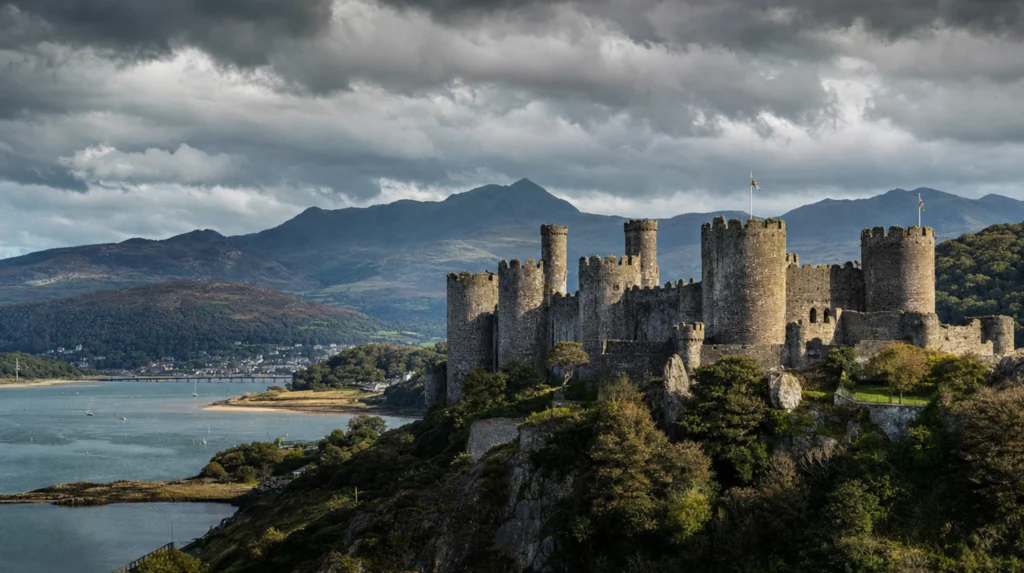
The practical pitch breaks down into four offers. First, the castles — about 600 of them, the highest density anywhere on Earth, with four of Edward I’s “Ring of Iron” fortresses (Caernarfon, Conwy, Beaumaris and Harlech) inscribed together as a single UNESCO World Heritage site. Second, the mountains — Eryri (Snowdonia), 823 square miles of glacial cwms and Iron Age fort sites, with Yr Wyddfa (1,085 m) the highest peak in Wales or England. Third, the coast — 870 miles of continuous National Trail, three coastal areas designated as Heritage Coast, the only national park in the UK that’s entirely coastal (Pembrokeshire). Fourth, a living Celtic language with around one million target speakers by 2050 and equal legal status with English since 2011.
🏛️ Historical Context
The “Ring of Iron” — Edward I’s chain of castles built between 1277 and 1330 to subdue the conquered north Wales — is the largest and most expensive military construction project of medieval Europe. James of St George, the king’s master mason, designed Caernarfon’s polygonal towers deliberately to evoke the walls of Constantinople; the project consumed roughly £80,000 in 13th-century money, equivalent to more than £80 million today, and required at one point 40% of the king’s annual revenue. The Welsh Prince Llywelyn ap Gruffudd was killed at the Battle of Cilmeri in December 1282, ending the last native Welsh principality; his head was sent to London and displayed on the Tower’s gate for fifteen years. Caernarfon was used for the investiture of Edward Prince of Wales in 1911 and again for Charles in 1969 — both ceremonies pointedly chosen to frame the title’s English origin. The current Prince of Wales, William, has not been formally invested at Caernarfon and has indicated he will not be.
🎌 Did You Know?
Wales has more castles per square mile than anywhere on Earth — roughly 600 across its 8,022 square miles, of which about 100 are still standing in recognisable form. The country has 9.6 million sheep — more than three for every human resident — and a per-capita male-voice-choir density that has produced Bryn Terfel, Tom Jones and Katherine Jenkins from a population smaller than greater Manchester. The Welsh Language (Wales) Measure 2011 made Welsh the only language other than English with explicit equal legal status anywhere in the UK; 28% of the population speaks it as of the 2021 census, rising to 60–70% in Gwynedd and the Isle of Anglesey. The Welsh Government’s published target: one million speakers by 2050.
🌾 Late-April / Early-May 2026 — The Wye Valley Bluebell Window
The wood at Tintern at 6:45 a.m. on April 28 is the colour of the inside of a violet, and the only sound is wood pigeons. If you’re reading this in the last week of April or the first week of May 2026, you’ve landed in arguably the country’s prettiest fortnight. The native English bluebell (Hyacinthoides non-scripta) — Britain holds 25–50% of the global population — carpets the mixed oak and beech woods of the Lower Wye for roughly three weeks each spring, peaking in the last week of April and the first week of May. The Wye Valley AONB straddles the Welsh-English border and the bluebell display in the woods around Tintern Abbey, the Devil’s Pulpit viewpoint and the Lancaut peninsula is the headline route — about 4 miles round trip, and the only window in the year when this forest floor turns blue.
It’s not the only bluebell wood in Wales. Coed Cefn outside Crickhowell in Bannau Brycheiniog (the Brecon Beacons) is the southern alternative — a small National Trust beech wood with a 2.5-mile loop walk that locals consider better-light than Tintern but harder to find. Pembrokeshire’s Stackpole Estate has bluebells along the cliff path between Broad Haven South and Bosherston in the second week of May, slightly later than the Wye thanks to the maritime climate. North Wales, Plas Newydd on Anglesey and the woods around Bodnant Garden near Conwy peak in the first week of May with the rhododendrons starting to flush behind them.
Two practical points carry over from England. Bluebells are protected under the Wildlife and Countryside Act 1981; trampling them is illegal and they take 5–7 years to recover from being walked on. Stick to the marked paths. Second, the light is everything: shoot before 9 a.m. or after 6 p.m., when the side-light cuts under the canopy. Midday flattens the colour and the woods are usually busy with day-trippers between 11 a.m. and 3 p.m. on weekends. The walk from Tintern Abbey up through the Devil’s Pulpit gives you both the bluebells and the most-photographed monastic ruin in Britain in the same morning.
Pair the bluebells with a second seasonal anchor. The Hay Festival opens in late May at Hay-on-Wye, and the Bannau Brycheiniog hills in early May have the first lambs in the fields and the gorse in flower. From a Cotswolds base in England, the Wye is 90 minutes’ drive over the Severn Bridge — making this the natural cross-border weekend for travellers who want both. Don’t miss Tintern’s parish church (free) on the way down: a small medieval foundation in the shadow of the abbey ruin, with a 14th-century rood screen that survived the 1539 dissolution by accident.
🧳 Travel Guru Tip — The Wye Crossing Trick
The single best way to photograph the Wye Valley bluebells is from above, not within. Park at the Eagles Nest car park near Wyndcliff, walk fifteen minutes to the Devil’s Pulpit limestone outcrop, and you’re 700 feet above Tintern with the abbey ruin in the foreground and a carpet of blue wood spreading downhill toward the river. Arrive at 6:30 a.m. on a still morning. The same view from the path level is a tunnel; from above, it’s a valley. Most foreign visitors stop at the abbey car park and miss this. Bring a head torch for the predawn walk in — the path is good but unlit, and Welsh sheep on rural lanes are a real driving hazard before sunrise. Plan your route via Chepstow rather than Bristol for the better light angle on the way up.
Best Time to Visit (Season by Season)
Wales has weather rather than a climate, and any honest guide has to start there. The west of the country is one of the wettest places in Europe — the higher slopes of Eryri receive 4,500 mm of rain a year, more than four times London’s total — and the weather can change inside an hour. That said, the year breaks down into four reasonably distinct seasons.
Spring (March – May)
The underrated window. Lambs in the fields from late March, daffodils (the national flower) everywhere through April, bluebells in the Wye and Pembrokeshire woods late April into early May, and the coastal path quiet enough that you’ll have whole headlands to yourself. Days lengthen rapidly — sunrise is around 5:30 a.m. by mid-May. The worst of the school-holiday crowds haven’t arrived. Pack for everything: April in Wales can give you sun, hail and a soft sea breeze inside one afternoon. Average highs run 10–15°C in the south, a few degrees cooler at altitude, with snow lingering above 800 m in Eryri until early May.
Summer (June – August)
The busiest season. Pembrokeshire, Eryri and the north coast fill up with British family holidays from mid-July through late August, and accommodation prices roughly double. June is the sweet spot: warm enough for the beach (sea temperatures around 15°C, bracing but swimmable), school holidays haven’t started, and Welsh evenings stay light until 10 p.m. in the north. July and August are warmer (highs of 18–22°C, occasional 28°C heatwaves) but you’ll want to book everything weeks ahead. Pembrokeshire boat trips to Skomer Island, the world’s most accessible Manx shearwater colony at around 350,000 breeding pairs, fill especially fast — book the Skomer landing at least three weeks out for July and August.
Autumn (September – November)
September is, on balance, the best month to visit Wales. The crowds clear after the August bank holiday, the sea is at its warmest of the year (around 16–17°C, paradoxically warmer than June), the heather on the moors is still purple, and the countryside has the long golden light that does most of the work for your photographs. October brings genuinely good autumn colour in the Wye and the Brecon woods, and lower hotel rates everywhere. November is cold and frequently wet, but cheap, atmospheric, and ideal for castle and pub afternoons.
Winter (December – February)
Short days (sunset around 4 p.m. in December), real cold above 500 metres, and a high chance of rain at any elevation. But the rewards are real. The Welsh Christmas markets in Cardiff and the Brecon towns run through December, snow on the higher Eryri peaks gives you genuine alpine days, and the coastal path is yours alone on a sunny February morning. Many Pembrokeshire and Eryri pubs and cafes shut entirely in January and February, so check ahead. Cardiff and the larger towns run year-round. February also catches the Six Nations Rugby — any Saturday with a home Wales fixture turns Cardiff into a city of 80,000 visitors, all in red shirts, and accommodation books out three months ahead.
| Season | Best regions | Avoid | Pricing |
|---|---|---|---|
| Spring (Mar–May) | Wye Valley, Pembrokeshire, Bannau Brycheiniog, Cardiff | Eryri summits before mid-May (snow + ice) | Mid-tier; bluebell weekends spike |
| Summer (Jun–Aug) | Llŷn peninsula, Anglesey, Eryri lakes, Gower coast | Pembrokeshire on July/August Saturdays | Peak; doubles July–Aug |
| Autumn (Sep–Nov) | Eryri ridges, Wye Valley colour, the Cambrian coast, Cardiff city break | Higher coastal paths after first storms (mid-Nov) | Best value, especially Sep |
| Winter (Dec–Feb) | Cardiff (Six Nations), Conwy Christmas markets, snowy Carneddau | Pembrokeshire (most pubs & B&Bs shut Jan–Feb) | Cheapest of the year (except rugby weekends) |
Getting There — Flights & Arrival
Wales has one international airport that matters: Cardiff (CWL), 12 miles southwest of the capital, with a modest international footprint of mostly Spanish, Portuguese and Irish routes plus seasonal Mediterranean. For long-haul, almost every traveller flies into one of three English gateways and crosses by road or rail. Bristol (BRS) is the closest practical international airport to Cardiff — 45 minutes by car across the M4 Severn Bridge — and handles direct flights from the US East Coast on Aer Lingus via Dublin, plus most European hubs. Manchester (MAN) is the long-haul gateway for north Wales, with flights from North America, Asia, the Middle East and Australasia, and a direct rail link to Llandudno Junction (2h 15m) for Eryri. Birmingham (BHX) handles the Midlands and is two hours by car from the central Welsh border.
Most travellers, however, fly into London. From England‘s big five (Heathrow, Gatwick, Stansted, Luton, City), the train into Wales is the easy move. London Paddington to Cardiff Central is 1h 50m on the Great Western Railway’s electrified high-speed service (departures every 30 minutes during the day, advance singles from £25, walk-up around £140). London Euston to Bangor on the north coast is 3h 30m via Crewe. Eurostar from Paris, Brussels or Amsterdam lands at London St Pancras — five Underground stops from Paddington — making a same-day arrival into Cardiff from continental Europe genuinely realistic.
From Ireland, the quickest entry is the Holyhead-Dublin ferry — Stena Line and Irish Ferries run multiple daily crossings, 3h 15m by fast ferry, with foot passengers from £30 and cars from £80 booked ahead. Holyhead has direct Avanti West Coast trains to Bangor, Crewe and London, making it a useful Irish-into-British backdoor. Our Ireland travel guide covers the Dublin side.
⚠️ Important — The UK ETA, Driving on the Left & Mountain Weather
Wales is part of the United Kingdom and uses UK immigration rules. Most visa-exempt nationalities (US, Canada, Australia, NZ, EU, Japan, Korea, Singapore) need a UK Electronic Travel Authorisation (ETA) — apply at gov.uk/eta for £16, valid two years, processed in under three days. The ETA covers entry into England, Scotland, Wales and Northern Ireland on a single application. Wales drives on the left. If you’re hiring a car, factor in 24 hours of mental rewiring, and remember that single-track lanes in Eryri and the Brecon Beacons require passing-place etiquette (see the Getting Around section below). Mountain weather in Eryri changes fast — the summit of Yr Wyddfa is 10°C colder, twice as windy, and visibility-zero when the valley is sunny. Mountain Rescue is called out roughly 200 times a year, almost always for trainers-and-cotton walkers caught above 700 m in weather they didn’t expect.
Getting Around — Trains, Sherpas & Single-Track Lanes
The single most important thing to know about Welsh transport: the M4 in the south does not connect to the A55 in the north. There is no fast east-west corridor inside Wales. To get from Cardiff to Bangor by train you go via Crewe (in England), which adds two hours to the equivalent 3-hour drive. Build itineraries around either the south or the north, not both, unless you have at least ten days.
Trains. The mainline rail network is good for the south coast (London Paddington to Cardiff in 1h 50m, Swansea in 3h) and decent along the north coast (London Euston to Bangor in 3h 30m via Crewe). The mid-Wales line from Shrewsbury through Aberystwyth is the famously scenic Cambrian Line — beautiful, slow, and an experience in itself. Book through National Rail or Trainline; advance singles are dramatically cheaper than walk-up, and split-ticketing through Trainsplit can save 30–60% on through journeys (see our England travel guide for the technique).
Driving. A car is the right tool for almost any Welsh trip outside a Cardiff city break. The country drives on the left, most rental cars are manual unless you specifically request automatic (book early — automatics are pricier and less common), and the major routes are the M4 along the south, the A470 (the great north-south road, Cardiff to Llandudno, 186 miles, 4 hours), and the A55 along the north coast. Petrol runs roughly £1.45–1.55 per litre at the time of writing; budget around £80–100 to fill a mid-size tank. The Welsh national speed limit on most rural roads has been cut to 50 mph (from 60), and built-up areas have been at 20 mph as default since September 2023 — the change has been controversial but is the law.
Buses. The TrawsCymru network runs longer-distance routes that the trains don’t cover (the T1 from Aberystwyth to Carmarthen is a useful mid-Wales spine), and local council buses cover most market towns. Rural service can be sparse — one or two buses a day on smaller routes, and almost nothing on Sundays in the north and west. Check journeys on traveline.cymru.
The Snowdon Sherpa is the dedicated bus network around Eryri, running circular routes between Llanberis, Pen-y-Pass, Beddgelert and Betws-y-Coed. £6 day ticket; runs more frequently April–October. Pen-y-Pass car park fills by 8 a.m. in summer, so the Sherpa is often the easier way in.
✨ Pro Tip — Single-Track Lane Etiquette
Many of the best roads in Wales are single-track with passing places, marked by white diamond signs every few hundred metres. The etiquette is simple but worth knowing: if you see oncoming traffic, the driver closer to the next passing place pulls in — into the bay if it’s on your side, or opposite the bay if it’s on theirs. Wave thank you with two fingers off the wheel as the other car passes; a held-up hand at the back is the equivalent. Don’t reverse uphill if you can avoid it (the downhill driver should usually back up). Don’t try to squeeze past — Welsh hedges hide dry-stone walls and the rental excess will catch you. And on rural roads, expect sheep on the tarmac, especially in Eryri and the higher Brecon valleys: they have right of way, both legally and biologically.
Top Cities & Regions
📍 Map of Wales: Every Place in This Guide
Wales splits roughly into three: the south (Cardiff, the valleys, Pembrokeshire, the Wye), the mid (Bannau Brycheiniog and the empty middle), and the north (Eryri, the Llŷn peninsula, Conwy, Anglesey). The north and south are physically close on the map but historically distinct, and you cross the country lengthwise on slow, beautiful single-carriageway roads — which is most of the point. Below are the bases worth building an itinerary around.
🏙️ Cardiff (Caerdydd)
The seagulls in Cardiff are the size of small dogs and have been observed to mug visitors of their fish-and-chip suppers on Westgate Street with statistical reliability. Cardiff is the capital and the natural starting point for a first Welsh trip — two hours from London Paddington by train, an hour from Bristol by car, and the only city in Wales with a serious international flight footprint. It’s also a much more interesting city than its modest population (around 365,000) suggests. The centre clusters around Cardiff Castle, which is genuinely two castles welded together (a Norman keep on a Roman foundation, then a wildly extravagant Victorian Gothic remodel by William Burges in the 1860s). The National Museum, ten minutes away, is free and holds one of the best Impressionist collections outside Paris — courtesy of the Davies sisters, who bought Monet, Renoir and Van Gogh canvases between the wars when nobody else in Britain was paying attention to them.
South of the centre, Cardiff Bay is the regenerated dockland — Wales Millennium Centre (the copper-fronted opera house with “Creating Truth Like Glass From Inspiration’s Furnace” carved across the front in Welsh and English), the Senedd, and a string of waterfront pubs and cafes. Allow two days for the city, and a third for either Caerphilly Castle (twenty minutes north by train, second-largest castle in Britain after Windsor at 30 acres of ground plan) or a half-day trip into the Valleys.
- What to do: Cardiff Castle (£17.50, including the Burges State Apartments tour); National Museum Cardiff (free, Impressionist gallery); Wales Millennium Centre tour or evening show; Principality Stadium tour (£18, the only retractable-roof stadium in the UK); a half-day walk through the Valleys to the Big Pit National Coal Museum (free, with retired-miner-led underground tours).
- Signature eats: Welsh cakes from Fabulous Welshcakes in Cardiff Market; a Sunday lunch at Bully’s in Pontcanna (one Michelin star); cawl at the Pen & Wig in Cathays.
- Best for: First-time UK visitors with a Welsh focus, rugby pilgrims, weekend breaks from London.
- Access: Cardiff Central from London Paddington (1h 50m); Cardiff Airport (CWL); Bristol Airport (BRS, 45 min by car).
⛰️ Eryri (Snowdonia)
Eryri is the mountainous heart of north Wales and the country’s most-visited national park. The park officially rebranded in 2022 to use Welsh place names primarily, with English in parentheses where helpful — Yr Wyddfa for Snowdon, Eryri for Snowdonia. It contains Yr Wyddfa (1,085 m) — the highest mountain in Wales and England — plus a dozen other 900-metre-plus peaks, glacial lakes, slate-quarry villages, and the world’s first commercially operated narrow-gauge passenger railway still operating on its original route (the Ffestiniog, opened 1836 to haul slate from the Blaenau Ffestiniog quarries to Porthmadog harbour). The slate landscape of north-west Wales was inscribed as a UNESCO World Heritage Site in 2021 — only the second cultural inscription in Wales after the Edwardian castles.
Bases are Betws-y-Coed for the eastern park, Llanberis for direct access to Snowdon, Beddgelert for the most picturesque village, and Porthmadog for the southern coast. You can summit Yr Wyddfa six different ways on foot — the Llanberis Path is the longest and gentlest (9 miles return), the Pyg and Miners’ tracks are shorter and steeper, and Crib Goch is a knife-edge scramble that should not be your first Welsh hike (six fatalities in the last decade). The Snowdon Mountain Railway runs a rack-and-pinion service to the summit from Llanberis between mid-March and the end of October, weather permitting; tickets are £40–50 return and sell out weeks ahead in summer.
- What to do: Climb Yr Wyddfa via the Llanberis or Pyg Path; ride the Ffestiniog Railway from Porthmadog to Blaenau (£32, narrow-gauge steam, 13.5 miles); zip-line at Zip World Penrhyn Quarry (the longest in Europe, 1.5 km, £85); hike Cwm Idwal in the Glyderau (3 miles, glacial U-shape valley); wild swim at Llyn Padarn or Llyn Idwal (cold, even in August).
- Signature eats: Sheep’s-cheese ploughman at the Pen-y-Gwryd Hotel (where the 1953 Everest team trained); fish and chips at Pete’s Eats in Llanberis; lamb shank at the Tafarn Sinc in Rosebush (the famous corrugated-iron Welsh-language pub).
- Access: Bangor station from London Euston (3h 30m via Crewe); Llanberis by Sherpa bus from Bangor or Caernarfon.
🐬 Pembrokeshire (Sir Benfro)
Pembrokeshire is the southwestern peninsula and the only entirely coastal national park in the UK — a 186-mile section of the Wales Coast Path runs along its cliffs, and the entire shoreline is protected. It’s where Welsh families have holidayed for a hundred years and where surfers, sea kayakers and coasteering instructors (the sport was invented here in the 1980s, the world’s first commercial coasteering operator opening at Twr y Felin in St Davids in 1986) now base themselves. The headline towns are St Davids — Britain’s smallest city, with a 12th-century cathedral that’s larger than its population of 1,800 — Tenby (walled medieval harbour town with three sand beaches), Solva (postcard fishing village), and Newport on the wilder northern stretch.
The cliff walking is what draws most visitors back. The stretch from Marloes Sands to Martin’s Haven, the headland at Strumble Head, and the coast at Stackpole Quay (with the secret Barafundle Bay below it, regularly named one of the best beaches in the UK) are the headline sections. Boat trips from Martin’s Haven run to Skomer Island between April and September for one of the world’s most accessible puffin colonies — around 40,000 breeding pairs in a good year, all visible from a few feet away on the clifftop paths. The same boats run nearer Skokholm for shearwater nights in late May.
- What to do: Walk a section of the Wales Coast Path (Stackpole Quay to Barafundle, 3 miles); boat to Skomer (£40, book at lockleyboattrips.com 3+ weeks ahead); coasteering with Celtic Quest (£55, 3-hour group); St Davids Cathedral (free; medieval foundation, the only UK cathedral set below ground level on a riverside flat).
- Signature eats: Crab sandwiches at the Boat House in Aberaeron (technically Ceredigion but worth the drive); Welsh black beef at the Grove of Narberth (Michelin star); fish and chips on the harbour at Tenby.
- Access: Pembroke Dock or Tenby station (4h from London Paddington via Swansea); rental car essential beyond Tenby.
🌄 Bannau Brycheiniog (Brecon Beacons)
Bannau Brycheiniog (the park officially adopted the Welsh name as its primary form in 2023) is mid-Wales’ national park and the empty middle of the country — 520 square miles of rolling sandstone moorland, glacial cwms and waterfall country in the south. Pen y Fan (886 m) is the highest peak in southern Britain and a four-hour return walk from the Storey Arms car park; the Four Falls trail near Ystradfellte is the country’s best short waterfall walk, especially Sgwd yr Eira where the path goes behind the curtain of water. The park is also designated an International Dark Sky Reserve — one of only 20 worldwide — and is the best stargazing location within easy reach of London.
Bases are Brecon (the market town, with good pubs and a Tuesday and Friday market), Crickhowell (foodie village on the eastern edge), and Hay-on-Wye on the English border — the famous “town of books” with around two dozen secondhand bookshops in a population of 1,500, and the Hay Festival in late May that brings 200,000 visitors a year for ten days of literary events. Bill Clinton called Hay “the Woodstock of the mind” in 2001 and the slogan stuck.
- What to do: Pen y Fan day-hike (4 hours, free); Four Falls walk near Ystradfellte (5 miles, 3 hours); Brecon Mountain Railway (£26, narrow-gauge steam, mountain reservoirs); a stargazing night at Cwm Du or the Usk Reservoir.
- Signature eats: Welsh lamb at the Felin Fach Griffin (Michelin Bib Gourmand); cheese at the Bookshop café in Hay; Penderyn Welsh whisky at the Penderyn Distillery (£15 tour, free shop tasting).
- Access: Abergavenny station from London Paddington (2h 45m via Newport); rental car for the park interior.
🏰 Conwy & Llandudno
The north Wales coast east of Eryri is anchored by two adjoining towns. Conwy is the medieval one — a UNESCO-listed Edwardian castle (one of the four “Ring of Iron” sites), the most complete town walls in Britain (you can walk the entire 1,400-metre circuit), and the smallest house in Britain on the quayside, a six-foot-wide cottage that was inhabited by a 6’3″ fisherman until 1900 (the city council finally evicted him on health grounds). Llandudno, four miles north, is the Victorian seaside resort — a perfectly preserved Victorian promenade, a pier, a cable car up the Great Orme limestone headland, and the genuine sense of a town that has not changed its mind about what it is since 1880.
Both make excellent bases for east Eryri (Betws-y-Coed is forty minutes inland), and Llandudno’s Victorian hotels are some of the best-value accommodation in Wales — proper sea-view rooms with breakfast for £100–140 a night in summer, less in shoulder season.
- What to do: Conwy Castle (£12.30, included on CADW Explorer Pass); walk the town walls; Bodnant Garden 7 miles south (£17, RHS partner garden, 80 acres); cable car up the Great Orme (£9 single).
- Signature eats: Mussels and chips at the Mulberry in Conwy harbour; afternoon tea at the Empire Hotel in Llandudno; ice cream at Forte’s on Llandudno pier.
- Access: Llandudno Junction from London Euston (3h via Crewe); rental car for Eryri side trips.
🏝️ Anglesey (Ynys Môn)
Anglesey is the flat, low-lying island off the northwest corner of Wales, separated from the mainland by the Menai Strait and connected by Telford’s 1826 suspension bridge and Stephenson’s 1850 tubular bridge — both engineering landmarks worth a slow drive over. The island is mostly farmland and 125 miles of coast, and you come for the beaches (Newborough, Rhosneigr, Porth Dafarch), the sea kayaking around the western cliffs, and the Druidic and Neolithic sites — Anglesey was the spiritual heartland of pre-Roman Druidism, and Bryn Celli Ddu (a 5,000-year-old passage tomb aligned to the summer solstice sunrise) is in a farmer’s field you can walk to from the road.
The island also holds Llanfairpwllgwyngyllgogerychwyrndrobwllllantysiliogogogoch — the longest place name in Europe at 58 letters, a Victorian publicity invention that has stuck. The railway sign on platform 1 is a competitive selfie spot. The locals just call it Llanfairpwll.
- What to do: South Stack lighthouse cliffs (free, RSPB reserve, puffins May–July); Plas Newydd house and gardens (National Trust, £14); Beaumaris Castle (£8.30, one of the four UNESCO Ring of Iron); Newborough Beach + Llanddwyn Island walk (4 miles, dog-legal, sunset spot).
- Signature eats: Sosban & The Old Butchers in Menai Bridge (one Michelin star, no fixed menu); Black Boy Inn in Caernarfon for traditional cawl; Marram Grass Café for casual lunch.
- Access: Bangor station then 15 min by car or bus across the Menai bridges.
📜 The Wye Valley
The Wye Valley is the wooded river gorge that forms the southeastern border with England, designated an Area of Outstanding Natural Beauty and arguably the prettiest stretch of countryside in either country. Tintern Abbey — the ruined Cistercian monastery that Wordsworth wrote his most famous poem about in 1798 (“Lines Composed a Few Miles above Tintern Abbey”) — sits in a horseshoe bend of the river and remains one of the most atmospheric ruins in Britain, especially at first light. Upriver, Symonds Yat (technically just over the English side of the border) gives you the classic viewpoint over the gorge; downriver, Chepstow’s Norman castle is the oldest stone castle in Britain (begun 1067, the year after Hastings).
- What to do: Tintern Abbey (£8.10, CADW); Devil’s Pulpit walk (4 miles round trip from Tintern, the bluebell window in late April); Chepstow Castle (£8.30); canoe the Wye from Hay-on-Wye to Glasbury (3 hours, £45).
- Access: Chepstow station from London Paddington via Newport (2h 30m); car essential beyond.
“Five years have past; five summers, with the length / Of five long winters! and again I hear / These waters, rolling from their mountain-springs / With a soft inland murmur.”
— William Wordsworth, “Lines Composed a Few Miles above Tintern Abbey” (July 13, 1798)
🗓️ Sample Itineraries
Wales rewards depth over breadth. The single biggest first-timer mistake is trying to see Cardiff, Pembrokeshire and Eryri in five days — possible on paper, mostly motorway in practice. Below are three templates that have worked for FFU travellers.
3 Days — Cardiff + Wye Valley
Day 1: Arrive Cardiff (1h 50m from London Paddington), drop bags, walk to Cardiff Castle for the afternoon tour, evening at Wales Millennium Centre or a Cardiff Bay pub. Day 2: Caerphilly Castle morning (20 min by train), National Museum Cardiff afternoon, dinner at Bully’s in Pontcanna. Day 3: Rental car or guided day-tour to Tintern Abbey (45 min by car), Devil’s Pulpit walk for the bluebells (in late April / early May), Chepstow Castle on the way back, evening train to London or back to Cardiff. This works as a long-weekend extension of any English trip via the England travel guide route.
7 Days — South Wales Loop
The classic introduction. Days 1–2: Cardiff (as above). Day 3: Drive west to Bannau Brycheiniog, climb Pen y Fan in the morning, Four Falls walk in the afternoon, sleep Brecon. Day 4: Drive to Pembrokeshire via Carmarthen (2.5h), arrive Tenby late afternoon, harbour dinner. Day 5: Pembrokeshire — Stackpole walk to Barafundle, lunch at the Quay café, afternoon at St Davids Cathedral, sleep St Davids. Day 6: Boat to Skomer (book ahead) or coasteering at Whitesands; alternative if weather closes the boats — drive the coast to Strumble Head and watch porpoises. Day 7: Drive back via the Hay-on-Wye bookshops (3h), one night Hay or straight on to Bristol airport for departure. Skips Eryri entirely; that’s the trip’s design.
14 Days — Full Country + Edinburgh Add-On
For travellers willing to drive 1,200+ miles. Days 1–4: South Wales loop as above (Cardiff, Brecon, Pembrokeshire). Day 5: Drive north on the A470 — the great country-spine road, Cardiff to Llandudno via Builth Wells, Rhayader and Betws-y-Coed (4–5 hours with stops). Day 6: Eryri — Yr Wyddfa via the Llanberis or Pyg Path. Day 7: Ffestiniog Railway from Porthmadog, lunch in Beddgelert, sleep Caernarfon. Days 8–9: Anglesey — South Stack, Newborough Beach, Beaumaris Castle, Sosban & The Old Butchers for dinner. Day 10: Conwy Castle and Llandudno; sleep Llandudno. Day 11: Drive east via Chester (1h) and on to England‘s Lake District (2h further) for one night. Days 12–13: Train to Edinburgh for two nights (2h 45m from Penrith). Day 14: LNER train back to London King’s Cross (4h 19m), departure.
🎯 Strategy
If you have one trip to Wales, do the 7-day south Wales loop — it gives you Cardiff, mountains, coast and castles in a coherent geography that doesn’t waste time on the country’s interior gap. If you’re a returner, the 14-day version with Eryri and Anglesey is the right next move. If you have only three days, do Cardiff + Wye and save Eryri for a separate north-Wales trip flown into Manchester. The country’s biggest itinerary trap is the sense that it’s small enough to do in five days. It is not. Talk to our planning team if you want a custom split.
Culture, Etiquette & the Welsh Language
The first thing a Welsh person will ask a foreigner, after the weather, is whether you can pronounce the name of the village they grew up in. Welsh (Cymraeg) is one of the oldest living languages in Europe — older than English by several centuries — and since the Welsh Language (Wales) Measure 2011, it has equal legal status with English. Every road sign, public document, government form and railway announcement is bilingual, with the Welsh version typically listed first in the Welsh-speaking heartlands of the north and west. About 28% of the population speaks Welsh, rising to 60–70% in Gwynedd and Anglesey, and the language is genuinely growing — the Welsh government has a target of one million speakers by 2050, and Welsh-medium schools are oversubscribed in Cardiff.
You don’t need any Welsh to travel here — everyone you’ll meet in a tourism context speaks English fluently — but a handful of words and pronunciations make the road signs less baffling. The Welsh national anthem, Hen Wlad Fy Nhadau (“Land of My Fathers”), is one of the most stirring sporting moments in world rugby — sung in Welsh by 74,000 people in the Principality Stadium before any Six Nations match in Cardiff. Worth listening to on YouTube before a match if you’ve got tickets.
Festivals. Welsh culture takes its festivals seriously. The National Eisteddfod (Eisteddfod Genedlaethol Cymru) is the largest celebration of Welsh-language culture in the world — a week-long festival of music, poetry, drama and competitive bardic performance held in early August and rotating between locations in north and south Wales each year. The whole event is conducted in Welsh (with simultaneous translation), and roughly 150,000 people attend. The 2026 National Eisteddfod is in Wrexham (Wrecsam) from August 1–9. The Llangollen International Musical Eisteddfod is the smaller, English-friendly cousin, held every July in Llangollen since 1947 (founded as a post-war reconciliation festival, with around 4,000 performers from 50 countries). St David’s Day on March 1 is the patron saint’s day, marked with parades and leeks pinned to lapels.
Etiquette overlaps with England — the queue is sacred, tipping is light (10–12.5% in restaurants where service isn’t added, nothing in pubs), Sunday lunch is the genuine national meal. The differences: rugby is a religion (especially during the Six Nations, February to mid-March), Welsh hospitality runs warmer and more direct than London-Tube politeness, and the assumption that you’ve heard of anyone other than the most famous Welsh names (Tom Jones, Anthony Hopkins, Catherine Zeta-Jones, Bryn Terfel) is genuine.
💬 The Welsh Pronunciation Cheatsheet
Welsh is phonetic and far easier to pronounce than it looks once you know the rules. Ll is a hissed “kl”-like sound (Llanberis = roughly “klan-BERR-is”). Dd is “th” as in “this” (Eisteddfod = “ay-STETH-vod”). F is “v” (Yr Wyddfa = “uhr WITH-va”). Ff is the English “f” (Ffestiniog = “fes-TIN-yog”). W is usually a vowel, sounding like “oo” (Cwm = “koom”). Y is “uh” or “ih” (Cymru = “KUM-ree”, “Wales”). Ch is the Scottish “loch” sound. The stress almost always falls on the second-to-last syllable. Have a go — locals visibly warm up the moment you try.
— Welsh-language pronunciation primerA Food Lover’s Guide
Welsh food is built around lamb, leeks, dairy, seafood and the things that grow in a wet maritime climate, and the modern scene has been quietly excellent for at least a decade. The clichés about British food don’t apply here, and never really did.
Cawl is the national dish — a slow-simmered lamb (or sometimes beef) stew with leeks, swede, carrots and potatoes, traditionally served in two courses (broth first, then the meat and vegetables) with a wedge of crumbly Caerphilly cheese and bread on the side. Every farmhouse kitchen makes it slightly differently, and most country pubs will put it on the menu in winter. £9–14 for a proper bowl.
Welsh cakes (picau ar y maen) are flat griddle scones — flour, butter, currants, sugar, sometimes a pinch of mixed spice — cooked on a hot bakestone and eaten warm with butter or just on their own with a cup of tea. Cardiff Market has the most famous stall (Fabulous Welshcakes); 50p to £1 each, and you should buy six.
Laverbread (bara lawr) is the genuinely Welsh oddity — boiled and minced laver seaweed, traditionally fried into patties with oats and bacon for breakfast, sometimes mixed into sauces for lamb. Earthy, briny, an acquired taste, but worth ordering at least once at a Pembrokeshire or Gower breakfast. It has the highest natural iodine content of any food regularly eaten in Britain. Welsh rarebit is the better-known dish and is not “cheese on toast” — it’s a properly seasoned cheese sauce (cheddar, ale, mustard, Worcestershire, sometimes egg yolk) grilled onto thick bread. The Hare and Hounds in Aberthin and the Ffin y Parc gallery cafe in Llanrwst do versions worth driving for.
Welsh lamb has Protected Geographical Indication status, like Champagne or Parmigiano-Reggiano, and it earns the label — sweet, herbaceous, mostly grass-fed, and at its best in late summer and early autumn. Order it as a Sunday roast in any country pub between Brecon and Aberystwyth. Caerphilly cheese is the country’s most famous, a young crumbly white originally made in the Glamorgan valleys; Hafod cheddar (a raw-milk organic cheddar from west Wales) is the modern flagship and travels well.
The drink to know is Welsh ale. The country has more than 70 independent breweries, with Tomos Watkin (Swansea), Purple Moose (Porthmadog), Tiny Rebel (Newport) and Wild Horse (Llandudno) leading the modern wave. Welsh whisky was distilled commercially again from 2000 — Penderyn (in the Brecon Beacons) is the headline name and worth a tour and a bottle; the distillery’s first commercial release in March 2004 was the first Welsh whisky in over 100 years. Pubs typically serve cask ale at cellar temperature in pints (£4.50–6.00 outside Cardiff, £5.50–7.00 in the cities).
📸 Photography Notes
Wales has been quietly producing some of Britain’s best landscape photography for fifty years and the rest of the world is only just catching up. The country’s compactness — coast, mountain and ancient woodland often in the same 30-mile circle — means a single weekend can yield three radically different photographic environments, lit by the kind of fast-changing maritime light that ruins exposures and makes them all at the same time.
Best light by month: April–May 7–9 a.m. for bluebells in the Wye and beech canopies on the Llŷn; June–July 9 p.m.–10 p.m. for the long northern dusk on Anglesey beaches; September–October 5–6 p.m. for golden side-light on Eryri ridges and Pembrokeshire cliffs; November–February 11 a.m.–2 p.m. for the entire useable daylight window, with snow on Yr Wyddfa giving the country’s most reliably cinematic shots.
Five locations worth the detour:
- Llyn Llydaw & Crib Goch reflection, Eryri (53.0731°N, 4.0258°W) — glacial lake at 440 m, with the Crib Goch knife-edge mirrored on a still morning. Best 6 a.m. in late September before the first wind.
- Three Cliffs Bay, Gower (51.5743°N, 4.1192°W) — the country’s most-photographed beach, with three limestone stacks at low tide. Sunrise and low-tide window required; check tidetimes.org.uk.
- Tintern Abbey from the Devil’s Pulpit, Wye Valley (51.6991°N, -2.6788°W) — the elevated angle Wordsworth wrote about. April bluebells under the canopy, October colour above.
- Llanddwyn Island, Anglesey (53.1479°N, 4.4022°W) — tidal causeway, abandoned chapel ruin, lighthouse at the tip. Sunset westward over Llŷn peninsula. Walk only at low tide.
- Stackpole’s Green Bridge of Wales, Pembrokeshire (51.6173°N, 5.0421°W) — natural limestone arch on the South Pembrokeshire coast. Best in low afternoon light, August–October when the sun aligns through the arch.
Drone rules: Wales follows UK CAA Open Category rules. Drones under 250g require online operator registration (£11.40/year). Drones 250g+ require an A1/A3 certificate. National parks (Eryri, Bannau Brycheiniog, Pembrokeshire) prohibit drones outright without a permit applied for at least 30 days in advance — they’re particularly strict around the Pembrokeshire seabird colonies (April–August), where any disturbance can carry a £5,000 fine under the Wildlife and Countryside Act 1981. National Trust land is a blanket no-fly zone. CADW historic-environment sites (including all four UNESCO castles) require permission. Fines start at £100 for failure to register; up to £2,500 for unauthorised flight near restricted airspace.
✨ Pro Tip — The Rain Window
Wales’s reputation for rain is earned, but the photographic upside is what most foreign visitors miss. The 30-minute window after a rain shower is the country’s best photographic light — wet slate roofs in Eryri villages glisten, the Pembrokeshire cliffs deepen in colour, and the bluebell woods around Tintern photograph at twice the saturation of a dry morning. Watch the radar on the BBC Weather app, time your drive to arrive at a viewpoint just as a front clears, and you get light that no other northern country reliably produces. The Llanberis Pass at 8 p.m. on a clearing summer evening is the canonical version of this — the wet road reflecting Yr Wyddfa back at you in mirror.
Off the Beaten Path
Most Welsh visitors hit the same dozen spots — Cardiff, Snowdon, Pembrokeshire, the headline castles. The country rewards going one valley further. Five places that don’t show up in the big guidebooks but should.
🌊 The Llŷn Peninsula
The 30-mile finger of land that points southwest from Eryri into the Irish Sea, and one of the strongest Welsh-speaking regions in the country (around 70% of residents). Aberdaron at the tip is a working fishing village with two excellent pubs (Y Gegin Fawr and the Tŷ Newydd hotel); Porth Oer (“Whistling Sands”) is named for the squeaking sound the dry sand makes underfoot, a phenomenon found at only a handful of beaches in the world (the silica grains have to be a specific size and shape to oscillate against each other). Bardsey Island, two miles offshore, is the medieval pilgrimage site where 20,000 saints are reputedly buried; day boats run from Porth Meudwy in summer and a single farmhouse on the island offers self-catering rentals booked 18 months ahead.
🏞️ The Elan Valley
Mid-Wales reservoir country, in the empty Cambrian Mountains east of Aberystwyth. A chain of five Victorian dams built between 1893 and 1952 to supply Birmingham with water, set in 70 square miles of bare upland. The visitor centre at Cwmdauddwr does a free leaflet for the dam circuit, the road through the valley is one of the great quiet drives in Britain, and the Dark Sky designation makes it one of the best stargazing spots within four hours of London. Roughly 80,000 visitors a year, against 6 million for Eryri.
🪶 Strumble Head, Pembrokeshire
The headland north of Fishguard with a still-active lighthouse on a tidal islet, reached by a bridge that’s covered at high tide. The cliffs here are the best place in the UK to spot harbour porpoises and common dolphins from shore — turn up an hour either side of low tide, sit on the bench above the lighthouse, and watch the tidal race below. Choughs (red-billed crows, found nowhere else in Britain in viable numbers) nest in the cliffs and are visible most days. The bridge to the lighthouse islet is covered for roughly four hours either side of high tide; check tide times for Fishguard at tidetimes.org.uk before you set off, and don’t try to wade across — the tidal race here is one of the strongest on the Welsh coast and has dragged dogs and adults out to sea.
⛏️ The Rhondda Heritage Park
A working colliery turned museum in the south Wales valleys, in the village of Trehafod between Pontypridd and Tonypandy. The Lewis Merthyr pit was active until 1983, and the underground tour is led by ex-miners who actually worked there — a serious, unsentimental, and frequently funny education in the industry that built modern south Wales (the coal industry employed 250,000 men in Wales at its 1920 peak, and 0 today). £10 entry, two-hour tour, and ten minutes from the M4. Pair with a stop at the Welsh Mining Memorial in Senghenydd, where 439 men and boys died in the country’s worst mining disaster in October 1913.
🏖️ Portmeirion
The Italianate fantasy village built by architect Clough Williams-Ellis between 1925 and 1975 on a private peninsula in southern Eryri — a cluster of pastel-coloured Mediterranean buildings that has no business being in Wales and is all the more delightful for it. Famous as the location for the 1960s cult TV series The Prisoner; 50 buildings, beach access, two hotels on site, day visitors welcome (£18 entry, less in winter). Best at golden hour after the day-trippers have left. The pottery shop sells the still-produced Portmeirion ceramics designed by Williams-Ellis’s daughter Susan in 1960 — it remains one of the most exported ceramic ranges in the UK.
Wales by Numbers
- 9.6 million — sheep (more than three for every human resident)
- 870 miles — Wales Coast Path (world’s first continuous national-coastline trail, opened May 2012)
- 4,500 mm — annual rainfall on the higher slopes of Eryri (4× London’s total)
- 58 letters — Llanfairpwllgwyngyllgogerychwyrndrobwllllantysiliogogogoch (longest place name in Europe)
Practical Information
Currency: Pound sterling (£). Contactless payment is universal — even rural pubs and most farm shops accept Apple Pay or a tap card. ATMs are common in towns; rural petrol stations sometimes still surcharge cash withdrawals (£1.50–2 per transaction). Tipping is more relaxed than in the US: 10% in restaurants if service isn’t already added, nothing required in pubs, round up the fare for taxis.
Plugs and electricity. UK three-pin (Type G) at 230V/50Hz. Bring an adapter; the same plug works for England and Scotland.
SIM cards and data. EE and Vodafone have the best rural coverage in Wales (notably in Eryri and Pembrokeshire); O2 and Three are patchier in the mountains. Most US and EU phones work on 4G/5G; UK eSIMs are cheap (£10–15 for 10 GB on a 30-day plan).
Emergency numbers. 999 (or 112 from a mobile) for police, ambulance, fire, coastguard, or Mountain Rescue. Mountain Rescue is summoned via 999 — ask for “police, then mountain rescue.”
The CADW Explorer Pass covers all 130 Welsh historic sites managed by CADW (the Welsh equivalent of English Heritage), including Caernarfon, Conwy, Beaumaris, Harlech, Caerphilly, Raglan, Pembroke and Tintern Abbey. £37.40 for an adult 7-day pass at the time of writing; £74.50 for two adults. Pays for itself in three or four castle visits.
Sundays. Smaller towns and villages still wind down on Sundays — many independent restaurants close, and rural buses run reduced or no service. Pubs and the bigger CADW sites stay open. Plan around it.
Wales is meaningfully cheaper than London for almost everything except rail fares from London — accommodation, pub meals, museum entry (most national museums in Wales are free, including the National Museum Cardiff and St Fagans), and groceries all run 20–30% below London prices.
📋 Regulatory Note — 20 mph Default & the Welsh Speed Limits
Since September 17, 2023, Wales has had a default 20 mph speed limit in built-up areas — the first nation in the UK to do so. The change applies to “restricted roads” with street lighting (typically the same roads previously at 30 mph). Some local councils have applied for exemptions on through-routes and reverted specific stretches to 30 mph; signage indicates the prevailing limit. Police enforcement carries fixed-penalty notices from £100 and three points, with speed-awareness courses available for first-time minor offences. Rural roads outside built-up areas still apply the 60 mph national limit, except where signed (a 50 mph default has also been mooted but not yet introduced). The cleanest rule for tourists: assume 20 mph in any village or town you drive through unless a 30 sign explicitly says otherwise. The change has reduced built-up-area road deaths in the first 18 months of operation — the most-cited Welsh Government statistic.
Budget Breakdown
Wales is the cheapest of the four UK nations to travel in, by a small but real margin. A mid-range hotel double room outside Cardiff runs £85–140 a night (versus £150–250 for the equivalent in London); pub mains are £12–18, pints £4.50–6. Rail fares from London are the budget killer — book Advance singles three to eight weeks ahead through National Rail or Trainline, and consider a Two Together or 26–30 Railcard if you qualify (each saves a third off most fares). Most national museums in Wales are free, including the National Museum Cardiff, St Fagans National Museum of History and the Big Pit National Coal Museum — that alone offsets a lot of the accommodation cost.
💚 Budget Traveller — £55–95/day (~$70–120)
Hostel dorms or budget B&Bs (£25–45 a bed), pub meals at lunch (£10–13 a main), supermarket picnics for dinner, public transport and the occasional CADW castle entry. Doable in shoulder season; tighter in July and August. Real example: 2 nights Cardiff hostel (£60) + train Advance singles (£30) + 3 nights YHA Pen-y-Pass in Eryri (£105) + free National Museums + Sherpa bus day pass (£6) + supermarket meals = £400 for a 5-day budget split.
💙 Mid-Range — £130–230/day (~$165–290)
A double room in a guesthouse or three-star hotel (£85–140), pub dinners with a pint (£18–28 a head), a hire car split between two, and admission to most paid attractions. The standard Welsh holiday budget for a couple, and gives you most of the country comfortably. Real example: 7-day south Wales loop with hire car from Cardiff (£280), 6 nights in B&Bs averaging £110 (£660), pub meals (£35/day = £245), CADW Explorer Pass for two (£74.50) ≈ £1,260 for the week, two travellers.
💜 Luxury — £450+/day (~$565+)
Country-house hotels and the better Pembrokeshire and Eryri inns (Bodysgallen Hall, Plas Bodegroes, the Grove of Narberth all run £250–400 a room), tasting-menu dinners (Sosban & The Old Butchers in Menai Bridge has a Michelin star, as does Ynyshir near Machynlleth — the latter widely considered the best restaurant in Wales as of 2025), private guides, and helicopter transfers if you really want to. Wales has the upmarket end if you want it; you have to look for it.
| Item | Budget | Mid-range | Luxury |
|---|---|---|---|
| Bed (per night) | £25–45 | £85–140 | £250–400+ |
| Dinner | £10–13 (pub lunch) | £18–28 (gastropub dinner) | £200+ (tasting + pairing) |
| Daily transport | Bus / Sherpa pass £6 | £40 hire car split + fuel | £250+ private driver / transfer |
| One activity | Free national museum | £12–18 (CADW castle) | £85+ (Zip World, private tour) |
| Daily total | £55–95 (~$70–120) | £130–230 (~$165–290) | £450+ (~$565+) |
✅ Pre-Trip Checklist
The minimum admin to lock before you fly. Wales is a forgiving country once you arrive, but mountain weather and rural Sunday closures will punish underprepared visitors.
- Documents: Passport valid 6 months past return date. UK ETA approved (gov.uk/eta, £16, 72h). Save offline copies of bookings.
- Insurance: Travel insurance with £100,000+ medical cover. NHS treats emergencies free for visitors but bills for non-emergency care. Add Mountain Rescue cover if hiking — Llanberis Mountain Rescue is volunteer-staffed and free, but recovery transport from a remote slope can carry private bills.
- Reservations to lock 8–12 weeks ahead: Advance rail fares (London–Cardiff, London–Bangor, Heart of Wales line); Snowdon Mountain Railway (sells out in summer); Skomer Island boat (lockleyboattrips.com); Sosban & The Old Butchers in Menai Bridge for any weekend; the Grove of Narberth or Bodysgallen Hall for any luxury weekend.
- Reservations 4–6 weeks ahead: Cardiff hotels for any rugby Six Nations Saturday; Pembrokeshire B&Bs for July/August; Eryri YHA hostels at Pen-y-Pass for any summer weekend; CADW castle timed entry at Caernarfon and Conwy.
- Apps to download: Trainline + Trainsplit (rail booking); Citymapper (Cardiff transit); BBC Weather + Met Office Mountain Forecast (mwis.org.uk for the mountains); What3Words (rural emergency location reference); OS Maps (Eryri and Pembrokeshire navigation, £29.99/year); Traveline Cymru (rural buses).
- Layers: Waterproof shell jacket non-negotiable in any season. Merino base layer for spring and autumn. Compact umbrella for cities — useless on a mountain.
- Footwear: Proper hiking boots with ankle support if any of Eryri or the Brecon Beacons is on the itinerary. Trainers won’t survive Yr Wyddfa.
- Cash: £20–30 in £5 and £10 notes for the rare rural pub and the occasional cash-only farm shop. Card-only is now the norm even in Aberdaron.
- Welsh phrasebook: “Diolch” (thank you), “Bore da” (good morning), “Iechyd da” (cheers/good health). Try them. Locals visibly warm up.
- Driver’s licence: Your home licence works. International Driving Permit recommended if not in English. Drive on the left, mirror on your left, single-track lane etiquette as above.
🤔 What Surprises First-Timers
- Welsh is everywhere on signs. Every road sign is bilingual, with the Welsh version typically first in the north and west. The 58-letter station name on Anglesey is real and the railway sign is one of the most photographed pieces of Victorian publicity ever produced.
- The country is bigger than the map suggests. Cardiff to Bangor by car is 4 hours; by train via Crewe in England, it’s 7 hours. There is no fast east-west route inside Wales. The A470 north-south spine takes 4–5 hours with stops.
- Sheep have legal right of way on common-grazing roads. Wales has 9.6 million sheep — three for every human — and on common land in Eryri and the higher Brecon valleys they wander onto unfenced roads. They’re not in a hurry; you must be patient.
- National museums are free. The National Museum Cardiff, St Fagans National Museum of History (a 100-acre open-air museum of relocated Welsh buildings), the Big Pit Coal Museum and the National Slate Museum all charge nothing for general admission. Donate £5 if you can.
- Cardiff shuts down on Six Nations rugby weekends. Any Saturday with a home Wales fixture (Feb–March) brings 80,000 visitors to a city of 365,000. Hotels are full three months ahead, restaurants are full three days ahead, and the city is genuinely impassable from 2 p.m. to 10 p.m.
- The 20 mph default speed limit applies. Wales lowered the default urban limit from 30 to 20 mph in September 2023. Police enforce it. Adjust your driving rhythm accordingly.
- The Welsh weather is real. The higher slopes of Eryri get 4,500 mm of rain a year — more than four times London’s total. Pack waterproofs and assume the forecast is right.
Frequently Asked Questions
Do US, Canadian or Australian travellers need a UK ETA for Wales?
Yes. As of 2025, the UK Electronic Travel Authorisation applies to all visa-exempt nationalities entering any part of the UK, including Wales. Apply online at gov.uk for £16, allow 72 hours processing (most are approved inside a day), and the authorisation is good for multiple visits over two years. There is no separate Welsh entry process.
How far is Wales from London?
Closer than most visitors think. London Paddington to Cardiff Central is roughly 1h 50m by train (departures every 30 minutes during the day, advance singles from £25). London to Bangor on the north coast is around 3h 30m via Crewe. By car it’s about 3 hours from central London to Cardiff via the M4, or 4.5–5 hours to Eryri via the M40 and A5. A long weekend in Cardiff is realistic from London; a week in Eryri or Pembrokeshire is comfortable.
Do I need to rent a car in Wales?
For Cardiff, no — the city is walkable and well-served by trains and buses. For everywhere else, yes, almost certainly. Rural Wales — Pembrokeshire, the Brecon Beacons, the Llŷn peninsula, the smaller corners of Eryri — has thin bus service that effectively stops on Sundays and after 6 p.m. A car gives you the country on your terms. Book early in summer (rentals from Cardiff or Bristol airports run £35–60 a day for a small manual; automatics are 30–40% more).
Is there a language barrier in Wales?
None at all. Welsh is widely spoken — about 28% of the population, rising to 60–70% in Gwynedd and Anglesey — but everyone you’ll deal with as a visitor speaks fluent English, and almost all signage is bilingual. The Welsh language adds texture rather than friction, and locals genuinely appreciate any attempt to pronounce place names correctly (see the cheatsheet earlier).
How do I book the train up Snowdon (Yr Wyddfa)?
The Snowdon Mountain Railway runs from Llanberis to the summit (1,085 m) between mid-March and the end of October, weather permitting. Book online at snowdonrailway.co.uk — return tickets are £40–50 in summer, £30–40 in shoulder season, and slots sell out two to four weeks ahead in July and August. Single up / walk down (using the Llanberis Path) is a popular option and saves time. Diesel trains run in March and November; steam services on select dates only — the website lists the schedule.
Why are there sheep on the road, and what do I do?
Wales has roughly 9.6 million sheep and 3.1 million people, and on common-grazing land in Eryri and the higher Brecon Beacons the sheep have legal right to wander onto unfenced roads. Slow right down, give them space, sound your horn briefly only if they’re settled in the road and not moving (they will eventually amble off), and never assume a lamb won’t dart across in front of a moving car — they often do. At dusk and in fog they’re harder to see; drive accordingly.
Can you actually surf in Wales?
Yes — Wales has some of the best surf in the UK, and a surprisingly active scene. The Gower peninsula (Rhossili, Llangennith, Caswell Bay) is the south Wales surf hub; Pembrokeshire (Freshwater West, Newgale) catches Atlantic swell from the southwest; and Hell’s Mouth (Porth Neigwl) on the Llŷn peninsula is the cult north Wales break. Water temperatures run 8–10°C in winter and 15–17°C in late summer, so a 4/3mm wetsuit is non-negotiable year-round. Lessons run £35–50 for a 2-hour group class, board hire £10–20 a day. Surf Snowdonia, the inland artificial wave pool near Conwy, is open year-round and useful for beginners.
What’s the best base for a first trip to Wales?
For a first trip of a week or less: split it. Three days in Cardiff (city, castle, museum, valleys side trip), then four days in either Pembrokeshire (coast, beaches, St Davids) or Eryri (mountains, castles, narrow-gauge railways). The two are five hours apart by car and difficult to combine in under ten days. For longer trips, add a base in mid-Wales — Hay-on-Wye for the Brecon Beacons, or Aberystwyth for the Cambrian coast and the Elan Valley.
Is Wales safe to travel in?
Yes, almost without qualification. Wales has lower violent crime rates than the UK average, and the countryside is exceptionally safe by any global standard. The bigger risks are environmental: mountain weather in Eryri, sea conditions on the coast, and tides on causeway crossings (Strumble Head, Worm’s Head on the Gower, the tidal cut to St Catherine’s Island in Tenby). Tell someone your route if you’re walking solo on the higher fells, carry a charged phone and a paper map, and check tide tables before any coastal scramble.
What’s the one thing first-timers always regret skipping?
A walk on the Wales Coast Path. The path is the country’s defining piece of infrastructure — 870 miles, the world’s first continuous-coastline national trail, opened in May 2012 — and even a 3-mile stretch (Stackpole Quay to Barafundle in Pembrokeshire, or Aberdaron to Porth Oer on the Llŷn) gives you the country at its most distinctive. Travellers spend three days on Welsh castles and skip the path because they think it’s a multi-day commitment. It’s not. A single afternoon on the coast is the photograph on the fridge ten years later.
Ready to Explore?
Wales rewards a slow itinerary more than a packed one. A useful first trip is two or three days in Cardiff, then a slow four or five days split between Pembrokeshire and either the Brecon Beacons or Eryri, depending on whether you’re chasing coast or mountains. Add the Wye Valley as a stop on the way in or out from Bristol, and the Llŷn peninsula or Anglesey if you have a second week. For a full UK loop, pair this guide with our Scotland travel guide, our England travel guide, and our Ireland travel guide across the Irish Sea.
Pack a waterproof, leave room for the weather, learn how to say “diolch” (thanks — pronounced “dee-olch”, with the Scottish “loch” sound), and let the country set the pace. The rest tends to look after itself.
Explore More
🏴 Scotland travel guide
Edinburgh, the Highlands, Skye and the islands — the natural northern Celtic counterpart, by 5h Avanti train from Cardiff via Crewe.
🏰 England travel guide
London, the Cotswolds, Lake District, York — the obvious cross-border pairing via the Severn Bridge or the West Coast Main Line.
☘️ Ireland travel guide
Dublin and the Wild Atlantic Way — reachable by Holyhead-Dublin ferry from Anglesey in 3h 15m, foot-passenger from £30.
🏰 Edinburgh city guide
Scotland’s capital — the deeper read on Old Town, New Town, Arthur’s Seat and the Festivals. The natural multi-week add-on.
🏙️ London city guide
The deeper neighbourhood-level read on the UK’s capital and the most likely arrival point for any Wales trip.
🗺️ Plan a custom trip
Tell us when you’re going and we’ll design a day-by-day Welsh itinerary that respects the geography, the weather, and the speed of the A470.
More country guides you might like

Plan your trip to Wales
The booking tools we use ourselves. FFU may earn a commission at no extra cost to you.
Plan & book your trip to Wales
Booking through these searches supports our guides at no extra cost to you.