
Tuvalu Travel Guide — Inside the World’s Fourth-Smallest Country, One Flight a Week from Everywhere
I will be honest with you before you read another word: Tuvalu is the hardest country on this site to actually get to, and that is the entire point. Nine islands, three of them true reef islands and six true coral atolls, add up to about 26 square kilometres of land scattered across the middle of the Pacific — smaller than most airports. Roughly 10,600 people live here, making it one of the least-populated sovereign nations on Earth. There is exactly one international airport, served by exactly one airline, flying a handful of times a week. There is no ATM anywhere in the country. And the highest point in the entire nation is 4.6 metres above sea level — which is also, unavoidably, the reason you have probably heard of Tuvalu at all, as the poster child for what climate change does to a country that contributed almost nothing to causing it. None of that makes it a chore to visit. It makes it one of the last genuinely remote places you can still fly to on a scheduled ticket — turquoise lagoon, fatele drumming circles, kids riding bikes down the airstrip between flights, and a slower rhythm than anywhere else I’ve written about on this site.
In This Guide
- Overview — Nine Islands, One Runway, One Extraordinary Story
- Tuvalu Day — Independence Weekend on Funafuti
- Best Time to Visit Tuvalu (Season by Season)
- Getting There — The One Flight That Rules Everything
- Getting Around — Bicycles, Motor Scooters & the Government Ferry
- The Islands — Funafuti and the Outer Atolls
- Culture & People — Fatele, Te Ano & Island Life
- A Food Lover’s Guide to Tuvalu
- Off the Beaten Path
- Practical Information
- Budget Breakdown — What Tuvalu Actually Costs in 2026
- Frequently Asked Questions
Overview — Nine Islands, One Runway, One Extraordinary Story
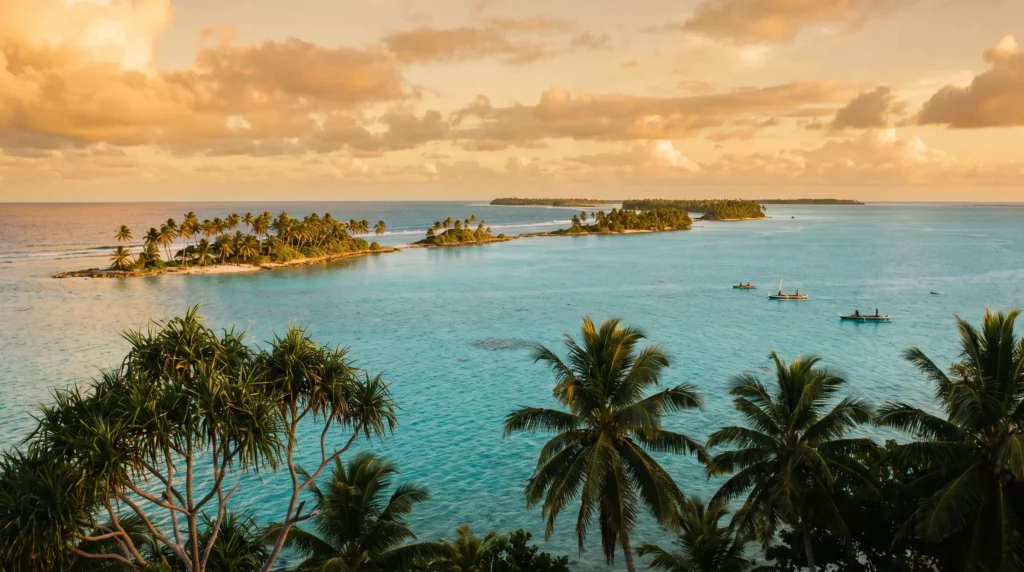
Tuvalu sits in the western Pacific roughly midway between Hawaii and Australia, a scatter of three reef islands and six true atolls strung across hundreds of kilometres of open ocean, with a combined land area of about 26 square kilometres — making it the fourth-smallest country in the world by land area. The capital, Funafuti, is itself an atoll: a thin ring of coral islets wrapped around a lagoon, with the main settlement squeezed onto the Fongafale islet, in places barely wider than the road and the airstrip that runs down its middle.
Formerly the Ellice Islands under British administration, Tuvalu split from the Gilbert Islands (now Kiribati) in a 1974 referendum and became fully independent on 1 October 1978, joining the United Nations in September 2000. It remains a Commonwealth realm under King Charles III, with its own parliament and prime minister. Christianity, and specifically the Congregationalist Church of Tuvalu, sits at the absolute centre of daily life — around 96% of the population is Christian, with the national church claiming roughly 86% on its own.
What actually pulls people here is not a checklist of sights — Tuvalu doesn’t really have any in the conventional sense. It’s the fact that so few outsiders ever make the trip that a visitor is still a genuine novelty, the fact that a country this size runs its own government, currency, airport and internet domain (yes, that .tv you keep seeing on streaming sites is Tuvalu’s), and the sobering, unavoidable subtext that this whole nation may not physically exist in its current form by the end of the century. Go with that context, not in spite of it.
Tuvalu Day — Independence Weekend on Funafuti
If you can build a trip around one date, make it 1–2 October, Tuvalu Day, marking independence from Britain in 1978. Funafuti fills with flag-raising ceremonies, church services, canoe races and — the real draw — back-to-back fatele performances: communal song-and-dance sessions where drummers on upturned biscuit tins drive a slow build into full-throated singing and synchronised hand movements, telling stories of island history and daily life. It is the single best window into Tuvaluan culture you’ll get as a visitor, and locals are generally happy to have outsiders watch, and sometimes join in.
Book flights for this window six months out if you can manage it — seats on the only route in are limited year-round, and they sell out fastest around the national holiday, when Tuvaluans working abroad fly home to celebrate.
Best Time to Visit Tuvalu (Season by Season)
May – October · Drier season
The more settled stretch of the year, with steadier south-east trade winds and lower cyclone risk. This is the window most guesthouses and the Funafuti Lagoon Hotel recommend, and it lines up with Tuvalu Day at the start of October.
November – April · Wet / cyclone season
Tuvalu’s cyclone season runs November through April, per the US State Department’s country guidance. Direct hits are infrequent given Tuvalu’s small footprint, but the already-thin inter-island ferry schedule gets thinner, king tides and storm surge are more likely to flood low-lying Fongafale, and travel insurance with medical evacuation cover is essential in any season, but doubly so now.
Whatever the season, the honest advice is: build your trip around the flight schedule first, everything else second. Tuvalu’s weather swings are mild by Pacific standards — the real planning constraint is Fiji Airways’ timetable, not the sky.
Getting There — The One Flight That Rules Everything
Funafuti International Airport (FUN), built on a WWII-era airstrip on Fongafale islet, is Tuvalu’s only international airport, and Fiji Airways is the only carrier flying there. Services run three times a week (Tuesday, Thursday, Saturday) from Suva, and twice a week (Monday, Friday) from Nadi, using ATR 72-600 turboprops that seat around 70 passengers. There is, in practical terms, no other way in — no cruise calls, no yacht-friendly marina infrastructure to speak of, no second airline waiting in the wings.
That single-route dependency has real consequences: seats are limited, schedules shift with little notice, and flights are sometimes delayed or rerouted around Pacific weather. Book as early as you can, keep your onward connections loose, and don’t schedule a same-day international transfer on either end of a Tuvalu trip. Immigration requires a passport valid at least six months beyond your arrival date, an onward or return ticket, and proof of sufficient funds. Most nationalities get a visitor permit free or on arrival for up to 30 days; travellers from countries without a fee waiver pay AUD $100 at the airport.
Getting Around — Bicycles, Motor Scooters & the Government Ferry
Funafuti’s main islet, Fongafale, is a sliver of land you can walk end to end in a few hours, so getting around the capital mostly means a bicycle or a rented motor scooter — there’s no public bus network, and no need for one. A handful of trucks and vans double as informal taxis.
Reaching the outer islands is the real logistical adventure: the government runs two inter-island vessels, the Nivaga III and the Manu Folau, on an infrequent and weather-dependent schedule, with a round trip to the northernmost atolls sometimes taking the better part of a week. There is no scheduled inter-island air service, so if the ferry timetable doesn’t line up with your dates, the outer islands simply aren’t reachable on that trip — plan for Funafuti-only unless you have real flexibility and a generous buffer either side of your international flight.
The Islands — Funafuti and the Outer Atolls
Funafuti
Home to the capital and to nearly everyone a visitor will meet — this is where the airport, government offices, the only hospital and the country’s single proper hotel all sit, strung along the narrow Fongafale islet. The Funafuti Conservation Area, a 33-square-kilometre marine and island reserve covering roughly a fifth of the atoll’s lagoon reef, is the natural centrepiece: snorkelling over healthy coral, uninhabited motu that are nesting grounds for green sea turtles, and a black noddy breeding colony on Fualopa islet.
Vaitupu
The largest atoll by land area and home to Motufoua Secondary School, one of the country’s key education hubs. Quiet, agricultural, and rarely visited by outsiders.
Nanumea
The northernmost inhabited atoll and, at roughly two to three days by government ferry from Funafuti depending on conditions, one of the furthest-flung. It saw fighting and construction during WWII and retains wartime relics alongside its own lagoon and village life.
Nukufetau
Another WWII-era airstrip site, this atoll’s wide lagoon and dispersed islets make it a favourite among the very few visitors who make the ferry crossing.
Niulakita
The southernmost and smallest inhabited island, home to Tuvalu’s official highest natural point at 4.6 metres above sea level. Settled relatively recently by resettlers from Niutao, it is the outer island least likely to feature on any itinerary, ferry schedule permitting.
Culture & People — Fatele, Te Ano & Island Life
With around 10,600 people spread across nine islands, Tuvalu runs on close community ties, a strong communal land and family (kaitasi) system, and a church calendar that structures the week as much as any work schedule. The Tuvaluan language and English are both official; most people speak both, plus their home island’s own dialect variations.
The fatele — communal singing and dancing driven by biscuit-tin percussion and hand-clap rhythms — is the cultural centrepiece of any gathering, wedding, or national occasion, telling stories through movement rather than words alone. Te ano, a traditional ball game played with a woven pandanus-leaf ball, is the community sport of choice at festivals and holidays, prizing teamwork over individual flair. Handicrafts lean on what the lagoon and coconut palm provide — shellwork, woven pandanus mats, and crochet, at which Tuvaluan women are locally renowned experts. Ask before photographing church services or family ceremonies, and dress modestly outside the beach — Tuvalu is conservative and devoutly Christian.
A Food Lover’s Guide to Tuvalu
Don’t come to Tuvalu for restaurant culture — there is very little of one, and what exists is concentrated around the Funafuti Lagoon Hotel and a few small local eateries. Come instead for the staples that have fed these atolls for centuries: pulaka, a giant swamp taro grown in composted pits dug into the coral rock (there’s no real topsoil to speak of), alongside breadfruit, coconut in every form, and reef fish — tuna, wahoo and reef fish grilled, boiled or eaten raw with lime and coconut cream in a style close to other Pacific ceviche traditions.
Because almost everything that isn’t fished or grown locally arrives by the same infrequent cargo ships that bring mail and supplies, imported staples like rice, tinned meat and instant noodles round out most tables, and variety is genuinely limited compared to anywhere else on this site. That scarcity is part of the honest picture: pack a few treats from Fiji if you have particular dietary needs, and don’t expect much beyond the essentials.
Off the Beaten Path
The Funafuti Conservation Area’s outer motu
Beyond the popular snorkel spots, the reserve’s smaller uninhabited islets — including Fualopa’s noddy colony and green turtle nesting beaches — see only a trickle of visitors even by Tuvalu’s standards.
WWII relics
The US military built Funafuti’s original airstrip during WWII as a staging base against Japanese forces, and rusting equipment, bunkers and wreck sites survive quietly around Fongafale and on Nanumea and Nukufetau for those who make the ferry crossing.
The outer atolls, full stop
Simply reaching Nanumea, Nukufetau, Vaitupu, Nui, Niutao, Nanumaga or Niulakita by the government ferry — with no fixed return date, guesthouse-only lodging, and village life essentially unchanged by tourism — is about as far off the map as scheduled travel gets anywhere in the world.
Practical Information
Money. There are no ATMs anywhere in Tuvalu and cards are not accepted, so bring enough Australian dollar cash — the de facto legal tender — for your entire stay. Currency carried in or out is capped at AUD $3,000.
Safety. The US State Department rates Tuvalu Level 1 — Exercise Normal Precautions — its lowest advisory tier, and crime rates are low. Water safety is the real risk: currents around the reef passes can be strong and inconsistent, and safety signage and staff training at recreational operators shouldn’t be assumed to match what you’re used to elsewhere. One important legal note for LGBTQ+ travellers: consensual sex between men remains illegal in Tuvalu, carrying penalties of up to 14 years’ imprisonment — discretion is strongly advised.
Health. Funafuti’s single hospital handles routine care, but serious conditions require evacuation to Fiji, Australia or further afield, so comprehensive travel insurance with medevac cover is non-negotiable. The CDC recommends travellers be up to date on routine vaccines plus typhoid and hepatitis A, and stick to bottled or treated water.
Connectivity. Tuvalu’s “.tv” domain — leased to global streaming and tech companies — is a genuine slice of national revenue, but on-the-ground internet is limited and slow outside Funafuti’s main hub; treat connectivity as a bonus, not a given, especially on the outer islands. Time zone: UTC+12. Plugs: Australian/NZ-style three-pin, 230–240V.
Budget Breakdown — What Tuvalu Actually Costs in 2026
Tuvalu isn’t expensive to be in — it’s expensive and difficult to reach, and that changes how you should budget entirely.
Budget (US$70–120/day): A room at a family guesthouse like Filamona near the airport, local meals of fish, pulaka and rice, a rented bicycle, no organised tours.
Mid-range (US$150–220/day): A room at the government-run Funafuti Lagoon Hotel, restaurant-adjacent meals, a scooter rental, snorkel gear hire for the Funafuti Conservation Area.
The real cost centre: flights. Fiji Airways’ Nadi–Funafuti or Suva–Funafuti fares, booked well ahead, will likely dwarf everything you spend on the ground combined — budget for that first, and don’t expect luxury-tier options to exist here at any price; Tuvalu simply doesn’t have that kind of tourism infrastructure yet.
Planning Your First Trip to Tuvalu
Because there’s only one flight route in, the plan basically writes itself: fly into Nadi or Suva, connect on to Funafuti International Airport, and build in slack on both ends in case of schedule changes. Four to six nights on Funafuti is plenty for most travellers — enough time for the Funafuti Conservation Area, a fatele evening if your dates align, and a genuinely restful pace with almost no set-piece attractions to rush between. Most itineraries pair Tuvalu with a longer Pacific stopover; our Fiji guide covers the Nadi/Suva gateway in depth, and our Samoa guide and Australia guide both work well as the bulk of a longer South Pacific trip built around a short, memorable Tuvalu detour.
Frequently Asked Questions
Is Tuvalu safe to visit?
Yes — the US State Department rates it Level 1, its safest tier, and crime against visitors is rare. The bigger risks are practical: strong reef currents, limited medical care, and an LGBTQ+ legal environment that requires discretion.
Do I need a visa?
Most nationalities get a free visitor permit for up to 30 days on arrival; travellers whose passport isn’t fee-exempt pay AUD $100 at Funafuti International Airport. Everyone needs a passport valid six months beyond arrival, an onward ticket, and proof of funds.
How do I actually get to Tuvalu?
Fiji Airways is the only airline flying there, from Nadi (Mondays and Fridays) or Suva (Tuesdays, Thursdays, Saturdays), landing at Funafuti International Airport. There is no other scheduled way in.
Is Tuvalu sinking — should I go now?
Tuvalu’s highest point is 4.6 metres above sea level, and the country is widely cited as one of the nations most existentially exposed to sea-level rise. That’s a serious, long-term national story rather than a reason to rush a trip — but it’s also honestly part of why some travellers prioritise visiting now rather than later.
Can I use my credit card in Tuvalu?
No — there are no ATMs in the country and cards are generally not accepted, so bring sufficient Australian dollar cash for your whole trip.
Can I visit the outer islands?
In theory, via the government ferries Nivaga III and Manu Folau, but schedules are infrequent and weather-dependent, and a round trip can take the better part of a week. Most visitors, given the constraints of the international flight schedule, see Funafuti only — and that’s a perfectly complete trip.
Ready to Explore Tuvalu?
There is no country on this site harder to reach and fewer reasons that matters once you’re there — a lagoon full of turtles, a fatele circle under the stars, and a nation of 10,600 people who will very likely remember you as the visitor who actually showed up. Book the flight early, bring cash, and go slow — Tuvalu doesn’t really offer any other speed.
Explore More
- Fiji Travel Guide — the Nadi and Suva gateway to Tuvalu’s only flight
- Samoa Travel Guide — another deeply traditional Polynesian culture nearby
- Australia Travel Guide — the region’s other major Pacific hub
- Maldives Travel Guide — another low-lying island nation facing the same sea-level story
How this guide was built
Published as part of Facts From Upstairs’ country guide series. Built from authoritative sources — Wikipedia’s entity pages for Tuvalu, the Tuvaluan dollar, Fatele, Funafuti International Airport and Funafuti Conservation Area, the US State Department’s Tuvalu country information page, the UK FCDO’s Tuvalu travel advice, the US CDC traveler health page for Tuvalu, Fiji Airways’ route information, and specialist Pacific travel reporting on inter-island ferry logistics. Numeric and factual claims carry inline citations.
Sources cited on this page
- Wikipedia — Tuvalu
- Wikipedia — Tuvaluan dollar
- Wikipedia — Fatele
- Wikipedia — Funafuti International Airport
- Wikipedia — Funafuti Conservation Area
- Wikipedia — Public holidays in Tuvalu
- US State Department — Tuvalu
- UK FCDO — Tuvalu travel advice
- UK FCDO — Tuvalu money
- UK FCDO — Tuvalu health
- UK FCDO — Tuvalu safety and security
- US CDC — Tuvalu traveler page
- Fiji Airways — Flights to Tuvalu
- Far and Away Adventures — Getting to Tuvalu
More country guides you might like

Plan your trip to Tuvalu
The booking tools we use ourselves. FFU may earn a commission at no extra cost to you.
Plan & book your trip to Tuvalu
Booking through these searches supports our guides at no extra cost to you.