
Languages of Macao SAR China
All languages of Eastern Asia →fluent beta classical · classes by phone with Maya at ranas.ai/maya
Macau Travel Guide — Portuguese Ruins, Record Casinos & the Densest City on Earth
Macau is the strangest hour-and-a-quarter you can spend on a ferry. Step off the boat from Hong Kong and the street signs switch to Portuguese, the pavement turns to Lisbon-style wave-patterned mosaic, and a 17th-century cathedral façade stands three streets from a casino floor bigger than most airports. I did not expect to love Macau the way I do — it reads on paper like a gambling day-trip, and then you spend an afternoon getting lost in the Historic Centre and realize it is one of the most layered small cities in Asia. It is also, by land area, the single most densely populated place on the planet, which sounds like a warning and turns out to be part of the charm — everything worth seeing is packed into a walkable few square kilometers. Bring an appetite for pork chop buns and contradictions; leave the illusion that this is just “Asia’s Vegas” at home.
In This Guide
- Overview — Why Macau Is Two Cities Wearing One Passport
- Grand Prix Season — Macau’s Loudest Month
- Best Time to Visit Macau (Season by Season)
- Getting There — MFM Airport, Ferries & the Bridge
- Getting Around — Buses, Walking & Free Casino Shuttles
- Neighborhoods — Peninsula, Taipa, Cotai & Coloane
- Culture & People — 460 Years of East Meets West
- A Food Lover’s Guide to Macau
- Off the Beaten Path
- Day Trips from Macau
- Practical Information
- Budget Breakdown — What Macau Actually Costs in 2026
- Frequently Asked Questions
Overview — Why Macau Is Two Cities Wearing One Passport
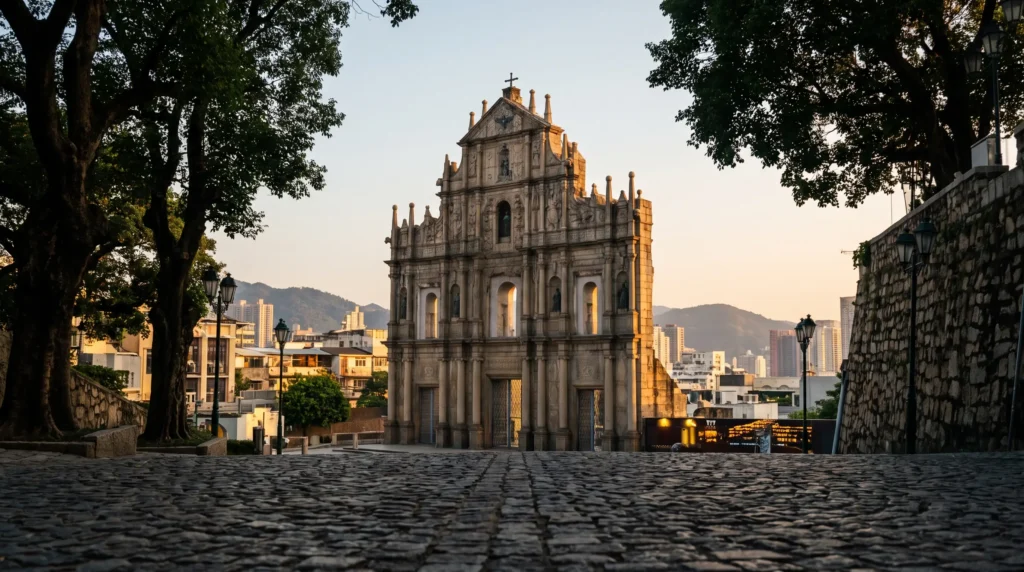
Macau is a Special Administrative Region of China, governed since the 1999 handover from Portugal under a “one country, two systems” arrangement that keeps its own currency, laws and border controls separate from the mainland. Portugal held the territory as a trading post for close to 450 years — the longest European colonial presence in Asia — and that history is still legible on nearly every block: calçada mosaic pavements, baroque church façades, street names in Portuguese script above the Cantonese.
The other Macau is the one most people have actually heard of: a gaming industry so large it runs roughly seven times the annual gambling revenue of the Las Vegas Strip, concentrated in the glass towers of Cotai and along the peninsula’s waterfront. It is genuinely strange to walk out of a Cirque du Soleil-scale casino atrium and, ten minutes later, be standing alone in a 17th-century Jesuit courtyard where a cat is asleep on the steps. That whiplash — not one or the other — is the actual Macau experience.
All of this happens in a footprint of just 32.9 square kilometers holding around 713,000 people, making Macau the most densely populated territory on Earth. You can walk the entire Historic Centre in a day, ride a ferry to Hong Kong in about an hour, and still have time for an egg tart before the last boat home.
Grand Prix Season — Macau’s Loudest Month
Mid-November is when Macau turns the volume up. The Macau Grand Prix — one of the oldest and most technically demanding street circuits in motorsport, run through closed public roads on the peninsula since 1954 — takes over for four days of practice and racing, typically Thursday to Sunday. The 2025 edition (the 72nd) ran November 13–16; expect a similar mid-November slot going forward.
The city times its biggest food event to overlap: the Macau Food Festival at Sai Van Lake Square near Macau Tower runs for roughly two weeks each November, evenings only, with dozens of local restaurant stalls plating pork chop buns and African chicken streetside. Book hotels well ahead if your dates overlap the race — rooms across the peninsula sell out and rates spike hard for the weekend.
Best Time to Visit Macau (Season by Season)
October – December · Cool and dry (peak)
The best weather window: lower humidity, blue skies, comfortable for walking the Historic Centre all day. This is also Grand Prix and Food Festival season, so hotel prices climb accordingly — book the peninsula two to three months out if your trip lands mid-November.
January – February · Chinese New Year
Cool and mild, but Lunar New Year (dates shift yearly) brings the single busiest travel period across the Pearl River Delta — casinos and hotels fill with visitors from mainland China, and some shops close for family time. Fun to witness once, frustrating if you need a quiet room.
March – May · Warm, humid, foggy
Spring fog and rising humidity roll in; visibility on the bridge crossing and Guia Lighthouse views can suffer. Prices ease from winter peak.
June – September · Hot, wet, typhoon season
Sticky heat, frequent downpours, and the core of the South China typhoon season — signal 8 closures can shut ferries, the airport and outdoor attractions for a day or two with short notice. It’s also the cheapest and least crowded stretch if your schedule can absorb a delay.
Getting There — MFM Airport, Ferries & the Bridge
Macau International Airport (MFM), built on reclaimed land off Taipa island, handles direct flights from across mainland China, Taiwan, South Korea and Southeast Asia via carriers including Air Macau, China Eastern, China Southern, EVA Air, Korean Air, AirAsia and Scoot — but has no direct long-haul service from North America or Europe. Most Western visitors instead fly into Hong Kong International Airport and connect onward.
From Hong Kong, the classic route is the TurboJET or Cotai Water Jet ferry, crossing in roughly an hour from Hong Kong (Sheung Wan or the airport SkyPier) to Macau’s Outer Harbour or Taipa terminals — sailings run every 15–30 minutes through the day. Since 2018, the Hong Kong–Zhuhai–Macau Bridge — at 55 kilometers one of the longest sea-crossing bridges in the world — offers a road alternative via shuttle bus, cutting what used to be a multi-hour drive around the Pearl River Delta down to well under an hour. Both routes involve a full border and customs crossing — Macau keeps its own immigration control separate from mainland China and Hong Kong.
Getting Around — Buses, Walking & Free Casino Shuttles
Macau is small enough that the Historic Centre is entirely walkable, and the city’s excellent, cheap public bus network covers everywhere else — the peninsula, Taipa, Cotai and Coloane — for a few patacas a ride, paid with the Macau Pass smart card or exact change. Traffic drives on the left, a holdover from Portuguese-British regional convention.
The genuinely useful hack: every major casino resort runs free shuttle buses connecting the airport, the ferry terminals, the border gate and its own property, and non-guests are generally welcome to ride along — it’s an easy, air-conditioned way to hop between the peninsula and Cotai without a taxi. Taxis are metered and inexpensive but can be hard to flag during rain or rush hour; ride-hailing apps work as a backup. Macau’s light rail (Macau LRT) now links Taipa, Cotai and parts of the peninsula, useful for avoiding surface traffic on Grand Prix weekends.
Neighborhoods — Peninsula, Taipa, Cotai & Coloane
Macau Peninsula — Historic Centre & Senado Square
The mainland-connected core and the reason Macau is on the UNESCO list. The Historic Centre of Macao, inscribed in 2005, groups more than twenty monuments and public squares — Senado Square’s wave-pattern mosaic, the Ruins of St. Paul’s façade, A-Ma Temple, St. Joseph’s Seminary and Church, and Guia Fortress with its 1865 lighthouse, the first modern lighthouse on the China coast — into a single walkable testimony to four centuries of Portuguese-Chinese exchange. This is also where the older, denser, more local Macau lives — narrow lanes, wet markets, and the casinos that started it all (Grand Lisboa, the original Casino Lisboa).
Taipa & Taipa Village
Once its own island, now fused to the mainland peninsula’s story by reclamation. Taipa Village keeps a pocket of Portuguese colonial streets and the Taipa Houses–Museum, but the real draw is Cunha Street, a pedestrian food lane thick with pork-chop-bun stalls and egg tart bakeries. The airport sits at Taipa’s eastern edge.
Cotai — the Strip
A 5.2-square-kilometer strip of reclaimed land built since 2005 to connect Taipa and Coloane, and now home to Macau’s mega-resort skyline: The Venetian Macao (with its indoor canals and gondolas), City of Dreams, Galaxy Macau, Wynn Palace, The Parisian Macao, Studio City and MGM Cotai. This is where the “Vegas of Asia” comparisons come from — and where most first-time visitors spend a night, even if they came for the ruins.
Coloane
The quiet, green counterweight to all of the above: a former fishing village and pirate haunt turned low-key escape, with Hac Sa’s black-sand beach, hiking trails, and a scattering of old temples. Coloane Village is where locals go to eat the original Lord Stow’s-style egg tarts away from the coach-tour crowds.
Culture & People — 460 Years of East Meets West
Macau’s population is overwhelmingly Chinese, but the Macanese — a small, distinct Eurasian community descended from Portuguese settlers and Asian intermarriage over centuries — gave the territory its own creole language, cuisine and surnames that still show up on shopfronts and street signs today. Both Chinese and Portuguese are official languages, though Cantonese is the everyday tongue for the large majority of residents and Portuguese is now spoken by a small minority.
Religious life reflects the same layering: A-Ma Temple, dedicated to the seafarers’ goddess Mazu and reputedly the site of the first Portuguese landing, sits a short walk from baroque Catholic churches still holding regular Mass. Lunar New Year, the Feast of A-Ma, and the mid-autumn Mooncake Festival bring lion dances and incense-thick temple courtyards; the Feast of the Drunken Dragon and Tam Kung Festival keep older Cantonese-Macanese traditions alive alongside the casino calendar.
A Food Lover’s Guide to Macau
Macanese cuisine is arguably the world’s original fusion food — a genuine 16th-century blend of Portuguese, Cantonese, Indian, Malay and West African cooking built along Portugal’s old trade routes, and UNESCO has recognized Macau as a Creative City of Gastronomy for exactly this reason. Start with the pork chop bun — a bone-in fried pork chop, marinated in soy, Shaoxing wine and five-spice, wedged into a crusty Portuguese-style roll — sold from hole-in-the-wall counters across Taipa and the peninsula.
The Macanese egg tart — flakier and less sweet than Portugal’s pastel de nata, without the cinnamon dusting — is the city’s edible souvenir, best eaten warm from the oven in Coloane or Taipa Village. African chicken (galinha à Africana), grilled and marinated in coconut milk, chili and paprika, is the signature Macanese main, invented locally by a Portuguese-African trade cook rather than imported wholesale from Africa. Round it out with minchi (minced meat and potato over rice), Portuguese egg custard bica coffee culture, and the local Macau Beer. On the mainland-Cantonese side, dim sum and wet-market congee stalls are everywhere and cheap.
Off the Beaten Path
Guia Fortress & Lighthouse
A steep walk (or the century-old funicular) up Guia Hill to the oldest lighthouse on the China coast, dating to 1865, with a chapel of Portuguese-Indian frescoes and panoramic views over the whole peninsula and Cotai skyline.
Coloane’s Hac Sa Beach and hiking trails
Black volcanic sand, a scattering of chapels, and quiet coastal trails that feel a world away from Cotai’s neon, all a short bus ride from the mega-resorts.
Taipa & Coloane History Museum
A small, underrated museum covering the fishing-village and firecracker-factory history of the islands before land reclamation joined them to the mainland peninsula’s story.
Back streets of the Historic Centre after dark
Once the tour groups clear out by early evening, the lanes around St. Lazarus and Camoes Garden are quiet, lantern-lit, and some of the best-value dining in the city.
Day Trips from Macau
Zhuhai, the mainland Chinese city directly across the border, is a five-minute walk through the Gongbei checkpoint (or a hop across the Hong Kong–Zhuhai–Macau Bridge) and worth an afternoon for its waterfront promenade and very different, mainland-priced dining and shopping scene — note this requires a separate mainland China visa for most non-Chinese passport holders, so check requirements before you plan on crossing.
Hong Kong itself works comfortably as a day trip in the other direction — about an hour each way by ferry — for travelers based in Macau who want Victoria Harbour and Hong Kong’s own Cantonese food scene without changing hotels.
Practical Information
Money. The Macau pataca (MOP) is pegged to the Hong Kong dollar at 1.03 MOP per HKD, and Hong Kong dollars are accepted virtually everywhere at close to par — cards and mobile pay are standard in casinos and malls, but carry small cash for street food and markets.
Safety. Macau’s tourist areas are orderly and low-crime day to day, but the US State Department currently rates Macau a Level 3 “Reconsider Travel” advisory — a notably higher rating than mainland China or Hong Kong — citing limited US consular reach and arbitrary enforcement of local law; dual US-Chinese nationals face added scrutiny. Check current guidance before you go. The UK’s FCDO recommends a passport valid at least 90 days beyond your departure date.
Health. Tap water is not considered reliably drinkable — stick to bottled or boiled water, and keep routine vaccinations plus hepatitis A/B current before travel.
Connectivity & logistics. An eSIM covering Hong Kong/Macau or mainland China saves roaming headaches, since the three jurisdictions use separate mobile networks despite the short distances. Plugs: mostly UK-style three-pin (Type G) at 220V/50Hz — pack an adapter even if you’ve just come from Hong Kong. Time zone: UTC+8, no daylight saving. Traffic: drives on the left.
Budget Breakdown — What Macau Actually Costs in 2026
Macau’s cost of living splits sharply along its dual identity: street food and mid-range hotels are genuinely affordable by regional standards, while the casino-resort layer is priced like anywhere else five-star.
Budget (US$50–90/day): Guesthouse or budget hotel on the peninsula, pork chop buns and wet-market meals, public buses, free casino shuttles between areas, self-guided Historic Centre walking.
Mid-range (US$120–220/day): A mid-tier Cotai or peninsula hotel (rates swing hard with weekday/weekend and event dates), restaurant meals mixing Macanese and Cantonese dishes, a Guia Fortress or museum ticket, one ferry round-trip to Hong Kong.
Luxury (US$400+/day): A suite at one of the flagship Cotai resorts (Venetian, Wynn Palace, Galaxy), fine-dining Macanese tasting menus, and — if that’s your interest — a night at the tables, which is entirely optional to a great Macau trip.
Grand Prix weekend and Chinese New Year are the two windows where hotel prices spike hardest across every tier; the rest of the year, especially the humid summer months, sees some of the best-value five-star rates in the region.
Planning Your First Trip to Macau
Most visitors treat Macau as a one- or two-night add-on to a Hong Kong trip, and that’s a reasonable minimum: a single day covers the Historic Centre on foot, and one night in Cotai covers the resort-and-casino side if you want it. Given three days, split it peninsula (Historic Centre, Senado Square, local food), one night in Cotai or Taipa, and a half-day in quiet Coloane. Pair it naturally with our Hong Kong guide for the ferry-hop combination most travelers actually do, or continue the wider trip with our China travel guide if a mainland visa is already in the plan.
Frequently Asked Questions
Is Macau safe for tourists in 2026?
Day to day, yes — tourist areas are orderly and low-crime. But the US State Department rates Macau Level 3 “Reconsider Travel,” higher than its rating for Hong Kong or mainland China, due to limited consular access and arbitrary enforcement of local law; check current advisories, especially if you hold dual US-Chinese nationality.
Do I need a visa for Macau?
US and Canadian passport holders can enter visa-free for up to 30 days; UK passport holders get up to 6 months visa-free. Carry proof of onward travel and keep at least 90 days of passport validity remaining.
Can I visit Macau on a day trip from Hong Kong?
Yes — the TurboJET/Cotai Water Jet ferries take about an hour each way, run frequently, and a full day gives you time for the Historic Centre plus a meal, though you’ll be rushing to also see Cotai. Two days lets you actually relax into both sides of the city.
Is Macau only about gambling?
No, and that’s the guide’s whole point — the UNESCO-listed Historic Centre, Macanese food scene and Coloane’s quiet beaches are all reason enough to come, casino or not. That said, the gaming industry genuinely dwarfs Las Vegas in scale and funds much of the city’s modern skyline, so it’s impossible to ignore entirely.
Macau or Hong Kong — which first?
They’re not really either/or since they’re an hour apart — most trips do both. If forced to choose one, Hong Kong offers more to fill a week; Macau rewards a focused one-to-two-day visit built around history and food rather than volume of sights.
What’s the easiest way to see the Historic Centre?
Walk it — the entire route from A-Ma Temple to the Ruins of St. Paul’s to Guia Fortress covers just a few kilometers, and free casino shuttles or cheap buses handle the longer hops to Taipa and Cotai afterward.
Ready to Explore Macau?
A baroque church façade next to a neon casino skyline, a pork chop bun that costs less than the ferry ticket that got you there, and an entire UNESCO-listed old town you can walk in an afternoon — Macau packs an outsized trip into one of the smallest territories on the map. Go for a night, stay for the contradictions.
Explore More
- Hong Kong City Guide — the classic hour-away pairing
- China Travel Guide — for onward mainland trips via Zhuhai
- Taipei City Guide — another East-meets-history Asian capital
- Singapore City Guide — Asia’s other food-and-skyline city-state
How this guide was built
Published as part of Facts From Upstairs’ city guide series. Built from authoritative sources — UNESCO’s Historic Centre of Macao inscription, Wikipedia entity pages for Macau, the Macanese pataca, Macau International Airport, the Hong Kong–Zhuhai–Macau Bridge, Cotai, Taipa and the Macau Grand Prix, the US State Department’s Macau travel advisory, the UK FCDO’s Macau entry requirements page, the US CDC traveler health page for China, TurboJET’s official ferry information, the Macau Grand Prix official schedule page, and Britannica’s Macau entry. Numeric claims carry inline citations.
Sources cited on this page
- Wikipedia — Macau
- UNESCO — Historic Centre of Macao
- Wikipedia — Macanese Pataca
- Wikipedia — Macau International Airport
- Wikipedia — Hong Kong–Zhuhai–Macau Bridge
- Wikipedia — Cotai
- Wikipedia — Taipa
- Wikipedia — Macau Grand Prix
- Wikipedia — Pork Chop Bun
- Macau Grand Prix — Official Schedule
- TurboJET — Sea Ferry Travel Information
- US State Department — Macau Travel Advisory
- UK FCDO — Macao Entry Requirements
- US CDC — China Traveler Health Page
- Britannica — Macau
More city guides you might like
Plan your trip to Macau
The booking tools we use ourselves. FFU may earn a commission at no extra cost to you.
Plan & book your trip to Macau
Booking through these searches supports our guides at no extra cost to you.