
Languages of Finland
All languages of Northern Europe →fluent beta classical · classes by phone with Maya at ranas.ai/maya
Finland Travel Guide — Aurora Skies, Sauna Steam & the Land of a Thousand Lakes
Finland Travel Guide
📋 In This Guide
- Overview — Why Finland Belongs on Every Bucket List
- 🎅 Aurora & Santa Season 2026 — Lapland at Its Peak
- Best Time to Visit Finland (Season by Season)
- Getting There — Flights & Arrival
- Getting Around — VR Trains, Santa Claus Express & Lake Ferries
- Top Cities & Regions
- Finnish Culture & Etiquette
- A Food Lover’s Guide to Finland
- Off the Beaten Path
- Practical Information
- Budget Breakdown
- Planning Your First Trip to Finland
- Frequently Asked Questions
Overview — Why Finland Belongs on Every Bucket List
Finland is a long, forested, lake-studded country that reaches from the Baltic up into the Arctic, and the quiet, stubborn people who live in it have built what the United Nations’ World Happiness Report has called the happiest society on Earth for seven consecutive years. The country covers 338,462 square kilometres — a bit larger than Germany — and holds just 5.63 million people, which makes it one of Europe’s emptiest, greenest landscapes. Roughly 75% of that land is forest, and there are more than 188,000 lakes scattered across it.
The geography explains most of the rest. Finland’s south (Uusimaa, around Helsinki) is a shallow rocky coastline broken into an archipelago of islands and skerries; the middle (Lakeland, around Tampere and Savonlinna) is a vast maze of lakes, pine and birch; the north (Lapland) is fell country, tundra and reindeer pasture, the traditional homeland of the Sami people — Finland’s only recognised indigenous nation, whose language and livelihoods long predate the modern Finnish state. The country has 178,947 islands and its highest point, Halti on the Norwegian border, rises to 1,324 metres. Inside those borders sit 19 regions and a national sensibility — quiet, stoic, slightly deadpan — that the Finns themselves sum up in one untranslatable word: sisu.
Culturally, Finland runs on trust, silence and sauna. There are roughly 3.3 million saunas in a country of 5.6 million people — more saunas than cars — and the Finnish sauna tradition was inscribed on UNESCO’s Intangible Cultural Heritage list in 2020. Finland is a member of the European Union, the Schengen Area and (since 2023) NATO; it uses the euro, and mobile payment is essentially universal — cash is rare enough that many buses, museums and even public saunas are card-only. Finns are often called reserved by outsiders — and they are, on first contact — but the warmth arrives reliably once you are inside a sauna or across a coffee table.
Practically, Finland is one of the easiest countries in Europe to travel. Near-universal English makes the language barrier almost nonexistent; VR’s Pendolino and Santa Claus Express trains connect Helsinki to Turku, Tampere, Oulu and Rovaniemi on a clean and punctual spine; and the Everyman’s Right (Jokamiehenoikeus) gives every visitor the legal freedom to walk, ski, swim and forage across most private land. A day out can take in Suomenlinna fortress, a harbourside public sauna and a bowl of salmon soup for under €50.
🎅 Aurora & Santa Season 2026 — Lapland at Its Peak
Finnish Lapland is the easiest place on Earth to combine two bucket-list draws in a single trip: the northern lights and the official hometown of Santa Claus. Rovaniemi, Lapland’s capital, sits directly on the Arctic Circle; its Santa Claus Village has welcomed visitors year-round since 1985, and the aurora borealis is visible on roughly 200 nights of the year in Lapland skies when clouds cooperate. The aurora window runs late August through early April, with the statistical peak in the cold, clear months of December, January, February and March.
- Aurora window: late August through early April; peak viewing December–March
- Santa Claus Village peak: December 1, 2026 through January 6, 2027 — Rovaniemi transforms into the busiest Christmas destination in the Nordic region
- Peak duration: aurora shows typically 10–45 minutes per display, 2–6 displays per clear night
- Rovaniemi & Santa Claus Village: Arctic Circle crossing, Santa Claus Post Office, reindeer farms, the 12-hour Santa Claus Express overnight sleeper from Helsinki
- Saariselkä, Levi, Kakslauttanen, Nellim: glass-igloo country north of Rovaniemi, well above the Arctic Circle and with some of Europe’s lowest light pollution
Best Time to Visit Finland (Season by Season)
Spring (Mar–May)
The thaw. Southern Finland climbs from -3°C to 14°C through the three months, daylight stretches rapidly (by mid-May it is light past 22:00 in Helsinki), and lake ice finally breaks up in April–May. Aurora hunting holds into late March in Lapland — some operators argue March is the single best month of the season because skies are darker than April but days are long enough to ski and dogsled in comfort. May in Helsinki brings the Vappu May Day student festival and the first café terraces of the year. Downside: a patchy shoulder season with melting snow, closed winter lodges in late March–April and limited lake-cottage openings.
Summer (Jun–Aug)
The main event. Helsinki runs 15–22°C, occasionally spiking to 28°C, with 19+ hours of daylight in June; north of the Arctic Circle the Midnight Sun shines continuously for more than two months around Utsjoki. Juhannus (Midsummer) on June 19–20, 2026 empties the cities; Savonlinna Opera Festival fills Olavinlinna Castle in July; and every lake in Lakeland is full of swimmers, kayakers and cottage saunas. Warnings: Helsinki and Tampere go quiet in July when Finns take four weeks off; mosquitoes in Lapland are legendary; pre-book Midsummer accommodation at least three months ahead.
Autumn (Sep–Nov)
A short, golden season known locally as ruska. Temperatures drop from 14°C in early September to near 0°C by late November; Finland’s birch and rowan forests turn copper and gold through late September, and Lapland’s tundra glows orange — often considered the single best two weeks of the year for hiking. The aurora window reopens in late August and is fully active by mid-September. Mushroom and berry foraging under the Everyman’s Right peaks in September. Helsinki Design Week and Helsinki Baltic Herring Market animate the capital.
Winter (Dec–Feb)
Dark and dramatic — and the heart of the Lapland season. Helsinki runs -5°C to 2°C with 6 hours of daylight; Rovaniemi drops to -15°C to -25°C with the polar night (kaamos) from early December to early January, when the sun never rises above the horizon in Utsjoki. Santa Claus Village peaks December 1–January 6; Lucia processions on December 13 fill Swedish-speaking coastal towns; and every frozen lake becomes a skating rink. Husky sledding, reindeer farms, snowmobiling and ice swimming (avantouinti) all run through the cold months.
Shoulder-season tip: Early September is Finland’s best-value window — ruska autumn colour, aurora just returning to Lapland skies and hotel rates 20–30% below midsummer. Late February and March beat December for aurora statistics and fewer crowds while glass igloos are still running.
Getting There — Flights & Arrival
Helsinki-Vantaa dominates arrivals for most visitors, with Finnair’s Asia hub funnelling long-haul passengers through on one-stop routings. Lapland has its own direct flights from Helsinki during aurora and Santa season. Pick your entry by region.
- Helsinki-Vantaa Airport (HEL) — Finland’s main international gateway; 16.0 million passengers in 2024. The Ring Rail Line (I and P trains) reaches Helsinki Central in about 30 minutes for €4.40 on an HSL ticket.
- Rovaniemi Airport (RVN) — the Lapland gateway for Santa Claus Village, Saariselkä and Kakslauttanen, with Finnair and Norwegian running 90-minute direct flights from Helsinki and seasonal direct charters from the UK and continental Europe during aurora season.
- Turku Airport (TKU) — a small southwest-coast airport useful for the Turku archipelago and Åland routings, with Finnair regional service from Helsinki.
- Tampere-Pirkkala Airport (TMP) — inland Finland’s main airport, ~170 km north of Helsinki, with Finnair and seasonal low-cost service.
Flight times: New York–Helsinki 8 hours 30 minutes; London–Helsinki 3 hours; Toronto–Helsinki 8 hours 45 minutes; Tokyo–Helsinki 10 hours.
Flag carrier: Finnair, plus Norwegian on Nordic routes.
Visa / entry: Schengen rules apply — citizens of the US, UK, Canada, Australia, Japan, South Korea and 60+ other countries enter visa-free for up to 90 days in any 180-day window. Beginning late 2026, visa-exempt travellers will need an ETIAS pre-authorisation (~€7, online).
Getting Around — VR Trains, Santa Claus Express & Lake Ferries
Finland is a long country but a well-connected one. The national rail operator VR runs the Helsinki–Tampere–Oulu–Rovaniemi spine under Pendolino high-speed service; an overnight sleeper — the legendary Santa Claus Express — reaches the Arctic Circle in 12 hours with car-carrier wagons attached; lake ferries animate the Saimaa region in summer; and Finlines ferries link Helsinki with Tallinn, Stockholm and Åland. Cars are useful for Lapland, Åland and lake-cottage country but unnecessary in the big cities.
- VR Pendolino S220 high-speed rail: top speed 220 km/h on the Helsinki–Tampere–Oulu spine.
- Helsinki → Tampere: 1 hour 30 minutes by VR Pendolino.
- Helsinki → Turku: 2 hours by VR Intercity.
- Helsinki → Rovaniemi (Santa Claus Express overnight sleeper): 12 hours, with berth cabins and a car-carrier wagon.
- Helsinki → Savonlinna: 4 hours 30 minutes by VR with one change at Parikkala.
Rail pass: the Eurail Finland Pass — 3 days in 1 month — runs around €155 for an adult in 2nd class, while individual VR tickets booked 60+ days ahead are often cheaper on the Helsinki–Tampere and Helsinki–Turku spines.
City transit apps: HSL (Helsinki region, single ticket €3.10), Nysse (Tampere), Föli (Turku and Naantali). All three accept contactless Visa, Mastercard and Apple Pay and sell QR mobile tickets in-app.
Apps: VR Matkalla (rail booking), HSL (Helsinki), Google Maps (reliable countrywide for every mode).
Top Cities & Regions
📍 Map of Finland: Every Place in This Guide
🏛️ Helsinki
Finland’s compact seaside capital sits on a peninsula with an archipelago at its doorstep — a design-forward city of neoclassical squares, modernist libraries and harbourside public saunas. An HSL day ticket covers every tram, metro, bus and island ferry.
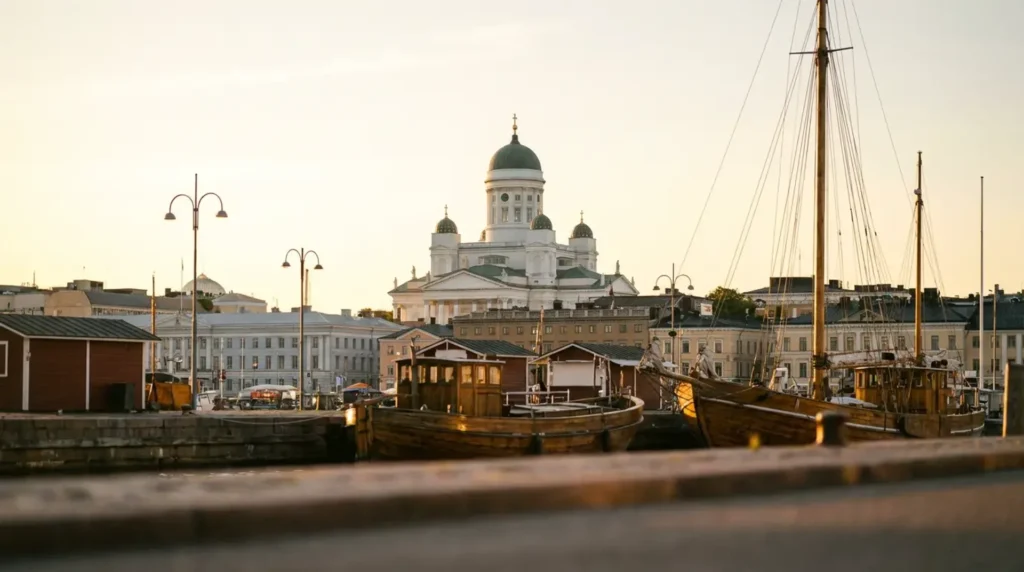
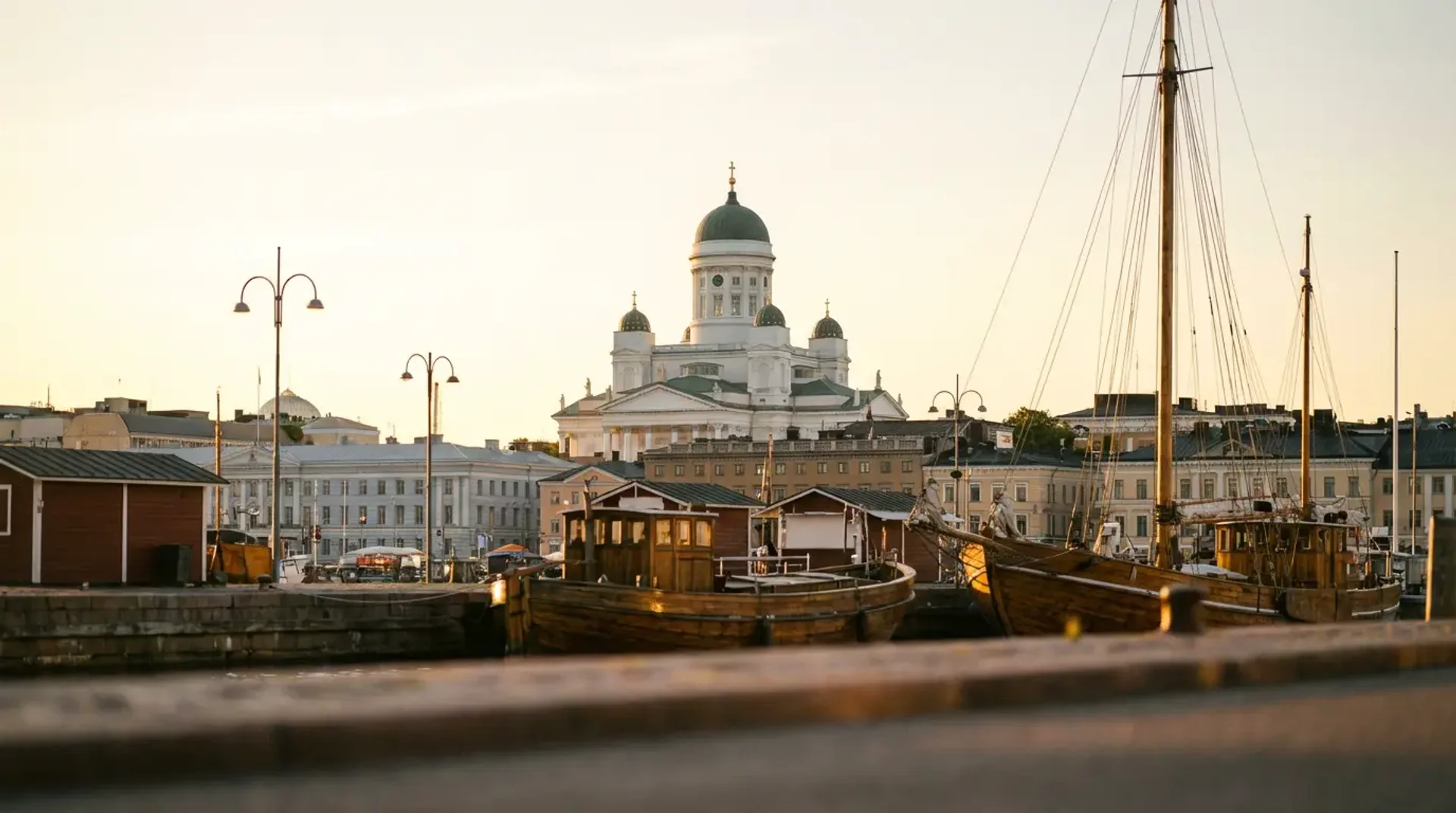
- Senate Square and Helsinki Cathedral — the neoclassical white-and-green heart of the city, built 1830–1852 under C. L. Engel
- Suomenlinna sea fortress — UNESCO-listed 18th-century fortress across six islands, a 15-minute HSL ferry from Market Square
- Löyly harbourside public sauna, Oodi central library (opened 2018) and the Design District’s Marimekko and Iittala flagships
Signature eats: salmon soup (lohikeitto) at Kauppatori market stalls, karjalanpiirakka with egg butter, dense rye bread (ruisleipä), a Lonkero grapefruit long drink on a summer terrace.
🎅 Rovaniemi
The official hometown of Santa Claus on the Arctic Circle — Lapland’s capital, rebuilt post-1945 on an Alvar Aalto plan laid out in the shape of a reindeer’s head, and the busiest gateway for aurora tourism, reindeer farms and Sami culture.
- Santa Claus Village on the Arctic Circle — open year-round, with the official Santa Claus Post Office (replying to children worldwide since 1985) and the painted Arctic Circle line across the main boulevard
- Arktikum science centre and the Pilke forest museum — a smart deep dive on Arctic science, the Sami and Finland’s wartime evacuation of Lapland
- Aurora hunting, husky-kennel half-days and reindeer farm visits throughout the surrounding Ounasvaara area
Signature eats: sautéed reindeer (poronkäristys) with lingonberry jam and mashed potato, Arctic char, cloudberries with cream, and karjalanpiirakka with strong filter coffee.
⚓ Turku
Finland’s oldest city and former medieval capital, at the mouth of the Aura River — a UNESCO Creative City of Gastronomy with a 13th-century castle, Finland’s largest archipelago at its doorstep and a compact walkable old town.
- Turku Castle (begun 1280) — the largest surviving medieval building in Finland, now a permanent museum
- Turku Cathedral — the mother church of the Finnish Lutheran tradition, founded in the 13th century on the Aura River’s north bank
- Turku Archipelago Trail (Saariston rengastie) — a 250-km ferry-linked driving loop through 20,000+ islands, best June–August
Signature eats: archipelago black bread (saaristolaisleipä), pickled Baltic herring, smoked salmon, dense rye (ruisleipä), a Lonkero at a harbourside pub.
🏭 Tampere
Finland’s third-largest city and the unofficial sauna capital of the world — a former Manchester-style industrial town between two lakes, with red-brick factories reborn as design museums, food halls and public saunas.
- Rajaportin Sauna (opened 1906) — Finland’s oldest continuously running public sauna, still firewood-heated
- Tampere Hall and the Moomin Museum — the only museum in the world dedicated to Tove Jansson’s Moomin stories
- Pyynikki observation tower and the Näsinneula tower with rotating restaurant over Lake Näsijärvi
Signature eats: mustamakkara (Tampere’s black blood sausage) with lingonberry jam at Tammelantori market, lake-caught muikku (fried vendace), karjalanpiirakka, salty salmiakki liquorice.
🎭 Savonlinna (Lake District)
The lake-district pearl — a small town strung across the islands of Lake Saimaa, Finland’s largest lake. Every July the 15th-century island castle hosts one of Europe’s most atmospheric opera festivals inside its courtyard.
- Olavinlinna Castle (begun 1475) — Finland’s best-preserved medieval castle, venue of the Savonlinna Opera Festival since 1912
- Lake Saimaa cruises and the endangered Saimaa ringed seal (~440 individuals)
- Punkaharju ridge — a forested esker ridge between two lakes, 30 km east of Savonlinna
Signature eats: lörtsy (deep-fried sweet or savoury pasty), muikku (fried vendace), smoked lake fish, karjalanpiirakka, and lakka (cloudberry liqueur).
🏝️ Oulu (Bothnian Archipelago)
The Bothnian Bay tech hub and 2026 European Capital of Culture — a northern coastal city with a 250-island archipelago, cycling-first winter infrastructure and, in summer, a Midnight Sun over the water.
- Oulu Market Hall and the bronze Toripolliisi statue on the Market Square — the city’s riverside centre
- Hailuoto island (reached by free ferry) — Finland’s largest Bothnian island, with dunes and fisher villages
- Nallikari beach, Koiteli Rapids and the Air Guitar World Championships (held in Oulu every August since 1996)
Signature eats: rieska (flat barley bread), smoked whitefish, liver casserole (maksalaatikko), cloudberry pastries, salmiakki.
Finnish Culture & Etiquette — What to Know Before You Go
Finnish culture runs on quiet egalitarianism, precise punctuality, and comfort with silence. There is almost no social hierarchy on display: the chief executive and the summer intern take the same tram, use the same first names, and queue in the same order at the same coffee counter. Finns are often described as “reserved” — and they are, on first contact — but the warmth arrives reliably by the second coffee, and still more reliably inside a sauna. Most social mis-steps come from being loud, late, or starting small talk with strangers.
The Essentials
- Remove shoes at the door. Finnish homes, guesthouses and many lakeside cottages universally expect shoes off the moment you arrive. Watch the hosts and follow their lead.
- Silence is comfortable. Finns do not fill pauses with small talk — it is not rudeness, it is cultural comfort. Waiting in quiet beside a Finn at a bus stop is entirely normal.
- Arrive on the minute. For a 19:00 dinner, 19:00 means 19:00 — not 19:05. Finnish punctuality is near-Swiss, and lateness without advance warning reads as disrespectful.
- Address people by first name. Finland is strongly egalitarian; titles and formalities are almost never used socially, from the prime minister to the post-office clerk.
- Keep your voice down on public transit. Phone calls and loud conversations on Helsinki trams mark you out immediately as the visiting tourist.
Sauna Etiquette
- Nudity is the Finnish norm. Public saunas are gender-separated, so nude bathing is the default among same-gender strangers; in mixed-gender family and private saunas, wrapping a towel around yourself is fine. A small cotton towel (pefletti) to sit on is universal for hygiene.
- Shower before you enter the hot room — it is not optional, it is hygiene.
- Pour water on the kiuas (stove) gently to make löyly (the steam); ask permission in a shared sauna before the next pour.
- Swim in the lake, sea or snow between rounds — the hot-cold contrast is the entire point of the ritual, and Finns genuinely do it year-round.
- Silence is fine, and so is quiet conversation; phones are not.
A Food Lover’s Guide to Finland
Finnish food has quietly become one of Northern Europe’s most interesting cuisines. The traditional canon — salmon soup, Karelian pies, reindeer, rye bread, cloudberries — sits alongside a Copenhagen-influenced New Nordic restaurant scene that has produced Helsinki Michelin stars at Palace, Grön, Olo and Finnjävel. Baltic fish, Arctic char, foraged berries and reindeer flow into kitchens that take seasonality seriously; the coffee ritual, which Finns consume more of per capita than any other nation, ties everything together.
Must-Try Dishes
| Dish | Description |
|---|---|
| Lohikeitto (Salmon Soup) | Finland’s creamy salmon-and-potato soup with dill, leek and allspice — served on every lunch-café menu nationwide, traditionally with dense rye bread and butter on the side. The Helsinki Market Hall stalls and the harbourside Kauppatori kiosks serve famously good versions. Expect €12–18 for a generous bowl. |
| Karjalanpiirakka (Karelian Rice Pies) | Thin rye-crust hand pies filled with rice porridge (occasionally mashed potato or carrot), fluted at the edges, and eaten warm with munavoi — egg butter — mashed onto the top. Originally from Karelia, now a nationwide breakfast and coffee-break staple, awarded EU Traditional Speciality Guaranteed status. Supermarket six-packs run €2–4; café-baked €2–3 each. |
| Poronkäristys (Sautéed Reindeer) | Thinly sliced reindeer sautéed with butter and served over mashed potato with lingonberry jam and pickled cucumber — the iconic Lapland dish. Nearly every Rovaniemi restaurant serves it. Reindeer is locally raised by Sami herders across northern Finland. Expect €22–32 a plate in Rovaniemi, €26–36 in Helsinki. |
| Ruisleipä (Finnish Rye Bread) | Dense, dark, sourdough Finnish rye — sold everywhere in tin-loaf and ring (reikäleipä) forms, and the country’s proud national food, elevated to official cultural-heritage status. Eaten with butter, cheese, cold smoked fish, or cucumber and dill. The rye-bread sour is something a Finn will defend for hours at a time. |
| Mustikkapiirakka (Blueberry Pie) | Finnish blueberry pie with a yeasted or butter-pastry base and a set-custard or whipped-cream topping — made with wild bilberries (mustikka) foraged in midsummer under the Everyman’s Right. A café staple alongside a coffee, which Finns drink more of per capita than any nation on Earth, at around 12 kilos per adult per year. |
| Lonkero (Finnish Long Drink) | The national cocktail — a grapefruit-flavoured gin soda — originally created for the 1952 Helsinki Olympics to give visitors an easy ready-to-drink option. Canned, 5.5% ABV, sold in supermarkets, at bars and by the pint at every summer terrace. Salmiakki (salty liquorice) Koskenkorva shots are the other signature Finnish drink. |
Market Halls & Alko — Where Finnish Food Shopping Happens
Finland does not have convenience-store food culture in the Japanese sense, but it has two institutions every visitor needs to learn. First: the kauppahalli (market hall) — 19th-century indoor food halls in Helsinki (Vanha Kauppahalli, 1889), Turku, Tampere and Oulu, where salmon, cheese, karjalanpiirakka and smoked fish are sold from independent counters. Second: Alko, the state-run alcohol monopoly — the only place to buy any drink stronger than 5.5% ABV, with shorter hours than normal shops (closed Sundays, early Saturdays) and a serious craft-gin and local-wine section. Between supermarket chains and R-kioski kiosks, day-to-day groceries are easy; a market-hall lunch plus an Alko stop is the proper Finnish food run.
- Chains: K-Market / K-Citymarket (Kesko), S-market / Prisma (S-Group), R-kioski (kiosk), Alepa (Helsinki neighbourhood stores), Alko (state alcohol monopoly).
- Signature items: karjalanpiirakka, ruisleipä, smoked salmon, salmiakki liquorice, Fazer Blue chocolate, cloudberry jam, korvapuusti (cinnamon buns), Lonkero in a can, and lakka liqueur.
Off the Beaten Path — Finland Beyond the Guidebook
Kakslauttanen & Saariselkä, Lapland
Purpose-built glass igloos inside the Arctic Circle north of Rovaniemi — sleeping under the aurora from a heated bed, with Urho Kekkonen National Park’s fells outside the door. Kakslauttanen’s Arctic Resort added its first glass-roofed igloos in 1999 and now has roughly 65 glass igloos alongside traditional Finnish log-cabin accommodation; Saariselkä village 10 km north is the larger commercial hub with husky kennels, reindeer farms and ski slopes. Aurora viewing is best late August through late April, peaking December–March.
Åland Islands (Ahvenanmaa)
An autonomous, Swedish-speaking archipelago of roughly 6,700 islands between Finland and Sweden, with its own flag, parliament and postal system. Reached by 5-hour overnight ferry from Helsinki or 5-hour daytime ferry from Turku, Åland is summer-cottage country par excellence — red-painted wooden barns, pirate-legend stone maritime museums and endless island cycling on a flat, protected network of bridges and short crossings. Mariehamn is the only town of size. Midsummer here is among the country’s most traditional, and the islands get noticeably warmer sun than the mainland.
Koli National Park, North Karelia
The view from Koli’s quartzite ridge over Lake Pielinen is arguably Finland’s most painted landscape — Jean Sibelius honeymooned here in 1892, and Eero Järnefelt’s 1899 painting ‘Autumn Landscape from Lake Pielinen’ now hangs in Helsinki’s Ateneum. The park reached its centenary in 2024, holds the highest point in southern Finland (Ukko-Koli at 347 metres), and is a year-round destination for ruska-season hikers in September and backcountry skiers and smoke-sauna saunausers from December through March.
Suomenlinna, Helsinki
A UNESCO-listed 18th-century sea fortress spread across six interconnected islands — a 15-minute HSL ferry from central Helsinki on the regular Helsinki transit card. Built by Sweden in 1748 to defend against Russia, it passed to Russia in 1808 and to independent Finland in 1918. It is now home to around 800 year-round residents alongside six museums, a working dry dock, cafés and coastal walking paths, and has been on the UNESCO World Heritage list since 1991.
Inari & Siida (Sami Homeland)
The spiritual heart of Finland’s Sami community, 330 km north of Rovaniemi. Siida, the Sami museum and nature centre in Inari, is Finland’s best introduction to indigenous Sami history, language, joik music and the traditional reindeer-herding economy — and is a respectful, Sami-led institution, not a curiosity stop. Lake Inari is Finland’s third-largest and stays iced over into May. Nellim, on the lake’s Russian-border side, is one of the lowest-light-pollution aurora locations in Europe. Visitor-respect for Sami land, language and livestock is central here.
Practical Information
| Currency | Euro (€ / EUR); 1 USD ≈ 0.94 EUR (April 19, 2026). Finland adopted the euro in 2002. |
| Cash needs | Near-zero. Finland is one of the world’s most cashless economies — contactless Visa, Mastercard and Apple Pay work everywhere, including trams, market stalls, kiosks and public saunas. Carry one backup card. |
| ATMs | Otto. ATMs are common in cities and airports and accept most foreign Visa/Mastercard. Rural Lapland villages may have only one machine — draw cash ahead if heading deep into the backcountry. |
| Tipping | Not expected. Service is included by law. Rounding up to the nearest euro at a café or adding 5–10% at an upscale sit-down restaurant is appreciated, never obligatory. |
| Language | Finnish is the official language — Finno-Ugric, unrelated to Swedish, English or Russian, and genuinely difficult for outsiders. Swedish is a second official language; Sami is recognised in Lapland. English is near-universal. |
| Safety | Very safe — Finland ranked 13th in the 2024 Global Peace Index and violent crime against visitors is rare. Petty theft around Helsinki Central Station is the main tourist-facing risk. |
| Connectivity | Nationwide 4G/5G on Elisa, Telia and DNA; eSIMs (Airalo, Holafly) work from landing. Free WiFi on VR trains, in airports, libraries and most cafés. |
| Power | Type C and Type F (Schuko) plugs; 230V / 50 Hz. |
| Tap water | Safe and excellent — Helsinki tap water ranks among the cleanest on Earth and is served free at every Finnish restaurant on request. |
| Healthcare | Universal public system; EU visitors use EHIC, others need travel insurance. Terveysasema is the first-contact clinic; the national medical advice line is 116117. |
Budget Breakdown — What Finland Actually Costs
💚 Budget Traveller
Hostels (Eurohostel Helsinki, Dream Hostel Tampere), K-Market and Prisma supermarket runs, VR off-peak Intercity tickets booked 60+ days out, and free city walking plus the Everyman’s Right for rural nights. Doable at €85–135 per day (~US$95–150), with Tampere and Turku roughly 20% cheaper than Helsinki. A supermarket lunch under €7, an R-kioski coffee plus karjalanpiirakka around €4.50, and a hostel dorm €30–50 per night.
💙 Mid-Range
A 3-star central hotel or a trusted Airbnb, one sit-down restaurant meal and one café meal per day, VR Pendolino bookings, and two to three paid sights daily (Suomenlinna fortress free to enter; Ateneum around €22). Plan €170–290 per day (~US$190–320). Helsinki during Midsummer weekend and Rovaniemi from mid-December to early January hit the top of that range; everywhere else and most of the year settle 20–30% lower.
💜 Luxury
5-star hotels (Hotel Kämp and St George in Helsinki, Arctic TreeHouse Hotel in Rovaniemi, Kakslauttanen glass igloos), VR first class, Michelin-starred tasting menus with wine pairings and private aurora-chase or archipelago charters. Plan €430+ per day (~US$480+). A Grön or Palace Michelin tasting with paired wines runs €180–240 per person; a Kakslauttanen glass igloo runs €450–1,100 per night in peak December–January; a private aurora-chase minivan runs €150–250 per person for a 4-hour guided tour.
| Tier | Daily (USD) | Accommodation | Food | Transport |
|---|---|---|---|---|
| Budget | $95–150 | Hostel €30–50 / budget hotel €80–120 | €25–40/day | HSL day pass €11 |
| Mid-Range | $190–320 | 3-star hotel €130–220 | €55–95/day | VR Intercity €30–70 |
| Luxury | $480+ | 5-star hotel €350–700+ / Kakslauttanen €450–1,100 | €130–260/day | VR first class / private transfers €150–300/day |
Planning Your First Trip to Finland
- Pick your season deliberately. December–March is the heart of Lapland — aurora, Santa Claus Village, husky sleds, glass igloos. Midsummer (June 19–20, 2026) empties most cities. September is the ruska autumn sweet spot with aurora just returning.
- Base in one city, day-trip the rest. Helsinki–Tampere is 1h 30m by Pendolino; Helsinki–Rovaniemi is a 12-hour overnight sleeper. One base plus day returns beats chasing hotel check-ins.
- Pre-book Santa Claus Express berths, Kakslauttanen igloos and Savonlinna Opera. Berths sell out 3–4 months ahead for December; glass igloos for Christmas week sell out 6–9 months ahead.
- Carry a contactless bank card — nothing else. Finnish shops, transit, museums and most public saunas are card-only. One Visa or Mastercard on your phone covers HSL, VR and Alko.
- Download an aurora-forecast app and commit to the hot-cold sauna ritual at least once. If skies are clear and the KP index is above 3, head away from town — and take one sauna round followed by a lake or snow dip.
Classic 10-Day Itinerary: Days 1–3 Helsinki · Day 4 Porvoo · Days 5–6 Tampere · Day 7 Turku · Days 8–10 Rovaniemi by Santa Claus Express for Santa Claus Village, reindeer sled and an aurora night.
Frequently Asked Questions
Is Finland expensive to visit?
More expensive than Southern Europe, roughly on par with Germany and Sweden, and cheaper than Norway, Switzerland or Iceland. Budget travellers manage €85–135 per day with hostels and supermarket food; mid-range travellers should plan €170–290 per day. Helsinki and Rovaniemi glass igloos during Christmas week are the priciest slots; Tampere, Turku and Oulu run 15–25% lower year-round.
Do I need to speak Finnish?
No. Finland ranks in the top 5 of the EF English Proficiency Index every year and English is near-universal, especially under 60. Finnish itself is Finno-Ugric, unrelated to most European languages and genuinely difficult — nobody expects tourists to learn much. Learning “kiitos” (thanks), “moi” (hi) and “anteeksi” (excuse me) softens every interaction.
Is the Eurail Finland Pass worth it?
For a single-city visit, no — urban transit apps (HSL in Helsinki, Nysse in Tampere, Föli in Turku) are better value. For a multi-city itinerary covering the Helsinki–Tampere–Oulu–Rovaniemi spine, the Eurail Finland Pass (3 days in 1 month, ~€155) can save money, especially when advance VR tickets have sold out.
Is Finland safe for solo travellers?
Yes — Finland ranked 13th in the 2024 Global Peace Index, and violent crime against visitors is rare. Solo women consistently report feeling comfortable on late-night Helsinki trams and VR sleeper trains. The main tourist risk is pickpocketing around Helsinki Central Station.
When is aurora season in Finland?
The aurora window in Finnish Lapland runs late August through early April, with the statistical peak in December, January, February and March when skies are coldest and clearest. Saariselkä, Kakslauttanen and Nellim in far north Lapland offer the lowest light pollution; Rovaniemi combines aurora with Santa Claus Village.
Can I get by as a vegetarian or vegan?
Easily in Helsinki and the larger cities — Finland has one of Europe’s strongest plant-based supermarket shelves and a growing vegan restaurant scene (Yes Yes Yes, Palsa Pizza, Tori Vegan). Rural Finland and Lapland are harder; reindeer, salmon and game dominate menus, and you should expect 1–2 vegetarian options per menu and stock up at K-Market or Prisma before heading north.
Is it okay that Finnish sauna is nude?
Yes — it is culturally normal and expected. Public saunas are almost always gender-separated, so nude bathing is the default among same-gender strangers; in mixed-gender family and private saunas, wrapping a towel around yourself is fine. A small cotton towel (pefletti) to sit on is universal for hygiene. Shower before entering, silence phones, and pour the löyly gently.
Ready to Explore Finland?
Finland rewards travellers who let the trains, the lakes and the long silence do the work — pick a city base, book Lapland glass igloos six months ahead, learn five Finnish words, and let sisu take care of the rest. Start in Helsinki for design and the archipelago, Tampere for the saunas, or head above the Arctic Circle to Rovaniemi for Santa Claus Village and the aurora.
Explore More
Cities we cover in Finland
More country guides you might like
Plan your trip to Finland
The booking tools we use ourselves. FFU may earn a commission at no extra cost to you.
Plan & book your trip to Finland
Booking through these searches supports our guides at no extra cost to you.