
Languages of Ghana
All languages of Western Africa →fluent beta classical · classes by phone with Maya at ranas.ai/maya
Ghana Travel Guide — Year of Return Legacy, Ashanti Gold & Cape Coast Castles
Ghana Travel Guide
📋 In This Guide
- Overview — Why Ghana Belongs on Every Bucket List
- 🪘 Year of Return Homecoming & December Festivals 2026
- Best Time to Visit Ghana (Season by Season)
- Getting There — Flights & Arrival
- Getting Around — Tro-Tros, STC Buses & Domestic Flights
- Top Cities & Regions
- Ghanaian Culture & Etiquette
- A Food Lover’s Guide to Ghana
- Off the Beaten Path
- Practical Information
- Budget Breakdown
- Planning Your First Trip to Ghana
- Frequently Asked Questions
Overview — Why Ghana Belongs on Every Bucket List
Ghana calls itself the Gateway to Africa, and for most first-time visitors to the continent the label is well earned. English is the official language, the country has been one of West Africa’s most stable democracies since 1992, and a single two-week itinerary can deliver the Ashanti Kingdom’s gold regalia, the whitewashed slave castles of the Cape Coast, a walking safari with elephants in the northern savannah, and Accra’s frenetic Pan-African music scene. Since the 2019 Year of Return campaign opened the country to the African diaspora, visitor numbers have held at record highs and Ghana has become the continent’s default homecoming destination.
Geographically the country sits just north of the equator on the Gulf of Guinea, sharing borders with Côte d’Ivoire to the west, Burkina Faso to the north and Togo to the east. Lake Volta — one of the largest human-made lakes in the world by surface area — stretches up the centre, Mount Afadja rises in the Volta Region along the Togo border, and the north-to-south gradient runs from semi-arid Sahel around Bolgatanga through humid forest at Kumasi to Atlantic surf at Cape Coast. Population stood at roughly 33 million in 2024, distributed across 16 regions and more than 100 ethnic groups including Akan (the largest grouping, covering Ashanti, Fante, Akuapem and others), Ewe, Ga Adangbe, Mole-Dagbani and Guan communities.
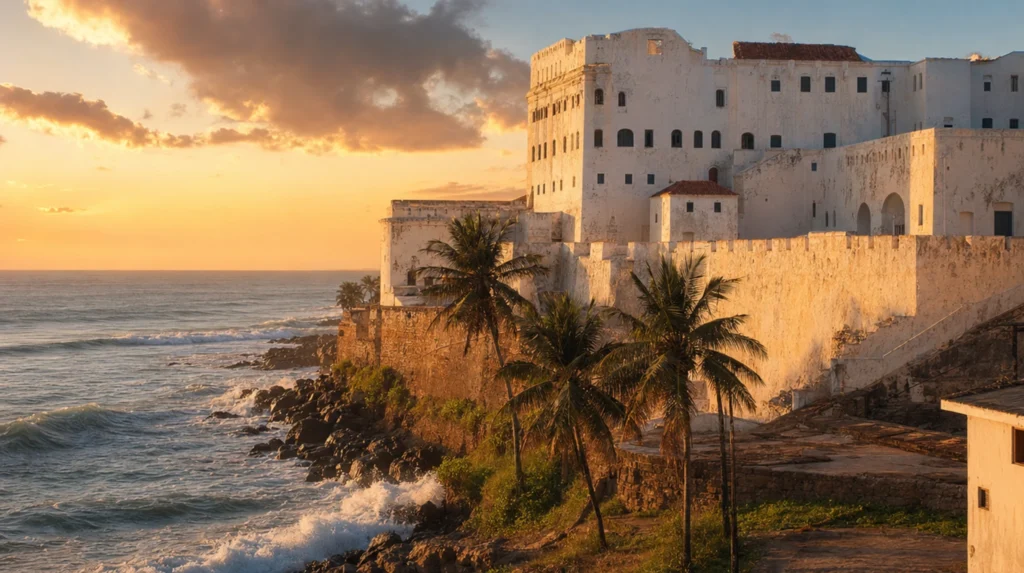
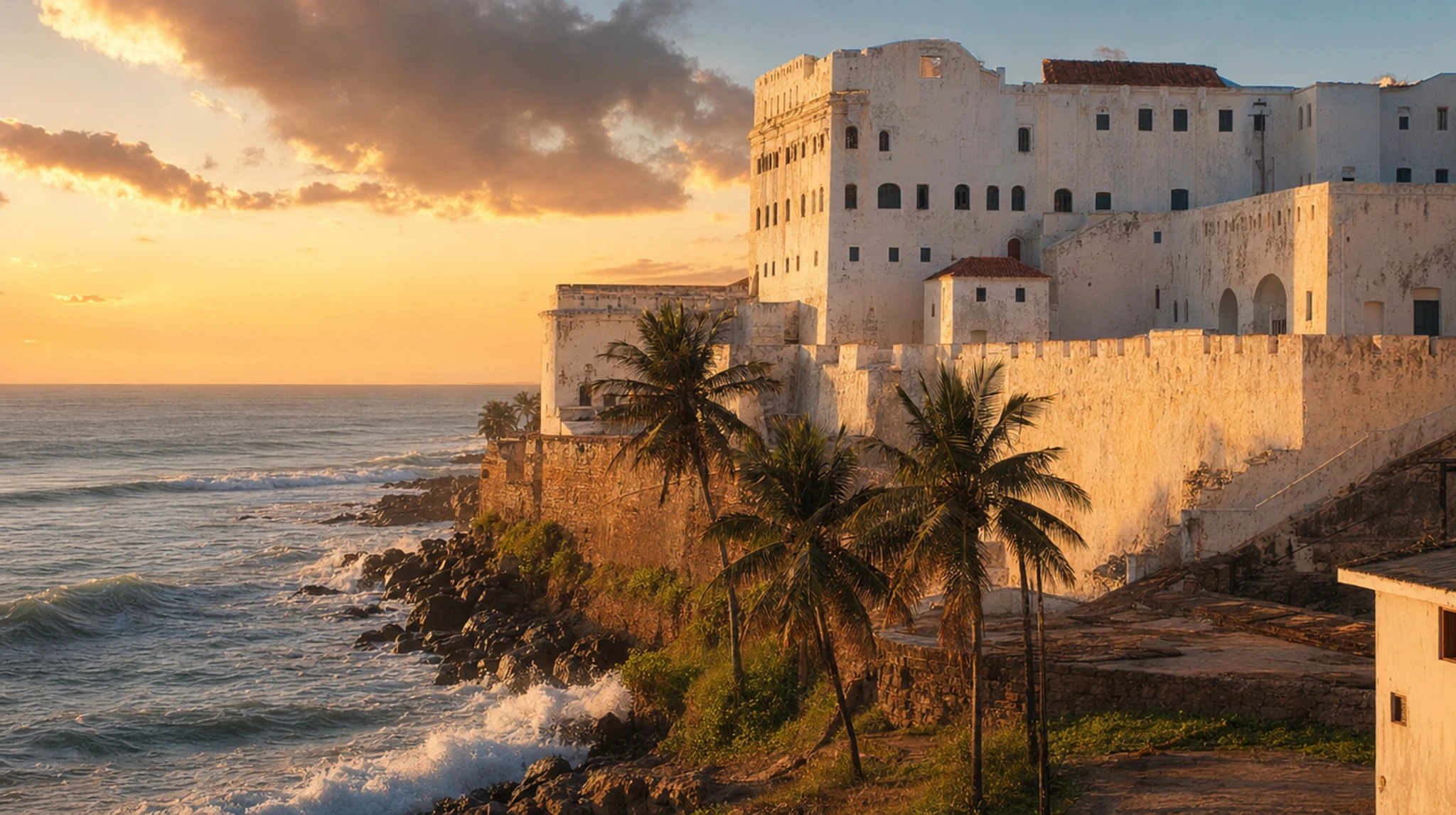
Culturally Ghana is anchored by two powerful threads. The Ashanti Kingdom, centred on Kumasi and still headed by the Asantehene at Manhyia Palace, remains one of Africa’s most visible living monarchies — kente cloth, adinkra symbols and the Golden Stool are not museum pieces but active institutions. Running alongside that is the Atlantic slave-trade history of the Cape Coast, where the UNESCO-listed Forts and Castles — Cape Coast Castle, Elmina’s St George’s (1482), and more than thirty smaller coastal forts — preserve the infrastructure of the transatlantic slave trade and now function as places of pilgrimage and reckoning for visitors of African descent worldwide.
The everyday draws deliver. Ghana Jollof is contested with Nigeria as West Africa’s great rice dish, waakye (rice and beans) is the national breakfast, kelewele (spiced plantain) is the street-food everyone asks for by name, and the phrase Akwaaba — welcome — is printed at Kotoka Airport, on hotel doormats and on the lips of every hospitality worker you’ll meet. Akwaaba.
🪘 Year of Return Homecoming & December Festivals 2026 — Ghana’s Diaspora Season
Ghana’s 2019 Year of Return campaign — timed to the 400th anniversary of the first enslaved Africans landing in Virginia — turned the country into the default homecoming destination for the African diaspora and seeded what has since become a permanent annual pull. The December window has been rebranded “Detty December” by returning diasporans and now centres on AfroFuture (formerly Afrochella) plus a dense calendar of concerts, gallery openings, cape-coast pilgrimages and Ashanti court visits. If you want Ghana at its loudest and most internationally connected, December is the month.
Outside December two other anchor festivals are worth building a trip around. Homowo, celebrated by the Ga Adangbe people of Greater Accra, falls in late August or early September — a harvest festival where the Ga Mantse sprinkles kpokpoi (steamed maize meal) through the streets. Panafest, the Pan-African Historical Theatre Festival, runs every other year in Cape Coast and Elmina around Emancipation Day (1 August); verify 2026 dates with the organisers before booking.
- AfroFuture 2026: 27-28 December 2026 at El Wak Stadium, Accra
- Homowo festival: late August / early September 2026, Ga Traditional Area across Greater Accra
- Emancipation Day pilgrimage: 1 August 2026, Cape Coast and Elmina
- Panafest 2026: dates vary biennially — verify with organisers
- Hogbetsotso (Anlo-Ewe migration festival): first Saturday of November at Anloga, Volta Region
Best Time to Visit Ghana (Season by Season)
Ghana is a warm-weather country year-round — temperatures rarely dip below 20°C anywhere outside the northern Harmattan nights — and the real calendar is the wet-dry cycle plus the Harmattan dust window. Two broadly distinct regimes matter: the south (Accra, Cape Coast, Kumasi, Volta) has two rainy periods separated by a short dry interval, while the north (Tamale, Mole, Bolgatanga) has a single long rainy season.
Dry / Harmattan (Dec–Feb)
The prime visitor window. Coastal Accra and Cape Coast sit at 22–33°C with low humidity and clear skies, and the northern Harmattan — a dry, dusty wind off the Sahara — cools Tamale and Mole at night to around 15°C while dusting the daytime sky hazy yellow. December concentrates the diaspora homecoming, AfroFuture, Watch Night services and Akwasidae royal festivals in Kumasi. Book accommodation 4–6 months ahead for this window.
Hot Pre-Rains (Mar–May)
Hot and increasingly humid, with temperatures rising through 25–35°C and the first major storms arriving in the south from April. March is Independence Day month — 6 March is a national holiday with parades at Black Star Square in Accra. Visitor numbers drop sharply; lodges outside Accra offer shoulder-season rates. The north stays dry and brutally hot until June; Mole game drives remain good but midday travel is demanding.
Main Rains (Jun–Aug)
The south’s main rainy season. Heavy morning storms, green landscapes and 22–30°C temperatures; Accra flooding is a real concern in low-lying areas. August brings the short break in the southern rains and the Homowo festival across the Ga Traditional Area. Emancipation Day (1 August) pulls diaspora visitors to Cape Coast and Elmina for the Panafest years, and rates in Cape Coast rise for the first two weeks of August around the pilgrimage.
Short Rains & Warm Dry (Sep–Nov)
September is the south’s short rainy season; October and November dry out into one of the year’s best-kept secrets. Temperatures sit at 23–32°C and the Hogbetsotso festival at Anloga on the first Saturday of November draws Ewe communities from across the Volta Region. Mole National Park’s wildlife concentrates around shrinking waterholes from late October and stays excellent through February — the classic northern safari window.
Shoulder-season tip: Early November delivers dry weather, low hotel rates and one of Ghana’s great traditional festivals (Hogbetsotso) before the December price spike. It is the single best-value window for first-time visitors.
Getting There — Flights & Arrival
Virtually every international visitor enters Ghana through Kotoka International Airport (ACC) in Accra. The airport’s Terminal 3, opened in 2018, hosts a full roster of European, American and intra-African carriers, and the city centre is a 30–45 minute taxi or Uber ride.
- Kotoka International (ACC) — Ghana’s primary gateway; taxis or Uber to central Accra (Osu, East Legon, Cantonments) in 30–45 minutes for roughly GHS 100–180.
- Kumasi International (KMS) — Ashanti Region domestic hub, being upgraded to full international status; 20 minutes to central Kumasi and Manhyia Palace.
- Tamale International (TML) — Northern Region gateway for Mole National Park and Larabanga; the practical airport for any northern itinerary.
Flight times: London to Accra is about 6h 30m non-stop on British Airways; New York JFK to Accra runs roughly 10h 20m on Delta; Amsterdam to Accra is approximately 6h 45m on KLM.
Airlines: Africa World Airlines and PassionAir run domestic hops; Ethiopian, British Airways, KLM and Delta cover long-haul.
Visa / entry: An eVisa is required for most visitors; stays issued for up to 90 days. Yellow fever vaccination is mandatory and certificates are checked at immigration.
Getting Around — Tro-Tros, STC Buses & Domestic Flights
Ghana has no passenger rail of note — long-distance trains were phased out decades ago and the Accra–Tema suburban rail does not reach tourist destinations. Long-distance travel runs on air-conditioned STC and VIP inter-city buses between the big cities, tro-tros (privately operated shared minivans) for everything shorter, and two reliable domestic airlines that collapse Accra-to-Tamale from a full-day drive to a 70-minute flight.
- Accra → Kumasi (road): approximately 4h 30m, 250 km via the N6 highway.
- Accra → Cape Coast (road): roughly 3 hours, 165 km on the N1 coastal highway.
- Accra → Tamale (domestic flight): approximately 1h 10m with Africa World Airlines or PassionAir.
- Tamale → Mole National Park (road): about 3 hours on a mostly tarred road via Larabanga.
Inter-city buses: STC (State Transport Company) and VIP Jeoun Transport run air-conditioned coaches between Accra, Kumasi, Tamale, Cape Coast and Takoradi. Typical one-way fares are GHS 150–280 depending on distance; book a day ahead at the terminal or online.
Tro-tros: The ubiquitous Nissan-Urvan minivans are cheap (GHS 5–25 within Accra), depart when full, and are the default local option. Fine for daylight travel around Accra, Kumasi and Cape Coast; less comfortable for long intercity runs.
Ride apps: Uber, Bolt and Yango operate across Accra, Kumasi and Takoradi. Fares within Accra run GHS 25–80 for most city trips.
Navigation apps: Google Maps is reliable in Accra, Kumasi and along the coast; Maps.me offline maps are useful in the north and around Mole.
Top Cities & Regions
📍 Map of Ghana: Every Place in This Guide
🏙️ Accra
Ghana’s coastal capital is the Pan-African nerve centre of the moment — a metro of roughly 2.6 million where Year of Return diasporans, tech founders and independence-era monuments share one grid. Osu, Labone and East Legon hold the restaurants; Jamestown delivers the colonial and fishing-fleet history; Makola Market concentrates the commerce. Food: jollof, waakye, kelewele, banku with tilapia.
- Kwame Nkrumah Mausoleum and Memorial Park in the city centre
- Jamestown walking tour with Ussher Fort and the old lighthouse
- Makola Market for fabric, spices and the full commercial texture of the city
👑 Kumasi
The Ashanti Region capital — metro population roughly 3.4 million — is the cultural heart of Ghana and the seat of the Asantehene. Manhyia Palace is both royal court and museum; Kejetia Market is one of West Africa’s largest; and the UNESCO-listed Asante Traditional Buildings in surrounding villages preserve 17th-century courtyard-house architecture. Food: fufu with light soup, kontomire stew, abenkwan.
- Manhyia Palace Museum and Akwasidae royal festival viewing
- Kejetia (Central) Market — one of West Africa’s largest
- Asante Traditional Buildings UNESCO cluster around Besease and Ejisu
⛓️ Cape Coast & Elmina
The emotional centrepiece of any Ghana trip. Cape Coast Castle and Elmina’s St George’s (Portuguese-built 1482, the oldest surviving European structure south of the Sahara) sit above the Atlantic surf and preserve the “Door of No Return” that funnelled the Middle Passage. Both are UNESCO-listed and active pilgrimage sites; allow a full day for each. Kakum canopy walk inland adds counterweight. Food: red red, grilled tilapia, banku.
- Cape Coast Castle guided tour including the Door of No Return
- Elmina Castle (St George’s, 1482) — the first European coastal fort south of the Sahara
- Kakum National Park canopy walkway (seven rope bridges, 40 m above the rainforest floor)
🐘 Mole National Park
Ghana’s largest protected area — 4,577 km² of Guinea savannah in the Savannah Region — and the country’s flagship wildlife destination. Mole is unusual in African safari terms because elephants can be tracked on foot with an armed ranger as well as by vehicle, and the main Mole Motel terrace overlooks a waterhole where elephants drink most afternoons. Roan antelope, kob, warthog, baboons and more than 300 bird species are resident. Combine with the 13th-century Larabanga mud-and-stick mosque en route and the Mognori eco-village canoe trips nearby.
- Walking and vehicle safaris with elephant and antelope
- Larabanga Mosque — one of West Africa’s oldest mud-and-stick mosques
- Mognori eco-village river canoe trips with community guides
💧 Volta Region & Wli Falls
Ghana’s waterfall, mountain and monkey-sanctuary region on the Togo border — Ewe heartland and the greenest corner of the country. Wli Waterfalls near Hohoe is described as the tallest waterfall in West Africa; Mount Afadja is Ghana’s highest peak; and the Tafi Atome Monkey Sanctuary lets visitors feed semi-habituated Mona monkeys that are considered sacred by the local community. Lake Volta’s eastern shore offers ferry crossings and overnight trips. Food leans to akple with okra stew and banku with tilapia.
- Wli Waterfalls upper and lower falls hike
- Mount Afadja summit hike from Liati Wote village
- Tafi Atome Mona monkey sanctuary community visit
🕌 Tamale
The Northern Region capital — Ghana’s Islamic-influenced north and the practical gateway to Mole National Park and the Larabanga Mosque. Tamale is culturally distinct from the Akan south: Dagomba, Mamprusi and Gonja traditions dominate, the local cuisine centres on TZ (tuo zaafi, a stiff porridge) with ayoyo leaves, and the Central Mosque anchors Fridays across the city. Lower prices, fewer tourists and a very different Ghana from the coast.
- Tamale Central Mosque and the old quarter
- Aboabo market and the Tamale Cultural Centre
- Gateway to Mole National Park (3h road) and Larabanga Mosque
Ghanaian Culture & Etiquette — What to Know Before You Go
Ghana is a mosaic of more than 100 ethnic communities, with Akan (Ashanti, Fante, Akuapem), Ewe, Ga Adangbe and Mole-Dagbani the largest. The south is predominantly Christian, the north predominantly Muslim, and traditional practices — libations, chieftaincy, harvest and lunar festivals — remain active. English is official; Twi functions as a de facto lingua franca. Visitors will hear Akwaaba (welcome), Medaase (thank you) and Ete sen? (how are you?) within an hour of arrival.
The Essentials
- Greet before transacting. Shake hands with a slight head bow, ask about health and family, and only then raise the business at hand. Skipping the greeting is the most visible faux pas visitors make.
- Use your right hand. Eating, passing money and handing gifts happens with the right hand or both hands; the left is reserved for hygiene and its use reads as insulting.
- Dress modestly off the beach. Covered shoulders and knees are the baseline in Muslim northern cities (Tamale, Bolgatanga) and at traditional events.
- Ask before photographing people, chiefs, fetish priests or shrines. A tip of GHS 10–20 is standard at markets and cultural sites.
- Tipping is welcomed but not mandatory — 5–10% at restaurants if no service charge, GHS 30–50 per day for guides.
Chieftaincy & Castle Visit Etiquette
- At Manhyia Palace and other royal courts, remove your hat and sunglasses, and do not cross your legs while seated before the chief.
- At Cape Coast and Elmina Castles, follow your guide’s lead on silence in the male and female dungeons — these are active memorial spaces, not photo stops.
- Pouring libations (a splash of schnapps or palm wine to the ancestors) begins many formal events; stand quietly until it is done.
- Do not point with your index finger — use your whole hand or your chin. Pointing with the left hand compounds the rudeness.
A Food Lover’s Guide to Ghana
Ghanaian food divides roughly along the north-south line. The south runs on rice, plantain, cassava and seafood: jollof rice, waakye, banku, kenkey, kelewele and red red are the everyday plates, with fresh tilapia grilled over charcoal the default Friday night. The north runs on millet, sorghum and guinea fowl: tuo zaafi (TZ), ayoyo soup and guinea-fowl stews anchor the plate. Expect to pay GHS 25–60 for a street-food meal, GHS 80–180 for a mid-range Accra restaurant dinner, and GHS 300+ at the fine-dining restaurants in Osu, Labone and East Legon. Ghana Jollof, incidentally, is the subject of the region’s most famous culinary rivalry — Ghanaians and Nigerians each claim to make the superior version, and the debate is a national sport.
Must-Try Dishes
| Dish | Description |
|---|---|
| Jollof rice | Ghana’s signature one-pot tomato-and-pepper rice — smoky, spicy and rice-grain-separate. The centrepiece of every celebration, and the permanent battleground of the Ghana-Nigeria Jollof Wars. Served with fried plantain, chicken or grilled tilapia. |
| Waakye | The national breakfast — rice and black-eyed peas cooked together with dried millet leaves that tint the grains a distinctive purple-brown. Served with shito (pepper sauce), boiled egg, gari (cassava grits), spaghetti and fried plantain at “waakye joints” from dawn to about midday. |
| Banku & tilapia | The classic coastal plate — a fermented corn-and-cassava dough (banku) eaten by hand alongside a whole grilled tilapia with pepper sauce and fresh shito. Accra’s Osu and Labadi beachfront pepper-soup joints are the benchmark. |
| Fufu & light soup | The Ashanti interior plate — pounded cassava and plantain (or yam) formed into a soft dough and eaten with light tomato-and-chilli soup containing goat, chicken or bushmeat. Fufu is swallowed, not chewed; the soup is fiery. |
| Kelewele | The country’s most beloved street snack — ripe plantain cubes tossed with ginger, chilli, nutmeg and clove, then deep-fried and sold in paper cones for GHS 5–15. Best at dusk from kelewele stands across Accra. |
| Red red | Coastal bean stew — black-eyed peas simmered with palm oil, onion, tomato and chilli, served with fried plantain. The name refers to the red palm oil and red peppers. A vegetarian staple across Ghana. |
Chop Bars, Market Stalls & Waakye Joints
Ghana’s food scene lives in informal settings far more than in restaurants. Chop bars — open-air, canopy-shaded cookshops with plastic stools and laminated menus on a wall — serve the everyday hot lunch of fufu, banku and rice-based plates for GHS 25–50. Waakye joints are morning-only institutions where the rice-and-beans is ladled from enormous aluminium pots and eaten from plastic-bag-lined bowls. Accra’s Osu Oxford Street, Labone and Cantonments corridors hold the sit-down restaurant scene, while Kumasi’s Adum area and Tamale’s Aboabo are the markets to eat around. Chain-wise, Papaye Fast Food and Pizza Inn are the cheap national staples.
- Chains and stops: Papaye Fast Food, Pizza Inn, Marwako, Kingdom Bakery, Holy Basil
- Signature items: Star Lager and Club beer, sobolo (hibiscus) drink, asaana (fermented corn drink), bofrot (fried doughnut), sobolo-ginger cocktails, pure-water sachets
- Classic roadside order: waakye + shito + egg + fried plantain for around GHS 30
Ghanaian cocoa deserves a paragraph of its own. Ghana is the world’s second-largest cocoa producer, and local bars by Niche, ’57 Chocolate and Midunu are world-class. The craft-chocolate scene is concentrated in East Legon and Cantonments; most producers run cocoa-to-bar workshops on request.
Off the Beaten Path — Ghana Beyond the Guidebook
Nzulezo Stilt Village
A UNESCO-tentative-listed village built entirely on wooden stilts over Lake Tadane in the Western Region, about three hours’ drive west of Takoradi. Residents are descendants of a Nzema community that migrated from Mali generations ago, and the only access is a 90-minute dugout canoe paddle through mangrove channels from Beyin. Homestays are possible, schooldays see children paddling canoes to class, and the entire village runs on a single wooden walkway. One of the most remarkable settled communities in West Africa and still almost entirely unvisited.
Paga Crocodile Ponds & the Slave Camp
In the far north on the Burkina Faso border, Paga is famous for two distinct experiences. The community crocodile ponds — where villagers have a centuries-old pact with the resident Nile crocodiles — allow visitors to sit beside, touch and photograph the animals under the guidance of local attendants. A short drive away, the Pikworo Slave Camp preserves the 19th-century transit station where enslaved people were chained, fed from bowls carved into the granite, and held before being marched south to the coastal castles. Sobering and essential context.
Wli Falls & Mount Afadja
The Volta Region’s twin adventure draws. Wli Waterfalls near Hohoe is described as the tallest waterfall in West Africa, with a 40-minute forest walk leading to the lower pool and a longer climb reaching the upper cascade. Mount Afadja, Ghana’s highest peak at 885 m, is a short but steep day-hike from Liati Wote village with panoramic views across the Togo border. Both combine easily from a Ho base and deliver a cooler, greener Ghana that most visitors never see.
Larabanga Mosque & Mystic Stone
On the road between Tamale and Mole National Park, Larabanga is a small village built around a 13th-century mud-and-stick mosque often described as one of the oldest surviving mosques in West Africa. The structure is whitewashed, conical-buttressed and visually striking. A short walk away sits the Mystic Stone, which local tradition says cannot be moved — road-builders are said to have abandoned multiple attempts. Stop en route to Mole and combine with the Mognori eco-village canoe trip.
Ada Foah & the Volta Estuary
About two hours east of Accra where the Volta River meets the Atlantic, Ada Foah is a barrier-island beach escape with dolphin-spotting river cruises, turtle-nesting beaches from October through March, and a handful of low-key river lodges. Weekends draw Accra’s middle class for kayaking, kite-surfing and grilled tilapia lunches; weekdays remain quiet. The cleanest, calmest beaches within striking distance of the capital.
Practical Information
The table below collects the answers travellers look up most often. Every row cites an official source. Ghana runs on a cash-and-mobile-money economy — card acceptance is widespread in Accra’s hotels and supermarkets but patchy elsewhere, and a working MTN or Vodafone MoMo account makes every transaction smoother.
| Currency | Ghanaian cedi (GHS / GH₵); 1 USD ≈ GHS 13.5 (April 2026) |
| Cash needs | Carry small-denomination GHS for tro-tros, market tips, chop bars and rural travel. Bargaining is expected in markets (aim for 60–70% of opening price). |
| ATMs | Ecobank, GCB Bank, Stanbic and Absa ATMs widespread in Accra, Kumasi, Cape Coast, Takoradi and Tamale. Withdraw inside bank branches or mall lobbies for safety. |
| Tipping | Restaurants 5–10% if no service charge; cultural and castle guides GHS 30–50; safari guides at Mole GHS 80–150 per day per guest. |
| Language | English is the official language and universally spoken by tourist-facing workers; Twi is the lingua franca, with Ga, Ewe, Fante and Dagbani regional. |
| Safety | US State Department Level 1 (Exercise Normal Precautions) for Ghana overall, with specific caution for border areas with Burkina Faso. |
| Connectivity | MTN SIM from GHS 50 with a solid data bundle; Airalo eSIM from USD $4.50. 4G covers all major cities and Mole; 3G elsewhere. |
| Power | Type D and Type G plugs (UK-style three-pin dominant); 230V / 50Hz. |
| Tap water | Not drinkable; stick to sachet water (“pure water”, GHS 0.50 per sachet) or bottled. Hotels provide filtered refill stations. |
| Healthcare | Private hospitals in Accra (37 Military, Nyaho Medical, Trust Hospital) are competent; public system is overstretched. Yellow fever vaccination required on entry; malaria prophylaxis essential year-round. |
Budget Breakdown — What Ghana Actually Costs
💚 Budget Traveller
USD $40–75 (GHS 540–1,000) per day covers a hostel-and-public-transport trip. Hostel dorm beds run GHS 150–300 in Accra and GHS 120–250 in Cape Coast and Kumasi. STC buses between major cities cost GHS 150–280. Chop bars and waakye joints keep daily meals under GHS 80 total, tro-tro fares within Accra run GHS 5–25, and a castle guided tour at Cape Coast or Elmina is GHS 80–120 per visitor. A shared STC trip plus two nights at Mole Motel with a shared safari sits comfortably under the USD $75 ceiling.
💙 Mid-Range
USD $180–350 (GHS 2,400–4,700) per day is a realistic couple’s mid-range budget. A 3★ Accra hotel in Osu or East Legon runs GHS 900–1,800 per night; bistro dinners with wine come in at GHS 200–400 per head; and a private driver with a 4×4 for a three-day Cape Coast loop costs USD $150–220 per day all-in including fuel. Domestic flights between Accra, Kumasi and Tamale run USD $80–140 one-way; Mole Motel chalets with private balconies over the waterhole are USD $150–220.
💜 Luxury
From USD $650 (GHS 8,800) per day upward, effectively uncapped. Kempinski Hotel Gold Coast in Accra, Villa Monticello and Movenpick Ambassador run USD $350–600 per night; Zaina Lodge at Mole is USD $400–600 per guest all-inclusive; and fine-dining at Buka, Skybar 25, Chez Clarisse or Santoku in Accra runs GHS 600–1,200 per person before wine. A private 4×4 with dedicated driver-guide for a ten-day Accra–Kumasi–Cape Coast–Mole loop runs approximately USD $2,800–3,800 all-in.
| Tier | Daily (USD) | Accommodation | Food | Transport |
|---|---|---|---|---|
| Budget | $40–75 | Hostel dorm GHS 150–300 | Chop bars GHS 50–80 | Tro-tros + STC buses |
| Mid-Range | $180–350 | 3★ hotel GHS 900–1,800 | Bistro mains GHS 200–400 | Private driver + domestic flights |
| Luxury | $650+ | 5★ hotel USD $350–600 | Fine dining GHS 600–1,200 | Private 4×4 + charter flights |
Planning Your First Trip to Ghana
First trips stumble in predictable ways — visitors arrive without the yellow fever certificate, miss the eVisa, or try to do Mole as a day trip from Accra (it is not). Work through the five steps below in order.
- Apply for the eVisa online at the official Ghana Immigration portal at least 5 business days before departure, and keep a PDF on your phone.
- Book a yellow fever vaccination at a travel clinic at least 10 days before departure (the certificate is required on entry) and start malaria prophylaxis the same visit.
- Reserve December and Akwasidae-week accommodation 4–6 months ahead. November and February are the best-value shoulder windows.
- Decide transport style: private driver with 4×4 for a flexible Cape Coast – Kumasi – Mole loop (USD $150–220 per day) versus STC buses plus domestic flights for half the cost but less flexibility.
- Pick up an MTN SIM and register mobile money on arrival — it is the country’s default payment rail.
Classic 12-Day Itinerary: 2 days Accra arrival and city → 2 days Cape Coast and Elmina (slave castles plus Kakum) → 2 days Kumasi (Manhyia Palace and Kejetia market) → 1 day Tamale transit → 2 days Mole National Park → 1 day Volta region detour → 2 days Accra departure buffer including AfroFuture if travelling in December.
Frequently Asked Questions
Is Ghana expensive to visit?
It is one of Africa’s better-value destinations. Everyday costs — chop bars, tro-tros, STC buses and 3★ hotels — are cheap; backpackers live well on USD $40–75 (GHS 540–1,000) per day. International flights are the single biggest expense. Accra’s 5★ hotels and fine-dining rival any capital, but stepping down a tier delivers excellent value.
Do I need to speak Twi?
No — English is Ghana’s official language and is spoken fluently by nearly every tourist-facing worker. A few Twi phrases earn goodwill: Akwaaba (welcome), Medaase (thank you), Ete sen? (how are you?), Eye (it’s good). In the north, try Dagbani equivalents.
Is Ghana Jollof really better than Nigerian Jollof?
Depends which side of the Volta you stand on. Ghana Jollof is smokier, drier and rice-grain-separate, cooked on wood fires; Nigerian Jollof tends wetter and more tomato-forward. The rivalry is one of the region’s great culinary debates. Try both. Pick a side at your peril.
Is Ghana safe for solo travellers?
Yes — Ghana is one of the safest countries in West Africa. The US State Department rates it Level 1 (Exercise Normal Precautions) overall, with specific caution for the Burkina Faso border area. Use Uber after dark in Accra and solo travel (including female solo) is widely practised.
When is the best time to visit Ghana?
The Dry / Harmattan season from December through February is the prime window — low humidity, clear skies and the full diaspora festival calendar. November is the best-value shoulder month. Mole game viewing peaks November through March.
Can I get by as a vegetarian or vegan?
Yes. Red red (bean stew with plantain), kontomire stew, abomu (ground-nut paste), kelewele and vegetarian jollof are standard chop-bar fare. Accra has a growing vegan scene — Holy Basil, Gold Coast Restaurant and East Legon’s health-food spots. In the rural north, TZ with ayoyo soup is a staple vegetarian plate.
Is visiting the slave castles emotionally difficult?
Yes — and that is the point. Cape Coast Castle and Elmina are active memorial sites. Guides take visitors through the male and female dungeons, condemned cells and the Door of No Return. Plan a quiet evening afterwards and pair with Kakum canopy walk the following day as counterweight.
Ready to Explore Ghana?
From Cape Coast Castle’s Door of No Return to the Asantehene’s Akwasidae court at Manhyia, Mole’s walking elephants and AfroFuture’s end-of-year stage lights, Ghana delivers more cultural weight per fortnight than almost any country in West Africa. Apply for the eVisa early, get the yellow fever certificate, pack malaria prophylaxis, and leave room for the one extra day at Ada Foah you did not see coming. Akwaaba.
Explore More
More country guides you might like
Plan your trip to Ghana
The booking tools we use ourselves. FFU may earn a commission at no extra cost to you.
Plan & book your trip to Ghana
Booking through these searches supports our guides at no extra cost to you.