
Arequipa, Peru: White City, Colca Canyon & Volcanic Landscapes
Explore Peru’s most strikingly beautiful city and gateway to dramatic Andean scenery where volcanoes dominate the horizon
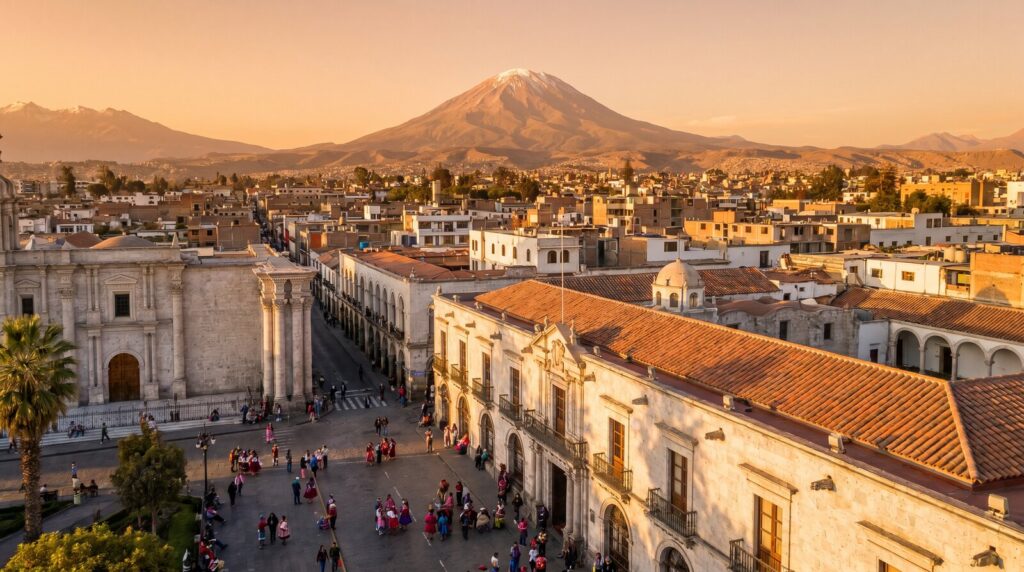
Arequipa is one of South America’s most visually striking cities. The entire historic center appears to have been carved from cream-white volcanic stone (sillar)—giving it the nickname “La Ciudad Blanca” (the White City). This isn’t marketing hyperbole: the architectural homogeneity created by building material and colonial design really does create an almost otherworldly aesthetic. But Arequipa transcends architectural beauty through its location. Perched at 7,625 feet above sea level on the Altiplano (high plateau), the city is surrounded by volcanoes—eight peaks visible from the city itself, including the active Misti volcano that dominates views from nearly every vantage point. This combination of architectural elegance and dramatic natural surroundings makes Arequipa Peru’s most compulsively photogenic city, beloved by visitors and photographers alike.

What You’ll Discover
- White City Architecture: Sillar Stone & Spanish Colonial Design
- Religious Heritage: Convents & Spiritual Traditions
- Volcanoes: Geological Drama & Climbing Opportunities
- Colca Canyon: Second Deepest Canyon & Condor Country
- Local Culture: Food, Traditions & Regional Identity
- Practical Guide: Altitude & Regional Exploration
White City Architecture: Sillar Stone & Spanish Colonial Design
The architectural coherence of Arequipa stems from building material and historical decisions. When Spanish colonizers founded Arequipa in 1540, they selected the sillar stone as primary building material—a soft, easily carved volcanic rock found locally. This stone’s pale color created a distinctive aesthetic. Moreover, the city’s relative isolation from Lima (Peru’s capital and primary colonial authority) allowed Arequipa to develop its own architectural traditions, creating a stylistic identity distinct from the rest of Peru. The result is a colonial city that feels cohesive in ways that Lima, with its varied architectural periods and styles, does not.
Walking through Arequipa’s historic center is a visual feast. Every street corner offers compositions of white stone facades with dark volcanic rock trim creating striking geometric patterns. Doorways feature elaborate carvings. Rooflines show distinctive architectural vocabulary. The Plaza de Armas (main square) anchors the city—surrounded by arcaded buildings of perfect white stone with the Misti volcano framed dramatically beyond. The craftsmanship evident in even simple buildings reflects a culture that valued beauty in daily structures.
Sillar Quarries Tour
Visit working quarries to see artisans extracting and carving stone. Understand the labor involved in creating architectural elements. Shops sell small carvings and decorative pieces. Educational and authentically shows living tradition.
Architectural Walking Tours
Guided tours explore the historic center identifying architectural styles, elements, and historical context. Reveals details invisible to casual walking. Professional guides explain the symbolism and craftsmanship embedded in structures.
Casa Moral
Museum in a restored 18th-century mansion showcasing period furnishings and architecture. Glimpses life during Arequipa’s colonial prominence. Intricate stone carvings exemplify sillar craftsmanship.
Photography Vantage Points
Plaza de Armas at sunrise, Carmen Alto viewpoint for elevated perspectives, various street corners offer photogenic compositions. Arequipa rewards photography—bring good camera.
Religious Heritage: Convents & Spiritual Traditions
Arequipa’s religious heritage shaped the city profoundly. The Cathedral dominates the Plaza de Armas—a massive structure requiring multiple columns to support its weight and height. Its baroque facade exemplifies Spanish colonial religious architecture. But more remarkable are the convents—particularly Santa Catalina and San Francisco—which served as both spiritual centers and seats of power during colonial times.
Visiting these religious spaces reveals not just architecture but living tradition. The convents continue functioning as religious communities, not merely museums. Nuns still pray in chapels, tend gardens, and maintain rituals that have persisted for centuries. This living continuity makes experiencing the spaces feel sacred in ways that fully secularized historic sites don’t.
Santa Catalina Convent
Massive compound occupying entire city block. Colorful architecture (brilliant whites, blues, oranges), intimate courtyards, museum exhibits exploring monastic life. Allow 2-3 hours. Accessible to visitors respecting sacred spaces.
San Francisco Church & Catacombs
Beautiful baroque church featuring intricate carvings. Underground catacombs reveal burial practices. Museum explores religious art and iconography. Guided tour recommended for full understanding.
Cathedral
Massive church dominating Plaza de Armas. Baroque style with intricate architectural details. Enter respectfully during non-service times. The scale and craftsmanship communicate the importance of religion in colonial hierarchy.
Religious Art Museum
Exhibits exploring religious iconography, colonial religious practices, and spiritual traditions. Contextualizes the religious buildings by examining the beliefs they embodied.
Volcanoes: Geological Drama & Climbing Opportunities
Arequipa sits in a volcanic landscape. Eight major volcanoes are visible from the city itself, including the iconic Misti volcano dominating the skyline at 19,100 feet. Volcan Chachani, at 19,931 feet, is a popular (non-technical) climbing destination for visitors to Arequipa. Most impressive is Volcan Picchu Picchu, visible on clear days rising dramatically from the high plateau. These volcanoes aren’t historical curiosities—they’re active geological features that have shaped and continue to shape the landscape.
Climbing Chachani is a popular activity for acclimatized visitors. The climb doesn’t require technical climbing skills but does require significant physical exertion at altitude. Most climbers depart at 2 AM for a pre-dawn ascent, reaching the summit as dawn breaks. The views from the top—looking across the volcanic landscape toward distant peaks—justify the physical effort. Other climbers attempt Misti, though it’s slightly more technical and requires more experience.
Chachani Climbing
19,931-foot volcano accessible by hiking (non-technical climbing). Full-day guided climbs depart early morning. Requires good acclimatization. Pre-dawn summit arriving at sunrise. Professional guides handle logistics and safety.
Misti Climbing
19,100-foot volcano visible from the city. More technical than Chachani. Requires rope work and climbing experience. Spectacular views from summit. Generally takes 2 days including acclimatization.
Volcanic Landscape Tours
Day tours exploring volcanic formations, lava flows, and geological features without requiring climbing. Educational, less physically demanding, still revealing the dramatic geological forces shaping the region.
Viewpoint Visits
Various elevated locations around Arequipa provide volcano views. Early morning offers clearest views before afternoon clouds develop. Many viewpoints accessible by short hikes from the city.
Colca Canyon: Second Deepest Canyon & Condor Country
Approximately 100 miles northwest of Arequipa lies Colca Canyon—one of the world’s deepest canyons, roughly twice as deep as the Grand Canyon. The canyon was carved by the Colca River through thousands of years of erosion. The landscape is dramatic: terraced agricultural fields clinging to steep canyon walls show pre-Incan and Incan engineering. Small villages within the canyon represent some of Peru’s most isolated communities, many maintaining indigenous traditions despite centuries of Spanish colonial influence.
Most visitors experience Colca through multi-day treks combining hiking, cultural visits to canyon villages, and natural hot springs. Full-day tours allow experiencing the main viewpoint and a village. The 2-3 day treks descend deep into the canyon, encountering more isolated communities and more dramatically revealing the canyon’s scale and beauty.
Full-Day Colca Tour
Visit Cruz del Condor viewpoint (condor spotting), touring a canyon village, visiting local markets. Tour departs early from Arequipa. Includes lunch and condor-spotting time. Good introduction to the canyon.
Multi-Day Canyon Treks
2-3 day hikes descending into canyon depths. Trekking past Incan terraces, visiting isolated villages, soaking in natural hot springs. More physical but more immersive. Guided treks necessary for route and safety.
Chivay Town
Main town in canyon rim. Thermal hot springs nearby. Base for experiencing local culture. More tourist facilities than canyon villages. Good intermediate destination between Arequipa and deep canyon.
Incan Terraces
Pre-Columbian agricultural engineering visible throughout canyon. Terraces prevent erosion and facilitate irrigation in high-altitude harsh environment. Walking among terraces provides perspective on indigenous engineering genius.
Local Culture: Food, Traditions & Regional Identity
Arequipa has distinct regional identity within Peru. Arequipeños (people from Arequipa) view themselves as culturally distinct from Limenos (people from Lima). The region’s indigenous heritage, Spanish colonial history, and relative geographic isolation created unique traditions. This cultural distinctiveness manifests in food, celebrations, and values.
Market Exploration
Mercado San Camilo is Arequipa’s central market. Fresh produce, prepared foods, local products, and raw ingredients. Wandering reveals local food culture. Try local snacks—empanadas, tamales, fresh fruit juices.
Restaurant Scene
Everything from simple markets to upscale restaurants. Try cevicherías for fresh fish dishes, local establishments for rocoto relleno and adobo. Restaurants range from dirt-cheap to expensive—excellent food at all price points.
Local Traditions
Arequipa maintains strong traditions around celebrations, religious observances, and cultural festivals. If traveling during local celebrations (check dates), experiencing authentic festivities provides deeper cultural insight.
Textile & Craft Shopping
Local artisans produce textiles, alpaca products, and handicrafts. Unlike highly commercialized craft markets in major tourist areas, Arequipa’s craft culture remains more authentic. Support local artisans by purchasing directly when possible.
Practical Guide: Altitude & Regional Exploration
Altitude Management
- Arrive in Arequipa before higher-altitude destinations (Colca Canyon is even higher)
- Spend first day acclimatizing with light activities
- Drink extra water throughout the day
- Avoid alcohol first day; minimize alcohol throughout stay
- Eat light meals your first day
- Consider coca tea (traditional Andean remedy)
- Altitude medication (acetazolamide/Diamox) available by prescription
Regional Exploration Routes
From Arequipa, you can visit Colca Canyon, climb volcanoes, explore the Altiplano, or continue south to Puno and Lake Titicaca. The city serves as perfect base for southern Peru exploration. Plan 3-5 days in Arequipa depending on your interests.
Experience the White City & Volcanic Drama
Arequipa rewards slow exploration. Walk the white stone streets observing architectural details. Visit convents and churches understanding religious history. Climb a volcano feeling your body adapt to extreme altitude. Trek into Colca Canyon seeing condors soar above canyon depths. Experience local food traditions connecting you to regional culture. Arequipa is photogenic, historically rich, and geologically dramatic—a complete Andean experience compressed into one region.