
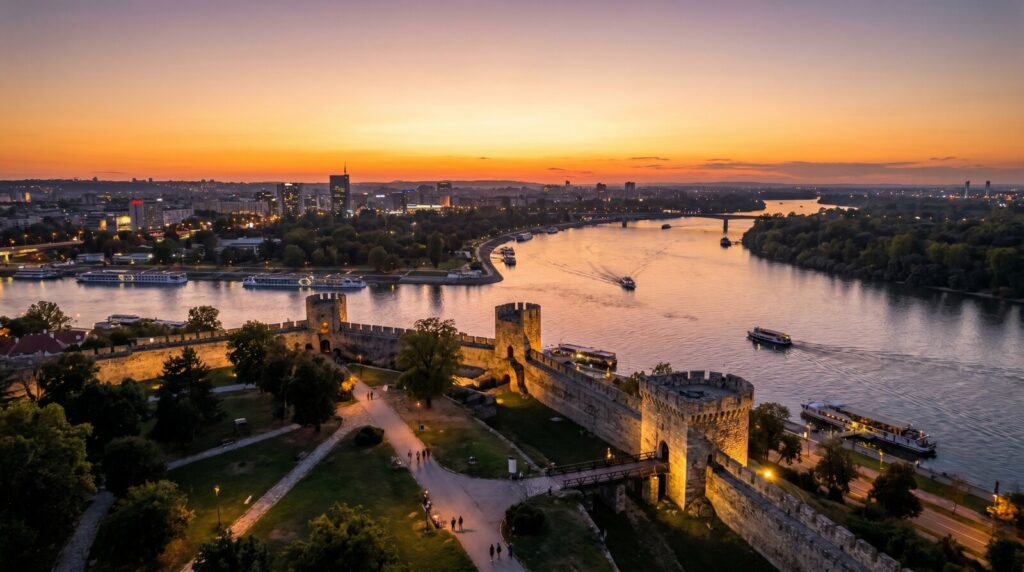
Belgrade, Serbia: Danube Fortress, Legendary Nightlife & Kafana Culture
Where Balkan intensity meets riverine beauty, and nights never end
Belgrade hits you immediately with its raw energy. The city doesn’t apologize for itself or perform demurely for tourists. It lives loudly, drinks deeply, argues passionately, and loves fiercely. Sitting where the Danube and Sava rivers converge, this Balkan capital has been conquered, destroyed, and rebuilt more times than any European city should endure. Yet somehow it refuses to become a museum piece. Instead, it pulses with creative defiance—street art explodes across Communist-era buildings, underground clubs throb until dawn, and kafanas (traditional taverns) overflow with locals sharing rakija and arguments about politics, sport, and life.

This is not a polished capital like Vienna or Prague. Belgrade is rough around the edges, geographically dramatic, and blessed with an authenticity that comes only from genuine hardship transformed into cultural resilience. The Danube fortress of Kalemegdan watches over it all, standing as a literal and symbolic sentinel above the confluence, visible from everywhere. To experience Belgrade is to understand the Balkans—its turbulent history, its artistic explosion, its unpretentious joy in living.
Where to Go in Belgrade
Kalemegdan Fortress: Riverside Guardian
Kalemegdan rises from the confluence of the Danube and Sava like a stone proclamation of continuity against chaos. The fortress has evolved from Celtic fortification to Roman stronghold to Ottoman military installation to modern symbol of Belgrade’s survival. Walking its weathered walls and towers connects you physically to 2,000 years of people who stood in this exact spot, watching armies march, rivers flood, and empires rise and fall.
The fortress divides into two sections: the Lower Fortress and Upper Fortress, connected by stone passages and staircases. The Sahat Tower, the fortress’s iconic minaret-like structure, served as a watchtower for Ottoman occupiers and now stands as a melancholic reminder of centuries of foreign rule. The views from the upper ramparts encompass the entire confluence—the brown Danube flowing from the northwest, the Sava from the south, and the sprawling city beyond. On clear days, the vista extends kilometers into the Pannonian Plain.
The Military Museum occupies portions of the fortress, displaying weapons, uniforms, and military artifacts from various occupations. The Museum of Vince, featuring prehistoric pottery, adds another temporal layer. But the fortress’s true power comes from simply walking its paths, sitting on its stone walls, and feeling the accumulated weight of history seeping from the ancient walls into your consciousness.
Kafana Culture: Soul of Belgrade
To understand Belgrade, you must experience kafanas. These aren’t mere bars or restaurants—they’re institutions of Balkan social life. A kafana is a place where strangers become friends after several rakijas (fruit brandy), where music transitions from live folk to accordion-driven melancholy, and where the boundary between customer and staff dissolves into genuine human connection. The word itself carries weight: kafana means refuge, gathering place, spiritual home.
The architecture of a traditional kafana follows patterns perfected over centuries: dim lighting from bare bulbs, wooden tables worn smooth by decades of elbows, walls decorated with photographs of folk singers and handwritten jokes, and an intimate intensity despite often-crowded conditions. Kafanas are democratic spaces—lawyers sit next to construction workers, grandmothers next to teenagers, all united in the ritual of shared drink and conversation.
Ordering in a kafana requires participation, not just consumption. Specify your rakija preference (plum, apricot, walnut, grape—each region has specialties), order simple food (grilled meat, cheese, bread), and prepare for an evening that extends far beyond what you anticipated. Many famous kafanas remain family-run establishments operating for 50+ years, with ownership passing from parent to child like sacred trusts.
Kafana Code
In kafanas, songs are ordered like food. A waiter brings a list; you select songs matching your mood. A live musician performs your selection. It’s karaoke without the cringe—people sing genuinely, sometimes mournfully, always with emotional honesty.
Rakija Ritual
Rakija is sipped, never shot. It’s contemplative. Strong rakija (65% proof) is normal. Tipping the glass toward your host before drinking is courtesy. Refusing a second glass might offend. Local rakija often surpasses commercial bottles dramatically.
The Danube Waterfront: Floating Culture
The Danube’s relationship with Belgrade is complicated by geography and metaphor. The river defined the city’s strategic importance but also created vulnerability to flooding and invasion. Modern Belgrade celebrates this complexity through its waterfront culture. The Danube’s north bank hosts numerous splavovi (floating river clubs), which are literally barges transformed into restaurants, bars, and nightclubs.
Splavovi represent Belgrade’s creative resourcefulness. When building restrictions limited expansion, entrepreneurs simply built on water. Now, dozens of these floating establishments create a parallel city along the river. Some are elegant, others rowdy, all authentically Belgrade. The experience of dining or dancing on a barge floating on the Danube at midnight, city lights reflecting in the water, creates memories that solidify into life-defining moments.
Daytime river activities are equally appealing. Beach clubs operate along the Sava, particularly in the Ada Ciganlija area—a green space with artificial beaches where Belgradians escape summer heat. Kayaking, stand-up paddleboarding, and simple swimming occur alongside beer consumption and social lounging. It’s casual, unpretentious, and deeply refreshing.
Bohemian Neighborhoods: Art & Resistance
Belgrade’s neighborhood character varies dramatically across districts. Dorćol, the old trading quarter, pulses with bohemian energy. Street art covers nearly every surface with politically charged murals, tributes to musicians, and abstract explosions of color. The buildings are aging gracefully, their peeling facades hosting cafes, galleries, and vintage shops where young creatives gather. It feels authentically lived-in rather than gentrified into museum status.
Knez Mihailova Street, Belgrade’s main pedestrian thoroughfare, marches uphill toward fortress and democracy. During day, it’s shopping and sightseeing. At night, street performers entertain crowds, musicians busking pull genuine emotion from instruments, and the street transitions into an open-air social gathering. The energy builds as evening progresses.
Beton Hala (“Concrete Hall”) develops around an abandoned Communist-era pavilion, transformed by artists into an alternative cultural space. Galleries, experimental music venues, and street food operate in semi-legal creative chaos. The Belgrade establishment largely ignores the area, allowing genuine artistic expression to flourish. It represents the city’s creative resistance to commercialization.
Legendary Nightlife: Nights Without End
Belgrade’s nightlife doesn’t begin—it ignites. Dinner at 10 PM is standard. Clubs fill around midnight. By 3 AM, the city’s energy peaks toward crescendo. By 6 AM, dedicated clubbers have moved to even more underground venues. The city has produced world-class techno and house music DJs. Electronic music runs through Belgrade’s veins like rakija through kafana conversations.
The club scene divides between massive warehouse spaces hosting international DJs and intimate clubs where local selectors explore avant-garde sounds. Both thrive simultaneously. The warehouse clubs draw tourists and serious dancers. The intimate clubs preserve artistic credibility. Neither dominates. LGBT clubs operate openly and happily, with more tolerance than many Western European cities offer. This speaks to Belgrade’s complicated openness—traditional in some ways, radically progressive in others.
But Belgrade’s nightlife extends far beyond clubs. The entire city becomes entertainment after dark. Streets fill with socializing humans. Rooftop bars overlook Kalemegdan and the Danube confluence. Street food carts serve cevapcici (grilled meat) and burek at 4 AM. The night becomes a vertical and horizontal experience—clubs below, rooftops above, streets between, all simultaneously active and interconnected.
Historic Landmarks: Layers of Time
The Church of Saint Sava marks Belgrade’s skyline with its enormous white dome. Built on the location where a revered Serbian saint’s remains were burned by Ottoman occupiers in the 16th century, the church represents spiritual resilience. Construction began in 1935, was interrupted by war, and wasn’t completed until 2004. The interior contains staggering artistic achievement—mosaics, frescoes, and iconography spanning the entire building. It’s spiritually moving regardless of religious belief.
The National Museum contains art from Serbian history, European paintings, and artifacts tracking the region’s tumultuous past. The Yugoslav History Museum documents the country’s existence and dissolution through photographs and memorabilia. Walking through these exhibits clarifies just how recent Yugoslavia’s breakup was—people still living remember its existence as unified nation.
The Parliament Building, completed in 1936, represents Austro-Hungarian architectural grandeur. The old royal compound contains palaces surrounded by gardens. The Nikola Tesla Museum, dedicated to the inventor whose work fundamentally shaped modern electrical technology, contains original documents and artifacts. Museums here aren’t dusty—they tell stories about people who lived, died, created, and resisted in these exact locations.
Ready for Belgrade?
Pack comfortable shoes for endless walking. Reserve energy for late nights. Be prepared for passionate conversations about politics and sports—both are sacred. Embrace the kafana culture with genuine openness. Belgrade rewards those who engage authentically, reject judgment, and understand that beauty coexists with imperfection. The city will exhaust and exhilarate you, probably simultaneously.