
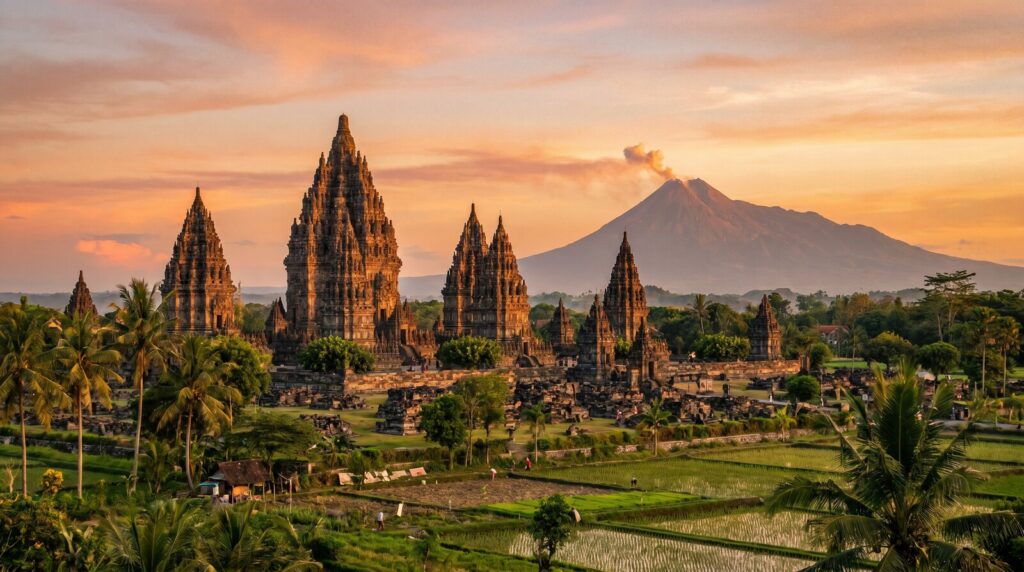
Yogyakarta, Indonesia: Borobudur Temple, Batik Art & Java’s Cultural Heart
Your Complete Guide to Yogyakarta, Indonesia
📍 In This Guide
- When to Visit Yogya ☀️
- Borobudur Sunrise 🛕
- Prambanan Temple 🏛️
- The Kraton & Culture 🎭
- Batik & Arts 🎨
- Mount Merapi 🌋
- Budget & Practical Tips 💰
When to Visit Yogya ☀️
Yogyakarta is tropical year-round with two seasons: dry (April-October) and wet (November-March). The dry season is ideal, with clear skies crucial for that Borobudur sunrise photo. June-August is peak tourist season. The wet season brings afternoon thunderstorms but mornings are usually clear — and there are far fewer tourists. Borobudur at sunrise in the wet season can be misty and atmospheric in a completely different way.

☀️ Dry Season
April-October. Clear skies, best for temple visits and Merapi views. June-August busiest.
🌧️ Wet Season
November-March. Afternoon rain, misty mornings. Fewer tourists, lower prices.
🌋 Merapi Activity
Check volcanic status before visiting. Merapi is one of the world’s most active volcanoes.
🎭 Ramayana Ballet
Performed at Prambanan May-October. Open-air setting with temples as backdrop. Book ahead.
Borobudur Sunrise 🛕
Borobudur is the largest Buddhist temple in the world — a 9th-century mandala in stone, rising from the Kedu Plain with 504 Buddha statues and 2,672 relief panels telling the story of Buddhist cosmology. The sunrise experience involves entering the grounds at 4:30am and climbing to the top stupa to watch the sun rise over volcanoes and rice paddies. The play of first light on the bell-shaped stupas, each containing a seated Buddha, is one of Southeast Asia’s most transcendent moments.
🌅 Sunrise Tour
Enter at 4:30am. $25-35 entry. Limited tickets — book through Manohara Hotel or official site.
🛕 The Temple
9 platforms, 504 Buddhas, 2,672 relief panels. Walk clockwise through each level — it tells a story.
🔔 The Stupas
72 perforated stupas at the top, each housing a Buddha. Touch a Buddha’s hand through the latticework for luck.
📸 Timing
Sunrise is the only option for photography. By 8am, tour groups arrive and the magic fades.
Prambanan Temple 🏛️
If Borobudur is Buddhist serenity, Prambanan is Hindu drama. This 9th-century Hindu temple compound — built around the same time as Borobudur by a rival dynasty — features towering spires dedicated to Shiva, Vishnu, and Brahma. The central Shiva temple reaches 47 meters and is covered in intricate carvings depicting the Ramayana epic. During dry season, the Ramayana Ballet is performed on an outdoor stage with the floodlit temples as a backdrop — genuinely spectacular.
🏛️ Main Temples
Three main temples dedicated to Shiva (center), Vishnu, and Brahma. The Shiva temple is 47m tall.
🎭 Ramayana Ballet
May-October at the open-air theater. Traditional Javanese dance with Prambanan lit up behind. From $20.
🌅 Best Time
Late afternoon for golden light on the towers. Sunset is beautiful but crowded.
🎫 Combo Ticket
Combined Borobudur + Prambanan ticket saves money. Buy at either site. ~$40 for both.
Batik & Art Scene 🎨
Yogya is Indonesia’s art capital, and batik — the wax-resist dyeing technique — is its crown jewel. UNESCO recognized Indonesian batik as Intangible Cultural Heritage in 2009. Workshops throughout the city teach the painstaking process of applying hot wax, dyeing, and repeating. A single piece of fine batik tulis (hand-drawn batik) can take months to complete. Beyond batik, Yogya’s Jalan Malioboro is the main shopping and street food strip, lined with silver workshops, wayang puppet makers, and contemporary art galleries.
🎨 Batik Workshops
Try making your own batik at studios like Batik Winotosastro. Half-day classes from $10.
🛍️ Jalan Malioboro
Yogya’s main drag. Street vendors, batik shops, street food carts. Come at night for the full experience.
🎭 Wayang Puppets
Shadow puppet performances at the Kraton (palace). Intricate leather puppets — performances last hours.
🖼️ Contemporary Art
Yogya has a thriving modern art scene. Check Cemeti Art House and the many galleries along Jalan Prawirotaman.
Budget & Practical Tips 💰
Yogyakarta is absurdly cheap. A plate of nasi goreng costs $0.50-1, a comfortable guesthouse room $5-10, and even Borobudur sunrise entry is only $25-35. Jalan Prawirotaman (the backpacker area) has excellent budget accommodation and restaurants. Rent a motorbike ($5/day) to explore independently, or hire a driver for the day ($25-30) to cover Borobudur, Prambanan, and the countryside. Grab is available for city transport.
🏨 Accommodation
Prawirotaman guesthouses from $5/room. Mid-range boutique hotels $15-30. The area has great cafés too.
🛵 Transport
Motorbike rental $5/day. Private driver $25-30/day (covers temples). Grab for city rides $0.50-2.
💰 Costs
Street food $0.50-1. Restaurant meal $2-4. Borobudur $25-35. Budget travelers: $15-25/day.
⚠️ Temple Tips
Cover knees and shoulders at temples. Sarongs available for rent at entrance. Shoes off at Borobudur.
Where ancient Java lives.
The world’s largest Buddhist temple at sunrise, Hindu spires at sunset, $0.50 noodles in between, and art that UNESCO calls a masterpiece. Yogyakarta is Java’s gift to the world.
Getting Around Yogyakarta
Yogyakarta is compact enough that the city center is walkable, but the heat and humidity make motorized transport appealing. Renting a motorbike (50,000-75,000 IDR/day) is the most flexible option for reaching Borobudur, Prambanan, and surrounding villages. Grab and Gojek ride-hailing apps are widely available and extremely affordable — a 15-minute Grab car ride costs around 15,000-25,000 IDR ($1-2 USD). Gojek motorbike taxis are even cheaper and faster in traffic.
For a uniquely Yogya experience, hire a becak (bicycle rickshaw) for short trips around the Kraton area and Malioboro — negotiate the fare before departing, and expect to pay 20,000-40,000 IDR for a 10-15 minute ride. The Trans Jogja bus system connects major sites along fixed routes for just 3,500 IDR per ride. For day trips to Borobudur (about 40 km northwest), your options range from organized tours (150,000-300,000 IDR including entry) to renting a driver for the day (400,000-600,000 IDR), which gives you flexibility to stop at lesser-known temples along the way.
Javanese Food in Yogyakarta
Yogyakarta’s food scene is one of Indonesia’s most distinctive. Gudeg, the city’s signature dish, is young jackfruit slow-cooked in coconut milk and palm sugar for hours until it turns a deep caramel brown. It’s served with rice, chicken, egg, tofu skin (krecek), and a fiery sambal. Gudeg Yu Djum and Gudeg Pawon are local institutions — try gudeg for breakfast (yes, breakfast) for the authentic Javanese experience.
Jalan Malioboro comes alive at night with angkringan — simple street stalls where you sit on low stools and point at pre-cooked dishes: fried rice packets wrapped in banana leaves (nasi kucing), satay, tempeh, and fried snacks, all for just a few thousand rupiah. Wash it down with wedang uwuh, a warm spiced drink made from cloves, cinnamon, nutmeg, and rock sugar — it’s Yogya’s answer to mulled wine. For something adventurous, seek out sate klathak in the Imogiri area — lamb satay grilled over charcoal on bicycle spoke skewers, served with nothing but salt and a squeeze of lime. The simplicity is the point, and it’s extraordinary.
Frequently Asked Questions About Yogyakarta
What is the best time to visit Yogyakarta?
May to September (dry season) offers the most comfortable weather with lower humidity and clear skies — ideal for temple visits at sunrise. June to August is peak tourist season, so book accommodation and Borobudur sunrise passes in advance. The rainy season (November-March) brings afternoon downpours but fewer crowds, lush landscapes, and lower prices. Temperatures are warm year-round (27-33°C), so the rain is really the only weather variable.
How do I visit Borobudur at sunrise?
The sunrise experience at Borobudur is the highlight of most Yogyakarta trips. You need to purchase a special sunrise ticket (around 450,000 IDR for international visitors) through the Manohara Hotel, which is located within the temple complex. Gates open at 4:30 AM, giving you time to climb to the upper terraces before dawn breaks. Arrive early to secure a spot near the central stupa. The combination of mist, ancient stone, and the emerging silhouette of Mount Merapi in the background is genuinely breathtaking.
Is Yogyakarta safe?
Yogyakarta is one of Indonesia’s safest cities for tourists. The Javanese culture is warm and welcoming, and locals are accustomed to visitors. Petty theft is uncommon but take standard precautions with valuables. The main safety consideration is Mount Merapi, an active volcano 30 km north of the city — check the current alert level before visiting the slopes, and follow local authorities’ guidance. The city itself is safe even for solo travelers and at night.
How many days should I spend in Yogyakarta?
Three to four days is ideal. Day one: explore the Kraton (Sultan’s Palace), Taman Sari Water Castle, and Malioboro Street. Day two: sunrise at Borobudur and afternoon at Prambanan temple complex. Day three: batik workshops, local food tours, and the Kotagede silver village. An optional fourth day opens up possibilities like Mount Merapi jeep tours, Jomblang Cave rappelling, or the hidden beaches of Gunung Kidul along the southern coast.
What should I wear when visiting temples?
Both Borobudur and Prambanan require modest dress — shoulders and knees should be covered. Sarongs are provided at both temples if needed, but wearing your own long pants/skirt and a t-shirt avoids queuing at the counter. Comfortable shoes with good grip are essential as temple steps can be steep and slippery when wet. A hat and sunscreen are critical for midday visits, as there is very little shade on the temple structures.