
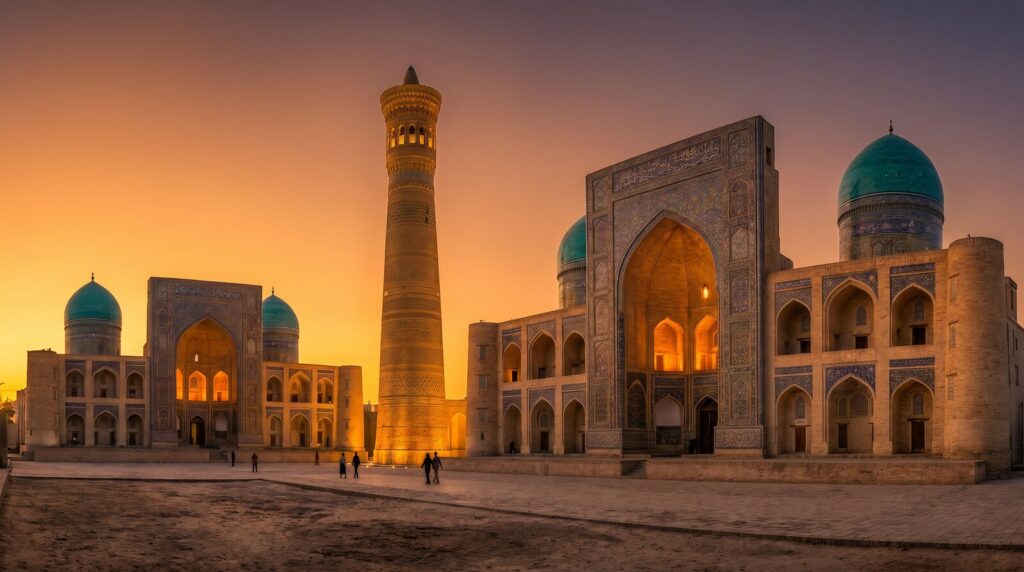
Bukhara, Uzbekistan: Silk Road Jewel, Ancient Madrasas & Desert Caravans
Ancient Silk Road crossroads where desert caravans traded precious goods, domed bazaars, and medrasas preserve Central Asian Islamic architecture and mercantile traditions
Bukhara represents the Silk Road’s spiritual and commercial center, where desert trade routes converged and merchants from China, India, Persia, and Europe exchanged goods and ideas. The city’s architecture—domed bazaars, carved turquoise tilework, Islamic geometric patterns—expresses Central Asian Islamic culture reaching aesthetic heights. Contemporary Bukhara preserves medieval urban fabric with remarkably minimal modern intrusion, allowing visitors to experience authentic medieval city remaining relatively unchanged across centuries.

The city functioned as intellectual center where scholars debated theology, mathematics, and astronomy. Multiple medrasas (Islamic teaching institutions) educated young men in Islamic law, language, and sciences. This educational infrastructure created cultural sophistication and connection to broader Islamic intellectual traditions. Understanding Bukhara requires appreciating the integration of commerce, religion, and learning characterizing medieval Islamic cities.
Bukhara declined during the 19th century as trans-Caspian trade routes shifted, but survived as regional center. Contemporary Bukhara remains relatively untouched by Soviet modernization, preserving medieval architecture and urban character. Visiting Bukhara provides remarkable access to medieval Islamic city—the most intact surviving medieval urban fabric in the Muslim world.
Table of Contents
Medieval Bazaar & Trading Architecture
Bukhara’s bazaars represent medieval commerce frozen in time—covered arcades with vaulted ceilings protecting merchants and customers from harsh desert sun and occasional weather. The bazaars organized by merchandise type—silk traders occupying specific location, spice merchants concentrated in adjacent section—creating efficient commercial structure. Walking through these bazaars reveals narrow passages, individual shop stalls, and spaces where merchants conducted international trade.
The Poi-Kalyan complex, one of Bukhara’s primary commercial centers, features covered bazaar connected to caravanserais, medrasas, and mosques. The complex demonstrates how medieval Islamic cities integrated commercial, religious, and educational functions. Walking through the complex reveals how different functional spaces connected within organic urban framework.
Contemporary bazaars continue operating, with merchants selling textiles, carpets, spices, handicrafts, and metalwork. Modern tourists comprise increasing portion of customers, yet local merchants and traders continue conducting business with local populations. The bazaar’s primary function remains commerce, with tourism as secondary consideration.
Islamic Medrasas & Religious Architecture
The medrasas—Islamic teaching institutions—represent Bukhara’s intellectual heritage. These buildings feature courtyards surrounded by vaulted chambers where students studied Qur’an, Islamic law, mathematics, astronomy, and language. The architecture emphasizes inward-facing courtyards creating peaceful learning environments isolated from street commerce. Multiple medrasas throughout Bukhara demonstrate how communities invested resources in religious education.
Tilework throughout Bukhara’s medrasas and mosques represents Islamic geometric art expressing religious principles through visual form. The absence of figurative representation (Islamic tradition prohibits human and animal depiction) directs attention to pure geometric patterns and calligraphic inscriptions. These artistic traditions express theological principles through visual expression.
The Kalyan Mosque, with its enormous courtyard accommodating thousands, served as primary religious gathering space for the city’s Muslim population. The mosque’s scale and decorative sophistication reflect community commitment to religious expression and architectural excellence. Contemporary restoration returns the mosque to near-original condition after Soviet-era neglect.
Courtyard Design
Inward-facing spaces creating peaceful environments isolated from street chaos, facilitating concentrated study and meditation.
Turquoise Tilework
Glazed ceramic tiles arranged in geometric patterns creating visual sophistication and color contrast against desert landscape.
Calligraphic Inscriptions
Qur’anic verses and religious phrases rendered in elaborate scripts adorning walls and architectural elements.
Vaulted Architecture
Complex mathematical arches and domes creating aesthetic beauty while serving structural functions.
Merchant Life & Caravanserais
Bukhara’s caravanserais—fortified trading inns—served as merchants’ headquarters, warehouses, and lodging. These buildings featured strong defensive walls protecting against bandits, secure storage for valuable goods, and communal spaces where merchants conducted business. The caravanserai architecture reveals the dangers merchants faced and the security measures necessary for conducting long-distance trade.
The Habibi Hanaka Caravanserai, one of Bukhara’s surviving trading inns, reveals how merchants lived during their stays. The building features small rooms for individual merchants, stables for pack animals, storage chambers for merchandise, and courtyard spaces for business negotiations. Contemporary restoration reveals daily life of medieval merchants.
Understanding merchant life requires appreciating the cosmopolitan nature of Bukhara’s trading community. Merchants from different countries, religions, and cultures conducted business, sometimes establishing permanent residencies and families. This commercial cosmopolitanism created cultural diversity and exchange of ideas alongside goods exchange.
Medieval Preservation & Contemporary Bukhara
Bukhara’s exceptional preservation results from relative isolation during 20th century. While Soviet authorities modernized Uzbek cities (Tashkent), Bukhara remained peripheral, avoiding massive destruction and reconstruction. The medieval urban fabric survived largely intact, preserving original street patterns, building relationships, and spatial organization. This accident of history preserved medieval city more completely than intentional preservation efforts could achieve.
Contemporary Bukhara undergoes careful restoration balancing preservation with basic infrastructure improvements. Electricity, water systems, and sanitation infrastructure integrate into medieval buildings without dramatic visual alterations. This respectful modernization allows residents to remain in medieval residences while accessing contemporary amenities.
Young Bukhara residents increasingly pursue tourism-related employment—guide services, guesthouse operations, craft production—creating economic opportunities while engaging with global visitors. This economic foundation supports preservation by demonstrating that maintaining historical character generates income and community benefit.
Visiting Ancient Bukhara
Bukhara is accessible via domestic flight from Tashkent (approximately 50 minutes) or overnight train from Tashkent (10-12 hours). The city center is walkable, with most attractions within easy walking distance. The compact medieval core concentrates major sites, allowing efficient exploration.
Uzbekistan requires visas for most nationalities, obtainable through embassies or online systems. The process typically requires several days, though expedited services exist. Tourist visas permit 30 days, sufficient for Bukhara visits combined with other Uzbek destinations.
The best visiting season extends from April-May and September-November, when temperatures remain moderate. Summer (June-August) brings extreme heat exceeding 40°C, making outdoor exploration challenging. Winter (December-February) offers cool conditions with occasional cold but remains walkable.
Accommodations range from guesthouses operated by families to small hotels. Guesthouses typically cost 20-40 USD nightly and provide authentic experiences. Many guesthouses include traditional meals and arrange guides for city exploration.
Experience the Silk Road’s Preserved Heart
Bukhara invites immersion in medieval Islamic culture, where centuries-old bazaars, magnificent medrasas, and caravanserais preserve Silk Road commerce and scholarship. Discover one of the world’s most intact medieval cities.
Start planning your Bukhara adventure today with Facts From Upstairs.
🚕 Getting Around Bukhara
Bukhara’s historic center is wonderfully walkable — most major sights cluster within a 2 km radius around the Lyabi-Hauz ensemble and Poi Kalon complex. Cobblestone lanes wind between madrasas and caravanserais, and getting lost is half the charm. Comfortable shoes are essential as surfaces are uneven.
For trips beyond the old town, shared taxis and marshrutkas (minivans) run along major routes. Taxis within the city are cheap — agree on a fare beforehand as meters are uncommon. Most rides within town cost 10,000–20,000 Uzbekistani som. Ride-hailing apps like Yandex Go work in Bukhara and offer transparent pricing.
To reach Samarkand (270 km east), the Afrosiyob high-speed train takes about 1.5 hours and should be booked in advance via the Uzbekistan Railways website. Shared taxis to Samarkand are also popular and depart when full from the main bazaar area. For a Silk Road loop, combine Bukhara with Samarkand and Khiva (440 km west) — overnight trains or a shared taxi through the Kyzylkum Desert make this route an epic Central Asian journey.
🍽️ Where to Eat & Drink in Bukhara
Bukharan cuisine carries distinct influences from centuries of Silk Road trade. The city’s signature dish is plov (pilaf) — Bukharan-style plov uses more carrots and chickpeas than the Tashkent version and is traditionally cooked in a massive kazan over open flame. Head to the Lyabi-Hauz area in the evening where restaurants set tables around the ancient pool and serve plov alongside live traditional music.
Shashlik (grilled meat skewers) and somsa (baked pastries stuffed with lamb and onion) are everywhere — the best somsa comes from tandir ovens built into the ground. Try naryn (hand-pulled noodles with horsemeat) for something uniquely Central Asian, and mastava (a hearty rice and vegetable soup with yogurt) for cold-weather comfort.
Bukharan chaikhanas (teahouses) are essential social institutions. Green tea is served in delicate ceramic bowls, often accompanied by dried fruits, nuts, and halva. The chaikhana near Toqi Sarrafon trading dome offers a particularly atmospheric setting beneath centuries-old brick arches. Alcohol is available at restaurants catering to tourists, with Uzbek wines and local Sarbast beer being the most common options.
❓ Frequently Asked Questions About Bukhara
What is the best time to visit Bukhara in 2026?
April to May and September to October offer the most pleasant temperatures (20–28°C) and clear skies ideal for exploring the old city on foot. Summers (June–August) are brutally hot, often exceeding 40°C, making outdoor sightseeing uncomfortable. Spring brings blooming gardens and coincides with Navruz celebrations in late March.
Do I need a visa for Uzbekistan?
Uzbekistan has dramatically liberalized its visa policy in recent years. Citizens of over 90 countries (including EU, US, UK, Canada, Australia, Japan, and South Korea) can enter visa-free for 30 days. Others can apply for an e-visa online. Check the latest requirements before travel, as the list of visa-free countries continues to expand.
How many days do I need in Bukhara?
Two to three days is ideal for exploring the major monuments, getting lost in the trading domes, and soaking up the atmosphere at Lyabi-Hauz. Add a day if you want to visit the Emir’s Summer Palace outside town or take a day trip to Gijduvan for traditional ceramic workshops.
Is Bukhara expensive?
Bukhara is remarkably budget-friendly. A hearty meal at a local restaurant costs $3–5 USD, guesthouse rooms run $15–30 per night, and entrance fees to monuments are typically $2–4 each. The Bukhara Card bundles multiple attractions at a discount. Budget travelers can easily manage on $30–40 per day.
Can I combine Bukhara with Samarkand and Khiva?
Absolutely — this is the classic Silk Road triangle. The Afrosiyob high-speed train connects Bukhara to Samarkand in 1.5 hours. From Bukhara to Khiva, shared taxis or the overnight train cross the Kyzylkum Desert. Allow 10–14 days to explore all three cities comfortably, with a few extra days in Tashkent for arrival and departure.
🌍 Explore More Destinations
If Bukhara’s Silk Road magic captured your imagination, these guides continue the journey:
- Lhasa, China: Roof of the World & Potala Palace — Another ancient trade route terminus where spirituality and mountain landscapes converge.
- Petra, Jordan: Rose-Red City & Nabataean Wonder — A desert civilization carved into sandstone cliffs along ancient caravan routes.
- Ouarzazate, Morocco: Door of the Desert — Saharan gateway with kasbahs and camel caravans echoing Silk Road adventures.
- Riyadh, Saudi Arabia: Kingdom’s Capital & Edge of the World — Desert landscapes and rapid transformation in the heart of Arabia.