
Casablanca, Morocco: Art Deco Glamour, Hassan II Mosque & Atlantic Coast
Morocco’s Atlantic port city where Art Deco elegance frames the Hassan II Mosque and sophisticated Moroccan culture meets cosmopolitan urbanity
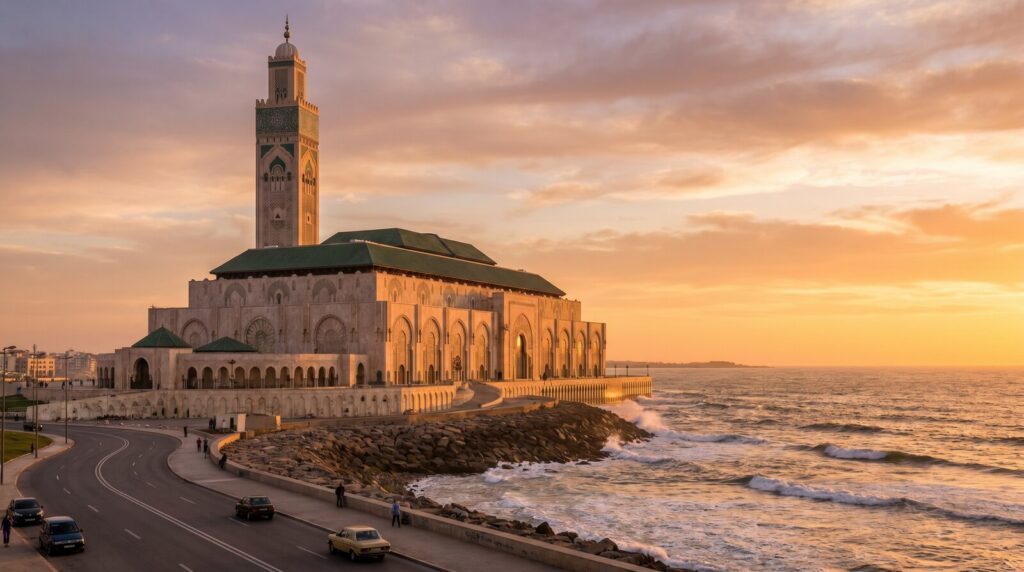
Casablanca announces itself through the Hassan II Mosque, towering 33 meters above the Atlantic shoreline with a minaret reaching 210 meters skyward. The structure represents one of Islam’s greatest contemporary architectural achievements, completed in 1993 yet designed to feel timeless. But Casablanca’s architectural character extends far beyond the mosque. The city’s downtown district showcases Art Deco buildings from the 1920s-1940s—elegant facades, geometric decoration, and modernist spirit frozen in concrete and tile. This convergence of Islamic sacred architecture and European modernist aesthetics creates visual landscape unlike any other North African city.

Casablanca isn’t Morocco’s imperial capital (Fez and Marrakech hold that cultural crown), nor is it the administrative center (Rabat functions as capital). Instead, Casablanca is Morocco’s economic powerhouse—the port that moved 60 percent of Morocco’s maritime cargo, the financial center where wealth concentrates, the modern city where Moroccan development happens. For travelers accustomed to ancient medinas and imperial palaces, Casablanca feels contemporary and cosmopolitan, a city built for commercial function as much as cultural expression.
Navigate This Guide
Hassan II Mosque & Architecture
The Hassan II Mosque represents one of the Muslim world’s most impressive contemporary structures and Morocco’s most significant architectural achievement. Completed in 1993, the mosque was built on a promontory jutting into the Atlantic, with parts of the structure actually sitting above the ocean. The design incorporates traditional Islamic architecture—geometric patterns, arabesques, calligraphy—with contemporary construction techniques and materials. The marble, zellige (tile mosaic), and intricate woodwork demonstrate craftsmanship at the highest levels.
The minaret rises 210 meters, making it one of the world’s tallest, visible from across the city and from considerable distances at sea. The structure houses a green laser emitted from the minaret’s tip, pointing toward Mecca to guide the faithful. The practical detail—guiding prayer—merged with contemporary technology—laser beam—exemplifies how Islamic tradition adapts to modern context.
The mosque can accommodate 25,000 worshippers, with the main prayer hall holding 7,000. The remainder of the capacity distributes across courtyards and adjacent spaces. The scale reflects Morocco’s importance as a Muslim nation and King Hassan II’s desire to create a monument befitting that significance. The architecture’s grandeur isn’t merely aesthetic but expresses religious devotion through scale and magnificence.
Visiting the mosque requires appropriate dress—women should cover shoulders and legs; men should avoid shorts. Tours are available for non-Muslims at specific times, typically mornings and afternoons. Tours guide visitors through sections of the mosque while respecting Islamic prayer times. The experience provides exposure to Islamic sacred space and contemporary Islamic architectural achievement. The setting overlooking the Atlantic adds to the atmosphere—few mosques sit in such visually dramatic locations.
Art Deco Heritage District
Casablanca’s downtown district contains one of the world’s most concentrated collections of Art Deco architecture. The style flourished during the 1920s-1940s when French protectorate administration and European immigration shaped the city’s development. Architects imported Art Deco aesthetic to Morocco, adapting the style to North African context—incorporating geometric Moroccan patterns, Islamic design elements, and Mediterranean influences. The result is distinctly Moroccan Art Deco, not merely European style transplanted.
The buildings showcase characteristic Art Deco features: geometric facades, stepped forms, decorative tile work, and modernist sensibility. The architectural vocabulary emphasizes clean lines, symmetry, and functional beauty. The buildings served commercial, residential, and administrative functions. Many remain active—shops, offices, and restaurants continue operating within these structures. This ongoing use preserves the buildings’ social role beyond mere museum preservation.
Walking the downtown district reveals architectural details rewarding patient observation. Building facades tell design stories through geometric patterns, tile arrangements, and decorative elements. Photography enthusiasts find endless subjects in architectural details and street scenes capturing daily life within historic buildings. Documenting the architecture preserves record of the style for future generations as buildings age and potentially deteriorate.
The Art Deco heritage faces preservation challenges. Some buildings deteriorate as economic circumstances limit maintenance budgets. Modernization pressures encourage demolition for contemporary replacement. Recognition of the architectural significance has motivated heritage preservation efforts, yet threats remain. Visiting and appreciating the architecture demonstrates cultural value, supporting arguments for preservation and restoration.
Medina & Traditional Markets
Casablanca’s medina contrasts sharply with the Art Deco downtown. While not as labyrinthine as medinas in Fez or Marrakech, the medina contains traditional markets and residential areas maintaining Moroccan cultural practices. The souks sell produce, textiles, spices, and crafts serving local populations. Market energy and commerce reveal how daily life actually functions beyond tourism infrastructure.
The medina’s density and narrow streets create atmospheric experience distinct from modern downtown. Walking through winding passages, you encounter people engaged in business, craftsmanship, and social exchange. The market’s sensory experience—sounds, smells, sights—creates immersion in daily urban life. Haggling is expected in markets, creating interaction between vendors and buyers that differs from fixed-price retail transactions.
Exploring the medina requires comfort with narrow streets, crowds, and unfamiliar surroundings. Maps are less useful than in organized downtown; instead, you navigate by landmarks, street names, and helpful locals. This navigation demands engagement with the environment and residents. Many travelers find medina exploration more rewarding than tourism-oriented visits because the space functions for residents’ use, not tourist consumption.
The medina maintains mosques, hammams (public baths), and other community institutions that continue functioning traditionally. Visiting a hammam reveals Moroccan bathing culture—gender-separated spaces, specific protocols, and social dimensions of communal bathing. The experience differs fundamentally from individual showers, engaging communal cleansing traditions of cultures across the Islamic world and Mediterranean regions.
Atlantic Coastline & Beaches
Casablanca’s Atlantic waterfront defines the city. The Hassan II Mosque sits on a promontory overlooking the ocean, but beaches extend north and south of the city center. The Corniche—the waterfront promenade—stretches several kilometers with restaurants, cafes, and public spaces overlooking the Atlantic. Walking the Corniche, you encounter locals exercising, socializing, and relaxing beside the ocean. The oceanfront provides respite from urban density while remaining within the city.
Beach culture in Casablanca differs from Mediterranean resorts. The Atlantic water is cooler than Mediterranean or tropical waters, and the wave action is considerably more powerful. Surfing is popular, with several breaks attracting surfers from across the region and internationally. Swimming requires awareness of currents and conditions. Lifeguards exist at main beaches but vigilance remains important. Respecting the ocean’s power prevents problems.
The waterfront restaurants serve fresh seafood—fish prepared grilled, fried, or in traditional tagine preparations. The combination of fresh catch and skilled culinary preparation creates memorable meals. Waterfront dining at sunset or evening creates atmosphere enhancing the food experience. Prices range from affordable casual options to upscale establishments, accommodating different budgets and preferences.
The port itself remains active with commercial shipping, fishing boats, and maritime commerce. The working waterfront demonstrates how Casablanca functions as a functioning city beyond tourism, with economic activities continuing based on genuine commercial need rather than visitor consumption. Observing the port’s activity provides understanding of Casablanca’s actual role in Moroccan economy.
Contemporary Culture & Food
Casablanca’s cultural scene extends beyond heritage sites into contemporary artistic production. Galleries showcase contemporary Moroccan artists gaining international recognition. Theater productions and music performances occur regularly. The city’s economic importance means investment in cultural institutions that smaller Moroccan cities cannot sustain. Museums document Moroccan history alongside showcasing contemporary work. The Jewish Museum of Morocco preserves the history of Morocco’s Jewish communities, an important part of North African heritage often overlooked in contemporary Islamic-focused narratives.
Moroccan cuisine ranks among the world’s great culinary traditions. Casablanca’s restaurants offer everything from casual street food to sophisticated fine dining. Tagines—slow-cooked stews combining meat with fruit, spices, and vegetables—represent quintessential Moroccan cuisine. Couscous appears in numerous preparations. Fresh seafood reflects the coastal location. The spice palettes—cumin, cinnamon, coriander, preserved lemon—create distinctive flavors differentiating Moroccan cooking from other North African cuisines.
Café culture is central to Moroccan urban life. Sitting in a café with mint tea or coffee, watching street life unfold, enables cultural observation while participating in daily social practice. Conversations flow naturally, strangers greet each other, and the café functions as community gathering space. This social dimension of café culture differs from North American or European coffee shop experiences where individuals remain isolated despite physical proximity.
Food shopping in markets provides practical provisioning while enabling cultural immersion. Vendors negotiate prices, produce quality, and building relationships. Purchasing directly from producers or market vendors supports individuals more directly than purchasing from supermarkets. Cooking your own meals using market ingredients provides deeper engagement with food culture than restaurant dining alone.
Getting to Casablanca
Casablanca is served by Anfa International Airport, one of North Africa’s major hubs. Direct flights connect to Europe and across the continent. Ground transportation from airport uses taxis, shuttle services, or car rental. The drive to the city center takes 30 minutes to an hour depending on traffic. Flights or trains from other Moroccan cities provide alternatives to international entry.
When to Visit
Spring (March-May) and autumn (September-November) offer ideal weather: mild temperatures, minimal rain, and comfortable humidity. Summer (June-August) is hot and humid with crowds. Winter (December-February) is mild (15-18°C) and can be rainy. The city is visitable year-round, though shoulder seasons provide the best balance of weather and crowds.
Accommodation Options
Budget hostels cost $15-25 nightly. Mid-range hotels run $50-120. Luxury options exceed $150. The proximity to Europe means higher prices than other Moroccan cities. Downtown locations offer convenience to both Art Deco district and medina. Oceanfront hotels provide Corniche access but are pricier.
Transportation & Costs
Taxis are abundant and negotiate fare before entering. Public buses are cheap ($0.50) but require familiarity with routes. Uber and ride-sharing operate in Casablanca. Walking downtown is practical for main attractions. Exploring beyond downtown requires transportation—the city’s sprawl makes some areas inaccessible on foot.
Neighborhoods Worth Exploring
The Ville Nouvelle (New City) district contains the Art Deco architecture and upscale establishments. Walking this neighborhood reveals European-influenced urban planning adapted to Moroccan context. The streets feel safer and more orderly than the medina, though lacking the medina’s atmospheric density. Shopping, dining, and cultural institutions concentrate here. Many travelers spend considerable time in this district given its comfort and attractions.
The Derb Ghalef neighborhood offers residential character distinct from tourist-oriented areas. Walking residential streets reveals how ordinary Casablancans live—children playing, neighbors socializing, daily commerce serving community needs. This neighborhood exploration provides authentic cultural immersion without organized tours or commercial intermediation.
The Bab el-Bhar district marks the transition between medina and modern city. The neighborhood contains both traditional and modern elements. Walking this boundary zone reveals urban layering—how modern development both preserves and transforms traditional patterns. The neighborhood’s mix creates visual and social complexity rewarding patient observation.
Ain Chock, located south of the city center, is primarily residential and working-class. Tourism infrastructure is minimal. This area reveals Casablanca as ordinary city where most residents live rather than exceptional tourist destination. Exploring working-class neighborhoods provides perspective on how cities actually function beyond tourist zones.
Practical Planning & Logistics
Casablanca is easily reached via Anfa International Airport, one of North Africa’s major aviation hubs. Direct flights connect to Europe, Middle East, and other African cities. The airport is 20 kilometers from downtown, with shuttle services, taxis, and car rental providing ground transportation. The airport has modern facilities and handles large passenger volumes smoothly.
Visas for Morocco are not required for most nationalities for stays under 90 days. Passport validity of 6 months from entry is typically required. Yellow fever vaccination isn’t required unless arriving from endemic countries. Tap water is drinkable in urban areas, though some sensitive stomachs prefer bottled water. Healthcare facilities in Casablanca are modern and reliable—better equipped than most African cities.
The Moroccan Dirham (MAD) is the official currency. ATMs are abundant in Casablanca. Credit cards work in major establishments. Currency exchange favors banks over tourist exchanges. Haggling is expected in markets but not in formal shops or restaurants. Tipping is customary—roughly 10 percent in restaurants, small amounts for service workers.
French is widely spoken, particularly among merchants and educated Moroccans. Arabic is the official language. English proficiency varies but is increasingly common among younger generations and tourism workers. Spanish is spoken less in Casablanca than in northern Morocco. Learning basic French or Arabic phrases demonstrates respect and aids navigation. Translation applications help bridge language gaps.
Plan 3-4 days in Casablanca to experience the city adequately. This enables Hassan II Mosque visit, Art Deco district exploration, medina walking, and Corniche relaxation. Longer stays allow deeper neighborhood exploration and cultural engagement. Many travelers find themselves extending stays due to city charm and amenities.
Discover Modern Morocco’s Greatest City
Casablanca defies expectations of Morocco shaped by imperial Fez and romantic Marrakech. Instead, this is modern Morocco—ambitious, commercial, contemporary, yet maintaining Islamic devotion and traditional culture. The Hassan II Mosque towering above the Atlantic, the Art Deco downtown, the medina’s living markets, and the Corniche’s oceanfront beauty converge in a city that reveals Morocco’s complex modernity.