
San Miguel de Allende Travel Guide — Cobblestones, Baroque Domes & Mexico’s Most Romantic Highland Town
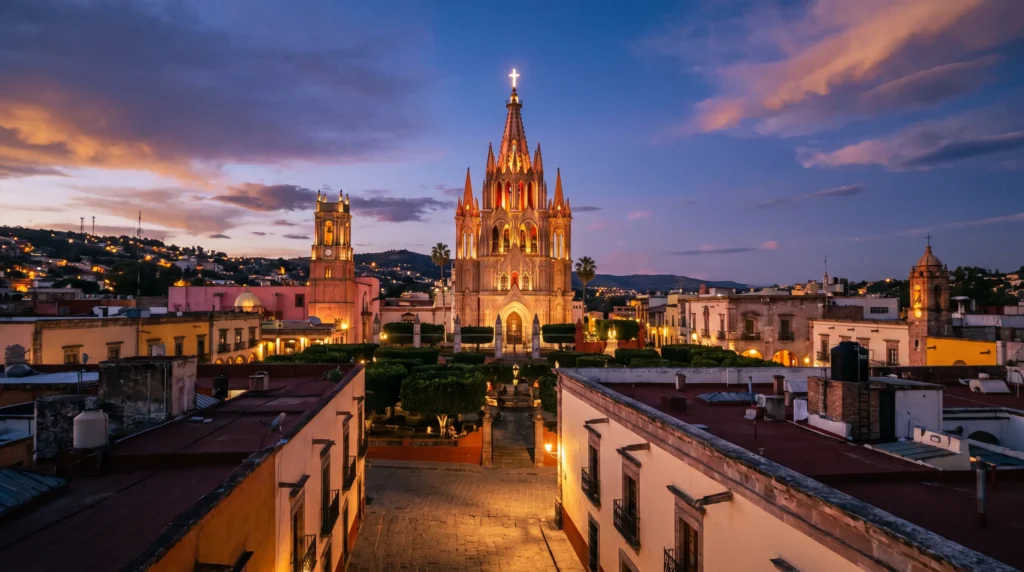
I’ve walked into a lot of town squares expecting to be underwhelmed, and San Miguel de Allende’s Jardín is the one that still stops me mid-step every time — pink neo-Gothic spires against a sky that high-altitude light makes almost too saturated to be real. This is a small city, roughly 72,000 people in the municipal seat, sitting at nearly 1,900 metres in Mexico’s central highlands, and it punches enormously above its weight: a UNESCO World Heritage historic core, a genuinely serious food and art scene, and a decades-old expat community that has reshaped both its economy and, depending who you ask, its soul. I love it, and I’ll tell you the parts that are worth the hype and the parts — the cobblestones that will roll your ankle, the gringo-pricing creep in the centro — that nobody puts in the brochure.
In This Guide
- Overview — Why San Miguel de Allende Keeps Winning “Best City” Lists
- La Alborada & the Fiesta of San Miguel Arcángel
- Best Time to Visit San Miguel de Allende
- Getting There — QRO, BJX & the Overland Options
- Getting Around — Cobblestones, Taxis & Your Own Two Feet
- Neighborhoods — Centro, San Antonio & the Aurora Arts District
- Culture & People — Colonial Roots, Expat Overlay
- A Food Lover’s Guide to San Miguel
- Off the Beaten Path
- Day Trips From San Miguel de Allende
- Practical Information
- Budget Breakdown — What San Miguel Actually Costs in 2026
- Planning Your First Trip
- Frequently Asked Questions
Overview — Why San Miguel de Allende Keeps Winning “Best City” Lists
San Miguel de Allende sits in east-central Guanajuato state, on Mexico’s high central plateau, about 52 kilometres north of Celaya by highway. It was founded in the 1540s by the Franciscan friar Juan de San Miguel as the first Spanish settlement in the region, and picked up its second name in 1826 in honor of Ignacio Allende, a local-born hero of Mexico’s war of independence. That independence history isn’t a footnote here — this stretch of the Bajío is where the movement against Spanish rule effectively started, and the town’s colonial wealth (built on the silver trade) is exactly what produced the Baroque churches and mansions that now draw the crowds.
UNESCO inscribed the historic center in 2008, jointly with the nearby Sanctuary of Jesús Nazareno de Atotonilco, under the name “Protective Town of San Miguel and the Sanctuary of Jesús Nazareno de Atotonilco” — the listing covers roughly 64 blocks of preserved civic and religious Baroque architecture. The skyline is owned by the Parroquia de San Miguel Arcángel, whose candy-pink neo-Gothic façade was rebuilt in 1880 by a self-taught local bricklayer, Zeferino Gutiérrez, reportedly working from postcards of European cathedrals.
What makes San Miguel different from Mexico’s other colonial gems is the overlay: since the Instituto Allende art school opened in 1938, the town has drawn a steady stream of foreign artists, writers and, eventually, retirees. Estimates put the resident foreign population — mostly American and Canadian — somewhere in the 20,000 to 25,000 range today, a huge share of a city this size, and it shows: English menus, yoga studios, a farmers market that feels like Marin County transplanted to the Bajío. It’s a genuinely gorgeous, genuinely walkable, genuinely well-run small city. It is also, at this point, not an undiscovered secret — go in expecting both things to be true.
La Alborada & the Fiesta of San Miguel Arcángel
If you can build a trip around one date, make it late September, when the city celebrates its patron saint, the Archangel Michael. The festival opens before dawn with La Alborada — church bells, brass bands and a genuinely startling amount of fireworks set off simultaneously across the historic center around 4 a.m., a tradition locals take very seriously and light sleepers should be warned about well in advance. Over the following days come processions, mock battles between “Moros y Cristianos” dance troupes, and the Desfile de los Locos (“Parade of the Crazies”), a raucous costumed street parade that, in most years, runs in June — check the current calendar, as exact dates shift with the liturgical calendar and are set by the municipality each year.
Two more dates worth planning around: the city’s Chamber Music Festival, held each August and one of Mexico’s most respected classical-music gatherings, and Día de los Muertos in early November, when the Jardín fills with marigolds, sugar skulls and altars — beautiful, but also the single hardest weekend of the year to find a hotel room in town.
Best Time to Visit San Miguel de Allende
November – April · Dry season (peak)
This is the postcard version of San Miguel: clear high-desert skies, daytime highs in the low-to-mid 20s°C and nights that drop into the single digits Celsius, cool enough that you’ll want a jacket for evening drinks on a rooftop. It’s also peak season and peak pricing — Christmas, Semana Santa (Easter week) and Día de los Muertos bracket the busiest, priciest weeks, and hotel rooms in the historic center can sell out months ahead.
May – June · Shoulder window
Hot and mostly still dry, with the rains typically arriving toward June’s end. This is the value stretch experienced travelers aim for — festival energy (Los Locos, patron-saint season warming up) without full winter pricing.
July – October · Rainy season
Expect warm days and short, dramatic afternoon thunderstorms rather than all-day washouts — mornings are usually clear and this is when the surrounding hills turn brilliantly green. It’s also the cheapest and least crowded stretch of the year, which is a real trade worth considering if you don’t mind planning outdoor time around a 3 p.m. downpour. Altitude matters here too: at nearly 1,900 metres, the sun is stronger than it feels — pack sunscreen even on cloudy days, and give yourself a day to acclimatize if you’re arriving from sea level and plan on hiking the surrounding hills.
Getting There — QRO, BJX & the Overland Options
San Miguel de Allende has no commercial airport of its own. The nearest is Querétaro Intercontinental Airport (QRO), about 86 kilometres away, with a growing roster of US nonstops (Dallas, Houston, and seasonally others) alongside Mexico City connections. Del Bajío International Airport near León/Guanajuato (BJX) is the second option, roughly 97 kilometres out. Private shuttle or taxi transfers from Querétaro typically run 1.5 to 2 hours depending on traffic; door-to-door shuttle companies based in San Miguel are generally more comfortable and only slightly pricier than a bare taxi.
From Mexico City, it’s a straightforward 3.5-to-4-hour first-class bus (ETN or Primera Plus) from the Terminal Norte, or a similar drive if you rent a car — the toll highways through the Bajío are in good condition. Many visitors combine San Miguel with Mexico City or Querétaro City on either end of a Bajío loop; it’s a genuinely easy region to string together without much backtracking.
Getting Around — Cobblestones, Taxis & Your Own Two Feet
The historic center is compact and, by most accounts, one of the most walkable colonial cores in Mexico — you can cross the entire tourist zone on foot in twenty minutes. The catch is the cobblestones (and flagstones) themselves: streets are steep, uneven and occasionally end without warning at a curb or step, and the city’s aesthetic preservation rules keep it that way. Flat, rubber-soled shoes are non-negotiable; heels or thin sandals are a sprained-ankle waiting to happen.
Taxis are unmetered but cheap and easy to flag or call — agree the fare before getting in, since fixed zone-based pricing is the norm rather than meters. Ride-hailing apps operate in San Miguel but pickup can be awkward in the pedestrianized, one-way core, where car access is increasingly restricted in favor of pedestrians and cyclists. A rental car is genuinely more hassle than help inside the centro — narrow one-way streets and scarce parking make it a liability — but useful if you’re basing yourself outside town or plan several day trips into the surrounding countryside.
Neighborhoods — Centro, San Antonio & the Aurora Arts District
El Centro / Jardín Principal
The historic heart, anchored by the Jardín (the main square) and the Parroquia. This is where the postcard streets, the boutique hotels, the rooftop bars and nearly every must-see church and museum sit within a few blocks of each other. It’s also the most expensive and most tourist-facing part of town — gorgeous, but expect gringo pricing on the main plazas.
San Antonio
A more residential, lower-key neighborhood just west of the centro, popular with longer-term expats and increasingly with visitors looking for a quieter home base within a manageable walk of the Jardín. Good mid-range rentals and a more local, less curated feel.
Fábrica La Aurora (Aurora Arts District)
A former 20th-century textile factory converted into a dense cluster of art galleries, design studios and a handful of excellent cafés — the best single stop for contemporary Mexican art and design in the city, and a nice contrast to the colonial-era sights everywhere else.
Guadiana & Colonia Independencia
Hillside residential districts on the edges of the historic core, worth the climb for panoramic viewpoints over the city and the Parroquia’s spires — several of the best-known photo overlooks and small mirador cafés sit up here.
Mercado de Artesanías & the market district
North of the centro, the crafts market and adjoining streets are where locals actually shop — cheaper, louder, and a good corrective if the Jardín has started to feel like a movie set. The main municipal market (Mercado Ignacio Ramírez) is the place for cheap, excellent breakfast and produce.
Outskirts & countryside estates
Increasingly, San Miguel’s higher-end hospitality has moved to converted haciendas and boutique properties on the town’s edges, trading walkability for pools, views and quiet — a reasonable trade on a longer stay if you have a car or don’t mind taxis.
Culture & People — Colonial Roots, Expat Overlay
San Miguel’s culture runs on two intertwined tracks. The base layer is deeply Mexican and Catholic: patron-saint festivals, Semana Santa processions, and a working-class market culture that persists a few blocks from the tourist core. Layered on top is the arts-and-expat culture that’s defined the city since the Instituto Allende opened its doors in 1938 and drew American and other foreign artists in search of cheap studio space and dramatic light — a tradition that eventually snowballed into today’s large resident foreign community.
The honest read: this duality is San Miguel’s biggest asset and its most common complaint. It’s given the city an unusually rich gallery and culinary scene for its size, real bilingualism in the centro, and a level of polish rare in a town this small. It’s also driven up real-estate prices for locals and created a visible, sometimes uncomfortable economic split between the historic core and the neighborhoods just outside it. Go in aware of both halves of the story rather than just the Instagram half.
A Food Lover’s Guide to San Miguel
San Miguel’s food scene punches well above its population — a mix of serious Bajío regional cooking and an outsized concentration of destination restaurants that trade on the expat and weekend-tourist market from Mexico City. Start at the Mercado Ignacio Ramírez for breakfast: gorditas, chilaquiles, fresh-pressed juice and a coffee stand or two, all at genuinely local prices.
The regional specialty worth seeking out is enchiladas mineras (“miner’s enchiladas”), a Guanajuato-state dish of chile-guajillo-dipped tortillas stuffed with cheese and topped with carrots and potatoes — a legacy of the region’s silver-mining past. Street-level classics — tacos al pastor, gorditas, elote — are everywhere and cheap; the contrast with the centro’s chef-driven tasting menus is part of what makes eating here interesting. For a splurge, the town’s fine-dining scene has grown genuinely serious over the last decade, with several restaurants doing modern Mexican tasting menus that would hold their own in Mexico City or Oaxaca. Mezcal and craft cocktail bars have multiplied around the Jardín; rooftop bars with Parroquia views are a San Miguel rite of passage, best done at golden hour.
Off the Beaten Path
El Charco del Ingenio
A botanical garden and nature reserve on the edge of town centered on a dramatic canyon and a series of cactus and succulent gardens — a quiet, cheap counterpoint to the busy centro, especially at sunrise or sunset.
Mirador viewpoints
The classic postcard shot of the Parroquia over the rooftops is taken from El Mirador, a short taxi or uphill walk from the centro — go for sunset, but expect other photographers there with the same idea.
La Gruta & Taboada hot springs
Natural thermal spring complexes a short drive outside town, popular with both locals and visitors on weekends — arrive early on weekdays to have the pools closer to yourself.
The eastern barrios
A short walk east of the tourist core, neighborhoods like Colonia San Rafael retain a working-class, distinctly non-touristy character — no sights to check off, just a useful reminder of the city beyond the Jardín.
Day Trips From San Miguel de Allende
Atotonilco
The Sanctuary of Jesús Nazareno de Atotonilco, about 14 kilometres from San Miguel, is jointly inscribed with the town on the same UNESCO listing and is often called the “Sistine Chapel of Mexico” for its dense, dramatic Baroque murals. A pilgrimage site as much as a sight — dress modestly and expect to share the space with worshippers.
Dolores Hidalgo
The town where Mexico’s war of independence was launched in 1810, roughly 45 minutes north — visit the church where Father Hidalgo issued his famous call to arms, and don’t skip the town’s famously eccentric ice cream (flavors run from mole to shrimp) sold around the main plaza.
Guanajuato City
The state capital, about two hours away, is arguably San Miguel’s rival for Mexico’s prettiest colonial city — a tangle of tunnels, alleys and pastel houses stacked up a ravine, plus its own UNESCO-listed historic center and silver-mining history. Easily worth an overnight rather than a rushed day trip.
Querétaro City
Closer to the airport than San Miguel and worth a stop on the way in or out — its own well-preserved colonial core, aqueduct, and a noticeably more local, less expat-heavy feel than San Miguel’s centro.
Practical Information
Money. The Mexican peso floats freely against the US dollar; check the current Banco de México reference rate before you travel rather than relying on a fixed figure. Cards are widely accepted in the centro’s restaurants and hotels, but smaller businesses, taxis and the markets are frequently cash-only — carry pesos.
Safety. San Miguel de Allende itself sits in the northeastern part of Guanajuato state and has a well-earned reputation as one of the calmer, more tourist-friendly towns in the region. That said, Guanajuato state as a whole carries a Level 2 “Exercise Increased Caution” advisory from the US State Department, citing crime and cartel-related violence concentrated mainly in the state’s south and center — around cities like Celaya, Salamanca and Irapuato, well south of San Miguel. UK guidance similarly flags an increase in security incidents and organized-crime activity across Guanajuato state, concentrated in the south. Practical takeaway: stick to daytime travel on intercity highways, use licensed taxis or arranged transport after dark, and check your government’s current advisory before you go rather than relying on this paragraph alone.
Health. No special vaccinations are required for entry; routine travel vaccines and standard food-and-water caution (stick to bottled or purified water, be selective with street-food stalls) are the main precautions the CDC flags for Mexico generally. The altitude (nearly 1,900 metres) can cause mild breathlessness or headaches for the first day or two — hydrate more than usual and go easy on alcohol your first night.
Connectivity. An eSIM or local SIM gives solid 4G coverage through the centro; hotel Wi-Fi is generally reliable given the size of the digital-nomad and long-stay expat population. Plugs: US-style Type A/B, 127V. Time zone: Central Time (UTC-6), observes the same daylight-saving conventions as neighboring US Central states in recent years.
Budget Breakdown — What San Miguel Actually Costs in 2026
San Miguel is noticeably pricier than most Mexican colonial towns of its size — a direct effect of the expat population and weekend-trip demand from Mexico City — but still a bargain against most US or European destinations at the same level of polish.
Budget (US$45–80/day): A simple guesthouse or hostel outside the immediate Jardín blocks, market breakfasts and street tacos, walking everywhere, one or two paid sights.
Mid-range (US$120–220/day): A boutique hotel or well-reviewed Airbnb in the centro or San Antonio, a mix of market food and sit-down restaurants, a cooking class or gallery-hopping day in the Aurora district, occasional taxis.
Luxury (US$350+/day): Five-star hotels and converted haciendas, tasting-menu dinners, private guided day trips to Guanajuato City or Atotonilco, spa days built around the surrounding hot springs.
Tipping 10–15% is standard at sit-down restaurants where it isn’t already included; small change for market stalls and taxis is appreciated but not obligatory.
Planning Your First Trip to San Miguel de Allende
Three to four nights is enough to cover the centro properly — churches, the Aurora arts district, a cooking class, an evening or two on a rooftop bar — with a day trip to Atotonilco or Dolores Hidalgo built in. Five to seven nights lets you add an overnight in Guanajuato City, which genuinely deserves more than a rushed afternoon. Most visitors fly into Mexico City first and either bus or drive up through the Bajío, which also makes it easy to pair with our Mexico travel guide or a stop in our Mexico City guide before heading north. If colonial-town architecture is what draws you here, our Guatemala guide (Antigua) and Cartagena guide cover two of Latin America’s other great preserved colonial cores.
Frequently Asked Questions
Is San Miguel de Allende safe for tourists in 2026?
The historic center is generally considered one of the calmer, more tourist-oriented towns in Guanajuato state. State-level advisories from the US and UK do flag crime and cartel-related risk in Guanajuato overall, but the specific concerns concentrate in the state’s southern and central cities, not San Miguel itself. Use normal city precautions, stick to daytime highway travel between towns, and check current advisories before booking.
Do I need a visa?
US, Canadian, UK, EU and Japanese passport holders don’t need a visa for tourism — you’ll receive a tourist permit (FMM) on arrival valid for up to 180 days. Keep the paper or digital copy of your entry form until you leave.
How many days do I need in San Miguel de Allende?
Three to four full days covers the historic center comfortably; add extra nights if you want to fold in Guanajuato City or a slower, gallery-and-café pace rather than a checklist visit.
Is San Miguel de Allende walkable, and how bad are the cobblestones really?
Very walkable within the historic core, but the cobblestones and steep, uneven streets are a genuine tripping hazard — flat, closed-toe shoes with real grip are the single most useful packing decision you’ll make.
San Miguel de Allende or Guanajuato City?
San Miguel for a more polished, food-and-gallery-forward stay with better hotel and restaurant infrastructure; Guanajuato City for a rawer, more purely Mexican colonial experience with dramatic hillside geography and a livelier student-town energy. Many visitors do both — they’re about two hours apart.
What’s the cheapest way to get from the airport?
Shared shuttle vans from Querétaro Airport (QRO) undercut private transfers considerably, though they take longer with multiple stops; booking a return trip in advance with a San Miguel-based shuttle company usually beats hailing something on arrival.
Ready to Explore San Miguel de Allende?
Pink stone spires at sunrise from a rooftop bar, enchiladas mineras from a market stall that costs less than your coffee back home, a Baroque sanctuary fourteen kilometres out of town that most visitors never make time for. San Miguel de Allende earns its reputation — just bring good shoes, a healthy cash stash, and a plan for the crowds it now, deservedly, attracts.
Explore More
- Mexico Travel Guide — the full country picture beyond the Bajío
- Mexico City Guide — the easiest gateway in and out of San Miguel
- Guatemala Travel Guide — Antigua’s colonial core, a close cousin of San Miguel’s
- Cartagena Guide — another walled, pastel-colored colonial classic
How this guide was built
Published as part of Facts From Upstairs’ city guide series. Built from authoritative sources — UNESCO’s World Heritage Centre listing for the Protective Town of San Miguel and the Sanctuary of Atotonilco, Britannica’s San Miguel de Allende entry, Wikipedia’s San Miguel de Allende entity page, Banco de México’s exchange-rate portal, the Mexican consular network’s visa-exemption guidance, the US State Department’s Mexico travel advisory, the UK FCDO’s Mexico regional-risk page, the US CDC’s Mexico traveler health page, and Querétaro Airport’s official transportation page. Numeric and checkable claims carry inline citations.
Sources cited on this page
- Wikipedia — San Miguel de Allende
- UNESCO — Protective Town of San Miguel and the Sanctuary of Jesús Nazareno de Atotonilco
- Britannica — San Miguel de Allende
- US State Department — Mexico Travel Advisory
- UK FCDO — Mexico Regional Risks
- US CDC — Mexico Traveler Health
- Embassy of Mexico in Canada — Visa Exemption (180 Days)
- Banco de México — Exchange Rate Portal
- Querétaro Airport — Airport Transportation
More city guides you might like
Plan your trip to San Miguel de Allende
The booking tools we use ourselves. FFU may earn a commission at no extra cost to you.
Plan & book your trip to San Miguel de Allende
Booking through these searches supports our guides at no extra cost to you.
Curated multi-day tours to San Miguel de Allende — Exoticca →