
☰ On this page
- Calcio Storico & San Giovanni: Florence’s Most Intense Day Is June 24
- 📋 In This Guide
- Overview — Why Florence Belongs on Every Bucket List
- 🌳 Late-April / Early-May 2026 — Iris Garden & Genio Fiorentino
- Best Time to Visit Florence (Season by Season)
- Getting There — Flights, Trains & Arrival
- Getting Around — Walking, Trams & the No-Drive Zone
- Neighbourhoods & Cultural Sights
- 🗓️ Sample Itineraries
- Florentine Culture & Etiquette
- A Food Lover’s Guide to Florence
- 📸 Photography Notes
- Off the Beaten Path — Florence Beyond the Duomo
- Practical Information
- Budget Breakdown — What Florence Actually Costs
- ✅ Pre-Trip Checklist
- 🤔 What Surprises First-Timers
- Frequently Asked Questions
- Ready to Explore Florence?
- Explore More
Part of our Italy travel guide.
Florence is the only city in the world where you can stand inside a 1436 dome that nobody at the time knew how to build, walk three blocks to the marble David that Michelangelo carved when he was 26, eat the steak Tuscany invented at a butcher’s bench his great-grandfather worked at, and ride a bicycle out of the city walls to a vineyard that has made the same wine since the 14th century — all between breakfast and dinner. The historic centre covers about three square kilometres, holds something like 30% of Italy’s most-cited art, and has been a UNESCO World Heritage site since 1982. Roughly 380,000 people live here. Roughly 16 million visitors arrive every year.
What makes Florence different from Rome or Venice is the compression. Rome rewards weeks; Venice rewards drift. Florence rewards a notebook. The Renaissance didn’t happen here by accident — the Medici banking family bankrolled it deliberately between 1397 and 1737 — and the consequence is that almost every building you walk past was either commissioned, built, painted or financed by the same dozen families whose names still mark the streets. Brunelleschi’s dome, Ghiberti’s gilded baptistry doors, Donatello’s David, Michelangelo’s everything, Leonardo’s Annunciation, Botticelli’s Primavera and Birth of Venus, Vasari’s corridor, Galileo’s telescope: this is the address where the modern Western imagination got drafted.
This guide covers Florence end to end — from the Duomo crush at 11 a.m. to the Oltrarno workshops where someone is still hammering a leather satchel by hand, plus day trips to Siena, Pisa, Lucca and the Chianti hills. If you’re planning a wider Italy loop, see our Italy travel guide; for the Rome and Venice halves of the standard triangle, our Rome city guide and Venice city guide pick up where this one hands off. Travellers comparing Mediterranean city breaks should also see our Barcelona city guide for the Iberian counterpoint.
What’s Happening in Florence Right Now · Updated June 22, 2026
Calcio Storico & San Giovanni: Florence’s Most Intense Day Is June 24
June 24 is the feast of San Giovanni, Florence’s patron saint — and the day of the Calcio Storico final, the city’s ferocious 16th-century football match played in costume on a sand-covered Piazza Santa Croce. A Renaissance procession of hundreds of costumed Florentines sets off around 4 p.m. and the match kicks off at 5, with fireworks over the Arno from Piazzale Michelangelo to close the night. It’s a public holiday and the whole city is in festa — ideal cover for a long Tuscan lunch between the spectacle. Below: how the tournament works, where to watch, and the Florentine tables worth booking.
Source: Invitation to Tuscany — Calcio Storico 2026
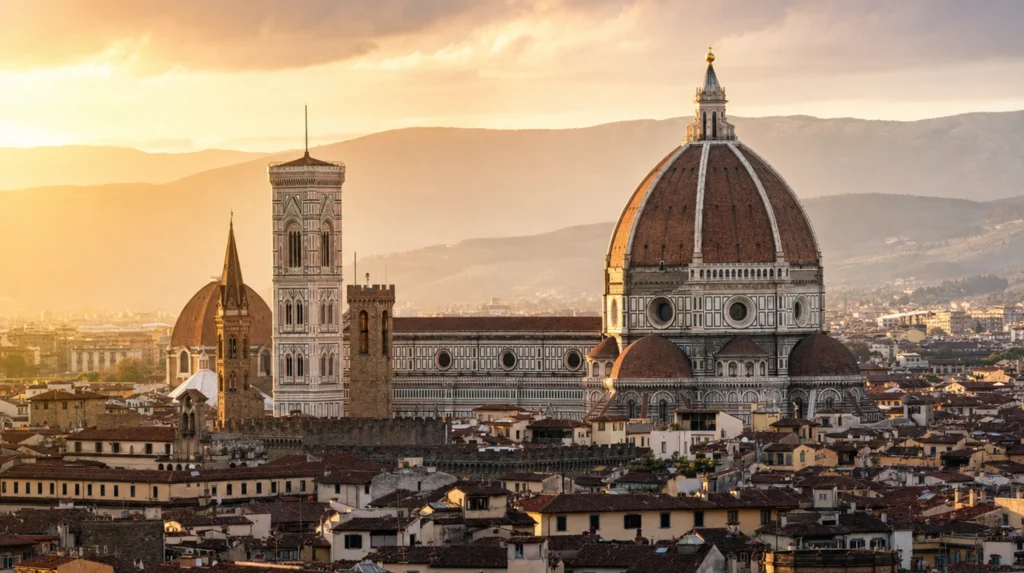
Cinematic aerial of Florence (8s).
📋 In This Guide
- Overview — Why Florence Belongs on Every Bucket List
- 🌳 Late-April / Early-May 2026 — Iris Garden & Genio Fiorentino
- Best Time to Visit Florence (Season by Season)
- Getting There — Flights, Trains & Arrival
- Getting Around — Walking, Trams & the No-Drive Zone
- Neighbourhoods & Cultural Sights
- 🗓️ Sample Itineraries — 2, 4 and 7 Days
- Florentine Culture & Etiquette
- A Food Lover’s Guide to Florence
- 📸 Photography Notes
- Off the Beaten Path — Florence Beyond the Duomo
- Practical Information
- Budget Breakdown — What Florence Actually Costs
- ✅ Pre-Trip Checklist
- 🤔 What Surprises First-Timers
- Frequently Asked Questions
- Ready to Explore Florence?
Overview — Why Florence Belongs on Every Bucket List
Florence sits in a basin in the Arno valley, ringed by the Tuscan hills that supply its olive oil, wine and the gentle pink-grey-green colour palette of its quarried stones. The city is small. Inside the medieval walls — torn down between 1865 and 1877 and replaced by the ring road — you can walk corner to corner in 25 minutes. The historic centre is essentially a single 200-hectare museum that happens to contain a working city, and the consequence is that the foot-traffic density on Via dei Calzaiuoli at midday in July is comparable to Times Square at rush hour.
Florence’s outsized importance comes down to one family and 350 years. The Medici were originally a clan of small wool merchants from the Mugello hills who entered banking in the 1390s, became the personal bankers to the Pope by 1410, and used the resulting cash flow to commission a generation of artists who happened to live within walking distance: Donatello, Brunelleschi, Ghiberti, Botticelli, Leonardo da Vinci, Michelangelo, Galileo, and dozens of lesser-knowns. The bank failed in 1494; the family hung on as Grand Dukes of Tuscany until 1737, when the last heir Anna Maria Luisa de’ Medici signed the Patto di Famiglia bequeathing the entire family art collection to the city of Florence forever, on condition it never leave. That document is why the Uffizi, the Pitti Palace, the Boboli Gardens and the Bargello are still here.
The modern city is improbably layered. The 1966 Arno flood — the worst in 700 years, when the river rose 6 metres above the embankments and submerged the Santa Croce neighbourhood under 4-5 metres of mud — destroyed or damaged about 14,000 movable artworks and 4 million books. The recovery effort, led by Florence’s “Mud Angels” (Angeli del Fango, the international student volunteers), invented modern art-conservation as a discipline. You can still see the high-water mark plaque on the wall of Santa Croce, six metres above the pavement.
🏛️ Historical Context
Brunelleschi’s dome — the 45-metre-wide red-tiled cap on the Cathedral of Santa Maria del Fiore — was completed in 1436 after 16 years of construction, and at the time nobody knew how to build it. The cathedral had been left domeless since 1296 because the planned span was too wide for any known centring (the wooden scaffolding that arches were normally built on). Filippo Brunelleschi, a goldsmith with no architectural training, won the 1418 commission with a sealed proposal — the egg-balancing trick is the apocryphal version — and built the double-shell dome with no internal scaffolding at all. He invented hoists, a horizontal pulley system, and a herringbone brick pattern that locks the courses against gravity as they spiral upward. His own tomb is in the cathedral crypt directly below his work. The 463-step climb to the lantern still uses his original staircase.
🎌 Did You Know?
The medical condition known as Stendhal Syndrome — a documented psychosomatic response that includes dizziness, racing heart, and occasional fainting from sustained exposure to overwhelming art — is named after the French novelist who described his 1817 reaction in the church of Santa Croce. The Florentine psychiatrist Graziella Magherini coined the term in her 1989 book after observing 106 cases at the Santa Maria Nuova hospital between 1977 and 1986, almost all in tourists in their 20s and 30s, almost all single travellers, and almost all on day three or four of an Italy trip. The hospital still treats two or three cases a year, mostly from the Uffizi.
🌳 Late-April / Early-May 2026 — Iris Garden & Genio Fiorentino
Late April through mid-May is arguably the best three-week window in the Florentine calendar, and locals quietly know it. The summer heat hasn’t yet pushed daytime highs into the 32°C-plus range that empties the historic centre by 2 p.m., the Uffizi crowd-density has not reached the late-June queue-up-the-street levels, and two specifically Florentine cultural events open in this window that almost no foreign guidebook flags.
The first is the Giardino dell’Iris (Iris Garden), the city’s secret garden tucked beside Piazzale Michelangelo. The garden opens for just three weeks each year — from approximately April 25 through May 20 — when the iris is in bloom; the lily, Florence’s symbol on the city seal since 1251, is technically an iris. The garden contains over 2,000 varieties from across the world cultivated by the Italian Iris Society, who run an international competition during the open weeks. Entry is free. It’s roughly 200 metres uphill from the famous Piazzale Michelangelo viewpoint and is consistently overlooked by tourists arriving for the panorama. Plan an hour at golden hour.
The second is the Genio Fiorentino festival in the Boboli Gardens — a week-long programme of historic re-enactments, classical music in the Limonaia (the lemon greenhouse), early-morning yoga on the Cypress Avenue, and Tuscan craft demonstrations that runs the last week of April. The festival celebrates the city’s “creative genius” tradition with a deliberately unhurried, locally-attended schedule. Most events are free with the standard Boboli ticket (€11). Combined with the Iris Garden three minutes’ walk away, this is the most distinctively Florentine three-week window of the entire year.
One important caveat for spring 2026: the Maggio Musicale Fiorentino (Florence May Music Festival) — Italy’s oldest classical music festival, running annually since 1933 — overlaps the same window with concerts at the Teatro del Maggio. Tickets to the headline opera and orchestral nights book up 6-8 weeks ahead. The smaller chamber-music events at San Lorenzo and the Pergola theatre are usually available 2-3 days out. Check maggiofiorentino.com when planning.
⚠️ Important — Major Museum Bookings
The Uffizi, the Accademia (David), and the Brunelleschi dome climb all require timed-entry reservations year-round and are essentially unsellable on the day during shoulder season. Book at least 2-3 weeks ahead via the official sites (uffizi.it, accademia.org, duomo.firenze.it) — a €4 booking fee per ticket applies. Third-party reseller sites mark up by 30-100%. The combined Duomo Pass (€30) covers the dome, baptistry, campanile, crypt and museum and is the single best ticket value in the city; book a specific dome-climb time slot when purchasing. No-show forfeits the full ticket.
Best Time to Visit Florence (Season by Season)
Florence has four genuine seasons and a microclimate shaped by its bowl of hills. The basin holds heat in summer, fog in autumn, and a surprising winter chill that catches first-time visitors off guard. The Tuscan light is the constant — that pale gold that bounces off pietra forte sandstone and travels well in oil paintings — and is the reason the city has been painted obsessively for 700 years.
Spring (April – May)
The shoulder window. Daytime highs climb from 17°C in early April to 24°C by late May; the Iris Garden opens, the Boboli rose garden flowers around mid-May, and the surrounding Chianti vineyards begin their bud-burst phase. Crowds are 25-35% lower than July, prices roughly 15% lower, and the major museums are still bookable 7-10 days ahead. The Maggio Musicale festival runs through May. Pack layers — evenings can drop to 9-12°C, and the marble of the Duomo holds the chill.
Summer (June – August)
The high season and the hot season. June sits at a manageable 28°C high, but July and August routinely hit 35°C-plus with no breeze in the basin, and locals leave the city for the Tuscan coast in droves through August. The historic centre at midday becomes a heat-trap; museums, churches and Brunelleschi’s dome (which acts as a chimney) are uncomfortable from 11 a.m. to 5 p.m. The flip side: outdoor concert season, Estate Fiorentina events in piazze across the city, the long aperitivo evenings that don’t really take off elsewhere in Italy until August. The crowds are the headline cost — Uffizi entries can stack 90-minute queues even with timed tickets if you arrive late.
Autumn (September – October)
Many Florence regulars argue this is the best window of all. Daytime highs run 25°C in early September dropping to 18°C by late October, the Tuscan harvest (vendemmia) peaks in late September, and the surrounding hills turn the colour of the city’s pietra serena stone. Truffle season (white Alba truffles) begins in mid-October — Sant’Andrea in Florence and the truffle markets in nearby San Miniato make this the best food window of the year. Hotel rates drop 15-20% from August. The Festa della Rificolona on September 7 — a children’s lantern parade tied to the medieval pilgrimage to the Annunziata church — is a small, locally-attended ritual most foreign visitors miss.
Winter (November – March)
Cold, occasionally foggy, and the cheapest the city gets. Daytime highs sit at 8-13°C in January-February, with overnight lows around 2°C; snow falls every few years but rarely sticks. The crowds genuinely thin — Uffizi can be walked through at a normal pace in January, and the Accademia’s David is sometimes encountered with fewer than ten people in the room. Christmas markets in Piazza Santa Croce run from late November through December 23. Carnival in Viareggio (40 minutes by train, the largest carnival parade in Italy) runs late January through mid-February. The trade-off is that some smaller restaurants and Oltrarno workshops close for winter holidays in the first half of January.
🧳 Travel Guru Tip
If you have one trip and want Florence at its photogenic best with manageable crowds, target the second half of October. The harvest is in, the chestnut trees in the surrounding hills are turning, the truffle restaurants have switched their menus, the Iris Garden’s daughter event (the Rose Garden adjacent) is in second bloom, and prices have dropped 20% from August peak. Most international guides default to “go in May for the weather”; the regulars who have been four times go in late October.
| Experience | Best months | Best locations | Notes |
|---|---|---|---|
| Iris Garden bloom | Late Apr – mid-May | Giardino dell’Iris, beside Piazzale Michelangelo | Open 3 weeks only; free entry |
| Maggio Musicale Festival | Late Apr – Jun | Teatro del Maggio, Pergola, San Lorenzo | Italy’s oldest classical festival; book 6-8 weeks out |
| Truffle season | Mid-Oct – Dec | San Miniato market, Sant’Andrea restaurant | White Alba truffle peak Nov |
| Tuscan vendemmia | Mid-Sep – early Oct | Chianti Classico hills (Greve, Castellina, Radda) | Day trips with rental car or organised tour |
| Outdoor aperitivo | May – Sep | Piazza Santo Spirito, Piazza della Passera | Oltrarno-side, lower tourist density |
| Christmas market | Late Nov – Dec 23 | Piazza Santa Croce | German-style; Heidelberg-Florence twinning since 1956 |
Getting There — Flights, Trains & Arrival
Florence has its own small airport (Amerigo Vespucci, FLR, 4 km northwest of the centre) but most international visitors fly into Pisa Galileo Galilei (PSA, 80 km west) or arrive by high-speed train from Rome or Milan. FLR handles roughly 3.4 million passengers a year and is the convenient option — direct flights from London City, Paris CDG, Frankfurt, Amsterdam, Munich, Madrid, Barcelona, Vienna and most major European hubs, plus Iberia, Air France and KLM connections to North America via their main hubs. The airport tram (T2) runs to the city centre in 22 minutes for €1.70.
Pisa airport is bigger, cheaper and the Ryanair / EasyJet hub for Tuscany. The Pisa-Florence train (Trenitalia) runs every 30 minutes, takes 60 minutes, and costs €11.20 — drop your bag at Florence Santa Maria Novella station, which is a 10-minute walk from the Duomo. Flying into Rome Fiumicino and taking the Frecciarossa or Italo high-speed train to Florence is also realistic — 1h35m journey, €35-65 depending on advance booking. The Milan-Florence Frecciarossa is 1h45m and similarly priced.
Florence Santa Maria Novella (SMN) is the central station, a 1934 rationalist masterpiece designed by Giovanni Michelucci that’s worth a 10-minute walkthrough as architecture even if you’re not catching a train. From SMN, the major hotels are 5-15 minutes on foot; taxis from the official rank charge €8-12 to most central addresses. Tram T1 connects SMN south toward the city’s industrial periphery; the T2 (north) handles airport runs.
✨ Pro Tip — The Frecciarossa Trick
If you’re combining Florence with Rome and Venice on the standard Italy triangle, the high-speed Frecciarossa Executive class — booked 60+ days ahead via trenitalia.com — costs €69-89 Rome-Florence-Venice with seat-back screens, complimentary food and drink, and a saloon car at the front you can sit in for 90 minutes. This is the same train as the standard Frecciarossa first class but a different fare bucket; the savings vs. last-minute booking are roughly 50%. See our Rome city guide for the southern leg.
Getting Around — Walking, Trams & the No-Drive Zone
Florence is a walking city. The historic centre — bounded roughly by SMN station, the Arno river, the Pitti Palace and the Sant’Ambrogio market — is 3 square kilometres and crosses corner to corner in 25 minutes on foot. The cobbled streets are mostly flat (excluding the Oltrarno hills toward Piazzale Michelangelo and San Miniato), pavements are narrow, and the entire central area is a Limited Traffic Zone (ZTL — Zona a Traffico Limitato) where private vehicles without a permit are banned 7:30 a.m. to 8 p.m. Mondays through Fridays and most Saturdays. License-plate cameras enforce automatically. Hotels can pre-register your rental car for arrival and departure transit (€20-40 admin fee), but driving in Florence as a tourist is otherwise pointless.
Public transport is minimal because you don’t need it. Two tram lines (T1, T2) and the ATAF bus network (€1.70 single, €5 daily) handle airport runs and outlying neighbourhoods like Coverciano (the Italian Football Federation training site) and Settignano. The C1, C2 and C3 minibus lines serve the historic centre on circular routes — useful for travellers with mobility issues, otherwise rarely needed. Taxis can be flagged from designated ranks (Piazza della Repubblica, Piazza Santa Croce, SMN station) but cannot be hailed on the street; download the appTaxi or itTaxi apps. Uber operates as Uber Black only — the standard UberX is illegal nationally.
For day trips outside the city, the train is overwhelmingly the right answer. Pisa, Lucca, Arezzo, Bologna and Siena are all 35-90 minutes by Trenitalia from SMN, with frequent service and €8-15 one-way regional fares. The Chianti hills require either a rental car (collected from outside the ZTL — most agencies have offices near SMN) or an organised wine tour ($80-180 per person). Bicycle rental is increasingly viable — the city has invested in cycle lanes since 2018, and Florence by Bike (€18/day) and the dockless ride-share Mobike are the standard options.
⚠️ Important — ZTL Fines & Driving Mistakes
The ZTL camera system is the single most expensive tourist mistake in Florence. Driving into the historic centre without a permit triggers an automatic €83-160 fine per camera passed (cameras are at every entry point and you can rack up multiple in a single visit). Italian rental car companies pass these fines to you with an admin surcharge 4-8 weeks after travel. Hotels inside the ZTL can pre-register your plate for a 2-hour transit window — confirm in writing before driving in. The ZTL hours change seasonally and at night; the Florence Mobility Office posts updates at firenze.it. When in doubt: park outside the ZTL (Parcheggio Beccaria, Parcheggio Stazione) and walk in.
Neighbourhoods & Cultural Sights
📍 Florence Map: Every Place in This Guide
Florence is conventionally split into the four medieval quartieri — Santa Maria Novella, San Giovanni, Santa Croce and Santo Spirito — but for a traveller the practical map is simpler: the Duomo zone, the Uffizi-Signoria axis, the Oltrarno (south of the river), the Santa Croce side, and the upper-city viewpoints at Piazzale Michelangelo and San Miniato. Below are the bases worth building an itinerary around.
⛪ The Duomo Zone — Cathedral, Baptistry & Campanile
The geographic and visual centre. The Cathedral of Santa Maria del Fiore (begun 1296, completed 1436 with Brunelleschi’s dome) is the third-largest church in Italy and the fourth-largest in Europe; its 153-metre length and 90-metre height define every other building’s relationship to the sky. The exterior pink-green-white marble facade is 19th-century (1887, by Emilio De Fabris) — the medieval facade was demolished in 1587 and never replaced until then.
The dome climb is the headline experience. 463 steps up Brunelleschi’s herringbone staircase, with 90-degree wall-tilts on the upper landings as you walk inside the double shell, ending at the lantern with a 360° view of the Arno valley. Reserve a specific time slot when buying the Duomo Pass (€30); the climb takes 30-45 minutes round trip. The 414-step Giotto’s Campanile climb across the piazza has fewer crowds and a better photograph of the dome itself. The 11th-century Baptistry of San Giovanni — the oldest structure in central Florence and Dante’s “il mio bel San Giovanni” — has Ghiberti’s Gates of Paradise on the east side (1452, copies; the originals are inside the Cathedral Museum) and a 13th-century Byzantine mosaic ceiling that turns molten gold under late-afternoon sun.
- What to do: Climb the dome (timed, €30 pass); climb Giotto’s Campanile for the dome photograph; visit the Cathedral Museum (Museo dell’Opera del Duomo) for Donatello’s Mary Magdalene and the original Baptistry doors.
- Signature eats: A schiacciata sandwich at All’Antico Vinaio (€7-10) — the queue is real but moves quickly; the quattro stagioni at Don Nino just behind the Duomo.
- Access: 10-minute walk from SMN station; trams and buses bypass the Cathedral square.
🎨 Uffizi & Piazza della Signoria
The single densest concentration of Renaissance art on the planet. The Uffizi Gallery (€25 + €4 booking) was originally the administrative offices (uffizi) of the Medici Grand Duchy, built 1560-1580 by Vasari. The collection — 1,500-plus paintings displayed across 50 rooms on the top floor of a U-shaped building — was bequeathed to the city in 1737. Highlights are Botticelli’s Birth of Venus and Primavera (Room 10-14, the spring 1480s), Leonardo da Vinci’s Annunciation (Room 15, painted at age 20), Caravaggio’s Medusa and Bacchus (Room 90), Michelangelo’s Doni Tondo (the only panel painting he completed), Titian’s Venus of Urbino (Room 83), and the entire room of Filippo Lippi.
Plan 3-4 hours minimum. Audio guides (€8) help; the official app is free. Skip the Vasari Corridor add-on for now (closed since 2016 for restoration; expected reopening late 2025-2026). The Uffizi Café terrace on the top floor, with views of the Arno toward Ponte Vecchio, is a worthwhile 15-minute pause halfway through.
Adjacent Piazza della Signoria is Florence’s outdoor sculpture gallery and political square — the rebuilt Palazzo Vecchio (the medieval town hall, still the city government) faces the Loggia dei Lanzi where Cellini’s bronze Perseus (1554) holds Medusa’s head and Giambologna’s Rape of the Sabine Women writhes in white marble. The replica David in front of the Palazzo Vecchio entrance marks the spot the original stood from 1504 to 1873.
- What to do: Uffizi Gallery (3-4 hours minimum, book 2-3 weeks ahead); Palazzo Vecchio interior tour with the Salone dei Cinquecento (€19); Loggia dei Lanzi sculpture walk (free).
- Signature eats: Trippa fiorentina (tripe sandwich) at Da’ Vinattieri behind Palazzo Vecchio (€5); a Negroni at Caffè Rivoire on the piazza (the Negroni was invented in Florence in 1919 at the Caffè Casoni nearby).
- Access: 5-minute walk from the Duomo southwest along Via dei Calzaiuoli.
🗿 Accademia — Michelangelo’s David
The Accademia Gallery (€16, book ahead) is functionally a one-statue museum, and that statue is genuinely worth the visit. Michelangelo’s David — 5.17 metres tall, carved 1501-1504 from a single block of Carrara marble that two earlier sculptors had abandoned as flawed, originally intended for the cathedral facade — has stood in the Accademia tribune since 1873 when it was moved indoors to protect from weathering. The intentional anatomical exaggeration (oversized head and right hand, designed to be viewed from below at the cathedral level) becomes visible only at close range. Plan 30-40 minutes.
The lesser-known Slaves (Prigioni) in the corridor approaching David — four unfinished Michelangelo blocks intended for Pope Julius II’s tomb — are arguably more affecting than David himself; the figures are still half-emerging from the stone, the chisel marks are visible, and the sense of Michelangelo’s “freeing the figure from the marble” technique is more apparent than in any finished work. The musical instrument collection on the upper floor (housed in former monastery cells) holds the oldest known piano (1720, by Bartolomeo Cristofori, who invented the instrument in Florence) and is the small reward for a longer Accademia stay.
- What to do: David and the Slaves (1-1.5 hours); Cristofori piano on the upper floor (15 minutes); the gypsum-cast room of plaster studies.
- Signature eats: Lampredotto sandwich at Il Trippaio del Porcellino market (€5); coffee at Ditta Artigianale on Via dello Sprone (the city’s third-wave coffee benchmark).
- Access: 8-minute walk north of the Duomo on Via Ricasoli.
🌉 Ponte Vecchio & the Oltrarno
The Ponte Vecchio (1345) is the oldest surviving bridge in Florence and the only one not blown up by retreating German forces in August 1944. The story is that Hitler personally ordered it spared on aesthetic grounds; the more likely truth is that the Wehrmacht commander on the ground, General Frido von Senger, intervened and dynamited the buildings on either bank instead, which still trapped Allied forces for weeks. The shops along the bridge have been jewellers since 1593 — Cosimo I de’ Medici evicted the original butchers and tanners to clean up the smell on his Vasari Corridor walking route to the Pitti Palace overhead.
Cross south into the Oltrarno (“beyond the Arno”), which is the Florentine half-of-the-city most travellers under-rate. The Oltrarno is the artisan quarter — leather workshops, gold-leaf gilders, frame-makers, ceramic studios, and a coffee culture that has held its own against the tourist tide. Walk Via Maggio for antique stores, Via dello Sprone for the artisan workshops on the Borgo San Frediano fringe, and Piazza Santo Spirito (one of Brunelleschi’s churches, his last and unfinished, and the most authentic neighbourhood square in central Florence). The Pitti Palace at the southern end of Via Maggio (the Medici Grand Ducal residence from 1550 onwards) holds the Palatine Gallery — Raphael, Titian, Rubens — and the Boboli Gardens behind it, a 45,000 m² Renaissance landscape garden that’s the largest in central Florence.
The Brancacci Chapel in Santa Maria del Carmine, a 10-minute walk west of Pitti, is the small Oltrarno masterpiece — Masaccio’s 1425 frescoes including The Tribute Money, sometimes called the first true Renaissance perspective painting. Reserve in advance (€10, only 30 visitors at a time, 30-minute slots).
- What to do: Walk Ponte Vecchio at sunset; Pitti Palace + Boboli Gardens (€16 combined); Brancacci Chapel (€10, reserve); Oltrarno workshop visits at Scuola del Cuoio leather school.
- Signature eats: Bistecca alla fiorentina at Trattoria Quattro Leoni in Piazza della Passera (€55-75 per kg, ordered by weight, served rare); peposo (peppered Tuscan beef stew) at Il Magazzino in San Niccolò.
- Access: Cross Ponte Vecchio south or Ponte alle Grazie; 5 minutes walking from the Uffizi.
🌅 Piazzale Michelangelo & San Miniato al Monte
The classic sunset view. Piazzale Michelangelo is the panoramic terrace built in 1869 by the architect Giuseppe Poggi as part of the city’s Risorgimento-era expansion, with a bronze copy of David in the centre and a sweeping view of the Duomo, Palazzo Vecchio tower and the Arno. Climb the staircase from Piazza Giuseppe Poggi or take Bus 12 from Piazza San Marco — about 25 minutes either way. Sunset crowds the terrace; arrive 90 minutes early for railing space, or skip ahead.
Five minutes uphill from Piazzale Michelangelo is the Romanesque San Miniato al Monte (1018-1207), one of the oldest churches in Florence and arguably the city’s most beautiful single building. The black-and-white marble facade is from 1090; the interior crypt (closed Mondays) holds the relics of Saint Minias, a 3rd-century martyr who, the legend says, walked across the Arno carrying his own decapitated head. The Benedictine monks still chant Gregorian Vespers daily at 5:30 p.m. The terrace in front of the church has a view nearly as good as Piazzale Michelangelo with about 5% of the crowd. The Iris Garden (mentioned earlier) sits between the two.
- What to do: Sunset at Piazzale Michelangelo; San Miniato Vespers at 5:30 p.m.; the small Iris Garden in late April-May.
- Signature eats: Aperitivo at La Loggia restaurant on Piazzale Michelangelo for the view (touristy but genuine); a panino at Il Rifrullo on Via San Niccolò on the way down.
- Access: Bus 12 from Piazza San Marco; or 25-minute uphill walk from Ponte alle Grazie.
⛪ Santa Croce & the Pantheon of Florence
The basilica of Santa Croce (begun 1295, finished 1442) is the burial church of Florence and the Pantheon-equivalent of the Italian Renaissance — Michelangelo, Galileo, Machiavelli, Rossini, the poet Foscolo, and a memorial cenotaph to Dante (whose actual remains are in Ravenna, where he died in exile) all rest here under marble floor slabs. The 16 chapels around the apse hold Giotto’s frescoes from the early 14th century — the Bardi Chapel and Peruzzi Chapel — and the Pazzi Chapel in the cloister is one of Brunelleschi’s most pure architectural designs. Entry €8.
The Santa Croce neighbourhood was the worst-hit by the 1966 flood — water reached six metres up the church’s facade — and the restoration that followed turned the area into the city’s quiet artisan-and-bookshop district. The Sant’Ambrogio market (Tuesday-Saturday mornings) is the Florentines’ food market, smaller and more local than the central Mercato Centrale tourist version. The leather-school Scuola del Cuoio inside the Santa Croce monastery still trains apprentice leatherworkers in 17th-century techniques.
- What to do: Santa Croce basilica (1.5 hours); Sant’Ambrogio market on Tuesday-Saturday morning; Scuola del Cuoio leather school.
- Signature eats: Cibrèo Trattoria (€40-60 per person, no reservations on the casual side); Cantinone del Gallo Nero for Tuscan classics with Chianti by the glass.
- Access: 10-minute walk east from Piazza della Signoria.
🚂 Day Trips — Siena, Pisa, Lucca & Chianti
Florence’s strongest secondary asset is the Tuscany around it. Siena (90 minutes by Trenitalia, €10.40) holds the medieval Piazza del Campo, the Duomo with its black-and-white striped facade, and twice-yearly the Palio horse race (July 2 and August 16) — the most authentic medieval ritual still held in Italy, where the city’s 17 contrade (neighbourhoods) compete in a 90-second bareback gallop around the Campo. The Palio days require 2-3 month advance booking and most travellers attend the rehearsals on the preceding day instead.
Pisa (35 minutes by train, €11.20) is genuinely worth the half-day for the Field of Miracles — the leaning bell tower (€20 to climb, reserve), the Duomo, the baptistry with the 11th-century pulpit by Nicola Pisano. Most visitors go in a tight 3-hour loop and leave by lunch. Lucca (90 minutes, €8.20) is the antidote — a walled medieval town where the 4.2-kilometre Renaissance city walls are still intact and topped with a public park you can walk or bike all the way around. Lucca makes a slow-paced full day. San Gimignano (1h45m via Poggibonsi connection, €13) is the medieval-skyscraper town with 14 surviving towers (originally 72 in the 12th century) and the world’s best Vernaccia white wine.
The Chianti Classico wine region between Florence and Siena is the half-day requiring a rental car or organised tour — Greve in Chianti, Castellina, Radda and Gaiole are the four central villages. Sangiovese-based Chianti Classico DOCG, Sangiovese-Cabernet “super-Tuscans,” and the Antinori family’s wine museum at Bargino are the headlines. Plan a tasting tour at Castello di Brolio (the 11th-century Ricasoli family castle that invented modern Chianti in 1872) or Antinori in Chianti (cellar designed by Marco Casamonti, €40-60 tour). Cinque Terre is also reachable as a long day from Florence — 3 hours each way by train, €20-30 — though most travellers do it as a 2-day overnight from Pisa.
- What to do: Siena Palio rehearsal in early July or mid-August; Pisa half-day; Lucca city walls bike loop; Chianti tasting at Castello di Brolio or Antinori.
- Signature eats: Pici cacio e pepe at Trattoria Papei in Siena; cecina chickpea pancake at Il Montino in Pisa; buccellato sweet bread at Taddeucci in Lucca.
- Access: Trenitalia from SMN station; rental car from outside ZTL for Chianti.
“I had attained that point of emotion where the heavenly sensations of the fine arts meet passionate feeling. As I emerged from the porch of Santa Croce, I was seized with a fierce palpitation of the heart; the wellspring of life was dried up within me, and I walked in constant fear of falling to the ground.”
— Stendhal, Naples and Florence: A Journey from Milan to Reggio (1817)
🗓️ Sample Itineraries
Florence rewards thoughtful pacing and punishes art-marathon ambition. Below are three templates that work for the realistic visitor; pick the one that matches your time, then adjust by interest. Every museum reservation should be booked 2-3 weeks ahead in shoulder season, 6-8 weeks ahead in summer.
2 Days — Florence Essentials
Day 1: Arrive morning, drop bags at hotel near SMN. Climb Brunelleschi’s dome (timed reservation, 9 a.m. ideal); tour Duomo + Baptistry; lunch at All’Antico Vinaio (schiacciata, €8); afternoon Uffizi Gallery (3-hour reservation 2 p.m.); aperitivo on Piazza della Signoria; dinner at Trattoria Mario near San Lorenzo (no reservations, lunch only — switch to Trattoria Sostanza for dinner). Day 2: Accademia Gallery for David (8:15 a.m. opening reservation); walk to San Lorenzo Mercato Centrale for lunch upstairs; cross Ponte Vecchio in afternoon; Pitti Palace OR Boboli Gardens (one or the other, 2-3 hours); sunset at Piazzale Michelangelo or San Miniato Vespers (5:30 p.m.); dinner in Oltrarno at Trattoria Quattro Leoni or Il Santo Bevitore.
4 Days — Florence + Day Trips
The classic. Use Days 1-2 above as the city-only spine. Day 3: Day trip to Siena by train (1h30m); Piazza del Campo, Duomo, the Pinacoteca Nazionale; lunch at Osteria le Logge; afternoon walk in the contrada neighbourhoods; back to Florence by 7 p.m. Day 4: Either Pisa-Lucca double-header (Pisa 3 hours in morning, Lucca afternoon, return Florence by 8 p.m. — total 6 hours travel) OR Chianti Classico tour with rental car (Greve-Castellina-Radda triangle, lunch at Castello di Volpaia, return Florence by 6 p.m.). Save Day 4 evening for a final dinner at one of the city’s serious restaurants — Cibrèo Ristorante (€80-110), Enoteca Pinchiorri (Michelin 3-star, €290+), or the bistecca-focused Trattoria Sostanza (€55-75).
7 Days — Florence + Tuscany Loop
For travellers wanting the slow-Florence experience plus Tuscany. Use Days 1-2 above for the city. Day 3: Brancacci Chapel morning, Bargello sculpture museum afternoon, dinner at Cibrèo Trattoria. Day 4: Pisa half-day (morning), Lucca afternoon. Day 5: Chianti Classico full-day with rental car or organised tour. Day 6: Siena (full day, including the Duomo museum and the Pinacoteca; consider San Gimignano stop on the return). Day 7: Slow Florence morning — Sant’Ambrogio market shopping, an artisan workshop visit in the Oltrarno, Iris Garden if seasonal, late-afternoon coffee at Caffè Gilli on Piazza della Repubblica, departure. The 7-day trip is the only one that lets Florence breathe; the 4-day version is the best ratio of effort to coverage.
🎯 Strategy
If you only have one trip to Florence, do the 4-day version in late April or late October. The 2-day Florence-essentials trip works only if you’ve pre-booked every major museum 3 weeks ahead and accept missing the Oltrarno and the day-trip half of Tuscany. The 7-day trip is the only one worth doing if you’ve been to Florence before — the second visit is when the artisan workshops, the lesser-known churches (Santa Trinita, San Marco, Ognissanti), and the Mugello villas in the surrounding hills become the trip rather than the supplement.
Florentine Culture & Etiquette
Florentines have a reputation, even within Italy, for being slightly aloof — direct, unromantic, dryly witty, and quietly scornful of southern Italian effusiveness. The local self-image is of careful craftspeople and shrewd merchants whose city invented modern banking, double-entry bookkeeping, the public limited company, the printed book and a great deal of the Italian language. Tourists who arrive expecting Roman warmth or Venetian theatricality sometimes leave wondering why the waiter wasn’t more charming. The Florentine answer is that being charming is a southern thing.
Practical etiquette. The morning coffee is consumed standing at the bar (€1.20-1.50) and the same coffee at the table costs three to four times more — this is not a tourist trap, it is the entire Italian café system, and locals do not sit for an espresso. Cappuccino is a breakfast drink; ordering one after 11 a.m. marks you as a tourist, though no one will say anything. Bread is served without butter and without a side plate; you tear pieces with your hands. Pasta is eaten with a fork only, no spoon; the spoon-twirl is an American invention. Asking for parmesan on seafood pasta is a serious cultural error.
Dress is more formal than Anglo-American visitors expect. Florence is a small city where the same people see each other repeatedly; the result is a quiet code of well-cut linen, leather shoes (the city is the Italian leather capital — wear actual ones, not running shoes, in restaurants), and clothes that show effort even when the weather pushes 35°C. Shoulders and knees should be covered for church visits — Santa Croce, San Lorenzo, San Miniato all enforce this and shawls are sold at the entrance. Voices are kept low in churches and museums. Loud English-speaker cell phone calls in Piazza del Duomo are the most-mocked tourist behaviour after photographing your pasta plate.
💬 The Saying
“Lingua toscana in bocca romana.” Roughly: “Tuscan language in a Roman mouth.” This medieval proverb captures the Florentine self-image — the city where modern Italian was effectively invented (Dante’s Divine Comedy, written in Florentine vernacular 1308-1320, became the literary standard for the entire peninsula), spoken with a distinctive aspirated “h” sound (Florentines pronounce “Coca-Cola” as “Hocha-Hola”) that locals own with pride. The Tuscan is taken as the language; the Roman is taken as the speaker. It’s the national observation that Florence supplies the words and Rome supplies the volume.
A Food Lover’s Guide to Florence
Tuscan cuisine — and Florentine in particular — is built on a peasant tradition called cucina povera (poor kitchen), where stale bread, beans, offal, and inexpensive cuts of meat are turned into dishes that have been refined over 600 years. The headline ingredients are the local olive oil (the IGP Toscano denomination protects 19 varieties), Chianti Classico wine, the white Chianina cattle of the Val di Chiana valley, and bread made famously without salt — the result of a 12th-century salt tax dispute with Pisa that is now simply how Florentine bread tastes. Dunking it in olive oil and salt is the locals’ workaround.
Bistecca alla fiorentina is the city’s signature dish — a 1.2-1.5 kg T-bone steak from a Chianina cow, grilled rare on hot coals, served with nothing but lemon and salt, sliced at the table and shared between 2-3 diners. Authentic versions cost €55-75 per kg by weight (Chianina is roughly half the cost of Wagyu but produces denser, leaner meat). Trattoria Sostanza near SMN, Buca Lapi by the Hotel Tornabuoni, and Il Latini in the Oltrarno are the three classic addresses. Order rare. Asking for it well-done is the cultural equivalent of asking for ketchup at a sushi bar.
Ribollita is the cucina povera flagship — a thick vegetable-and-bean stew thickened with day-old bread, traditionally cooked twice (the name means “reboiled”). Pappa al pomodoro is the summer version: bread, tomato, basil, olive oil. Crostini neri are the universal Tuscan appetiser — chicken-liver pâté on toasted bread, often served as a free amuse-bouche. Pici are the hand-rolled fat noodles of southern Tuscany, almost always served with cinghiale (wild boar ragù) or aglione (garlic and tomato). Trippa alla fiorentina (tripe with tomato and parmesan) and lampredotto (the cow’s fourth stomach, slow-braised, served on a bun with green sauce) are the city’s two great offal dishes — try the latter at any of the trippai street stalls (Sergio Pollini at Sant’Ambrogio market, Il Trippaio del Porcellino).
The schiacciata is Florence’s flatbread — thin, salt-crusted, with rosemary and olive oil — and the basis of the city’s signature street food. All’Antico Vinaio near the Uffizi (the chain that started as a small shop on Via dei Neri in 1991) builds them with prosciutto, pecorino, truffle cream and fig spread; €7-10, and the queue moves quickly despite appearances. Cantucci are the almond biscuits dunked in vin santo at the end of a meal — the Antonio Mattei bakery in nearby Prato has been making them since 1858.
Wine. Chianti Classico (with the Gallo Nero black-rooster seal — designating the Chianti Classico DOCG zone between Florence and Siena, in production since at least 1716) is the standard table wine; Brunello di Montalcino is the prestige southern Tuscan; Vino Nobile di Montepulciano sits between them. Super-Tuscans (Cabernet Sauvignon-based wines that don’t fit the DOCG rules — Sassicaia, Tignanello, Ornellaia) are the $200+ bottles serious Italian wine collectors target. The wine windows (buchette del vino) are the Florentine architectural curiosity — small wooden hatches in palazzo walls, dating to the 1559 Medici decree allowing nobles to sell wine direct from their cellars without a license. About 150 buchette survive; a handful (in Via dell’Isola delle Stinche, near Santa Croce) have been reopened as actual functioning wine windows since 2020.
The Mercato Centrale upstairs food court (since 2014) is the easy-introduction option — 12 vendors covering pizza, pasta, lampredotto, fish, gelato, all priced €8-18 per dish. The market downstairs (since 1874) is the actual food market for the neighbourhood. The Sant’Ambrogio market in Santa Croce is the locals’ alternative — smaller, less translated, more rewarding for serious cooks.
📸 Photography Notes
Florence is one of the world’s most photogenic cities and one of the most photographed — which means the standard angles have been claimed for 200 years. Doing them well still works; finding the side angles is what makes the trip yours. The Tuscan light is the canvas — that thin, even, slightly cool quality that travels through pietra forte sandstone and pale plaster, especially in spring and autumn. Summer hard-light shadow contrast is the photographer’s enemy; the basin retains heat-haze that flattens long shots.
Best light by month: April-May 7-9 a.m. and 6:30-8 p.m. for the cool spring light that defines the painted-Florence aesthetic; June-August for the long-shadow blue hour 8:30-10 p.m. (the basin holds light past official sunset); September-October 8-9:30 a.m. and 5-6:30 p.m. for the warm autumn tone the Macchiaioli painters chased; November-March 9-10:30 a.m. and 3-4:30 p.m. for the low winter sun that turns the marble facades pink-orange.
Five locations worth the detour:
- Piazzale Michelangelo (43.7629°N, 11.2650°E) — the classic city panorama with the Duomo, Palazzo Vecchio, and Arno bridges in one frame. Sunset is the photograph; arrive 90 minutes early. Tripod legal but heavily contested for railing space.
- San Miniato al Monte terrace (43.7591°N, 11.2647°E) — five minutes uphill from Piazzale Michelangelo with a similar view, far fewer people, and the Romanesque facade as a foreground element. The 5:30 p.m. Vespers chants are an audio bonus.
- Ponte Santa Trinita at golden hour (43.7706°N, 11.2520°E) — the 1567 Ammannati bridge upstream of Ponte Vecchio, with a clean side-view of the medieval shop-bridge against the river. Best 30 minutes before sunset; the gold light bounces off the Pitti palace facade behind.
- Brunelleschi’s dome from Giotto’s Campanile (43.7732°N, 11.2560°E) — the only place to photograph the cathedral dome at eye level. €15 separate ticket, 414 steps, no tripod allowed.
- Forte di Belvedere (43.7634°N, 11.2543°E) — the 1590 hilltop fortress in the Boboli upper gardens, with a different angle on the city than Piazzale Michelangelo (more central, with the Arno’s S-curve in the foreground). Open seasonally; entry sometimes free with the Pitti combined ticket.
Drone rules: Italy enforces EASA Open Category rules; Florence is overlaid with strict no-fly zones because the entire historic centre is a UNESCO site. Drones are effectively banned in the centre — no exceptions for under-250g toy models. The Tuscan countryside is more permissive but vineyards and private estates require landowner consent. Permits for commercial work go through ENAC; tourist drones are not realistic. Save your drone for the Chianti hills (with permission) or skip it entirely.
✨ Pro Tip — Museum Photography Rules
The Uffizi allows hand-held photography without flash and without tripod; the Accademia explicitly prohibits all photography of David (enforced by guards). Most churches allow non-flash photography but Santa Croce, San Miniato and Santa Maria Novella all ban it during Mass. The Brancacci Chapel (Masaccio frescoes) is timed-entry 30 minutes maximum and photography is permitted but discouraged. The Boboli Gardens are entirely photo-friendly. The actual frustration is the no-tripod rule almost everywhere — bring a small Manfrotto Pixi or Joby Gorilla you can rest on a wall, never deploy a full tripod indoors without explicit permission.
Off the Beaten Path — Florence Beyond the Duomo
The Duomo-Uffizi-Accademia triangle accounts for roughly 80% of foreign visits and about 5% of the city’s actual cultural surface area. The remaining 95% is harder to find, less-photographed, and much closer to the Florence Florentines actually live in.
🖼️ The Bargello — Florence’s Sculpture Museum
The Bargello (Museo Nazionale del Bargello, €11) is a 13th-century former prison and execution courtyard converted in 1865 into Italy’s first national museum. It holds the world’s most important collection of Renaissance sculpture — Donatello’s bronze David (1440, the first free-standing nude bronze since antiquity), Michelangelo’s Brutus, the early Drunken Bacchus, and the head-to-head 1401 baptistry-doors competition panels by Brunelleschi and Ghiberti that effectively launched the Renaissance. Crowds are roughly 10% of the Uffizi’s. Plan 90 minutes.
🌹 Museo di San Marco
The 1437 Dominican monastery where Fra Angelico was a resident monk and frescoed his masterpieces directly onto the cell walls. Each of the 44 friars’ cells contains a single religious scene Angelico painted between 1438 and 1445; the corridor Annunciation at the top of the staircase is the most-reproduced single image. The Savonarola cells (the controversial 1490s reformer who briefly governed Florence after expelling the Medici, then was burned at the stake in 1498) preserve his hair shirt and the cross from his execution. €8 entry. The crowds are minimal because the museum is 10 minutes’ walk north of the Duomo and the location confuses tour buses.
🛒 Sant’Ambrogio Market & Cibrèo
The locals’ food market (Tuesday-Saturday, 7 a.m.-2 p.m.), in a 1873 wrought-iron hall in the Santa Croce neighbourhood. About 60 stalls — fresh fish from Viareggio, Tuscan cheeses, butchers, fruit and vegetables — at half the prices of the central Mercato. The Cibrèo restaurant complex around it (Trattoria Cibrèo, the higher-end Cibrèo Ristorante, and the Caffè Cibrèo) is a 50-year Florence institution; founder Fabio Picchi died in 2022 and the family still runs it. Lunch at Trattoria Cibrèo is the locals’ splurge — €30-45, no menu, the chef’s daughter explains the day’s options.
⛪ Cappella Brancacci & Santa Maria del Carmine
Easily the most underrated room in Florence. The Brancacci Chapel inside the Carmelite church Santa Maria del Carmine in the Oltrarno holds Masaccio’s 1425 frescoes — The Tribute Money, The Expulsion from the Garden of Eden, Saint Peter Healing the Sick — that are widely credited as the first true Renaissance paintings. Masaccio died at 26 before completing the cycle (Filippino Lippi finished it 60 years later). The chapel is open by reserved 30-minute slot only, €10, maximum 30 visitors at a time. The 1771 fire that destroyed most of the church miraculously spared the Brancacci.
🍇 Fiesole — The Etruscan Hill Town
The hilltop town 8 km northeast of Florence (Bus 7 from Piazza San Marco, 25 minutes, €1.70) — the Etruscan settlement that pre-dates Florence by 600 years and where wealthy Florentines have built villas since the 14th century. Fiesole has its own 1st-century BCE Roman amphitheatre (still used for summer concerts), an 11th-century cathedral, the Convento di San Francesco at the summit (a 30-minute walk uphill from the main square), and a panoramic view of Florence in the basin below that’s better than Piazzale Michelangelo. Fiesole’s Estate Fiesolana summer festival runs June-August with classical concerts in the Roman theatre.
Florence by Numbers
- 380,000 — city population (2025)
- 16 million — annual visitors
- 1296-1436 — years to build the Cathedral of Santa Maria del Fiore
- 463 — steps to climb Brunelleschi’s dome
- 5.17m — height of Michelangelo’s David
- ~150 — surviving wine windows (buchette del vino) across the city
Practical Information
Currency: Euro (€). Italy is broadly a card-friendly country in 2026 — every restaurant, museum and major shop accepts Visa, Mastercard and (less reliably) American Express. The exceptions are the small trippai street stalls, some neighbourhood bars, and parking meters that still expect coins. Carry €100-150 in cash for these. ATMs (bancomat) are everywhere; the in-network bank ATMs (Intesa Sanpaolo, UniCredit, Banca Toscana) charge no foreign fee, while the Euronet machines at tourist sites add €4-6 per withdrawal. Tipping is genuinely not expected — the 10-15% American reflex is unnecessary; Italian restaurants include a coperto (cover charge) of €2-4 per person, which is the bread-and-table fee, not a tip. Round up the bill or leave €5-10 for outstanding service.
Visa & entry: Italy is in the Schengen Area and the EU. US, UK, Canadian, Australian, NZ and most other passport-holders enter visa-free for 90 days within any 180-day period. The EU’s ETIAS authorisation is now expected to begin enforcement in late 2026 and will require non-EU travellers to register online (€7) before flying. Check travel-europe.europa.eu before booking.
Language: Italian is the official language and standard Tuscan is the dialect that became modern Italian via Dante. English is widely spoken in tourist-facing roles — hotels, museums, central restaurants — and rarer in the Oltrarno workshops, the neighbourhood markets, and the smaller trattorias. Learning “buongiorno,” “grazie,” “scusi,” “il conto, per favore,” and “permesso” (used for “excuse me, may I pass”) covers the daily interactions.
Connectivity: 5G covers central Florence and most of the Tuscan towns; 4G covers the Chianti hills and rural areas. eSIMs from TIM, Vodafone Italia or WindTre cost €15-25 for 30-50 GB and activate instantly on arrival. EU roaming rules apply for travellers with European mobile contracts. Free Wi-Fi is universal in cafés, hotels and museums.
Tap water: Safe to drink everywhere in Florence and the surrounding towns. The fountains in the historic centre (Fontana del Porcellino, the bronze boar near the Mercato Nuovo whose snout is rubbed by tourists; the public drinking fountains in piazze) are potable. Restaurants will offer “naturale” (still) or “frizzante” (sparkling) bottled at €2-4 per bottle, but free tap water is usually available on request.
Plug type: Type C, F, and L (European, 230V/50Hz). North American travellers need a simple adapter; UK travellers also.
📋 Regulatory Note — ZTL, Tourist Tax & Museum Cancellations
The historic centre’s Limited Traffic Zone (ZTL) operates 7:30 a.m.-8 p.m. weekdays and most Saturdays; license-plate cameras enforce automatically and rental car fines reach the bill 4-8 weeks after travel (€83-160 per camera). Florence imposes a tourist tax of €1-7 per person per night depending on hotel category, payable at checkout in cash or card. Major museum tickets (Uffizi, Accademia, Duomo Pass) are non-refundable and non-transferable — no-shows forfeit the full ticket. Plan accordingly when booking weeks ahead in shoulder season.
Budget Breakdown — What Florence Actually Costs
Florence is the most expensive Italian city outside Venice for short stays — accommodation has tightened with the Airbnb saturation curve, the major museums have crept past €25 each, and the centre-of-centre restaurants charge a premium that the Oltrarno still resists. The good news is that the city’s strongest experiences — walking the streets, San Miniato Vespers, the Iris Garden, sunset at Piazzale Michelangelo — are free or cheap. The bad news is the bistecca.
💚 Budget Traveller — €60–95 / day ($65–100)
Hostel dorm bed €28-45 (Plus Florence, Hostel Archi Rossi, the YellowSquare). Mercato Centrale upstairs lunch €10-15. Trattoria neighbourhood dinner €18-25 with a glass of house Chianti. Free attractions — Boboli Gardens off-peak entry, San Miniato, Iris Garden in season, the buchette del vino windows. Skip ZTL drives, walk everywhere, eat lampredotto from the trippai stalls.
💙 Mid-Range — €170–280 / day ($185–305)
Three-star hotel double €130-220 (Hotel Davanzati, Palazzo Galletti, the Antica Torre di Via de’ Tornabuoni). Restaurant dinner with antipasto, primo, wine €45-75 per person. Combined museum spend €40-55/day (Uffizi €25 + €4 booking, Accademia €16 + €4). Aperitivo €12-18. This is the realistic shoulder-season cost for a couple staying centrally and dining out twice daily.
💜 Luxury — €500+ / day ($545+)
Florence’s high-end — the Four Seasons Florence in the 15th-century Palazzo della Gherardesca with Italy’s largest hotel garden, Belmond Villa San Michele in Fiesole (Michelangelo-attributed facade), the Helvetia & Bristol, Portrait Firenze on the Arno, the new Rocco Forte Hotel Savoy — runs €700-1,800 per night. Tasting menu at Enoteca Pinchiorri (Michelin 3-star since 1993) €290 plus wine pairing €185. Private Uffizi after-hours tour €450-700 per person. Florence scales beautifully at the top end if you have the budget; nowhere else gives you a 700-year-old Vasari fresco above the breakfast table at the same price as a New York hotel.
| Item | Budget (€) | Mid-range (€) | Luxury (€) |
|---|---|---|---|
| Bed (per night) | 28–55 | 130–220 | 700–1,800 |
| Dinner | 10–25 (trattoria, market) | 45–75 (full sit-down) | 180–290+ (tasting menu + wine) |
| Daily transport | 0 (walking) – 5 (tram day pass) | 0–15 (occasional taxi) | 80–150 (private driver) |
| One activity | 10–16 (single museum) | 40–55 (Uffizi + Accademia) | 450–700 (private tour) |
| USD daily | $65–100 | $185–305 | $545+ |
🧳 Travel Guru Tip — Eat Where the Florentines Eat
Every Florentine knows the rule: walk three minutes off the central tourist drag and prices drop 30%, quality often rises. The Oltrarno trattorias (Trattoria Quattro Leoni, Il Santo Bevitore, Trattoria Cammillo, Il Magazzino) consistently undercut the equivalent Santa Croce-side restaurants. The neighbourhood pizzerias around San Frediano (Tipo Toscano, the Forno Galli) are €8-14 a pizza. Lunch is cheaper than dinner — most trattorias offer a €15-22 fixed-price set lunch for office workers. Avoid restaurants with English-only menus, photo-illustrated dishes outside, and waiters who try to pull you in from the street: these are the three reliable signals of the tourist-trap circuit.
✅ Pre-Trip Checklist
The minimum kit and admin to have sorted before you fly. Florence rewards advance planning more than almost any city in Europe — every major museum operates timed-entry-only and the on-the-day option is no longer realistic.
- Documents: Passport valid 3 months past return date. Print rental-car voucher (if applicable). Register ETIAS from late 2026 if non-EU. Save Uffizi/Accademia/Duomo Pass tickets to your phone — Apple Wallet integration works with the official sites.
- Museum bookings: Uffizi (uffizi.it, €25 + €4), Accademia (accademia.org, €16 + €4), Duomo Pass (duomo.firenze.it, €30) — all 2-3 weeks ahead in shoulder season, 6-8 weeks in summer. Brancacci Chapel, Bargello and Pitti Palace can be booked 7-10 days out.
- Restaurant reservations: Cibrèo, Enoteca Pinchiorri, Sostanza, Buca Lapi, Il Latini all need 2-3 weeks for prime time slots in season. Less-touristed Oltrarno trattorias usually take same-day or 1-2 days ahead.
- Insurance: Standard travel insurance with medical cover up to $1m and trip-cancellation rider for the museum tickets. Allianz, World Nomads and SafetyWing are the standard options.
- Layers: Lightweight merino t-shirt, cotton or linen layers for spring-summer, a light wool cardigan for evenings (the basin’s evening drop is real), waterproof shell for late autumn-winter. Sunglasses, sunhat. Florence is a flat city — leave the hiking gear at home.
- Footwear: Comfortable leather walking shoes (the cobblestones are unkind to flimsy soles); a single pair of dressier shoes for evening dinners. Avoid running shoes for restaurants — locals notice.
- Modest layers for churches: Shoulders and knees covered for Santa Croce, San Lorenzo, the Duomo. A light scarf works for both genders.
- Apps to download: Trenitalia (the official rail booking app), Google Maps with Florence downloaded offline, Apple Wallet for tickets, the Uffizi official app, FlorenceCard if you’re buying the city tourist card.
- Cash: €100-150 in small notes for trippai stalls, the small bars, parking meters and cash-only neighbourhood places.
- Credit card: A no-foreign-transaction-fee Visa or Mastercard. Amex acceptance is patchy in smaller venues.
- Reading material: Mary McCarthy’s The Stones of Florence (1959, the most graceful single book on the city) or Tim Parks’ Medici Money (2005, the financial history) — both available in English at the Paperback Exchange on Via delle Oche.
🤔 What Surprises First-Timers
- The Duomo facade is 19th-century, not medieval. The pink-green-white marble pattern that defines every postcard was completed in 1887 by Emilio De Fabris — the medieval facade was demolished in 1587 and the cathedral stood with bare brick for 300 years. The dome itself is medieval; the front is Victorian.
- The David in front of Palazzo Vecchio is a copy. The original was moved to the Accademia in 1873 to protect from weathering. The replica there since 1910 is a careful copy, but it confuses many travellers who think they’ve “seen the David” without actually entering the Accademia.
- Florentine bread is unsalted. A 12th-century salt tax dispute with Pisa is the historical reason; the modern reason is that locals genuinely prefer it that way and consider it the perfect canvas for olive oil and rich Tuscan dishes. Don’t ask for salt — ask for olive oil.
- The Ponte Vecchio is built on bridge number five. Roman bridges (3) and medieval predecessors washed away in floods; the current 1345 structure has survived seven major floods and a German wartime mining attempt. The 1966 flood reached the bridge but didn’t break it.
- Cappuccino after lunch is an American invention. Italians drink cappuccino only at breakfast (before 11 a.m.); after that, it’s espresso or macchiato. Ordering a cappuccino at 4 p.m. is not offensive but is a tourist-tell, and the barista will smile politely.
- Florence is genuinely cold in winter. The Tuscan Riviera image of perpetual sunshine is misleading — January sees daytime highs of 8°C and overnight lows around 2°C. Pack a real winter coat for December-February.
- Tipping is unnecessary, even unwelcome. The Italian coperto (cover charge, €2-4) is the bread-and-table fee, not a tip. Restaurant service is built into salaries; rounding up to the nearest €5 is the local standard for outstanding service. The American 18-20% tip is treated as foreign and slightly awkward.
- The Vasari Corridor is closed. The 1-km elevated passage from Palazzo Vecchio over Ponte Vecchio to the Pitti Palace, used by the Medici to commute privately above the streets, has been closed for safety renovation since 2016. It is expected to reopen in 2026 but no firm date yet — check the Uffizi site before booking on the assumption you can walk it.
Frequently Asked Questions
How many days do I really need in Florence?
The functional minimum is 2 full days for the Duomo-Uffizi-Accademia core. 4 days adds Pitti Palace, the Oltrarno, and one major day trip (Siena or Pisa-Lucca). 7 days is the only count that lets you do the Tuscan day trips properly (Chianti, Siena, Lucca + Pisa) without rushing the city itself. Any trip under 2 days is essentially an art highlights blur.
Do I really need to book the Uffizi and Accademia in advance?
Yes — non-negotiable. Both museums sell timed entries 6-8 weeks ahead in summer, 2-3 weeks in shoulder season, and on-the-day tickets are essentially never available between April and October. The official sites (uffizi.it, accademia.org) charge €4 booking fees per ticket; third-party reseller sites mark up by 30-100%. No-show forfeits the full ticket.
Is Florence walkable?
Yes — the historic centre is 3 km² and crosses corner to corner in 25 minutes on foot. The Oltrarno hills toward Piazzale Michelangelo and San Miniato are the only meaningful elevation gain. Public transport is rarely needed except for the airport (Tram T2) or Fiesole (Bus 7).
When is Florence least crowded?
January and February are genuinely uncrowded — Uffizi can be done at a normal pace and the David room is sometimes empty. Late November and early December (before the Christmas market) are similarly quiet. The shoulder windows of late April and late October still have manageable crowds; June through August is wall-to-wall.
Is Pisa worth the day trip?
Yes — for a half-day. The Field of Miracles (Leaning Tower, Duomo, Baptistry) is a genuine UNESCO masterpiece, the train is 35 minutes, and you can be back in Florence by lunch. Pairing Pisa morning with Lucca afternoon is the standard full-day itinerary; both are doable from Florence with the Trenitalia regional pass.
Should I rent a car?
Not for Florence itself — the ZTL makes driving in the centre essentially impossible and parking is expensive. For Tuscany day trips beyond the train network (Chianti hills, Val d’Orcia, San Gimignano back routes), a car is the right answer; collect from outside the ZTL on Day 3 or 4 of your trip. Skip the rental if you’re staying in Florence and using only Trenitalia for day trips.
Is Florence safe?
Very. Violent crime is rare; pickpocketing in tourist crush zones (Piazza del Duomo, Ponte Vecchio, SMN station) is the only meaningful concern. Use a front pocket or money belt for valuables. Solo female travellers report Florence as comfortable; the ZTL keeps the centre car-free at most hours which makes evening walking pleasant.
Can I drink the tap water?
Yes — and you should. Florence’s tap water is from the Apennine springs and is potable everywhere in the city and surrounding towns. The historic public fountains in the piazze are also drinkable (look for the small “acqua potabile” sign). Restaurants will charge €2-4 for bottled water; ask for “acqua del rubinetto” if you want tap (some upscale places will demur but most simple trattorias comply).
When is the Iris Garden open?
Three weeks only — approximately April 25 to May 20, depending on the bloom. Free entry, beside Piazzale Michelangelo, run by the Italian Iris Society. The exact dates are announced at irisfirenze.it about 2 weeks before opening. The garden’s international iris competition runs in mid-May and is open to visitors as part of the standard entry.
What’s the one thing first-timers always regret skipping?
The Bargello sculpture museum. Travellers spend €25 on the Uffizi crush and skip the €11 Bargello, which holds Donatello’s bronze David, the original Brunelleschi-Ghiberti baptistry-doors competition panels, and the most coherent narrative of how Renaissance sculpture actually evolved. The crowds are 10% of the Uffizi’s. Two hours at the Bargello are a more focused art experience than four hours fighting selfie-stick traffic in the Botticelli rooms upstairs.
Ready to Explore Florence?
Florence rewards travellers who plan a little and improvise a lot. The Duomo, the Uffizi, the David, the Oltrarno, the Tuscan vineyards — they will be there. The light, the timed-entry windows and the crowds decide the order. Book the museums, then let the trattorias take over.
For a tailored Florence trip — including a 2026 Iris Garden timing, a Chianti Classico tasting tour, or a private after-hours Uffizi visit — start with our trip-planning team. We can match you with the right hotel zone, restaurant reservations, and Tuscan day-trip rhythm.
Explore More
🇮🇹 Italy travel guide
The country-level context — north to south, Alps to Sicily, with the regional structure that frames a Florence-and-beyond trip.
🏛️ Rome city guide
The southern bookend of the standard Italy triangle. Pair Florence with 3 days in Rome via the 1h35m Frecciarossa.
🚣 Venice city guide
The northern alternative — water instead of stone, Byzantine instead of Renaissance. The natural Florence follow-up via 2h Frecciarossa.
🇪🇸 Barcelona city guide
The Iberian counterpoint — Gaudí instead of Brunelleschi, tapas instead of trattoria. For travellers comparing the two great Mediterranean city breaks.
🗺️ Plan a custom trip
Tell us when you’re going and we’ll design a day-by-day Florence itinerary that respects the timed-entry windows and the Tuscan harvest calendar.
More city guides you might like
Plan your trip to Florence
The booking tools we use ourselves. FFU may earn a commission at no extra cost to you.
Plan & book your trip to Florence
Booking through these searches supports our guides at no extra cost to you.