
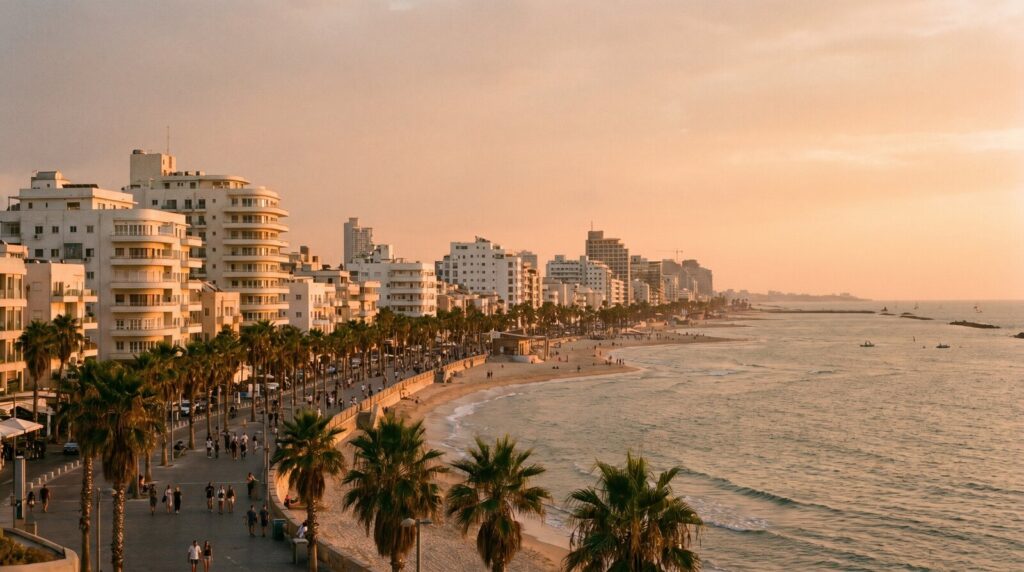
Tel Aviv, Israel: Bauhaus Architecture, Beaches & Startup Nation
Practical Travel Information
Ben Gurion Airport, located 20 kilometers southeast of Tel Aviv, is Israel’s main international gateway. The airport is modern and efficient, though security protocols are thorough—arrive early and expect detailed questioning about trip purposes. Direct flights connect Tel Aviv to major European cities, Istanbul, and other regional hubs. The airport-to-Tel Aviv trip takes 30 minutes via taxi, bus, or ride-sharing. Direct train connections to downtown provide the cheapest option (shekel cost is minimal).
Accommodation ranges from budget hostels ($25-40 nightly) through luxury hotels ($200-400+), with excellent midrange options ($80-150) offering comfort and walkability. South Tel Aviv neighborhoods near the beach provide walkable locations with strong social atmospheres. Northern neighborhoods are quieter but require longer walks or transportation to reach downtown and beaches.
Walking and public transportation (buses and light rail) provide primary mobility within the city. Buses are affordable and extensive though sometimes crowded. Taxis and ride-sharing are available but more expensive. Car rentals are unnecessary given good public transportation. The city remains walkable in sections, particularly for beach-focused visits. Most attractions are accessible through 10-20 minute walks from central locations.
The best visiting period spans April-May and September-October when temperatures are moderate (20-25°C). Summer (June-August) brings heat and crowds; winter is mild but can include rainfall. Ramadan (varies annually) doesn’t substantially affect Tel Aviv services as the city is secular. Shabbat (Friday evening to Saturday) affects bus service and many businesses, though secular restaurants and entertainment remain open.
Getting Around
Walking: Beach areas and downtown are walkable; other neighborhoods require transport.
Buses/Light Rail: Affordable, extensive coverage; best for longer distances.
Taxis/Ride-sharing: Available but expensive; negotiate taxi fares beforehand.
Best Time to Visit
Ideal: April-May or September-October for pleasant weather and fewer crowds.
Summer: Hot (30-35°C) but lively with international tourists and festivals.
Tel Aviv is expensive by Middle Eastern standards but reasonable compared to Western European cities. Street food and casual dining costs $8-15, restaurants $15-35, fine dining $40-80. Accommodation and entertainment follow similar patterns. A daily budget of $100-150 provides comfortable mid-range experience including accommodation, good dining, and entertainment.
Most visitors spend 3-5 days in Tel Aviv, allowing beach time, architectural exploration, and nightlife experience. Day trips to Jerusalem (45 minutes by bus), Dead Sea (near Jerusalem), or Mediterranean towns like Caesarea extend experiences beyond the city.
Discover Tel Aviv’s Modern Mediterranean Vitality
Tel Aviv represents something rare—a city that is simultaneously ancient and ultramodern, Mediterranean and high-tech, cosmopolitan and deeply local. Its beaches, architecture, food culture, and social vitality create compelling experiences, while its complex position within Israeli-Palestinian context requires visitors engage thoughtfully with history and contemporary realities.
Frequently Asked Questions About Tel Aviv
What is the best time to visit Tel Aviv in 2026?
April to June and September to November offer the best weather — warm (22-28°C) without the intense summer heat. April 2026 is perfect with beach-friendly temps and spring energy across the city.
Is Tel Aviv safe for tourists?
Tel Aviv is generally very safe with low street crime. Check your government’s travel advisories for the latest situation. The city itself has a relaxed, Mediterranean atmosphere. Use normal precautions as you would in any major city.
How expensive is Tel Aviv?
Tel Aviv is one of the pricier Middle Eastern cities. Budget around $80-120/day. A meal at a mid-range restaurant costs $15-25, a beer $7-9, and hostel beds start around $25-35/night. Sabich and falafel from street vendors are great budget meals at $4-7.
What is Shabbat like for tourists?
Shabbat runs from Friday sunset to Saturday sunset. Public transport stops, many shops close, but restaurants in central areas remain open. Friday afternoon sees a lively pre-Shabbat atmosphere at Carmel Market. Saturday is great for walking and cycling the quiet streets and waterfront.
Can I visit Jerusalem as a day trip from Tel Aviv?
Yes, Jerusalem is only about 1 hour away by bus or train. Trains run frequently from Tel Aviv HaHagana station. A day trip lets you visit the Old City, Western Wall, and Church of the Holy Sepulchre, though Jerusalem deserves at least 2-3 days on its own.
Explore More of the Middle East & Mediterranean
The Art of Batik: Wax-Resist Textile Mastery
Yogyakarta and the Javanese region maintain the world’s most sophisticated batik traditions, recognized by UNESCO as a Masterpiece of the Oral and Intangible Heritage of Humanity. Batik is more than a textile technique—it represents centuries of artistic evolution, mathematical precision in pattern-making, and cultural identity woven into fabric. The traditional process involves applying hot wax to cloth using a tjanting (a copper tool with a small spout), then plunging the fabric into dye baths. Where wax protected the cloth, the dye didn’t penetrate, creating patterns of stunning complexity and subtle gradations.
Two primary batik traditions define the region: batik tulis (hand-drawn, using the tjanting tool) and batik cap (stamped, using metal stamps). Batik tulis requires extraordinary skill—artisans spend years mastering consistent wax application, understanding how different temperatures affect flow, and visualizing the final pattern through wax-covered fabric. A single piece may require 40 hours or more to complete. Batik cap, using carved metal stamps, accelerates production but demands equal precision in stamp carving and pattern registration.
Visiting batik workshops offers insight into this meditative craft. Artisans work in open-air studios where the smell of hot wax and indigo dye fills the air, and conversations flow between generations of craftspeople. You’ll witness the remarkable transformation from plain white cotton to vibrant patterned cloth, understanding viscerally why batik commands premium prices and cultural reverence. Many workshops offer hands-on classes where you can create your own small batik piece, gaining appreciation for the precision required.
Hand-Drawn Batik (Tulis)
Traditional method requiring 30-40 hours per piece. Patterns show organic variations and hand-applied precision. Most expensive and artistically valued form.
Stamped Batik (Cap)
Uses metal stamps for pattern repetition. Faster production allows wider accessibility. Stamps themselves become heirloom pieces passed through generations.
Sultan’s Palace & Royal Ceremonies
The Kraton (Sultan’s Palace) remains the official residence of Yogyakarta’s reigning Sultan, making it unique among palace museums worldwide. The current Sultan, Hamengkubuwono X, continues an unbroken line of succession stretching back to the 18th century, and the palace functions as both living royal residence and historical site. This creates an unusual dynamic where visitors tour genuine spaces of governance and family life rather than rooms abandoned to museums.
The palace complex spans 25,000 square meters, built according to Javanese cosmological principles with precise directional alignment. The central pendopo (pavilion) rises dramatically with a roof supported without internal pillars, engineered to accommodate royal ceremonies and vast gatherings. Intricate wooden carvings showcase scenes from Hindu-Buddhist epics and Javanese folklore, each crafted by master artisans whose descendants continue the tradition today. Pools and gardens scattered throughout the complex serve both aesthetic and spiritual functions—water features represent the cosmic ocean in Javanese belief systems.
Visitors can witness ceremonial activities during certain hours, including the changing of the palace guard and occasional royal processions. The nearby Taman Sari (Water Castle), originally designed as a royal bathing retreat, presents another glimpse into royal leisure and architectural sophistication, with hidden gardens, underground channels, and meditation chambers demonstrating the intersection of pleasure and spirituality in palace design.
Prambanan Temple: Hindu Magnificence
If Borobudur represents Buddhist cosmology in stone, Prambanan temple expresses Hindu philosophy with equally breathtaking architectural ambition. This 10th-century temple complex honors Trimurti—the three primary Hindu deities: Brahma, Vishnu, and Shiva. The main temple tower reaches 47 meters high, making it the tallest religious structure in Southeast Asia when constructed, a distinction it held for centuries. Its needle-like spire curves in a distinctive style that dominated Indonesian temple architecture.
Unlike Borobudur’s unified massive structure, Prambanan comprises a central temple sanctuary surrounded by 224 smaller temple chambers, creating a complex spatial arrangement that reflects Hindu religious hierarchy and cosmological understanding. The stone craftsmanship rivals Borobudur’s precision—blocks fit so tightly that mortar wasn’t necessary. Relief carvings depict scenes from Hindu epics, particularly the Ramayana, with narrative panels showcasing the devotion, conflict, and triumph central to Hindu mythology.
In 2006, an earthquake caused significant damage to Prambanan, collapsing several towers. The subsequent restoration, completed over more than a decade, required painstaking reconstruction using historical records, architectural analysis, and traditional stone-working techniques. The restoration process itself became a learning laboratory for archaeologists and craftspeople studying how ancient builders achieved such precision without modern tools.