
Munich, Germany: Beer Gardens, Bavarian Culture & Alpine Doorstep
Germany’s cultural hub where lederhosen and cutting-edge art coexist between bountiful beer culture and nearby mountains
Munich sits in south-central Germany where the Isar River flows from Alpine foothills toward the North European Plain. The city represents Bavaria’s cultural heart—a region with distinct identity, traditions, and pride that distinguish it from broader German culture. Lederhosen, dirndls, beer gardens, classical music traditions, and Alpine heritage define Munich’s character. Yet the city also represents Germany’s cultural sophistication—world-class museums, the Neuschwanstein Castle proximity, BMW heritage, and a thriving contemporary art scene create complexity beyond stereotype.
Munich’s beer culture transcends tourism marketing. The Oktoberfest festival in September draws millions but runs for only 2-3 weeks. Year-round, Munich maintains a beer culture that shapes daily life—beer gardens function as social gathering places where locals conduct business, families spend evenings, and the beverage serves as social lubricant rather than tourist curiosity. This cultural reality distinguishes Munich from cities that commodify traditions for visitors.
What You’ll Find Here
Beer Gardens: Social Institution & Daily Culture
Munich beer gardens function as outdoor cafés where beer serves as the primary offering but food, socializing, and leisurely time occupation matter equally. The concept originated in 19th-century Bavaria when breweries stored beer in caves and created surrounding gardens for patrons to enjoy products. Modern beer gardens retain this structure—long tables under chestnut trees, self-service or table service beer, food vendors offering Bavarian specialties, and informal social atmosphere. Entry is free; you purchase beverages and food. The price of beer (€5-8 for large 1-liter mugs) is remarkably reasonable considering the location and quality.
The Englischer Garten, one of Europe’s largest urban parks, contains the Hirschau beer garden—an enormous facility seating thousands where locals and tourists mix freely. The Augustiner-Bräu beer garden, the largest, occupies the brewery grounds and maintains exceptional quality due to its traditional production and local clientele. The Hofbräuhaus, more touristy than others, retains significance as a historic venue with multiple levels creating different social atmosphere options. The smaller, neighborhood beer gardens—Hirschau, Augustiner-Bräu, and others—offer more authentic cultural exposure with less tourist saturation.
The beer garden season runs May through September, with the most pleasant weather in June and August. Sitting in a beer garden on warm summer evenings, drinking traditional Bavarian beer, eating pretzels and sausages, observing a cross-section of Bavarian society, captures something essential about Munich culture. The atmosphere is democratic—businesspeople in suits sit at tables with tourists, families with children occupy neighboring benches, musicians perform, and everyone participates in the collective social experience of leisurely outdoor gathering.
Marienplatz & Gothic Architectural Drama
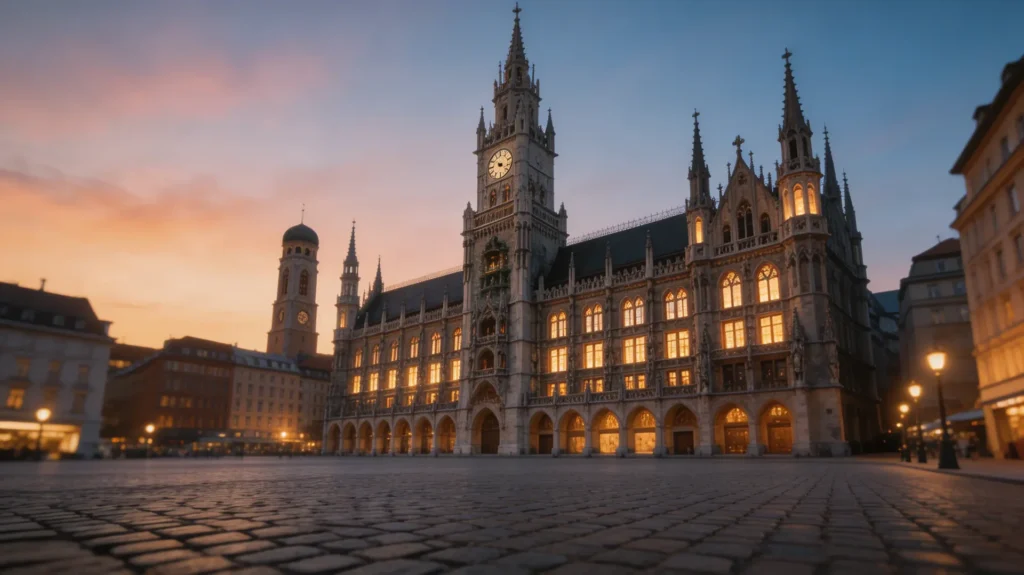
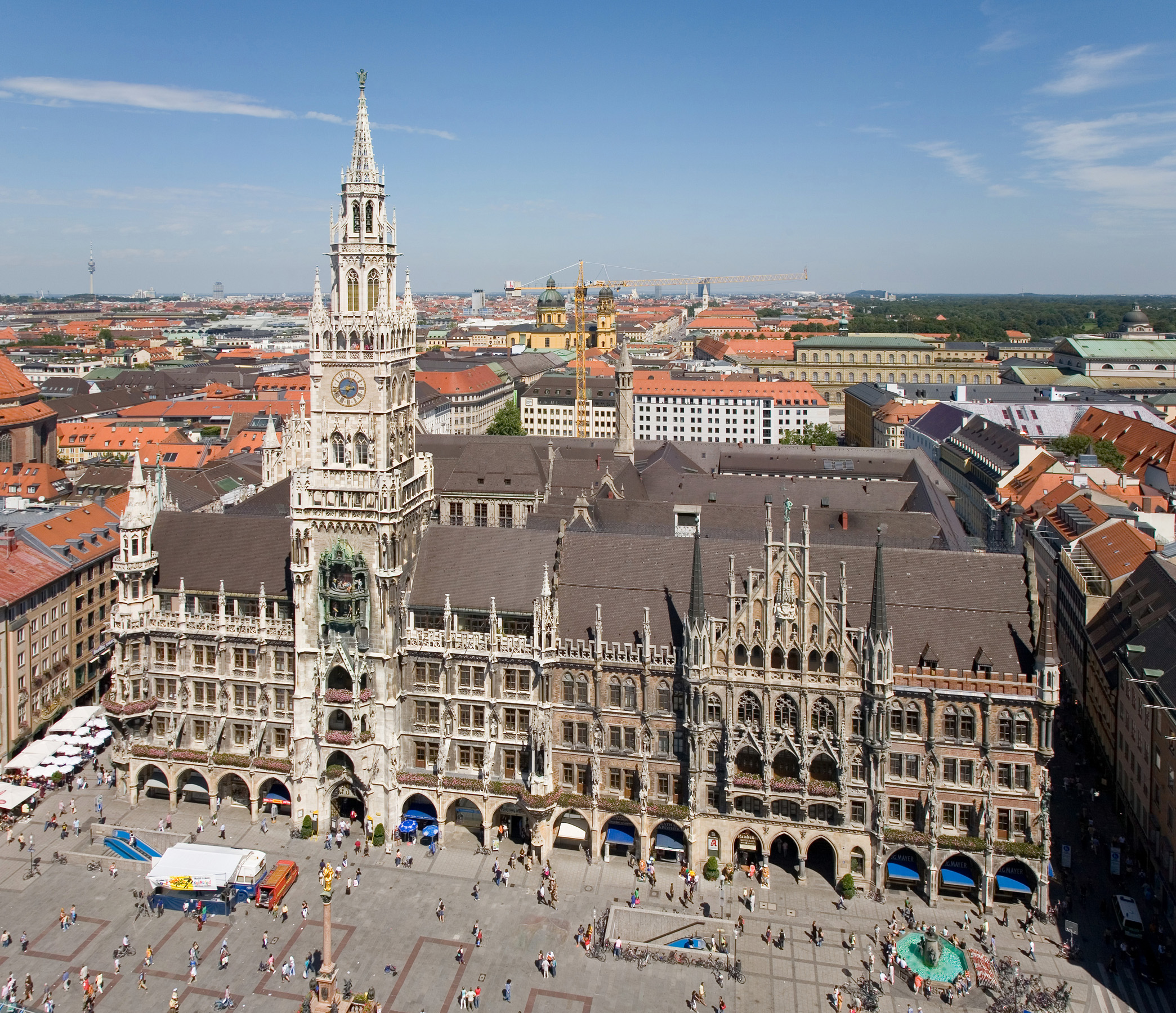
Munich’s Marienplatz (Mary’s Square) serves as the historic center, dominated by the Neues Rathaus (New Town Hall), a Gothic Revival building completed in 1909 that manages to be simultaneously imposing and ornate. The building’s detailed facade features pinnacles, spires, and countless decorative elements that exemplify late Gothic-inspired architecture. The Marienplatz itself functions as the city’s primary plaza, where markets, festivals, and public gatherings occur. The Glockenspiel, a mechanical clock tower within the town hall, performs shows multiple times daily featuring automated figures depicting historical events.
The Altes Rathaus (Old Town Hall), dating to the 15th century, sits on the plaza’s opposite side and represents genuine medieval architecture predating the dramatic Neues Rathaus. The contrast between the two buildings illustrates architectural evolution across 400+ years. The Frauenkirche (Church of Our Lady), Munich’s most recognizable structure, features distinctive twin onion domes (a feature common in Bavaria) and stands as a symbol of Bavarian religious identity. The church interior is surprisingly austere for its exterior drama—Protestant reformation stripped decorative elements, focusing on space and structure.
Walking around Marienplatz and surrounding streets reveals Munich’s medieval street patterns mixed with modern commerce. The surrounding Altstadt (Old Town) maintains pedestrianized shopping streets that balance preservation with contemporary retail. This is tourist-heavy territory, yet it retains authentic functionality—locals shop here, work in surrounding buildings, and pass through daily. The mixture of genuine city function and tourism creates livelier atmosphere than purely touristic zones.
Museums & Cultural Institutions
Munich’s Kunstareal (Arts District) clusters multiple significant museums within walking distance. The Pinakothek der Moderne houses modern and contemporary art with particular strength in 20th-century German art. The Alte Pinakothek contains Renaissance and Baroque masterworks including significant Rubens, Dürer, and Italian Renaissance collections. The Neue Pinakothek focuses on 19th and early 20th-century art with emphasis on German Romanticism. The museums are individually excellent; visiting one requires 2-3 hours; visiting multiple requires dedicated time.
The Deutsches Museum (German Museum) surveys German scientific and technical achievements across centuries—an enormous collection that could consume an entire day of exploration. The museum’s strength lies not in fine art but in understanding German technological development. The Marienplatz area contains several smaller specialized museums addressing specific topics or artists. Munich’s cultural offerings reflect both historical importance and contemporary cultural investment—the city takes culture seriously and funds institutions accordingly.
The BMW Museum, celebrating the automobile company’s history, operates adjacent to the distinctive BMW headquarters building. The building itself functions as a major architectural landmark. The museum traces development of motorcycles and cars, with particular emphasis on engineering innovation. Automotive enthusiasts find this museum exceptional; others might find it specialized. The nearby Olympic Park, site of the 1972 Olympics, offers architectural interest through its modernist structures and serves as recreational space for locals.
Bavarian Heritage & Cultural Traditions
Bavaria maintains a distinct identity within Germany, with cultural pride, regional traditions, and political independence that shape daily life. The lederhosen (leather pants) and dirndl (traditional dress) represent Bavarian heritage and appear not merely as tourist costumes but as genuine ceremonial dress worn at festivals and formal events. This cultural continuity reflects that Bavarian traditions persist in contemporary life rather than being merely historical artifacts. Understanding Munich requires appreciating that Bavarians view themselves as distinct from broader German culture.
The language—Bavarian dialect (Bairisch)—differs from standard German enough to challenge even German speakers. The hospitality culture emphasizes warmth, informality, and enjoyment of life—often contrasting with German reputation for formality and reserve. Bavarian food emphasizes hearty preparations: sausages, schnitzel, dumplings, and bread. Beer consumption integrates into daily culture in ways beyond other German regions—it’s not excessive consumption but rather normalized beverage with meals and social occasions.
The Markt (market) culture remains important in Munich. Weekly markets, seasonal celebrations, and food traditions connect contemporary life to agricultural heritage. The Christmas markets (Christkindlmarkts) transform plazas into festive spaces with food vendors, decorations, and thermal beverage stalls. These markets attract both locals and tourists—they remain genuinely functional markets rather than purely touristic operations. Experiencing Munich’s seasonal rhythms and market culture provides understanding beyond major monuments.
Food Essentials
Weisswurst: light sausage served with sweet mustard. Schnitzel: breaded veal or pork cutlet. Knödel: bread dumplings served with various sauces. Flammkuchen: Alsatian pizza variation.
Bavarian Beers
Pilsner/Helles: light lager. Dunkel: dark lager. Weizen: wheat beer. Bockbier: strong seasonal variety. Each brewery maintains distinct characteristics and loyal followings.
English Garden: Urban Park & Social Space
The Englischer Garten (English Garden) ranks among Europe’s largest urban parks—3.75 square kilometers of landscaped green space in the city center. Created in 1789, the park predates most other European city parks and represents an early example of green space democratization (originally, parks were aristocratic preserves). Today, the English Garden functions as Munich’s primary recreational space—locals jog, cycle, walk, socialize, and swim here daily. The park’s centerpiece is the Isar River, which runs through it with excellent swimming conditions in summer (though water temperatures remain cool).
Within the English Garden sits the Hirschau beer garden, the Rummelsburger recreational area, and multiple smaller cafés. The park attracts all social classes and ages—families with children, office workers on lunch breaks, elderly people walking, cyclists on dedicated paths, swimmers during warm months. The park demonstrates successful urban green space integration into daily life rather than as a tourist attraction.
The Chinese Pagoda (Chinesischer Turm), built in the 1790s, still stands within the park as a surprising historical artifact. The tower’s function remains unclear; it may have been purely decorative or served observation purposes. Regardless, it demonstrates the 18th-century fashion for exotic ornamentation. The pagoda anchors one significant beer garden area and has become iconic despite somewhat unusual placement in a European park.
Alpine Day Trips & Bavarian Countryside
Neuschwanstein Castle, perhaps Europe’s most famous castle, sits approximately 90 kilometers southwest of Munich. The fairy-tale castle inspired Disney’s castle design and dominates Bavarian tourism. Day trips involve 2-3 hour travel via train or organized tour, exploration of the castle (with advance reservation required), and return to Munich by evening. While extraordinarily touristic, Neuschwanstein’s architectural uniqueness and mountain setting justify the effort. The castle appears repeatedly in photographs as the archetypal European castle—understanding why requires seeing it in person.
The Bavarian Alps, an hour south of Munich, offer hiking accessible without mountaineering experience. The Zugspitze (2,962m), Germany’s highest peak, is accessible via cable car from small Alpine villages. The journey through mountain scenery and small communities provides contrast to urban Munich. Many day trips involve visiting small villages, walking for 2-3 hours, and enjoying traditional Bavarian food in village restaurants before returning to the city.
The Starnberger Lake, 25 kilometers south, offers an accessible water destination for day excursions. Small villages along the lake serve as bases for hiking, swimming, and village exploration. The lake provides Bavarian countryside experience without extensive travel requirements. Many local residents use the lake for regular recreation rather than special trips.
Plan Your Munich Experience
Spend minimum 3-4 days to experience beer gardens, explore Marienplatz and Old Town thoroughly, visit at least one major museum, and potentially take an Alpine day trip. Longer stays enable deeper cultural engagement, multiple beer gardens in different neighborhoods, and extended exploration of surrounding areas. The ideal visit balances famous sights with discovery of local neighborhoods and participation in beer garden culture.