
City Guide · Japan · Kansai
Osaka, Japan: Kuidaore Capital, Tokaido Anchor & Kansai’s Loud, Generous Heart
I have ridden into Shin-Osaka Station on the Tokaido Shinkansen at least a dozen times over the last decade and I still feel the city change shape inside three blocks. Tokyo polishes its food until it shines; Osaka grills it on a metal griddle in front of you and shouts the price as you sit down. The 23 wards on the Yodo River delta are home to roughly 2.82 million people , but the broader Greater Keihanshin region pulls in around 20.4 million people across Kyoto, Osaka, Kobe and Sakai — Japan’s second-largest urban agglomeration after Greater Tokyo . The Tokaido Shinkansen connects Tokyo Station to Shin-Osaka in roughly 2 hours 21 minutes on the fastest Nozomi services , and most travellers misuse that proximity by spending one rushed afternoon here on the way to Kyoto. Treat this guide as the brief I would hand my own family the night before they checked in at the Cross Hotel Osaka in Namba: four full days, two day-trips, one Yamazaki distillery afternoon, and an unembarrassed amount of takoyaki.

Table of Contents
- Why Osaka?
- Best Time to Visit Osaka
- Cherry Blossom & Tenjin Matsuri 2026
- Getting There — KIX, Itami & Shin-Osaka
- Getting Around — JR Loop, Metro & ICOCA
- Neighborhoods
- Cultural Sights
- Day Trips from Osaka
- Food & Drink in Osaka
- Practical Information
- Budget Breakdown
- Planning Your Trip
- Frequently Asked Questions
Why Osaka?
Osaka is the food capital of Japan and one of the country’s three working megacities — the city itself counts about 2,816,247 people across 24 wards as of October 2025 , while the surrounding Greater Keihanshin region pulls in roughly 20.4 million residents across 13,228 km² . Britannica frames the same city differently — 86 square miles, 1,360 mm of annual rainfall, and the historical engine of the Keihanshin Industrial Zone, Japan’s second-largest urban agglomeration . The geography is a flat, river-laced delta on the eastern edge of Osaka Bay , which is why the bullet train arrives in a matter of minutes from the inland direction and KIX’s artificial island sits 38 km south-west out at sea . Walk the Midosuji boulevard from Umeda south to Namba and you’ve crossed the city in under an hour; ride the orange-livery JR Loop Line and you’ve circled it in 40 minutes .
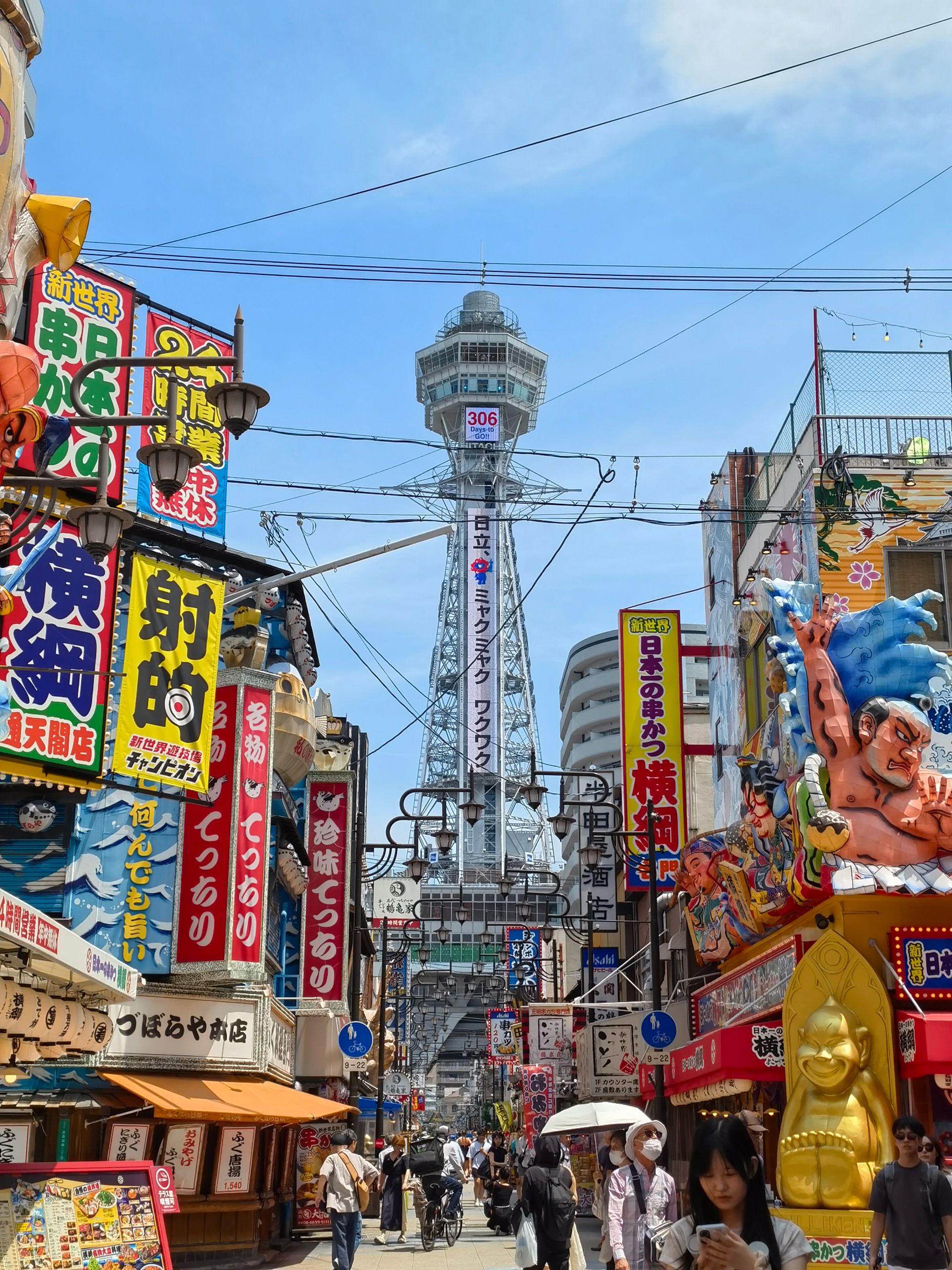
What makes Osaka singular for visitors is the rhythm of kuidaore — literally “eat oneself bankrupt”, the Edo-era stereotype of a city whose residents will spend their last yen on dinner . The street-food vocabulary started here: takoyaki was popularised in 1935 by a vendor named Tomekichi Endo at his Aizuya shop ; okonomiyaki in its mixed-batter Kansai form is the way most Japanese still default to the dish nationwide ; and kushikatsu, the deep-fried skewer with the famous “no double-dipping” rule, was born in 1929 in Shinsekai under the Tsutenkaku tower . Add Osaka Castle (1583, Toyotomi Hideyoshi’s stronghold; current tenshu rebuilt in 1931 by citizen donations) set in a 105.6-hectare park , the 593 CE Shitennoji temple Prince Shotoku founded as “the first officially administered Buddhist temple in Japan” , and the Mozu-Furuichi Kofun Group of 4th-to-6th-century burial mounds in nearby Sakai inscribed by UNESCO in 2019 , and you have a city whose history is wider than “little Tokyo” first-time visitors expect.
The other Osaka argument is geographic. The city is the spine of the Kansai golden triangle: Kyoto is 28 minutes north on the JR Special Rapid , Nara is 50 minutes east on the JR Yamatoji or Kintetsu lines , Kobe is half an hour west by JR Kobe Line , Himeji’s UNESCO castle is 40 minutes by Sanyo Shinkansen , and Mt Koya’s 800-metre temple plateau is 90 minutes south on Nankai . Most travellers split a Japan trip into Tokyo and Kyoto and miss Osaka’s case as the better Kansai base. We disagree, and so does the JNTO — the official tourism organisation makes the same argument in its Osaka regional overview . Pair this guide with the Japan Travel Guide for the country-level context, and read the Kyoto City Guide together with this one as a side-by-side Kansai briefing.

Best Time to Visit Osaka
Osaka is a humid-subtropical four-season city with a slightly warmer profile than Tokyo. The Japan Meteorological Agency’s 1991–2020 climate normals for Osaka record a January average of 6.2°C with 47 mm of precipitation and an August average of 29.0°C with 113 mm ; the JMA portal also covers typhoon-window forecasts and J-Alert advisories for the wider Kansai region . Britannica records an average annual rainfall around 1,360 mm with a tsuyu rainy peak in June and a typhoon window centred on September ; the same source lists January average highs around 9.7°C and August average highs of 33.7°C, with summer humidity routinely above 70% . The two windows worth re-arranging your year around are sakura (cherry blossom, late March to early April) and the Tenjin Matsuri festival on 24–25 July. Between those bookends sit two quieter shoulder months (May and early November) that are the actual sweet spot if you don’t need either headline event.
Spring (March – May)
The blockbuster window. Osaka Castle Park’s Nishinomaru Garden hosts roughly 600 sakura trees that bloom on the same calendar as central Honshu — kaika first-bloom typically lands 25–30 March, with full bloom four to seven days later . The Osaka Mint Bureau’s Sakura no Toorinuke (“cherry blossom passage”) opens for one week in mid-April with around 350 trees of approximately 130 varieties on a single 560-metre walk — admission is free but advance reservations are required during peak years . May is the warmest month before tsuyu, with breezy 22–26°C days and the lowest humidity on the calendar; Golden Week (29 April – 5 May) is the only week to avoid because domestic travel saturates Kyoto-Osaka-Nara hotels three months out .
Summer (June – August)
June is the rainy season — humid, occasionally pouring, but green and quiet on the streets. July and August deliver Osaka’s loudest calendar item: the Tenjin Matsuri on 24–25 July, one of the “three great festivals” of Japan alongside Kyoto’s Gion and Tokyo’s Kanda . August is hot — multi-week stretches above 33°C, with overnight lows around 26°C and humidity in the 75–85% range . The Yodogawa fireworks festival in early August and the Osaka Castle summer illumination round out the city’s warm-month calendar . Pack a packable umbrella and an insulated water bottle.
Autumn (September – November)
The best season for first-time visitors after late September. Typhoon risk fades through the second half of September; cool, low-humidity 17–22°C days settle in for October and November. Kōyō (autumn foliage) peaks in central Osaka mid-November — Osaka Castle Park’s ginkgos turn first, followed by the maples around Sumiyoshi Taisha and Mt Mino-o’s waterfall trail just north of the city. The Midosuji Autumn Party (street festival on the central avenue) and Osaka’s November Bunraku run at the National Bunraku Theatre are the two cultural anchors of the month .
Winter (December – February)
Cold and bright. December averages 10°C / 3°C with very low humidity, and Osaka rarely sees lying snow. The Midosuji illuminations from late November through December turn the central boulevard into a 4-kilometre LED tunnel; Universal Studios Japan’s Christmas season is the busiest park calendar of the year . New Year (hatsumōde) draws roughly 2 million visitors to Sumiyoshi Taisha in the first three days — the shrine is one of the country’s top three first-visit destinations . February is the cheapest month for hotels in the central wards.
Cherry Blossom & Tenjin Matsuri 2026 — Osaka’s Two Headline Calendars
If you can match your dates to either window, do. Osaka’s spring sakura calendar and its summer Tenjin Matsuri calendar are the two seasonal events the rest of the country plans around , and Osaka does both with more swagger than Kyoto or Tokyo because the river-laced delta gives festival organisers easy water-side staging.
Timing the sakura is the hard part. Osaka’s bloom typically opens in the last few days of March and reaches full bloom in the first week of April, though the exact dates shift year to year with late-winter temperatures, so the Japan Meteorological Corporation and JMA forecasts that begin publishing in January are the only reliable guide — a warm February can pull full bloom forward by a week, a cold snap can push it back . The practical move for a 2026 trip is to book a flexible four-night window that straddles the first week of April, then watch the forecast revisions through March; the trees hold full bloom for only about a week before the petals fall. Tenjin Matsuri is the opposite problem — its dates are fixed on 24–25 July every year, so the only variable is how early you stake out a riverbank spot. Between the two, the spring window is the harder ticket and the one worth building an entire itinerary around.

Osaka Castle Park & Mint Bureau Sakura, late March – mid-April 2026
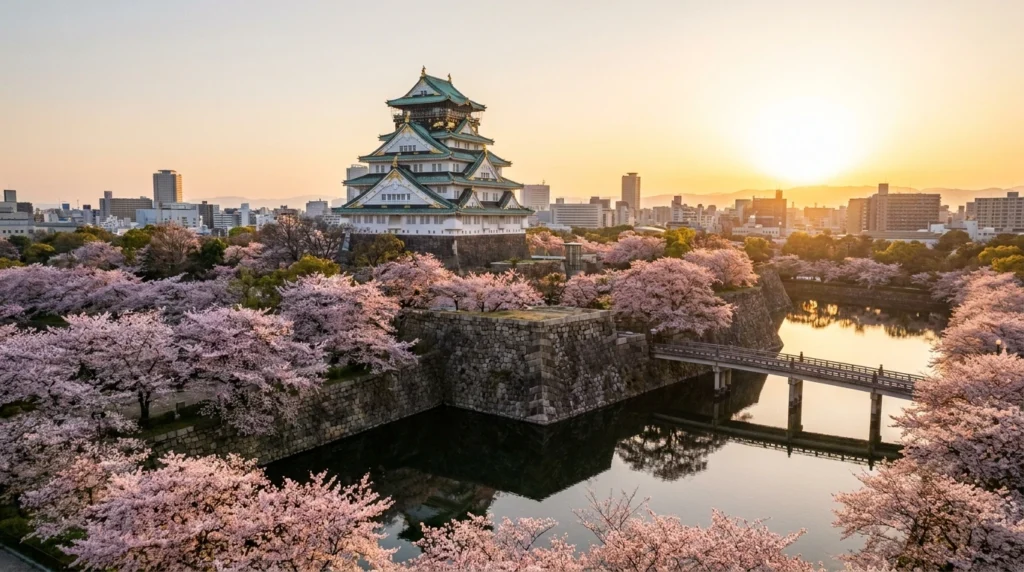
Three sakura sites dominate central Osaka. Osaka Castle Park’s Nishinomaru Garden is the photogenic anchor — about 600 cherry trees on the western inner-bailey lawn, with the white-and-jade-green tenshu rising behind . Nishinomaru charges a separate ¥350 admission during sakura week and sells evening illumination tickets that book out 2–3 weeks ahead. Kema Sakuranomiya Park stretches a full 4 kilometres along the Okawa River with roughly 4,800 trees — the longest sakura tunnel in central Japan and free to walk at any hour . The Osaka Mint Bureau’s Sakura no Toorinuke (“passage through the cherries”) opens for a single mid-April week along the western bank of the Okawa, with around 350 trees of approximately 130 varieties on a 560-metre one-way path — the late-blooming yaezakura double-flowered varieties are the headline. Admission is free but the bureau requires online advance reservations during peak years to manage capacity .
Tenjin Matsuri, 24–25 July 2026
Tenjin Matsuri is Osaka’s biggest annual party and one of the three great Shinto festivals of Japan. The host shrine, Osaka Tenmangu, was founded in 949 CE and is dedicated to Sugawara no Michizane, the deified scholar-statesman known as Tenjin . The 25 July evening climax is a flotilla of about 100 boat groups carrying the sacred mikoshi and an army of drummers up the Okawa River, illuminated by torches on the embankments . Around 19:30 the fireworks start — roughly 90 minutes of pyrotechnics directly above the river, doubled by the reflection on the water (the festival’s nickname is the “Festival of Fire and Water”) . Crowds peak at well over a million along the riverbanks . Get on the Sakuranomiya or Temmabashi side of the river by 17:00 if you want a front-row patch; reserved riverboat tickets sell out 6+ months ahead via the shrine’s ujiko association.
Getting There — KIX, Osaka Itami & Shin-Osaka
Osaka is the second-most-connected city in Japan after Tokyo, with two airports plus the country’s busiest Shinkansen line all converging on the central wards. The 2026 split is simple: Kansai International (KIX) for international flights, Osaka Itami (ITM) for domestic, and Shin-Osaka Station for the Tokaido and Sanyo Shinkansen.
Kansai International Airport (KIX)
KIX opened on 4 September 1994 as the first 24-hour airport in Japan, built on a 4-kilometre artificial island in Osaka Bay 38 km south-west of central Osaka . Terminal 1 was designed by Renzo Piano and remains the longest airport terminal in the world at 1.7 km . The airport handled 30.6 million passengers in 2024, of which roughly 78% were international — KIX is, by passenger split, the most international-skewing major Japanese airport . The official Kansai Airports portal sits at the operator level .
Three rail / road options reach the city from KIX:
- Nankai Rapi:t — the metallic-blue limited express that runs into Namba in roughly 36 minutes for ¥1,490 (¥1,290 standard + ¥200 express); it’s the fastest route into the southern half of the city . The slower Nankai “Airport Express” covers the same route in 45 minutes for ¥970.
- JR Haruka — JR West’s purple-and-white Limited Express runs to Tennoji in roughly 33 minutes and to Shin-Osaka in 50 minutes, then to Kyoto in 75 minutes; ¥2,410 reserved seat from KIX to Shin-Osaka, with ICOCA-Haruka discount packages for foreign passport holders .
- Airport Limousine Bus — door-to-major-hotel coaches at ¥1,800–¥2,200; the simplest option with three-plus checked bags or with a hotel right by Umeda or Namba.
Osaka Itami Airport (ITM)
Itami sits 11 km north of Osaka Station and handles domestic flights only since KIX absorbed the international traffic in 1994 . In January 2025 the operator officially renamed the airport from “Osaka International Airport” to “Osaka Itami Airport” to stop confusing first-time visitors who book international flights into ITM by mistake . The Osaka Monorail is the only direct rail link — pick it up at the airport and connect to the Midosuji subway line at Senri-Chuo for central-city hotels. By car, central Osaka via the Hanshin Expressway is roughly 25–30 minutes . Pick ITM only if you’re flying domestic and your origin city has more flights into Itami than KIX (Sapporo and Naha both do); for any international arrival or any connection onward to Kyoto and the wider Kansai region, KIX remains the default choice.
Shin-Osaka — Tokaido & Sanyo Shinkansen
The Tokaido Shinkansen connects Tokyo Station to Shin-Osaka in roughly 2 hours 21 minutes on Nozomi services, the line covers 552.6 km and is JR Central’s busiest line, carrying 161 million passengers in fiscal 2023 with up to 16 trains per hour at peak using 16-car 1,323-seat rolling stock . The Sanyo Shinkansen continues west from Shin-Osaka to Kobe, Himeji, Hiroshima and Hakata; both the Hikari and Kodama services are JR Pass eligible (Nozomi requires a supplement). Shin-Osaka has direct Midosuji subway and JR Loop Line connections; getting to Umeda from Shin-Osaka takes about 4 minutes, to Namba about 13 minutes, to Tennoji about 22 minutes .
Visa & Visit Japan Web
Roughly 70 nationalities (UK, US, Canada, Australia, EU, NZ, Singapore, Korea among them) get 90 days visa-free on arrival into KIX or ITM . Pre-clear immigration and customs through Visit Japan Web at least 6 hours before landing — you receive QR codes that route you through the “fast lane” gates at KIX and ITM, measurably faster than the paper-form lane in 2026. The CDC notes no required vaccinations for Japan and confirms tap water is safe across the country .
Getting Around — JR Loop, Osaka Metro, ICOCA & Privates
JR West and the Osaka Loop Line
The Osaka Loop Line is the orange-livery JR West circular that ties the city’s northern hub at Osaka Station (Umeda) to Tennoji on the southern arc, with Tsuruhashi, Morinomiya and Osakajōkōen as the eastern stations near the castle . The loop is 21.7 km long with 19 stations and ran roughly 984,000 daily passengers in FY2015; trains use 8-car 323-series sets with 5-minute headways during the day . Like Tokyo’s Yamanote, services run inner-loop and outer-loop rather than “up” and “down” . JR West also runs Sanyo Shinkansen services from Shin-Osaka and operates the JR Haruka express to KIX and the Universal Studios shuttles on the Yumesaki branch .
Osaka Metro
Osaka Metro operates 9 lines plus the New Tram, formerly run by Osaka City and corporatised in 2018 . The four most useful for visitors are the Midosuji Line (red, M) — the north-south spine running Shin-Osaka – Umeda – Shinsaibashi – Namba – Tennoji; the Tanimachi Line (purple, T) — from Higashi-Umeda south through Osaka Castle’s eastern station; the Chuo Line (green, C) — the east-west line that crosses the bay to Cosmosquare; and the Sennichimae Line (pink, S) — running through Namba and Nipponbashi for theatre access . Single fares run ¥190–¥400 within the city core; the Osaka Metro Enjoy Eco Card is a 1-day unlimited pass at ¥820 weekdays / ¥620 weekends and holidays.
ICOCA & Mobile ICOCA
ICOCA is JR West’s contactless smart card — launched on 1 November 2003, it works on every train, subway, bus, taxi, vending machine and most convenience stores nationwide . The standard card costs ¥2,000 (¥500 refundable deposit plus ¥1,500 of usable balance) and uses Sony’s FeliCa contactless RFID system . Mobile ICOCA launched in March 2023 for Apple Pay and Google Pay; the digital version is the cleanest 2026 path for most travellers because you can top up from your phone, tap through any gate, and spend leftover balance at any 7-Eleven before flying home . ICOCA is interchangeable with Suica, Pasmo, Pitapa and the other major IC cards through the Japan-wide mutual usage system since March 2013 .
Hankyu, Hanshin, Keihan, Kintetsu & Nankai — the Five Privates
Osaka has the densest private-railway network in Japan after Tokyo. Each private operator anchors at a specific Umeda or Namba terminal:
- Hankyu (maroon livery) — from Umeda to Kobe (Sannomiya, 27 min) and Kyoto (Kawaramachi, 45 min) and the Takarazuka theatre town; the Hankyu 1-Day Tourist Pass at ¥800 covers the whole network .
- Hanshin (yellow stripe) — from Umeda to Kobe along the coastal alignment, with the Koshien baseball stadium stop for Hanshin Tigers games.
- Keihan (green) — from Yodoyabashi or Kyobashi to Kyoto’s Gion-Shijo via Hirakata; the most scenic route to Kyoto’s eastern hills.
- Kintetsu (red & white) — from Osaka-Namba and Tsuruhashi east to Nara (Kintetsu-Nara, 35 min) and on to Ise-Shima.
- Nankai (blue) — from Namba south to Wakayama and the Mt Koya cable car at Gokurakubashi ; also the Nankai Rapi:t to KIX.
Taxis & Walking
Osaka taxis are excellent and reasonable: ¥600 flag-fall for the first 1 km, then ¥100 per 244 m, with the entire 24-ward city covered for under ¥3,000 most of the day. Use them only for late-night cross-ward hops once trains stop (last train ~24:30, first train ~05:30). Walking the Midosuji boulevard from Umeda south to Namba (3.5 km, 45 min) is the single best urban walk in the city — ginkgo-lined, lined with Western luxury flagships, and ending at Dotonbori’s neon. Apps that work: Google Maps for transit routing, Citymapper for full Osaka Metro coverage, and Japan Travel by NAVITIME for the most accurate next-train timings.
Neighborhoods: Finding Your Osaka
Deciding between Namba and Umeda — or between Osaka and Kyoto entirely? Our guide to where to stay in Japan compares them all.
📍 Osaka Map: Every Place in This Guide
Umeda & Kita
Umeda is the northern business and shopping capital of Osaka, anchored on JR Osaka Station — the largest passenger station in the JR West network . The 1993 Umeda Sky Building, with its mid-air Floating Garden Observatory linking two towers at 173 metres, is the architectural icon; the 2011 Osaka Station City rebrand turned the railway hub itself into a destination of department stores, restaurant floors and rooftop gardens . The kanji for Umeda originally meant “buried field” (埋田) before being changed to “plum field” (梅田) when Osaka Station opened in 1874 . Sleep here for a final pre-flight night and easy Hankyu day-trips to Kobe.
- Umeda Sky Building Floating Garden — 173-metre observatory open to 22:30
- Grand Front Osaka — northern annex of Osaka Station City, six floors of restaurants
- Hep Five Ferris Wheel — red, 106-metre, on top of a fashion mall
Best for: Shinkansen exits, business stays, Hankyu day-trips. Access: JR Osaka, Hankyu / Hanshin Umeda, Midosuji / Tanimachi / Yotsubashi metro lines.
Namba & Minami
Namba is the southern entertainment capital and the better first-trip base — on the Midosuji line three subway stops south of Shinsaibashi, on the Sennichimae line for the National Bunraku Theatre, on the Nankai line for KIX in 36 minutes via Rapi:t . Namba Walk and Namba Parks are the two big modern complexes; Sennichimae Doguyasuji is the city’s “kitchenware street” of about 50 shops selling everything from copper takoyaki griddles to plastic food samples. Sleep here on a first trip.
- Namba Parks — rooftop garden mall over the old Osaka Stadium site
- Sennichimae Doguyasuji — 150-metre kitchenware arcade
- Hozen-ji Yokocho — lantern-lit Edo-style alley behind the Shochikuza theatre
Best for: first-timers, food access, late-night returns from KIX. Access: Midosuji / Sennichimae / Yotsubashi metro, JR Namba, Nankai Namba, Kintetsu Osaka-Namba.
Dotonbori
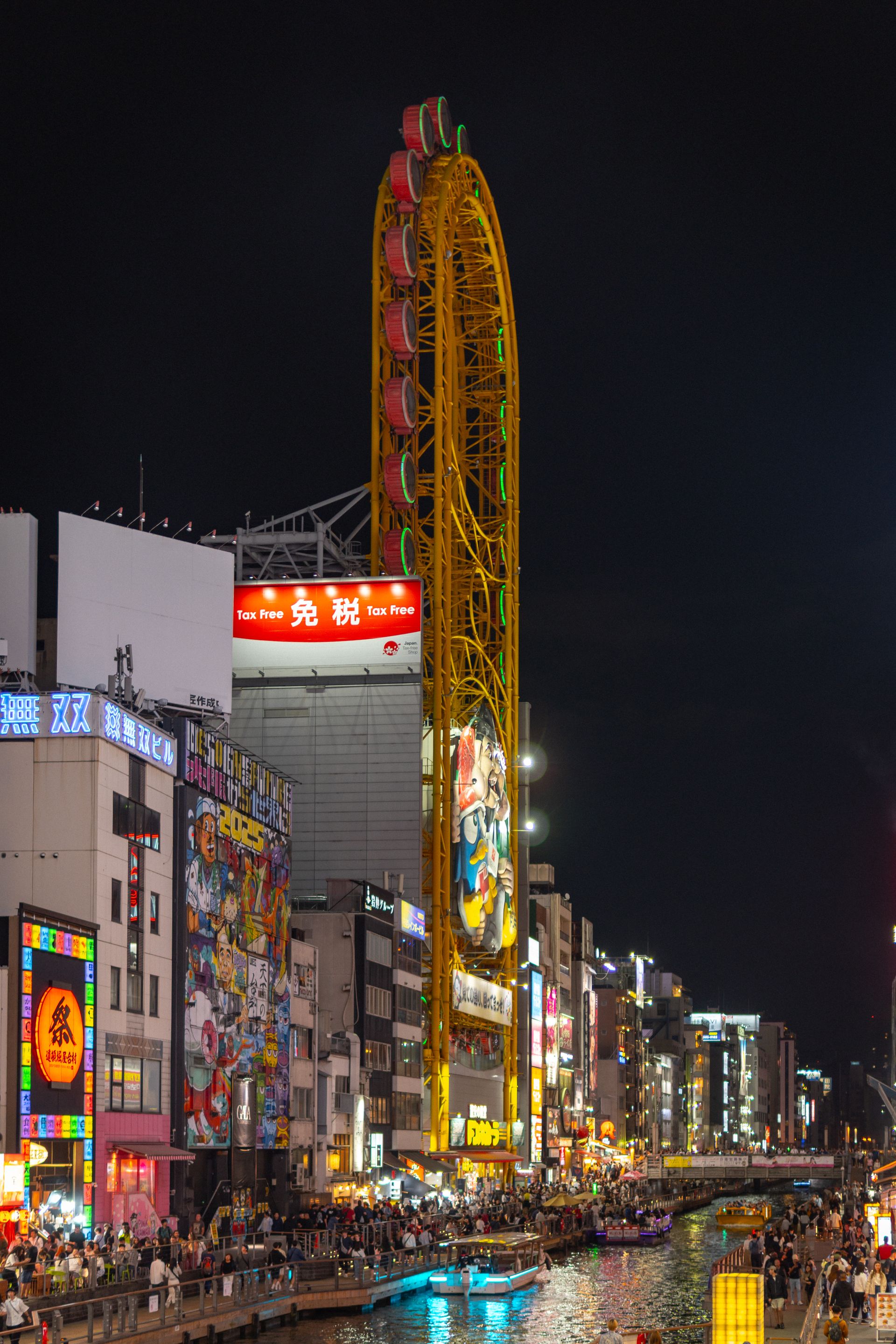
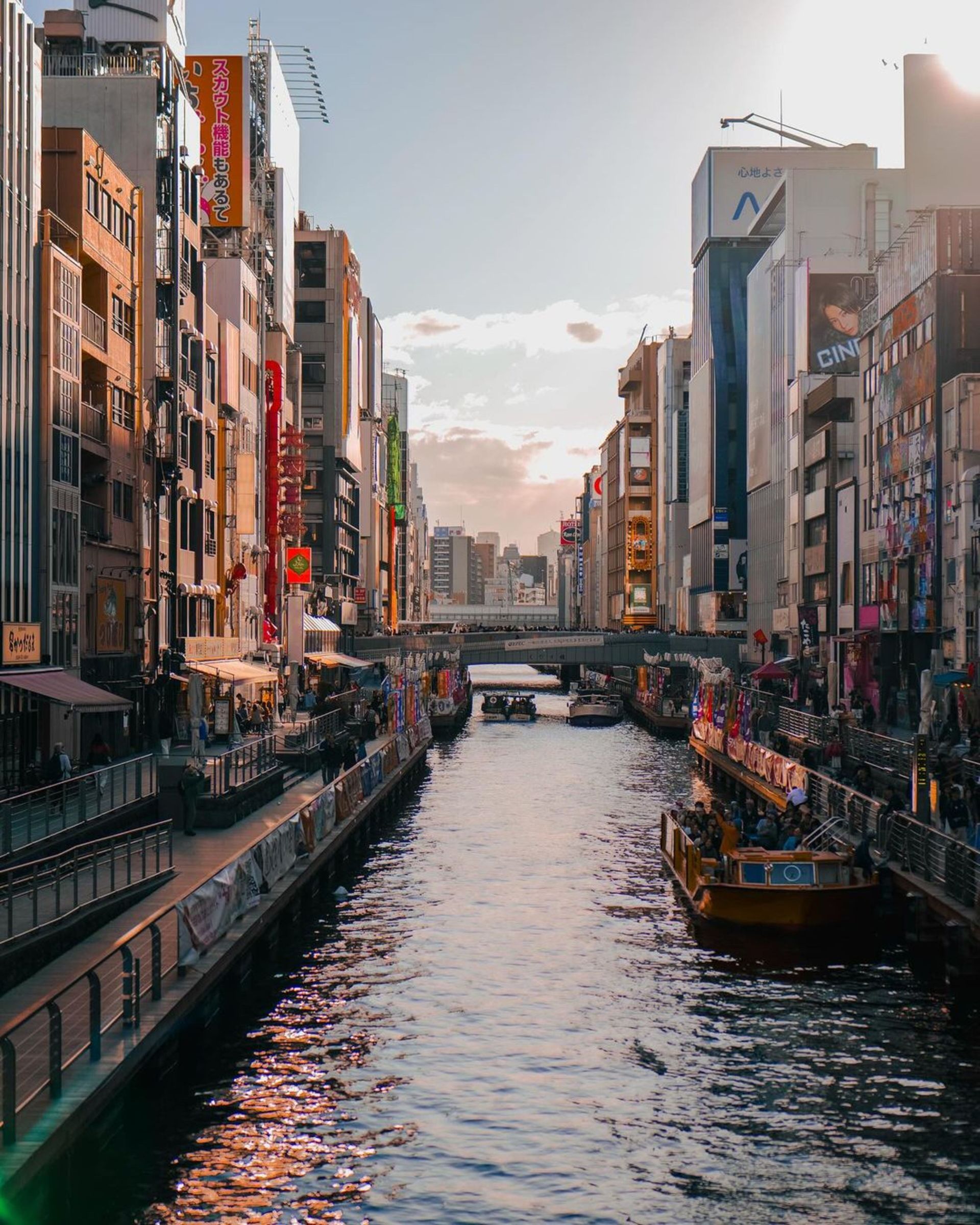
Dotonbori is the canal-and-neon spine of central Osaka, established as an entertainment district in 1612 around a canal whose digging was completed in September 1615 . The district’s most photographed asset is the Glico Running Man billboard, originally installed in 1935 with the current sixth-generation LED version unveiled in October 2014 . Other landmarks: the 6.5-metre mechanised crab sign at Kani Doraku (built 1960; the restaurant opened 1962), Kinryu Ramen (1982), and the 1924 Hariju beef restaurant . The Ebisu Bridge over the canal is the photo-the-Glico-sign anchor; tour boats run the canal in 25-minute loops day and night. The kuidaore phrase originated here — “to ruin oneself by extravagant spending on food” .
- Glico Running Man billboard — 1935 original, 6th-gen LED 2014
- Kani Doraku mechanical crab — 6.5 m, 1960
- Hozen-ji Yokocho — lantern alley behind the canal
Best for: first-night arrival, food crawls, Insta-tourism. Access: Midosuji / Sennichimae lines (Namba), Yotsubashi line.
Shinsaibashi & Amerika-mura
Shinsaibashi is Osaka’s premier shopping arcade, named after the 1622 bridge merchant Shinsai Okada built across the Nagahori-gawa canal — replaced by an iron bridge in 1873, a stone bridge in 1909, then reclaimed in 1964 with the modern Crysta Nagahori underground mall opening in 1997 . The 600-metre covered Shinsaibashi-suji shotengai runs from Mido-suji north to Nagahori-dori, with Daimaru as the anchor department store and Dior, Chanel, Louis Vuitton and Hermes flagships in the surrounding blocks . Across Mido-suji to the west is Amerika-mura (“American Village”) — the centre of Osaka’s youth culture, vintage Hawaiian shirts, indie record stores and triangle-park scene .
- Shinsaibashi-suji — 600 m covered shopping arcade
- Amerika-mura Triangle Park — youth-fashion hub
- Daimaru Shinsaibashi — 1933 Vories-designed flagship
Best for: shopping, weekend foot traffic, vintage clothing. Access: Midosuji line (Shinsaibashi), Nagahori-Tsurumi-ryokuchi line, Yotsubashi line.
Tennoji & Abeno
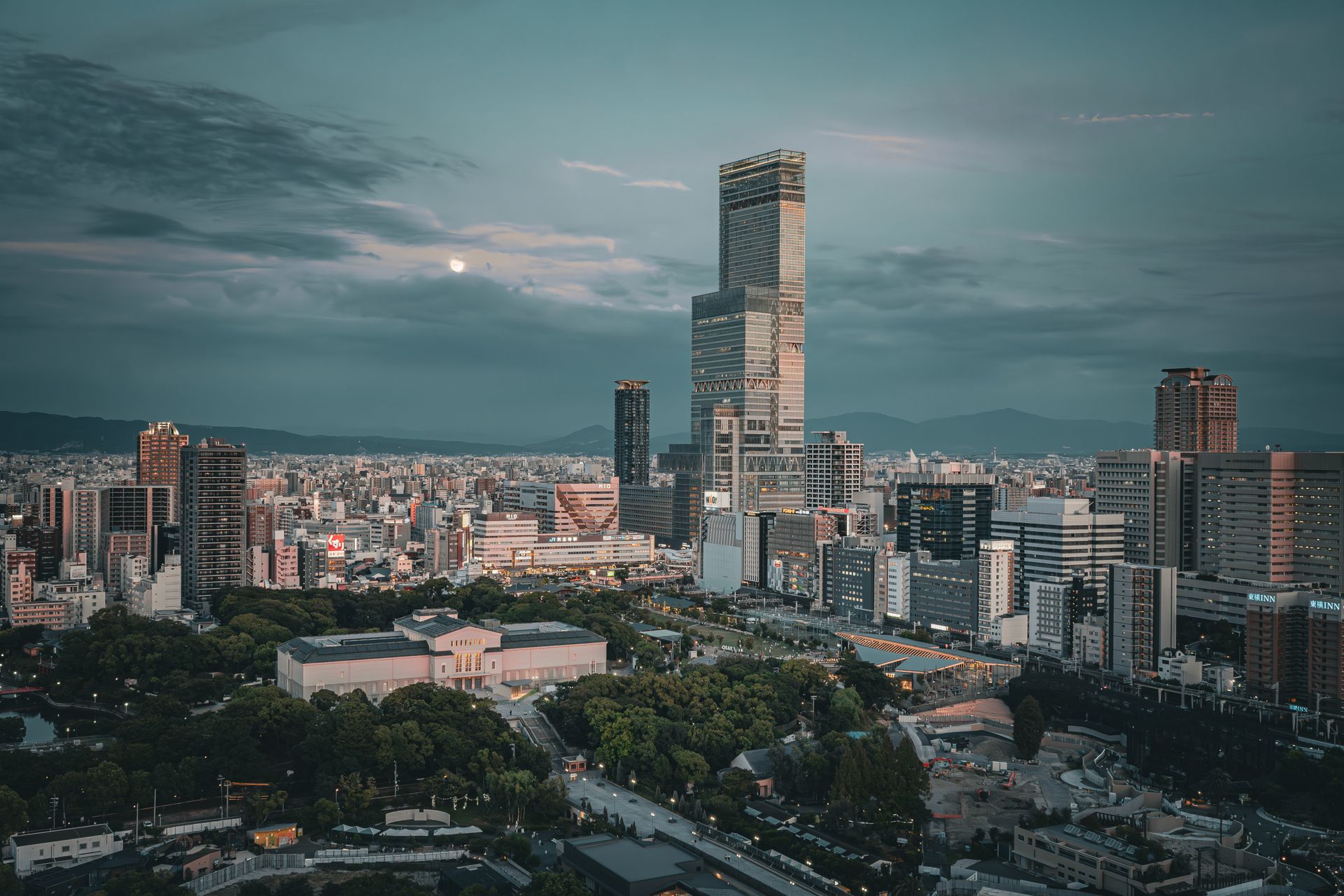
Tennoji is the southern transit anchor, named after Shitennoji temple, with Osaka’s major southern terminus at Tennoji Station . The headline asset is Abeno Harukas, the 300-metre Cesar Pelli-designed mixed-use tower that fully opened on 7 March 2014 and held the title of Japan’s tallest building until Azabudai Hills Mori JP Tower surpassed it in 2023 . The Harukas 300 observation deck on floors 58–60 has the best 360° city view in Osaka; the Osaka Marriott Miyako Hotel occupies floors 19–55, and Kintetsu Department Store Main Store fills the lower floors as one of Japan’s largest department stores . Tennoji Park, with its zoo and the Osaka City Museum of Fine Arts, sits between Tennoji Station and the Shitennoji temple precinct.
- Abeno Harukas Harukas 300 — 300 m observation deck
- Tennoji Zoo — 1915, third-oldest in Japan
- Spa World — 16-country onsen complex, 24-hour
Best for: skyline views, hotel value, Shitennoji and Shinsekai access. Access: JR Loop / Yamatoji / Kansai-Honsen, Midosuji / Tanimachi metro, Kintetsu Osaka-Abenobashi.
Tsuruhashi & Ikuno Korea-Town
Tsuruhashi is Japan’s oldest and largest Korean diaspora neighbourhood, served by JR Loop, Kintetsu Nara/Osaka and the Sennichimae subway lines . The district sits in Ikuno-ku, where roughly 20% of residents hold foreign nationality and South Koreans (~20,460 in 2021) form the largest single group . The food argument: Tsuruhashi is the densest yakiniku (Korean BBQ) belt in Japan, with smoky charcoal grills running curbside in a low-rise 1950s-vintage market grid; many families have lived here for three generations or more . The market alleys also sell kimchi by the kilo, hand-pulled mochi and the city’s best fresh-grilled gizzard skewers.
- Tsuruhashi Shotengai — densest yakiniku alley in Japan
- Miyukimori Tenjingu — 1875 shrine in the market grid
- Korea Town arches — Miyukidori shopping street
Best for: serious food walks, photography, off-Yamanote-style backstreets. Access: JR Loop (Tsuruhashi), Kintetsu Osaka Line, Sennichimae metro.
Osaka Bay & Tempozan
Osaka Bay is the city’s western waterfront, anchored on the Tempozan Harbor Village complex with the Osaka Aquarium Kaiyukan and the Tempozan Ferris Wheel side by side . The bay is dotted with artificial islands — KIX (1994), Kobe Airport, Port Island, Rokko Island, and Yumeshima which hosted Expo 2025 from 13 April to 13 October 2025 with 29 million visitors over six months and the Sou Fujimoto-designed Grand Ring confirmed by Guinness as the largest wooden architectural structure in the world . The Expo grounds are now reverting to a long-term redevelopment under MYAKU-MYAKU branding ; the Yumeshima IR casino-resort project is the post-Expo successor.
- Osaka Aquarium Kaiyukan — whale shark, 1990, ¥2,700 adult
- Tempozan Ferris Wheel — 112.5 m, 17-min loop
- Yumeshima — former Expo 2025 site, now redeveloping
Best for: families, sunset bay views, half-day rest from neon. Access: Chuo metro line (Osakako), Sakurajima JR for Universal City.
Universal City & Sakurajima
Universal Studios Japan opened on 31 March 2001 in Konohana ward as the first Universal park outside the United States, and is owned by USJ LLC, a wholly-owned subsidiary of Comcast NBCUniversal . The park covers 54 hectares and hosted 16 million visitors in 2024, ranking it the third-most-visited theme park globally and the most-visited in Asia . Super Nintendo World opened on 18 March 2021 with Mario Kart: Koopa’s Challenge as its anchor ride; the Donkey Kong Country expansion opened on 11 December 2024 . Access is the JR Yumesaki Line shuttle from Osaka Station to Universal-City Station, roughly 11 minutes ; tickets run ¥8,900–¥11,900 depending on season tier, with timed-entry reservations required for Super Nintendo World during peak periods.
- Super Nintendo World — Mario Kart ride, opened 2021
- Donkey Kong Country — opened 11 December 2024
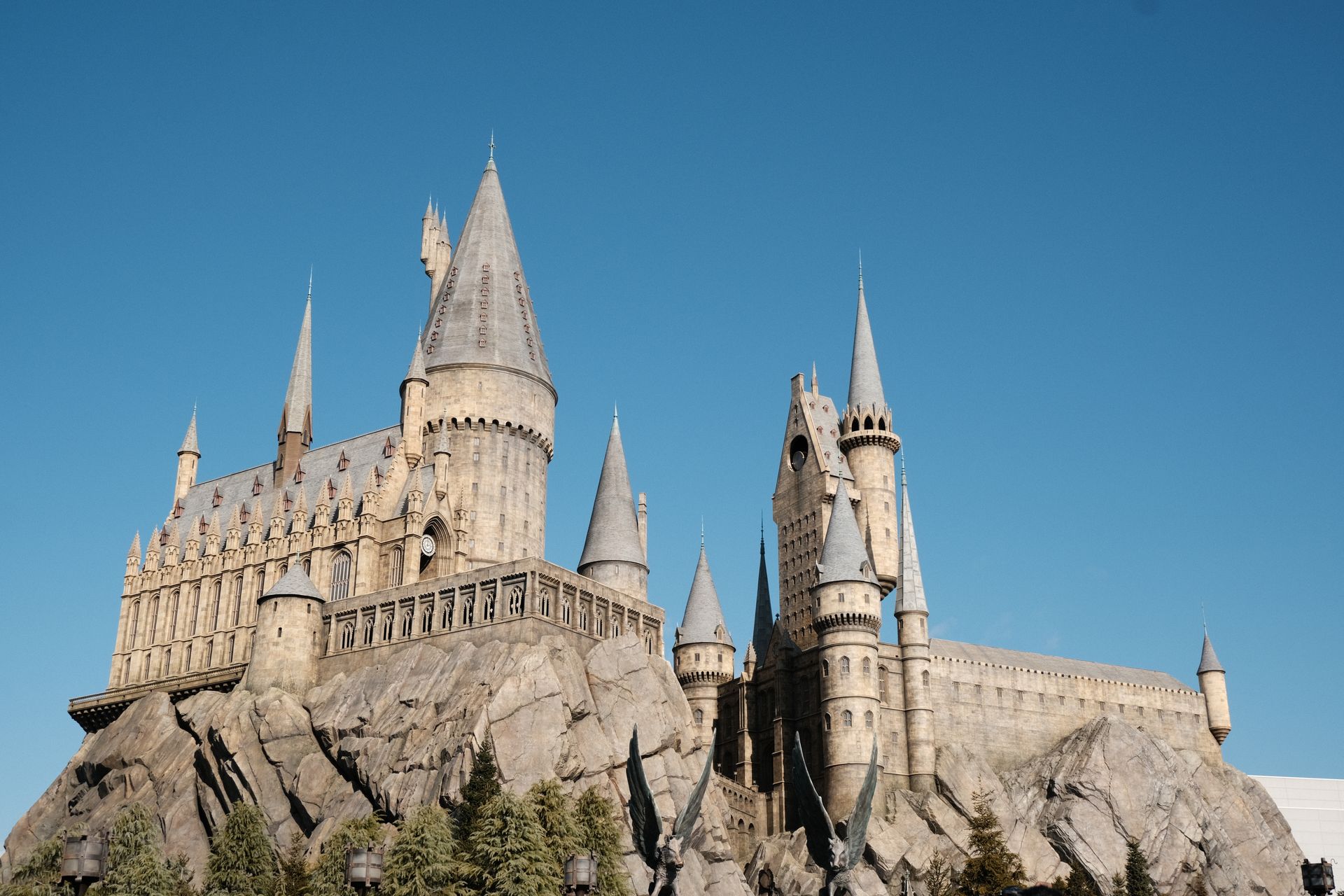
- Wizarding World of Harry Potter — Hogwarts Castle replica
Best for: family visits, Nintendo / Harry Potter / Jurassic Park fans. Access: JR Yumesaki Line (Universal-City).
Cultural Sights

Osaka Castle
Osaka Castle is the city’s defining sight — built starting in 1583 by Toyotomi Hideyoshi on the site of the militant Ishiyama Hongan-ji temple, and later contested in the Stone Wall Battle against Oda Nobunaga’s forces . The current main keep is the third generation: the Toyotomi tenshu fell during the 1614–15 Siege of Osaka, the Tokugawa replacement burned in 1868 during the Meiji Restoration, and the present concrete-and-tile reconstruction was financed entirely by citizen donations and completed in 1931 . The keep’s eight floors operate as a museum facility housing artifacts from Hideyoshi’s era and the Sengoku period . The surrounding 105.6-hectare Osaka Castle Park is one of the city’s biggest urban parks, opened to the public in 1931, and includes plum (Jan–Mar), peach (Mar) and cherry blossom (Apr) gardens . Admission ¥600 adult, free for park grounds; nearest stations are Osakajōkōen (JR Loop), Tanimachi 4-chōme (Tanimachi line), and Morinomiya (JR Loop / Chuo line).
Sumiyoshi Taisha
Sumiyoshi Taisha is one of the oldest shrines in Japan and the headquarters of the Sumiyoshi sect of Shinto. Founded in 211 CE during the legendary 11th year of Empress Jingu’s reign by Tamomi no Sukune , the shrine’s main hall exemplifies the Sumiyoshi-zukuri architectural style — the oldest known surviving example of the form, designated a national treasure for its forked-finial okichigi roofs and five horizontal katsuogi billets . The square-edged Kakutorii (square torii gate) is so distinctive that the design type itself is now called the “Sumiyoshi torii” in honour of the shrine . The arched Sorihashi taiko-bashi drum bridge in the front grounds is the photo anchor; New Year hatsumōde draws roughly 2 million visitors in the first three days, ranking the shrine among the country’s most-visited New Year shrines . Free admission, dawn to dusk; access via the Hankai tram or Nankai Sumiyoshitaisha Station.
Shitennoji
Shitennoji is the oldest officially administered Buddhist temple in Japan, founded in 593 CE by Prince Shotoku as part of his campaign to promote Buddhism . The complex includes a five-story pagoda, the Kondo (golden hall) housing a Kannon image, a lecture hall connected by covered corridors, and four gates plus a stone torii symbolising the eastern entrance to Sukhavati pure land . After WWII the temple separated from the Tendai sect and now operates as the headquarters of the Wa-shu (“harmony school”) . The current buildings date to the 1963 reconstruction. One of Shitennoji’s original 6th-century carpenter families founded Kongo Gumi, the world’s oldest continuously operating company until its 2006 absorption into Takamatsu Construction . The 21st “Daishi-e” flea market on the 21st of every month spreads through the temple grounds and is a cultural anchor of southern Osaka. Inner-precinct admission ¥300; outer grounds free.
Osaka Museum of History
The Osaka Museum of History opened in 2001 at 4-1-32 Otemae adjacent to the NHK Osaka Broadcasting Center; both buildings were designed by Cesar Pelli & Associates with Nihon Sekkei and connected by a shared atrium . The four-floor exhibition narrates the city from the Naniwa Palace era forward; the museum is built directly on the Naniwa Palace excavation site, and the basement preserves actual warehouse foundations, walls and water-supply systems in situ . The collection grew from 100,000 objects in 2005 to over 138,000 by 2016, plus a further 17,632 on deposit . The 10th-floor view of Osaka Castle and the reconstructed palace floor on the same level are the museum’s twin photo anchors. ¥600 adult; closed Tuesdays. Tanimachi 4-chōme metro station, 5-minute walk.
Osaka Mint Bureau
The Japan Mint, established in Kawasaki, Osaka on 4 April 1871, is the government coin-and-medal facility — not technically a museum, but the on-site Mint Museum is open weekday afternoons with displays of historic Japanese, foreign and decorative coins . The Mint became an Independent Administrative Institution in 2003 and remains responsible for producing Japan’s circulating coins, decorations and medals, plus testing precious metals through hallmarking . The single most-visited week of the Mint Bureau’s year is the mid-April Sakura no Toorinuke (“cherry blossom passage”) when the western 560-metre walkway opens for around seven days with about 350 trees of approximately 130 varieties — mostly the late-blooming yaezakura double-flower types . Admission free; advance reservation required during peak years.
Cup Noodles Museum Osaka Ikeda
The Cup Noodles Museum in Ikeda, north of central Osaka, sits at 8-25 Masumi-cho, Ikeda-shi 563-0041, a 5-minute walk from Ikeda Station on the Hankyu Takarazuka Line . The museum celebrates the 1958 invention of Chicken Ramen and the 1971 invention of Cup Noodles by Momofuku Ando, who developed both products in the wooden shed reconstructed inside the museum’s “Birth of Chicken Ramen” gallery . Hours are 9:30–16:30 (last admission 15:30), closed Tuesdays and over the New Year period; admission to the museum is free, with paid optional workshops — the Chicken Ramen Factory (hands-on noodle-making, reservation required) and the My CUPNOODLES Factory (design your own cup) . Allow 90 minutes for the museum proper, longer for either workshop. The Instant Noodles Tunnel displays roughly 800 product packages tracing the global instant-noodle industry from 1958 forward .
National Bunraku Theatre
Bunraku puppet theatre originated in Osaka in the early 17th century, with the modern art form traceable to the 1684 partnership between playwright Chikamatsu Monzaemon and chanter Takemoto Gidayu at the Takemoto-za in Dotonbori . The art form requires three performer types working in concert: three puppeteers per puppet (head and right arm, left arm, feet), a tayu chanter who voices every character and narrates, and shamisen players whose Bunraku-specific instruments are slightly larger and lower-pitched than standard . UNESCO inscribed Bunraku on the Representative List of the Intangible Cultural Heritage of Humanity in 2003. The National Bunraku Theatre at 1-12-10 Nipponbashi, Chuo-ku, opened in 1984 as Japan’s fourth national theatre, designed by Kisho Kurokawa with a 753-seat main hall and a smaller venue for rakugo and manzai . The Bunraku Kyokai performers’ association runs four 22-day performance blocks each year — January, April, July–August and November . Tickets ¥2,400–¥7,500; English audio guides available.
Entertainment & Nightlife
Osaka stays up later and louder than almost anywhere else in Japan, and the after-dark map is concentrated enough to walk. The neon spine runs from Dotonbori’s Ebisu Bridge south through Namba and Shinsaibashi, with the older Shinsekai grid under Tsutenkaku as the retro counterweight. Most venues cluster within a 20-minute walk of Namba Station, so a single night out rarely needs a taxi until the trains stop around 24:30 . The city’s nightlife reputation is earned honestly: where Tokyo’s after-dark scene is scattered across distant districts and Kyoto’s winds down early, Osaka packs comedy theatres, standing bars, whisky counters, live houses and a 24-hour onsen into a few square kilometres of walkable, low-cost ground, which is exactly why it draws weekenders from across Kansai every Friday night.
Comedy, Bunraku & the Manzai Tradition
Osaka is the home of manzai, the fast double-act stand-up comedy that anchors Japanese television, and Yoshimoto Kogyo’s Namba Grand Kagetsu (NGK) theatre is the genre’s flagship stage — daily shows from around ¥4,800, with the Osaka-ben dialect’s comic timing as the through-line . For traditional performance, the National Bunraku Theatre runs four 22-day blocks a year of UNESCO-listed puppet drama, tickets ¥2,400–¥7,500 with English audio guides . The Shochikuza in Dotonbori has staged kabuki since 1923 .
Bars, Izakaya & Live Music
The drinking culture splits three ways. Standing bars (tachinomi) around Shinsekai and Tenma serve ¥300 highballs and skewers to a shoulder-to-shoulder crowd; izakaya alleys like Ura-Namba and Hozen-ji Yokocho hide tiny counter joints down lantern-lit lanes; and a small but serious cocktail and whisky-bar scene in the Kitashinchi district north of Namba pours Yamazaki and Hibiki flights for those who missed the distillery tour . Live houses around Amerika-mura carry indie and jazz most weekends, and the city’s baseball energy peaks at Koshien Stadium (Hanshin Tigers) a short Hanshin Line hop from Umeda .
Theme Parks & Late-Night Spots
Universal Studios Japan is the headline after-dark draw in summer, with evening parades and the Super Nintendo World night lighting running until park close, typically 21:00–22:00 in peak season . For a quieter night, Spa World in Shinsekai is a 24-hour 16-country onsen complex, and the Tempozan and HEP FIVE Ferris wheels run their illuminated loops into the late evening over Osaka Bay and Umeda respectively .
Day Trips from Osaka

The Kansai region built itself around Osaka, which means the city is also the best base for the most famous day-trips in Japan. The five trips below all run as in-and-out from Shin-Osaka, Osaka, Tennoji or Namba in 30 to 90 minutes one-way . Most travellers stack two of them per Osaka stay; aggressive itineraries do four.
Kyoto (28 min by JR Special Rapid)
Kyoto served as Japan’s imperial capital from 794 to 1868 — over 1,100 years — and is now sometimes called the “thousand-year capital” . The JR Special Rapid (Shin-Kaisoku) reaches Kyoto Station in approximately 28 minutes from Osaka Station, free with any ICOCA tap (¥580 single fare) . The 1.43 million-resident city packs roughly 1,600 Buddhist temples and 400 Shinto shrines into a compact grid ; UNESCO inscribed 17 Historic Monuments of Ancient Kyoto in 1994, including Kinkaku-ji (the Golden Pavilion), Kiyomizu-dera, Ryoan-ji and the Nijo-jo castle . Pair this guide with the dedicated Kyoto City Guide and pick three or four temples for a day; cycle if you can.
Nara & Todai-ji (50 min by JR Yamatoji or Kintetsu)
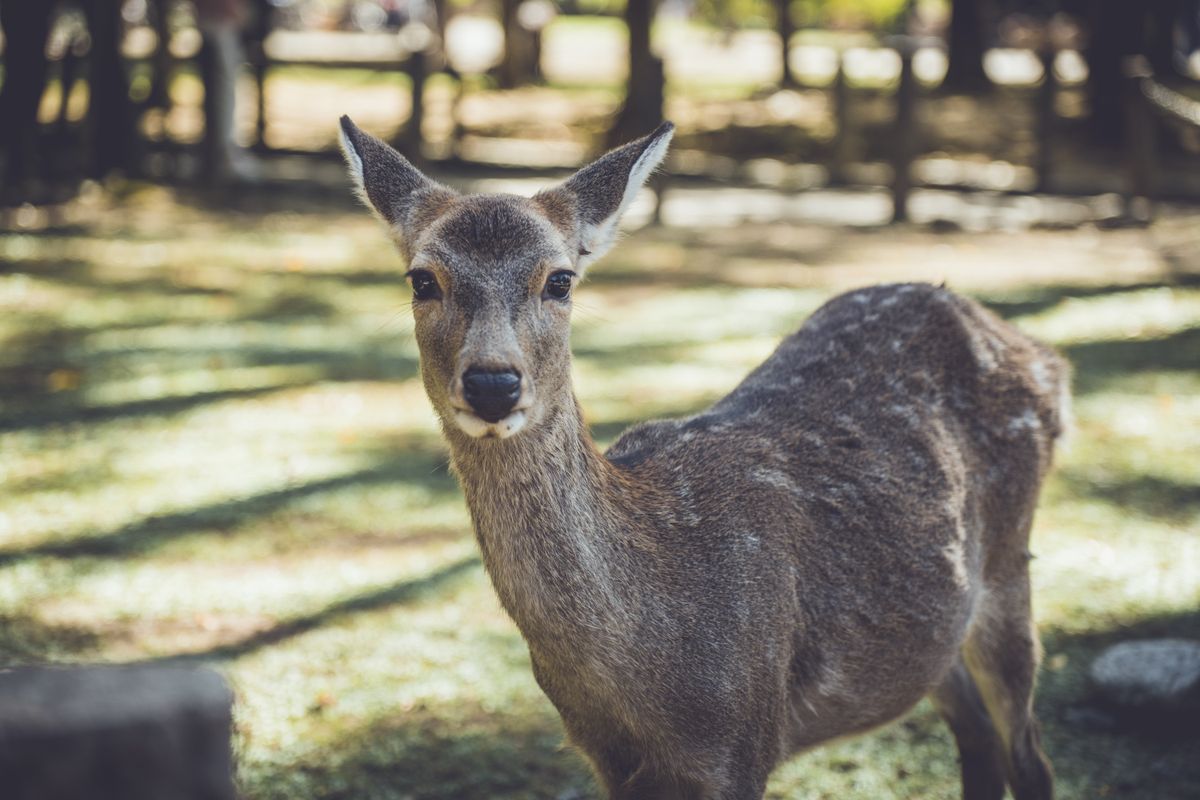
Nara is Japan’s first permanent capital, the seat of the imperial court from 710 to 784 CE, and now a city of about 367,353 residents anchored by the deer of Nara Park and the Todai-ji temple complex . The JR Yamatoji Line reaches Nara Station from JR Namba in 32–50 minutes; the Kintetsu Line from Osaka-Namba hits Kintetsu-Nara in 35 minutes and is the closer terminus to Nara Park — the JR station sits 500 m to the west . Over 1,200 sika deer roam freely through Nara Park, considered messengers of Kasuga Taisha shrine and protected as a national treasure . Todai-ji holds the world’s largest bronze Buddha — a 15-metre, 500-tonne Vairocana known as the Daibutsu, built starting in 743 CE under Emperor Shomu; the surrounding Daibutsuden hall is 57 m long, 50 m wide, 49 m high and held the world-largest-wooden-building title until 1998 . UNESCO inscribed the “Historic Monuments of Ancient Nara” in 1998 ; admission to Todai-ji’s Daibutsuden ¥800.
Himeji Castle (40 min by Sanyo Shinkansen)
Himeji Castle is the finest surviving example of prototypical Japanese castle architecture and one of two original UNESCO cultural sites inscribed in Japan’s first 1993 round (alongside Horyu-ji) . The complex covers 233 hectares with 83 surviving structures; the main keep stands 46.4 metres tall with six interior floors plus a basement, though it appears to have only five stories from outside . The castle was founded in 1333 by Akamatsu Norimura and reached its current form under Ikeda Terumasa in 1609 . The brilliant white exterior earned the nickname “White Egret” or “White Heron” castle; a major restoration completed in March 2015 returned the roof to its original white. The castle famously survived both the 1945 Himeji firebombing and the 1995 Great Hanshin earthquake with minimal damage . Sanyo Shinkansen Hikari from Shin-Osaka to Himeji takes about 40 minutes; admission ¥1,000 adult.
Kobe & Mt Rokko (30 min by JR Kobe Line)
Kobe is Japan’s seventh-largest city by population (about 1.5 million) and the third-busiest port after Tokyo and Yokohama . The city stretches narrowly between Osaka Bay and the Rokko mountain range, with Mt Rokko itself rising to 931 metres directly above the city centre . The JR Special Rapid reaches Sannomiya in roughly 21 minutes from Osaka Station; Hankyu and Hanshin private services take 28 minutes from Umeda. Day-trip stack: Kitano-cho ijinkan (Western consul houses), Sannomiya for Kobe beef teppanyaki, Mt Rokko cable car for the night view (one of Japan’s “three new big night views”), and Arima Onsen on the mountain’s far side — one of Japan’s oldest hot-spring towns . Kobe’s Ikuta Shrine is recorded as having been founded in 201 CE ; the 1995 Great Hanshin Earthquake (M6.9, 6,434 fatalities) is memorialised at the Earthquake Memorial Museum near the port .
Mt Koya (90 min by Nankai Koya Line)
Mt Koya is the headquarters mountain of Shingon Buddhism in Japan, founded in 819 CE by the monk Kukai (posthumously known as Kobo Daishi) on an 800-metre-high plain surrounded by eight peaks in Wakayama Prefecture . The settlement holds 120 sub-temples, the 48.5-metre Konpon Daito pagoda, and Okunoin — the largest cemetery in Japan — which contains Kukai’s mausoleum . UNESCO inscribed the entire mountain plateau in 2004 as part of the “Sacred Sites and Pilgrimage Routes in the Kii Mountain Range” world heritage property . The Nankai Koya line runs from Namba to Gokurakubashi in roughly 90 minutes, then a 5-minute cable car climbs to the temple plateau . Most travellers turn this into an overnight by booking a shukubo temple lodging at one of the 50+ monasteries that accept guests; you sleep on tatami, eat shojin ryori vegetarian temple cuisine, and join the 06:00 morning service. Mt Koya is the slowest, most contemplative day-trip on this list and the only one we’d argue you should turn into 24 hours.
Wakayama Coast & Sakai Mozu Tombs
Two day-trips that round out the Kansai picture without burning a half-day on long rail. The Wakayama coast (Nankai Wakayama-shi line, 1 hour from Namba) gives you Wakayama Castle, the Kuroshio Market sashimi counter, and the Adventure World safari park. Closer in, the Mozu Tombs in Sakai — UNESCO-inscribed on 6 July 2019 as part of the Mozu-Furuichi Kofun Group — sit a 35-minute Hankai tram ride south of Osaka Station . The Daisen Kofun is the keyhole-shaped tomb attributed to Emperor Nintoku; at 525 metres long, 300 metres wide and roughly 35 metres high above the surrounding terrain, it’s among the largest burial mounds anywhere in the world . The site holds 44 surviving mounds across a 166.6-hectare core zone with an 890-hectare buffer; the Sakai City Mozu Furuichi Kofungun Visitor Center provides English orientation .
Food & Drink in Osaka — The Kuidaore Capital
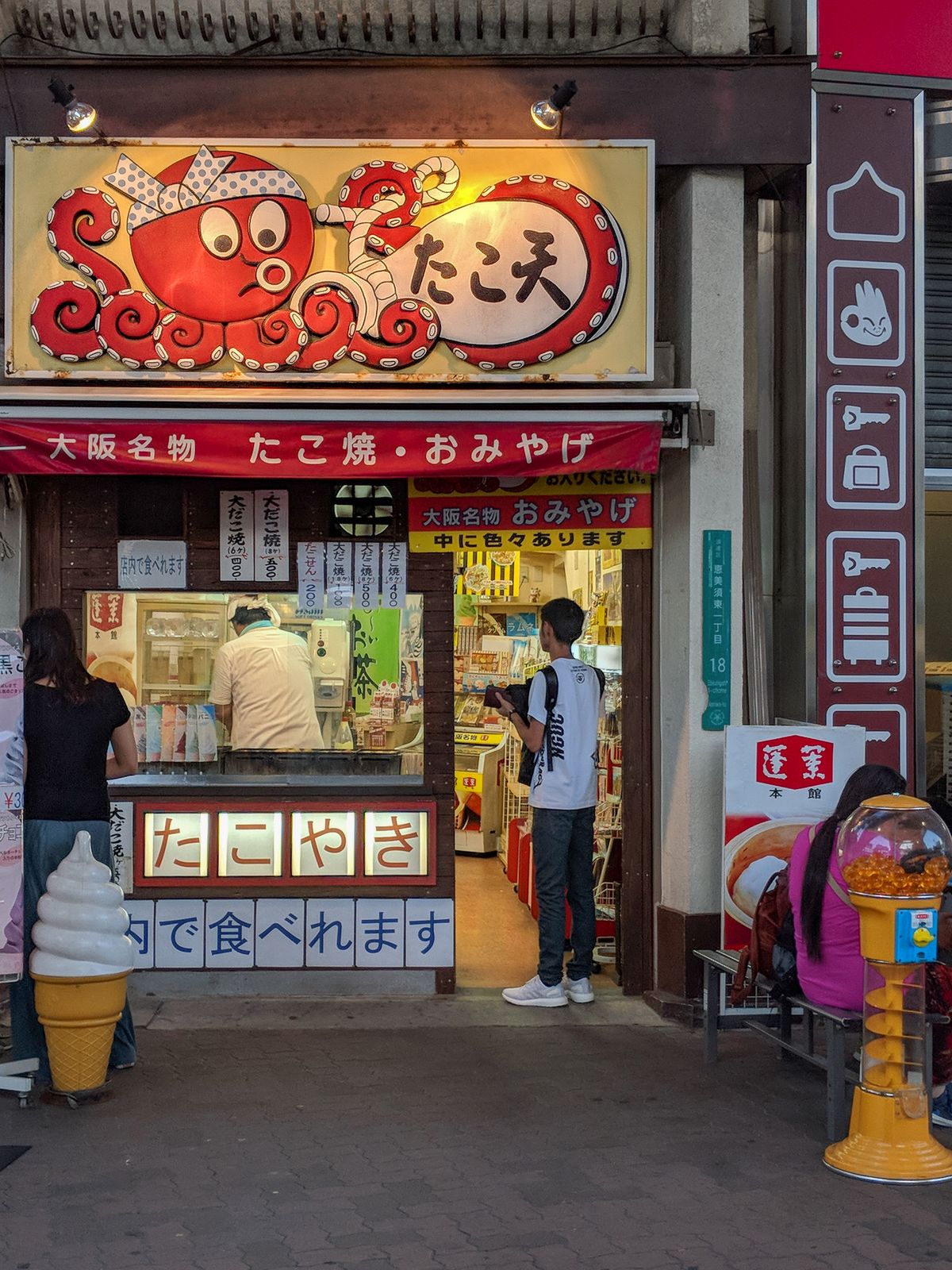
Osaka’s food identity is encoded in a single word — kuidaore, meaning “to ruin oneself by extravagant spending on food” . The phrase is Edo-period slander that the city has cheerfully reclaimed; locals will tell you that Osaka’s real history is its food history, which is why the takoyaki, okonomiyaki and kushikatsu vocabularies all trace their origin stories to specific Osaka street-corners. Build your meals here by category — the prices are low, the queues move fast, and the genre depth in any single neighbourhood is wider than most travellers expect.
Takoyaki — the 1935 invention
Takoyaki are golden-brown ball-shaped snacks of wheat-flour batter wrapped around minced octopus, tempura scraps, pickled red ginger and green onion, cooked on a cast-iron griddle of half-spheres and topped with takoyaki sauce, mayonnaise, aonori seaweed powder and dried bonito flakes . Tomekichi Endo, a street vendor in Osaka, is credited with the 1935 invention; his shop Aizuya in Tamatsukuri still operates and uniquely serves the original sauceless version . The post-war addition of sauce and mayonnaise is what most travellers picture today.
- Aizuya (Tamatsukuri) — The 1933 originator, sauceless, ¥600 / 8 pieces
- Wanaka (Sennichimae) — Mid-tier classic, ¥600 / 8 pieces, queue at 18:00
- Kukuru (Dotonbori) — The neon-canal anchor, ¥640 / 8 pieces, mascot crab
Okonomiyaki — the Kansai-style mixed batter
Okonomiyaki literally means “how you like it grilled” (okonomi + yaki) — a savoury wheat-flour pancake mixed with shredded cabbage, dashi, egg and a chosen protein, then cooked on a flat griddle and topped with Worcestershire-base sauce, Japanese mayonnaise, aonori and bonito flakes . Osaka’s style mixes everything into the batter before cooking, while Hiroshima’s style layers ingredients (Hiroshima also has 2,000+ specialist okonomiyaki shops, the highest count per capita anywhere in Japan) . The classic Osaka order is a buta-tama (pork-and-egg) or a modan-yaki (with yakisoba noodles folded in). Many shops have a teppan grill at your table; the staff cook for you, but the Tokyo-style myth of cooking it yourself is mostly hokum — just watch.
- Mizuno (Dotonbori) — 1945 Showa-era classic, ¥1,500 buta-tama
- Chibo (Dotonbori or Umeda) — Mid-range chain, foreign-friendly menus, ¥1,400–¥2,200
- Fukutaro (Sennichimae) — Negiyaki specialist (scallion variant), ¥1,200
Kushikatsu — deep-fried skewers, no double-dipping
Kushikatsu (deep-fried skewered meat and vegetables) emerged in Osaka’s Shinsekai district around 1929, where a pioneering female restaurant owner began serving the affordable street food to construction workers . The defining etiquette: no double-dipping in the communal sauce pot. Every shop posts the rule on a sign, and many sing-song it at you when you sit down — pulling a skewer back into the sauce after taking a bite is the single biggest faux-pas in Osaka casual dining . The Osaka style favours smaller individual ingredients per skewer, premixed batter, and panko coating; you order at the counter, eat 5–15 skewers depending on hunger, and pay ¥150–¥250 per skewer .
- Daruma (Shinsekai) — The 1929 originator, scowling-chef logo, ¥150–¥250 per skewer
- Yaekatsu (Shinsekai) — Less touristy alternative across the Tsutenkaku square
- Tengu (Tennoji) — Standing-bar style, ¥1,500 for 10 skewers + beer
Beyond the Big Three
Osaka’s food map is wider than the headline trio. Build at least one meal from each of these:
- Kitsune Udon — Hot dashi-based wheat-noodle soup with a sheet of sweetened deep-fried tofu (aburaage); the dish was invented at Usami-tei Matsubaya in central Osaka in 1893. ¥600–¥900.
- Tessa & Tetchiri (Fugu) — Osaka and Shimonoseki are the two Japanese cities most associated with fugu pufferfish — tessa is the paper-thin sashimi platter, tetchiri the hot-pot. Licensed restaurants only; ¥6,000–¥15,000 per person, October–March season.
- Oshizushi (Box-Pressed Sushi) — Osaka’s pre-Tokyo style of sushi: rice and topping pressed in a wooden box and sliced. Battera (mackerel) and saba-zushi are the icons; Yoshino-zushi (founded 1841) is the oldest specialist.
- Kobe Beef — Wagyu beef from the Tajima strain of Japanese Black cattle, raised in Hyogo Prefecture; certification requires a marbling score (BMS) of 6+ and quality grade 4 or 5 with a carcass under 499.9 kg . Only ~3,000 cattle per year qualify ; expect ¥15,000–¥40,000 per person at top teppanyaki counters.
- Kuromon Ichiba Market — The 580-metre “kitchen of Osaka” arcade in Nipponbashi: 150+ stalls of fresh seafood, fruit, wagashi sweets and street-food counters; the unagi grills, blue-fin tuna sashimi cubes and ¥500 strawberries are the photo anchors.
Yamazaki — Japan’s First Whisky Distillery
The Yamazaki distillery, opened in 1923 by Suntory founder Shinjiro Torii in Shimamoto, Osaka Prefecture (between Osaka and Kyoto), was Japan’s first commercial whisky distillery . Torii hired Taketsuru Masataka as factory director in 1924 after Taketsuru returned from studying whisky-making in Scotland with his Scottish wife Jessie Roberta “Rita” Cowan . The site uses six wash stills and six spirit stills; the on-site Whisky Library displays seven thousand bottles of unblended single malt across the visitor centre walls . The Yamazaki 18-Year earned six consecutive double-gold medals at the San Francisco Spirits Competitions between 2008 and 2013, and the Yamazaki Single Malt Sherry Cask 2013 was named World Whisky of the Year by Jim Murray’s 2015 Whisky Bible . JR Yamazaki Station is on the Tokaido Main Line 25 minutes from Osaka Station; advance reservation is required for the paid factory tour, which sells out 3+ months ahead.
Food Experiences You Can’t Miss
- A 18:00 Dotonbori takoyaki crawl, three shops, three different fillings
- A teppan-table okonomiyaki dinner at Mizuno or Chibo with a Kirin Lager
- A 22:00 standing-bar kushikatsu round in Shinsekai under the Tsutenkaku tower
- An early-morning Kuromon Ichiba walk for tuna sashimi cubes and grilled scallops
- A Kobe-beef teppanyaki counter dinner in Tennoji on a budget night
Practical Information
| Topic | Osaka 2026 details |
|---|---|
| Visa | 90 days visa-free for ~70 nationalities; Visit Japan Web pre-clearance recommended |
| Currency | Japanese yen (¥, JPY); ATMs at 7-Eleven and Japan Post Bank accept foreign cards 24/7 |
| Plug / Voltage | Type A two-flat-pin, 100V; western Japan including Osaka runs at 60Hz |
| Tap water | Safe everywhere; CDC lists no Japan drinking-water warnings |
| Tipping | Do not tip — service staff will return the money |
| Earthquake / Typhoon | Mid-typhoon season is September; the JMA J-Alert covers volcano, quake and typhoon push notifications ; the US State Department keeps a Level-1 advisory on Japan as of May 2025 |
| Health | No required vaccines; Hep A, Hep B, MMR routine recommended |
| SIM / eSIM | Mobal, Sakura Mobile and IIJmio are the main travel SIMs; eSIM via Airalo packages start at $6 / 1 GB / 3 days for Japan |
| Luggage | Coin lockers ¥400–¥800 at every JR / metro station; Yamato luggage forwarding ¥2,000 to next-night hotel |
| Tax-free shopping | Tax-free counter at most major department stores for ¥5,000+ purchases; passport required |
Language & Osaka-ben
Lower than its reputation in 2026. Every Osaka train, subway and JR sign is bilingual; ticket machines run in English; restaurant menus in tourist districts come with photos or English translations. The local dialect Osaka-ben uses ya instead of the standard da as copula, and -hen instead of -nai in negative verbs — you’ll hear “maido!” (a multi-purpose merchant greeting) and “mokarimakka?” (“making money?” as a casual hello) on the streets . Outside the central wards or in older izakaya, Google Translate’s camera mode and a friendly smile carry every transaction.
Cash vs. Cards
Osaka is more card-friendly than five years ago. Visa, Mastercard and Amex work at every chain restaurant, hotel, department store and most cafes. Cash remains the practical default at small okonomiyaki shops, kissaten coffee houses, traditional izakaya, shrine vending machines and most taxis outside the central wards. Carry ¥10,000–¥20,000 cash as a daily backstop. Numbeo’s 2026 Osaka cost-of-living data lists an inexpensive restaurant meal at ¥1,000, a domestic draft beer at ¥400, a cappuccino at ¥471 and a 1-bedroom city-centre apartment at ¥120,750 / month .
Safety & Disasters
Osaka consistently ranks as one of the world’s safest large cities; the UK FCDO maintains a stable “exercise normal precautions” advisory for Japan with most updates relating to drink-spiking warnings in nightlife districts . The two real risk vectors are seismic and meteorological. Osaka sits on the Uemachi fault line; the most recent significant tremor was the M6.1 northern Osaka earthquake of June 2018. Typhoon season runs roughly mid-July to mid-October with a September peak; Britannica notes that “typhoons occur in September and can be destructive” in Osaka . Download the JNTO “Safety tips” app before flying for English-language J-Alert push notifications.
Cultural Etiquette
Bow as the universal greeting / thanks. Volume down on trains (no phone calls in carriages). Shoes off when entering tatami-floored rooms, most homes, and all temple inner halls. Stand on the right on Osaka escalators — this is the most-cited Osaka-vs-Tokyo difference, since Tokyo stands on the left . Don’t double-dip kushikatsu skewers. Don’t walk and eat: eat takoyaki, takoyaki and kushikatsu standing at the counter or in a designated curbside zone. The JNTO etiquette overview covers temple manners, escalator side-standing and chopstick rules .
Connectivity
Free Wi-Fi is widespread — Osaka Metro stations, JR West stations, Hankyu and Hanshin terminals, and most cafes broadcast on the Osaka Free Wi-Fi network . The most reliable route is a travel SIM or eSIM; data SIMs through Mobal or Sakura Mobile are sold at KIX arrivals counters with passport check, while Airalo and Saily eSIMs activate on landing without a counter visit. 5G is widespread across the central wards and KIX.
Budget Breakdown — Making Your Yen Count
| Tier | Daily | Sleep | Eat | Transport | Activities | Extras |
|---|---|---|---|---|---|---|
| Budget | $55–90 | Hostel dorm $25–40 in Namba | Takoyaki + ramen $15 | Enjoy Eco Card ¥820 | Free shrines + Osaka Castle Park | 7-Eleven onigiri lunches |
| Mid-Range | $140–220 | 3★ business hotel $90–160 | Okonomiyaki + 1 kushikatsu $40 | Mobile ICOCA + 1 Shinkansen day-trip | USJ ¥8,900 + Castle ¥600 | Kuromon Ichiba dinner |
| Luxury | $400+ | Ritz-Carlton / Conrad / Marriott Miyako $400+ | Kobe-beef teppanyaki $250+ | Hire car / private taxi | Yamazaki distillery tour + onsen ryokan | Mizukami kaiseki, custom kimono |
Where Your Money Goes
Osaka is meaningfully cheaper than Tokyo at the budget tier and roughly equivalent at mid-range; the luxury tier is similar pricing to Tokyo but easier to book and harder to over-spend in. Numbeo’s 2026 Osaka data lists monthly costs for a single person at ~¥118,750 excluding rent, with inexpensive restaurant meals at ¥1,000, a 1-bedroom city-centre apartment at ¥120,750 / month, and public transport at ¥5,150 / month . The local-vs-Tokyo gap is roughly 15–20% on lodging, 25–30% on food, and within margin-of-error on transit and activities.
The single biggest swing in any Osaka budget is the day-trip rail bill, not the hotel. A return Shinkansen leg to Himeji runs about ¥6,200, a Kyoto round-trip on the JR Special Rapid is closer to ¥1,160, and a Nara loop on the Kintetsu line lands near ¥1,160 — so two aggressive day-trips can quietly add ¥8,000–¥12,000 to a four-day stay before you have eaten a single takoyaki . The food bill, by contrast, is almost impossible to overspend at street level: a full kuidaore crawl of three takoyaki shops, one okonomiyaki dinner and a kushikatsu round rarely tops ¥4,500 a head. Where budgets actually break is the single luxury reservation — a Kobe-beef teppanyaki counter or a kaiseki dinner can equal an entire day’s mid-range spend on its own, so treat those as planned splurges rather than spontaneous walk-ins. Numbeo’s 2026 figures also show domestic draft beer at ¥400 and a cappuccino at ¥471, which means the everyday cafe-and-izakaya rhythm stays cheap even when the headline dinners do not .
Money-Saving Tips
- Lunch at any teppanyaki Kobe-beef counter is half the dinner price — same chef, same beef, same room
- The Osaka Metro Enjoy Eco Card at ¥820 weekday / ¥620 weekend is the city’s best transit value if you ride 4+ times
- The Osaka 1-Day Amazing Pass at ¥3,300 is only worth it for 4+ paid attractions in a single day — otherwise pay individual admissions
- Sleep one stop east of the JR Loop in Tsuruhashi for 30% lower hotel rates and 8-minute centre access
- Skip the JR Pass for Kansai-only itineraries; ride single Shinkansen tickets and use the JR West Kansai Wide Pass (¥12,000 / 5 days) for Himeji + Wakayama coverage
Planning Your Trip — Five Steps
Osaka rewards a little front-loading. Because the city doubles as the natural base for the whole Kansai region — Kyoto, Nara, Himeji, Kobe and Mt Koya all sit inside a 90-minute radius — the planning decisions that matter most are made before you land: which week you travel, whether you have pre-cleared immigration, and which two or three choke-point attractions you have actually reserved. Get those right and the rest of the trip runs on walk-ins and IC-card taps. The five steps below take roughly an evening to work through and save the two failure modes first-timers hit: arriving in sakura week with no hotel, and reaching the Super Nintendo World gate without a timed-entry ticket .
- Pick a window. The two non-negotiable dates are sakura week (last week of March + first week of April) and Tenjin Matsuri (24–25 July) . Both saturate hotels four months out. If neither works, mid-October to mid-November is the sweet shoulder; February is the cheapest.
- Pre-clear immigration. Register a Visit Japan Web account 6+ hours before landing — flight, passport, accommodation, customs declaration . Confirm your nationality on the visa-free list (90 days for ~70 nationalities).
- Set up Mobile ICOCA. Add ICOCA to Apple Pay or Google Pay before flying — you avoid the ¥500 deposit, can top up from your phone, and skip the airport ticket-machine queue . Backup: pick up a physical Welcome ICOCA at JR Kansai Airport Station.
- Build the four-day skeleton. Day 1: Namba arrival, Dotonbori sunset, Kuromon Ichiba dinner. Day 2: Osaka Castle morning, Shitennoji + Tennoji afternoon, Shinsekai kushikatsu dinner. Day 3: pick a day-trip (Kyoto, Nara, Himeji, Kobe or Mt Koya). Day 4: USJ all-day, or a slow Yamazaki distillery + Sumiyoshi Taisha day if Universal isn’t on the list .
- Reserve the choke-points. USJ Super Nintendo World timed entry (3 weeks ahead, peak season) ; Yamazaki distillery factory tour (3 months ahead) ; National Bunraku Theatre (4 weeks ahead for popular runs) ; Kobe-beef teppanyaki dinners (1–2 weeks ahead).
Frequently Asked Questions
How many days do I need in Osaka?
Four full days as an urban anchor is the realistic floor for first-time visitors — one day for Osaka Castle and the eastern half (Tennoji, Shitennoji, Shinsekai), one day for Namba/Dotonbori/Shinsaibashi food, one day-trip into Kansai (Kyoto, Nara, Himeji, Kobe or Mt Koya), and one day at Universal Studios Japan or for a slower Yamazaki distillery + Sumiyoshi Taisha rhythm. Three days is enough for a stopover; six lets you breathe and stack two day-trips.
Is Osaka good for solo travellers?
Among the easiest big cities in Asia. The 23 wards consistently rank among the safest urban environments globally, English transit signage is comprehensive on JR West, Osaka Metro and the five private rail operators, single-counter dining (takoyaki stalls, kushikatsu standing bars, ramen counters) is the cultural default rather than a quirk, and the city is genuinely walkable. The Osaka-ben dialect and the city’s reputation for friendlier-than-Tokyo locals also tilts solo travellers’ reports positive. The only practical risk is over-eating and over-stimulation; build a slower morning into the week.
Is the Osaka Amazing Pass worth it?
Only if you plan to hit four-plus paid attractions in a single day. The 1-Day Osaka Amazing Pass costs ¥3,300 and bundles entry to Osaka Castle, the Umeda Sky Building Floating Garden, the Tempozan Ferris Wheel, Tsutenkaku, the HEP FIVE wheel, the Tombori River Cruise and unlimited Osaka Metro and city-bus rides for that day . For a more typical itinerary that mixes attractions and street-food walks, layer the Osaka Metro Enjoy Eco Card (¥820 weekday / ¥620 weekend) over a Mobile ICOCA and pay individual attraction admissions — usually 30–40% cheaper across the day.
What about the Osaka-ben language barrier?
Lower than its reputation. Every Osaka train, subway and JR sign is bilingual; ticket machines run in English; restaurant menus in tourist districts come with photos or English translations. Outside the JR Loop or in older izakaya the Osaka-ben dialect (with ya for da and -hen for -nai) makes Google Translate occasionally hiccup, but the camera-translation mode handles handwritten chalkboards and a friendly smile carries the rest .
When are the busiest weeks in Osaka?
Sakura week (last week of March + first week of April) is the global tourism peak — book accommodation 4+ months out. Golden Week (29 April – 5 May) is the domestic travel peak; Kyoto-Osaka-Nara hotels saturate together. Tenjin Matsuri (24–25 July) and Obon (mid-August, ~13–16) are the two summer peaks. Christmas to early January is busy on hotel rates but quiet on streets — many shops close 1–3 January. The mid-October to mid-November shoulder is the best price-quality trade-off.
Can I use credit cards everywhere in Osaka?
Mostly yes — Visa, Mastercard and Amex work at every chain restaurant, hotel, department store and most cafes. Cash remains the practical default at small okonomiyaki shops, kissaten coffee houses, traditional izakaya, shrine vending machines and most taxis outside the central wards. Carry ¥10,000–¥20,000 cash as a daily backstop. Decline dynamic currency conversion at the till — always pay in yen .
Should I base in Osaka or Kyoto for a Kansai trip?
Base in Osaka for food, nightlife and value; base in Kyoto for temple-heavy itineraries and a quieter rhythm. Osaka has cheaper hotels, more late-night options, faster KIX access (74-minute Nankai Rapi:t into Namba) , and a 28-minute JR Special Rapid into Kyoto Station . Kyoto has 17 UNESCO sites in walking distance and a more contemplative atmosphere. Most travellers split: 4 nights Osaka, 3 nights Kyoto. Read the Kyoto City Guide alongside this one for the full Kansai briefing.
How do I reserve Universal Studios Japan?
Buy a 1-Day Studio Pass at the official USJ website 1–3 weeks ahead — tier pricing runs roughly ¥8,900 (low) to ¥11,900 (peak) . Super Nintendo World requires a separate timed-entry ticket during peak periods that can be added to your park pass via the Club Universal app or Lawson convenience-store ticket machines on the morning of your visit. The Donkey Kong Country expansion that opened on 11 December 2024 is included in the Super Nintendo World timed-entry zone . Express Passes (¥7,800–¥31,800) shortcut individual ride queues; useful in school holidays, optional otherwise. Access by JR Yumesaki Line shuttle from Osaka Station to Universal-City in about 11 minutes .
Ready to Experience Osaka?
Four full days in the loud heart of Kansai, two day-trips into the golden triangle, an unembarrassed amount of takoyaki and one Yamazaki distillery afternoon — that is the Osaka rhythm. For the full country context, read the Japan Travel Guide; for the second half of any Kansai itinerary, pair this guide with the Kyoto City Guide via a 28-minute JR Special Rapid leg, or set the Kansai trip beside the Tokyo City Guide for the full west-vs-east contrast.
Explore More City Guides
Where to Stay
Osaka hotels guide — coming soon, with our recommended Namba and Umeda anchors.
- Tokyo City Guide — the country’s eastern megacity, 2h 21min by Tokaido Shinkansen
- Kyoto City Guide — Japan’s former imperial capital, 28 minutes north by JR Special Rapid
- Beijing City Guide — the East Asian capital pairing for a wider regional trip, roughly 3 hours by direct flight
- Japan Country Guide — the country-level briefing for everything beyond Osaka
- All City Guides
- 🗾 Japan 14-Day Itinerary
Alex the Travel Guru
Alex has been writing destination guides for FFU since 2019, with a dozen Osaka stays anchored on a recurring Namba base camp and a serious depachika problem at Hankyu Umeda’s B1. Osaka is the city Alex returns to between Tokyo and Kyoto stays for a reason: it’s the easiest big Japanese city to relax in, the food map is the widest per square kilometre on the islands, and the Tokaido Shinkansen makes it the perfect Kansai base. For the full country context, read the Japan Travel Guide.
More city guides you might like
Plan your trip to Osaka
The booking tools we use ourselves. FFU may earn a commission at no extra cost to you.
Plan & book your trip to Osaka
Booking through these searches supports our guides at no extra cost to you.