
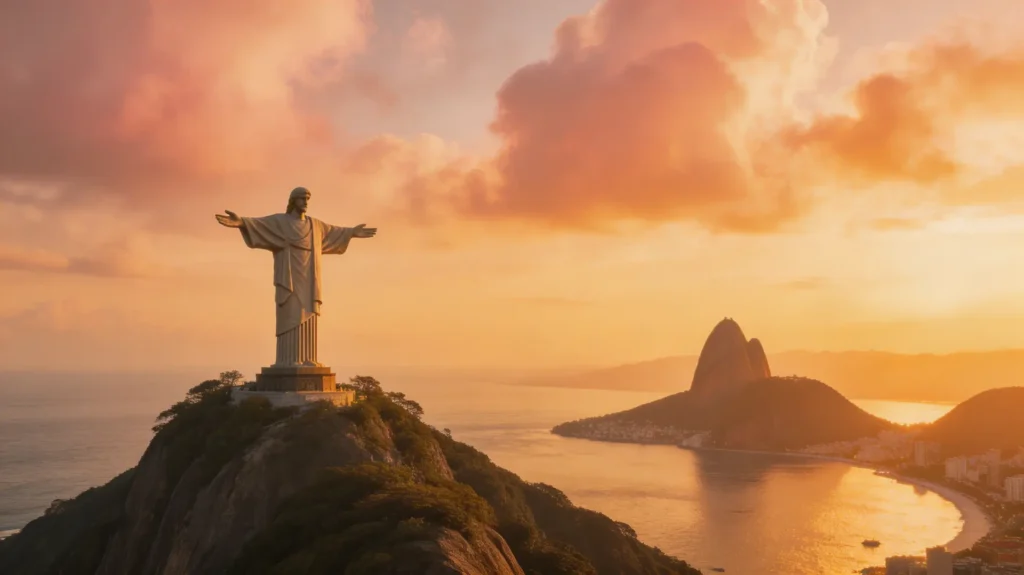
Rio de Janeiro, Brazil: Christ the Redeemer, Copacabana & Samba Rhythms
Where mountains meet sea in Brazil’s most iconic and passionate city
Rio de Janeiro is theater. The entire city performs. The landscape—steep mountains emerging from Atlantic waters, sculpted by millions of years of geology into forms resembling sculpture—forms the stage. Christ the Redeemer, arms outstretched in eternal benediction from Corcovado mountain, watches over everything. The sandy beaches of Copacabana and Ipanema pulse with life and energy. The favelas (residential communities clinging to hillsides) pulse with music, color, and authentic culture. Rio pulses generally—with samba rhythm, Brazilian passion, sun-soaked intensity, and an underlying sensuality that permeates daily life.

The city’s character combines contradictions uneasily but persistently. Extreme wealth and poverty exist visibly alongside one another. World-class tourist infrastructure surrounds you while genuine inequality shapes the city’s geography. The beaches are genuinely beautiful and functionally public. The food is exceptional. The nightlife is legendary. The people are famously warm and socially open. Rio is not subtle. It doesn’t apologize for its sensuality, its music, its exuberance, or its problems. To visit Rio is to accept the entire package—beauty and complexity, joy and hardship, energy and occasional danger.
Where to Go in Rio
Christ the Redeemer: Spiritual Iconography
Christ the Redeemer, completed in 1931, rises from Corcovado mountain at 1,145 meters elevation. The statue—32 meters tall, weighing 635 tons, and constructed entirely of reinforced concrete and soapstone—has become Rio’s most recognizable symbol. The scale is staggering. The arms span 28 meters. The face remains serene despite having faced 90+ years of Atlantic storms, tropical sun, and millions of visitors. French-Polish sculptor Paul Landowski designed the statue; Brazilian engineer Heitor da Silva Costa managed construction.
The experience of ascending to Christ involves multiple options: the iconic cog railway, the winding road accessible by car or bus, or hiking trails. The railway, remarkably steep, climbs through Atlantic Forest vegetation to emerge beneath the statue. As you ascend, Rio’s sprawl becomes visible—the beaches defining the city’s edge, the mountains creating the landscape’s complexity, the human settlement pattern revealing centuries of geographic expansion. The view from the statue’s base encompasses the entire city and surrounding mountains.
Beyond the statue’s religious significance, Christ the Redeemer functions as Rio’s spiritual emblem—a figure watching over the city’s chaos, its contradictions, its beauty, its struggles. The statue has been damaged by lightning multiple times and repaired, creating metaphors about resilience. Pilgrims visit for spiritual reasons; tourists visit for the view and the icon; locals view it as the city’s eternal guardian. All interpretations coexist.
Beaches: Sand, Sun & Society
Rio’s beaches define urban experience with unusual intensity. Copacabana, the most famous, stretches 4 kilometers in a perfect arc. The beach was Rio’s primary tourist destination for decades, hosting legendary nightlife and beaches that seemed to contain Rio’s entire social life. Modern Rio has diffused toward neighboring Ipanema, Barra, and more distant beaches, yet Copacabana remains iconic—the name evokes the city itself for many travelers. The beach’s character divides by location: close to Avenida Atlântica (the beachfront avenue), social life concentrates and prices rise; walking toward the less-developed ends reveals more local character.
Ipanema, adjacent to Copacabana, developed as the artistic and bohemian neighborhood. Bossa Nova emerged from Ipanema in the late 1950s—a musical fusion of samba and jazz that became globally influential. The beach maintains sophisticated character combined with cultural vitality. The neighborhood’s streets contain galleries, bookstores, and restaurants. The beach itself remains public and accessible, though the surrounding neighborhood includes substantial wealth and commercial tourism.
The beach culture—beginning early morning with exercise, continuing through daytime swimming and sunbathing, extending into evening social gathering—represents authentic Rio daily life. Vendors sell everything from fresh coconut water to sandwiches to beach toys. Musician-performers roam with instruments. Soccer games organize spontaneously. The beach creates a democratizing space where Brazilians of all classes interact with unusual equality.
Copacabana
Rio’s most famous beach. 4-kilometer sandy crescent. Heavy tourism and nightlife. Watch carefully for belongings and don’t display valuables. The beach is safe during day; evening brings appropriate caution.
Ipanema
Sophisticated bohemian beach culture. Neighboring neighborhood contains galleries and restaurants. The beach is slightly less touristy than Copacabana but more expensive. Popular with artists and intellectuals.
Samba Culture: Rhythm & Community
Samba originated in Rio’s Afro-Brazilian communities, drawing from African rhythms retained through slavery and post-slavery cultural transmission. The music became Rio’s identity—not just entertainment but spiritual expression, social commentary, and community cohesion mechanism. Rio’s Carnival—the city’s most famous celebration—features samba schools competing in elaborate parades that cost millions to produce and mobilize thousands of performers. The competition’s outcomes matter intensely to community members who’ve invested time and resources.
Beyond Carnival, samba permeates Rio constantly. Street musicians play samba. Clubs featuring live samba operate nightly. Informal samba circles form in neighborhoods. The rhythm—a syncopated beat driven by percussion—becomes inescapable and infectious. Learning basic samba steps, offered at numerous dance schools, provides insight into Rio’s cultural essence. The physicality of samba—the hip movement, the footwork, the interplay between individual and group—requires both abandon and precision.
The most authentic samba occurs in the neighborhoods where it originated—the favelas and working-class districts. Visiting these communities through organized cultural tours (rather than solo exploration, which creates security concerns) provides understanding of samba’s social meaning. The music represents community resilience, joy despite difficulty, and cultural pride amid economic marginalization. Samba schools function as social organizations providing education, social services, and cultural transmission alongside musical performance.