
San Miguel de Allende
Art, Architecture & Mexico’s Most Beautiful Colonial Town
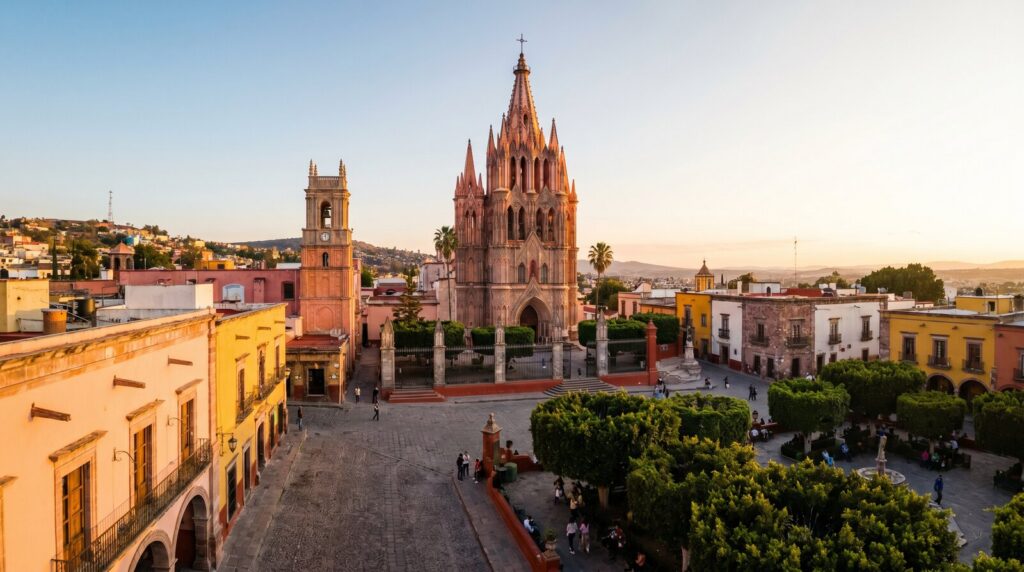
San Miguel de Allende exists in chromatic perfection. Pastel-hued buildings cluster on hillsides in unlikely arrangements—coral pink beside pale yellow beside soft green beside lavender. Cobblestone plazas host centuries-old fountains. The Parish Church (Parroquia Arcángel San Miguel) rises impossibly from the central square, its neo-gothic spires layered against Mexican sky. Bougainvillea cascades over compound walls. The light—especially during the golden hour—renders everything in romantic softness.
This is Mexico’s most aggressively picturesque town. It’s also become something more complicated: a creative haven that’s gentrified dramatically as wealthy foreigners (primarily Americans) have relocated here, transforming the economy, demographics, and culture. San Miguel de Allende now exists in a productive tension between its authentic colonial heritage and its contemporary identity as an international art destination. Understanding this complexity is crucial for visiting with awareness.
Table of Contents
Colonial History & Architecture: Layered Timescapes
San Miguel de Allende was founded in 1542 as a mission town in New Spain’s interior. The colonial architecture reflects centuries of cultural layering: Spanish colonial design merged with indigenous building traditions, later modified by mestizo aesthetics, then reinterpreted by 19th and 20th century Mexican identity assertions, and most recently adapted by contemporary international residents.
The Parroquia (Parish Church) is the architectural centerpiece and spiritual heart. Built primarily in the 18th-19th centuries, it features neo-gothic towers that were added in the 1880s by a local stonemason who was reportedly trained entirely through studying architectural books. The result is charmingly imperfect—those towers are visibly crude up close, yet somehow they work, adding character to the urban profile.
Beyond the church, the town reveals architectural richness through exploration. Massive compound walls protect interior patios from street noise—a sensibility inherited from Islamic architectural traditions via Spain. Building facades conceal sophisticated interior spaces. Individual buildings might feature Byzantine-influenced arches alongside baroque ornamentation alongside neoclassical restraint, reflecting different eras’ aesthetic preferences.
UNESCO designated San Miguel de Allende a World Heritage Site in 2008, recognizing the “exceptional preservation” of colonial architecture. The designation brought both benefits (funding for restoration, protection from demolition) and complications (increased tourism pressure, foreign investment speculation).
Art Culture & Creative Community
San Miguel de Allende’s reputation as an art destination emerged gradually. In the 1930s, Mexican muralist David Alfaro Siqueiros began organizing artists here. By the 1950s-1960s, it became a bohemian haven for creative refugees from the United States—poets, painters, musicians seeking low-cost living and inspiration. This cultural infrastructure attracted subsequent waves of artists.
Today, the town maintains a robust contemporary art scene. Multiple galleries display work by local and international artists. Art schools and workshops offer classes in painting, sculpture, printmaking, photography, and installation art. The town attracts artists in residence, creative retreats, and experimental projects. The energy is genuine—this isn’t fabricated “artsy” atmosphere but an actual creative community.
However, gentrification has fundamentally altered who can participate. Rising real estate costs, rent inflation, and property speculation have pushed out many working artists. Today’s “creative community” skews toward wealthy individuals with capital to invest in art projects, not emerging artists needing affordable studios and living space. The art scene has become more curated, commercialized, and internationalized.
Gentrification & Cultural Transformation
Here’s an uncomfortable reality: San Miguel de Allende is actively being transformed by foreign wealth. Property values have increased 400-600% in the past 15 years. Longterm residents sell family homes to foreign investors at prices they can’t refuse. Renters are displaced by property owners seeking higher returns through short-term vacation rentals. Mexican workers commute from increasingly distant towns as local housing becomes unaffordable.
The demographic shift is stark. In the 1990s, San Miguel was roughly 90% Mexican. Today, it’s approximately 40-50% foreign residents (predominantly American), with Mexican residents increasingly concentrated in specific neighborhoods. Property ownership is increasingly foreign. Business ownership is increasingly foreign. The cultural landscape has shifted dramatically toward international preferences.
This isn’t unique to San Miguel de Allende—gentrification happens in creative cities globally. But it’s worth acknowledging honestly. Visiting here means encountering the results of gentrification: pricing that reflects international market values rather than local economics, English prevalence competing with Spanish, cultural offerings tailored toward foreign residents and tourists, and a genuine community tension between maintaining Mexican identity and economic integration into the international market.
Being a conscious visitor means: eating at Mexican-owned restaurants rather than international chains, shopping at local markets rather than tourist galleries, learning Spanish, asking about historical context, supporting Mexican artists specifically, and acknowledging that your consumption of this place contributes to the economic dynamics transforming it.
Neighborhoods & Walking Routes
Centro (Central Historic Core): The Plaza Principal is the true heart. Surrounding streets bustle with galleries, restaurants, and shops. It’s touristy and often crowded, but architecturally stunning. Best experienced early morning or at sunset when light is optimal and crowds thin.
Atascadero (West Side): More residential, less touristy. Narrow streets, local restaurants, artisan workshops. This is where everyday San Miguel life happens—local grocers, families walking, schools. It feels authentically Mexican and offers respite from tourist density.
El Chorro (North End): Home to workshops, small factories, and agricultural areas. Less visited by tourists but accessible. The Botanical Garden (Jardín Botánico) is located here—peaceful grounds with native Mexican plants and excellent city views.
Pila Seca (Southeast): Residential neighborhood with working-class character. Local pulquerias (pulque bars), markets, and family-oriented establishments dominate. It’s the San Miguel that tourists rarely see—and is worth seeking out for authentic cultural engagement.
Walking routes: Start at the Parroquia, explore radiating streets systematically, get deliberately lost in the neighborhood passages. Most efficient tourist coverage happens in 2-3 hours, though genuine engagement requires longer immersion.
Surroundings & Day Trips
The high-altitude Mexican plateau surrounding San Miguel de Allende offers multiple day trip options. Guanajuato (45 minutes) is another colonial town famous for underground streets and the dramatic Juárez Theater. Dolores Hidalgo (30 minutes) is where Mexican independence began (Father Miguel Hidalgo’s church is historically significant). Both towns offer colonial architecture and cultural experiences with less tourist development than San Miguel.
Ranches and agricultural estates around San Miguel offer horseback riding through countryside. Many include traditional Mexican meals and cultural activities. Quality varies—research thoroughly before booking.
Hot springs (spas) in the region provide thermal bathing and relaxation. Several operate at various price points. They’re popular with both locals and visitors—a good cultural crossover point.
Facts About San Miguel de Allende
Founded in 1542
San Miguel was established as a mission town to evangelize and control indigenous populations. The Spanish colonial system integrated indigenous people into a hierarchical social structure through religious conversion and economic dependence.
Independence Connection
Ignacio Allende, born here in 1769, was a key figure in Mexican independence. He coordinated early insurgency efforts before being captured and executed by Spanish authorities in 1811.
American Migration Wave
Post-WWII, American artists, writers, and bohemians discovered San Miguel. By the 1970s-1990s, it became an established destination for creative Americans seeking affordable living and inspiration. Recent decades have seen increasing American retirement migration.
Expat Majority in Centro
In the historic center, foreign residents now substantially outnumber Mexican residents. Real estate prices reflect international market values rather than local economics, creating a two-tiered housing market.
Experience San Miguel with Awareness
San Miguel de Allende is genuinely beautiful and culturally rich. It genuinely hosts a vibrant creative community. But visit with awareness of the gentrification dynamics that have transformed this place. Support Mexican businesses. Learn Spanish. Seek out less-touristy neighborhoods. Engage with actual residents rather than other tourists. Acknowledge that your visit contributes to the economic transformations reshaping this town. Done with consciousness and respect, San Miguel offers authentic encounter with Mexican colonial heritage and contemporary creative culture.