
Seoul, South Korea: Where Joseon Palaces Meet K-Pop Skyscrapers
Part of our South Korea travel guide.
Seoul City Guide
Table of Contents
Why Seoul?
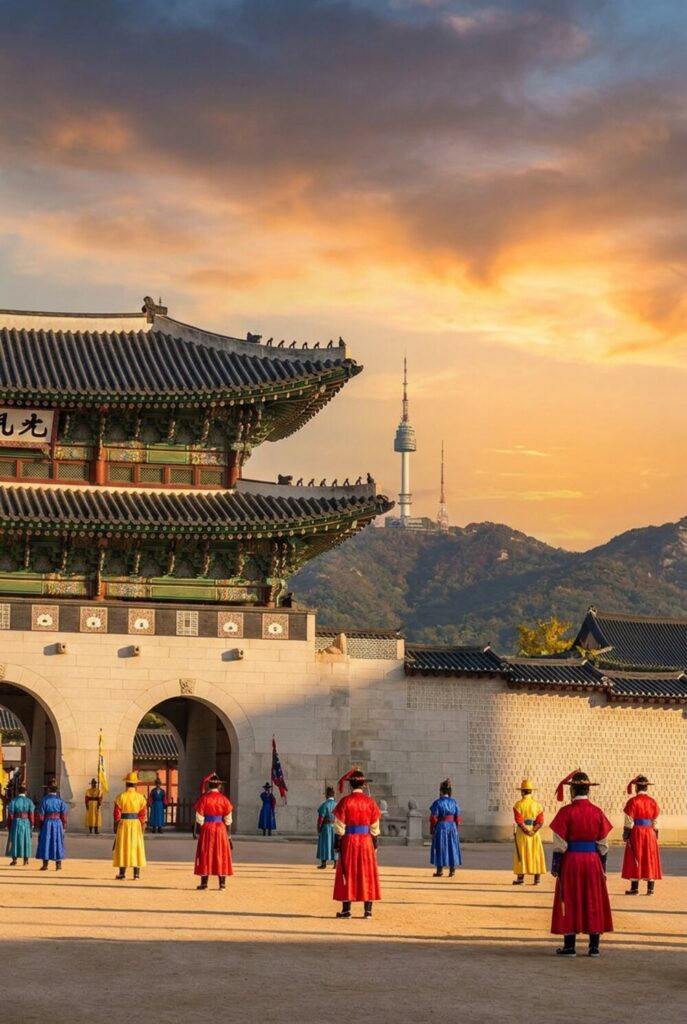
Seoul is the capital that invented the modern Korean Wave and still keeps a 600-year-old royal palace in the middle of its financial district. Few cities telescope six centuries of continuous political history and one of the planet's densest consumer-technology ecosystems into a single subway ride, but a seven-minute hop on Line 3 will carry you from Gyeongbokgung's changing-of-the-guard ceremony to Gangnam's mirrored tower of SM Entertainment, one of the three major K-pop labels that power a domestic music industry estimated at well over USD 10 billion a year. The Hallyu wave — the global export of Korean pop, drama, film, beauty and food — is not a distant abstraction here: it is the industrial feedstock of whole neighbourhoods, from the plastic-surgery towers of Apgujeong to the idol-label headquarters along Seongsu-dong's Ttukseom-ro.
At 9.6 million residents inside the city limits and roughly 26 million across the Seoul Capital Area, Seoul is one of the ten largest metropolitan agglomerations on earth and concentrates about half of South Korea's total population of roughly 51 million. The contradiction that hits every first-time visitor is how legible the city feels despite the scale: 23 colour-coded subway lines, signage in Hangul and English on every platform, and an IC transit card you can top up at any convenience store. You can cross the Han River at 300 km/h on the KTX and ten minutes later be standing barefoot on the heated floor of a 1930s hanok teahouse in Bukchon, sipping omija tea while a five-storey construction crane builds a new Blackpink-backed concept hotel two blocks away.
Seoul is also the city with the highest density of three-Michelin-star Korean restaurants anywhere, with Mingles, La Yeon and Gaon all holding three stars in the 2025 Michelin Guide, and more than 170 venues recognised across Bib Gourmand and starred categories. The other superlative that sticks is cosmetics: Korean beauty exports topped USD 9 billion in 2023, and Myeongdong's six-block flagship gauntlet remains the consumer-facing capital of the industry. Over the course of this guide you will get our pick of the nine neighbourhoods worth structuring a visit around, a full tour of Korean barbecue and temple cuisine, practical routes to the UNESCO-listed Changdeokgung Palace and its Secret Garden, the Bukchon Hanok Village with its new quiet-hours rule, and a same-day border crossing to the DMZ — plus the 2026 festival calendar, from cherry blossoms at Yeouido in April to the Seoul Lantern Festival along the Cheonggyecheon stream in November, and the Buddha's Birthday Lotus Lantern parade on 24 May 2026 that lights up Jongno with more than 100,000 paper lanterns.
Neighborhoods: Finding Your Seoul
📍 Seoul Map: Every Place in This Guide
Seoul is administratively divided into 25 districts (gu) and 423 smaller neighbourhoods (dong) spread across 605 km² of land, but travellers only need to learn a shortlist. The city straddles the Han River with the royal-palace core, Jongno, sitting on the north bank and the glass-tower business district of Gangnam on the south. Distances between neighbourhoods are deceptive: Gangnam to Hongdae looks long on the map but runs 25 minutes on Line 9 express, and the entire palace corridor from Gyeongbokgung east to Jongmyo is walkable in a single morning. The following nine neighbourhoods cover every itinerary from a four-night first visit to a two-week deep-dive, and each one anchors to a specific subway exit so you can drop it into your route without a map. Together they touch all five royal palaces, three major market complexes, the two most important Han River parks and the city's two principal rail terminals (Seoul Station and Yongsan), which means any daily plan can start and end at one of these anchors without backtracking across the river.
Myeongdong
Myeongdong is the tourist epicentre north of the river and the neighbourhood most first-time visitors use as a base. The six blocks between Myeongdong Cathedral and Lotte Department Store are a gauntlet of Korean beauty flagships — Innisfree, Olive Young, Etude House, Missha, The Face Shop, Nature Republic — where free sheet-mask samples are pushed into your hands at every storefront and multilingual staff will assemble a basket of your target ingredients (centella, snail mucin, propolis, retinol) in ten minutes. The street-food alley that runs off Myeongdong 8-gil fires up around 16:00 and stays open until midnight, selling tornado potato, grilled scallops, lobster cheese, gyeranbbang egg bread and ₩3,000 tteokbokki skewers. Hotels here run the full range from 5-star Lotte Hotel Seoul to capsule sleeps and mid-range business chains (Nine Tree, Shilla Stay), and the Myeongdong Night Market sets up tarpaulin tables directly on the main street four nights a week. The neighbourhood's strengths are convenience and density; its weaknesses are tourist markups of roughly 15-20% on food and beauty relative to Hongdae or Seongsu.
- Myeongdong Cathedral — 1898 Gothic brick landmark, country's first Catholic seat.
- Lotte Department Store Main Branch — 12-floor flagship with tax-free counters on L10.
- Myeongdong Night Market — street-food strip operating Wed-Sun on the main artery.
- Myeongdong Underground Shopping Centre — 300-stall arcade linked to the station.
Best for: first-timers and Korean-beauty hauls. Access: Line 4 Myeongdong Station, Exit 6.
Hongdae
Hongdae — shorthand for the streets around Hongik University's art-and-design campus — is the student nightlife core. The "Playground" outside Exit 9 of Hongik Univ. Station hosts free dance covers and indie bands every weekend evening from roughly 19:00 to 23:00, and the side alleys are thick with cheap Korean chicken-and-beer (chimaek), board-game cafes, noraebang rooms, trick-photography museums and 24-hour PC bangs. The Yeonnam-dong strip running west from the station has become Seoul's most concentrated row of photogenic third-wave cafes, centred on the 1.3 km former railway cutting now converted to the Yeontral Park linear green space. KT&G Sangsangmadang hosts free arthouse cinema and design exhibitions, and the Hongdae Free Market runs every Saturday March-November in the Hongik sculpture park. Hongdae links directly to Incheon Airport via the AREX line, which makes it the single most convenient neighbourhood for a jet-lagged first night out, and the density of mid-range guesthouses (₩60,000-90,000 per night) is unmatched elsewhere in the city.
- Hongik University Playground — free weekend street performances.
- Yeonnam-dong cafe strip — one-block-wide linear park lined with third-wave cafes.
- KT&G Sangsangmadang — multi-floor arts complex with a rooftop cafe.
- Trick Eye Museum — 3D optical-illusion gallery popular with teens.
Best for: nightlife, live indie music, under-30 crowds. Access: Line 2 / AREX Hongik Univ. Station, Exit 9.
Itaewon
Itaewon is Seoul's international dining and expat neighbourhood, stretched along a single hillside street on the south slope of Namsan mountain directly below N Seoul Tower. The restaurant mix leans Turkish, Middle Eastern, Indian, Mexican, Thai and Southeast Asian, reflecting a century of proximity to the former Yongsan US military base that relocated to Pyeongtaek in 2018. The vacated US Army land is being redeveloped into Yongsan Park, a 300-hectare green space projected to open in phases through 2028. Haebangchon (HBC), the residential hill south of Itaewon-ro, has become the craft-cocktail and natural-wine pocket of the city, with Southside Parlor and Le Chamber ranked on Asia's 50 Best Bars lists. The Leeum Samsung Museum of Art — designed by Jean Nouvel, Mario Botta and Rem Koolhaas — houses one of the country's best contemporary-art collections (admission ₩10,000 ~$7.40, free on the first Sunday of each month). Itaewon was the site of the October 2022 Halloween crowd tragedy and now has formal crowd-management protocols on festival nights.
- Itaewon-ro international food strip.
- Leeum Samsung Museum of Art — contemporary and traditional Korean collections.
- Haebangchon (HBC) craft-cocktail hill.
- War Memorial of Korea — 10-minute walk north.
Best for: international food, craft cocktails, expat-friendly nightlife. Access: Line 6 Itaewon Station, Exit 1.
Gangnam
Gangnam (literally "south of the river") is the glass-tower business district made globally famous by Psy's 2012 single and still the headquarters neighbourhood for SM Entertainment, HYBE's subsidiary offices and much of the Korean plastic-surgery industry clustered around Apgujeong, where an estimated 500-plus clinics operate inside a two-kilometre radius. The COEX Mall underneath the Trade Tower contains the Instagram-famous Starfield Library, an open atrium with 13-metre shelves holding more than 50,000 books, and the SMTOWN COEX Artium is where the K-pop label's hologram concerts run daily for fans who cannot get physical-concert tickets. Garosu-gil ("tree-lined street") in Sinsa-dong is the boutique-shopping anchor, while Gangnam Station itself sits at one of the city's busiest interchange nodes with an estimated 200,000 daily passengers. The Lotte World Tower in Jamsil, at 555 metres, is the tallest building in South Korea and the fifth-tallest in the world, with the Seoul Sky observation deck on floors 117-123 (admission ₩29,000 ~$21.30).
- COEX Mall and Starfield Library.
- SMTOWN COEX Artium — K-pop hologram venue and official merch.
- Garosu-gil shopping street.
- Bongeunsa Temple — 794 CE Seon Buddhist temple opposite COEX.
Best for: shopping, K-pop industry sightseeing, corporate hotels. Access: Line 2 Gangnam Station / Line 9 Sinnonhyeon.
Insadong
Insadong is the traditional-arts and souvenir corridor of Jongno-gu, a single pedestrianised street (closed to cars Saturdays and Sundays) lined with galleries, antique shops, calligraphy supply stores and the kind of ceramic-studios where you can sign up for a ninety-minute hands-on lesson for around ₩40,000. Ssamziegil is the spiralling four-floor craft mall where young Korean designers sell leather goods and jewellery, and the surrounding alleys hide long-established tea houses pouring omija (five-flavour berry) and yuja (citron) tea for ₩8,000-12,000 a pot. Jogyesa, Seoul's most important working Buddhist temple and the site of the annual Lotus Lantern Festival, sits just two blocks west of the main Insadong drag and opens to visitors daily 04:00-21:00 with free entry. The nickname "Mary's Alley" applies to the micro-lane of vintage-everything east of Ssamziegil. The Ikseon-dong hanok cafe cluster, a five-minute walk east, has become the younger and more Instagram-driven alternative to Insadong itself in recent years, occupying a lattice of 100-year-old hanok courtyards.
- Ssamziegil — spiralling craft-and-fashion shopping building.
- Jogyesa Temple — Jogye-order headquarters, host of the lantern festival.
- Tongin Market — dosirak (lunchbox) token system market.
- Kyung-in Museum of Fine Art — oldest traditional tea house in the city.
Best for: craft shopping, traditional tea culture, souvenirs. Access: Line 3 Anguk Station, Exit 6.
Bukchon Hanok Village
Bukchon is the hillside residential enclave between Gyeongbokgung and Changdeokgung palaces where roughly 900 hanok courtyard houses still stand, many of them private family homes dating to the late Joseon and early Republic eras. The steep streets of Gahoe-dong and the "Bukchon 8 Views" photograph points are the most famous backdrops in Korea after the palaces themselves. As of November 2023 the Jongno-gu office has designated Bukchon a "special management zone" with a 17:00-10:00 quiet-hours rule: during those hours photography is restricted and loud voices may draw a fine of up to ₩100,000, because complaints from residents about tourist density reached breaking point. Daytime is still open to visitors, and the Bukchon Hanok Cultural Centre offers free English maps.
- Bukchon 8 Views — signposted photography viewpoints down the Gahoe-dong alley.
- Bukchon Hanok Cultural Centre — free guided walk resources.
- Samcheong-dong cafe street — boutiques and galleries on the western edge.
Best for: traditional architecture, pairing with palace visits. Access: Line 3 Anguk Station, Exit 2.
Jongno
Jongno ("Bell Street") is the civic and historical spine of old Seoul, running east-west from Gwanghwamun Square — with its statues of Admiral Yi Sun-sin and King Sejong the Great — along the restored Cheonggyecheon stream. All five of the royal palaces of Joseon Korea sit inside Jongno-gu, as does the Jogyesa temple, the national Folk Museum and most of the country's central government buildings. The 11 km Cheonggyecheon was an elevated expressway until a controversial 2003-2005 restoration returned it to an open-channel urban creek, and it is now Seoul's favourite evening stroll. Pair Jongno with Insadong and Bukchon for a full walking day inside the historic palace corridor.
- Gyeongbokgung Palace — the principal Joseon royal residence.
- Cheonggyecheon stream — 11 km restored urban creek.
- Gwanghwamun Square — civic plaza with statues of Sejong and Yi Sun-sin.
- National Folk Museum of Korea — inside the Gyeongbokgung grounds, free entry.
Best for: history, museums, palace bundles. Access: Line 3 Gyeongbokgung Station / Line 5 Gwanghwamun.
Yongsan / Ichon
Yongsan is the central-transit district on the north side of the Han River where KTX high-speed services share a concourse with regional, subway and airport-rail lines. It is also the neighbourhood of the National Museum of Korea, the country's flagship cultural institution and the sixth-most-visited museum on the planet in recent years, and Ichon next door is the family-apartment quarter that locals use for riverside bike rides and picnics. The Yongsan Electronics Market, several blocks north of the station, is where to go for graphics cards, gaming keyboards and second-hand cameras, although it has been shrinking as e-commerce has grown.
- National Museum of Korea — free permanent collection, Silla-gold gallery.
- Yongsan Station — KTX, ITX, Gyeongui-Jungang, Line 1.
- Yongsan Electronics Market — 20+ buildings of electronics retail.
- Hangang (Han River) Ichon Park — riverside cycling path and picnic lawn.
Best for: museums, KTX departures, riverside cycling. Access: Line 1 / KTX Yongsan Station.
Seongsu-dong
Seongsu-dong is the former shoe-factory and light-industrial district east of Han River that has, since roughly 2016, remade itself into the Brooklyn of Seoul. Warehouses have been converted into concept stores for Dior pop-ups, Gentle Monster eyewear flagships, and third-wave coffee bars like Onion Seongsu that serve pastries on a bare concrete roof. Common Ground, near Konkuk University, is a shipping-container mall built from 200 blue containers stacked two-storeys high, housing independent Korean fashion and streetwear brands. Seoul Forest, the 1.16 km² public park on the neighbourhood's north edge, contains deer paddocks, an ecological forest and one of the city's best outdoor concert lawns.
- Seongsu Cafe Street.
- Common Ground — blue shipping-container mall near Konkuk University.
- Seoul Forest — 1.16 km² public park with deer paddock.
- Dior Seongsu / Gentle Monster Haus Dosan (nearby) flagships.
Best for: third-wave coffee, streetwear shopping, fashion pop-ups. Access: Line 2 Seongsu Station, Exit 3.
The Food
Korean food in Seoul is unusually democratic: the ₩4,000 mayak gimbap you eat standing up at Gwangjang Market and the ₩330,000 tasting menu at La Yeon use many of the same pantry ingredients, and banchan (side dishes) are still served free at both ends of the spectrum. The city holds more than 170 Michelin-recognised venues across starred and Bib Gourmand categories in the 2025 Michelin Guide Seoul, and three restaurants — Mingles, La Yeon and Gaon — currently hold the full three stars. What follows is structured the way most first-time visitors actually eat: barbecue at night, hansik at lunch, markets for snacks, and one splurge. Korean food culture places unusual weight on the meal being a shared social object rather than an individual order — most menus assume two or more diners, most side dishes arrive communal, and the traditional rule that the youngest person pours drinks for the oldest still holds in business dinners and family gatherings.
Korean BBQ & Samgyeopsal
Korean barbecue in Seoul runs on tabletop charcoal or gas grills and two categories of meat: samgyeopsal (fatty pork belly) and the beef cuts led by bulgogi, galbi (short rib) and hanwoo (Korean premium beef, equivalent to wagyu). The classic assembly is a lettuce leaf, a strip of grilled pork, a smear of ssamjang bean paste, a slice of raw garlic and a piece of kimchi folded into a single bite (ssam). Lunch BBQ sets start around ₩12,000 per person; dinner at a hanwoo speciality house in Gangnam can run to ₩80,000 per 150 g portion. Most places charge per person for the banchan set and per portion of meat, and at lunchtime you will often share a single cut with a steel dish of gyeran-jjim egg custard. Charcoal (sutbul) is the quality marker: ask for "sut-bul gogigui" to confirm real charcoal over gas. Most BBQ houses in the mid-range automatically grill the first round for you and leave you to flip the rest; premium venues keep a dedicated grill attendant at the table throughout the service.
- Maple Tree House (Itaewon) — mid-range hanwoo galbi and samgyeopsal in a wood-beamed hanok dining room. Samgyeopsal sets ₩25,000-45,000 (~$18-33).
- Hadongkwan (Myeongdong, established 1939) — clear gomtang beef bone soup is the speciality here, not BBQ, but the single-dish lunch is the reference point for ₩15,000 (~$11) classic Seoul dining.
- Geumdwaeji Sikdang (Sinsa) — the viral premium-pork-belly spot with open wood-charcoal grills. Portions ₩18,000 (~$13) each, queues of 90+ minutes at dinner.
- Mapo Jeong Daepo (Mapo) — outdoor-stool pork-skirt (galmaegi-sal) institution; ₩13,000 (~$10) per portion.
- Born & Bred (Seongsu) — Michelin-listed hanwoo tasting room from the producer Dongwoo Farm. Tasting menu ₩180,000 (~$132).
Hansik — Traditional Korean (Bibimbap, Tteokbokki, Samgyetang)
Hansik is the umbrella term for the rice, soup, banchan, stew, and grill that make up a standard Korean meal. A proper hansik lunch is called a baekban ("set meal") and comes with 6-12 small banchan dishes alongside a main. Seoul's most distinctive hansik dishes include samgyetang (young chicken stuffed with sticky rice and ginseng, simmered in broth) eaten in summer on the three "dog days" (sambok) to restore energy, jeon (various savoury pancakes traditionally served on ancestral memorial days), and Jeonju-style bibimbap with a raw egg yolk and gochujang. Winter speciality: budae-jjigae ("army base stew"), a peppery hot pot invented in Uijeongbu with Spam, frankfurters and ramyeon, now ubiquitous in Seoul and commonly priced ₩14,000-18,000 (~$10-13) per portion. Also look for ddukbaegi-bulgogi — bulgogi served in a sizzling earthenware pot — and samgyeop-kimchi-jjim, a slow-braised pork-and-aged-kimchi pot that pairs particularly well with the Korean rice wine makgeolli.
- Tosokchon Samgyetang (Jongno) — the reference ginseng-chicken soup a short walk west of Gyeongbokgung. ₩20,000 (~$15). Queue by 11:30 for lunch.
- Gogung (Insadong / Myeongdong) — Jeonju-style bibimbap served in a hot stone bowl. ₩15,000 (~$11).
- Myeongdong Kyoja — kalguksu hand-cut noodle soup with mandu dumplings, ₩11,000 (~$8). Cash or card, cavernous two-floor dining room.
- Andong Jjimdak (Seongbuk-gu) — braised chicken with glass noodles, ₩32,000 (~$23) for a 2-person pot.
- Jaha Son Mandu (Buam-dong) — hand-made dumplings from a renowned chef's family kitchen. ₩14,000 (~$10).
Street Food & Markets: Gwangjang and Beyond
Gwangjang Market in Jongno-gu is the country's oldest permanent market, opened in 1905, and the stall-by-stall benches at the centre of the south wing are the single best introduction to Korean street food. The "mayak gimbap" (literally "drug kimbap") at Mo-Ssi Nene is the most-Instagrammed bite: three-centimetre seaweed rice rolls dipped in mustard-soy. Bindae-tteok mung-bean pancakes are ground and fried in front of you at ₩5,000-7,000 each, and the yukhoe alley in the market's east corridor serves Korean-style raw beef tartare with pear and raw egg yolk. Tongin Market in Jongno runs a clever dosirak (lunchbox) system where you buy a bundle of ten ₩500 brass tokens, receive an empty bento box, and collect banchan dish by dish from participating stalls — it operates Tuesday-Sunday until 17:00 and is entirely cashless from the token-purchase point onward. Namdaemun Market is the larger wholesale-retail complex near Seoul Station, best for ganjang-gejang (soy-marinated raw crab) and galchi-jorim (braised hairtail fish). Mangwon Market in Mapo is the current local favourite among Seoul residents for affordable evening banchan and fried chicken. Gwangjang opens daily 09:00-22:30 for the food stalls, with the fabric and hanbok sections closing earlier around 18:00.
- Gwangjang Market — bindae-tteok ₩5,000-7,000 (~$4-5), mayak gimbap ₩4,000 (~$3), yukhoe ₩20,000 (~$15).
- Myeongdong Street Food alley — tornado potato ₩5,000 (~$4), tteokbokki ₩3,000 (~$2), hotteok pancake ₩2,000 (~$1.50).
- Tongin Market — dosirak lunchbox ₩5,000 (~$4) in brass tokens.
- Namdaemun Market — ganjang-gejang set ₩35,000 (~$26), galchi-jorim ₩15,000 (~$11).
- Noryangjin Fish Market — live hoe (sashimi-equivalent), buy downstairs at ₩30,000-80,000 (~$22-59) and pay ₩5,000 per person to have it served upstairs.
- Mangwon Market (Mapo) — local market beloved for gochu-twigim (fried stuffed chili) at ₩2,000 (~$1.50) each.
Michelin & High-End: Where to Splurge
Seoul's top end is tightly concentrated in three neighbourhoods: Hannam-dong and Itaewon on the north of the river, Gangnam/Cheongdam south of it. Three-star tasting menus run ₩280,000-330,000 per person (~$205-242) before pairings, and the wine-pairing supplement typically adds ₩120,000-180,000 (~$88-132). Reservations open 30 days out on the restaurant's own site or Catch Table — do not expect walk-ins. The Michelin Guide Seoul 2025 lists 33 starred restaurants, 59 Bib Gourmand addresses, and more than 170 restaurants recognised overall, one of the most comprehensive guides in Asia. Seoul has also developed a serious natural-wine and cocktail scene in the last five years; bars in the Hannam and HBC corridors regularly place on Asia's 50 Best Bars. Dress codes at the three-star rooms are smart-casual at a minimum; most request no open-toe footwear for men and jackets (though not ties) at dinner service.
- Mingles — chef Kang Min-goo's contemporary Korean tasting, three Michelin stars. ₩280,000 (~$205) dinner.
- La Yeon (The Shilla Hotel) — royal court cuisine, three Michelin stars, 23rd-floor Namsan views. ₩330,000 (~$242).
- Gaon — refined hanjeongsik in a Kwangjuyo-ceramic setting, three Michelin stars. ₩330,000 (~$242).
- Mosu Seoul — chef Sung Anh's two-Michelin-star inventive Korean. ₩320,000 (~$235).
- Jungsik Seoul — two Michelin stars, "new Korean", Cheongdam-dong. ₩290,000 (~$213).
Beyond BBQ and Bibimbap: Cafes, Chimaek and Cold Noodles
Seoul's café density surpasses even Tokyo's on a per-capita basis, and the coffee scene is now led by native roasters like Fritz Coffee Company (with six branches), Center Coffee, and Anthracite, whose Hapjeong warehouse pours single-origin pour-overs at ₩7,000 (~$5). Chimaek — fried chicken and beer — is the non-negotiable late-night pairing; BBQ Chicken, Kyochon and Bonchon operate hundreds of storefronts city-wide, and the Han River parks see nightly waves of delivery scooters handing over chimaek ordered through the Baemin app. A typical two-person chimaek order runs ₩25,000-35,000 (~$18-26) for a whole fried chicken plus two draught beers. Other dishes worth clearing stomach space for include naengmyeon (cold buckwheat noodles, eaten in summer) at Eulji Myeonok (₩14,000, ~$10), hoddeok (stuffed pancakes) from the winter carts on Namdaemun-ro at ₩2,000 each, patbingsu (red-bean shaved ice) at Milky Bee in summer for ₩14,000 (~$10), and gyeran-bbang (hot egg bread from cart vendors at ₩2,000). Seoul is also the world capital of Korean fried chicken (KFC, no relation to the American chain), with an estimated 36,000 chicken-and-beer outlets operating nationwide, the highest density per capita of any cuisine-type in the country.
Convenience-Store Culture, Banchan and Breakfast
Korean convenience stores — CU, GS25, 7-Eleven, Emart24 — are a genuine eating category and not a fallback; a typical Seoul commuter breakfast is a triangle gimbap (₩1,200 ~$0.90), a yakult drink and a banana-milk at the counter microwave. The CU and GS25 chains rotate seasonal ramyeon cups, collab instant noodles with celebrity chefs, and bestselling lunchboxes at ₩4,500-6,500 (~$3.30-4.80). Korean breakfast itself is not a distinct food category — the same hansik rice, soup and banchan that appear at lunch also appear at breakfast, with haejang-guk ("hangover soup" of ox bones, congealed blood, soybean sprouts) being the classic Sunday-morning order at places like Cheongjinok in Jongno (₩13,000 ~$9.55, open since 1937). Banchan deserve their own note: most restaurants serve 6-12 small side dishes free with any meal, and the standard rotation includes kimchi (three or four types), pickled radish, seasoned spinach, bean sprouts, dried squid, fried fish cake and a rotating stew; asking for refills ("banchan jom deo juseyo") is expected and free. Breakfast hotels often add Western options; true Korean inns still serve a ₩10,000-15,000 (~$7.40-11) set with rice, miyeok-guk seaweed soup and a grilled mackerel. Seoul's drinking culture pairs with food as tightly as anywhere on earth: soju runs ₩2,000 (~$1.50) a bottle at a pojangmacha street tent, Korean craft beer has risen to 200+ breweries nationwide, and makgeolli rice wine is the autumn-foliage drink of choice, poured in traditional brass bowls for ₩6,000 (~$4.40) a jug. The pairing rule is simple — soju with samgyeopsal, beer with chimaek, makgeolli with pajeon pancakes, and the Korean ssogeo (bomb) cocktail of soju dropped into a beer glass in company with colleagues at the end of a long shift.
Cultural Sights
Gyeongbokgung Palace (경복궁)
Gyeongbokgung is the principal royal palace of the Joseon Dynasty, founded in 1395 by King Taejo at the foot of Bugaksan mountain, and the symbolic heart of Korean monarchy for five centuries. Admission ₩3,000 (~$2.20) and opening hours are 09:00-18:00 March-October and 09:00-17:00 November-February, closed Tuesdays. The changing-of-the-guard ceremony runs at 10:00 and 14:00 at Gwanghwamun Gate with 50+ costumed performers, and if you arrive wearing a rented hanbok (traditional dress) from one of the neighbouring Insadong shops, admission is waived. The rear Hyangwonjeong pavilion, sitting on a hexagonal stone-pillar bridge over a lotus pond, is the single most photographed corner of the palace complex, and the adjacent Gyeonghoeru banquet hall is built on a rectangular island in a man-made pond and was the site of Joseon-era state dinners. The palace complex burned down during the 1592 Imjin War, was restored in 1867, partly dismantled under Japanese colonial occupation 1910-1945, and is still being reconstructed in phases under a long-term restoration programme that started in 1990 and is scheduled to run through the 2040s.
Changdeokgung Palace & Secret Garden (창덕궁)
Changdeokgung, founded in 1405 and inscribed on the UNESCO World Heritage List in 1997, is the palace most architecturally sensitive to its hillside topography, with buildings laid out to follow the contours rather than the grid pattern used at Gyeongbokgung. Admission ₩3,000 (~$2.20), plus a ₩5,000 (~$3.70) guided-only ticket for the 78-acre Huwon Secret Garden, which was the private retreat of the Joseon royal family for more than 250 years. English tours run at 10:30, 11:30, 13:30 and 14:30 and sell out online up to six days in advance during autumn foliage season. Closed Mondays. The garden's Buyongji lotus pond and the Juhamnu two-storey library pavilion built in 1776 are the highlights of the 90-minute tour. Changdeokgung is widely considered the most beautiful of the five royal palaces by Koreans themselves, and most UNESCO-focused tours place it ahead of Gyeongbokgung on first-day itineraries.
Bukchon Hanok Village
Bukchon is a living residential neighbourhood rather than a paid attraction; entry is free but the 17:00-10:00 quiet-hours restriction (in place since late 2023) applies to the Gahoe-dong alley core, where residents' complaints led the Jongno-gu office to restrict photography during those hours, with fines of up to ₩100,000 for violations. The Bukchon Hanok Cultural Centre (09:00-18:00, free) is the official starting point and provides the paper map with the eight designated "Bukchon 8 Views" photo spots. The village dates to the early Joseon era and roughly 900 traditional hanok homes remain standing, some of which have been converted to guesthouses (₩150,000-300,000 per night) that let visitors sleep on the ondol-heated hanji floors. Daytime etiquette: keep voices low, do not enter private gates, do not use tripods.
N Seoul Tower (Namsan)
N Seoul Tower, completed in 1969 and standing 236 metres tall on Namsan mountain, is the city's most visible landmark and a favourite proposal spot for Korean couples. Observatory admission ₩21,000 (~$15.40), open 10:00-23:00 on weekdays, 10:00-24:00 weekends. The cheapest access is the Namsan Cable Car (₩14,000 round trip) from the base station in Myeong-dong; the most scenic is the 40-minute hike up from the Namsan Tunnel trailhead; and the free option is the 02 yellow-bus shuttle that loops Namsan park. The "love locks" fence on the observation deck has been refreshed multiple times since 2007 and now operates as a paid padlock-purchase wall. The HanCook tower-level Korean restaurant and the rotating nCafe both command Seoul's widest panoramic views, particularly at sunset.
DMZ / Panmunjeom Day Tour
The 4 km-wide Demilitarised Zone along the 1953 armistice line runs 55 km north of Seoul; independent travel is prohibited and visitors must join an approved tour. Standard half-day DMZ tours from Seoul cost ₩50,000-80,000 (~$37-59), and the more restricted JSA (Joint Security Area) tour to Panmunjeom itself runs ₩130,000-150,000 (~$95-110) when access is permitted. JSA access is subject to political conditions and has been partially suspended since July 2023 following the defection of a US soldier; DMZ Observatory and Third Infiltration Tunnel tours have remained open throughout. Bring your passport (photocopies are rejected), wear closed-toe shoes, and expect multiple security checks at the Imjingak staging point. Tours typically depart Seoul 08:00-09:00 and return by 16:00-17:00.
Jongmyo Shrine
Jongmyo, a short walk east of Changdeokgung, is the oldest and longest-surviving royal Confucian shrine in the world, built in 1394 and inscribed by UNESCO in 1995 as one of the earliest Korean sites on the World Heritage List. Admission ₩1,000 (~$0.75), timed-entry guided-only on weekdays with English tours at 10:00, 12:00 and 14:00 (free-exploration on Saturdays and the last Wednesday of each month). The twice-yearly Jongmyo Jeryeak ancestral ritual held the first Sunday of May is one of the most important intangible cultural events on the Korean calendar, recognised by UNESCO as a Masterpiece of the Oral and Intangible Heritage of Humanity in 2001.
National Museum of Korea & War Memorial
The National Museum of Korea in Yongsan, opened in 2005, is the country's flagship cultural institution and one of the ten largest museums in the world by floor area; the permanent collection is free and includes the pensive bodhisattva gilt-bronzes and Silla gold crowns that are among Korea's National Treasures. The museum receives 3-4 million visitors a year and special exhibitions sometimes carry ticket fees of ₩10,000-20,000. The War Memorial of Korea nearby (admission free, opened 1994) documents the 1950-1953 conflict with indoor exhibits and an outdoor yard of American and Korean military hardware including fighter aircraft, tanks and a preserved Korean naval patrol boat. Both are within a 20-minute walk of each other and make the obvious full-day museum pairing. Time the War Memorial visit for 14:00 on Fridays to catch the military band ceremony in the outdoor plaza.
Entertainment
Noraebang (Karaoke Rooms)
Noraebang — literally "song room" — is the single most Korean night-out and the universal fallback for post-dinner groups of any age. Group rooms in places like Su Noraebang or Luxury Su run ₩15,000-30,000 (~$11-22) per hour for a private room seating 4-8, with an English songbook spanning K-pop, J-pop, Western pop, and Chinese mandopop, and a free 30-minute service extension once you approach closing time. The cheaper alternative is the coin-noraebang (kkoin-noraebang), where ₩1,000 buys two songs in a single-occupancy booth — these are everywhere in Hongdae, Sinchon and around university campuses, operate 24 hours, and are perfect for a 30-minute solo warm-up after dinner. Premium business noraebang (daru-bi in the local slang) add hostess service and run significantly more expensive but are not typical tourist venues. Alcohol is not always served; shift to a sul-jip (drinking establishment) afterwards if needed.
PC Bang & Gaming Culture
PC bangs are Korea's institutional gaming cafes, where rows of high-end gaming PCs run League of Legends, Valorant, Starcraft, Overwatch 2 and FIFA for ₩1,000-2,000 (~$0.75-1.50) per hour. Most are 24-hour, most serve ramyeon and fried rice directly at your station for ₩4,000-6,000, and most have a Korean-ID login system — tourists should pick places with an English-friendly "guest" option or ask for the seat fee up front. Hongdae, Gangnam and Sinchon have the densest clusters with more than 50 PC bangs each within a 500-metre radius. Esports spectating is also accessible: the LoL Park arena in Jongno hosts the LCK (League of Legends Champions Korea) regular season from January through playoffs in April and August, and tickets run ₩10,000-30,000 (~$7-22) when available. T1, the Lee Sang-hyeok ("Faker")-led club that won the 2023 and 2024 Worlds titles, is the marquee draw.
Jjimjilbang (Korean Bathhouses)
Jjimjilbangs combine gender-segregated hot and cold bathing pools with a mixed-gender rest area of heated ondol floors, sauna rooms of different temperatures (the 90°C bulgama "fire room" is the tradition), and snack counters for sikhye rice-punch and baked eggs. Overnight entry at Dragon Hill Spa in Yongsan runs ₩15,000 (~$11) and is one of the few remaining 24-hour facilities open to tourists; Siloam Sauna near Seoul Station is ₩15,000-18,000 (~$11-13). Bring your own toiletries, although they can be bought on site.
K-Pop Experiences
With HYBE Insight in Yongsan having closed in March 2023 the most reliable K-pop tourist venues are SMTOWN COEX Artium in Gangnam (daily hologram concerts, meet-and-greets, free first-floor café) and the JYP Entertainment building in Seongsu-dong (no public tours but regular fan gatherings on the sidewalk). The HYBE headquarters in Yongsan operates an artist-merch store on the ground floor but does not run public tours of its BTS or NewJeans studio floors. Pop-up exhibitions from SM, JYP, YG and HYBE move through the city every few months; check the official fan cafes and Seoul Tourism Organization social accounts for dates. Live-music tapings of KBS Music Bank (Fridays), SBS Inkigayo (Sundays) and Mnet M Countdown (Thursdays) require a fan-club card for an affiliated artist and pre-registration; third-party tour operators also sell ₩100,000-150,000 (~$74-110) audience packages. Concerts at the 20,000-seat KSPO Dome (formerly Olympic Gymnastics Arena) or the 65,000-seat Gocheok Sky Dome sell out in minutes via Interpark Global. The Hallyu Experience Center in Jongno, opened in 2024, is the government-run free exhibition space dedicated to the Korean Wave and worth the 45-minute walk-through.
Han River Parks
The Han River (Hangang) is spanned by 31 bridges and lined on both banks by a continuous chain of 11 public parks. Yeouido is the default choice for cherry-blossom season and the late-April fireworks festival, Banpo Hangang Park hosts the Moonlight Rainbow Fountain (the world's longest bridge fountain at 1,140 m) with shows at 20:00, 20:30 and 21:00 April-October. Ttukseom is the kayaking, SUP and windsurfing park, and Nanji Hangang in western Seoul has campsite pitches. Chicken-and-beer delivery via Baemin is the universal picnic ritual — enter your exact park-blanket location and the scooter will find you.
KBO Baseball & Professional Sports
Korean baseball (KBO) is the most accessible live-sport experience in Seoul. The Doosan Bears and LG Twins share Jamsil Baseball Stadium (capacity 25,000); the Kiwoom Heroes play at Gocheok Sky Dome. Tickets start at ₩8,000 (~$6) in the outfield and top out around ₩40,000 (~$29) behind home plate, the season runs April-October, and the fan culture — synchronised chants for every player, cheerleader routines every half inning, fried-chicken deliveries to your seat — is arguably the draw over the sport itself. Other options: Seoul FC in the K League, and spectator-ticketed ssireum (Korean wrestling) tournaments in winter.
Day Trips
Suwon Hwaseong Fortress (40 minutes by Line 1 subway)
Suwon lies 30 km south of Seoul and is reached in 40 minutes on Line 1 for a ₩1,850 (~$1.35) fare from Seoul Station, or faster on Mugunghwa/ITX trains from Yongsan (28 minutes, ₩2,700). Hwaseong Fortress is a 5.7 km late-18th-century city wall built by King Jeongjo between 1794 and 1796 and inscribed by UNESCO in 1997. Admission is ₩1,000 (~$0.75) and the full perimeter walk takes 2-3 hours with four major gates (Paldalmun in the south is the most photographed), the Hwaseong Haenggung temporary palace at ₩1,500 admission, and a UNESCO-listed command post. Suwon is also home to the Korean Folk Village (a day in itself, admission ₩32,000 ~$23.50) and is internationally known for its wang-galbi (king-rib) barbecue — the Gabojung restaurant near Suwon Station is the benchmark. Return trains run until 23:00. The Hwaseong Cultural Festival held annually in early October includes a full recreation of King Jeongjo's royal procession between Seoul and Suwon.
Nami Island & Gapyeong (1 hour 20 minutes by ITX-Cheongchun)
Nami is the small crescent-shaped river island where "Winter Sonata" was filmed and which now hosts somewhere around two million visitors a year on tree-lined avenues (metasequoia in autumn, cherry-blossom in spring). Take the ITX-Cheongchun from Yongsan or Cheongnyangni to Gapyeong (1h10-1h20, ₩5,900 ~$4.35), then a 10-minute shuttle to the ferry pier, then a 5-minute ferry (₩16,000 ~$11.80 return including island admission). Nearby the Garden of Morning Calm (33 themed outdoor gardens) and Petite France — a French-village film set — can be bundled into the same day via the Gapyeong City Tour Bus (₩6,000 all-day pass). The Rail Bike along the decommissioned Gyeongchun railway line is the popular family add-on at ₩35,000 per 4-seater for an 8-km return ride.
DMZ / Panmunjeom (1 hour by USO or Koridoor tour bus)
Independent travel to the DMZ is not permitted and tours must be booked 48-72 hours in advance. Standard tours to the Third Infiltration Tunnel, Dora Observatory and Imjingak peace park run ₩50,000-80,000 (~$37-59) and operate Tuesday-Sunday. The full JSA tour to Panmunjeom itself, which since July 2023 has had restricted access following the defection of a US soldier, runs ₩130,000-150,000 when open. Bring a passport (not a photocopy) and dress modestly — open-toe shoes and military-style clothing are refused at the JSA line.
Incheon: Chinatown & Songdo (1 hour by Line 1 / AREX)
Incheon lies west of Seoul on the Yellow Sea and is reached in 60 minutes on Line 1 to Incheon Station for a ₩2,150 (~$1.60) fare, or faster on the AREX line with a transfer. The Chinatown district at Incheon Station is Korea's oldest (established 1883) and the birthplace of Korean-style jajangmyeon black-bean noodles (Gonghwachun is the original 1905 location, ₩8,000 ~$5.90). The adjacent Songwol-dong Fairytale Village is a two-block mural district popular with families. The newer Songdo International Business District (reached via Incheon Subway Line 1) is a planned smart-city on reclaimed land with 41-hectare Central Park, a canal system, and the twisting Tri-Bowl cultural centre — a contrast study in 21st-century Korean urbanism. Return trains run to 23:30. Skipping the city, travellers can also connect directly to the 1.4 km Eurwangni Beach near ICN Airport for a quiet sunset pit-stop if they have a long layover.
Everland Theme Park (1 hour by shuttle bus from Gangnam)
Everland, operated by Samsung C&T in Yongin, is South Korea's largest theme park and one of the top 20 most-visited in the world with over 5 million visitors a year. A one-day pass costs ₩62,000 (~$45.60). The marquee ride is the T Express, the world's steepest wooden roller coaster (77-degree drop), and the Zootopia section houses giant pandas (Fu Bao's siblings are here, born in July 2023). The park's seasonal festivals — the Rose Festival in May-June, the Halloween Horror Nights in October, the Romantic Illumination light show November-February — justify return visits. The easiest access is the Everland shuttle bus from Jamsil Station on Line 2 (1 hour, ₩12,000 round trip) or from Gangnam Station. Arrive before 09:30 to clear the T Express queue before it hits a 90-minute wait. Neighbouring Caribbean Bay (same ownership) is the country's largest water park, June-August.
Seasonal Guide
Spring (March – May)
Daytime temperatures climb from 5°C in early March to 22°C by mid-May, with cherry blossoms peaking in the first week of April at Yeouido Yunjungno — the 1,700-metre avenue of 1,800 cherry trees lining the National Assembly is closed to cars for the ten-day Yeouido Spring Flower Festival. The headline spring event in 2026 is the Yeondeunghoe Lotus Lantern Festival around Buddha's Birthday, which falls on May 24, 2026: the parade runs Jongno-gu from Dongguk University to Jogyesa with more than 100,000 paper lanterns and a crowd of roughly 400,000 spectators. Late April adds the Seoul International Fireworks Festival at Yeouido Hangang Park (approx. 1.2 million spectators, usually the last Saturday of April or first Saturday of May). Crowds peak early April; book accommodation 90 days ahead and expect a 20-40% rate premium at three-star and above hotels.
Summer (June – August)
Summers are hot (22-30°C daytime, humid) and bracketed by the jangma monsoon from late June to mid-July that brings an average of 380 mm of rain to the city in a three-week window. August is the hottest month with highs above 33°C; Han River outdoor swimming pools open mid-June (₩5,000 ~$3.70 entry, seven venues including Yeouido, Ttukseom and Gwangnaru) and the Boryeong Mud Festival on the Yellow Sea coast (mid-July) is the big day-trip draw. Indoor alternatives include museum-hopping in Yongsan, book-browsing in the COEX Starfield Library, and the six-floor Lotte World Mall in Jamsil. Crowds quietest in early August (overseas visitors lowest after the domestic Korean summer-holiday rush mid-late July); expect a short but intense typhoon window in late August.
Autumn (September – November)
Autumn is the widely-agreed best travel season in Seoul. Temperatures fall from 25°C in September to 8°C by mid-November, skies are at their clearest (annual PM2.5 readings are also lowest), and the foliage peak falls in the last week of October to the first week of November. The Changdeokgung Secret Garden is the city's prime foliage location (tickets sell out six days ahead) and Namsan's maple corridor is a good free alternative, as is the lake loop at Seokchon near Lotte World. The Seoul Lantern Festival along the Cheonggyecheon stream typically runs the first two weeks of November with around 300 large-format illuminated installations stretched 1.2 km along the restored creek. Crowds moderate, prices stable, weather the most reliable of any season.
Winter (December – February)
Winters are cold (-6°C to 4°C, with dry clear air), and January nights routinely drop below -10°C with occasional snowfalls of 5-15 cm. The payoff is low tourist density, open jjimjilbang culture, and seasonal ice skating at Seoul Plaza (₩1,000 ~$0.75 for an hour session, December-February). Ski day trips to Yangji Pine or Jisan Forest resorts are reachable in 90 minutes by shuttle (lift pass plus equipment ₩90,000-120,000 ~$66-88). Seollal Lunar New Year falls on February 17, 2026 and closes many museums and restaurants for two to three days — plan accordingly. Snow scenes at Nami Island are seasonal photography favourites, and the Christmas illuminations along Cheonggyecheon and at the Shinsegae flagship in Myeongdong run December 1 through January 8.
Getting Around
Seoul Subway — 23 Lines, Seven Million Daily Rides
The Seoul Metropolitan Subway is one of the world's largest urban rail networks, with 23 numbered and letter-named lines stretching across 1,228 km of track and around 7 million weekday passengers. All station names, signage and automated announcements are in Korean, English, Chinese and Japanese, and every platform has a numerical station code (e.g. 101 for Seoul Station on Line 1) for language-free reference. The base fare is ₩1,400 (~$1.03) for up to 10 km, rising by ₩100 per additional 5 km; transfers between lines on a T-money card are free within 30 minutes of tap-out. Lines 1, 2, 3 and 4 cover the historic core; Line 9 (express) is the fastest cross-Gangnam route stopping only at major interchange stations; the AREX line is dedicated to Incheon Airport. Service runs 05:30-24:30 on weekdays; the last train out of central stations is around 23:50, slightly earlier on Sundays. All trains have women-only cars during peak hours and wheelchair-accessible elevators at every station (confirmed 100% accessibility rate by Seoul Metro in 2024).
T-money Card — One Tap for Everything
T-money is the universal prepaid IC card used for subway, city bus, inter-city bus, taxis and many convenience-store purchases. The card itself costs ₩2,500-4,000 (~$1.85-2.95) at any CU, GS25, 7-Eleven or subway-station vending machine and tops up in ₩1,000 increments with cash or card at any convenience store register or at the reloading kiosks inside every subway station. A travel-specific variant called Narita-T-money and the Discover Seoul Pass combo sell at Incheon arrivals. Unused balance up to ₩20,000 can be refunded at exit desks (small service fee of ₩500). A virtual T-money card can also be provisioned directly to Android phones via the T-money app; iPhone support is limited to specific Apple Pay markets as of early 2026.
Airport Access — Incheon (ICN) and Gimpo (GMP)
Incheon International Airport (ICN, IATA: ICN) sits 48 km west of central Seoul and handles the overwhelming majority of international flights; Gimpo (GMP) 18 km west handles domestic and some regional flights (Tokyo-Haneda, Osaka-Itami, Beijing, Shanghai).
- AREX Express Train (ICN → Seoul Station) — 43 minutes, ₩11,000 (~$8.10) one way.
- AREX All-Stop Train (ICN → Seoul Station) — 66 minutes, ₩4,750 (~$3.50).
- KAL Limousine / Airport Bus — 60-90 minutes, ₩17,000-18,000 (~$12.50-13.25); door-to-hotel service across 30 routes.
- Taxi (ICN → central Seoul) — 60-80 minutes, ₩70,000-95,000 (~$51-70) including tolls.
- Gimpo (GMP) → Seoul Station via Line 5 or AREX — 30 minutes, ₩1,550 (~$1.15).
Taxis, Kakao T & International Taxis
Seoul's regular orange/silver taxis have a flag-fall of ₩4,800 (~$3.55) for the first 1.6 km and then ₩100 every 132 m, with a late-night surcharge of 20% between 22:00-04:00. Kakao T is the local ride-hail app and is by far the most reliable way to flag a cab outside the city centre, allowing English-language destinations and pre-registered credit cards. Orange International Taxi is the English-language variant with trained drivers and flat fares from the airport. Uber operates in premium (black-car) tier only and is more expensive than Kakao T.
Bus Network & Night Buses
Seoul's buses are colour-coded: blue (city-wide trunk), green (neighbourhood feeder), red (intercity / commuter), yellow (circular in the core). Flat fare is ₩1,500 (~$1.10) on T-money; paying cash costs ₩200 more and forfeits free transfer privileges. Night buses ("N"-prefixed routes, nine routes total) run 00:00-05:00 at ₩2,500 (~$1.85) and are essential after the subway closes; the N16 is the critical cross-river route connecting Gangnam to Hongdae. Routes display next stop in English on digital signboards, and Naver Map provides real-time arrival countdowns in English for every bus stop in the city.
Navigation Tips
Google Maps is partially functional for walking directions in Seoul but cannot return driving or transit directions because South Korea has not released national map data to Google. Use Naver Map or Kakao Map instead — both have full English interfaces, real-time subway arrivals and door-to-door walking directions. For taxis use Kakao T. The Subway Korea app is worth installing for offline fare calculations.
Budget Breakdown: Making Your Won Count
The Korean won sits around ₩1,360 to USD 1 in early 2026; all dollar figures below use that rate . Seoul is more affordable than Tokyo at equivalent quality tiers for food and transit, but luxury hotel rates and Michelin tasting menus have caught up with Singapore and Hong Kong over the last five years. Most travellers find the daily numbers compress considerably if they eat two convenience-store meals (triangle gimbap, instant noodles, banana-milk) and reserve splurges for a single dinner; the T-money subway system is the single biggest driver of low-cost sightseeing. Hotels are priced notably higher in the first two weeks of April (cherry blossom), the last week of October (foliage) and late December (Christmas illuminations); the best-value windows are mid-November, late January after Seollal, and early September.
| Tier | Daily | Sleep | Eat | Transport | Activities | Extras |
|---|---|---|---|---|---|---|
Budget |
₩70,000 (~$51) | ₩25,000 hostel dorm | ₩15,000 (kimbap, BBQ lunch set) | ₩3,500 T-money | ₩4,000 (palace + Jongmyo) | ₩12,000 |
Mid-Range |
₩200,000 (~$147) | ₩120,000 3-star hotel | ₩50,000 (BBQ + 2 meals) | ₩8,000 (subway + taxi) | ₩15,000 (N Seoul Tower) | ₩30,000 |
Luxury |
₩700,000+ (~$514+) | ₩400,000 Shilla / Four Seasons | ₩300,000 Michelin tasting | ₩40,000 taxi / KTX | ₩80,000 DMZ private tour | ₩80,000 |
Where Your Money Goes
The single biggest spend variable in Seoul is accommodation: a Hongdae guesthouse dorm is ₩25,000 but a Four Seasons or Shilla suite runs above ₩400,000 in high season. Food and transit barely scale with tier — a ₩11,000 bowl of kalguksu at Myeongdong Kyoja is one of the city's most loved dishes at any price bracket, and the subway costs the same whether you are staying in a hostel or the Park Hyatt. Most travellers report that a ₩130,000-180,000 daily budget (~$96-132) lands in the sweet spot for a private hotel room, three solid meals, palace admissions and full-day transit. Entertainment is unusually affordable by global standards: a noraebang hour for four people runs ₩25,000 total (~$4.50 per person), a jjimjilbang overnight is ₩15,000, a KBO baseball game starts at ₩8,000, and palace admissions are ₩1,000-3,000 each. The heaviest non-accommodation line items are premium-tier Michelin dining (₩280,000+ per head) and private DMZ tours (₩150,000 per head).
Money-Saving Tips
- Buy the Discover Seoul Pass (24/48/72-hour versions, ₩50,000-90,000 ~$37-66) if you plan to visit 4+ paid attractions; it includes N Seoul Tower, 5 palaces, Lotte World and AREX fares.
- Eat lunch at the restaurant where you'd otherwise eat dinner — most top-end hansik and Michelin venues discount 30-50% on lunch menus, typically ₩80,000-120,000 (~$59-88) instead of the ₩280,000+ dinner rate.
- Skip taxis between 23:30-04:00 — the 20% late-night surcharge plus surge can double the fare to ₩40,000+ for a Hongdae-Gangnam run. Take the N-series night bus instead at ₩2,500.
- Rent hanbok near any of the five palaces (₩15,000-25,000 for 4 hours, ~$11-18) to waive the ₩3,000 admission fee and unlock free entry to all four core palaces the same day — the maths work if you plan to visit 2+ palaces.
- For two-plus people splitting a Michelin tasting, book the paired lunch service at La Yeon or Gaon (₩150,000 ~$110 per head) rather than dinner to keep the experience within mid-range budget totals.
- Use AREX All-Stop (₩4,750) rather than Express (₩11,000) from ICN — the time penalty is only 23 minutes and the saving buys a dinner.
Practical Tips
Language & Hangul
Korean is the only official language and is written in Hangul, the 24-letter alphabet King Sejong commissioned in 1443 and still one of the most rationally designed writing systems in the world. Hangul is completely phonetic and most tourists can learn to sound out station names within an afternoon — highly recommended. English signage is mandatory on all subway stations and tourist attractions, menus in most tourist neighbourhoods are bilingual, and the 1330 Korea Travel Hotline (dial 1330 from any Korean phone) is free and operates 24 hours in English, Chinese and Japanese. Outside tourist zones English fluency drops; use Papago (Naver's free translation app, better than Google Translate for Korean).
Cash vs. Cards
South Korea is one of the most card-dependent economies in the world; the government's long-standing tax policy incentivises card use, contactless T-money is accepted at most convenience stores, and the plastic-credit-card penetration rate exceeds 95%. Carry a small cash reserve (₩50,000 in ₩1,000-₩10,000 notes) only for traditional-market food stalls, older taxis, and the temples. ATMs at major banks (KB, Shinhan, Woori) accept foreign cards with a Global logo; 7-Eleven ATMs are the most reliable for after-hours withdrawals.
Safety
Seoul consistently ranks among the ten safest megacities globally on most indices, and petty street crime is rare even late at night in nightlife districts like Hongdae and Gangnam. Solo travellers of any gender can reasonably walk major streets at 02:00; the main caveats are the standard nightlife-district warnings (watch for overpriced-drink scams in Itaewon and Hongdae, do not accept "promotional" club invitations on the street). Pedestrian traffic safety is a bigger concern than crime: respect the walk signals. The general emergency number is 112 (police), 119 (fire/ambulance).
What to Wear
Dress is modest to smart-casual; shorts and t-shirts are fine in summer, but arms and shoulders should be covered when entering active Buddhist temples like Jogyesa or Bongeunsa (free shawls are usually available at the gate). Winter requires serious layering — a good base layer, insulated coat, hat and gloves are needed for January and early February when overnight temperatures can fall below -10°C. Rain gear for the late-June to mid-July monsoon. Korean office dress skews formal; evening dining in high-end restaurants is business-smart at a minimum.
Cultural Etiquette (Age, Bowing, Drinking)
Korean etiquette is shaped by Confucian norms of age-respect. Use two hands when giving or receiving (cash, business cards, gifts); a small bow from the waist is standard for greetings and thanks; do not write someone's name in red ink (traditionally reserved for the deceased). At the table, wait for the eldest person to lift chopsticks first, never stick them upright in a rice bowl, and when drinking with someone older turn your head slightly away as you sip. Shoes off at guesthouses, temples, some traditional restaurants with floor seating, and all private homes.
Connectivity & Mobile Data
South Korea has the world's highest average mobile download speeds and the fastest 5G penetration rate, and public Wi-Fi is universal in subway stations, cafes and shopping malls. The simplest tourist option is to collect a pocket Wi-Fi router or an eSIM at Incheon Airport arrivals: KT, SKT and LG U+ all run counters, with rates around ₩3,300-5,500 (~$2.40-4.05) per day for unlimited LTE/5G. eSIM data plans via Airalo or KT roaming start at ~$12 for 10 GB/30 days. Voice calls require a separate Korean number on most tourist SIMs.
K-ETA & Entry Requirements
Since September 2021, most visa-waiver nationals must obtain a Korea Electronic Travel Authorization (K-ETA) online before boarding, at a cost of ₩10,000 (~$7.40) valid for three years. However, the Ministry of Justice has temporarily exempted 22 countries (including the United States, United Kingdom, Canada, Australia, Japan, Singapore, Germany and France) from the K-ETA requirement until 31 December 2025, with the policy scheduled to be restored for 2026 travel per Korea Tourism Organization notices. Travellers outside the exempt list must file the application at least 72 hours before departure and receive the approval email to board. An Arrival Card is still required in physical form unless you use the e-Arrival Card site (launched 2024).
Luggage, Storage & Power
Most major stations (Seoul Station, Yongsan, Gangnam, Hongik Univ., Myeongdong) have T-Luggage self-service coin lockers at ₩2,000-5,000 (~$1.50-3.70) per 24 hours depending on size, and Incheon Airport runs a 24-hour staffed storage desk at both Terminals 1 and 2 (₩5,000-15,000/day). Type-C and Type-F plugs at 220 V / 60 Hz — same as most of continental Europe. North American and UK devices need an adapter but most modern laptop and phone chargers handle 100-240 V automatically.
Frequently Asked Questions
How many days do I need in Seoul?
Four full days is the minimum for a first visit that covers the palace corridor, Bukchon, one Korean BBQ dinner, one markets day at Gwangjang, a Han River evening and a same-day DMZ tour. Five to six days is more comfortable and allows for a Suwon or Nami Island day trip, a Gangnam shopping and K-pop half-day, and one unscheduled wander through Seongsu-dong or Ikseon-dong. Seven days unlocks Everland, Incheon Chinatown and a serious jjimjilbang immersion. Most visitors underestimate how much time the palace-Insadong-Bukchon triangle consumes — budget a full day for it alone.
Is Seoul good for solo travellers?
Seoul is one of the most comfortable solo-travel cities in Asia, especially for solo female travellers. The safety ranking is excellent, English signage is pervasive on transit, and many restaurants accept solo diners without the awkwardness sometimes encountered in Tokyo or Hong Kong. The big gaps for solo travellers are Korean BBQ (many places still have a two-person minimum) and some tasting menus; workarounds include solo-friendly BBQ chains like Hongdae Pocha, gopchang-only counter bars, and the Myeongdong food alley stalls. Jjimjilbangs are gender-segregated for bathing and mixed for the common floor — entirely viable solo.
Do I need a KR Pass or transit pass?
For movement inside Seoul, no — a T-money card loaded with ₩20,000-30,000 covers four days of unlimited subway-and-bus use for most itineraries. The KR Pass (Korea Rail Pass, ₩131,000 for 3-day consecutive) only pays off if you're doing a multi-city KTX itinerary (Seoul-Busan-Gyeongju-Jeonju). The Discover Seoul Pass (₩50,000 for 24 hours) pays off if you plan to visit 3+ paid attractions or take one AREX Express ride in that window. Otherwise pay as you go.
What about the language barrier?
Manageable to minimal in the core tourist neighbourhoods (Myeongdong, Hongdae, Gangnam, Insadong, Bukchon), where staff speak enough English to take orders and answer the obvious questions. Papago translation app handles menu photos and signs instantly, and Naver Map / Kakao Map display destinations in both Hangul and English. In Seongsu-dong cafes and craft shops, younger staff usually speak passable English. The drop-off happens in older neighbourhoods and with older taxi drivers — always have your destination in Hangul saved on your phone to show them.
When is cherry blossom season in 2026?
The Korea Meteorological Administration forecasts Seoul cherry-blossom first-bloom around April 3-5, 2026 and peak bloom April 7-10, 2026, with viewing windows of approximately seven days. Yeouido Yunjungno is the prime urban viewing site with the 1,700-metre avenue closed to cars for the Spring Flower Festival; other strong spots are Namsan circuit trail, Seokchon Lake (near Lotte World), and the Seonyudo Park loop. Accommodation rates rise 20-40% in the first ten days of April — book by January for the best options.
Can I use credit cards everywhere?
Yes, with very few exceptions. Korea is one of the most card-forward economies in the world, and Visa and Mastercard (both contactless and chip) are accepted at virtually every restaurant, convenience store, subway machine, taxi and department store. American Express is slightly less universal (accepted at hotels and larger chains but not every cafe). The exceptions are traditional-market food stalls, some older taxis, and temple donation boxes — carry ₩50,000 in cash for those. Most modern taxis now accept contactless card and T-money at taps.
Is Seoul worth visiting in winter?
Yes, but with preparation. The winter payoff is the lowest tourist density of the year (January especially), cheaper hotel rates, uninterrupted access to the jjimjilbang circuit, Seoul Plaza ice skating, Olympic Park snow scenes, and day-trip-reachable ski resorts within 90 minutes. The cost is genuinely cold weather — January averages -6°C and overnight lows can hit -15°C — so travellers used to temperate winters should plan a full insulated-coat layering system. The Seollal Lunar New Year (February 17, 2026) closes many restaurants and museums for two to three days; avoid arriving in that window unless you specifically want to see the holiday rituals.
What should I know about K-pop concerts and fan events?
Official artist concerts at the 20,000-seat KSPO Dome and the 65,000-seat Gocheok Sky Dome sell out in minutes on Interpark Global or Weverse. Secondary-market resale is legally restricted and a common source of scam listings — stick to official channels. Music-show tapings (KBS Music Bank, SBS Inkigayo, Mnet M Countdown) require either a fan-club card or a pre-registered audience package from a licensed tour operator; expect ₩100,000-150,000. The SMTOWN COEX Artium daily hologram concerts, JYP Square cafe in Seongsu and the HYBE artist-merch pop-ups in Hannam-dong are the reliable no-ticket fan activities. For the biggest names, apply to the fan club at least 3 months ahead of any planned visit.
Ready to Experience Seoul?
Seoul rewards travellers who arrive without a rigid itinerary and let the city's density do the work — one morning at Changdeokgung, one afternoon at Gwangjang Market, one evening on a Han River park blanket, one midnight noraebang session, and the city's contradictions start to resolve themselves. For the full country context, routes to Busan, Jeju and Gyeongju, and the national seasonal calendar, read the South Korea Travel Guide. Pair Seoul with a 2-3 night extension south on the KTX for a complete peninsular trip.
Explore More City Guides
Where to Stay
Seoul hotels guide — district-by-district accommodation pick from Myeongdong business hotels to Bukchon hanok stays to Seongsu-dong boutique properties.
- Busan City Guide — beaches, fish markets and South Korea's second city.
- Jeju City Guide — volcanic island escape 65 minutes by air.
- Gyeongju City Guide — Silla Dynasty capital and UNESCO burial-mound corridor.
- South Korea Country Guide — peninsula-wide travel planning.
- All City Guides — the full FFU city index.
Alex the Travel Guru
Alex has spent 18 years building travel guides for first-time and repeat visitors to East Asia, with a particular focus on Korea's rapidly evolving urban scenes. On the Seoul brief alone he has cross-referenced Korea Tourism Organization data, Seoul Metropolitan Government statistics, the Michelin Guide Seoul 2025 and on-the-ground staff reports from the Bukchon Hanok Cultural Centre, the Seoul Metro English helpdesk and the Incheon Airport Tourist Information centre. If a figure changes — and in Seoul they change quickly — he updates the page. The goal of every FFU city guide is a plan you can actually follow on the morning you land.
More city guides you might like
Plan your trip to Seoul
The booking tools we use ourselves. FFU may earn a commission at no extra cost to you.
Plan & book your trip to Seoul
Booking through these searches supports our guides at no extra cost to you.