
Languages of Burundi
All languages of Eastern Africa →fluent beta classical · classes by phone with Maya at ranas.ai/maya
Burundi Travel Guide — Lake Tanganyika, Royal Drums & Africa’s Least-Visited Corner
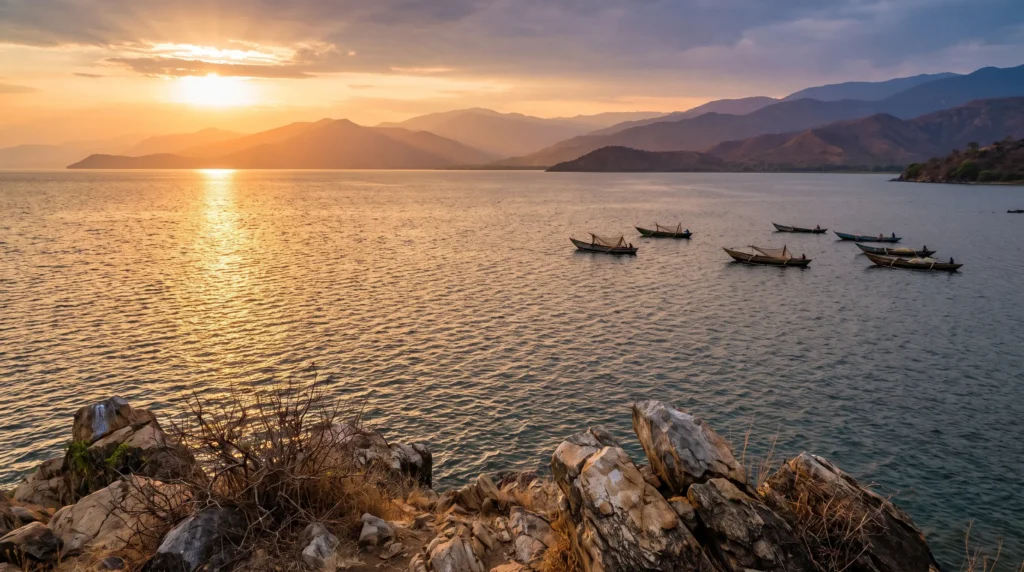
I’ll be straight with you before anything else: Burundi is not a destination I hand out casually, and I’m not going to pretend otherwise in the first paragraph and walk it back in the fine print. It is also, hand on heart, one of the most quietly beautiful places I’ve researched for this site — a tiny, hilly, landlocked nation wedged into the Great Rift Valley, wrapped around the northern tip of Lake Tanganyika, the second-deepest lake on the planet. Fishing pirogues go out at dusk with lanterns strung along the bow to draw sardines to the surface, the hills roll on in that impossible Rwanda-adjacent green, and somewhere in the highlands a dozen drummers can still make the ground under your feet feel like a heartbeat. This guide covers what’s genuinely worth seeing, what the current safety picture actually says, and how to think about a trip here without either romanticizing it or writing it off.
In This Guide
- Overview — Why Burundi Is Africa’s Least-Visited Great Lake
- Drums, Independence Day & the Dry-Season Sweet Spot
- Best Time to Visit Burundi (Season by Season)
- Getting There — BJM & the Border Reality
- Getting Around — Hills, Motos & Hired Drivers
- Top Regions — Lakeshore, Highlands & the Source of the Nile
- Culture & People — Hutu, Tutsi, Twa and the Royal Drum
- A Food Lover’s Guide to Burundi
- Off the Beaten Path
- Practical Information
- Budget Breakdown — What Burundi Actually Costs in 2026
- Frequently Asked Questions
Overview — Why Burundi Is Africa’s Least-Visited Great Lake
Burundi is small, hilly, and landlocked, squeezed between Rwanda, Tanzania and the Democratic Republic of the Congo in the heart of the African Great Lakes region, with a land area a little smaller than Belgium’s. It became independent from Belgium on 1 July 1962, and the decades since have been marked by cycles of ethnic conflict between the Hutu majority, Tutsi minority and small Twa population, along with genuine periods of calm and rebuilding. None of that history is background noise for a visitor — it shapes the honest safety conversation later in this guide, and I’d rather you have it up front than discover it in the small print of a booking site.
What Burundi has, almost entirely without competition for your attention, is Lake Tanganyika: the world’s longest freshwater lake at roughly 660 kilometres tip to tip, and its second-deepest at 1,436 metres, trailing only Siberia’s Lake Baikal. Bujumbura, the country’s largest city and long-time capital, sits right on its northern shore, hemmed in by mountains that rise straight out of the water. Since 2019 the political capital has officially been Gitega, a smaller highland town in the country’s geographic center, while Bujumbura keeps the economic and diplomatic weight and almost all the infrastructure a visitor will actually use.
Beyond the lake, this is a country of steep green hills, terraced hillsides, one of the most important Arabica coffee industries on the continent, and a handful of national parks holding onto chimpanzees, hippos and some of the last unlogged montane rainforest in the Albertine Rift. It receives a fraction of the visitors Rwanda or Tanzania next door do — Burundi currently has zero UNESCO World Heritage Sites inscribed, only a tentative list of ten proposed properties, which tells you plainly how far outside the mainstream tourism map this still sits. That’s not a knock — it’s the whole reason a certain kind of traveler ends up here at all.
Drums, Independence Day & the Dry-Season Sweet Spot
If you can time a trip around one date, make it 1 July, Burundi’s Independence Day, when Bujumbura and Gitega both put on parades, speeches and — if you’re lucky — performances of the ritual dance of the royal drum, a tradition UNESCO inscribed on its Representative List of Intangible Cultural Heritage in 2014. The dance calls for a dozen-plus drums arranged in a semicircle around a central drum, drummers dancing in turn to its beat, and it dates back to the 16th-to-17th-century royal court, when it was reserved for kings, coronations and welcoming honored guests. The Gishora Drum Sanctuary near Gitega is the most reliable place to see it performed for visitors outside of state occasions.
July also sits squarely inside the long dry season, which runs from June through August and is the clearest weather window of the year — minimal rain, the most reliable roads, and the best light on the lake. If your trip lines up with early July, you get the two best reasons to visit stacked on top of each other: the driest roads of the year, and the one week the drums are most likely to come out in public.
Best Time to Visit Burundi (Season by Season)
June – August · Long dry season (best window)
The clearest, sunniest stretch of the year, with rain becoming genuinely rare and sporadic. Roads into the highlands and national parks are at their most passable, and this is when most operators recommend visiting.
September – November · Short wet season
Rain returns in shorter, more predictable bursts. Green hillsides, fewer other travelers, but muddier trekking in Kibira’s forest interior.
December – January · Short dry season
A brief secondary dry spell — a decent fallback window if June–August doesn’t fit your calendar, though less reliable than the long dry season.
February – May · Long wet season
The heaviest rains of the year, peaking around April and May in Bujumbura. Waterfalls like Karera are at their most dramatic now, but unpaved roads to the parks and southern highlands can become genuinely difficult.
Because Burundi sits near the equator and close to Lake Tanganyika’s moderating effect, temperatures don’t swing wildly by season — Bujumbura’s average hovers in the low-to-mid 20s°C year-round — so it’s really rainfall, not heat, that should drive your timing.
Getting There — BJM & the Border Reality
Melchior Ndadaye International Airport (BJM), on Bujumbura’s western edge along Lake Tanganyika, is Burundi’s only paved-runway airport and its sole international gateway. Scheduled carriers have historically included Ethiopian Airlines, Kenya Airways, RwandAir, Brussels Airlines, Uganda Airlines and Air Tanzania, routing through regional hubs like Addis Ababa, Nairobi, Kigali or Brussels — there are no direct flights from North America, so expect at least one connection through Europe, the Gulf or East Africa. The airport has been mid-renovation since 2024 under a Sino-Burundian modernization project, so double-check terminal and runway status close to your travel dates.
Most passport holders need a visa: apply for an e-visa online before you travel, or take the visa-on-arrival option at Bujumbura airport, priced around US$90 for 30 days — bring proof of yellow fever vaccination either way, as it’s checked on entry. Citizens of several East African Community and COMESA neighbors, including Rwanda, Tanzania, Uganda, Kenya and the DRC, travel visa-free. Overland entry from Rwanda, Tanzania or the DRC is possible in principle, but both the US State Department and UK FCDO flag that borders can close without notice and that some crossing regions carry real risk — this is not a spontaneous backpacker border-hop the way East Africa’s other borders can be, so build in flexibility and check current conditions before you commit to an overland route.
Getting Around — Hills, Motos & Hired Drivers
Burundi is compact — you can cross the whole country by road in a matter of hours in good conditions — but the terrain is relentlessly hilly and much of the road network outside the Bujumbura–Gitega corridor is unpaved. In practice, almost every visitor gets around with a hired driver or a pre-arranged guide rather than self-driving or relying on public minibuses, and that’s the option I’d point you toward too, both for road conditions and for navigating checkpoints, which the US State Department notes are common and can affect movement around the country.
Within Bujumbura, motorcycle taxis and regular taxis cover short hops cheaply; agree the fare before you get on. Longer trips out to Gitega, the southern highlands or the national parks are best arranged through a local tour operator who supplies both vehicle and driver — this also gets you someone who knows which roads and areas are currently fine and which to skip that week, which matters more here than in almost any other country on this site.
Top Regions — Lakeshore, Highlands & the Source of the Nile
Bujumbura
The economic capital and largest city, strung along Lake Tanganyika’s northern shore beneath the Mitumba mountains. Lakeside beach clubs, fish markets selling the day’s ndagala (small sardines), and the jumping-off point for everything else in the country. Stick to well-known, recommended neighborhoods and travel with a local contact or guide rather than wandering unfamiliar districts alone.
Gitega
The political capital since 2019 and the historic seat of Burundi’s former kingdom, a couple of hours inland and up into the hills from Bujumbura. Home to the national museum and, just outside town, the Gishora Drum Sanctuary — the best place to see the royal drum tradition performed.
Lake Tanganyika’s Southern Shore
South of Bujumbura, the lakeshore road runs past fishing villages and a scattering of low-key beach lodges. This stretch of shoreline is the most straightforward taste of “lake life” Burundi offers, with warm water, palm-lined coves and grilled fish dinners.
Rutovu & the Source of the Nile
Up in the Bururi highlands, a stone monument at Rutovu marks what’s considered the southernmost source of the Nile River — first identified by a German explorer in the 1930s and marked with a monument in 1938. It’s a modest, slightly surreal pilgrimage: a small spring at over 2,000 metres elevation, thousands of kilometres of river away from the Mediterranean, with a pyramid-shaped cairn to mark the spot.
Karera Waterfalls, Rutana Province
A short drive from Rutovu, Karera’s main cascade drops around 80 metres through lush forest, usually paired on a day trip with the Nile-source monument and Gitega’s national museum. It’s at its most dramatic in the long wet season, though the access roads are trickier then too.
Kibira National Park
Burundi’s largest tract of untouched montane rainforest, roughly 40,000 hectares straddling the Congo–Nile watershed divide, and home to the country’s largest population of chimpanzees alongside colobus monkeys and baboons. Note that both the US State Department and UK FCDO currently advise against travel to Kibira and the surrounding Cibitoke/Bubanza provinces due to armed groups exploiting the porous, forested border with Rwanda and the DRC — this is one to watch closely rather than plan around right now.
Rusizi National Park
A wetland reserve where the Rusizi River meets Lake Tanganyika just north of Bujumbura, established in 1983 and known for dense hippo populations and strong birdwatching. The UK FCDO currently advises against travel to parts of this park too, so check the latest guidance and go only with an established local operator who can confirm current access.
Culture & People — Hutu, Tutsi, Twa and the Royal Drum
Burundi’s roughly 14 million people are overwhelmingly Hutu (about 85%), with a Tutsi minority (around 14%) and a small Twa population (roughly 1%). The relationship between these groups has driven much of the country’s difficult 20th- and early-21st-century history, including periods of mass violence — it’s worth reading a little of that history before you go, both out of respect and because it explains a lot of what you’ll see and be told on the ground.
Culturally, Kirundi is the language nearly everyone shares, French is common in official and educated contexts (a legacy of Belgian colonial rule), and English is gaining ground, especially among younger people and in tourism and business. The single most distinctive cultural export is the royal drum tradition: ingoma drums, carved from single tree trunks and topped with cowhide, performed in a specific choreographed dance that was once the exclusive province of the royal court and is now Burundi’s proudest calling card, having introduced global audiences to the country at the very first WOMAD festival back in 1982.
A Food Lover’s Guide to Burundi
Burundian food is simple, hearty, and built around what the hills and the lake provide: beans, cassava, sweet potato, plantain and rice form the daily base, often alongside ubugali, a thick maize or cassava porridge similar to dishes found across the African Great Lakes region. From Lake Tanganyika, small sardine-like fish called ndagala — dried, fried or grilled — are close to a national dish, sold everywhere from Bujumbura’s lakeside stalls to highland markets.
Burundi’s real point of culinary pride, though, is coffee. The country produces almost exclusively washed Arabica, and coffee makes up a striking share — roughly 80% by some estimates — of total export earnings, underpinning livelihoods for a huge share of smallholder farming families. Specialty roasters worldwide prize Burundian lots for their bright, fruit-forward cup profile, and a visit to a highland washing station during the April–June harvest is one of the more rewarding, low-key cultural experiences on offer here.
Off the Beaten Path
Gishora Drum Sanctuary
A working royal drum school and heritage site near Gitega, where drummers train in the same tradition UNESCO recognized in 2014 — arrange a demonstration through a local guide rather than turning up unannounced.
Lake Rwihinda Natural Reserve
A little-visited wetland in the north known locally as “the lake of birds,” proposed for future UNESCO recognition alongside Kibira, Rusizi and the Karera falls on Burundi’s ten-property tentative list.
Mugamba Highlands
The green, terraced coffee-growing heartland along the Congo–Nile ridge, with some of the best hill views in the country and almost no infrastructure built for outside visitors — go with a guide who knows the villages.
Rutana’s Rural Southeast
Beyond Karera, quiet farming country that sees a trickle of day-trippers at most, mostly on the falls-and-Nile-source circuit out of Bujumbura or Gitega.
Practical Information
Safety — read this one carefully. As of this writing, the US State Department rates Burundi Level 3, “Reconsider Travel,” citing the potential for political violence, checkpoints that can restrict movement, and violent crime including assault, carjacking, home invasion and armed robbery, with two areas — Bujumbura’s former Central Market and Cibitoke/Bubanza provinces including Kibira National Park — rated Level 4, “Do Not Travel.” The UK FCDO similarly advises against all travel to specific communes near the DRC border and parts of Rusizi National Park, citing armed group activity and instability tied to refugee movements from the DRC. None of that means Burundi is uniformly dangerous — plenty of NGO staff, researchers and small-group tours move through Bujumbura, Gitega and the southern highlands without incident — but it does mean this is a trip to plan with a specialist local operator, current advisory pages open in another tab, and realistic expectations, not one to wing solo.
Health. Yellow fever vaccination is required for all arriving travelers aged nine months and up, and is checked on entry. Malaria is present countrywide, including chloroquine-resistant strains, so the CDC recommends antimalarial medication for the whole trip; hepatitis A and typhoid vaccination are also commonly advised. Avoid swimming in untreated freshwater, including parts of Lake Tanganyika, due to schistosomiasis risk, and stick to bottled or treated water. Medical facilities fall well below what a lot of travelers are used to, with no reliable trauma care — comprehensive travel insurance with medical evacuation coverage is genuinely essential here, not a nice-to-have.
Money. The Burundian Franc (BIF) is the only legal tender, issued by the Banque de la République du Burundi, and it has depreciated substantially in recent years, so treat any exchange rate you read — including the one in this guide — as a rough guide to reconfirm just before you travel. Cards are essentially unusable outside a couple of Bujumbura hotels; bring cash (clean, recent US dollar bills exchange best) and budget for a country that runs almost entirely on physical currency.
Connectivity & logistics. Mobile data works reasonably well in Bujumbura and Gitega and drops off fast in rural areas. Plugs are the European two-round-pin type (Type C/E), 220–230V. Time zone is UTC+2, Central Africa Time, with no daylight saving.
Budget Breakdown — What Burundi Actually Costs in 2026
Burundi is genuinely inexpensive by international standards — it’s regularly cited as one of the world’s poorest countries by nominal GDP per capita, and prices for food, transport and basic guesthouses reflect that. The catch is that most of what a visitor needs — a trustworthy driver-guide, a well-run lodge, reliable vehicle maintenance for rough highland roads — is a smaller, pricier market than in neighboring Rwanda or Tanzania, since there’s simply less tourism infrastructure competing for your business.
Budget (US$40–70/day): Simple guesthouse in Bujumbura, local restaurants for beans, rice and ndagala, shared transport for short hops.
Mid-range (US$100–180/day): A comfortable Bujumbura hotel or lakeshore lodge, a private driver-guide for day trips to Gitega, Karera and the Nile source, restaurant meals throughout.
Top-end (US$300+/day): The best available lodges, a dedicated vehicle and guide for the full trip, and any add-on activities like a private drumming demonstration or a chartered lake excursion.
Build in a contingency line for this trip that you wouldn’t necessarily budget elsewhere: emergency medical evacuation coverage, and flexibility to change plans at short notice if border or security conditions shift.
Planning Your First Trip to Burundi
Most first-time visitors treat Burundi as a short, focused add-on rather than a stand-alone two-week trip: three or four nights split between Bujumbura (lakeshore, markets, day trip options) and Gitega (the drum sanctuary, the national museum, and — road conditions permitting — Karera Falls and the Nile source) covers the realistic highlights without overreaching. Because there are no direct long-haul flights, most itineraries connect through a regional hub, which makes it straightforward to pair Burundi with time in neighboring Rwanda for gorilla trekking, or Tanzania for a Lake Tanganyika-to-Serengeti combination. Whatever you plan, build it around the June–August dry season, book a specialist local operator rather than freelancing logistics, and check the latest government advisories again in the week before you fly, not just when you first book.
Frequently Asked Questions
Is Burundi safe to visit in 2026?
Treat this one honestly: the US State Department currently rates Burundi Level 3, “Reconsider Travel,” with two areas — Bujumbura’s former Central Market and Cibitoke/Bubanza provinces, including Kibira National Park — rated Level 4, “Do Not Travel,” and the UK FCDO advises against travel to specific communes near the DRC border. Travel here should be planned through an established local operator, with current advisories checked close to departure, not researched once months in advance and forgotten.
Do I need a visa for Burundi?
Most nationalities do — either an e-visa arranged in advance or a visa-on-arrival at Bujumbura’s airport for around US$90 covering 30 days, with proof of yellow fever vaccination required either way. A handful of neighboring East African Community and COMESA countries travel visa-free.
What vaccines do I need?
Yellow fever vaccination is mandatory for entry for travelers nine months and older. Malaria prophylaxis is strongly recommended for the whole trip given countrywide transmission, and hepatitis A and typhoid coverage are commonly advised too — talk to a travel clinic well before you go.
What’s the single best reason to visit?
Lake Tanganyika and the royal drum tradition, in that order — a lakeshore setting almost nobody outside the region talks about, paired with a UNESCO-recognized cultural performance you genuinely cannot see staged authentically anywhere else on Earth.
Burundi or Rwanda?
Choose Rwanda first if this is your only East African trip — it has far more tourism infrastructure, gorilla trekking, and a much more settled security picture. Choose Burundi as a deliberate, well-planned add-on once you already have a trusted local operator and a specific reason to go, like the drum tradition or Lake Tanganyika itself.
Is Lake Tanganyika safe to swim in?
Parts of it, with local guidance — but avoid untreated freshwater generally due to schistosomiasis risk, and ask your lodge or guide which stretches near you are considered safe for swimming that season.
Thinking About Burundi?
This is not a guide that ends with “just go, you’ll love it” — Burundi asks more of a visitor than most places on this site, and I’d rather you go in with clear eyes than rose-tinted ones. But if you do the homework, hire the right local operator, and time it for the June–August dry season, you’ll come home having seen a drumming tradition and a Great Lake shoreline that almost nobody else on your social feed has.
Explore More
- Rwanda Travel Guide — gorilla trekking and Kigali, just across the northern border
- Tanzania Travel Guide — the rest of Lake Tanganyika’s shoreline and beyond to the Serengeti
- Kenya Travel Guide — East Africa’s most-connected safari hub
- Uganda Travel Guide — more chimpanzee trekking and the source of the Nile’s other, more famous outlet
How this guide was built
Published as part of Facts From Upstairs’ country guide series. Built from authoritative sources — Wikipedia entity pages for Burundi, Lake Tanganyika, Gitega, Bujumbura International Airport, Burundi’s visa policy and its UNESCO World Heritage tentative list; UNESCO’s Intangible Cultural Heritage listing for the ritual dance of the royal drum; the Banque de la République du Burundi; the US State Department’s Burundi travel advisory; the UK FCDO’s Burundi travel advice; the US CDC’s Burundi traveler health page; and specialist sources on Burundi’s coffee industry and national parks. Numeric and safety claims carry inline citations, and given how fast Burundi’s security situation and exchange rate can shift, we’d urge you to re-check the State Department, FCDO and CDC links below yourself before finalizing any trip.
Sources cited on this page
- Wikipedia — Burundi
- Wikipedia — Lake Tanganyika
- Wikipedia — Gitega
- Wikipedia — Bujumbura (Melchior Ndadaye) International Airport
- Wikipedia — Visa Policy of Burundi
- Wikipedia — Climate of Burundi
- Wikipedia — List of World Heritage Sites in Burundi
- UNESCO ICH — Ritual Dance of the Royal Drum
- Banque de la République du Burundi
- US State Department — Burundi Travel Advisory
- UK FCDO — Burundi Travel Advice
- US CDC — Burundi Traveler Health Page
- Sweet Maria’s Coffee Library — Burundi Coffee Overview
- National Parks (GANP) — Rusizi & Kibira National Parks, Burundi
- Terenga Safaris — Karera Waterfalls & the Source of the Nile
More country guides you might like
Plan your trip to Burundi
The booking tools we use ourselves. FFU may earn a commission at no extra cost to you.
Plan & book your trip to Burundi
Booking through these searches supports our guides at no extra cost to you.