
Languages of Nigeria
All languages of Western Africa →fluent beta classical · classes by phone with Maya at ranas.ai/maya
Nigeria Travel Guide — Lagos Energy, Yoruba Sacred Groves & Africa’s Loudest, Most Rewarding Culture
I need to say this up front, because I’d want someone to say it to me: Nigeria is not a breezy add-a-beach-week destination, and I’m not going to pretend otherwise. It is also, hand on heart, one of the most culturally alive places I’ve ever written about — the country that gave the world Afrobeats and Nollywood, home to over 250 ethnic groups and roughly 230 million people, more than any other nation in Africa. Lagos is a sensory overload in the best and most exhausting sense — go-slow traffic, floating markets, rooftop bars, a music scene exporting stars worldwide — while a few hours inland, sacred groves and hilltop kingdoms tell a much older story. The catch, and it’s a real one, is that current government travel advisories flag serious safety concerns in specific parts of the country, and I’d be doing you a disservice not to walk you through exactly which ones before we get to the good stuff. This guide is for the culturally curious traveler, the diaspora visitor going home, and the business traveler with a free weekend — read the practical section closely, plan around it, and Nigeria will give you an experience genuinely unlike anywhere else on the continent.
In This Guide
- Overview — Why Nigeria Rewards the Traveler Who Does Their Homework
- Festival Season — Osun-Osogbo, Calabar Carnival & Eyo
- Best Time to Visit Nigeria (Season by Season)
- Getting There — LOS, ABV & the New e-Visa System
- Getting Around — Danfos, Domestic Flights & Ride-Hailing
- Top Regions — Lagos, Abuja, the Southwest & Cross River
- Culture & People — Yoruba, Igbo, Hausa, Nollywood & Afrobeats
- A Food Lover’s Guide to Nigeria
- Off the Beaten Path
- Practical Information
- Budget Breakdown — What Nigeria Actually Costs in 2026
- Frequently Asked Questions
Overview — Why Nigeria Rewards the Traveler Who Does Their Homework
Nigeria is Africa’s most populous country by a wide margin, with an estimated 230 million people packed into roughly 924,000 square kilometers — about twice the size of California. It became independent from Britain on 1 October 1960, and English remains the official language, chosen specifically to bridge a country with more than 250 ethnic groups and an estimated 500 living languages. The three largest groups — Hausa, Yoruba and Igbo — anchor the north, southwest and southeast respectively, and each carries its own cuisine, music, festivals and, in Lagos at least, its own rivalry-fueled banter.
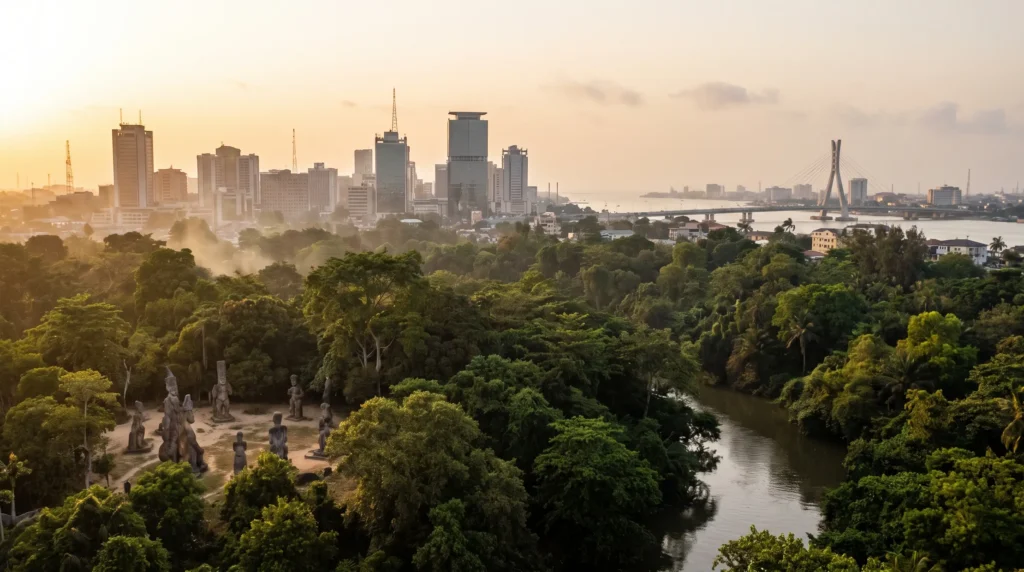
The cultural export machine is the headline: Nollywood is one of the largest film industries on Earth by volume, and Afrobeats — Burna Boy, Wizkid, Davido, Tems — has gone from a regional sound to a genuine global chart force. Lagos, the commercial capital, is now one of the largest and fastest-growing cities on the continent, with metro-area estimates running well past 17 million people. Abuja, the planned federal capital in the center of the country, is calmer, greener and considerably easier to navigate — a useful contrast if Lagos overwhelms you on day one.
Here’s the honest part: current government travel advisories place parts of Nigeria at elevated risk, and this guide will not soft-pedal that. What it will do is show you where the real advisories actually point — specific states, not the whole country — so you can plan a trip to Lagos, Abuja, the Yoruba southwest or Cross River with your eyes open and your itinerary built sensibly around the areas experienced travelers, diaspora visitors and business travelers already move through every week.
Festival Season — Osun-Osogbo, Calabar Carnival & Eyo
If you’re reading this in July, mark August on the calendar: the annual Osun-Osogbo Festival takes over the UNESCO-listed sacred grove outside Osogbo, a two-week celebration of the Yoruba river goddess Yeye Ọṣun that includes a ceremonial city-cleansing rite (Iwopopo), the lighting of a centuries-old sixteen-point lamp, and a procession to the riverside shrine that draws worshippers and spectators from across the world. It’s one of the most photographable, deeply-rooted spiritual events in West Africa and still flies well under most travelers’ radar.
Planning further out, December brings the Calabar Carnival in Cross River State — often billed as “Africa’s biggest street party” — with costumed band parades filling the city for the last week of the year, timed to coincide with the calmer, cooler dry season. Lagos has its own centuries-old spectacle in Eyo, a masquerade festival held on Lagos Island on dates announced only a few weeks ahead, so check locally if you want to catch it. Build any of these into your dates early — accommodation in Osogbo and Calabar tightens fast during festival week.
Best Time to Visit Nigeria (Season by Season)
November – March · Dry season (best for most travelers)
The most comfortable window to visit — little rain, easier road conditions, and the run-up to Calabar Carnival at year’s end. December and January bring the harmattan, a dry, dusty wind off the Sahara that hazes the sky and can delay flights in the far north; it’s a minor nuisance in Lagos and the south but worth knowing about if you’re headed further inland.
April – June · Early rains
The wet season builds gradually — expect afternoon downpours rather than all-day washouts, lush green landscapes, and noticeably thinner crowds at hotels and attractions.
July – September · Peak rains
The heaviest rainfall of the year across most of the south, with flooding a real possibility in low-lying parts of Lagos and the Niger Delta. Osun-Osogbo Festival falls right in this window in August, which is the trade-off for catching it.
October · Transition
Rains taper off, humidity starts to drop, and the dry season’s comfortable stretch begins — a genuinely good, under-the-radar time to visit before the December festival crowds arrive.
Getting There — LOS, ABV & the New e-Visa System
Murtala Muhammed International Airport (LOS) in Ikeja, Lagos, is Nigeria’s main international gateway, with a newly commissioned international terminal built to handle up to 14 million passengers a year and long-haul service from British Airways (London), Emirates (Dubai), Qatar Airways (Doha), Turkish Airlines (Istanbul), Delta (Atlanta, seasonal New York) and United (Washington-Dulles), alongside a dense network of African carriers. Nnamdi Azikiwe International Airport (ABV) in Abuja is the secondary gateway and the better choice if your trip is centered on the capital or the north-central region.
Visa rules changed significantly in 2025: Nigeria discontinued visa-on-arrival and rolled out a fully digital e-Visa system, so almost every visitor now needs to apply online in advance through the official Nigeria Immigration Service portal, with approvals typically arriving by email within 24–48 hours and needing to be printed for arrival. A yellow fever vaccination certificate is required for entry, and your passport needs at least six months of validity remaining. Apply well ahead of your trip — do not arrive expecting a stamp at the border.
Getting Around — Danfos, Domestic Flights & Ride-Hailing
Lagos traffic is legendary for a reason — the city’s “go-slow” gridlock can turn a 10-kilometer trip into a two-hour ordeal, so build serious buffer time into any schedule that involves an airport or an appointment. Uber and Bolt operate widely in Lagos and Abuja and are the easiest, most trackable way for a visitor to get around; yellow danfo minibuses and the Lagos BRT bus rapid transit system are the cheap local option but are best attempted with a local companion your first time.
For longer distances, domestic flights (Air Peace, Arik Air and others connect Lagos, Abuja, Port Harcourt, Kano, Calabar and other hub cities) are the sensible way to move around a country this large, rather than multi-hour road trips through unfamiliar territory. This isn’t just convenience — current safety advisories specifically flag road travel and inter-state routes as higher-risk in a number of states, so flying between the regions covered in this guide, and hiring a vetted local driver for city and short day-trip transfers, is the standard sensible approach travelers and residents alike use.
Top Regions — Lagos, Abuja, the Southwest & Cross River
Lagos
Nigeria’s commercial heart and Africa’s largest urban economy hub, spread across the mainland and a chain of islands. Victoria Island, Ikoyi and Lekki hold the rooftop bars, art galleries and beach clubs; Lagos Island carries the old colonial core, the floating stilt community of Makoko, and the National Museum. This is where Afrobeats, Nollywood and Nigeria’s fashion scene collide, and where most first-time visitors will spend the bulk of their trip.
Abuja
The purpose-built federal capital since 1991: wide boulevards, the striking Aso Rock monolith, the Nigerian National Mosque and National Christian Centre standing a few blocks apart, and a noticeably calmer pace than Lagos. A good base for business travel and for day trips into the Gwagwalada and Niger State hinterlands — though check current state-level advisories before venturing far outside the city itself.
Ile-Ife, Osogbo & the Yoruba Southwest
The spiritual heartland of Yoruba culture. Ile-Ife is considered the mythological origin point of the Yoruba people and holds important bronze and terracotta heritage; Osogbo is home to the UNESCO-listed Osun-Osogbo Sacred Grove, one of the last surviving sacred forests that once ringed every major Yoruba city. Ibadan, one of West Africa’s largest and oldest indigenous cities, sits nearby with a huge indoor market and university-town energy.
Cross River State — Calabar & Obudu
Nigeria’s most relaxed, tourism-friendly southern state. Calabar hosts the December carnival and a genuinely walkable, welcoming old colonial town center; a few hours inland, the Obudu Mountain Resort sits on a cool highland plateau with a cable car, hiking trails and views that feel nothing like the Lagos you just left. Cross River National Park protects some of Nigeria’s last rainforest and a population of endangered Cross River gorillas.
Sukur & the Mandara Mountains
Far in the northeast, on a hilltop above the Cameroon border, sits the Sukur Cultural Landscape — Africa’s first cultural landscape inscribed by UNESCO, a still-inhabited terraced kingdom with a chief’s palace, Iron Age smelting furnaces and centuries-old dry-stone construction. It’s extraordinary — and it’s also in Adamawa State, a region under active government advisories, so treat it as a “someday” entry rather than a near-term itinerary stop until conditions improve.
Port Harcourt
The oil-industry hub of the Niger Delta, generally visited for business rather than leisure. Current advisories flag riverine and outlying areas of Rivers State while treating the city itself with more caution than blanket avoidance — verify the latest guidance for your specific itinerary before booking.
Culture & People — Yoruba, Igbo, Hausa, Nollywood & Afrobeats
Nigeria’s three largest ethnic groups — Hausa (roughly 30% of the population), Yoruba (about 15.5%) and Igbo (about 15.2%) — together make up over 60% of the country, with more than 250 smaller groups filling out the rest. The north is predominantly Muslim and Hausa/Fulani; the southwest is largely Yoruba with a mix of Christianity and traditional Ifá/Orisha religion still practiced alongside it; the southeast is predominantly Igbo and Christian. Extended family and community obligation run deep everywhere — expect warmth, directness and a genuine curiosity about visitors.
Nollywood churns out thousands of films a year and is one of the most prolific film industries in the world, while Afrobeats has turned Lagos into a genuine global music capital — expect live shows, listening parties and street-level sound systems wherever you go. Traditional dress remains a point of pride at weddings, church and festivals: agbada for men, elaborately tied gele headwraps for women. If you’re invited to a Nigerian wedding or a naming ceremony while you’re there, go — it will likely be the highlight of your trip.
A Food Lover’s Guide to Nigeria
Jollof rice is the national dish and the center of a decades-long, mostly good-natured rivalry with Ghana over whose version is better — try both and form your own opinion, but expect Nigerians to have strong feelings on the subject. Suya, spiced grilled skewered meat sold from roadside stalls, is the essential late-night street food; egusi soup (ground melon seed, leafy greens and meat or fish) served with pounded yam or fufu is the classic Sunday meal.
Breakfast or snack staples include akara (deep-fried black-eyed pea fritters) and moin moin (steamed bean pudding). Along the coast and in the Niger Delta, pepper soup and fresh fish dominate menus. Wash it down with a cold Star or Gulder beer, or a Chapman — Nigeria’s signature fruity, lightly bitter cocktail, found on nearly every bar menu in Lagos. Palm wine, tapped fresh in rural areas, is worth trying at least once.
Off the Beaten Path
Idanre Hills, Ondo State
A dramatic range of granite hills above the old Yoruba town of Idanre, reachable via a long stone staircase built by early settlers seeking a defensible hilltop refuge. It sits on Nigeria’s UNESCO tentative list and sees only a trickle of visitors.
Erin-Ijesha (Olumirin) Waterfalls, Osun State
A seven-tiered waterfall in the same Yoruba heartland as Osogbo, popular with Nigerian day-trippers and almost unknown to foreign visitors — bring water shoes for the climb between tiers.
Obudu Mountain Resort, Cross River State
A colonial-era cattle ranch turned highland resort with a cable car up to cool mist-covered plateau views — a genuine change of pace from the coastal heat, in one of Nigeria’s calmer, more tourism-oriented states.
Nike Art Gallery, Lagos
A sprawling, multi-story private gallery on the Lekki-Epe corridor holding thousands of works of Nigerian contemporary and traditional art — one of the best free (donation-based) cultural stops in the city and a favorite of in-the-know Lagos residents.
Practical Information
Money. The Naira floats freely against major currencies and has been trading in the roughly ₦1,300–1,400 range to the US dollar through mid-2026 — check a current rate before you travel, since it moves. This remains largely a cash economy outside upscale hotels, malls and restaurants in Lagos and Abuja; carry Naira for everyday transactions and use bank-linked mobile transfer apps (widely used locally) or cards only where clearly accepted.
Safety. Be direct with yourself about this: the US State Department currently rates Nigeria at Level 3, “Reconsider Travel,” citing crime, kidnapping, terrorism and civil unrest risks, and specifically advises against travel to Borno, Yobe, Kogi, Jigawa, Kwara, Niger, Plateau, Taraba and northern Adamawa states for terrorism risk, and Bauchi, Gombe, Kaduna, Kano, Katsina, Sokoto and Zamfara for unrest and kidnapping risk, as well as most southeastern states outside Port Harcourt. The UK FCDO advises against all travel to a similar list of northern and Niger Delta riverine states, and against all but essential travel to several more. None of this rules out visiting Lagos, Abuja, the Yoruba southwest or Cross River, which fall outside these flagged zones — but check your government’s current advisory for your specific route before booking, use vetted drivers and registered tour operators, avoid displaying wealth or valuables, and keep valuables and travel documents secured.
Health. A yellow fever certificate is mandatory for entry; the CDC also recommends hepatitis A and B, typhoid and routine vaccines, plus antimalarial medication for the whole trip, since malaria risk is present nationwide. Drink bottled or filtered water, avoid swimming in untreated freshwater, and bring a good insect repellent.
Connectivity. Local SIMs from MTN, Airtel or Glo are cheap and give solid 4G coverage in Lagos and Abuja; coverage thins out in rural areas. Plugs: UK-style Type G, 230V. Time zone: West Africa Time, UTC+1, no daylight saving.
Budget Breakdown — What Nigeria Actually Costs in 2026
Nigeria can run surprisingly cheap for food and local transport and surprisingly expensive for international-standard hotels and security-conscious logistics — the spread is wider than most West African neighbors.
Budget (US$40–80/day): Guesthouse or budget hotel, street food (suya, akara, jollof from local buka spots), danfo buses or BRT, occasional Bolt/Uber ride.
Mid-range (US$100–220/day): Business-class hotel in Victoria Island or Abuja Central, restaurant meals, private driver for the day, a domestic flight between hub cities.
Luxury (US$350+/day): International five-star hotels (Eko Hotel, Transcorp Hilton and similar), private security-vetted drivers and guides, chartered domestic flights, high-end Lagos nightlife and dining.
Because the Naira floats and has moved significantly in recent years, treat any Naira price quote as approximate and reconfirm the current exchange rate before large transactions. Tipping 5–10% is appreciated in restaurants and for drivers, though not always expected the way it is in the US.
Planning Your First Trip to Nigeria
The sensible first-timer route is Lagos + the Yoruba southwest: fly into LOS, spend three or four nights in Lagos (Lekki/Victoria Island base, Nike Art Gallery, a night out for live Afrobeats), then take a half-day drive or short flight to Osogbo and Ile-Ife for the sacred grove and Yoruba heritage sites, returning to Lagos for departure. If your dates land in August, build around the Osun-Osogbo Festival; for December, Calabar Carnival is worth flying south for instead. Pair the trip conceptually with our Ghana guide or Accra city guide if you want to settle the jollof rice debate for yourself, or look at our Senegal guide for another West African culture-first itinerary. Always check current government travel advisories for your specific route before finalizing dates.
Frequently Asked Questions
Is Nigeria safe to visit in 2026?
It depends heavily on where. The US State Department currently rates the country Level 3, “Reconsider Travel,” with specific no-go advisories for named northern and some southeastern states, while Lagos, Abuja and the Yoruba southwest fall outside those flagged zones. Check the current advisory for your specific itinerary, use vetted local drivers and operators, and avoid the flagged states rather than treating the whole country as uniformly risky or uniformly safe.
Do I need a visa?
Yes, for almost every nationality. Nigeria discontinued visa-on-arrival in 2025 and now requires an e-Visa applied for online in advance through the official Nigeria Immigration Service portal, with approval typically emailed within 24–48 hours. Apply well before your trip.
What vaccines do I need?
A yellow fever certificate is mandatory for entry. The CDC also recommends hepatitis A and B, typhoid, routine vaccines, and malaria prophylaxis for the entire trip, since malaria risk exists nationwide. Talk to a travel clinic four to six weeks before departure.
What’s Lagos traffic actually like?
Bad, and worth planning around rather than fighting. A short trip across the city can take two hours or more at peak times, so build serious buffer time before flights and appointments, and lean on Uber/Bolt or a hired driver over self-navigating.
Nigeria or Ghana for a first West Africa trip?
Ghana is the gentler on-ramp — lower advisory levels, easier logistics, a well-trodden Cape Coast/Accra circuit. Nigeria is bigger, louder and culturally denser, better suited to travelers who want Lagos’s energy and Yoruba heritage sites and are willing to plan carefully around current advisories. Many travelers do both on one West Africa trip.
What’s the best single souvenir or experience?
A night out for live Afrobeats in Lagos, followed the next morning by the Osun-Osogbo Sacred Grove if your dates allow it — the two bookend Nigeria’s modern global culture and its centuries-old spiritual roots better than anything else on the itinerary.
Ready to Explore Nigeria?
Nigeria doesn’t do quiet. It’s Afrobeats blasting from a danfo bus, sacred river festivals older than most nations, and a food rivalry with Ghana that will not be settled at your dinner table. Plan around the current advisories, fly rather than road-trip between regions, and go in with realistic expectations — the reward is a culture with more depth, volume and sheer creative output than almost anywhere else on the continent.
Explore More
- Ghana Travel Guide — the gentler West African neighbor, and jollof rice’s other claimant
- Accra City Guide — Ghana’s capital, a short flight from Lagos
- Senegal Travel Guide — another West African culture-first itinerary
- Chad Travel Guide — Nigeria’s quieter neighbor to the northeast
How this guide was built
Published as part of Facts From Upstairs’ country guide series. Built from authoritative sources — Wikipedia’s Nigeria and Lagos entity pages, UNESCO’s Nigeria World Heritage listing and the Sukur Cultural Landscape and Osun-Osogbo Sacred Grove site pages, the US State Department’s Nigeria travel advisory, the UK FCDO’s Nigeria travel advice, the US CDC traveler health page for Nigeria, the Nigeria Immigration Service’s official e-Visa portal, the Central Bank of Nigeria, and Wikipedia’s Murtala Muhammed International Airport entry. Numeric and checkable claims carry inline citations. Given the fast-moving nature of travel advisories, always verify current government guidance before finalizing a Nigeria itinerary.
Sources cited on this page
- Wikipedia — Nigeria
- Wikipedia — Lagos
- UNESCO — Nigeria World Heritage Sites
- Wikipedia — Sukur Cultural Landscape
- Wikipedia — Osun-Osogbo Sacred Grove
- US State Department — Nigeria
- UK FCDO — Nigeria
- US CDC — Nigeria traveler page
- Nigeria Immigration Service — e-Visa Portal
- Central Bank of Nigeria
- Wikipedia — Murtala Muhammed International Airport
More country guides you might like
Plan your trip to Nigeria
The booking tools we use ourselves. FFU may earn a commission at no extra cost to you.
Plan & book your trip to Nigeria
Booking through these searches supports our guides at no extra cost to you.