
Languages of Guinea-Bissau
All languages of Western Africa →fluent beta classical · classes by phone with Maya at ranas.ai/maya
Guinea-Bissau Travel Guide — Salt-Water Hippos, a Brand-New World Heritage Archipelago, and West Africa’s Least-Visited Coast
I’ll be straight with you before we get to the good part: Guinea-Bissau is not an easy country to visit, and it’s going through a genuinely rough patch right now, which I’ll cover honestly in a moment. But underneath that is one of the most remarkable, least-known corners of West Africa — a nation of roughly 2.1 million people whose offshore archipelago just became a UNESCO World Heritage Site in 2025, home to salt-water hippos that swim between mangrove islands, nearly 10,000 green sea turtles nesting on a single beach, and a culture so far off the tourist map that “off the beaten path” undersells it. This isn’t a beach-holiday guide. It’s a guide for the kind of traveler who wants to see something almost nobody else has seen, understands that comes with real friction, and wants an honest map of both the wonder and the catch.
In This Guide
- Overview — A Small Country With an Outsized Archipelago
- Carnival — Masks, Drums and the Bijagós in Full Color
- Best Time to Visit Guinea-Bissau (Season by Season)
- Getting There — Osvaldo Vieira Airport & Regional Connections
- Getting Around — Boats, Bush Taxis & Why You Need a Guide
- Top Regions — Bissau, the Bijagós & the Rivers South
- Culture & People — Kriol, Balanta, Fulani & the Bijagó Islanders
- A Food Lover’s Guide to Guinea-Bissau
- Off the Beaten Path (Which Is Most of It)
- Practical Information
- Budget Breakdown — What Guinea-Bissau Actually Costs in 2026
- Frequently Asked Questions
Overview — A Small Country With an Outsized Archipelago
Guinea-Bissau is a small, low-lying country on West Africa’s Atlantic coast, covering about 36,125 square kilometers — smaller than the Netherlands — wedged between Senegal to the north and Guinea to the southeast. The mainland is mostly flat coastal plain and swamp, cut by a maze of tidal rivers and estuaries that rise gradually toward the eastern savanna. It was colonized by Portugal as “Portuguese Guinea,” and independence didn’t come easily: a guerrilla war fought from 1963 to 1974 under the PAIGC, led by Amílcar Cabral, ended with a unilateral declaration of independence on 24 September 1973 and formal Portuguese recognition on 10 September 1974. That history still shapes the country: Portuguese is the official language of government and schooling, yet fewer than one in fifty people actually speak it as a first language, while Guinea-Bissau Kriol — a Portuguese-based creole — is what nearly everyone actually speaks day to day.
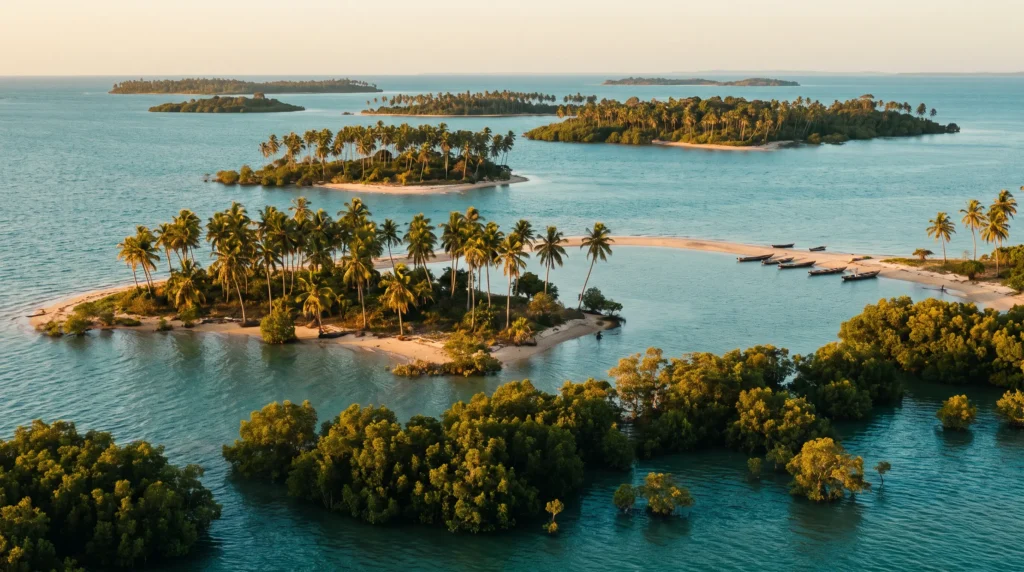
The headline attraction, and the reason this guide exists at all, is the Bijagós Archipelago: 88 islands and islets scattered across the mouth of the Rio Grande and Rio Geba deltas, forming the only active river-delta archipelago on the entire African Atlantic coast. UNESCO named it a Biosphere Reserve back in 1996, and in 2025 inscribed the “Coastal and Marine Ecosystems of the Bijagós Archipelago” as a full World Heritage Site — one of the newest natural sites on the entire UNESCO list. The islands host manatees, dolphins, close to 10,000 nesting female green sea turtles at Poilão Island alone, and — genuinely unique on this coast — a population of hippos that swim in salt water between the mangroves of Orango Island.
What Guinea-Bissau does not have is a tourism industry in any conventional sense. There’s no beach-resort strip, no dive-shop row, no backpacker circuit with hostels comparing Wi-Fi speeds. Lack of infrastructure and reliable transport links have kept the Bijagós largely undeveloped for tourism, and most visitors who do make it out there arrive on organized boat charters, often via Senegal. That’s the trade you’re making here: real friction, in exchange for something almost nobody else on your social feed has seen.
Carnival — Masks, Drums and the Bijagós in Full Color
Time a February or March trip around Carnival, a four-day explosion in the run-up to Lent that is Guinea-Bissau’s single biggest cultural event, centered in the capital Bissau but spilling into towns across the Bijagós Islands. Exact dates move with the Christian Easter calendar, so check the year you’re traveling — but the format is consistent: parades of dancers and drummers from every ethnic group in the country, elaborate hand-carved tribal masks representing animals, spirits and satirical figures, and a genuinely Carioca-influenced energy despite fewer than one in ten Bissau-Guineans identifying as Catholic.
Unlike Rio or Trinidad, this Carnival hasn’t been packaged for tourists — there are no grandstand tickets, no official tour packages, just a country celebrating loudly in its own streets. That’s exactly the appeal, and exactly why you should book accommodation in Bissau well ahead if your trip lines up with it, since the city’s limited hotel stock fills fast.
Best Time to Visit Guinea-Bissau (Season by Season)
November – May · Dry season (best window)
Hot, largely rainless, and the only realistic season for exploring the Bijagós Islands, when tidal channels and dirt tracks are passable and boat crossings are safer. February–March brings Carnival; by April–May, heat builds toward the coming rains.
June – October · Rainy season
The West African monsoon delivers Guinea-Bissau’s rain almost entirely in this window, with Bissau averaging around 2,024 millimeters annually and the heaviest downpours from July through September. Roads turn to mud, inter-island boat travel becomes riskier, and several already-thin tourism operators pause entirely. This is not the season to attempt independent travel here.
Late September · Independence Day
24 September marks the anniversary of the 1973 declaration of independence, celebrated nationwide with military parades and festivities in Bissau — worth knowing about even if the rains make it a tricky month to visit.
Getting There — Osvaldo Vieira Airport & Regional Connections
Osvaldo Vieira International Airport (OXB), in the Bissalanca district just outside Bissau, is the country’s only international gateway, with a single 3,200-meter runway. There are no direct flights from North America; the practical routing is via a European or regional African hub. TAP Air Portugal flies from Lisbon, Turkish Airlines connects via Istanbul, Royal Air Maroc via Casablanca, and regional carriers including Air Senegal, Air Côte d’Ivoire and ASKY Airlines link Bissau to Dakar, Abidjan and Lomé.
The most common overland approach for independent travelers is actually via Senegal — Dakar or the Casamance region — with bush taxis and shared vans covering the border crossing near Ziguinchor, and boat charters to the Bijagós sometimes launching from the Senegalese side. Because there is no permanent US embassy in Guinea-Bissau, Americans should know that consular backup runs through the US Embassy in Dakar — one more reason Senegal is worth pairing with this trip rather than treating Guinea-Bissau as a standalone destination.
Getting Around — Boats, Bush Taxis & Why You Need a Guide
Bissau itself is walkable and covered by shared taxis, but once you leave the capital, infrastructure thins out fast. Mainland roads range from paved to barely graded track, and bush taxis (shared minivans and converted pickups) are the standard way to move between towns — cheap, frequent, and not built for a tight schedule.
Reaching the Bijagós Islands means a boat, and this is where organizing through a local operator or guide stops being optional. Scheduled public ferries exist but run infrequently and unpredictably; most visitors book a chartered boat, either through a Bissau-based operator or as part of a package arranged from Senegal. Given the Level 3 advisory’s specific caution around rural mainland regions — Bafatá, Oiô, Biombo, Quinara and Tombali carry residual landmine risk from the 1998–99 civil war — a local guide isn’t just about convenience, it’s genuinely how you stay away from ground you shouldn’t be walking on.
Top Regions — Bissau, the Bijagós & the Rivers South
Bissau
The capital and only real city, built around a natural harbor on the Geba River estuary. Its Portuguese colonial core — the old Praça, the fortress of Amura, faded pastel façades — sits alongside a lively central market and the country’s only real concentration of restaurants and hotels. Nearly every trip starts and ends here, and it’s the base for arranging Bijagós boat charters.
Bubaque
The most populated and most accessible of the Bijagós Islands, and the default entry point for a first island visit, with the archipelago’s best (relative) lodge and guesthouse options.
Orango Island & Orango National Park
Home to the archipelago’s famous salt-water hippos, which wade and swim through mangrove channels and brackish lagoons — a genuinely rare sight found almost nowhere else on the continent’s Atlantic coast. Orango National Park protects the population alongside the island’s Bijagó communities, whose matrilineal social structure and animist traditions remain unusually intact.
João Vieira and Poilão Marine National Park
A remote marine park protecting some of the most important green sea turtle nesting beaches in Africa — Poilão Island alone hosts close to 10,000 nesting female green turtles in-season, alongside leatherback turtles and vast colonies of migratory shorebirds. This is the ecological core of the 2025 UNESCO World Heritage inscription.
Bolama
The old Portuguese colonial capital before Bissau took over the role, now a slow, half-abandoned town of crumbling colonial architecture being gently reclaimed by the forest — an eerie, fascinating stop for anyone drawn to faded colonial history rather than polished heritage sites.
The Southern Rivers & Cacheu
North of Bissau, the town of Cacheu holds the ruins of one of the oldest Portuguese trading forts on the West African coast, a sobering reminder of the region’s role in the Atlantic slave trade, set on the mangrove-lined Cacheu River.
The Eastern Interior (Gabú, Bafatá)
Drier savanna country toward the Guinea border, historically significant as the seat of the Kaabu Empire and home to larger Fulani and Mandinka communities — but among the regions the current US advisory specifically flags for residual landmine risk, so this is emphatically guided-visit-only territory, not a self-drive detour.
Culture & People — Kriol, Balanta, Fulani & the Bijagó Islanders
Guinea-Bissau’s roughly 2.1 million people break down into a genuinely diverse ethnic mosaic: Fulani communities make up around 40% of the population, Balanta about 20%, and Manjak around 14%, with Mandinka, Papel and the archipelago’s own Bijagó people rounding out the rest. Religiously, Islam is the largest affiliation at roughly 46%, traditional African beliefs account for close to 31%, and Christianity makes up most of the remainder — often blended with older animist practice rather than practiced in strict isolation.
The Bijagó people of the archipelago are a culture apart even within Guinea-Bissau: traditionally matrilineal, with initiation rites, masked ceremonies and a spiritual relationship to the islands and their wildlife (including the sacred status often given to the archipelago’s hippos and turtles) that predates any outside contact and remains largely intact today thanks to the islands’ isolation. Kriol — the Portuguese-based creole spoken as a first or second language by the overwhelming majority of the population — is the connective tissue across all of this, the language you’ll actually hear in markets, boats and bush taxis far more than formal Portuguese.
A Food Lover’s Guide to Guinea-Bissau
Rice is the staple starch across Guinea-Bissau’s coastal and river regions, typically served with a fish or meat sauce built on palm oil, peanuts, or tomato — closely related to the jollof-style rice dishes found across coastal West Africa. Fresh seafood is the obvious strength here: grilled fish straight off Bissau’s harbor boats, oysters harvested from mangrove roots, and shrimp are all easy to find and cheap by international standards.
Caldo de mancarra — a peanut-based stew with meat or fish — and jollof rice variants show up on most menus, alongside cassava and plantain sides that reflect the wider Guinea Coast palate. Palm wine, tapped straight from palm trees, is the traditional local drink in rural areas and the Bijagós especially, often served fresh and mildly fermented. Cashew, Guinea-Bissau’s dominant export crop, also shows up on the table — roasted nuts as a snack, and cashew-apple juice and spirits (cajú) made from the fruit that surrounds the nut, a genuinely distinctive taste you won’t find bottled back home.
Off the Beaten Path (Which Is Most of It)
Salt-water hippos of Orango
Guided boat trips into Orango National Park’s mangrove channels to spot a hippo population found swimming in brackish and salt water — behavior almost unheard of elsewhere in Africa, and one of the archipelago’s genuine claims to global uniqueness.
Poilão’s turtle nesting beach
Access is tightly restricted to protect the nesting population, but conservation-affiliated visits during the right season put you on a beach with one of the densest concentrations of nesting green sea turtles anywhere in Africa.
Bolama’s ghost town
The abandoned grandeur of the former colonial capital — crumbling government buildings and a cathedral shell being slowly swallowed by vegetation — is the kind of atmospheric, unphotographed ruin that barely exists anymore in more “developed” parts of the tourist world.
Cacheu’s slave-trade fort
One of the oldest European trading forts on the West African coast, its remains a quiet, largely unvisited site for understanding the region’s darkest colonial history firsthand.
Practical Information
Money. The West African CFA franc (XOF) is fixed at €1 = 655.957 XOF and shared across eight West African nations via the BCEAO (Central Bank of West African States). This is an almost entirely cash-based economy — only a handful of Bissau establishments take cards, and ATMs are limited and unreliable, so bring the cash you’ll need. Note the currency declaration rules if carrying large sums: over roughly 5,000,000 XOF (about $8,700) arriving from within ECOWAS, or over $10,000 equivalent arriving from outside it.
Safety. Covered in detail above — Level 3 “Reconsider Travel,” a November 2025 coup with the military still in charge, and specific landmine risk in Bafatá, Oiô, Biombo, Quinara and Tombali regions. Foreigners are occasionally targeted for opportunistic theft around markets and the airport; keep valuables minimal and avoid demonstrations entirely.
Health. Yellow fever vaccination is required for entry for all travelers one year and older. Malaria risk is present countrywide, predominantly P. falciparum, so prescription antimalarial medication is strongly advised, alongside routine, hepatitis A/B, typhoid and (seasonally, in the December–June dry season) meningococcal vaccination. Avoid swimming in untreated freshwater due to schistosomiasis risk, and stick to bottled or treated water.
Connectivity. Mobile coverage is reasonable in Bissau and Bubaque, thin to nonexistent on smaller islands — plan for real offline stretches in the Bijagós. Time zone: UTC+0, no daylight saving. Embassy note: the US has no permanent embassy in Guinea-Bissau; American citizens are served by the US Embassy in Dakar, Senegal.
Budget Breakdown — What Guinea-Bissau Actually Costs in 2026
There’s no real backpacker-vs-resort spectrum here the way there is in Belize or Thailand — Guinea-Bissau doesn’t have a developed tourism market, so most of your cost will be driven by boat charters and guide arrangements rather than accommodation tiers.
Budget (US$40–70/day): Simple Bissau guesthouse, market meals and street food, bush-taxi travel, no Bijagós boat charter included.
Mid-range (US$90–160/day): A better Bissau hotel or a Bubaque guesthouse, restaurant meals, a shared or group Bijagós boat charter split across a small group.
Organized trips (US$250+/day): Multi-day guided Bijagós itineraries covering Orango’s hippos and a marine-park visit, private boat charter, and a knowledgeable local fixer — realistically the way most independent travelers actually experience the outer islands, since going it alone isn’t really viable given the transport situation.
Cashew — which drives roughly 90% of the country’s export revenue and supports the livelihoods of a large share of the population — has almost no bearing on tourist costs, but it’s worth knowing you’re visiting a country whose entire economy leans on a single crop, which explains a lot about the state of its infrastructure.
Planning Your First Trip to Guinea-Bissau
Given the access constraints, the realistic first-timer plan is: fly into Bissau via Lisbon, Casablanca or Dakar, spend two or three nights in the capital arranging your Bijagós boat charter and getting oriented, then commit four to six days to the islands — Bubaque as your base, with day trips to Orango for the hippos and, permits and season allowing, the turtle beaches of João Vieira and Poilão. Book everything through a reputable Bissau- or Dakar-based operator rather than improvising once you land. Because Senegal is the practical gateway and safety net for this trip, pair it with our Senegal travel guide for Dakar and the Casamance region, and if West African wildlife and culture are the draw, our Ghana and Senegal guides cover more established alternatives on the same coast.
Frequently Asked Questions
Is Guinea-Bissau safe to visit in 2026?
It’s rated Level 3 “Reconsider Travel” by the US State Department, citing crime, civil unrest and residual landmines in specific rural regions, and the country is currently under military rule following a November 2025 coup. That’s a genuine caution, not a “do not travel” order — travelers who stick to Bissau and the Bijagós Islands via reputable operators, avoid rural border regions and demonstrations, and check the advisory again right before departure generally travel without incident, but this is not a casual, spontaneous destination.
Do I need a visa?
Yes — nearly all nationalities, including US, UK, EU and Canadian passport holders, need a visa, available as an eVisa in advance or on arrival at Bissau. Confirm current rules directly before you fly, since West African entry requirements shift with little notice.
How do I actually get to the Bijagós Islands?
By boat, arranged through a Bissau-based tour operator or as part of a package originating from Senegal — there’s no reliable scheduled ferry service, so book your charter ahead rather than expecting to arrange it on arrival.
Can I really see hippos swimming in salt water?
Yes — Orango Island’s hippo population is one of the very few in the world documented swimming and wading in brackish and salt water, a genuine ecological rarity that draws the small number of dedicated wildlife travelers who make it out here.
What vaccinations do I need?
Yellow fever vaccination is mandatory for all arrivals aged one year and up. Malaria prophylaxis is strongly recommended countrywide, along with routine, hepatitis A/B and typhoid vaccination — talk to a travel clinic well before departure.
Guinea-Bissau or Senegal for a first West Africa trip?
Senegal for an easier first West Africa trip — more infrastructure, a lower advisory level, and Dakar as an established hub. Guinea-Bissau for travelers who’ve already done a West Africa trip or two and want the archipelago and wildlife experience Senegal doesn’t have — ideally added onto a Senegal itinerary rather than attempted alone.
Ready to Explore Guinea-Bissau?
This isn’t a destination you book on a whim, and I’d never pretend otherwise — but for the traveler willing to plan properly, hire the right local operator, and travel with genuine respect for a country still finding its footing, the Bijagós Islands deliver something almost nowhere else on Earth can: salt-water hippos, a beach with 10,000 nesting turtles, and a UNESCO World Heritage Site that most of the travel world hasn’t discovered yet. Go with a plan, go with a guide, and go with realistic expectations — and you’ll come home with stories nobody else at the dinner table has.
Explore More
- Senegal Travel Guide — the practical gateway, Dakar and the Casamance
- Ghana Travel Guide — West Africa’s more established coast
- Madagascar Travel Guide — another island-heavy wildlife frontier
- Tanzania Travel Guide — for more of Africa’s iconic wildlife, with established infrastructure
How this guide was built
Published . Built from authoritative sources — the US State Department’s Guinea-Bissau country information page, the UK FCDO’s Guinea-Bissau travel advice, the US CDC’s traveler health page for Guinea-Bissau, UNESCO’s 2025 World Heritage listing for the Coastal and Marine Ecosystems of the Bijagós Archipelago, UN Tourism’s report on Guinea-Bissau’s Carnival, a UN peace-operations (UNIOGBIS) report on the country’s cashew economy, and Wikipedia entity pages covering Guinea-Bissau’s geography, history and demographics, the Bijagós Islands, Osvaldo Vieira International Airport, and the West African CFA franc. Given the current security and political situation, this guide leads with an honest advisory summary rather than downplaying it — numeric and checkable claims throughout carry inline citations.
Sources cited on this page
- US State Department — Guinea-Bissau Country Information
- UK FCDO — Guinea-Bissau Travel Advice
- US CDC — Guinea-Bissau Traveler Page
- UNESCO — Coastal and Marine Ecosystems of the Bijagós Archipelago
- UN Tourism — The Festivities of the Carnival of Guinea-Bissau
- UNIOGBIS (UN Peace Operations) — Cashew Nut Central to Guinea-Bissau’s Economy
- Wikipedia — Guinea-Bissau
- Wikipedia — Bijagós Islands
- Wikipedia — Geography of Guinea-Bissau
- Wikipedia — Osvaldo Vieira International Airport
- Wikipedia — West African CFA Franc
More country guides you might like
Plan your trip to Guinea-Bissau
The booking tools we use ourselves. FFU may earn a commission at no extra cost to you.
Plan & book your trip to Guinea-Bissau
Booking through these searches supports our guides at no extra cost to you.