
Languages of Venezuela
All languages of South America →fluent beta classical · classes by phone with Maya at ranas.ai/maya
Venezuela Travel Guide — Angel Falls, Tepuis & a Country Currently on Pause
I need to start this one differently than any other guide I’ve written. Venezuela has the tallest waterfall on Earth, table-top mountains older than complex life on land, a Caribbean archipelago that looks photoshopped, and some of the warmest, funniest people I’ve ever shared a plate of pabellón criollo with. It also, right now, has a government travel advisory most of my readers should take seriously, a currency in freefall, and — as of a few weeks ago — earthquake damage that shut down the main international airport. So this guide does something my others don’t: it sells you on why Venezuela belongs on a list, while being completely upfront that “on a list” and “book it for next month” are two different things right now. If you go, go informed, go with people who know the ground, and read the Practical section before you read anything else.
In This Guide
- Overview — A Country of Superlatives Under Serious Strain
- El Callao Carnival — Venezuela’s UNESCO-Listed Street Party
- Best Time to Visit Venezuela (Season by Season)
- Getting There — Airports, Routing & Current Disruptions
- Getting Around — Why You Fly, Not Drive
- Top Regions — Tepuis, Islands & the Andes
- Culture & People — Llanero, Afro-Venezuelan & Indigenous
- A Food Lover’s Guide to Venezuela
- Off the Beaten Path
- Practical Information — Read This Before You Book Anything
- Budget Breakdown — What Venezuela Actually Costs in 2026
- Frequently Asked Questions
Overview — A Country of Superlatives Under Serious Strain
Venezuela sits on South America’s northern Caribbean coast, bordered by Colombia, Brazil, Guyana and Trinidad and Tobago, with a population of roughly 31.8 million spread across a landmass larger than France and Germany combined. Officially the Bolivarian Republic of Venezuela, it declared independence in 1811 and became fully sovereign in 1830 — named, along with its currency and its politics, after Simón Bolívar, the man everyone here still calls El Libertador.
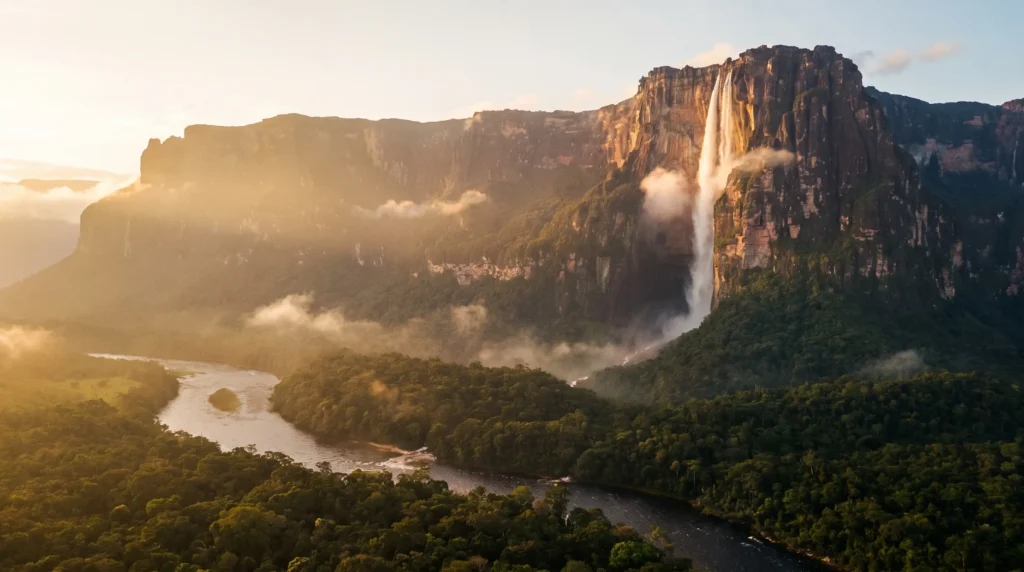
Geographically, it is genuinely one of the most varied countries on the continent: Caribbean beaches and coral cays in the north, the Andes running through Mérida in the west, the vast cattle plains of the Llanos in the middle, and — the reason most people put it on a bucket list at all — the Gran Sabana and its tepuis in the southeast, ancient flat-topped sandstone mountains that inspired Arthur Conan Doyle’s “The Lost World.” Canaima National Park, a UNESCO World Heritage Site since 1994, holds Angel Falls, which at 979 metres is the tallest uninterrupted waterfall on Earth.
None of that changes the fact that Venezuela has spent much of the last decade in economic and political crisis, and that in 2026 specifically it is dealing with severe currency depreciation, a healthcare system under real strain, and — as of late June — earthquake damage to Caracas’s main airport on top of an already complicated security picture. International tourism here has never fully recovered to pre-crisis levels, and it is not a country I’d point a first-time independent backpacker toward right now. This guide exists for the specialist-tour-operator traveler, the diaspora visiting family, and the armchair reader who wants to actually understand the place — read the Practical section carefully before deciding which of those you are.
El Callao Carnival — Venezuela’s UNESCO-Listed Street Party
If Venezuelan tourism has one unambiguous good-news story, it’s El Callao’s Carnival, running each year from January through March in this old gold-mining town in Bolívar state. UNESCO inscribed it on the Representative List of the Intangible Cultural Heritage of Humanity in 2016, recognizing a celebration that fuses Venezuelan, Trinidadian and West African tradition into something found nowhere else on the continent.
The parades are led by madamas — matrons in flowing Antillean dress representing the town’s Caribbean roots — alongside medio-pintos smudging good-natured charcoal on non-donors, diablos cracking whips to keep order, and mineros honoring the miners who built the town. The soundtrack is calipso venezolano, a genre born here that blends Trinidadian calypso’s melodic swing with Spanish lyrics and local percussion. It’s the kind of festival that, in a stable year, is worth planning an entire southeastern Venezuela itinerary around — paired with a Canaima and Angel Falls extension while you’re already in Bolívar state.
Best Time to Visit Venezuela (Season by Season)
December – April · Dry season
The best window for the Gran Sabana and Angel Falls: rivers are lower (which sounds counterintuitive, but low water means the light-aircraft and boat access to Canaima runs more predictably), skies are clearer for the flight over the tepuis, and Caribbean coast conditions are at their calmest. This is also carnival season, peaking with El Callao and national Carnaval in the days before Ash Wednesday.
May – November · Wet season
The Gran Sabana turns lush and the waterfalls run fuller and more dramatic, which some photographers actually prefer, but access gets harder — rivers can run too high for some boat routes and afternoon storms are routine. Along the coast this overlaps with the Atlantic hurricane season’s southern edge, though direct hits on Venezuela are rare compared with the Caribbean islands further north.
A note that overrides the calendar in 2026
Seasonal planning only matters once the current advisory and infrastructure picture allows the trip at all. The June 24, 2026 earthquakes damaged transport infrastructure including Caracas’s international airport, and both the US and UK governments were actively discouraging travel to large parts of the country at the time of writing. Check current advisories before booking regardless of which month looks best on paper.
Getting There — Airports, Routing & Current Disruptions
Maiquetía “Simón Bolívar” International Airport (CCS), about 21 kilometres from central Caracas, is the country’s main international gateway. There have been no direct commercial flights between the United States and Venezuela since 2019, so US-based travelers typically route through Bogotá, Panama City or another regional hub. As of this writing, CCS has also been affected by the late-June 2026 earthquakes, with commercial operations disrupted — confirm current airport status directly with your airline before finalizing any itinerary, and do not assume this guide’s routing advice reflects this week’s reality.
Land border crossings from Colombia (via Cúcuta) and Brazil (via Santa Elena de Uairén) exist, but the US State Department flags border regions in general as elevated risk, with several designated Level 4 “Do Not Travel” due to armed groups and kidnapping risk. If you are visiting, doing so through a specialist tour operator who handles routing, permits and ground transport is the standard, sensible approach rather than independent overland travel.
Getting Around — Why You Fly, Not Drive
Most visitors reach Canaima National Park and the Gran Sabana by small aircraft from Ciudad Bolívar or Puerto Ordaz, then continue by dugout canoe (curiara) up the Carrao and Churún rivers to reach Angel Falls viewpoints — there is no road to the falls themselves. Los Roques is reached by a roughly 40-minute flight from Caracas, or about an hour from Porlamar on Margarita Island. Domestic flights are the practical backbone of Venezuelan tourism precisely because road travel between regions carries the security concerns detailed in Practical Information below.
Within a single destination — Mérida town, Los Roques’ Gran Roque, Margarita’s beach towns — walking, official taxis arranged through your hotel, and tour-operator transport are the norm. Renting a car and self-driving between cities is not something I’d recommend for visitors given current advisories on inter-city road travel, particularly after dark.
Top Regions — Tepuis, Islands & the Andes
Canaima National Park & Angel Falls
The headline act: a 30,000-square-kilometre UNESCO World Heritage Site of table-top tepui mountains, sheer cliffs and savanna, home to Angel Falls at 979 metres — the world’s tallest uninterrupted waterfall, first brought to international attention by American aviator Jimmie Angel in the 1930s. Most trips base out of Canaima Camp on the lagoon, with excursions further upriver to the falls themselves during higher water months.
Gran Sabana
The wider savanna-and-tepui region south toward the Brazilian border, threaded with rivers, waterfalls and Pemón indigenous communities. Roraima — the tepui that straddles Venezuela, Brazil and Guyana — draws multi-day trekkers in stable years, though this is also one of the border-adjacent areas where current advisories urge extra caution.
Los Roques Archipelago
Roughly 350 islands, cays and coral reefs forming a federal dependency and marine national park, reachable only by small plane to Gran Roque, the sole inhabited island. This is Venezuela’s answer to the Maldives — powder sand, no cars, and posadas rather than resorts — and historically one of the more insulated destinations from mainland security concerns, though it deserves the same current-advisory check as anywhere else.
Margarita Island
A larger, more built-up Caribbean island off the northeast coast with beach resorts, colonial forts and a duty-free shopping history, plus its own airport serving as a secondary gateway to Los Roques.
Mérida & the Andes
A university town in the Venezuelan Andes, home to one of the world’s longest and highest cable cars, climbing toward Pico Espejo at 4,765 metres. The cooler climate, hot springs and páramo scenery make it feel like an entirely different country from the Caribbean coast a few hours away.
Caracas
The capital and largest city, home to the Ciudad Universitaria de Caracas — a UNESCO World Heritage Site since 2000, designed by architect Carlos Raúl Villanueva as a modernist showpiece adapted to the tropics. Caracas also sits at the center of the current earthquake-recovery and security picture — check status closely before routing through it.
Coro
Venezuela’s first colonial capital and its first UNESCO World Heritage Site, inscribed in 1993 for a historic center built in bahareque, adobe and rammed earth blending Spanish, Mudéjar and Dutch influences — though it has been on UNESCO’s endangered list since 2005 due to rain damage and encroaching development.
Culture & People — Llanero, Afro-Venezuelan & Indigenous
Venezuela’s roughly 31.8 million people mix Spanish, Indigenous and African heritage across genuinely distinct regional identities: the cowboy Llanero culture of the central plains, the Afro-Venezuelan communities of the coast and the south (El Callao among them), and Indigenous groups including the Pemón of the Gran Sabana and the Wayuu near the Colombian border. Spanish is the sole official language, though several Indigenous languages persist in border and interior regions.
Baseball, not football, is the national obsession — a legacy of early 20th-century US oil-industry ties — and Venezuelans have produced a steady stream of MLB talent. Beauty pageants and telenovelas have historically been genuine cultural exports. Music runs from joropo, the Llanos’ harp-driven folk dance, to the Afro-Caribbean calipso of El Callao described above, to a strong classical tradition built on El Sistema, the youth orchestra program that produced conductor Gustavo Dudamel.
A Food Lover’s Guide to Venezuela
The national dish is pabellón criollo — shredded beef, black beans, white rice and fried sweet plantain, arranged to echo the stripes of the Venezuelan flag, which is literally what “pabellón” means. Venezuela’s government declared it intangible cultural heritage in 2019. The black beans nod to African influence, the beef to Spanish technique, and the rice and plantain to Indigenous and Caribbean staples — a genuine three-culture dish on one plate.
The everyday staple is the arepa, a grilled corn cake dating back roughly 2,800 years to pre-Columbian peoples of what’s now Venezuela and Colombia, split and stuffed with everything from shredded beef and black beans (reina pepiada with avocado and chicken is the classic) to just cheese. Look also for cachapas (sweet corn pancakes folded around soft cheese), tequeños (fried cheese sticks, Venezuela’s genuine gift to party food everywhere), and hallacas — a Christmas-season cornmeal parcel wrapped in banana leaf, similar in spirit to a tamale but distinctly Venezuelan. Rum is the drink to know: Diplomático and Santa Teresa are both internationally regarded, aged in a country with genuinely good sugarcane terroir.
Off the Beaten Path
Auyán-tepui’s summit
Beyond viewing Angel Falls from below, a small number of specialist operators run multi-day treks onto the summit plateau itself — one of the most remote hiking experiences in South America, on the same tepui the falls plunge from.
Morrocoy National Park
A coastal park of mangrove cays and coral reef on the central coast, historically a popular weekend escape for Venezuelans themselves rather than international tourists — low-key, shallow turquoise water, no crowds by regional standards.
Ciudad Bolívar’s old town
The gateway to Canaima and Angel Falls has its own reward: a well-preserved 18th-century riverside center on the Orinoco, generally overlooked by travelers rushing straight to the airstrip.
Roraima’s lost-world plateau
The tepui that inspired Arthur Conan Doyle sits at the Venezuela-Brazil-Guyana tripoint — an extraordinary multi-day trek in stable conditions, and a clear example of why checking current border-region advisories matters before planning anything in this part of the country.
Practical Information — Read This Before You Book Anything
Safety and advisories — the most important paragraph in this guide. As of this writing, the US State Department rates Venezuela Level 3, “Reconsider Travel,” citing violent crime, kidnapping, the presence of two designated Foreign Terrorist Organizations (Tren de Aragua and Cartel de los Soles), a healthcare system in severe crisis, and damage from the June 24, 2026 earthquakes — with seven specific regions rated Level 4, “Do Not Travel.” The UK FCDO similarly advises against all travel to border-buffer zones with Colombia, Brazil and Guyana plus Zulia state, Delta Amacuro and the Orinoco Mining Arc, and against all but essential travel elsewhere in the country, and has noted Caracas’s international airport was affected by the recent earthquakes. Check both advisories directly, in full, close to your travel date — this guide is a reference, not a substitute for that.
Money. The bolívar floats freely and has depreciated sharply against the US dollar, with annual inflation in the hundreds of percent; most tourist transactions in practice run on cash US dollars rather than bolívares. Bring clean, undamaged small-denomination bills — card and ATM infrastructure is unreliable for foreign visitors.
Visas. US, UK, EU and Canadian citizens need a visa arranged in advance; there’s no visa on arrival, and consular services have been intermittent. Work with a specialist operator who handles the paperwork rather than attempting this independently.
Health. The CDC recommends yellow fever vaccination for most travelers and flagged an increased number of yellow fever cases nationally as of March 2026; hepatitis A/B, typhoid and up-to-date routine vaccines are also recommended, with malaria prophylaxis advised below 1,700 metres elevation. Avoid untreated water and freshwater swimming in areas with poor sanitation, and pack strong insect repellent against dengue, Zika and chikungunya risk. Given the healthcare-infrastructure strain cited in the advisory above, comprehensive medical evacuation insurance isn’t optional — it’s the baseline.
Connectivity. An international eSIM is far more reliable than assuming easy roaming or Wi-Fi access outside major hotels. Plugs: US-style (Type A/B), 120V. Time zone: UTC-4, no daylight saving.
Budget Breakdown — What Venezuela Actually Costs in 2026
Costs here don’t map cleanly onto neighboring countries because the economy runs substantially in cash US dollars alongside a collapsing bolívar — so quoted local prices in bolívares can be misleading day to day.
Budget (US$40–80/day): Simple posada or guesthouse, arepa and street-food meals, local transport arranged through your accommodation rather than independently.
Mid-range (US$100–200/day): A licensed tour operator’s Canaima or Los Roques package including domestic flights, guide and lodging, restaurant meals, organized ground transfers.
Higher-end (US$300+/day): Fly-in lodges at Canaima or private posadas on Gran Roque in Los Roques, multi-day guided tepui treks, full-service ground security arrangements in Caracas.
Nearly all legitimate visitor spending here should route through an established operator rather than ad-hoc independent budgeting — given the advisories above, that’s a safety recommendation as much as a financial one.
Planning Your First Trip to Venezuela
Given the current advisory picture, “planning your first trip” here means, first and foremost, planning with a specialist operator experienced in current on-the-ground conditions — not stitching together an independent backpacker route the way you might for a neighboring country. If a stable window opens, the classic circuit pairs three to four days in Canaima for Angel Falls with three or four island days in Los Roques, flying between the two via Caracas or Porlamar. If Venezuela itself isn’t the right call for your trip right now, the tepui-and-rainforest appeal translates well to Guyana for similar Gran Sabana-adjacent landscapes without crossing the border, or to Cartagena and Colombia more broadly for Caribbean-coast colonial charm with a far more established tourism infrastructure.
Frequently Asked Questions
Is it safe to travel to Venezuela right now?
As of this writing, no major Western government is recommending general tourism to Venezuela. The US rates it Level 3, “Reconsider Travel,” with seven regions at Level 4, “Do Not Travel,” and the UK FCDO advises against all or all-but-essential travel across nearly the entire country. Anyone considering a visit should read both advisories in full and travel only through an experienced specialist operator, not independently.
Can I fly there directly from the US?
No — there have been no direct commercial flights between the United States and Venezuela since 2019. Most routing goes through Bogotá, Panama City or another regional hub, and current airport disruptions following the June 2026 earthquakes make confirming your specific routing with the airline essential before booking.
Do I need a visa?
Yes — US, UK, EU and Canadian citizens need a visa arranged in advance; there’s no visa on arrival, and processing has been inconsistent given the broader operating environment. Work through a tour operator or the relevant consular channel rather than attempting a DIY application close to your travel date.
What currency should I bring?
Cash US dollars in good condition, small denominations. The bolívar floats and has depreciated sharply, and most tourist-facing transactions run in dollars in practice rather than local currency. Don’t rely on cards or ATMs.
Is Angel Falls worth the current hassle?
As a natural spectacle, it’s genuinely one of the best on the planet — the world’s tallest uninterrupted waterfall inside a UNESCO World Heritage tepui landscape. Whether it’s worth visiting this year is a question only you, current advisories, and a specialist operator can answer together — it isn’t a casual add-on to a South America itinerary right now.
What’s a lower-risk way to see this part of South America?
If the current picture rules out Venezuela for your trip, Guyana offers tepui-and-rainforest landscapes in the same Gran Sabana ecosystem with a more stable tourism infrastructure, and Colombia’s Caribbean coast delivers comparable colonial-port charm to Coro or Ciudad Bolívar with far more established, independent-friendly travel logistics.
Thinking About Venezuela?
Angel Falls, a Caribbean archipelago that rivals anywhere on Earth, and a UNESCO carnival unlike any other — the appeal is real and it isn’t going anywhere. Neither, right now, are the reasons for caution. Treat this guide as the “why,” check the current advisories for the “whether,” and if you do go, go through people who know the ground today, not the country I’m describing from research.
Explore More
- Colombia Travel Guide — Caribbean coast and Andes next door, with far more established tourism infrastructure
- Guyana Travel Guide — tepuis and Gran Sabana-adjacent rainforest without crossing into Venezuela
- Brazil Travel Guide — the Amazon and Roraima’s other border, at a different scale
- Cartagena City Guide — for the colonial-port charm of Coro, with a well-worn tourist trail
How this guide was built
Published as part of Facts From Upstairs’ country guide series. Given the current situation in Venezuela, this guide leans harder than most FFU country guides on official government advisory sources — the US State Department and UK FCDO travel advisory pages, current as of early July 2026 — alongside the US CDC traveler health page, UNESCO’s World Heritage and Intangible Cultural Heritage listings, and Wikipedia entity pages for Venezuela’s geography, currency, airports and cultural sites. Numeric and factual claims carry inline citations; advisory-related claims should be re-verified against the live source pages before publication or reader action, since conditions in Venezuela are changing quickly.
Sources cited on this page
- Wikipedia — Venezuela
- US State Department — Venezuela Travel Advisory
- UK FCDO — Venezuela Travel Advice
- US CDC — Venezuela traveler page
- Wikipedia — List of World Heritage Sites in Venezuela
- Wikipedia — Angel Falls
- Wikipedia — Simón Bolívar International Airport
- Wikipedia — Venezuelan Bolívar
- Wikipedia — Pabellón Criollo
- Wikipedia — Los Roques Archipelago
- Wikipedia — Tourism in Venezuela
- UNESCO ICH — Carnival of El Callao
More country guides you might like
Plan your trip to Venezuela
The booking tools we use ourselves. FFU may earn a commission at no extra cost to you.
Plan & book your trip to Venezuela
Booking through these searches supports our guides at no extra cost to you.