
Languages of Equatorial Guinea
All languages of Middle Africa →fluent beta classical · classes by phone with Maya at ranas.ai/maya
Equatorial Guinea Travel Guide — Rainforest Gorillas, Spanish-Colonial Malabo & Africa’s Least-Visited Country
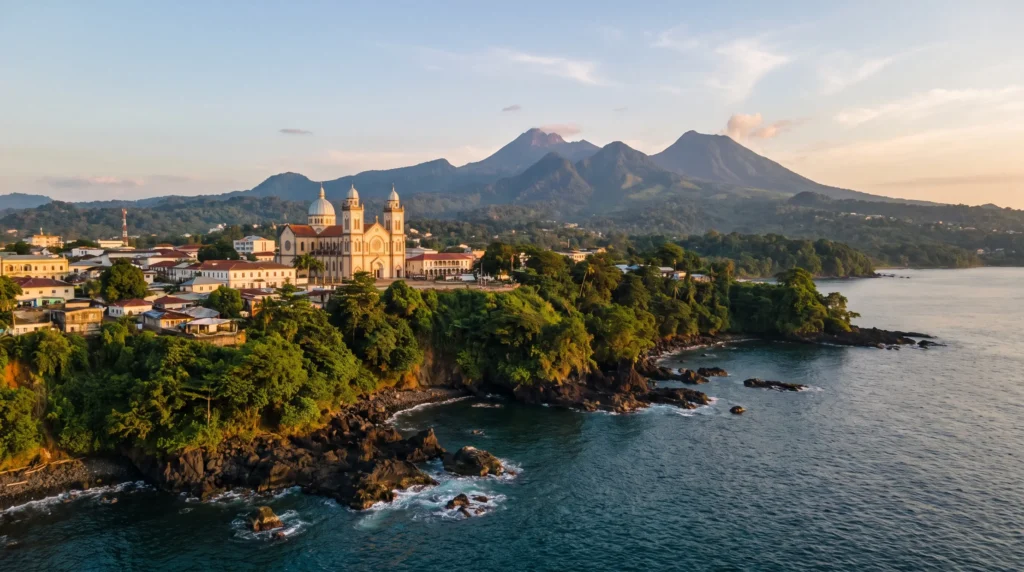
I’ll be honest with you before you even scroll further: Equatorial Guinea is not an easy trip, and if you want a relaxing week of sunbeds and cocktail menus, this isn’t it. But if you’re the kind of traveler who gets a genuine thrill from being somewhere almost nobody else goes, this small, oil-rich, Spanish-speaking sliver of Central Africa is one of the strangest and most fascinating places left on the map. It’s mainland rainforest thick with western lowland gorillas , a volcanic island capital with a neo-Gothic Spanish cathedral, a brand-new purpose-built capital carved out of the jungle that most of the country hasn’t finished moving into yet , and a government that only just built its first-ever UNESCO World Heritage tentative list this year. Tourism infrastructure here is close to nonexistent, the visa process has real friction, and the safety picture needs a clear-eyed read before you book anything — I’ll walk you through all of it, catches included.
In This Guide
- Overview — Why Equatorial Guinea Is Africa’s Strangest Open Question
- Independence Day & a Country Redrawing Its Own Map
- Best Time to Visit Equatorial Guinea (Season by Season)
- Getting There — SSG, BSG & the E-Visa Gauntlet
- Getting Around — Domestic Flights, Roads & the Malabo–Bata Split
- Top Regions — Bioko, Rio Muni, Annobón & Corisco
- Culture & People — Fang, Bubi & a Spanish-African Hybrid
- A Food Lover’s Guide to Equatorial Guinea
- Off the Beaten Path
- Practical Information
- Budget Breakdown — What Equatorial Guinea Actually Costs in 2026
- Frequently Asked Questions
Overview — Why Equatorial Guinea Is Africa’s Strangest Open Question
Equatorial Guinea is the only Spanish-speaking country in Africa, a legacy of Spanish colonial rule that ended with independence on 12 October 1968. Its roughly 1.8 million people are split across two very different halves of one small nation: the volcanic island of Bioko in the Gulf of Guinea, home to the traditional capital Malabo, and the mainland region of Río Muni, wedged between Cameroon and Gabon, home to the larger city of Bata and the country’s rainforest interior. Add in two far-flung island possessions — tiny, remote Annobón and the palm-fringed Corisco — and you have a country that feels less like one place than four.
What makes it genuinely unusual right now, in 2026, is that it’s mid-transformation. Since the mid-1990s, offshore oil has turned this into one of Sub-Saharan Africa’s wealthiest countries by GDP per capita, though that wealth is famously concentrated rather than shared. That oil money built Ciudad de la Paz, a purpose-built capital in the mainland jungle that officially replaced Malabo as the seat of government in January 2026 — a city with wide boulevards and government palaces built for a population that hasn’t fully arrived yet. Meanwhile Equatorial Guinea only established its first-ever UNESCO World Heritage tentative list in April 2026, nominating six sites including Monte Alén National Park and the Caldera de Luba — it had previously been the only African country without one.
None of this means Equatorial Guinea has tourist infrastructure to match its ambitions — it doesn’t, and won’t for years. What it means is that you’d be visiting a country literally in the middle of deciding what it wants to be, with rainforest gorillas, empty black-sand beaches and a genuinely rare Spanish-African cultural mix as the reward for the extra planning it takes to get there.
Independence Day & a Country Redrawing Its Own Map
12 October is Equatorial Guinea’s Independence Day, marking the end of Spanish colonial rule in 1968 and the single biggest civic holiday on the calendar, with parades and events concentrated in Malabo and, this year, likely split with the new capital. If you’re planning around a cultural landmark, this is it — though as a foreign visitor, expect to be a spectator rather than a participant, and to plan hotel bookings well ahead since the holiday pulls in diaspora visitors and officials alike.
2026 also happens to be an unusually newsworthy year to visit for reasons that have nothing to do with festivals: the government’s January decree relocating the capital to Ciudad de la Paz and April’s first-ever UNESCO tentative list submission both mean the country is actively repositioning itself — new infrastructure, new signage, and possibly the first real steps toward organized nature tourism around Monte Alén and the Caldera de Luba in years to come. Go now and you’re seeing the “before” picture.
Best Time to Visit Equatorial Guinea (Season by Season)
The split-season problem
Here’s the quirk that trips up first-time planners: Bioko Island and the Río Muni mainland run on opposite seasonal clocks. From June to August, the mainland has its driest stretch while Bioko is at its wettest; from December to February, that flips, with Bioko relatively dry and the mainland still seeing regular rain along the coast.
December – February · Best for Malabo & Bioko
Malabo’s relatively dry season, and the easiest window for exploring Bioko’s beaches, the Caldera de Luba reserve, and Ureka’s turtle-nesting coast (nesting typically runs October to March).
June – August · Best for the mainland
Río Muni’s driest window, the better time to push into Monte Alén National Park and Bata, though Bioko will be at its wettest during these same months.
March–May & September–November · Shoulder and heavy-rain windows
The mainland sees two rain peaks in this stretch (March–May and September–November), with September through November its wettest months. Humidity is high year-round regardless of season — this is equatorial rainforest climate, not a place with a truly comfortable dry stretch everywhere at once.
Getting There — SSG, BSG & the E-Visa Gauntlet
Malabo International Airport (SSG) on Bioko Island is the country’s main international gateway, with Bata’s airport (BSG) on the mainland serving a smaller set of regional connections. There are no direct flights from North America; realistic routings connect through European hubs (historically Madrid and Paris) or regional African hubs like Douala, Libreville and Addis Ababa, with Ceiba Intercontinental and Cronos Airlines handling much of the regional and domestic network.
The bigger hurdle is the paperwork, not the flight. Equatorial Guinea requires an e-visa in advance for almost all nationalities — applied for and approved before you travel, with a printed confirmation to show on arrival — plus a passport valid at least six months beyond your arrival date with a blank page, and an International Certificate of Vaccination showing yellow fever immunization administered at least 10 days before entry. There’s also a declared cash limit of USD $10,000 (or 5,000,000 CFA francs) on entry and exit. Start the visa process well ahead — this is not a country where you wing it at the airport.
Getting Around — Domestic Flights, Roads & the Malabo–Bata Split
Malabo and Bata sit on opposite sides of the country — an island capital and a mainland city — connected by a roughly 50-minute domestic flight rather than any road or bridge. Most visitors will need at least one of these hops if they want to see both the Bioko side and the Río Muni mainland (including Monte Alén and the new capital).
On Bioko, roads out of Malabo toward Luba and Ureka are limited and rough in places, and a hired driver or organized tour is the practical way to reach the island’s southern beaches and the Caldera de Luba reserve. On the mainland, Bata connects by road toward the Cameroon and Gabon borders and inland toward Monte Alén, though infrastructure outside the main towns is basic. There is no meaningful public transit system for tourists in the way you’d find in more visited African destinations — expect to arrange transport through your hotel, a tour operator, or a hired car and driver rather than relying on ad hoc local transit.
Top Regions — Bioko, Rio Muni, Annobón & Corisco
Malabo & Bioko Island
The historic capital sits on a volcanic island with genuine Spanish-colonial bones — the neo-Gothic Cathedral of Santa Isabel anchors the city center, a reminder that Equatorial Guinea was one of only two Spanish colonies in Africa. Beyond the city, Bioko’s south holds Arena Blanca beach near Luba and the black-sand, waterfall-fed coastline at Ureka.
Ureka & the turtle coast
One of the wettest inhabited places on Earth and one of the Atlantic’s important nesting grounds for leatherback, green and olive ridley sea turtles, typically October through March. It’s remote, undeveloped, and about as far from a resort experience as this coastline gets.
Caldera de Luba
A dormant volcanic caldera reserve on Bioko now on the country’s UNESCO tentative list, prized for its cloud forest and endemic wildlife.
Bata & the Río Muni mainland
The country’s largest city and commercial hub on the mainland coast, and the practical base for pushing into the interior — including day or multi-day trips toward Monte Alén.
Monte Alén National Park
The country’s largest protected area at roughly 2,000 km², home to western lowland gorillas, chimpanzees, forest elephants and forest buffalo, plus more than 260 recorded bird species. This is genuine, little-visited Central African rainforest — expect basic facilities and the need for a specialist guide, not a safari lodge experience.
Ciudad de la Paz
The purpose-built new capital, officially designated in January 2026, sits in the mainland forest near Djibloho. It’s more a curiosity stop than a destination in its own right right now — wide, largely empty boulevards and government buildings built for a population that has yet to fill them — but it’s a genuinely strange, of-the-moment sight if your route passes nearby.
Corisco & Annobón
Corisco is a small, low-lying island off the Río Muni coast known for its beaches and mangroves, now among the sites on the UNESCO tentative list. Annobón is another matter entirely: a tiny, extinct-volcanic island roughly 17 km² in size, sitting far south in the Gulf of Guinea near São Tomé’s latitude, with a population of only a few thousand, its own centuries-old cayuco whaling tradition, and a level of isolation that makes it one of the hardest-to-reach inhabited places in the region. Getting there typically means an irregular boat or charter connection — plan on this being an expedition, not a day trip.
Culture & People — Fang, Bubi & a Spanish-African Hybrid
Over 85% of Equatorial Guinea’s population belongs to the Fang ethnic group, concentrated on the mainland and dominant across the country’s politics and culture, with the Bubi — Bioko’s original inhabitants — making up roughly 6.5%, alongside smaller Annobonese, Bujeba and other communities. Christianity is the majority religion at close to 89% of the population, a direct legacy of Spanish missionary presence, and it blends visibly with older Fang and Bubi spiritual traditions in rural areas.
Spanish remains the dominant language of administration, media and daily commerce in a way found nowhere else on the continent, alongside official status for French and Portuguese and everyday use of Fang, Bubi and other local languages. One honest note: Equatorial Guinea has been governed by the same family for decades under a system widely described as an authoritarian, hereditary-leaning presidential system , and that reality shapes practical travel advice more than culture-page color ever will — see the Practical section below before you romanticize the trip too hard.
A Food Lover’s Guide to Equatorial Guinea
Equatoguinean cooking blends native Fang and Bubi traditions with Spanish colonial influence and touches from neighboring Cameroon and Nigeria — expect stewed sauces, dishes steamed in banana leaves, and tubers like yuca and plantain as the everyday base. The signature dish is pepesup (pepper soup), a spicy, warming fish soup eaten any time of day, and sopa de malamba, a thick vegetable-and-fish or meat soup often paired with fufu.
Seafood is unsurprisingly excellent given the coastline on both the island and mainland sides, and Spanish influence shows up in bread, coffee culture and some classic preparations carried over from the colonial era. Malamba also refers to a tart, tamarind-based drink that shows up alongside savory meals. Because the country imports much of its packaged food and produce, restaurant dining — especially in Malabo hotels catering to the oil sector — trends toward international, Spanish-leaning menus at prices closer to a European capital than a typical West or Central African one.
Off the Beaten Path
Annobón
About as far off the beaten path as the Gulf of Guinea gets — a small, remote extinct-volcanic island with fewer than six thousand residents, rich endemic biodiversity, and an artisanal whaling tradition using traditional cayuco canoes. Access is irregular and infrastructure minimal; this is for travelers who genuinely want the edge of the map, not a beach holiday.
Monte Alén’s deep interior
Camera-trap surveys have confirmed wild lowland gorillas in central mainland Equatorial Guinea for the first time in over a decade, underscoring how little-explored and intact this rainforest still is. Go with a specialist operator and conservative expectations about comfort.
Ciudad de la Paz
Whatever else it is, a brand-new capital city built from scratch in rainforest and only just declared the seat of government is a strange, singular thing to see with your own eyes while it’s still mostly empty.
Practical Information
Money. The Central African CFA franc (XAF) is fixed at 655.957 to the euro and shared with five other Central African states. Card acceptance is limited outside top-end hotels; plan to carry cash, and note the declared limit of USD $10,000 (or 5,000,000 CFA) on entry and exit.
Safety. The US State Department rates Equatorial Guinea Level 2 — Exercise Increased Caution, citing crime, uneven law enforcement capacity, and a real risk of arbitrary detention that the embassy cannot guarantee resolving quickly. Practical guidance: always carry your passport and visa, avoid traveling alone at night, use only known and trusted drivers, don’t display wealth, and register locally if staying beyond 90 days. Check your own government’s current advisory before booking — the UK FCDO likewise stresses that no trip abroad can be guaranteed safe and keeps its own detailed guidance updated.
Health. Yellow fever vaccination is required for entry (certificate at least 10 days old), and malaria risk is present countrywide — the CDC recommends antimalarial medication for all travelers, alongside routine and hepatitis A/B, typhoid and updated MMR vaccination. Avoid swimming in untreated freshwater (schistosomiasis risk), treat drinking water, and know that trauma and ambulance care outside major hospitals is very limited — medical evacuation insurance is strongly advised.
Connectivity. Internet is workable in Malabo and Bata hotels but drops off quickly outside the main towns; don’t count on connectivity in Monte Alén or Annobón. Plugs: European-style (two round pins), 220V. Time zone: UTC+1, no daylight saving.
Budget Breakdown — What Equatorial Guinea Actually Costs in 2026
There’s no honest way to sugarcoat this: Equatorial Guinea is genuinely expensive, and there is no real backpacker infrastructure to fall back on. The economy runs on oil-company and diplomatic demand, which pushes hotel and restaurant pricing toward European-capital levels rather than regional African norms, and the near-total absence of budget guesthouses or hostels in Malabo and Bata means costs stay high even for modest trips.
Modest (roughly USD $120–200/day): A simple hotel in Malabo or Bata, local restaurant meals rather than hotel dining, and getting around by hired car rather than tours — still not “cheap” by regional standards, just the lower end of what’s realistically available.
Mid-range to business-standard (roughly USD $250–450/day): A hotel serving the oil and diplomatic sector, restaurant dining, a domestic Malabo–Bata flight, and a guided day into Monte Alén or the Bioko coast with a driver and permits arranged through an operator.
Above that: Multi-day specialist expeditions (Monte Alén gorilla tracking, Annobón charters) run on bespoke pricing set by the handful of operators who run them — get a written quote before committing, since fixed published rates are rare here.
Whatever tier you land in, plan for a cash-first trip, build in a buffer for the visa and yellow-fever paperwork, and don’t expect the value-for-money you’d find in, say, neighboring Cameroon or Gabon.
Planning Your First Trip to Equatorial Guinea
Given the logistics, most first-timers are better served picking one side of the country rather than trying to cover both Bioko and Río Muni in a short trip. A Bioko-focused week — Malabo’s colonial core, the Caldera de Luba, and Ureka’s beaches — is the more manageable introduction; a mainland-focused trip built around Bata and Monte Alén is the pick for wildlife-first travelers willing to work with a specialist operator. Either way, start your e-visa and yellow fever paperwork at least a month out, book accommodation directly since online booking coverage is thin, and build slack into every transfer. If Central African wildlife is your real draw, our Rwanda guide covers the region’s other major gorilla-trekking destination with far more established infrastructure. For a wider look at former Spanish colonial footprints on the continent, see our Morocco guide, and for Gulf of Guinea coastal culture on the more accessible West African side, our Ghana and Senegal guides are good next reads.
Frequently Asked Questions
Is Equatorial Guinea safe for tourists in 2026?
The US State Department rates it Level 2 (Exercise Increased Caution) for crime, uneven policing capacity and the risk of arbitrary detention; the UK FCDO maintains its own current guidance. Most visitors travel without incident by staying alert, avoiding travel alone at night, using known drivers, and always carrying valid ID and visa documents — but this isn’t a destination to under-prepare for.
Do I need a visa?
Yes — nearly all nationalities need an e-visa approved before departure, plus a yellow fever vaccination certificate at least 10 days old and a passport valid six months beyond arrival with a blank page. Apply well in advance; there’s no visa-on-arrival option for most travelers.
What currency should I bring?
The Central African CFA franc (XAF), fixed to the euro at 655.957. The country runs largely on cash, so bring euros to exchange or withdraw XAF locally where possible, and don’t count on cards outside the top hotels.
Can I see gorillas in Equatorial Guinea?
Monte Alén National Park has a confirmed western lowland gorilla population, along with chimpanzees and forest elephants , but this is undeveloped rainforest without the guided-trekking infrastructure Rwanda or Uganda have built up — go through a specialist operator and keep expectations realistic about sightings and comfort.
Is Malabo still the capital?
As of a January 2026 presidential decree, the official capital moved to the newly built Ciudad de la Paz on the mainland, though Malabo remains the country’s main economic and logistical hub and the practical entry point for most visitors.
How does this compare to Gabon or Cameroon next door?
Similar Central African rainforest and coastline, but both neighbors have more developed tourism circuits and easier entry logistics. Equatorial Guinea trades that convenience for genuine exclusivity — you will see very, very few other travelers.
Ready to Explore Equatorial Guinea?
This is not a trip you book on a whim — it’s one you plan carefully, paperwork first, expectations set honestly. But for travelers who want rainforest gorillas, a Spanish-colonial island capital, and a country literally mid-transformation into something new, Equatorial Guinea offers an experience that’s genuinely hard to find anywhere else in Africa right now.
Explore More
- Rwanda Travel Guide — Central Africa’s other, far more developed gorilla-trekking destination
- Ghana Travel Guide — more accessible Gulf of Guinea coast and colonial-era history
- Senegal Travel Guide — West African culture with easier logistics
- Morocco Travel Guide — another African nation shaped by Spanish colonial history
How this guide was built
Published as part of Facts From Upstairs’ country guide series. Built from authoritative sources — Wikipedia entity pages for Equatorial Guinea, Ciudad de la Paz, the Central African CFA franc, Monte Alén National Park, Annobón, visa policy and cuisine; UNESCO’s April 2026 announcement of Equatorial Guinea’s first tentative World Heritage list; the US State Department’s Equatorial Guinea country information and travel advisory pages; the UK FCDO’s Equatorial Guinea travel advice; the US CDC traveler health page for Equatorial Guinea; Climates to Travel’s Equatorial Guinea and Malabo climate data; and Rumbo Malabo’s reporting on Bioko Island’s beaches and turtle-nesting sites. Numeric and checkable claims carry inline citations.
Sources cited on this page
- Wikipedia — Equatorial Guinea
- Wikipedia — Ciudad de la Paz
- UNESCO — Establishment of Tentative List of Equatorial Guinea
- Wikipedia — Central African CFA franc
- Wikipedia — Monte Alén National Park
- Wikipedia — Annobón
- Wikipedia — Cuisine of Equatorial Guinea
- Wikipedia — Visa policy of Equatorial Guinea
- US State Department — Equatorial Guinea
- UK FCDO — Equatorial Guinea
- US CDC — Equatorial Guinea traveler page
- Climates to Travel — Equatorial Guinea
- Rumbo Malabo — Sea turtles in Equatorial Guinea
- Rumbo Malabo — Bioko Island
- FlightsFrom.com — Malabo (SSG) direct flights
- FlightsFrom.com — Malabo–Bata route
More country guides you might like
Plan your trip to Equatorial Guinea
The booking tools we use ourselves. FFU may earn a commission at no extra cost to you.
Plan & book your trip to Equatorial Guinea
Booking through these searches supports our guides at no extra cost to you.