
Tunis, Tunisia: Carthage Ruins, Ancient Medina & Bardo Museum
Journey through Mediterranean North Africa’s greatest historical repository where Phoenician grandeur, Islamic heritage, and Ottoman charm coalesce
Tunis, Tunisia’s capital and North Africa’s cultural epicenter, occupies the strategic position where the Mediterranean connects to the Sahara, creating geographic centrality to regional trade and cultural exchange. The city’s history spans nearly three millennia—from its establishment as a minor Phoenician settlement around 1100 BCE through its dominance as the Islamic world’s intellectual center during medieval periods through its contemporary role as a modern North African capital. Few cities condense such extensive historical depth into so compact a geographic area, with archaeological sites, medieval Islamic architecture, and contemporary neighborhoods existing simultaneously throughout the metropolitan area.
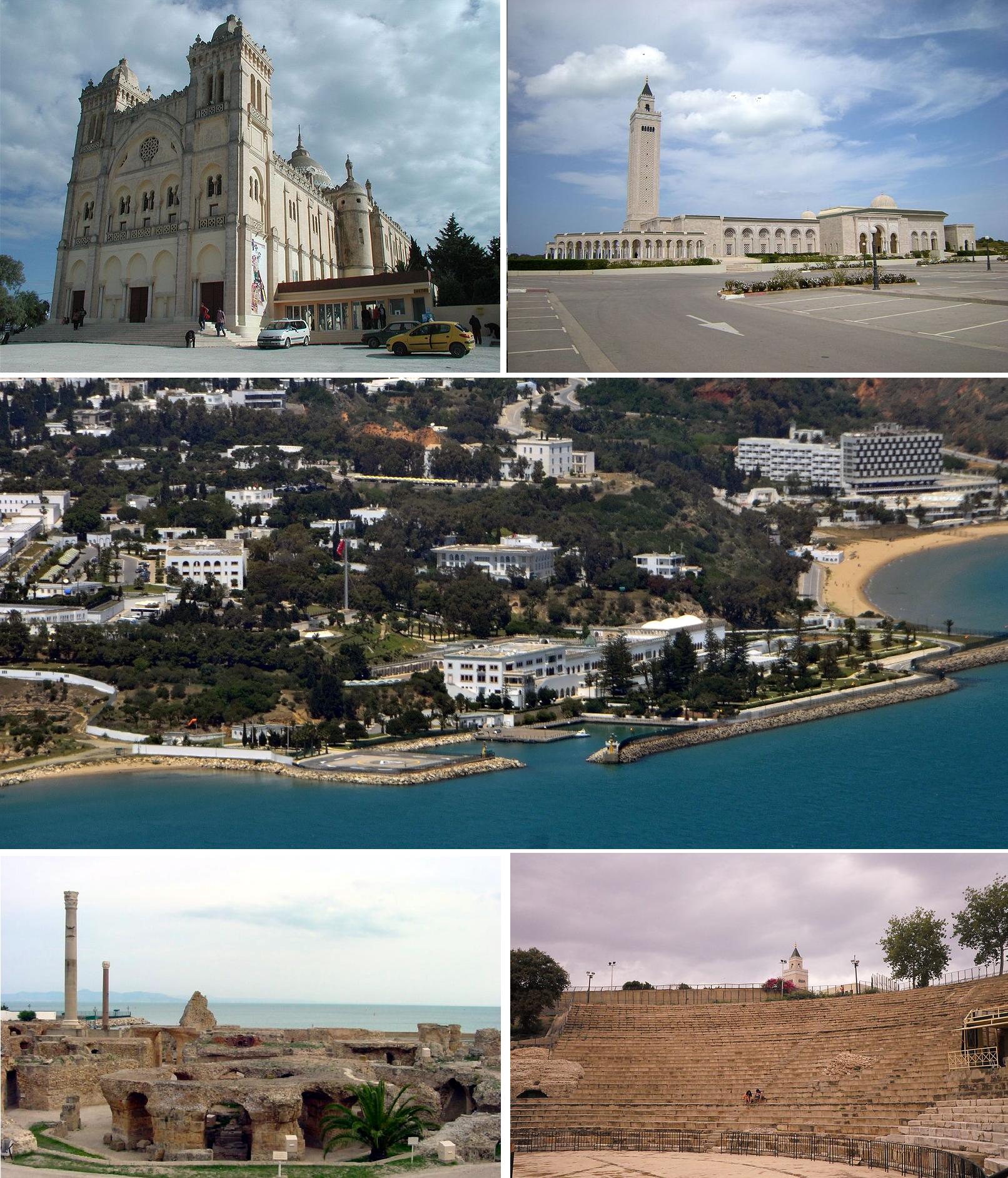
Tunis distinguishes itself among African capitals through sophisticated cultural institutions, preserved architectural heritage, and intellectual tradition. The Bardo Museum holds the world’s most comprehensive collection of Roman mosaics—artistic treasures rivaling the greatest European museums. The medina preserves medieval Islamic urban organization and architectural character despite centuries of external pressures and modernization. The nearby Carthage ruins—once Rome’s greatest rival—remain visible as archaeological evidence of one of antiquity’s most powerful civilizations.
What You’ll Discover
Carthage Archaeological Sites
Carthage, the Phoenician city that challenged Rome for Mediterranean dominance during the Punic Wars (264-146 BCE), occupied the position where Tunis now spreads. The three Punic Wars between Carthage and Rome shaped Mediterranean history and Roman ascendance. The most famous conflict involved Hannibal’s elephant-led crossing of the Alps to attack Roman territories—a military feat reflecting Carthaginian ambition and Hannibal’s tactical genius. Rome ultimately destroyed Carthage in 146 BCE, systematically eradicating the city and salt-sowing its fields to prevent recovery.
Contemporary Carthage ruins preserve fragmentary evidence of the ancient city scattered across a sprawling archaeological site extending several kilometers along the coast. The Antonine Baths represent the most impressive surviving structure—massive concrete vaults and marble columns documenting Roman construction technique and scale. Roman engineering sophistication becomes apparent observing the baths’ sophisticated water distribution systems and architectural engineering maintaining structural integrity despite millennia of weathering.
The Punic Ports, representing Carthage’s commercial and military harbors, remain partially excavated revealing ancient maritime infrastructure. The circular port (the naval/military harbor) and rectangular port (the commercial harbor) demonstrate sophisticated harbor engineering supporting the extensive merchant fleet and naval forces characterizing Carthaginian power. Walking among the port remains, observing the ancient quays, generates understanding of maritime civilization and trade networks connecting Mediterranean antiquity.
The Tophet of Carthage, an ancient sanctuary containing thousands of cremated remains of infants and young animals, documents Carthaginian religious practices including child sacrifice rituals. The site provokes contemporary moral reflection on ancient religious practices and cultural relativism challenges. Archaeological interpretation of the site reflects evolving understanding as scholars debate historical evidence and cultural contextualization.
The Carthage Museum, located near the archaeological sites, preserves artifacts documenting Carthaginian civilization. The collection emphasizes everyday objects—pottery, jewelry, tools—revealing daily life rather than exclusively focusing on elite remains. The museum approach humanizes ancient inhabitants through material culture documentation.
Roman residential villas with preserved mosaics indicate wealthy residents’ lifestyles. The remains of shops, workshops, and administrative buildings document urban organization. The scale of Roman Carthage reflected its status as a significant provincial city rather than a metropolis rivaling Rome, though still representing substantial urban development.
Bardo Museum & Roman Art
The Bardo Museum, housed in the beylical palace, contains the world’s finest collection of Roman mosaics alongside substantial Greek, Phoenician, Islamic, and medieval art. The museum’s mosaic collection documents artistic achievement spanning centuries and reflecting cultural diffusion across the Roman Empire. Mosaics from residential villas reveal entertainment spaces, philosophical interests, and aesthetic sensibilities of provincial Roman populations. The preservation quality—colors remaining vibrant, designs intact—provides insight into ancient artistic production techniques and aesthetic values.
The Alexander the Great mosaic represents one of the collection’s masterpieces. The composition depicts Alexander in battle against Darius of Persia, with dynamic action and sophisticated representation of military conflict. The mosaic’s scale and detail required thousands of individual stone pieces positioned by artisans creating seamless composition. Observing the mosaic’s technical execution—the precision of piece placement, the subtle color gradations creating perspective—reveals the artisanal skill characterizing Roman decorative production.
Neptune mosaics displaying the god amid marine creatures and sea vegetation convey the centrality of maritime themes in Mediterranean civilization. The sophistication of these compositions—featuring anatomical accuracy in human and animal figures, complex spatial arrangements, and color symbolism—documents that Roman art prioritized aesthetic achievement and symbolic meaning, not merely decoration.
The museum’s Greek collection documents the artistic heritage preceding Roman dominance. Phoenician artifacts illustrate the trading civilization’s material culture and artistic influences. Islamic art on display demonstrates artistic evolution following Mediterranean region’s religious transformation. The comprehensive collection provides historical depth documenting cultural continuities and transformations across the region’s complex history.
The museum building itself merits attention. The beylical palace represents Ottoman-era palatial architecture with traditional courtyards, decorative tilework, and spatial organization reflecting Islamic architectural principles. The palace’s conversion to museum use preserves the historic building while creating appropriate venue for artistic collections.
Medina & Islamic Heritage
Tunis’s medina ranks among the Arab world’s most extensive and best-preserved medieval Islamic urban centers. The winding streets, densely packed architecture, and warren-like organization reflect traditional Islamic city planning principles emphasizing community, privacy, and organic street network development. Over 700 streets comprise the medina, with markets (souks) organizing by trade—perfume merchants in one district, textile merchants in another, metalworkers, spice sellers, each quarter developing distinct character.
The Great Mosque of Ez-Zitouna represents the medina’s spiritual center and Tunisia’s most important Islamic site. The mosque’s founding dates to 732 CE, making it among Islam’s oldest surviving mosques. The architectural style blends Arab, Berber, and Byzantine influences reflecting North African syncretism. The courtyard features remarkable columns and arches creating interior vistas of geometric perfection. Non-Muslim entry to the prayer halls is restricted, though courtyard access provides understanding of mosque organization and Islamic architectural priorities.
Souks (traditional markets) dominate the medina’s commerce and social life. The Souk el Berka (slave market historically, now selling clothing and goods) retains its medieval organization with narrow passages facilitating commerce and social interaction. The Souk des Chechias (hat market) specializes in traditional Tunisian red fez-style hats still worn by some Tunisians. Walking through souks, observing vendors, negotiating prices, and experiencing the commercial bustle provides authentic daily life immersion impossible through tourist facilities.
The Dar Ben Abdallah (traditional Ottoman palace) functions as a museum documenting domestic life in historical Tunisia. The palace’s organization—with male reception spaces, female quarters, service areas—reveals social structures and spatial organization characterizing Ottoman households. The preservation of furnishings, decorative tile work, and architectural features provides intimate understanding of historical daily life.
The medina’s preservation despite modernization pressures represents Tunisia’s commitment to maintaining cultural heritage. UNESCO World Heritage designation provides legal protection and international recognition supporting preservation efforts. Walking the medina creates temporal dislocation—narrow streets, traditional dress worn by some inhabitants, animal transport, sensory intensity of commerce and crowds—transporting visitors partially toward historical experience.
Sidi Bou Said & Coastal Villages
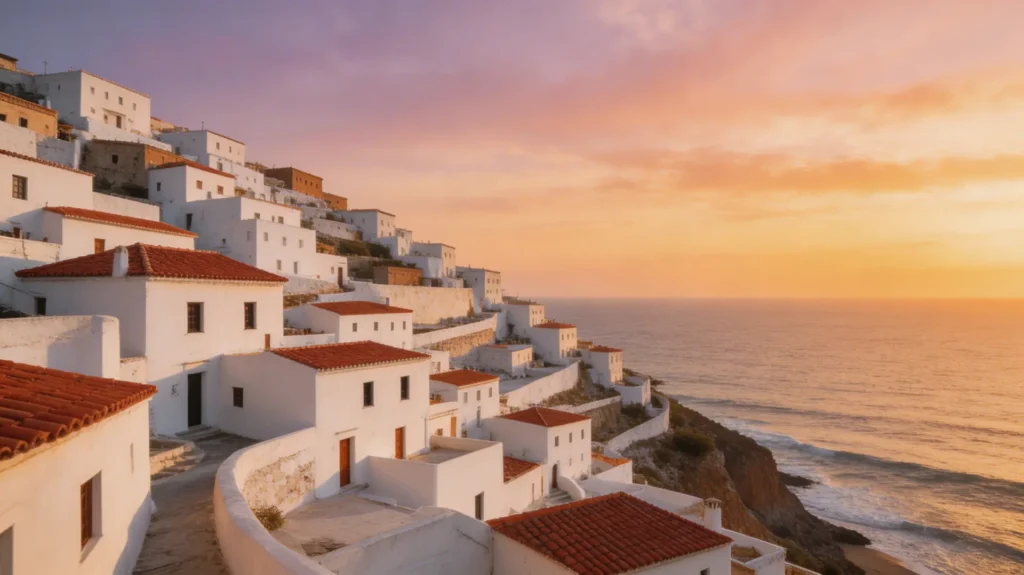
Sidi Bou Said, the whitewashed coastal village 20 kilometers northeast of Tunis, represents the aesthetic image defining Tunisia for international visitors. The village features predominantly white-painted buildings with distinctive blue doors and shutters creating photogenic uniformity. The color scheme—mandated by municipal regulation—emerged from artistic community prominence during early 20th century. Artists, writers, and intellectuals established the village as an alternative community, attracting international creatives including André Gide and Paul Klee. The aesthetic appeal remains intact with contemporary tourism development carefully controlled to maintain village character.
The village clusters on steep hillsides descending to the Mediterranean, with winding alleyways connecting residential quarters to commercial centers. The Ennejma Ezzahra (Green Palace), a traditional palace converted to museum, documents Ottoman-era elite life. The palace’s interior decoration—intricate tilework, carved plaster, elaborate furniture—reveals sophisticated aesthetic appreciation characterizing the Ottoman educated class.
Cafés throughout Sidi Bou Said emphasize social gathering, mint tea consumption, and leisurely afternoon engagement. The tradition of sitting for hours drinking coffee or tea while observing village life remains integral to daily rhythm despite tourism development. Engaging authentically requires participating in the relaxation aesthetic—accepting unhurried time passage and community observation priorities.
La Goulette, the harbor town north of Tunis, provides maritime character and beach access. The town’s history includes piracy, fortress construction, and Mediterranean trade significance. Beaches accommodate swimming, though pollution and crowding characterize peak season periods. The town offers casual dining emphasizing fresh seafood prepared simply.
Sidi Bou Said
Aesthetic village, artistic heritage, café culture. Can be touristy but retains character. Best visited mid-week to avoid weekend crowds.
La Goulette
Beach access, seafood restaurants, maritime history. Less touristy than Sidi Bou Said. Good for casual relaxation and swimming.
Ottoman Heritage & Culture
Tunisia experienced Ottoman governance from the 16th century through 1881 French colonization, creating cultural synthesis blending Arab-Islamic traditions with Ottoman administrative and aesthetic practices. The medina’s Ottoman-era architecture—palatial residences with enclosed courtyards, decorative tilework, and architectural sophistication—reflects this cultural integration. The Bey (Ottoman governor) maintained court structures, ceremonial practices, and artistic patronage sustaining Ottoman cultural traditions.
Contemporary Tunisian cuisine reflects Ottoman influences alongside Berber and Arab traditions. Couscous, tagines, and pastilla represent dishes blending regional ingredients with Ottoman cooking techniques and aesthetic presentation. Traditional Tunisian restaurants throughout the medina serve harissa (spiced paste), brik (fried pastry), and fresh seafood preparations sustaining historical culinary traditions.
The Tunisian textile traditions emphasize hand-weaving creating distinctive patterns and products sold throughout souks. The red and gold embroidered fabrics, prayer carpets, and decorative textiles represent artisanal production continuing Ottoman-era aesthetic and technique. Purchasing from artisans directly supports continuing traditional production.
Music traditions encompassing malouf (classical Arab-Andalusian music) remain performed in concert venues and cultural festivals. The musical form reflects Ottoman influence on Mediterranean Arab culture. Attending performances provides engagement with living cultural traditions rather than historical preservation only.
Practical Visitor Information
Tunis-Carthage International Airport (TUN) receives flights from Europe, Middle East, and other North African cities. Direct flights from North America are limited; most international visitors transit through European hubs or Middle Eastern cities. The airport’s location 8 kilometers northeast of downtown requires 20-30 minute transfer via taxi, ride-sharing, or shuttle services. The airport maintains tourist information, car rental services, and currency exchange.
Accommodation ranges from international five-star hotels through mid-range options to budget guesthouses. The downtown district near the medina concentrates tourist accommodations with varying quality and price points. Sidi Bou Said offers resort-style accommodations supplementing downtown options. Mid-range hotels provide comfortable accommodations at reasonable rates. Budget travelers find basic accommodations with acceptable facilities at minimal costs.
Currency is Tunisian Dinar (TND), with approximately 3.2 TND equaling 1 USD in 2026. ATMs distribute throughout downtown and medina. French language remains prevalent in commerce and official contexts, reflecting colonial legacy. English language skills are limited outside tourism establishments; French fluency significantly improves communication accessibility.
Tunisia’s climate shows Mediterranean patterns—mild winters (8-15°C) and warm summers (25-35°C). Rainfall concentrates November through February with dry summers. Most tourists visit October-April when temperatures remain moderate and rainfall unlikely. Summer heat (June-September) can be intense, though beach access and evening relaxation compensate for daytime heat.
Visa requirements vary by nationality with many Western passport holders receiving 90-day tourist visas on arrival. Confirm current requirements prior to travel. The country remains politically stable though economically challenged; travel advisories should be reviewed.
Best visiting periods are October-November and March-April when Mediterranean weather provides comfortable temperature and low rainfall probability. December-February brings occasional rain and cooler temperatures. May-September constitutes hot season with high tourism and crowded accommodations.
Traverse Three Millennia of Mediterranean History
Tunis concentrates historical depth matching destinations requiring continental travel elsewhere. From Roman Carthage’s tragic magnificence through the medina’s Islamic heritage to the Bardo’s artistic treasures, the city rewards visitors with authentic engagement with Mediterranean North African civilization across millennia.