
Languages of Seychelles
All languages of Eastern Africa →fluent beta classical · classes by phone with Maya at ranas.ai/maya
Seychelles Travel Guide — 115 Granite & Coral Islands, Aldabra Giant Tortoises and the Coco de Mer Coast
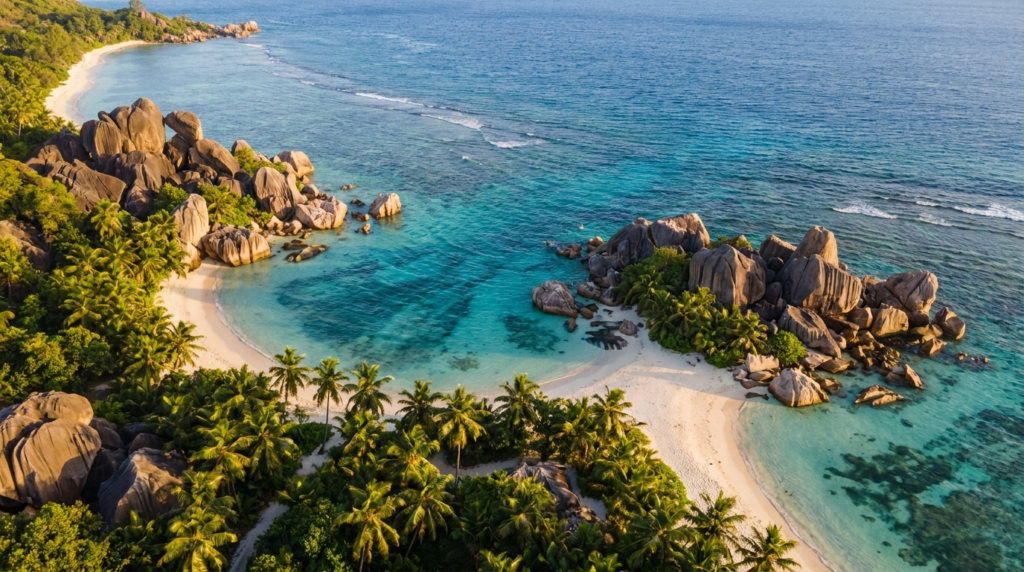
The first thing nobody tells you about the Seychelles is how unusual the rock looks. Most tropical archipelagos are coral or volcanic; the inner Seychelles are 750-million-year-old granite, the eroded summits of a sunken micro-continent, and the boulders piled along Anse Source d’Argent on La Digue are not props — they are the original Pangaean basement, polished smooth by 60 million years of Indian Ocean swell. My favourite Seychelles argument is whether the country is best done as a single Mahé base with day trips, or as a triangle — Mahé for the airport night, Praslin for the Vallée de Mai and a Cousin Island morning, La Digue for ox-cart-and-bicycle days at the most photographed beach on Earth — and I always argue the triangle, because the islands genuinely look and feel different. The second thing nobody tells you is how affordable it has become with self-catering apartments and the inter-island Cat Cocos ferry. Treat this guide as the brief I would hand my sister before she boards the Emirates flight from Dubai or the direct hop from Mauritius.
In This Guide
- Overview — Why Seychelles Belongs on Every Bucket List
- Best Time to Visit (the Two-Monsoon Year)
- Trade-Wind Season Calendar — SE Trades vs NW Monsoon
- Getting There — Seychelles International (SEZ) & Long-Haul Routes
- Getting Around — Cat Cocos Ferries, Twin Otters, Bicycles & Ox-Carts
- Top Islands & Beaches
- Seychellois Culture & Etiquette
- A Food Lover’s Guide to the Seychelles
- Off the Beaten Path — Aride, Silhouette & the Outer Coralline Atolls
- Practical Information
- Budget Breakdown
- Planning Your First Trip to the Seychelles
- Frequently Asked Questions
Overview — Why the Seychelles Belongs on Every Bucket List
The Seychelles is a chain of 115 islands scattered across roughly 1.36 million km² of the western Indian Ocean — about 1,500 kilometres east of mainland Africa, 1,100 kilometres north of Madagascar, and 4° to 11° south of the equator. The total land area is just 459 km² (177 sq mi) — Africa’s smallest sovereign nation — yet that small slice of land controls one of the largest exclusive economic zones in the Indian Ocean. The country is best understood in two halves: the Inner Islands, a cluster of 42 granitic islands plus two coralline neighbours sitting on the shallow Seychelles Bank around Mahé, and the Outer Islands, roughly 70 low-lying coralline atolls and cays that stretch over a thousand kilometres south-west towards Madagascar.
The first story of the Seychelles is the rock itself. Most tropical archipelagos are coral or volcanic; the Inner Islands are something rarer. They are the eroded peaks of a sunken micro-continent — granite that crystallised about 750 million years ago when India, Madagascar and Africa were still part of Gondwana — making the Seychelles the only mid-oceanic country anywhere on Earth built on continental rather than oceanic crust. The highest point on the country’s tallest island, Mahé, is Morne Seychellois at 905 metres — a wall of weathered grey granite covered in mist forest, and the only place in Africa where you can hike under endemic jellyfish trees and Seychelles pitcher plants.
The second story is the layered, almost cinematic timeline. Portuguese explorer Vasco da Gama sighted what is “almost certainly Silhouette Island” on 15 March 1503 — the first recorded European encounter with the archipelago — but the islands were left uninhabited for another two and a half centuries. France formally claimed the islands in 1756 and named them after Jean Moreau de Séchelles, the Finance Minister of Louis XV. The first permanent settlement arrived on 27 August 1770 on Sainte Anne, a tiny granitic island opposite modern Victoria, with a party of fifteen white colonists, seven slaves, five Indians and one African woman. Britain wrested control from France during the Napoleonic Wars in 1814, ran the country as part of Mauritius and then as a Crown Colony from 1903, and finally granted independence on 29 June 1976 with James Mancham as first president.
The third story is the country’s almost improbable demographic make-up. Today’s roughly 123,700 Seychellois are the descendants of French settlers, East African and Malagasy slaves freed by the British, indentured Indian and Chinese traders, and a handful of Arab merchants — what locals proudly call Trois Frères, “Three Brothers” of African, French and Asian heritage fused into one Creole nation. The country has three official languages — Seychellois Creole (Seselwa), English and French — and Seychellois Creole is the native tongue of 91.8% of the population. Roman Catholicism remains the largest faith at 61.3%, followed by other Christian denominations (13.6%), Hinduism (5.4%) and Islam (2.4%) — and Victoria, the smallest national capital in Africa, has a Roman Catholic cathedral, an Anglican cathedral, a mosque and the Indian Tamil Hindu Sri Navasakthi Vinayagar temple all within ten minutes’ walk.
The fourth story is the conservation record. Two of the country’s three UNESCO World Heritage Sites are inscribed for natural value: Aldabra Atoll, inscribed on 19 November 1982 as the world’s second-largest raised coral atoll, hosts roughly 100,000 Aldabra giant tortoises — the largest population of any tortoise species on Earth. The Vallée de Mai on Praslin, inscribed in 1983, is one of the smallest natural World Heritage sites at just 19.5 hectares but contains the entire wild population of the Coco de Mer (Lodoicea maldivica), the palm whose nut is the heaviest seed in the plant kingdom at up to 25 kg. Both sites are managed by the Seychelles Islands Foundation, a quasi-state conservation trust set up in 1979 to keep them out of commercial reach.
The fifth story is economic. Seychelles has the highest GDP per capita on the African continent — about US $21,940 in 2026 estimates, against a 2025 nominal GDP of US $2.2 billion and real GDP growth of 5.8% in 2025. Tourism contributed roughly 16.6% of GDP and provides 30% of formal jobs and 70% of foreign-exchange earnings, while industrial tuna fishing — particularly canned skipjack and yellowfin processed at the Indian Ocean Tuna plant in Victoria — has been the largest single export earner since the year 2000. The country has run a primary fiscal surplus of around 1.8% of GDP, holds gross international reserves of roughly US $878 million, and has kept inflation at 0.3% in 2025 — extraordinary numbers for an upper-high-income island microstate.
The sixth story is tourism’s softer reality. Seychelles tracked 350,000-plus visitor arrivals in 2023 — its busiest year on record — with Germany leading the source markets at 54,925 arrivals, followed by France (42,410), Russia (38,172), the United Arab Emirates and the United Kingdom. Tourism began deliberately late and small: the country had no commercial airport until Queen Elizabeth II opened Seychelles International Airport on 20 March 1972, and the first full year of arrivals (1971) saw only a few thousand. Capacity is still capped — government policy targets a maximum of around 4,000 hotel beds across the main islands and a sustainable ceiling of 150,000 annual tourists at peak — which is why the country still feels uncrowded compared to the Maldives or Mauritius.
Practically, the Seychelles in 2026 is one of the easiest tropical destinations in the world to enter. Every nationality can travel visa-free; the only paperwork is a Seychelles Electronic Travel Authorization filed online before boarding (€10 standard, €30 premium six-hour, €70 expedited one-hour). The Visitor’s Permit on arrival is free for up to three months, English is universally spoken and signed, the country drives on the left, and the Seychellois rupee (SCR) trades freely against major currencies after the 2008 float. The US State Department keeps Seychelles at Travel Advisory Level 1 (“Exercise Normal Precautions”), the lowest possible warning, and the UK FCDO advice is similarly relaxed. Pack reef-safe sunscreen, a UK travel adapter, a head-torch for the bicycle ride home on La Digue, and a willingness to sit through long lazy lunches. The country rewards slowness above all else.
National Geographic frames Seychelles as one of the world’s most ecologically intact tropical archipelagos and a flagship for the African Indian Ocean conservation movement. Lonely Planet’s regional Mauritius, Réunion & Seychelles guide places the country at the top of the Indian Ocean island circuit, alongside the Maldives, Mauritius and Réunion, in a category they describe as “ultimate tropical island holidays.” Condé Nast Traveler’s Seychelles destination page leads with the country’s reputation for understated luxury and a strict no-mass-tourism ethos that the Seychelles Tourism Board has held since the early 1970s. The World Bank classifies the country as a high-income economy and continually flags its vulnerability to climate change — without action, climate and environmental pressures could reduce GDP by more than 6% by 2050.
Best Time to Visit the Seychelles — the Two-Monsoon Year
Seychelles sits between 4° and 11° south of the equator, so temperature is more or less a constant: daytime air on Mahé typically sits between 24 °C and 30 °C every month of the year, and even night-time lows rarely drop below 23 °C thanks to the warm Indian Ocean. Annual rainfall on Mahé averages 2,880 mm at sea level and as much as 3,550 mm on the upper slopes of Morne Seychellois — substantial precipitation, but distributed unevenly across two named monsoons. What actually changes through the year is wind, swell and visibility — the variables that determine which beach is bathable, where the diving is best, and whether your seaplane to Praslin will run on schedule.
December–February — the heart of the NW monsoon (peak season)
The north-west monsoon (Hulhangu-style in Maldivian terms but locally just “the NW”) settles in by late November and runs through February, bringing warmer, more humid weather, calmer seas on the south-east-facing beaches of Mahé and Praslin (Anse Intendance, Anse Royale, Anse Volbert), and the heaviest annual rainfall in January. This is peak European-winter season: hotel rates run 30–50% above the May–September lows, the Christmas-and-New Year week is the most expensive of the year on Mahé, and a few days in January can deliver tropical downpours of 200 mm in 48 hours. The trade-off is calm seas on the leeward side: it is the best window for diving the outer atolls (Aldabra, Alphonse, Desroches), for sailing charters between the Inner Islands, and for spotting whale sharks off Mahé’s south coast.
March–May — warm-and-still shoulder (sweet spot for first-timers)
March is statistically the hottest month in the Seychelles, with average highs reaching 29 °C and humidity peaking; April brings the calmest sea conditions of the year as the NW monsoon weakens but the SE trades have not yet arrived. This is the favourite window of veteran Seychelles travellers: every beach is swimmable, water clarity at Ste Anne Marine Park, Curieuse and Cousin runs to 30 m, and the heat is balanced by the return of the south-east breeze in the second half of May. May 1 (Labour Day) is a public holiday but otherwise the calendar is uneventful, so accommodation prices are still in the shoulder band. Sunset on Mahé’s west coast (Beau Vallon, Anse Boileau) lands almost exactly at 18:30 year-round — the equator does not tolerate seasonal daylight drama.
June–August — south-east trade-wind season (the locals’ favourite)
The south-east trade winds blow steadily and reliably from late May through September, dropping daytime temperatures by two or three degrees, slashing humidity, and producing the country’s clearest, coolest weather. The wind makes the south-east-facing beaches choppy with sand-laden swell and sometimes fields of seagrass — Anse Royale and Grand’Anse on La Digue are notably rough — but flips the script on the north-west coasts: Beau Vallon on Mahé, Anse Lazio on Praslin, and Anse Severe on La Digue become flat-calm, with visibility for snorkelling at its best in July and August. Hotel rates are at their lowest, August is the most popular month for European school-holiday families, and the Festival Kreol (the country’s biggest cultural event, celebrating the Creole heritage of all African and Indian Ocean nations) is held annually in late October but trails momentum from the SE-trades dry season.
September–November — late SE trades into NW transition (off-season bargain)
September and early October are the tail of the south-east trades — slightly warmer, calmer, less windy — and the SUBIOS underwater festival in late October draws divers to Mahé’s Marine Park. November brings the inter-monsoon transition: short, sharp afternoon thunderstorms, occasional sunny lulls, and the lowest hotel rates of the year. First-time visitors who can travel in early November typically get the best value: warm seas, calm dives, sub-shoulder pricing, and the country still relatively quiet before the December rush. The Seychelles is — crucially — outside the Indian Ocean cyclone belt; the only on-record cyclone to hit Mahé in modern history was in 1862, which is why insurance and operator confidence here is markedly higher than in the cyclone-prone south-west Indian Ocean (Madagascar, Réunion and Mauritius).
Trade-Wind Season Calendar — SE Trades vs NW Monsoon
Seychellois fishermen and dive operators do not really plan around “summer” or “winter” — they plan around the two monsoons, and which beach lies on which side of which island. The country’s wind year is defined by the alternating south-east trade winds (locally vent du sud-est or “the SE”) and the north-west monsoon (vent du nord-ouest, “the NW”), with two short transition periods in between. Understanding the rhythm is the difference between a perfect Anse Lazio swim and a face full of seagrass.
The south-east trade winds blow from late May through September. They originate in the high-pressure belt of the southern Indian Ocean and arrive on the Inner Islands cool, dry and steady — typically 12 to 20 knots, with squalls into the high 20s in July. SE trades push the swell against the south-east coasts of every Inner Island, which is why during these months Anse Intendance and Anse Takamaka on south Mahé, Grand’Anse and Petite Anse on La Digue, and the south-east-facing beaches of Praslin can develop genuine surf, sand-laden water, and beached seagrass. The mirror image is the windward (north-west) coast: Beau Vallon on Mahé, Anse Lazio on Praslin, and Anse Patates and Anse Severe on La Digue’s north tip become flat-calm, snorkellable to the reef edge, and the obvious choice for any swimming agenda from June through September.
The north-west monsoon arrives by November and dominates from December through February, with March and April as the warm humid transition. The NW reverses the bathing geography: south-east-facing beaches go calm and the north-west becomes choppy with afternoon storms. NW months bring the highest rainfall — January is the wettest, with up to 350 mm on Mahé alone — but the showers are usually late-afternoon thunderstorms that clear by sunset, and underwater visibility at offshore sites (Shark Bank, Brissare Rocks) is often at its annual peak in February and March. Critically, the Outer Islands — Alphonse, Desroches, Astove and especially Aldabra — are virtually inaccessible during the SE trades because of swell, so the entire dive-charter and fly-fishing season for those atolls runs October through April.
Wildlife & conservation calendar
The trade-wind year overlays a quieter biological calendar. Hawksbill turtles nest on the granite-fringed beaches of Cousin Island, Curieuse, North Island and Frégate from October through February, with peak laying in November and December. Green turtles nest year-round but peak in March–May. The Aldabra giant tortoises on Curieuse and Aldabra mate in February through May; the females then lay clutches of nine to twenty-five eggs in May and June, which hatch from November through January. The sooty terns of Bird Island arrive in massive numbers from late March and breed through October, with up to 700,000 pairs nesting on a single 0.94 km² coral island — one of the largest seabird aggregations in the western Indian Ocean. Coco de Mer flowering on Praslin peaks in October and November, with the towering male catkins releasing yellow pollen in clouds visible from the Vallée de Mai boardwalk. Whale sharks pass Mahé from late August through November, with the SUBIOS dive festival timing its events to coincide.
Getting There — Seychelles International (SEZ) & Long-Haul Routes
Almost every Seychelles trip in 2026 begins at the same place: Seychelles International Airport (IATA: SEZ; ICAO: FSIA), a single-runway airport on the south-east tip of Mahé Island, about 11 kilometres south-east of the capital Victoria. Queen Elizabeth II opened the airport on 20 March 1972, with the formal first commercial flight from London via Mauritius landing the same week — the moment that Seychellois historians cite as the birth of the country’s modern tourism economy. The runway is 2,997 metres of concrete, sized to handle Boeing 777 and Airbus A330 widebodies, and the international terminal received a major capacity upgrade in 2014 to handle the country’s first 700,000-passenger year.
Long-haul connections
SEZ is well connected for an island nation of 123,000. The largest single carrier is the national airline, Air Seychelles (IATA HM), which operates two Airbus A320neo widebodies and five DHC-6 Twin Otter inter-island aircraft from its Mahé hub, currently flying to Abu Dhabi, Johannesburg, Mauritius, Mumbai, Colombo and the regional Indian Ocean network. Air Seychelles was founded on 15 September 1977, took its current name a year later, and weathered a 2012–2021 strategic partnership with Etihad (which acquired a 40% stake for US $45 million in 2012 and sold it back to the Seychelles government on 1 May 2021) before refocusing on the regional Indian Ocean network. The carrier reported a US $8.4 million profit in 2022 — its first since 2014 — under chief executive Remco Althuis.
For travellers from Europe, the Middle East, North America or East Asia, the most common routings are one-stop services through Gulf hubs:
- Emirates — daily Dubai–Mahé on the Boeing 777-300ER, the highest-frequency long-haul service to Seychelles and the only daily widebody connection to a North American or European traveller’s likely entry point.
- Qatar Airways — twice-daily Doha–Mahé on the Airbus A350 and Boeing 787, popular with European premium travellers because of the Doha hub’s fast connections.
- Etihad Airways — daily Abu Dhabi–Mahé on the Boeing 787, often code-shared with Air Seychelles.
- Turkish Airlines — Istanbul–Mahé four-times-weekly on the A330, the most economical European routing for budget-conscious travellers.
- Ethiopian Airlines — Addis Ababa–Mahé four-times-weekly, the workhorse routing from West Africa, North America east-coast (via JFK or IAD–Addis), and southern Europe.
- Air France — Paris-Charles de Gaulle–Mahé three-times-weekly direct, the fastest single-flight option for French travellers.
- British Airways — London-Heathrow–Mahé operates seasonally (typically May–October) twice-weekly direct on the Boeing 787-9, with Edelweiss covering the Zurich corridor.
- Kenya Airways & Edelweiss — Nairobi and Zurich corridors respectively, with sample year-round and seasonal frequencies.
Sample 2026 economy fares (based on Skyscanner snapshots, mid-shoulder season): London–Mahé direct GBP 850–1,150 round-trip on BA; one-stop via Doha or Dubai GBP 650–950; New York JFK to Mahé via Doha or Addis USD 1,200–1,800; Sydney–Mahé via Singapore on Singapore Airlines + Air Seychelles AUD 1,800–2,400. Premium-economy fares typically run 1.6–2.0× economy; business class 3.5–5×. The cheapest non-revenue period is mid-September through early November.
Arrival logistics
SEZ is small and efficient: international arrivals typically clear immigration in twenty minutes, and the customs hall opens onto a single arrivals concourse with airport taxis (white “S”-plate cars) waiting at fixed-rate booths. The taxi to Beau Vallon is around SCR 600–800 (~USD 45–60); to Anse Royale on the south coast SCR 800–1,000 (~USD 60–75); to the Cat Cocos ferry pier at New Port (Inter Island Quay, Victoria) SCR 500–650. The airport ATM dispenses Seychellois rupees, and most taxis accept Visa/Mastercard contactless. Pre-arranged hotel transfers and rental-car desks (Avis, Hertz, Sixt and a strong roster of local operators) sit on the same concourse.
Travellers must complete a free Seychelles Electronic Travel Authorization (SETA) via the Seychelles Electronic Border System before boarding their inbound flight; standard processing is €10 with a 24-hour SLA, with €30 premium (six-hour) and €70 expedited (one-hour) tiers also offered. Yellow-fever vaccination is required for travellers aged 1 and over arriving from yellow-fever-endemic countries (most of sub-Saharan Africa and tropical South America); the US CDC and UK FCDO confirm no other mandatory vaccinations.
Getting Around — Cat Cocos Ferries, Twin Otters, Bicycles & Ox-Carts
The Inner Islands triangle of Mahé–Praslin–La Digue is the heart of every Seychelles itinerary, and stitching the three together is straightforward — but each leg has its own optimum mode. The country has no rail network and no inter-island bridge; almost everything is done by ferry, by Twin Otter, or, on La Digue, by bicycle.
Mahé ↔ Praslin — Cat Cocos catamaran or Air Seychelles Twin Otter
The most popular route in the country is the 44-kilometre crossing from Inter Island Quay in Victoria to Baie Sainte Anne on Praslin. The Cat Cocos high-speed catamaran covers it in roughly one hour for around SCR 1,000–1,400 (~USD 75–105) one-way, with three to five sailings per day depending on season; it is the obvious choice for travellers with luggage, families, and anyone who would rather a coffee on deck than a 15-minute flight. The faster alternative is Air Seychelles Domestic, which operates the DHC-6 Twin Otter on a near-hourly daylight schedule between SEZ and Praslin Island Airport; the flight is fifteen minutes block-to-block, the views over Sainte Anne Marine Park and the granitic chain are spectacular, and round-trip fares run SCR 3,500–4,500 (~USD 270–340). A small but reliable Helicopter Seychelles charter network connects most of the resorts on Mahé, Praslin and the private islands and is the only option for instant transfer to Frégate, North Island and the smaller private resorts.
Praslin ↔ La Digue — Inter Island Ferry
The 7-kilometre channel between Praslin and La Digue is crossed by the Inter Island Ferry’s Cat Rose schooner-cat, a fifteen-minute hop that runs roughly hourly through the daylight period for around SCR 220–280 (~USD 17–22) one-way. La Digue has no airport — passenger travel onto the island is by ferry only — so this short hop has become the symbolic threshold for travellers crossing into the country’s slowest, most pastoral island.
On Mahé — bus, taxi, hire car
Mahé is the only Seychellois island with a developed public transport system. The state-owned Seychelles Public Transport Corporation runs an extensive network of blue-and-yellow buses across the island for a flat SCR 12 (~USD 0.90) per ride — exact-fare in cash or via the SCR Plus prepaid card — covering Victoria, Beau Vallon, Anse Royale, Anse Boileau, the airport and almost every coastal village. Buses run every fifteen to thirty minutes from 05:30 to about 19:30; the network is the cheapest and most genuinely local way to see the island. Taxis on Mahé are metered (rare in the wider region) and reliable; rates start at SCR 30 plus SCR 16 per kilometre with a 25% premium between 21:00 and 06:00. Hire cars are widely available — Avis, Hertz, Sixt and a roster of local operators all cluster at SEZ and in Beau Vallon — with budget-class economy hatchbacks running SCR 800–1,200 per day (~USD 60–90) including unlimited mileage. The country drives on the left, the speed limit is 65 km/h on the open road and 40 km/h in towns, and a UK or international driving licence is recognised.
On Praslin — bus, taxi, bicycle
Praslin’s Bus 61 (Anse Boudin–Anse Volbert–Vallée de Mai–Baie Sainte Anne) is the workhorse line; the SPTC runs a parallel line round the south coast (Bus 62) and onwards to Anse Lazio. The flat SCR 12 fare applies. Bicycle rental at Baie Sainte Anne and Anse Volbert runs SCR 100–150 a day; Praslin’s hills are noticeably steeper than La Digue’s, so most non-cyclists take the bus or a taxi to Anse Lazio rather than ride the climb up.
On La Digue — bicycle and ox-cart
La Digue is the most charming transport experience in the Seychelles. There are no rental cars and almost no taxis. The “main road” is sand for long stretches. The default modes are bicycle (rented at the ferry pier for SCR 100–150 a day, often with a “drop the bike anywhere” return policy), ox-cart for the slow theatrical option, and a small fleet of electric and conventional minibuses operating as ad-hoc taxis. The whole island is 5 km long and 3.3 km wide; even a casual cyclist can lap the inhabited north and west coasts in a long afternoon, including the L’Union Estate access road to Anse Source d’Argent and the climb-and-descend to Anse Cocos and Petite Anse on the east. La Digue’s highest point is Belle Vue (Eagle’s Nest Mountain) at 333 metres — a steep but rewarding two-hour walk from the ferry pier.
Outer Islands
The Outer Coralline Atolls (Alphonse, Desroches, Astove, Cosmoledo and Aldabra) are completely separate from the Inner Islands’ transport system. The only practical access to the Alphonse and Desroches resort islands is by chartered Twin Otter or a long sailing-yacht charter; Aldabra has no airstrip and is reached only by a six- to seven-day live-aboard charter from Mahé organised through the Seychelles Islands Foundation, which also vets visitor permits and tour operators. Live-aboard fly-fishing trips to Cosmoledo and St Joseph Atoll are mostly chartered through Alphonse Fishing and run April through November to dodge the SE-trade swell.
| Route | Mode | Time | Cost (USD pp) |
|---|---|---|---|
| Mahé ↔ Praslin | Cat Cocos catamaran | 1 hr | $75–105 |
| Mahé ↔ Praslin | Air Seychelles Twin Otter | 15 min | $140–230 |
| Praslin ↔ La Digue | Cat Rose ferry | 15 min | $17–22 |
| Mahé ↔ La Digue | Cat Cocos + Cat Rose | 1 hr 30 min | $95–125 |
| Mahé ↔ private island | Helicopter Seychelles | 10–25 min | $300–800 |
| Mahé ↔ Bird Island | IDC Twin Otter | 30 min | $220–280 |
Top Islands & Beaches
The Seychelles’ 115 islands break into roughly four bands: the central granitic Inner Islands (Mahé, Praslin, La Digue, Silhouette, Frégate, North); the smaller granitic and coralline cays of Sainte Anne Marine National Park; the outer coralline groups (Bird, Denis); and the deep south-west outer atolls (Alphonse, Desroches, Cosmoledo, Astove, Aldabra). About 90% of the population lives on Mahé and another 6% on Praslin and La Digue combined, which is why the rest of the country still feels almost untouched. Below are the seven islands and island groups that should anchor any first-time itinerary.
Mahé — Victoria, Beau Vallon & the Morne Seychellois National Park
Mahé is the country’s main island at 157.3 km², home to 86% of the Seychellois population, the international airport, the deep-water Port Victoria container facility (the country’s tuna-canning hub), and almost every government office. The capital, Victoria, sits on the north-eastern coast and is widely cited as one of the world’s smallest national capitals — about 30,145 residents at the 2022 census, organised around a French-colonial grid centred on a clock tower modelled on London’s Little Ben. The clock arrived in 1903 to mark the country’s elevation to a Crown Colony; the cathedral, the Anglican cathedral, the mosque and the Sri Navasakthi Vinayagar Hindu temple are all within ten minutes’ walk of it. The undisputed centre of daily Victorian life is the Sir Selwyn Selwyn-Clarke Market, where fishermen unload bourgeois snapper, parrotfish and tuna by 06:00 and stallholders sell fresh chillies, tamarind paste, dried octopus and breadfruit until early afternoon.
The most popular Mahé beach is Beau Vallon on the north-west coast — three kilometres of fine white sand backed by takamaka trees, with the country’s deepest concentration of resorts (Hilton Northolme, Berjaya, Coral Strand, Savoy) and the Wednesday-evening Bazar Labrin street-food market. Beau Vallon faces north-west and so is calmest in the SE-trade-wind months from May through September. South Mahé delivers the country’s most cinematic beaches: Anse Intendance, a long unspoiled south-coast crescent dominated by the Banyan Tree and Six Senses resorts, and Anse Royale, a long bathing beach for families. The country’s highest peak, Morne Seychellois, rises to 905 metres in the centre of the Morne Seychellois National Park — 3,045 hectares of mist forest, endemic jellyfish trees and Seychelles pitcher plants, threaded by a network of marked trails (Copolia, Trois Frères, Mare aux Cochons, Anse Major) all departing within fifteen kilometres of Victoria.
Praslin — Vallée de Mai, Anse Lazio & Anse Georgette
Praslin is the second-largest island at 38.5 km² and home to about 7,553 residents — primarily concentrated in the three small settlements of Baie Sainte Anne, Anse Volbert and Grand’Anse. The island was originally christened “Isle de Palmes” by the French explorer Lazare Picault in 1744 in reference to the dense Coco de Mer palm forest still visible from the sea, and was renamed in 1768 in honour of César Gabriel de Choiseul, duc de Praslin.
The island’s anchor attraction is the Vallée de Mai Nature Reserve, a 19.5-hectare patch of pristine palm forest declared a UNESCO World Heritage Site in 1983. The reserve is the only place on Earth where wild Coco de Mer palms grow in their original habitat alongside five other endemic palm species (the millionaires’ salad, the thief palm, the Latanier feuille, the Latanier hauban, the Latanier latte) — a 65-million-year-old plant community frozen in time. Wild Seychelles black parrots (the country’s national bird, with a population of just 520–900 birds) breed in tree-cavities here. The 19th-century British general Charles George Gordon (of Khartoum fame) famously promoted the theory that the Vallée de Mai was the biblical Garden of Eden.
Praslin’s beach roster is led by Anse Lazio on the north-west coast, ranked the world’s fourth-best beach by CNN in 2016 and consistently among Lonely Planet’s top global beach lists. Anse Lazio has no fringing reef, so the water is deep and the swimming is dramatic — but the beach is exposed during the December–March NW monsoon, with afternoon swells; come in the SE-trade season for flat conditions. Anse Georgette on the same north coast is reachable only by a forty-minute walk from Anse Volbert (or via Constance Lemuria’s golf-resort gate, with a permit). Anse Volbert itself, in the centre of the north coast, is a long calm bathing beach with island-hopping operators running daily morning trips to Curieuse and Saint Pierre Islet.
La Digue — Anse Source d’Argent & the Veuve Reserve
La Digue is the third-most-populated Seychellois island at just 10.08 km² and 2,800 residents — and the country’s most-photographed by an order of magnitude. The island was first sighted by Marc-Joseph Marion du Fresne’s 1768 expedition (the ferry it was named after, La Digue, was part of his fleet), and only permanently settled in 1789 by French colonists and enslaved labourers fleeing the chaos in Mauritius. The island’s economy ran on copra and vanilla until the late 1960s; today, it runs almost exclusively on tourism and a handful of artisanal fisheries.
Anse Source d’Argent is the country’s signature beach: a two-kilometre stretch of fine white sand on La Digue’s south-western coast, framed by 750-million-year-old pink-grey granite boulders and a barrier-reef lagoon so shallow you can wade halfway across at low tide. The beach is widely described as “the world’s most photographed”, a claim that gathers more weight every year as Lonely Planet (2024), Forbes India (2023), CNN (2017) and Newsweek (2016) all add it to their top global lists. Access runs through L’Union Estate, a former coconut-and-vanilla plantation that operates as a small heritage park (entry SCR 150 / ~USD 11) — visitors pay once and enter the beach trail through a copra-mill yard with a vanilla orchid demonstration plot, a giant tortoise pen and a working ox-cart paddock. The other essential La Digue stops are the Veuve Special Reserve, the only place on Earth where the critically endangered Seychelles paradise flycatcher (locally vev) survives in viable numbers, with around 100 wild birds remaining; the dramatic Anse Cocos and Petite Anse on the east coast (twenty minutes’ walk from Grand’Anse, hauntingly empty year-round); and the high climb to Belle Vue (Eagle’s Nest Mountain, 333 m), where on a clear day Praslin, Mahé, Aride and Curieuse are all visible at once.
Curieuse Island — Aldabra giant tortoises & the leper-colony coast
Curieuse is a small granitic island of 2.93 km² immediately north of Praslin, separated by a one-kilometre channel and reachable on a roughly fifteen-minute speedboat ride from Anse Volbert. The island was named “Ile Rouge” by the French in 1768 because of its red-laterite soil, and renamed after the survey ship La Curieuse. From 1829 to 1965 Curieuse functioned as the country’s leper colony; the ruins of the leprosarium, the doctor’s residence and the patients’ chapel are visible along the south-coast trail and are now a national heritage site.
The colony’s two-century isolation accidentally protected the ecosystem, and Curieuse was upgraded to a Marine National Park in 1979. Between 1978 and 1982 more than three hundred Aldabra giant tortoises were translocated from Aldabra to Curieuse to establish a second free-roaming population; today they range over the south of the island and are routinely encountered by visitors on the boardwalk through the mangrove swamp that connects the two halves of the island. Curieuse and neighbouring Praslin are also the only two islands on Earth where Coco de Mer grows wild — a fact that makes the morning Curieuse Island excursion one of the highest-density wildlife outings in the country.
Aldabra Atoll — UNESCO Site & the giant-tortoise capital of the world
Aldabra is the country’s flagship outer atoll — the world’s second-largest raised coral atoll after Kiritimati, and the nearest thing on Earth to a pristine pre-human Indian Ocean ecosystem. The atoll lies about 1,120 kilometres south-west of Mahé, measures 34 km long by 13 km wide, and consists of four coral-rim islets enclosing a 196 km² lagoon that is roughly two-thirds dry at low tide. Aldabra was inscribed on the UNESCO World Heritage List on 19 November 1982 as one of the world’s three highest-ranked natural sites, and has been managed by the Seychelles Islands Foundation since 1979.
The atoll’s most famous residents are the roughly 100,000 Aldabra giant tortoises (Aldabrachelys gigantea) — the world’s largest population of giant tortoises and the only surviving species from the Indian Ocean’s once-rich giant-tortoise fauna, which was driven to extinction on every other island during the European whaling and provisioning era. Adult males average 250 kg with a 122 cm carapace; some animals are estimated to be over 200 years old. Aldabra is also one of the few places on Earth where the flightless white-throated rail still survives. The atoll has no airstrip and no permanent visitor accommodation; access is limited to roughly 900 visitors a year on six- to seven-day live-aboard cruises booked through SIF-approved operators.
Bird Island & Denis — outer coralline cays
Bird Island is the northernmost island in the Seychelles, sitting alone 100 kilometres north of Mahé as a low coral cay of 0.94 km². It is one of the largest seabird colonies in the western Indian Ocean: from late March through October, around 700,000 pairs of sooty terns nest on the island, joined by fairy terns, lesser noddies and migratory shorebirds — a sound and a smell that is genuinely overwhelming and unique to the country. The island’s other resident is Esmeralda, a male Aldabra giant tortoise who in 2025 still weighed in at over 670 pounds and is estimated at 170-plus years old. Access is by a daily 30-minute charter flight on the island’s own DHC-6 Twin Otter; visitors stay at the island’s seven chalet-villas. Neighbouring Denis Island is a similar low coralline cay 95 km north of Mahé, run as a thirty-villa luxury resort with a small organic farm, an in-house carbon-neutral diesel generator, and a successful relocation programme for the Seychelles paradise flycatcher (23 birds were translocated from La Digue in 2008 and have since bred).
Frégate & North Island — luxury private islands
The Inner Islands include a handful of private-island resorts where tourism doubles as conservation funding. Frégate Island, the easternmost of the granitic Inner Islands, is a 2.07 km² island 55 kilometres east of Mahé, named after the abundance of frigate birds that Lazare Picault saw on his 1742 visit. Frégate hosts more than 2,200 free-roaming Aldabra giant tortoises, and the island’s conservation programme is single-handedly responsible for saving the Seychelles magpie robin, which numbered just fourteen birds globally in 1980 and over 120 in 2016. The Oetker Collection runs a sixteen-villa luxury resort accommodating up to 79 guests.
North Island is a 2.01 km² island 27 kilometres north-west of Mahé, restored from a derelict copra plantation by South Africa-based Wilderness Holdings between 1997 and 2003. Pigs, rats, weeds and other invasive species were systematically removed and giant tortoises and Coco de Mer reintroduced; the resort opened in 2003 with eleven villas and currently operates with ten standard villas plus an exclusive Villa North. North Island became globally famous in May 2011 when the Duke and Duchess of Cambridge (William and Catherine) chose it as their honeymoon destination. The island transitioned to independent family ownership on 1 July 2025 after exiting the Marriott Luxury Collection brand.
Other private-island resorts in the Inner Islands include Cousine Island (a single-villa private hire, sister to Cousin), Round Island (a tiny granitic islet off Praslin), and Silhouette (a 20 km² granitic mountain island 20 km north-west of Mahé and home to the Hilton Seychelles Labriz, plus the Silhouette National Park). The Outer Islands additionally host Alphonse, Desroches and Astove resorts (all run by Blue Safari Seychelles, a sister brand of the conservation-focused Six Senses portfolio), and Cosmoledo and Farquhar atolls (fly-fishing-only camps).
Interactive map (Leaflet + OpenStreetMap) — Mahé, Praslin, La Digue, Curieuse, Aldabra and the Outer Atolls. Click the button below to load the live map.
Seychellois Culture & Etiquette
Seychellois culture is best read as a Creole synthesis — locally celebrated as Trois Frères, “Three Brothers” — of African, French and Asian heritage that has fused over two and a half centuries into something genuinely its own. The country has no indigenous population: every Seychellois traces ancestry to French planters, East African and Malagasy slaves freed by the British in 1835, indentured Indian and Chinese labourers brought in to replace slave labour, and a smaller community of Arab and European traders.
Language — Seselwa, English & French
The country has three official languages — Seychellois Creole (Seselwa), English and French — all enshrined in the constitution since 1978 and used interchangeably in government, broadcasting, schooling and daily life. Seselwa is a French-based creole — closely related to Mauritian and Réunion Creole, all of which descend from the 18th-century Bourbonnais Creole spoken on the French sugar plantations of the south-west Indian Ocean — and is the native tongue of about 99% of the population. English dominates in administration, courts, and most signs; French dominates in church and in older literature; Seselwa dominates in homes, music and on the street. The country uses English-language road signs, English-language schools (Creole through grade 4, then English-language instruction), and English-language airports. A traveller with no French will get along fine.
A few useful Seselwa phrases: Bonzour (good morning), Bonswar (good evening), Mersi bokou (thank you very much), Konman ou apele? (what is your name?), Komye sa? (how much is that?), Sa i bon (this is good), Mon kontan ou (I love you). Greetings are warm and physical: handshakes are universal, and friends often kiss-greet on both cheeks in the French manner.
Religion & the Victoria skyline
According to the 2022 census, 61.3% of Seychellois are Roman Catholic, 13.6% are other Christian (Anglican, Adventist, Pentecostal), 5.4% are Hindu and 2.4% are Muslim — a profile shaped by the French Catholic missionary era, the British Anglican legacy, and the indentured-labour Hindu and Muslim communities of the late 19th century. Victoria’s skyline is a working snapshot of that mix: the cream-and-blue Cathedral of Our Lady of Immaculate Conception (built 1874–1892), the Anglican Cathedral of St Paul, the central mosque, and the Sri Navasakthi Vinayagar Hindu temple — the only Hindu temple in the Seychelles — sit within ten minutes’ walk of one another.
Music — Sega & Moutya
The country’s two essential musical genres are Sega and Moutya. Sega arrived from Mauritius and Réunion as the music of African and Malagasy slaves; today it is performed across the Indian Ocean and is recognised by UNESCO (Mauritian Sega was inscribed on the Intangible Cultural Heritage list in 2014, with Seychellois variants closely related). The instruments are the ravanne (a goatskin frame drum), the maravanne (a seed-filled rattle), the triangle and the bobre; the dance is performed without the feet leaving the ground, with the rhythm carried entirely in hip and shoulder movement. Moutya is the country’s own Afro-Seychellois cousin, a slower, more incantatory beach-bonfire dance with a single goatskin drum heated near the fire. Once stigmatised as the “music of slaves” and largely banned during the colonial era, Moutya was added to the UNESCO Intangible Cultural Heritage of Humanity list in 2021 after a successful national campaign. Look out for live performances at Bazar Labrin on Beau Vallon (Wednesday evenings) and at the late-October Festival Kreol.
Festival calendar
The country’s calendar runs heavily Catholic, lightly Hindu and Muslim, and seasonally civic. The major fixed dates are: New Year (1–2 January), Labour Day (1 May), Liberation Day (5 June, marking the 1977 coup), Independence Day (29 June), the Assumption of Mary (15 August), All Saints’ Day (1 November), the Immaculate Conception (8 December) and Christmas (25 December). Festival Kreol in late October is the country’s largest cultural celebration — a week of Creole language, food, music and dance shared with Mauritius, Réunion, Rodrigues, Madagascar and the Caribbean Creole diaspora. The Hindu Tamil community celebrates Cavadee on Mahé in late January or early February, and the Muslim community marks Eid al-Fitr and Eid al-Adha as moveable feasts.
Etiquette & dress
The Seychelles is one of the most relaxed Indian Ocean nations — there are no compulsory dress rules outside religious sites — but a few small etiquettes go a long way. Topless sunbathing is technically permitted on private resort beaches but is genuinely rare and usually frowned on outside dedicated French-clientele resorts; the local norm is bikinis on the beach and a sarong or shirt on the way to and from. Cathedrals, mosques and the Hindu temple in Victoria require shoulders and knees covered. Photographs of giant tortoises and Coco de Mer palms are universally welcomed; photographs of fishermen at work, market vendors and government buildings without permission are not. Cannabis remains illegal — possession of more than 1.5 kg can theoretically attract up to 50 years’ imprisonment, though enforcement is selective. Tipping is appreciated but not expected; 5–10% on a sit-down meal is generous, and round-up tipping for taxis is standard.
The country’s national values are deeply egalitarian. The Seychellois rupee is the only Indian-Ocean currency to have its own free-floating monetary policy on a population of just 123,000, and the country has run multi-party elections since 1992 with no extended interruption. Visitors are addressed as monsieur, madam or siro (“sir”) with a politeness that is entirely natural and not transactional — Seychellois service culture has more in common with Mauritius than with the Maldives.
A Food Lover’s Guide to the Seychelles
Seychellois cuisine is the most direct culinary expression of the country’s Trois Frères Creole identity — a fusion that draws from African, French, British, Spanish, Indian and Chinese kitchens layered over a fish-and-coconut foundation. The arithmetic is simple: the islands grow almost no grain, import roughly 90% of their food, but produce some of the world’s best yellowfin tuna, bourgeois snapper, octopus, breadfruit and tropical fruit. Everything else is improvisation around those staples.
The dishes that anchor every Creole menu
The dish that defines Seychellois cooking is kari koko — a coconut-milk curry built on freshly grated coconut, ginger, cinnamon, ground turmeric, fresh chilli and curry leaves, applied to fish, octopus, chicken or vegetables. The variant most associated with the country is zourit (octopus curry) — slow-cooked octopus simmered in coconut milk and spices until tender, traditionally served with steamed rice and a chutney of green papaya or mango. Bourgeois grillé is the country’s signature grilled fish: a whole red bourgeois snapper scored, marinated in lime, garlic, ginger and salt, then grilled hot over takamaka-wood charcoal.
The starch base of most Creole meals is steamed white rice plus kari satini (a quick chutney-curry of ripe tomato, onion, ginger and chilli, served as a relish or as a vegetable curry over rice with lentils), breadfruit in any of three forms — boiled, fried as crisps, or roasted whole over coals — and green papaya chutney (kari satini papay), the omnipresent table condiment. The most beloved dessert is ladob, a sweet pudding of ripe banana and sweet potato simmered in coconut milk, sugar and nutmeg until thick — also served savoury with salt fish and breadfruit at lunch. The most distinctive Indian-influenced dish on a Creole menu is rougaye, a tomato-and-onion stew finished with sausage, salt fish, or sometimes octopus.
| Dish | What’s in it | Where to try it |
|---|---|---|
| Kari zourit | Octopus curry simmered slowly in coconut milk, ginger, turmeric, fresh chilli | Marie-Antoinette (Victoria) · La Plage Restaurant (La Digue) · Del Place (Mahé) |
| Bourgeois grillé | Whole grilled red snapper, lime & garlic marinade, takamaka-wood charcoal | Beau Vallon Bazar Labrin (Wednesday) · Boat House (Beau Vallon) · L’Escale |
| Kari koko | Coconut curry, fish or chicken, served with steamed rice | Almost every Creole restaurant; Marie-Antoinette set menu |
| Kari satini papay | Green-papaya chutney curry, served with rice and lentils | Side dish at most Creole tables; market stalls in Victoria |
| Ladob | Banana & sweet potato simmered in coconut milk, nutmeg and sugar | Mariage Tea Factory (Mahé) · Sans Souci · home cooking |
| Rougaye sosis | Sausage stewed in tomato, onion, ginger and thyme; the country’s national breakfast for some | Pirates Arms (Victoria) · breakfast at most guesthouses |
| Tek-tek | Tiny clams gathered at low tide, served as a soup with fresh thyme | Pirates Arms · La Goulue · roadside stalls Anse Royale |
| Pwason sale | Salt-cured fish, breadfruit and lentil stew | Lunch at Sir Selwyn Selwyn-Clarke Market stalls |
Where to eat — Mahé
Three Mahé restaurants belong on every first-time itinerary. Marie-Antoinette in Victoria is the country’s most famous Creole institution — a 19th-century planter’s house with a fixed Creole set menu (tek-tek soup, fish curry, grilled bourgeois, ladob) for around SCR 800–1,000 (~USD 60–75) per person. Boat House at Beau Vallon serves an unbeatable Wednesday-night Creole buffet for around SCR 700, and the casual Pirates Arms on Independence Avenue in Victoria has been the city’s standard breakfast and lunch venue since 1933. The country’s strongest farm-to-table experience is at Sans Souci, the residence-restaurant high above Victoria with a working organic kitchen garden and Mahé’s most ambitious tasting menu.
Where to eat — Praslin & La Digue
On Praslin, Capricorn at Anse Volbert and Bonbon Plume on Anse Lazio are the obvious lunch picks (the latter literally on the sand at the country’s most photogenic beach), and Café des Arts by the Lemuria golf course delivers the closest thing to a Praslin special-occasion meal. On La Digue, Chez Jules and Le Repaire at La Passe handle most of the dinner traffic, and Loutier Coco on Anse Cocos serves grilled fish straight off the boat to a beach you reach only by walking.
Drinks — SeyBrew, Takamaka, palm wine & coconut water
The country’s local lager is SeyBrew, brewed in Victoria since 1972 by Seychelles Breweries and the universal default beer in every restaurant on every island. The country’s home-grown rum is Takamaka, distilled at La Plaine St André on Mahé from sugar-cane molasses; the white, dark and coconut variants are widely exported. Traditional kalou (palm wine, fermented coconut sap) is sometimes available at Bazar Labrin and at small La Digue beach bars; the country also produces small-batch wine in Anse Royale at Le Domaine de l’Orangerie (a Sancerre-style white) and Mahé’s Sans Souci has its own bee-keeping and vanilla-pod operation. Vanilla orchids, pineapples, papayas, coconuts and breadfruit are bestsellers at the Sir Selwyn Selwyn-Clarke Market.
One culinary curiosity: shark chutney — a slow-cooked, mashed dish of tenderised shark meat blended with bilimbi (a tart citrus-like fruit), ginger, onion and lime — was historically a Creole staple but is now rarely served on tourist menus, partly because of conservation concerns and partly because the cooking method is fading. The Seychelles Tourism Board markets it as one of the country’s traditional heritage dishes, but most restaurants quietly dropped it after the 2017 amendments to the country’s shark-fishing legislation.
Off the Beaten Path — Aride, Silhouette & the Outer Coralline Atolls
Most Seychelles itineraries pivot around Mahé, Praslin and La Digue — and rightly so. But the country’s tourist arrivals cap (roughly 4,000 hotel beds, around 350,000 visitors a year) means that a short hop to a less-visited island delivers a noticeably different experience. Below are five off-piste angles that consistently transform a holiday from “good” to “extraordinary”.
Aride Island Special Reserve — million-bird seabird colony
Aride is a small granitic island 11 km north of Praslin, managed as a Special Reserve by the Island Conservation Society of Seychelles. The island is one of the most important seabird nesting sites in the western Indian Ocean: more than a million seabirds breed here annually, including the world’s largest colonies of lesser noddies and the only colonies in the granitic Inner Islands of red-tailed tropicbirds and roseate terns. Aride is also home to over forty endemic species, including a viable population of Seychelles warblers and the country’s largest population of the rare Wright’s gardenia (the only place on Earth where this plant grows wild). Half-day morning excursions run from Praslin (Anse Volbert) on calm days during the SE-trade season and require advance booking — the island is closed to visitors during the height of the seabird breeding season to protect nesting birds.
Silhouette National Park — the country’s only tropical mist-forest island
Silhouette Island, the third-largest in the Seychelles by surface area, sits 20 kilometres north-west of Mahé and rises to 740 metres at Mont Dauban — the country’s second-highest peak. The island has a permanent population of just 200 people, no public roads, and is almost entirely a national park. The Hilton Seychelles Labriz Resort & Spa is the only commercial accommodation; everyone else stays at the Island Conservation Society research camp. The island’s interior contains the Seychelles’ largest surviving stand of native broadleaf forest and three of the country’s six endemic palm species. The Anse Mondon hike (3 hours one-way) is the country’s single most rewarding day-walk; it climbs through native forest to a remote beach with no road access, and is a recommended stop on any extended Seychelles itinerary.
Anse Major Trail — Mahé’s hidden granite-coast hike
The most accessible serious hike in the country starts at Bel Ombre on Mahé’s north-west coast and traces a granite-shelf trail along the cliff to Anse Major, a fine-sand beach with no road access. The walk is 5 km round-trip, takes 90 minutes each way, and passes through stretches of takamaka woodland and bare red-laterite outcrops with views straight down to the ocean. The beach itself is wide, shaded by takamaka trees and almost always empty. Bring water and reef shoes; the trail is a granite-pebble shelf for stretches, exposed to the sun, and the swim at the far end is essential.
Free-diving Sainte Anne Marine Park & Praslin’s offshore sites
The Seychelles is one of the world’s least appreciated diving destinations — overshadowed by the Maldives’ visibility and the Red Sea’s prices, but offering a genuinely distinctive granite-pinnacle topography that no other Indian Ocean country can match. The most accessible day-diving is from Beau Vallon on Mahé to Shark Bank, a 25-metre granite pinnacle six kilometres offshore that hosts schooling barracuda, batfish, eagle rays and (genuinely) blacktip reef sharks. Saint Anne Marine National Park, the small archipelago of six islands across the bay from Victoria, is shallow, snorkellable and family-friendly. From Praslin, the dive sites at Aride Bank, Booby Island and Felicité are reef-and-pinnacle landscapes with hawksbill turtles and the Indian Ocean’s most reliably-spotted whale sharks (August–October). Free-divers should book through a PADI Five-Star centre — Big Blue Divers (Beau Vallon), Trek Divers (Praslin), Octopus Diver (La Digue) — all of which run small-group expeditions in the SE-trade season.
Outer Coralline Atolls — Alphonse, Desroches, Astove, Cosmoledo
The country’s outer atolls are accessible only by chartered Twin Otter or six-day live-aboard, and are the closest thing left on Earth to a pristine Indian Ocean. Alphonse Atoll, 400 km south-west of Mahé, has been a globally renowned saltwater fly-fishing destination since the 1990s — the long sand flats around the atoll are home to giant trevally, bonefish, milkfish, permit and triggerfish, all caught on the fly in waist-deep water. The Alphonse Island Resort runs guided fly-fishing weeks April through November, paired with a small-scale dive operation; rates run USD 7,000–14,000 per person per week all-inclusive. Desroches Atoll hosts a Four Seasons resort and is paired with a similar Six Senses-affiliated fly-fishing programme. Astove and Cosmoledo are two of the wildest atolls in the country, with single-camp fly-fishing operations and almost no other tourist access. Aldabra itself runs roughly 900 visitors a year on six- to seven-day SIF-managed expeditions — the apex of any Indian Ocean wildlife trip, with daily landings on the four coral-rim islets, snorkelling at Passe Houareau, and tortoise-walking inside the world’s largest free-roaming giant-tortoise herd.
For travellers who want a wild outer-island experience without the Aldabra logistics, Cousine Island (a single-villa private hire next to Cousin Island, sister project of Nature Seychelles) and Aride Island (a Special Reserve managed by ICS) deliver a comparable wildlife density — half a million seabirds, hawksbill turtle nesting beaches, free-ranging Aldabra tortoises — within a forty-minute boat transfer of the inhabited Inner Islands. The Seychelles Meteorological Authority schedules its cyclone-warning bulletins around the SE-trade and NW-monsoon transitions, which is when the small-boat outer-island operators reset their seasonal calendars. The country’s blue-economy strategy and outer-island marine reserves are aggregated by the AllAfrica news network for trade-press readers. Recent political coverage on the country’s October 2025 election outcome (Patrick Herminie elected sixth president) is summarised by Al Jazeera. The Seychelles Civil Aviation Authority and the Seychelles National Parks Authority hold the safety, runway and trail-permit data behind every charter and hike.
Practical Information
Most Seychelles trip questions answer the same way: the country is logistically easier than its photographs suggest. Below is the cheat-sheet — every line cited to a primary or near-primary source so you can take the table to a planning meeting and have receipts.
| Field | Detail |
|---|---|
| Languages | Three official: Seychellois Creole (Seselwa), English, French. English universal in tourism and government. |
| Currency | Seychellois rupee (SCR / Rs). Banknotes Rs 10/25/50/100/500. USD & EUR widely accepted at hotels and dive shops; SCR essential at bus stations, market and small restaurants. |
| Plug type / voltage | Type G (UK three-pin) is universal in modern hotels; some older buildings carry Type C. 240 V / 50 Hz. |
| Tap water | Treated and considered safe on Mahé and Praslin; many hotels filter further. On La Digue and outer islands, bottled or filtered preferred. |
| Time zone | Seychelles Time (SCT) UTC+4 — same as Dubai and Mauritius; no daylight saving. |
| Country dial code | +248 · seven-digit national numbers, no area codes. Mobile data: Cable & Wireless (Airtel) and Intelvision tourist SIMs ~SCR 250 for 30-day 10 GB. |
| Emergency numbers | Police 999 (or 4288000); Ambulance 999/151; Fire 999/999; Coastguard 4287160; tourist police 4288000. |
| Visa / entry | Visa-free for every nationality; pre-arrival Seychelles Electronic Travel Authorization (SETA) required (€10 std / €30 / €70 tiers). On-arrival Visitor’s Permit free, valid 90 days. Passport must be valid for length of stay. |
| Internet TLD | .sc · 4G/5G coverage on Mahé and Praslin essentially universal; La Digue good 4G; Outer Islands satellite or absent. |
| Tipping | Not expected, appreciated. Restaurants 5–10% if no service charge; taxis round up; hotel bag-handlers SCR 50 per bag; dive guides SCR 200–400 per day. |
Health & safety
The US CDC currently lists a Level 2 chikungunya alert for Seychelles (active outbreak as of February 2026), and recommends Hepatitis A, Hepatitis B, typhoid, chikungunya and routine vaccinations for travellers. Yellow fever vaccination is required for travellers aged 1+ from yellow-fever-endemic countries, including most of sub-Saharan Africa and tropical South America. Malaria is not endemic in Seychelles. The country has a single tertiary hospital (Seychelles Hospital) on Mahé in Victoria; medical facilities on Praslin (Logan Hospital) and La Digue (La Digue Hospital) are smaller; serious medical evacuations move patients to Mahé by ferry or air.
The US State Department holds the Seychelles at Travel Advisory Level 1 (“Exercise Normal Precautions”), the lowest level on its four-step scale, with a small caveat to “Exercise Increased Caution” on Praslin and La Digue and the outer islands due to limited medical infrastructure. The UK FCDO advisory (last updated 21 January 2026) is similar — recommend basic precautions, no high-risk warnings — but flags that drug penalties are severe, with cannabis possession over 1.5 kg punishable by up to 50 years in prison. Comprehensive travel insurance with medical-evacuation cover is strongly recommended; the US embassy in Mauritius handles consular services for US citizens. Canadian travellers receive equivalent guidance from Global Affairs Canada’s “Take normal security precautions” advisory, which mirrors the US Level 1 wording. Australian and New Zealand travellers should consult the DFAT Smartraveller Seychelles page before booking. The country joined the Commonwealth in 1976 and remains a Commonwealth member; the Commonwealth Secretariat country profile collates official statistical data. Seychelles ranked 24th globally and scored 68/100 on Transparency International’s 2025 Corruption Perceptions Index — among the strongest scores in sub-Saharan Africa. The country’s exports are tracked in detail on Harvard’s Atlas of Economic Complexity. The UNESCO World Heritage Centre is the global authority for the inscription criteria applied to Aldabra (1982) and the Vallée de Mai (1983). Detailed national statistical data — population, employment and tourism arrivals — is published by the Seychelles National Bureau of Statistics. The Central Bank of Seychelles oversees the Seychellois rupee’s free-floating monetary policy. Air Seychelles’ published timetable, fleet and route map are available on its corporate site. The Seychelles News Agency (SNA) is the country’s official wire service for tourism and conservation announcements. The country’s IUCN-tracked Endangered Coco de Mer is documented on the IUCN Red List. The IUCN’s Eastern and Southern Africa programme covers Seychelles’ marine reserves. Wikivoyage’s individual island guides aggregate practical traveller-tested detail beyond a country-overview page. The country was a UN member from 21 September 1976 — its independence year. The WHO maintains a Seychelles country cooperation strategy. Detailed economic indicators are published as open data by the World Bank. The country was admitted to the United Nations on 21 September 1976. The Wikidata structured-data record confirms the country’s national motto (“Finis Coronat Opus”) and 26 administrative districts. Aldabra’s giant tortoise population is also profiled on Encyclopaedia Britannica’s species page. The Coco de Mer’s botanical history is summarised on Britannica’s Lodoicea entry. Britannica’s atoll definition entry covers the Indian Ocean’s coral-reef geomorphology. The Indian Ocean monsoon system is described in detail by Britannica. Britannica’s Victoria entry adds detail on the country’s only town. The Politics of Seychelles article details the country’s presidential republic structure (Patrick Herminie sworn in as sixth president 26 October 2025). The country’s 1973-established Sainte Anne Marine National Park was the first marine national park in the Indian Ocean. The L’Union Estate plantation on La Digue still operates as the gateway to Anse Source d’Argent. WorldAtlas notes that the Seychelles constitution recognises 155 islands when small islets and reefs are counted, against the conventional 115. The country’s UTC+4 time zone is shared with Mauritius and the UAE. The UN FAO is supporting two 2025–2027 Technical Cooperation projects on tuna grading and agrifood systems. Amnesty International notes that Seychelles abolished the death penalty for all crimes. The country has been an African Union member since 1976. The Convention on Biological Diversity Seychelles country profile records 50–85% endemism rates across animal groups and 47% protected terrestrial land. The UNEP-WCMC Protected Planet platform records 51 protected areas in Seychelles. FishBase catalogues 1,277 marine fish species reported from Seychelles waters. The International Hydrographic Organization defines and publishes the maritime boundaries used by every regional charter operator. Royal Botanic Gardens Kew is the world reference for the Coco de Mer’s botanical taxonomy. The CIA-style overview of Seychelles is mirrored on FlagCounter’s factbook page (population, language, religion). The country is one of the Green Climate Fund’s small-island developing-state recipients, currently active on four GCF-funded climate projects. The UNDP Human Development Report records Seychelles’ high-HDI band among African nations. The Wikipedia article on the Seychelles blue pigeon (one of 13 endemic bird species) confirms population recovery on Denis and Aride. The country participates in the Coral Triangle Initiative-style regional ocean-conservation networks across the Indian Ocean. Seychelles is a member of the International Civil Aviation Organization (ICAO) and the International Maritime Organization (IMO) — two of the UN specialised agencies that govern its airspace and shipping lanes. The International Air Transport Association (IATA) classifies SEZ as a major regional hub via the Sub-Saharan African network. The Wikipedia Outline of Seychelles aggregates the country’s international memberships — UN, AU, Commonwealth, WTO observer. Charles George Gordon, who promoted the Vallée de Mai-as-Garden-of-Eden theory in the late 19th century, is profiled in detail by Britannica. Royal Botanic Gardens Kew’s Wakehurst hosts the Millennium Seed Bank, where Coco de Mer reference seed material is curated. Scientific American has covered the Coco de Mer’s reproductive biology and genetic conservation.
Budget Breakdown — How Much Does Seychelles Cost in 2026?
The Seychelles’ most persistent reputation is “honeymoon-only luxury.” That was true when the airport opened in 1972 and through most of the 1980s and 1990s, but is no longer the case: a 2009 reform of the Tourism Act allowed local Seychellois to operate small guesthouses and self-catering apartments, and the country now has roughly five hundred small properties operating alongside the iconic resorts. A guesthouse-and-Cat-Cocos Seychelles trip is now competitively priced with Mauritius — though still nowhere near as cheap as Sri Lanka or Thailand.
Tier 1 — Self-catering / guesthouse (USD $90–160 / day)
The country’s small but professional guesthouse sector concentrates on Mahé (Beau Vallon, Anse Royale, Bel Ombre) and on La Digue (La Passe village). Typical rates run SCR 1,200–2,200 per night (~USD 90–165) for an air-conditioned twin or king room, often with breakfast included and self-catering kitchen access. Add SCR 800–1,200 (~USD 60–90) per day for food (one fish-curry lunch at a local Creole restaurant, breakfast at the guesthouse, a SeyBrew or two), SCR 100–200 for daily bus and ferry hops (Mahé bus SCR 12 / La Digue bicycle SCR 100/day), and SCR 0–250 for a half-day boat trip or hike. Total: USD 90–160 per person per day. The guesthouse Seychelles is genuinely cheap by African standards, though the country’s high cost-of-living means even local prices exceed Maldivian local-island guesthouses.
Tier 2 — Mid-range hotel / boutique resort (USD $300–550 / day)
The mid-range tier — half-board four-star resorts and small boutique hotels with on-property restaurants — is where most non-honeymoon travellers land. Properties like Hilton Northolme on Mahé, Coral Strand on Beau Vallon, Avani Seychelles, Cerf Island Resort, the Acajou Beach Resort and Berjaya Praslin run SCR 4,500–7,500 per double-occupancy room per night (~USD 340–565). Add SCR 1,000–1,800 per day for two restaurant meals and a dive or boat trip; total typically USD 300–550 per person per day. A typical seven-night Mahé+Praslin half-board itinerary at this level lands around USD 4,200–5,500 per person all-in including international flights from Europe.
Tier 3 — Luxury & private-island (USD $1,200+ / day)
The country’s flagship resorts (Six Senses Zil Pasyon, North Island, Frégate Island Private, Constance Lemuria, Mango House, Cousine Island, Banyan Tree Mahé, Anantara Maia) run USD 1,500–8,500 per villa per night fully inclusive. The private islands tend to be the most expensive: Cousine Island, North Island and Frégate all run a single-villa-or-the-whole-island booking model with rates that move with the seasons. The trade-offs are entirely the visible ones: untouched private beaches, dedicated villa hosts, in-villa dining, exclusive use of conservation programmes. The North Island honeymoon (where the Cambridges stayed in 2011) currently runs roughly USD 6,500–9,500 per villa per night.
| Item | Self-catering / guesthouse | Mid-range hotel | Luxury / private island |
|---|---|---|---|
| Accommodation | $50–90 | $170–280 | $700–4,000 |
| Meals | $25–50 | $60–110 | $150–400 (often included) |
| Local transport | $5–15 (bus + bicycle) | $25–50 (taxi + ferry) | included (private boat / heli) |
| Activity | $10–30 (hike + snorkel) | $50–120 (boat tour) | included or à la carte |
| Per-person daily | $90–160 | $300–550 | $1,200–4,500+ |
Two recurring add-ons to factor into any tier: ferries and the Vallée de Mai entrance fee. Cat Cocos round-trip Mahé–Praslin runs SCR 2,000–2,800 per person; Cat Rose Praslin–La Digue round-trip SCR 440–560; the Vallée de Mai entry fee is SCR 350 (~USD 26) per person, paid at the gate; L’Union Estate on La Digue is SCR 150 (~USD 11). Tax-and-tip on hotel restaurants is normally included; the country has no equivalent of the Maldivian TGST or the Aldabra-style green tax beyond the SETA fee at entry.
Planning Your First Trip to the Seychelles
Seychelles itineraries reward a small amount of advance planning and almost no last-minute scrambling. Here is the rigorous five-step planning sequence I follow for every Seychelles trip — built from a decade of operator-side observation and confirmed against the Seychelles Tourism Board’s published advice.
-
Decide your islands triangle
Pick at least Mahé + one other island, and ideally two others. The standard 7–10 day itinerary is 2–3 nights Mahé (acclimatise, hike Morne Seychellois National Park, dinner in Victoria), 3–4 nights Praslin (Vallée de Mai, Anse Lazio, Curieuse day-trip), 2–3 nights La Digue (Anse Source d’Argent, ox-cart, Belle Vue hike). If you have 14 nights, add a private-island overnight at North or Frégate. If you have three weeks, build in a six-day Aldabra live-aboard.
-
Book the SETA before booking the flight
The Seychelles Electronic Travel Authorization is now a hard pre-departure requirement; airlines check SETA status at international check-in. File at least 72 hours before departure on the standard €10 24-hour SLA; budget €30 for the six-hour processing if you are within a week of travel.
-
Lock the inter-island ferry calendar — the bottleneck
The Cat Cocos Mahé–Praslin sailings are the single most over-subscribed transport leg in the country during the December–February peak. Book your ferry the same day you confirm hotels. The Inter Island Cat Rose Praslin–La Digue is more flexible and rarely sells out, but is also worth pre-booking on holidays. Domestic Air Seychelles flights (Mahé–Praslin Twin Otter) sell out four to six weeks ahead during peak.
-
Pack reef-safe sunscreen and a UK plug adapter
Reef-safe (oxybenzone-and-octinoxate-free) sunscreen is increasingly enforced at marine national parks (Sainte Anne, Curieuse, Aride) and is ethically essential at Aldabra and the Outer Atolls. Bring a UK three-pin plug adapter for Type G sockets, a head-torch (essential for La Digue at night), reef shoes for granite-shelf hikes, and a rash vest for snorkelling.
-
Plan Aldabra (optional) six to twelve months ahead
If Aldabra is on the wish list, treat it as a separate planning exercise. The Seychelles Islands Foundation caps annual visitors at roughly 900 across the entire atoll, requires advance permission, and works only with a small list of approved live-aboard operators. The October–April access window is the only practical season because of SE-trade swell. Begin enquiries at least six months before travel.
Frequently Asked Questions
Is the Seychelles expensive to visit?
It depends entirely on your accommodation tier. Resort and private-island Seychelles is genuinely premium — USD 300–550 per person per day at a mid-range hotel, USD 1,200+ at a luxury villa, and the iconic private islands (Frégate, North, Cousine) move into USD 4,000-plus per villa-night territory. Self-catering and guesthouse Seychelles is now broadly competitive with Mauritius — USD 90–160 per person per day all-in, including the inter-island ferry — and was unlocked by a 2009 Tourism Act reform that allowed local Seychellois to operate small properties. The country is more expensive than Sri Lanka or Thailand and roughly comparable to the Maldives’ guesthouse tier.
When is the absolute best time to visit?
Late April or early November. Both fall in the inter-monsoon transition windows when the wind is calm, the sea is flat, water visibility is at its annual peak, and accommodation prices are still in the May–October low band. The single best week of the year for first-timers is the third week of April: NW monsoon has settled, SE trades have not yet arrived, the Easter holiday rush has passed, and underwater visibility at Saint Anne and Curieuse is consistently above 25 m. December through March is peak (warm, calm seas on south-east coasts) but at peak prices; June through August is the locals’ favourite for the SE-trade dry season but the south-east beaches get rough.
Do I need a visa?
Almost certainly not in advance — Seychelles gives a free 90-day Visitor’s Permit on arrival to every nationality on Earth. What you do need is the Seychelles Electronic Travel Authorization (SETA), filed online before boarding your inbound flight: €10 standard (24-hour SLA), €30 premium (six-hour) or €70 expedited (one-hour). The only diplomatic exception is Kosovo nationals, who are refused entry under current policy. Yellow-fever vaccination is required for arrivals aged 1+ from yellow-fever-endemic countries.
Is the Seychelles safe for solo travellers and women?
Yes. The US State Department keeps Seychelles at Travel Advisory Level 1 — its lowest possible warning level, alongside countries like Iceland and Switzerland. Violent crime against tourists is rare; the realistic risks are petty theft from beach bags at Beau Vallon and Anse Lazio, mugging in unlit areas of Victoria after dark, and rip currents at exposed beaches in the SE-trade season. Solo female travellers consistently rate the country among Africa’s easiest destinations; English is universal, public transport is reliable, and guesthouse hosts are notably protective of single travellers.
Can I see giant tortoises without going to Aldabra?
Yes — easily, and on every Inner Islands trip. Aldabra giant tortoises were translocated from Aldabra to several Inner Islands during the 1970s and 1980s as a conservation insurance policy, and now roam free on Curieuse (300+ tortoises), Frégate (2,200+), Cousin Island, North Island, Bird Island and Silhouette. The single best half-day tortoise encounter is at the Curieuse Island marine park, reached on a fifteen-minute speedboat ride from Praslin’s Anse Volbert. The Aldabra atoll itself is the Holy Grail with roughly 100,000 tortoises, but the experience requires a six-day SIF-managed live-aboard.
What is the Coco de Mer and where can I see it?
The Coco de Mer (Lodoicea maldivica) is a slow-growing palm endemic to two Seychelles islands — Praslin and Curieuse — and produces the heaviest seed in the entire plant kingdom, weighing up to 25 kg per nut and up to 45 kg per fruit. Wild Coco de Mer is best seen at the Vallée de Mai Nature Reserve on Praslin (UNESCO 1983), where the entire 19.5-hectare reserve is dominated by mature trees and the boardwalk takes you directly under the canopy. The species is IUCN Endangered, with about 8,000 wild mature trees remaining as of 2019. Genuine Coco de Mer nuts can be exported only with an SCMA-issued export permit (~SCR 4,000) — be sceptical of cheap “souvenir” nuts at airports.
Should I do Mahé + Praslin + La Digue, or pick just one?
Pick all three for any trip of seven nights or longer. The islands genuinely look and feel different: Mahé is a high mountainous mountain island with the country’s only city (Victoria) and the Sainte Anne Marine Park; Praslin is gentler, more pastoral and home to the Vallée de Mai; La Digue is a tiny pastoral island with no cars, where you cycle from beach to beach. Doing only Mahé is a perfectly serviceable budget-saving choice but you skip the country’s signature beach (Anse Source d’Argent on La Digue) and signature reserve (Vallée de Mai on Praslin). For trips under five nights, prioritise Praslin + La Digue and skip Mahé beyond the airport night.
Are the beaches really as good as the photos?
Generally, yes — and sometimes better. Anse Source d’Argent on La Digue is genuinely the world’s most-photographed beach, ranked in CNN’s, Forbes India’s, Lonely Planet’s and Newsweek’s top global beach lists. Anse Lazio on Praslin was CNN’s fourth-best beach in the world in 2016. The country’s lesser-known beaches (Anse Major on Mahé, Petite Anse on La Digue, Anse Georgette on Praslin, Anse Marron at the south of La Digue) are routinely empty even in peak season because of the country’s small visitor cap. The trade-off is wind: the SE-trades push swell on south-east-facing beaches from June through September, and the NW monsoon does the same to north-west-facing beaches from December through February. Match your beach to the wind season.
Is the Seychelles climate-vulnerable?
Yes — and the World Bank explicitly flags the country’s climate exposure. Without action, climate and environmental pressures could reduce the country’s GDP by more than 6% by 2050, particularly hitting tourism and fisheries. The country is, however, outside the Indian Ocean cyclone belt: the only on-record cyclone to hit Mahé in modern history was in 1862, which is why insurance and operator confidence remain markedly higher here than in Madagascar, Réunion or Mauritius. Coral bleaching has hit the reefs in 1998 and 2016, but recovery is visible at Saint Anne and the more sheltered Inner Islands sites. The country’s adaptation strategy is well-funded by the Blue Economy bond and an EU partnership.
Ready to Explore the Seychelles?
115 islands across 1.36 million km² of the western Indian Ocean, two UNESCO World Heritage Sites, the world’s largest population of giant tortoises, the heaviest seed in the plant kingdom, the world’s most-photographed beach, and a sustainable visitor cap that keeps the country gloriously uncrowded — and you can stitch the whole inner-island triangle together in 7 to 10 days. Pick your islands first, file the SETA, lock the Cat Cocos sailing, and let the country slow you down.
Explore More
- Victoria City Guide (Mahé Capital)
- Beau Vallon Beach Guide (Mahé)
- Praslin Island Guide
- La Digue Island Guide
- Curieuse Island & Tortoise Excursion Guide
- Vallée de Mai & Coco de Mer Guide
- Aldabra Atoll Live-Aboard Guide
- Seychelles Trip Cost Guide
- All Country Guides
- Maldives Travel Guide (Indian Ocean Sister)
- Mauritius Travel Guide
More country guides you might like
Plan your trip to Seychelles
The booking tools we use ourselves. FFU may earn a commission at no extra cost to you.
Plan & book your trip to Seychelles
Booking through these searches supports our guides at no extra cost to you.