
Languages of Eritrea
All languages of Eastern Africa →fluent beta classical · classes by phone with Maya at ranas.ai/maya
Eritrea Travel Guide — Asmara’s Art Deco Time Capsule, the Red Sea’s Emptiest Reefs & the World’s Most Bureaucratic Beach Trip
I want to be honest with you before you read another word: Eritrea is the hardest country on this entire site to actually visit, and that is precisely why I keep thinking about it. This is a nation slightly smaller than England with a Red Sea coastline over 1,300 kilometres long, a capital city frozen mid-1938 in a way no other African capital is, and one of the least-visited stretches of reef left on the planet. It is also a one-party state that requires you to get a visa from an embassy in person, declare your cash at the border, and apply for a permit every time you want to travel more than 25 kilometres outside Asmara. I’m not going to pretend that’s a minor inconvenience — it shapes the entire trip. But if you go in with the paperwork sorted and the expectations calibrated, you get something almost nobody else has: an Art Deco capital with barely another tourist in it, and a Red Sea archipelago where the fish have never learned to be afraid of a mask and snorkel.
In This Guide
- Overview — Africa’s Least-Visited Time Capsule
- Festival Eritrea — Asmara’s August Cultural Bonanza
- Best Time to Visit Eritrea (Season by Season)
- Getting There — ASM, Visas & the Fine Print
- Getting Around — Permits, Buses & Boats
- Top Regions — Highlands, Red Sea Coast & Beyond
- Culture & People — Nine Ethnic Groups, One Coffee Ceremony
- A Food Lover’s Guide to Eritrea
- Off the Beaten Path
- Practical Information
- Budget Breakdown — What Eritrea Actually Costs in 2026
- Planning Your First Trip to Eritrea
- Frequently Asked Questions
Overview — Africa’s Least-Visited Time Capsule
Eritrea sits on the Horn of Africa, bordered by Sudan to the west, Ethiopia to the south, Djibouti to the southeast, and the Red Sea along its entire northern and eastern flank. It won de facto independence from Ethiopia in 1991 after a thirty-year war, formalized by referendum in 1993, and has been governed since as a one-party state under President Isaias Afwerki — no elections have been held since independence, and the government’s rights record is a genuine, frequently-cited concern, not a footnote.
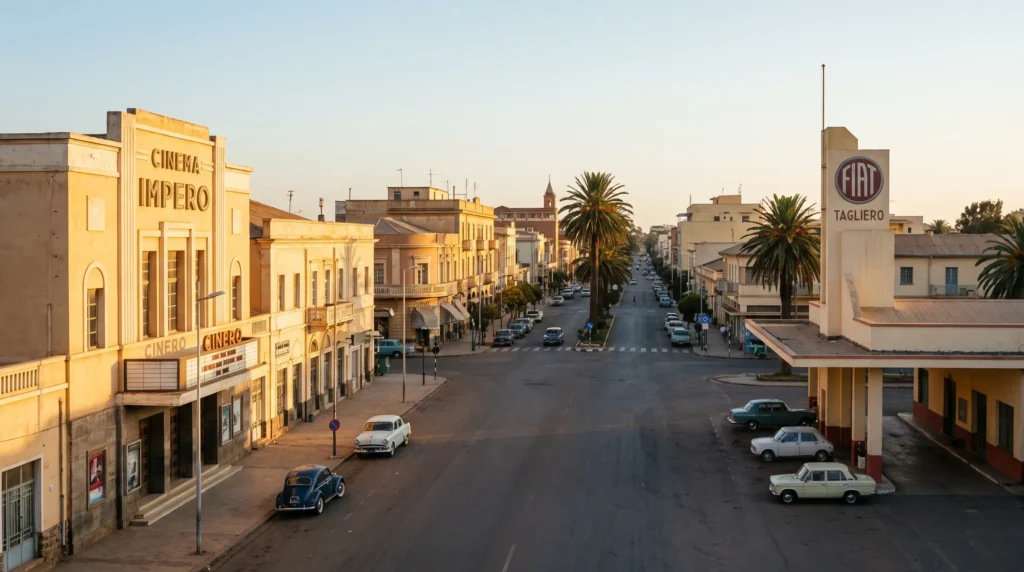
None of that is why people come. They come for Asmara, the 2,300-metre-high capital that Italian colonial planners rebuilt from the 1930s into a showcase of rationalist and Art Deco architecture — futurist cinemas, a Fiat Tagliero garage shaped like an airplane, cafés that still pour espresso the old way. UNESCO inscribed the city in 2017 as “Asmara: A Modernist City of Africa,” its first Eritrean listing and the first modernist World Heritage site on the continent, covering 481 hectares and more than 4,340 surveyed buildings. They come for the Dahlak Archipelago, over 200 Red Sea islands with reefs that see a fraction of the dive traffic of Egypt or Sudan just up the coast, and for Massawa, the port city whose Ottoman-Egyptian-Italian old town still stands (barely, in places) after a century of trade, war and earthquakes.
What Eritrea doesn’t have is a tourism industry in any normal sense: no visa on arrival for almost anyone, no ATMs that take foreign cards, and a permit system that governs movement outside the capital. Nearly everyone who visits does so through a licensed local operator who handles the paperwork. That’s not a sales pitch — it’s close to the only practical way in.
Festival Eritrea — Asmara’s August Cultural Bonanza
If you can time a trip around one date, make it early-to-mid August, when the annual National Festival takes over the Expo Grounds in Asmara. The 2025 edition ran 9–17 August, opened officially by the president, with each of Eritrea’s regions and ethnic groups building traditional “villages” showcasing food, dress, music and dance side by side. Expect book stalls, art and sculpture exhibitions, and evening concerts that run late into the warm highland night — it’s the single easiest way to see the country’s ethnic diversity compressed into one walkable fairground rather than chasing it across the map.
August also falls in Asmara’s rainy season, so pack a light layer for the highland showers and know that this is a controlled, state-organized event — expect a festive, orderly atmosphere rather than a chaotic street party.
Best Time to Visit Eritrea (Season by Season)
December – February · Cool and dry in the highlands
Asmara sits above 2,300 metres and this is its most pleasant stretch — crisp mornings, sunny days, and the easiest weather for wandering the modernist streets on foot. It overlaps with drier conditions on the coast too, though Massawa and the Red Sea shore stay warm to hot year-round regardless of season.
October – May · Prime window for the Dahlak Islands
Diving and snorkeling operators consider October through May the calm-seas season for the Dahlak Archipelago, with water temperatures around 24–30°C and the best underwater visibility of the year. This is also broadly the dry season for meningitis-belt precautions, which the CDC flags as relevant December through June.
June – September · Highland rains, coastal furnace
The highlands get their main rains in this window, which is also when Festival Eritrea runs in Asmara — pleasant enough up top, but the coastal lowlands around Massawa turn genuinely brutal, regularly pushing well past 40°C. Most visitors avoid pairing a coastal leg with a midsummer trip.
Getting There — ASM, Visas & the Fine Print
Asmara International Airport (ASM) is effectively the only way in — it’s the country’s sole airport with regular scheduled international service. As of 2026, direct flights connect Asmara to Istanbul (Turkish Airlines), Abu Dhabi (Etihad), Dubai (flydubai), Cairo (EgyptAir) and Jeddah, with Turkish Airlines’ roughly 4-hour-35 Istanbul route being the longest of the bunch. There are no direct flights from North America or Western Europe, so plan on one connection minimum, usually through the Gulf or Istanbul.
The visa is the real gatekeeper. Almost no nationality gets a visa on arrival or an e-visa — US citizens, for example, must apply in person or by mail through the Eritrean Embassy in Washington, D.C., with a minimum 15 business days of processing, and the resulting visa is generally valid for three months from issue and one month of use inside the country, extendable at Immigration in Asmara. Build the embassy visit into your planning timeline the way you’d plan for any other multi-week bureaucratic process — it is not something you can sort out the week before you fly.
Passports need at least six months’ validity and blank pages, a yellow fever certificate is required if you’re arriving from a country with yellow fever risk, and customs will want every electronic device declared on arrival.
Getting Around — Permits, Buses & Boats
This is the section where I have to be blunt: independent travel outside Asmara is not really a thing you plan yourself. Any journey beyond 25 kilometres of the capital requires a travel permit, and land borders — especially the long, tense frontier with Ethiopia — are areas both the US and UK governments advise against approaching at all, citing landmines and volatile conditions. In practice this means nearly every visitor moves through a licensed Eritrean tour operator who arranges permits, drivers and guides as a package — it removes the guesswork but also removes the option of winging it.
Within that structure, road trips down the escarpment from Asmara to Massawa (a dramatic, switchbacking two-to-three-hour drive that drops from cool highlands to sea-level heat) and up to Keren are the two classic day or overnight excursions. Buses and shared taxis exist for locals on these routes, but foreign visitors are generally expected to travel with their arranged guide. Getting out to the Dahlak Islands means a boat from Massawa, arranged as part of a dive or snorkeling trip rather than a public ferry service.
Top Regions — Highlands, Red Sea Coast & Beyond
Asmara
The reason most people come. Walk Harnet Avenue past Cinema Impero and the Art Deco Bar Zilli, admire the Fiat Tagliero service station’s cantilevered “wings,” and sit for an espresso at a café that’s been pulling the same shots since the 1940s. The UNESCO-listed core rewards slow, aimless walking more than any checklist.
Massawa
Down on the coast, Massawa’s Old Town blends Ottoman, Egyptian and Italian colonial architecture built largely from coral stone quarried nearby and from the Dahlaks. Much of it bears visible scars from war and earthquakes — the World Monuments Fund has flagged the historic town for its precarious condition — which makes wandering its narrow coral-block lanes feel less like a museum and more like an unfinished restoration project you’re allowed to walk through.
Dahlak Archipelago
Over 200 islands roughly 58 kilometres off Massawa, only a handful inhabited, ringed by reefs, walls and drop-offs that see very little diving pressure. Expect reef sharks, manta rays, turtles and dense schools of reef fish, usually accessed via liveaboard or a chartered day boat rather than resort infrastructure — there isn’t any.
Keren
Eritrea’s second city, a cooler highland town famous for its Monday livestock market, where camel, cattle and goat trading draws herders from as far as the Sudanese border. It’s also home to a well-known baobab tree wrapped around a small chapel and WWII-era Italian and British war cemeteries from the Battle of Keren.
The Northern Highlands & Sahel
The rugged mountain country around Nakfa was the heartland of the independence war, dotted with trenches and monuments that Eritreans regard with real reverence. This is also a region flagged for residual landmines, so it is guide-and-permit territory even by Eritrean standards.
Culture & People — Nine Ethnic Groups, One Coffee Ceremony
Eritrea officially recognizes nine ethnic groups — the Tigrinya are the largest and most widely spoken — each with its own language, dress and customs, and the country splits roughly evenly between Christianity and Islam. Asmara’s skyline reflects that mix directly: an Orthodox cathedral, a Catholic cathedral, and the Al Khulafa Al Rashiddin Grand Mosque all sit within a short walk of each other.
The daily ritual that ties it together is the coffee ceremony, shared with neighboring Ethiopia — green beans roasted over an open flame, ground by hand, brewed in a clay jebena, and poured in three rounds for guests and family. Being invited to one is a genuine gesture of hospitality; take the time, drink all three rounds if offered, and don’t rush it.
A Food Lover’s Guide to Eritrea
The everyday plate centers on injera, a spongy sourdough flatbread made from teff, served alongside tsebhi stews — beef, lamb or chicken simmered in berbere spice — and vegetarian lentil and split-pea versions during fasting periods observed by Orthodox Christians. Breakfast often means ful (stewed fava beans) reflecting the country’s coastal ties to the Red Sea and Arabia, alongside Italian-legacy staples: fresh pasta, macchiato and cappuccino are genuinely good and genuinely everywhere, a direct hangover from Italian colonial rule.
On the coast, grilled Red Sea fish and seafood dominate menus in Massawa. Melotti, brewed in Asmara since the Italian colonial era, is the local beer of choice, and no meal among friends properly ends without the coffee ceremony’s three rounds of jebena coffee and roasted popcorn.
Off the Beaten Path
Qohaito
A little-excavated plateau of pre-Aksumite ruins east of Asmara — stone dams, tombs and the remains of an ancient temple, visited by a trickle of people rather than a stream of them.
Dahlak Kebir
The largest of the Dahlak islands, home to the archipelago’s biggest population and traditional Dahlik-speaking fishing and camel-herding communities, plus scattered medieval Islamic cisterns and tombs largely left to the elements.
The Adulis Ruins
Near Zula on the coast, the remains of Adulis, once a major Aksumite-era Red Sea trading port, sit largely unmarked and unvisited despite their historical weight in the region’s ancient trade routes.
Sawa & the Nakfa Trenches
For travelers whose guide and permits extend that far, the war-era trench networks near Nakfa are a sobering, unpolished counterpoint to Asmara’s café culture — a reminder of how recently and how hard independence was won.
Practical Information
Money. The nakfa is officially pegged at 15 to the US dollar, but foreign cards are not accepted anywhere in the country and legal currency exchange happens only at state Himbol branches — bring the cash you need in clean, larger-denomination US dollars, and declare amounts over $10,000 at both entry and exit. You’re also limited to leaving with no more than 1,000 nakfa, so don’t over-convert.
Safety. The US State Department rates Eritrea Level 2 — Exercise Increased Caution — citing travel restrictions, limited consular assistance, wrongful detention risk and landmines in remote and border areas. The UK FCDO separately advises against all travel within 25 kilometres of any of Eritrea’s land borders given tensions with Ethiopia, and notes that even British diplomats need permits to leave Asmara. Stick to your operator’s planned route, keep your passport and permits on you, and check current advisories close to your departure date — this is not a country where conditions are static.
Health. The CDC recommends routine vaccines plus hepatitis A and B, typhoid, and meningococcal coverage if traveling in the dry season, and notes malaria risk in all areas below 2,200 metres elevation (so, everywhere except Asmara itself) — pack antimalarials and strong repellent. Avoid freshwater swimming due to schistosomiasis risk.
Connectivity. Internet is slow, state-controlled and unreliable by international standards; treat connectivity as a bonus, not a given. Plugs: mostly European two-pin (Type C/L), 230V. Time zone: UTC+3, no daylight saving.
Budget Breakdown — What Eritrea Actually Costs in 2026
Costs are modest by international standards, but the mandatory guide-and-permit structure adds a fixed overhead most budget destinations don’t have.
Budget (US$40–70/day): Simple Asmara guesthouse, local injera-and-stew meals, jebena coffee at neighborhood cafés, walking the UNESCO core independently.
Mid-range (US$100–180/day): A licensed guide and driver for excursions to Massawa or Keren, mid-tier hotel, restaurant meals including Italian-Eritrean fusion, a day snorkeling trip toward the Dahlaks.
Higher-end (US$250+/day): Multi-day Dahlak Archipelago dive charter or liveaboard, private guided circuits covering the highlands and coast, better hotels in Asmara.
Bring all the cash you’ll need in US dollars — there is no ATM or card fallback once you’re past Asmara’s very limited options, and unspent nakfa is difficult to reconvert on exit given the 1,000-nakfa departure limit.
Planning Your First Trip to Eritrea
Start the visa application through the Eritrean Embassy at least a month before you want to travel — this single step determines everything else about your timeline. Book through a licensed local operator who can arrange your travel permits alongside the trip itself; trying to freelance the permit system is the fastest way to lose days of a short visit. A workable first-timer’s frame is four or five days: two or three in Asmara for the UNESCO core and Festival Eritrea if your dates line up, one day trip down the escarpment to Massawa, and — if time and permits allow — an overnight on the Dahlaks. Eritrea pairs naturally, at least on the map, with a longer Horn-of-Africa itinerary; many travelers combine it with our Ethiopia guide next door for Aksum and the Danakil, or with Egypt’s Red Sea coast further north for a contrast in how differently two countries can develop the same sea.
Frequently Asked Questions
Is Eritrea safe for tourists in 2026?
Asmara itself is generally calm and walkable. The concerns flagged by the US State Department (Level 2) and UK FCDO center on travel restrictions, limited consular help, wrongful-detention risk and landmines in remote and border regions — not everyday street crime in the capital. Stay within your permitted areas, travel with your arranged guide outside Asmara, and check current advisories before you fly.
Do I need a visa, and can I get one on arrival?
Yes to a visa for nearly every nationality, and no to arrival visas for most — including US citizens, who must apply in advance through the Eritrean Embassy in Washington, D.C., with roughly 15 business days of processing. Apply well ahead of your trip.
Can I just rent a car and explore on my own?
Not really. Travel beyond 25 kilometres of Asmara requires a permit, and nearly all visitors move through a licensed local operator who arranges permits, drivers and guides together. Budget for that as a fixed part of the trip, not an optional upgrade.
What can I actually bring cash-wise, and do cards work?
Bring US dollars in cash — foreign cards are not accepted anywhere in the country. Declare amounts over $10,000 at entry and exit, and note you can’t leave with more than 1,000 nakfa, so don’t over-exchange.
Eritrea or Ethiopia for a Horn-of-Africa trip?
Choose Ethiopia first if you want easier logistics, more developed tourism infrastructure and rock-hewn churches at Lalibela; add Eritrea if what you actually want is Asmara’s frozen-in-time Art Deco streets and an empty stretch of Red Sea reef, and you’re comfortable with the visa and permit overhead. Many travelers do both on one longer Horn-of-Africa itinerary.
Is the Dahlak Archipelago worth the effort to reach?
For divers and snorkelers who want reefs without crowds, yes — the archipelago’s over 200 islands see a fraction of the traffic of the northern Red Sea, with warm water and strong visibility from October to May. Go through an operator who runs the boat charters; there’s no independent ferry infrastructure.
Ready to Explore Eritrea?
Espresso on an Art Deco boulevard at 2,300 metres, a coral-block old town slowly weathering by the Red Sea, and a reef archipelago that barely anyone dives. Eritrea makes you work for it — the visa, the permits, the cash-only economy — but that same friction is why Asmara still looks the way it did in 1938, and why the Dahlaks still look the way reefs looked before everyone else found them.
Explore More
- Ethiopia Travel Guide — Aksum, Lalibela and the Danakil next door
- Egypt Travel Guide — the Red Sea’s other, busier coastline
- Kenya Travel Guide — continue the Horn-and-East-Africa circuit south
- Tanzania Travel Guide — Zanzibar’s Indian Ocean coast for comparison
How this guide was built
Published as part of Facts From Upstairs’ country guide series. Built from authoritative sources — UNESCO’s World Heritage Centre listing for Asmara, the US State Department’s Eritrea international travel information page, the UK FCDO’s Eritrea travel advice, the US CDC traveler health page for Eritrea, the Eritrean Embassy in Washington D.C.’s visa page, and Wikipedia entity pages for Eritrea, the Eritrean nakfa, Asmara International Airport, the Dahlak Archipelago, Massawa and Eritrean culture, plus the World Monuments Fund’s Massawa Historic Town listing and Eritrea’s Ministry of Information coverage of the annual National Festival. Numeric and checkable claims carry inline citations.
Sources cited on this page
- Wikipedia — Eritrea
- UNESCO — Asmara: A Modernist City of Africa
- US State Department — Eritrea
- UK FCDO — Eritrea
- US CDC — Eritrea traveler page
- Embassy of Eritrea, Washington D.C. — Visa information
- Wikipedia — Eritrean nakfa
- Wikipedia — Asmara International Airport
- Wikipedia — Dahlak Archipelago
- Wikipedia — Massawa
- Wikipedia — Culture of Eritrea
- Wikipedia — Coffee ceremony of Ethiopia and Eritrea
- World Monuments Fund — Massawa Historic Town
- Worldometer — Eritrea Population
- Eritrea Ministry of Information — National Eritrean Festival 2025
- Lonely Planet — Keren Camel Market
More country guides you might like
Plan your trip to Eritrea
The booking tools we use ourselves. FFU may earn a commission at no extra cost to you.
Plan & book your trip to Eritrea
Booking through these searches supports our guides at no extra cost to you.