
Languages of Myanmar (Burma)
All languages of Southeast Asia →fluent beta classical · classes by phone with Maya at ranas.ai/maya
Myanmar Travel Guide — Bagan’s Temple Plains, Inle Lake & What You Actually Need to Know Before You Go
I need to start this one differently than I start most FFU guides, because Myanmar is different. This is a country of roughly 55.8 million people that holds one of the most staggering sights in Southeast Asia — over two thousand surviving temples scattered across the Bagan plain — alongside floating gardens on Inle Lake, a 99-metre gold pagoda glowing over Yangon , and some of the warmest hospitality I’ve encountered anywhere. It is also, as of mid-2026, a country under a US State Department Level 4 “Do Not Travel” advisory and a UK FCDO warning covering large parts of its territory, the result of an armed conflict that has run since the 2021 military coup. I’m not going to bury that under the temple photos, and I’m not going to pretend it isn’t the single biggest factor in whether this trip is right for you right now. What follows is the honest version: what Myanmar offers, what the current situation actually restricts, and how to make a genuinely informed call rather than a romantic one.
In This Guide
- Overview — Why Myanmar Is Extraordinary and Why It’s Complicated
- Thingyan — Myanmar’s New Year Water Festival
- Best Time to Visit Myanmar (Season by Season)
- Getting There — Yangon International & Overland Routes
- Getting Around — Domestic Flights, Trains & River Boats
- Top Regions — The Classic Circuit
- Culture & People
- A Food Lover’s Guide to Myanmar
- Off the Beaten Path
- Practical Information — Money, Safety & Health
- Budget Breakdown — What Myanmar Actually Costs
- Frequently Asked Questions
Overview — Why Myanmar Is Extraordinary and Why It’s Complicated
Myanmar (also called Burma) is the largest country in mainland Southeast Asia by area, at roughly 676,579 square kilometres, sharing borders with India, Bangladesh, China, Laos and Thailand and a long coastline along the Andaman Sea and Bay of Bengal. Buddhism shapes daily life more visibly here than almost anywhere else I’ve traveled — around 88% of the population identifies as Buddhist — and it shows in gilded stupas on every hilltop, monks collecting alms at dawn, and a rhythm of merit-making that structures the calendar.
The travel highlight reel writes itself: Bagan’s temple-studded plain, the last royal capital at Mandalay, the leg-rowers and floating villages of Inle Lake, and Yangon’s Shwedagon Pagoda lit gold at dusk. For much of the 2010s this was one of Asia’s fastest-growing travel stories, a country opening up after decades of isolation. That story reversed hard after the February 2021 military coup, which triggered nationwide resistance and armed conflict that continues in 2026, even as the country transitioned to a nominally civilian government this year.
Here’s the honest bottom line I’d give a friend: the US government currently rates Myanmar Level 4, its highest “Do Not Travel” category, citing armed conflict, civil unrest, land mines, arbitrary enforcement of local law, crime and the risk of wrongful detention of foreign nationals. The UK FCDO advises against all travel to most states and regions outside the traditional Yangon–Mandalay–Bagan–Inle Lake corridor, and against all but essential travel even within parts of that corridor. This guide describes Myanmar as the remarkable destination it is, but I’m writing it for readers doing serious due diligence before deciding whether — and how — to go, not as an unqualified recommendation. Check current advisories the week you’d actually book, not the week you first got curious.
Thingyan — Myanmar’s New Year Water Festival
If there’s one date to build a hypothetical itinerary around, it’s Thingyan, the Burmese New Year water festival held annually from 13 to 16 April. The premise is simple and joyful: everyone, everywhere, throws water at everyone else, symbolically washing away the previous year’s misfortune before the new year begins. Streets fill with makeshift stages, hoses and buckets; pandal (stage) crews blast music at intersections in Yangon and Mandalay; and the whole country effectively takes four days off to get soaked. UNESCO has recognized Thingyan on its Intangible Cultural Heritage list for its role in Myanmar’s cultural and religious life.
It’s also, practically speaking, one of the more chaotic weeks to travel — transport booking opens early and fills fast, many businesses close for the holiday, and city streets are genuinely soaked from morning to night. If the idea appeals, plan well ahead and expect a festival atmosphere rather than a sightseeing pace.
Best Time to Visit Myanmar (Season by Season)
October – February · Cool, dry season (peak)
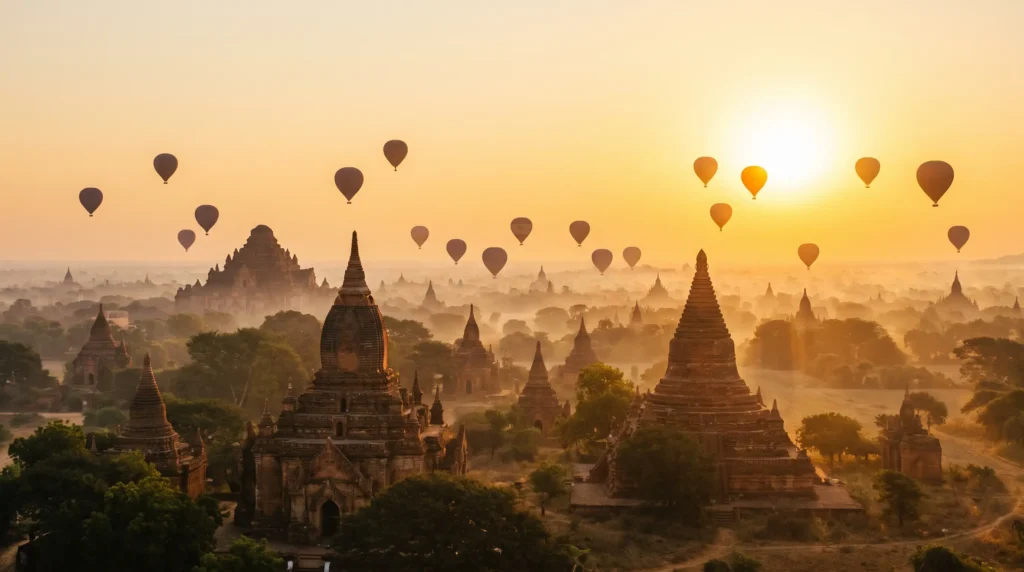
The classic window and the one nearly every “Big Four” itinerary (Yangon, Mandalay, Bagan, Inle Lake) is built around: clear skies, comfortable daytime temperatures, and the best conditions for sunrise balloon views over Bagan’s temples and cool mornings on Inle Lake. This is also peak pricing and the busiest month at major sites, December and January especially.
March – May · Hot season
Temperatures climb fast, especially in the central dry zone around Bagan and Mandalay, where April afternoons regularly push past 38°C (100°F). Thingyan falls in mid-April, right in the thick of this heat. Doable, but pack for it and slow down midday.
June – September · Southwest monsoon
Heavy, sustained rain across most of the country, particularly along the coast and in Yangon; travel logistics get harder and some rural roads become impassable. The dry-zone towns (Bagan, Mandalay) sit in a rain shadow and see noticeably less rainfall than the coast, which is why some operators pitch this as a legitimate shoulder season for the central circuit specifically — though it remains the least predictable window overall.
Getting There — Yangon International & Overland Routes
Yangon International Airport (RGN), around 15 kilometres north of downtown Yangon, is the country’s main international gateway, handling regional connections into Southeast Asia, South Asia and East Asia. Mandalay International Airport is the secondary gateway with a smaller set of regional links. There are no direct long-haul flights from North America or Europe; realistic routings connect through Bangkok, Singapore, Kuala Lumpur or Doha.
Almost all nationalities need a visa arranged before or on arrival — the tourist e-Visa, applied for online through the official government portal, is the standard route for most passport holders. A smaller number of nationalities qualify for visa-on-arrival, and land border crossings from Thailand exist but have been subject to closures and restrictions tied to the ongoing conflict — verify current status directly with your embassy or a specialist operator before planning an overland entry, since this changes without much notice.
Getting Around — Domestic Flights, Trains & River Boats
Domestic flights connect Yangon, Mandalay, Bagan (Nyaung U airport) and Heho (for Inle Lake) and are, for most itineraries, the sensible way to link the main circuit given both distances and the current security situation on many overland routes. Multiple domestic carriers operate this network, though schedules and reliability can shift with fuel availability and airspace conditions — build in buffer days rather than tight connections.
Myanmar’s rail network is extensive but slow by design, including the famous Gokteik Viaduct crossing in northern Shan State; it’s a scenic option where security conditions allow, not a practical way to cover ground quickly. River travel on the Irrawaddy — slow boats and faster private charters between Mandalay and Bagan — remains one of the more atmospheric ways to arrive at the temple plain. Within towns, taxis, trishaws and hired cars with drivers are the norm; self-driving is uncommon for visitors.
Top Regions — The Classic Circuit
Given the current advisories described above, the practical, most commonly recommended itinerary sticks to the traditional “Big Four” corridor. Regions outside it — including large parts of Rakhine, Kachin, Kayin, Chin, Kayah and Shan states, and swaths of Sagaing, Magway and Bago — currently carry “avoid all travel” advisories from the FCDO, and travel to them is not something this guide recommends.
Yangon
The country’s largest city and commercial hub, still officially former capital in most visitors’ minds even though Naypyidaw is the administrative capital. The unmissable sight is Shwedagon Pagoda, a gold-plated stupa on Singuttara Hill that rises 99 metres and anchors the skyline. Downtown’s colonial-era architecture, the Bogyoke Aung San Market, and Yangon’s genuinely excellent tea shop culture round out a base of two or three days.
Bagan
The reason most people book the trip in the first place: a river-plain scattered with the remains of more than 2,200 surviving Buddhist temples and pagodas, built mostly between the 11th and 13th centuries when Bagan was capital of the Pagan Kingdom. UNESCO inscribed Bagan as a World Heritage Site in 2019. Sunrise, whether from a designated viewing mound or a hot-air balloon, is the postcard moment; e-bike rental lets you cover the plain at your own pace across a full day or two.
Mandalay
Myanmar’s last royal capital and its cultural and religious heart, with the Mandalay Palace, U Bein Bridge’s teak causeway at Amarapura, and Mahamuni Pagoda’s devotional gold-leafing rituals. It’s also the jumping-off point for Sagaing Hill’s hillside monasteries and, historically, day trips further north — though northern Shan State and Sagaing region currently carry heightened or full “avoid” advisories, so confirm the specific township before planning anything beyond the city itself.
Inle Lake
A vast shallow lake in Shan State ringed by hills, known for iconic leg-rowing fishermen, floating vegetable gardens, and stilted villages of the Intha people. Boat trips typically combine lake life with visits to weaving and silversmith workshops and the Nyaung Shwe market circuit. Southern Shan State around Inle sits in the FCDO’s “essential travel only” tier rather than the full-avoidance tier that covers Shan State’s north and east — a distinction worth understanding rather than glossing over.
Naypyidaw
The purpose-built administrative capital, mostly of interest as a transit curiosity — vast empty highways and government buildings rather than a destination in its own right. Most itineraries skip it entirely.
Culture & People
Myanmar’s population is majority Bamar, but the country recognizes a striking range of ethnic groups beyond that — Shan, Kayin (Karen), Rakhine, Mon, Kachin, Chin and many smaller communities, each with distinct languages, dress and, in several cases, their own armed political movements that are central to the current conflict. Buddhism is the dominant faith at roughly 88% of the population, with Christian, Muslim, Hindu and animist minorities concentrated in specific regions and ethnic communities.
Daily religious practice is visible and participatory: monks walking pre-dawn alms rounds, gold-leafing at pagodas, novitiation ceremonies for young boys entering temporary monkhood. Visitors are generally welcomed warmly in the areas that remain open to tourism, and Burmese hospitality toward guests is frequently cited by travelers as a highlight that outlasts the trip itself — dress modestly at religious sites (shoulders and knees covered, shoes off before entering pagoda platforms) and ask before photographing people, especially in ethnic minority areas.
A Food Lover’s Guide to Myanmar
The national dish is mohinga — a fish-based broth with rice noodles, typically eaten at breakfast from streetside stalls, topped with crispy fritters, boiled egg and a squeeze of lime. It sits at the crossroads of Myanmar’s neighbors: curries show Indian influence, noodle dishes lean toward China and Yunnan, and salads are distinctly Burmese.
That last category is where Myanmar really stands apart: lahpet thoke, fermented tea-leaf salad tossed with fried garlic, peanuts, sesame and dried shrimp, is unlike anything else in the region and worth seeking out specifically. Shan noodles (thin rice noodles in a light, often tomato-based sauce, a specialty of Shan State and widely available in Inle Lake towns) and ohn no khao swè (coconut chicken noodle soup) are two more dishes worth building a meal around. Tea shops are a genuine social institution — strong, sweet, milky tea served alongside fried snacks — and a good barometer for how a town actually lives day to day, separate from its temples.
Off the Beaten Path
Under normal circumstances, Myanmar’s “off the beaten path” list would run long: Mrauk U’s overgrown temple ruins in Rakhine State, hill-tribe trekking around Hsipaw and Kalaw in Shan State, the beaches of the Myeik Archipelago in the deep south. In 2026, several of these sit in regions the FCDO advises against visiting entirely or advises visiting only for essential purposes, and this guide isn’t going to romanticize routes into areas under active conflict advisories.
Within the areas that remain more commonly visited, the quieter options are usually a matter of pace rather than geography: exploring Bagan’s eastern and southern temple clusters by e-bike rather than the handful of famous viewpoints, spending an extra day in Nyaung Shwe’s back lanes away from Inle’s main boat jetties, or picking a Yangon neighborhood tea shop over the guidebook favorite. Given how fluid the security picture is, the single best “off the beaten path” resource right now is a specialist Myanmar-focused tour operator or your embassy’s current guidance, not a list frozen in a blog post.
Practical Information — Money, Safety & Health
Safety, in detail. This is the section to actually read. The US State Department rates Myanmar Level 4, “Do Not Travel,” citing armed conflict occurring across many states and regions, civil unrest, arbitrary enforcement of local law, land mines and unexploded ordnance, crime, and a determined risk of wrongful detention of US nationals by the ruling authorities; the US Embassy in Yangon has also noted an average of roughly six explosive incidents per month across the greater Yangon area through 2025. The UK FCDO advises against all travel to Chin, Kachin, Kayah, Kayin, Mon and Rakhine states, most of Sagaing and Magway regions, northern Shan State and parts of Tanintharyi and Bago, and against all but essential travel to the rest of Shan State, Mandalay Region, southern Tanintharyi and remaining parts of Bago and Ayeyarwady. The security situation can deteriorate with little warning, and travel insurance is commonly invalidated by travel against a government’s advisory — check your own policy’s wording specifically. If you decide to travel anyway, register with your embassy, carry comprehensive evacuation-capable insurance, and reconfirm the advisory the week of departure, not months in advance.
Money. The Kyat floats and has moved substantially over the past several years; check the Central Bank of Myanmar’s reference rate or a live currency tool close to your travel dates rather than relying on any fixed number. Myanmar remains largely a cash economy for visitors — international card acceptance is limited outside a handful of hotels in Yangon and Mandalay, and ATM reliability varies. US dollars are useful as backup cash but banks and exchange counters are notoriously strict about condition: bring bills that are crisp, unfolded and free of any marks or stamps.
Health. The CDC recommends routine vaccines plus Hepatitis A for most travelers, and Japanese encephalitis vaccination for those spending a month or more in country or with rural, outdoor-heavy itineraries; malaria risk is present below about 1,000 metres elevation and is considered moderate, and cholera transmission has been reported in recent years. Hospitals meeting international standards are concentrated in Yangon and Mandalay only; anywhere else, medical evacuation coverage matters.
Connectivity & logistics. Myanmar keeps its own quirky half-hour time zone, Myanmar Standard Time at UTC+6:30, one of only a handful of such offsets worldwide. Power sockets are a genuine mixed bag — types C, D, F and G all appear, sometimes in the same hotel — so a universal adapter is worth packing rather than a single-type one. Mobile data coverage and internet access can be restricted or throttled depending on the security situation in a given area.
Budget Breakdown — What Myanmar Actually Costs
Myanmar remains inexpensive by regional standards even accounting for the tourism infrastructure that’s shrunk since the 2010s boom years.
Budget (US$25–45/day): Guesthouse rooms, mohinga and tea-shop meals, shared taxis and public buses between the main circuit towns, temple-entry fees at Bagan and Inle Lake’s zone fee.
Mid-range (US$70–150/day): Comfortable hotels in Yangon, Mandalay and Nyaung Shwe, private drivers between sites, a Bagan hot-air balloon flight (historically one of the pricier single line-items on a Myanmar itinerary), a full-day Inle Lake private boat.
Upscale (US$250+/day): Boutique lakeside or temple-view properties, domestic flights instead of overland transfers, private guided touring throughout.
Carry more cash than you think you’ll need given limited card acceptance, and budget separately for entry fees — Bagan’s archaeological zone fee and Inle Lake’s zone fee are both charged once per visit and collected at entry points.
Planning Your First Trip to Myanmar
If, after weighing the current advisories against your own risk tolerance, you decide to go, the classic route runs Yangon (2–3 nights) → fly to Bagan (2–3 nights) → fly or boat to Mandalay (2 nights) → fly to Heho for Inle Lake (2–3 nights) → fly back to Yangon to depart — roughly ten days to two weeks covers the full circuit without rushing. Many travelers pair it conceptually with neighboring Southeast Asian trips: our Thailand guide covers the most common regional gateway and onward connection, while our Cambodia guide and Laos guide cover the region’s other great Buddhist-heritage circuits — Angkor and Luang Prabang respectively — for travelers comparing where to spend limited Southeast Asia time this year.
Frequently Asked Questions
Is Myanmar safe to visit in 2026?
Officially, no government is telling you it is: the US rates it Level 4, “Do Not Travel,” and the UK FCDO advises against travel to most of the country outside the Yangon–Mandalay–Bagan–Inle corridor, with “essential travel only” guidance even within parts of that corridor. Read both advisories in full, understand that conditions change quickly, and make your own informed call — this isn’t a guide that’s going to tell you it’s fine.
Do I need a visa?
Yes, almost everyone does. Most nationalities apply for an e-Visa online in advance through the official government portal, generally costing around US$50 for a single-entry stay of up to about 28 days; a small number of nationalities qualify for visa-free entry or visa-on-arrival.
What’s the best time to visit?
October through February, the cool dry season, is the most comfortable and most commonly recommended window for the Bagan–Mandalay–Inle circuit. March–May turns hot, especially inland, and June–September brings the southwest monsoon, heaviest on the coast and lighter in the dry-zone towns.
Can I use credit or debit cards?
Rarely, and don’t count on it. Card acceptance is limited to a handful of hotels and upscale restaurants mainly in Yangon and Mandalay; plan for a cash-based trip with US dollars as backup, in pristine, unmarked condition.
Myanmar or Cambodia for temple travel?
Bagan’s sheer density of surviving temples rivals Angkor’s, and it currently sees far fewer visitors, which is either the appeal or a red flag depending on why the crowds have thinned. Cambodia’s Angkor complex has a far more developed, stable tourism infrastructure and none of Myanmar’s current travel advisories — for most travelers weighing the two right now, that’s the deciding factor rather than the ruins themselves. See our Cambodia guide for the Angkor side of that comparison.
Is it ethical to travel to Myanmar right now?
This is a genuinely debated question with no single right answer, and it’s separate from the safety question above — some travelers and advocacy groups argue tourism revenue can indirectly support the ruling authorities, while others argue responsible, independently-booked travel supports local livelihoods directly. We’d encourage reading current guidance from your own government and from Myanmar-focused human rights and travel organizations before deciding, rather than taking either position as settled here.
Thinking About Myanmar?
Bagan’s temple plain at sunrise is one of the most extraordinary sights I can point you toward anywhere in this guide series — and I’d be doing you a disservice if I let that photo do the talking without the rest of this page. Read the current advisories in full, talk to a specialist operator who works this route regularly, and go in with clear eyes about which regions are genuinely open to you right now.
Explore More
- Thailand Travel Guide — the region’s main gateway and easiest onward connection
- Cambodia Travel Guide — Angkor’s temple circuit, the closest comparison to Bagan
- Laos Travel Guide — Luang Prabang and the Mekong’s slower Buddhist heritage circuit
- Vietnam Travel Guide — for a Southeast Asia trip built around currently open, well-developed routes
How this guide was built
Published . Built from authoritative sources — the US State Department’s Burma travel advisory, the UK FCDO’s Myanmar travel advice, the US CDC traveler page for Burma, Myanmar’s official government e-Visa portal, the Central Bank of Myanmar’s reference exchange rate page, and Wikipedia entity pages for Myanmar’s geography and demographics, Bagan, Shwedagon Pagoda, Yangon International Airport, Thingyan, Myanmar Standard Time, and Myanmar’s visa policy and World Heritage Sites. Given the fast-moving security situation, safety and advisory claims specifically should be re-verified against the live State Department and FCDO pages before booking — this guide reflects information gathered in July 2026. Numeric and checkable claims carry inline citations.
Sources cited on this page
- US State Department — Burma Travel Advisory
- UK FCDO — Myanmar Travel Advice
- US CDC — Burma Traveler Health Page
- Myanmar eVisa — Official Government Portal
- Central Bank of Myanmar — Reference Exchange Rate
- Wikipedia — Myanmar
- Wikipedia — Bagan
- Wikipedia — Shwedagon Pagoda
- Wikipedia — Yangon International Airport
- Wikipedia — Thingyan
- Wikipedia — Myanmar Standard Time
- Wikipedia — Visa Policy of Myanmar
- Wikipedia — List of World Heritage Sites in Myanmar
More country guides you might like
Plan your trip to Myanmar
The booking tools we use ourselves. FFU may earn a commission at no extra cost to you.
Plan & book your trip to Myanmar
Booking through these searches supports our guides at no extra cost to you.