
Languages of Congo - Brazzaville
All languages of Middle Africa →fluent beta classical · classes by phone with Maya at ranas.ai/maya
Congo Travel Guide — Gorilla Trekking, the Congo River & Central Africa’s Quietest Rainforest
Let’s clear something up first, because it trips up almost every traveler who searches for this guide: this is the Republic of the Congo — Congo-Brazzaville, named for its capital — not its far larger, far more troubled neighbor across the river, the Democratic Republic of the Congo. The two capitals, Brazzaville and Kinshasa, happen to be the closest pair of national capitals on the planet, close enough that a fifteen-minute ferry crosses the Congo River between them. Beyond that river, the Republic of the Congo is its own quiet, oil-funded, French-speaking country of dense equatorial rainforest, savanna, and a coastline most people don’t know it has. I won’t pretend this is an easy trip — the visa takes planning, the infrastructure is thin, and gorilla trekking here costs real money — but for travelers willing to do the paperwork, it delivers something Uganda and Rwanda increasingly can’t: a national park where you might be the only vehicle on the track all day.
In This Guide
- Overview — Congo-Brazzaville, Explained
- Dry-Season Gorilla Trekking & Independence Day
- Best Time to Visit Congo (Season by Season)
- Getting There — Maya-Maya Airport & the River Crossing
- Getting Around — Bush Flights, Rivers & Rough Roads
- Top Regions — Brazzaville to the Congo Basin
- Culture & People
- A Food Lover’s Guide to Congo
- Off the Beaten Path
- Practical Information
- Budget Breakdown — What Congo Actually Costs in 2026
- Frequently Asked Questions
Overview — Congo-Brazzaville, Explained
The Republic of the Congo sits astride the Equator in west-central Africa, wedged between Gabon, Cameroon, the Central African Republic, and — across the Congo River — the much larger Democratic Republic of the Congo. It’s a country of roughly 6.3 million people spread across 342,000 square kilometers, most of them concentrated in the southwestern cities; the deep north is Congo Basin rainforest, some of the least-disturbed forest left on Earth. Independence from France came on 15 August 1960, and French remains the language of government, business, and street signs, even as Kituba and Lingala dominate daily conversation.
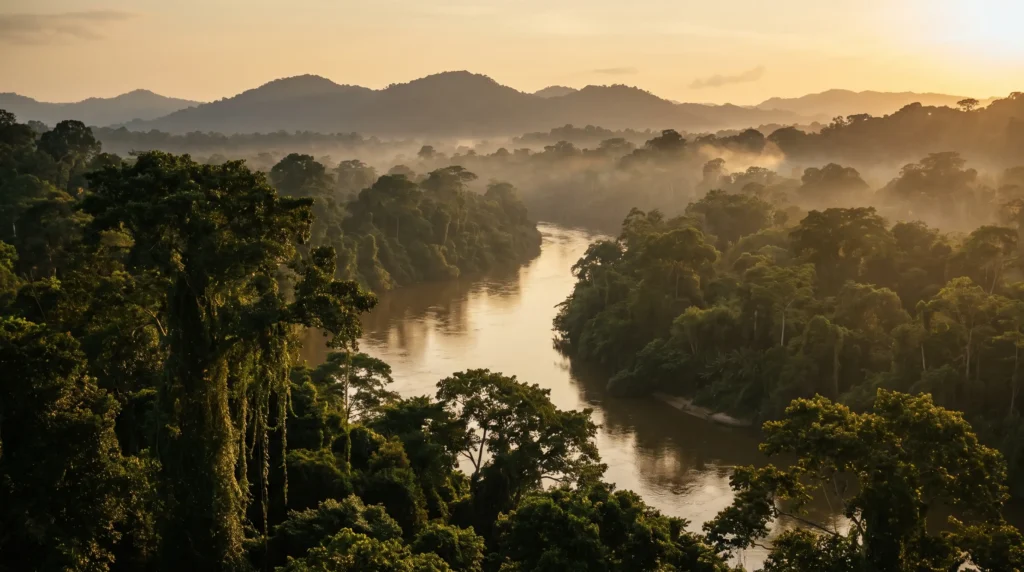
Petroleum built modern Brazzaville and Pointe-Noire — Congo is one of the larger oil producers on the Gulf of Guinea — and that money shows up as surprisingly good pavement in the two big cities and almost none of it beyond them. What the country sells travelers instead is space and wildlife: two UNESCO natural World Heritage sites, western lowland gorillas you can trek to without a lottery system, forest elephants, and 170 kilometers of underused Atlantic beach. This is not a backpacker circuit and it doesn’t pretend to be — outside Brazzaville and Pointe-Noire, tourism infrastructure is minimal, English is rare, and every serious trip into the parks runs through a handful of specialist operators. If that sounds like a lot of friction for a national park, it is — and it’s exactly why Odzala-Kokoua still feels the way East Africa’s gorilla parks did thirty years ago.
Dry-Season Gorilla Trekking & Independence Day
Congo’s gorilla trekking runs year-round but is genuinely better in the two dry windows — June to September and December to February — when forest trails firm up and trekking is less of a mud crawl. Odzala-Kokoua National Park, in the northwest, holds some of the densest western lowland gorilla and forest elephant populations left in Central Africa, and it earned UNESCO World Heritage status only in September 2023 — recent enough that most travel searches still haven’t caught up to it.
If you’re reading this in July, you’re already inside the June–September dry window — and closing in on the country’s biggest civic date, Independence Day on 15 August, marking the end of French colonial rule in 1960. Brazzaville marks it with parades and closures; if your trip overlaps the date, expect government offices (including anywhere handling visa extensions) to be shut, and book transport a few days either side of it.
Best Time to Visit Congo (Season by Season)
June – September · Long dry season
The most reliable window for gorilla and elephant trekking in Odzala-Kokoua and Nouabalé-Ndoki, with firmer trails and less rain. Coastal Pointe-Noire actually cools and greys over in this stretch — the Atlantic here runs a mild upwelling season — so don’t plan a beach trip around these months.
October – November · Short rains
A shoulder season: forest is lush, lodges are quieter, and rates soften before the December peak. Trails get muddier but wildlife viewing stays good.
December – February · Short dry season
The second good trekking window and Congo’s other reliable dry stretch — busier at the handful of gorilla lodges since it overlaps Northern Hemisphere holidays, so book Odzala accommodation well ahead.
March – May · Long rains
The wettest, muddiest months, hardest on forest trekking and rural roads. Brazzaville and Pointe-Noire function fine; expect the interior to slow down.
Getting There — Maya-Maya Airport & the River Crossing
Maya-Maya International Airport (BZV) in Brazzaville is the country’s main gateway, with Air France running the core European link to Paris and Ethiopian Airlines connecting via Addis Ababa; Royal Air Maroc, ASKY, Afrijet, Air Côte d’Ivoire and TAAG cover regional West and Central African routes. There is no direct nonstop from North America — routing through Paris, Addis Ababa, or Casablanca is standard. Pointe-Noire’s airport handles some regional and charter traffic for travelers heading straight to the coast.
The genuinely unusual option: fly into Kinshasa (DRC) and cross the Congo River by ferry to Brazzaville in about fifteen minutes — the two capitals are the closest national capitals on Earth, separated by the river rather than a border checkpoint of any real distance. This route requires separate visas and entry formalities for both countries and is not a shortcut around Congo’s own visa process — plan it as two country entries, not one.
Getting Around — Bush Flights, Rivers & Rough Roads
Congo has one paved corridor that matters to travelers: the road and rail link between Brazzaville and Pointe-Noire. Beyond that, the country runs on small aircraft, river barges, and 4x4s. Getting to Odzala-Kokoua or Nouabalé-Ndoki independently is genuinely impractical — nearly every visitor books a package through a specialist operator that includes light-aircraft charters from Brazzaville, since the alternative is a multi-day river-and-road slog through rainforest with no tourist services along the way.
Within Brazzaville and Pointe-Noire, taxis (shared and private) and ride-hailing apps cover city transport. Self-driving outside the two cities is uncommon among visitors and not recommended without local experience — road conditions deteriorate fast once pavement ends, and fuel stops thin out.
Top Regions — Brazzaville to the Congo Basin
Brazzaville
The capital and river-port city, home to the Basilique Sainte-Anne, lively riverside markets, and the closest big-city view of Kinshasa across the water. Most trips start and end here, since it’s the hub for both domestic flights and Odzala charters.
Pointe-Noire & the Atlantic Coast
Congo’s second city and its beach town, with 160 kilometers of coastline nearby and a more relaxed, port-city feel than Brazzaville. Diosso Gorge, a set of striking red-ochre canyon formations just north of the city, is the standout day trip.
Odzala-Kokoua National Park
The marquee wildlife destination: a UNESCO World Heritage forest massif in the northwest managed with African Parks, holding major populations of western lowland gorillas, forest elephants, and chimpanzees. Access is exclusively by charter flight and lodge package.
Nouabalé-Ndoki National Park
Part of the tri-national Sangha Trinational World Heritage site shared with Cameroon and the Central African Republic, protecting roughly 750,000 hectares of contiguous rainforest and famed for its forest elephant “bais” (natural forest clearings). Even more remote than Odzala, and correspondingly rarer to visit.
The Niari Valley & Mayombe Massif
Southwest of Brazzaville, a landscape of savanna plains folding into the forested Mayombe mountains near the Gabon border — scenic, agricultural, and almost entirely off the tourist map.
Cuvette & the Congo Basin North
Flooded forest and river country stretching toward the Central African Republic and DRC borders — the heart of the Congo Basin, reached mainly by river barge and small plane, and the setting for the country’s most remote conservation areas.
Culture & People
The Bakongo make up the largest group at roughly 41% of the population, followed by the Bateke (about 17%), Mbochi (about 13%), and Sangha peoples, alongside smaller communities of forest-dwelling Pygmy peoples whose traditional knowledge underpins much of the country’s conservation and tracking work in the northern parks. French is the language of school and government, but Kituba (in the south) and Lingala (in the north and Brazzaville) are what you’ll actually hear on the street and in markets.
Congolese rumba and sapeur fashion culture — the sharply, colorfully suited “SAPE” dandies of Brazzaville — are two of the country’s best-known cultural exports, and Brazzaville’s live-music scene draws on decades of rumba tradition shared with Kinshasa across the river. Independence Day on 15 August is the biggest national date on the calendar, with Brazzaville hosting the main parades and gatherings.
A Food Lover’s Guide to Congo
Cassava (manioc) is the staple, served as chikwangue — cassava dough steamed in leaves — or pounded into fufu, and eaten alongside saka-saka, cassava leaves stewed with palm oil, often with smoked fish or bushmeat where legally sourced. Grilled river fish — capitaine (Nile perch) and tilapia — is a staple along the Congo and Sangha rivers, and Pointe-Noire’s coastal kitchens lean into fresh Atlantic seafood.
Peanut-based sauces (mwambe) show up over chicken or fish, and plantains, both fried and boiled, are everywhere. Palm wine is the traditional drink of choice in rural areas; in the cities, look for Congolese-brewed lagers alongside imported beer. Markets in Brazzaville and Pointe-Noire are the easiest way to sample street food safely — go where the turnover is fast and the food is hot off the fire.
Off the Beaten Path
Sangha Trinational’s Nouabalé-Ndoki Bais
Forest clearings where elephants, buffalo, and gorillas congregate to feed on mineral-rich soil — a wildlife spectacle unique to Congo Basin forests, accessible only through licensed operators due to the park’s remoteness.
Diosso Gorge
A dramatic, wind-carved red canyon system just outside Pointe-Noire — a striking half-day trip that most beach-focused visitors never bother adding on.
Odzala’s Habituated Gorilla Groups
Western lowland gorillas are harder to habituate than their mountain cousins in Rwanda and Uganda, which makes a successful sighting here feel earned rather than scheduled — and permits run well below Rwanda’s four-figure mountain-gorilla fees.
The Congo River by Barge
For the genuinely adventurous, river barges still move people and cargo along the Congo and Sangha rivers — slow, unglamorous, and about as far from a cruise as travel gets, but a real slice of how the country actually moves.
Practical Information
Visas. Almost all nationalities, including US, UK, EU, and Canadian passport holders, need a visa in advance — commonly issued for up to 180 days, multiple entry, but requiring a notarized invitation letter naming a local contact. Start this process well before you fly; it is not a same-day or on-arrival process for most travelers.
Safety. The US State Department rates Congo Level 2 — Exercise Increased Caution — citing armed robbery and assault risks, with especially limited emergency assistance capacity outside Brazzaville. The UK FCDO advises against all travel within 50 kilometers of the Central African Republic border in Likouala Region, and against all but essential travel to several Pool Region districts (Boko, Kindamba, Kinkala, Mayama, Mindouli), a legacy of the Pool conflict that ceasefired in 2017 but could flare with little warning. Stick to Brazzaville, Pointe-Noire, and licensed park operators, avoid demonstrations, and check current advisories close to departure.
Health. Proof of yellow fever vaccination is required for entry for all travelers aged nine months and up, and border control checks it. Malaria risk is present countrywide with chloroquine resistance — bring prescribed antimalarials for the full trip, and pack strong repellent for forest lodges. UK guidance also flags a polio vaccination certificate requirement at the border.
Money & connectivity. The Central African CFA franc (XAF) is fixed at 655.957 to the euro and floats with it against the US dollar — carry euros or dollars to change, since cards are unreliable outside main hotels in the two big cities. Mobile data works reasonably well in Brazzaville and Pointe-Noire and drops off fast in the forest. Time zone: UTC+1, no daylight saving.
Budget Breakdown — What Congo Actually Costs in 2026
Congo splits sharply into two budgets: cheap cities and an expensive, specialist wildlife circuit.
Budget (US$70–130/day): Guesthouse in Brazzaville or Pointe-Noire, local restaurants and market food, shared taxis, no park time.
Mid-range (US$200–400/day): Business-standard hotel in the capital, private taxis, a Diosso Gorge or coastal day trip, domestic flight between Brazzaville and Pointe-Noire.
Gorilla-trekking package (US$700–1,200+/day): Odzala-Kokoua or Nouabalé-Ndoki lodge stays run roughly $500–1,200 a night, with gorilla trekking permits adding a few hundred dollars per trek — multi-day, all-inclusive packages (charter flights, permits, guiding) commonly total several thousand dollars for a week. This is the one line item where Congo doesn’t undercut East Africa on price — it undercuts it on crowds instead.
Planning Your First Trip to Congo
The realistic first-timer route is city + one park: fly into Brazzaville, spend two nights adjusting and sorting any final visa or permit paperwork, then charter into Odzala-Kokoua for three to four nights of gorilla and elephant trekking, returning via Brazzaville with a short Pointe-Noire and Diosso Gorge add-on if time allows. Nine to eleven days covers it comfortably. Because a Central African itinerary rarely stands alone, pair Congo with a broader regional trip — our Rwanda guide and Uganda guide cover the mountain-gorilla alternative for comparison, while our Tanzania guide and Chad guide round out a wider Central and East Africa loop.
Frequently Asked Questions
Is the Republic of the Congo safe to visit in 2026?
The US State Department rates it Level 2 — Exercise Increased Caution — mainly for opportunistic and armed crime, with emergency assistance limited outside Brazzaville. The UK advises against travel to specific border and Pool Region districts. Stick to Brazzaville, Pointe-Noire, and licensed park operators, and check current advisories before you fly.
Is this the same as the Democratic Republic of the Congo?
No — these are two separate countries sharing a border and a river, and a name. This guide covers the smaller Republic of the Congo (Congo-Brazzaville); the Democratic Republic of the Congo, across the river from Brazzaville via Kinshasa, is a much larger country with its own visa rules and a considerably more serious security situation.
Do I need a visa, and how far ahead should I apply?
Yes — almost all nationalities need a visa arranged in advance, typically requiring a notarized invitation letter, and it is not reliably available on arrival. Start the process at least a month out, longer if a gorilla-trekking operator is handling your invitation letter as part of the package.
Do I need vaccinations?
Yellow fever vaccination is required for entry for travelers nine months and older, and malaria prevention is recommended countrywide given chloroquine resistance. Check current CDC and your government’s health guidance before booking.
How does gorilla trekking here compare to Rwanda or Uganda?
Congo’s western lowland gorillas are a different (and harder-to-habituate) species than the mountain gorillas of Rwanda’s Volcanoes and Uganda’s Bwindi, and permits typically run well below Rwanda’s mountain-gorilla fees — but logistics are harder, since access is by charter flight through specialist operators rather than a drive-in park gate. Choose Congo for fewer crowds and forest elephants in the mix; choose Rwanda or Uganda for easier logistics and mountain gorillas specifically.
Do I need to speak French?
It helps enormously. French is the official language of government, signage, and most tour operators; English is uncommon outside a handful of international-standard hotels and specialist wildlife lodges. A phrasebook or translation app is worth having for Brazzaville and Pointe-Noire.
Ready to Explore Congo?
This isn’t a country that meets you halfway — the visa takes effort, the parks take a charter flight, and the rainforest doesn’t care about your itinerary. But for that effort, Odzala-Kokoua and Nouabalé-Ndoki hand you gorillas, forest elephants, and river-basin wilderness with a fraction of the visitor traffic East Africa now carries. Do the paperwork early, book through a specialist for the parks, and go while it still feels this uncrowded.
Explore More
- Rwanda Travel Guide — mountain gorillas and Volcanoes National Park, for comparison
- Uganda Travel Guide — Bwindi gorilla trekking and the Pearl of Africa
- Tanzania Travel Guide — Serengeti safari and Kilimanjaro next door in East Africa
- Chad Travel Guide — another under-the-radar Central African neighbor
How this guide was built
Published as part of Facts From Upstairs’ country guide series. Built from authoritative sources — Wikipedia’s Republic of the Congo, Brazzaville, Maya-Maya Airport, Sangha Trinational and Central African CFA franc entity pages; UNESCO’s World Heritage Centre listings for the Sangha Trinational and Forest Massif of Odzala-Kokoua; Britannica’s Republic of the Congo profile; the US State Department’s Republic of the Congo travel advisory and country information page; the UK FCDO’s Congo travel advice; the US CDC traveler page for Congo; the Embassy of the Republic of Congo’s visa information; and a specialist gorilla-trekking guide for on-the-ground cost ranges. Numeric claims carry inline citations.
Sources cited on this page
- Wikipedia — Republic of the Congo
- Britannica — Republic of the Congo
- UNESCO — Sangha Trinational
- UNESCO — Forest Massif of Odzala-Kokoua
- Wikipedia — Brazzaville
- Wikipedia — Maya-Maya Airport
- Wikipedia — Central African CFA franc
- US State Department — Republic of the Congo Travel Advisory
- US State Department — Republic of the Congo Country Information
- UK FCDO — Congo Travel Advice
- US CDC — Republic of the Congo Traveler Page
- Embassy of the Republic of Congo — Visa Information
- Far & Wild Travel — Republic of the Congo Gorilla Trekking Guide
More country guides you might like
Plan your trip to Congo
The booking tools we use ourselves. FFU may earn a commission at no extra cost to you.
Plan & book your trip to Congo
Booking through these searches supports our guides at no extra cost to you.