
Languages of Nicaragua
All languages of Central America →fluent beta classical · classes by phone with Maya at ranas.ai/maya
Nicaragua Travel Guide — Land of Lakes & Volcanoes, Colonial Cities & Pacific Surf
Nicaragua is Central America’s “land of lakes and volcanoes”: a strikingly beautiful, remarkably affordable country of smoking craters, colonial cities painted in tropical colours, an island of twin volcanoes rising from a freshwater sea, and some of the region’s best surf. It’s also a country travellers should research carefully right now — the U.S. currently advises reconsidering travel — so this guide pairs the wonder with the practical caveats you need.
📋 In This Guide
- Overview — Central America’s most dramatic landscapes
- Lakes & volcanoes — the signature scenery
- Best time to visit (season by season)
- Getting there & entry
- Getting around
- Where to go — Granada, León, Ometepe & the coast
- Culture & people
- A food lover’s guide to Nicaragua
- Off the beaten path
- Safety & practical information
- Budget breakdown — what Nicaragua costs in 2026
- Planning your trip
- Frequently asked questions
Overview — Central America’s Most Dramatic Landscapes
Sitting between Honduras and Costa Rica, Nicaragua is the largest country in Central America and arguably its most scenically dramatic. A chain of volcanoes — several of them active — runs down the Pacific side, dotted with crater lagoons and the vast freshwater expanse of Lake Nicaragua. Spanish-colonial cities like Granada and León add colour and history, while the Pacific coast draws surfers and the remote Caribbean Corn Islands offer castaway calm.
For travellers, the appeal is a rare combination of big-ticket nature, deep history and genuinely low prices — long a backpacker and surf favourite. That said, Nicaragua’s political situation has made it more complicated to visit in recent years, and the U.S. government currently advises travellers to reconsider going. This guide covers the highlights honestly, alongside the safety realities you should weigh before booking.
Lakes & Volcanoes — The Signature Scenery
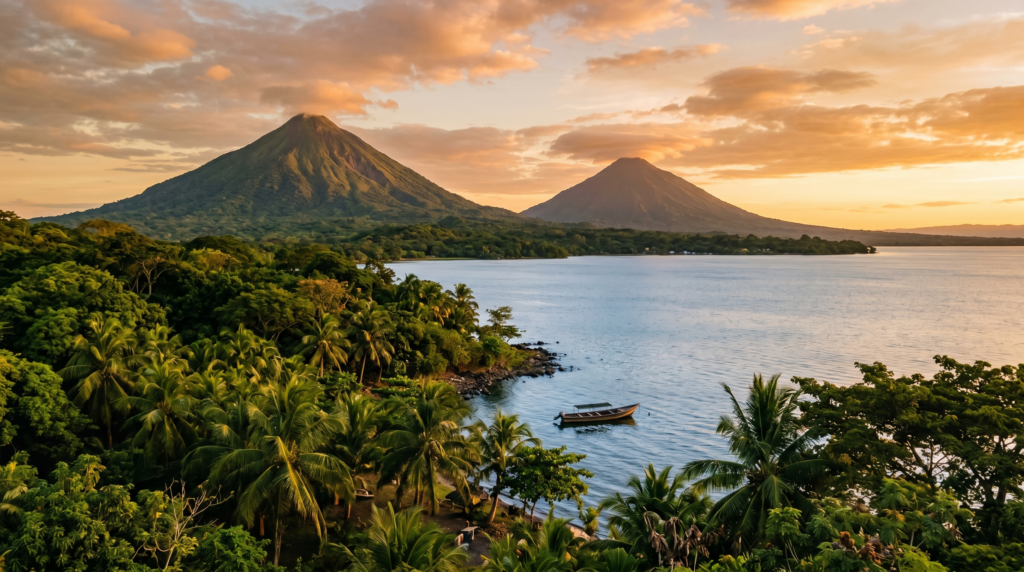
Nicaragua’s nickname is well earned. Ometepe, an hourglass-shaped island formed by two volcanoes — Concepción and Maderas — rising straight out of Lake Nicaragua, is one of the most beautiful places in the Americas. Near Managua, Masaya volcano lets you peer into a glowing lava lake after dark, while on Cerro Negro outside León you can sandboard down the black slopes of a young volcano. Crater lagoons like Laguna de Apoyo offer clear, swimmable water in an old caldera. It’s a landscape with few equals in the region.
Best Time to Visit Nicaragua (Season by Season)
December–March — Dry season (best overall)
Long sunny days, the most reliable weather and the easiest conditions for volcano hikes, colonial cities and the Pacific beaches. The peak of the dry season and the best time to visit Granada before the heat builds.
April — Hot & dry
The hottest stretch, particularly in Granada and León, with the dry season ending — great for surf, less so for midday sightseeing.
May–October — Green season (value)
Greener, quieter and cheaper, with afternoon showers rather than all-day rain. A good-value time for Ometepe and the lakes if you pace your days around the weather.
Getting There & Entry
Augusto C. Sandino International Airport (MGA) in Managua is the main gateway, with connections via the US (Miami, Houston, Atlanta), Panama and San Salvador. Many travellers also arrive overland from Costa Rica or Honduras.
- Visa: US citizens don’t need a visa for stays of up to 90 days. A $10 tourist card is purchased in cash on arrival (bring exact change), and you may be asked for proof of onward travel and funds.
- Passport: valid for at least six months.
- Important: entry has at times been denied or travellers expelled; review the current U.S. advisory and embassy alerts close to your travel date (see Safety, below).
Getting Around
- “Chicken buses”: retired US school buses are the cheap, colourful backbone of public transport between towns.
- Shuttles & tourist vans: comfortable door-to-door shuttles link the main traveller hubs (Granada, León, San Juan del Sur, Ometepe).
- Ferries: regular boats cross from San Jorge to Ometepe Island; the Corn Islands are reached by flight or a long ferry from Bluefields.
- Taxis & rental cars: negotiate taxi fares in advance; a rental car gives freedom but requires confident driving.
Where to Go — Granada, León, Ometepe & the Coast
Granada
The postcard colonial city: candy-coloured streets, a grand cathedral, horse-drawn carriages and access to Lake Nicaragua’s islets, Mombacho volcano and Laguna de Apoyo.
León
Granada’s student-city rival: a UNESCO-listed cathedral with rooftop views, revolutionary murals and history, and the launchpad for sandboarding down Cerro Negro.
Ometepe Island
Two volcanoes in a lake: hiking, waterfalls, the Ojo de Agua spring, petroglyphs and a slow, rural pace — many travellers’ favourite stop in the country.
The Pacific Coast & Corn Islands
San Juan del Sur and nearby beaches for surf and sunsets on the Pacific, and the laid-back Caribbean Corn Islands for diving and Creole calm.
Culture & People
Nicaragua is a warm, family-centred, predominantly Catholic country with a rich artistic heritage — it’s the land of the poet Rubén Darío, and poetry, music and muralism run deep. The Pacific and central regions are Spanish-speaking and mestizo, while the Caribbean coast has a distinct Afro-Caribbean and Indigenous (Miskito, Creole) culture, with English widely spoken.
Everyday hospitality is genuine, and the pace is relaxed. The country’s recent political history is, however, sensitive — public political expression is monitored, and travellers are advised to avoid demonstrations and political commentary, including on social media. Engaging respectfully and keeping a low profile on political topics is wise.
A Food Lover’s Guide to Nicaragua
- Gallo pinto — the national rice-and-beans staple, eaten morning, noon and night.
- Nacatamal — a hearty banana-leaf-wrapped tamale of masa, pork and vegetables, the Sunday classic.
- Vigorón & quesillo — yuca with crackling and cabbage slaw (a Granada speciality), and a warm cheese-and-tortilla snack.
- Fritanga & market food — cheap, delicious street grills and market lunches for a couple of dollars, washed down with fresh fruit drinks.
Off the Beaten Path
- Laguna de Apoyo — a clear, warm crater lake near Granada, perfect for swimming and a lazy day.
- Sandboarding Cerro Negro — hike up a young black volcano near León and slide back down on a board.
- Little Corn Island — a tiny, car-free Caribbean island with reefs, hammocks and barefoot calm.
- Somoto Canyon — a dramatic northern gorge for swimming, scrambling and cliff jumps.
- Masaya at night — one of the few places on Earth to look down into an active lava lake.
Safety & Practical Information
Travel advisory: the U.S. Department of State currently rates Nicaragua Level 3 — Reconsider Travel, citing crime, limited healthcare, the arbitrary enforcement of laws, and a risk of wrongful detention of U.S. nationals. Entry has at times been denied or travellers expelled, including dual nationals, and authorities monitor social media for political expression. Read the official advisory and U.S. Embassy alerts close to your travel date, register your trip, and avoid demonstrations and political commentary.
- Money: the córdoba (C$) is the official currency (~36.8 per US$); US dollars are accepted in tourist areas, but carry córdobas for markets, buses and rural areas. Cash is king.
- Health: drink bottled or filtered water; there is some malaria/dengue risk — use repellent. Healthcare is limited, so travel insurance with evacuation cover is essential.
- Power: 120V, US-style plugs — no adapter needed for US travellers.
- Crime: petty theft is the main everyday risk; keep valuables low-profile and use registered taxis or shuttles at night.
- Connectivity: reasonable in towns; buy a local SIM for data.
Budget Breakdown — What Nicaragua Costs in 2026
Nicaragua is one of the cheapest countries in the Americas. Rough per-person, per-day estimates in USD:
| Style | Accommodation | Food | Total / day |
|---|---|---|---|
| Backpacker | $10–19 hostel dorm | $5–10 (market/street) | ~$25–35 |
| Mid-range | $30–68 hotel | $15–25 | ~$60–90 |
| Comfort | $80–150+ | $30–50 | ~$150–200+ |
Market meals cost under $2.50, dorm beds and surf camps are cheap, and a two-week budget trip can run $300–670 before flights. Few destinations offer this much landscape for the money.
Planning Your Trip
A classic loop links Granada (colonial city, Laguna de Apoyo, Masaya), Ometepe Island (volcano hikes and waterfalls) and the Pacific surf around San Juan del Sur, with León and Cerro Negro to the north — all easily covered in 10–14 days by shuttle and ferry, in the December–March dry season. Before you commit, read the current U.S. travel advisory and embassy alerts, buy comprehensive travel insurance, keep copies of your documents, and steer clear of any political gatherings.
Frequently Asked Questions
Is it safe to travel to Nicaragua right now?
The U.S. State Department currently advises reconsidering travel (Level 3), citing crime, limited healthcare and a risk of wrongful detention of U.S. nationals. Many tourists still visit the main destinations without incident, but you should read the current advisory, register your trip, carry insurance, and avoid demonstrations and political commentary (including online).
Do US citizens need a visa for Nicaragua?
No visa is required for stays of up to 90 days, but you pay a $10 tourist card in cash on arrival and need a passport valid for at least six months. Entry has occasionally been denied, so check current conditions.
When is the best time to visit?
December to March (dry season) for the best weather and volcano hiking; May to October is greener and cheaper, with afternoon showers.
Is Nicaragua expensive?
No — it’s among the cheapest countries in the Americas, with dorms from around $10, market meals under $2.50, and budget travel possible on roughly $25 a day.
What are the must-sees?
Granada, Ometepe Island’s twin volcanoes, León and Cerro Negro sandboarding, the Masaya lava lake, and the Pacific surf at San Juan del Sur.
Thinking About Nicaragua?
Volcanoes, lakes and colonial colour at unbeatable prices — with real safety homework to do first. Tell us your dates and travel style and we’ll help you plan carefully, with the latest conditions in mind. Plan your trip →
Explore More
How This Guide Was Built
Researched and written by the Facts From Upstairs team, last updated . Travel advisories, visa rules and entry requirements change frequently — always confirm the latest official guidance before you travel.
More country guides you might like
Plan your trip to Nicaragua
The booking tools we use ourselves. FFU may earn a commission at no extra cost to you.
Plan & book your trip to Nicaragua
Booking through these searches supports our guides at no extra cost to you.