
Languages of Gabon
All languages of Middle Africa →fluent beta classical · classes by phone with Maya at ranas.ai/maya
Gabon Travel Guide — Surfing Hippos, Rainforest Coasts & Africa’s Best-Kept Wilderness Secret
Gabon is the country that made me rethink what “untouched” even means. Nearly 90% of it is rainforest , it’s been called the most carbon-positive country on Earth, and back in 2002 the government protected roughly a tenth of the entire nation as national parks in one stroke — thirteen of them, still mostly empty of tourists. This is a place where forest elephants, gorillas and buffalo wander onto Atlantic beaches, where hippos genuinely surf the shorebreak at Loango, and where you can go days without seeing another traveler who isn’t a researcher. It is also, I’ll be honest up front, not an easy trip: visas take real planning, infrastructure outside Libreville is thin, and a major U.S.–Gabon visa reciprocity dispute just reshuffled entry rules for American passport holders in 2026. If you want a beach chair and a swim-up bar, skip this one. If you want to see Central Africa’s rainforest coast the way it looked before anyone built a resort on it, keep reading.
In This Guide
- Overview — Why Gabon Is Central Africa’s Wildest Open Secret
- Whale Season on the Loango Coast (July–October)
- Best Time to Visit Gabon (Season by Season)
- Getting There — Visas, Léon-Mba Airport & the 2026 U.S. Reciprocity Snag
- Getting Around — Bush Planes, Pirogues & the Trans-Gabon Railway
- Top Regions — Libreville, Loango, Lopé & Ivindo
- Culture & People — Fang, Myene, Bwiti & Fifty Ethnic Groups
- A Food Lover’s Guide to Gabon
- Off the Beaten Path
- Practical Information
- Budget Breakdown — What Gabon Actually Costs in 2026
- Frequently Asked Questions
Overview — Why Gabon Is Central Africa’s Wildest Open Secret
Gabon sits on the Atlantic coast of Central Africa, straddling the equator, bordered by Equatorial Guinea and Cameroon to the north and the Republic of Congo to the east and south. It’s a mid-sized country — about 267,668 square kilometres, roughly the size of the UK — but with fewer people than the city of Houston: an estimated 2.3 million spread across a nation that is close to 90% forested. Independent from France since August 17, 1960, Gabon still runs on French as its official language, and oil has bankrolled the country for decades, contributing something like 43% of GDP and 81% of exports at its peak.
What makes Gabon genuinely unusual is what the government did with that oil money in 2002: it declared thirteen national parks in a single decree, protecting roughly 10% of the entire national territory overnight. Two of those landscapes are now UNESCO World Heritage sites — the Lopé-Okanda ecosystem, Gabon’s first inscription in 2007 and the first mixed cultural-natural site in Central Africa, and Ivindo National Park, added in 2021 for its blackwater rivers, waterfalls and forest biodiversity.
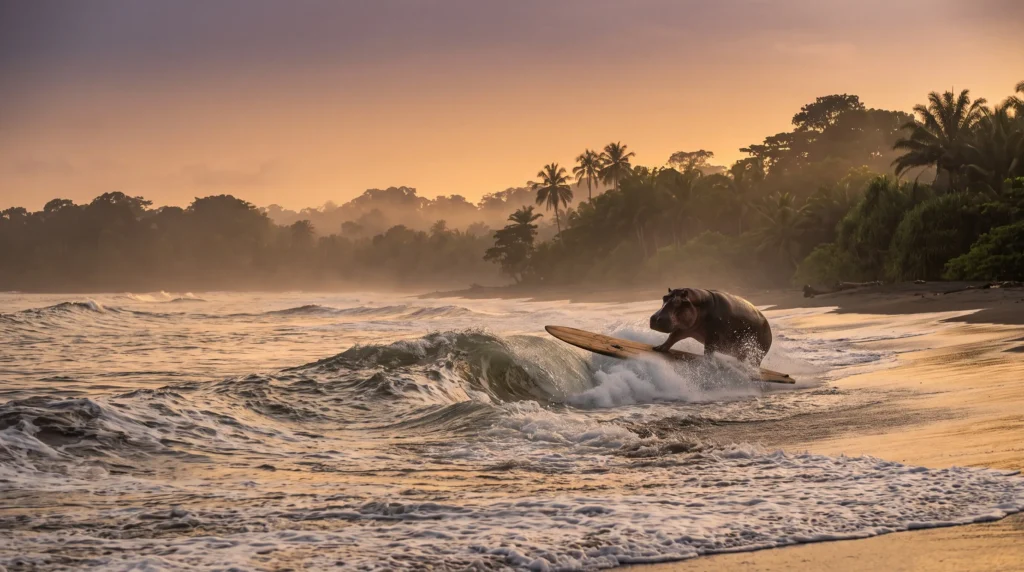
The headline attraction, though, is Loango National Park on the western coast, where forest elephants, buffalo, gorillas and leopards regularly wander onto empty Atlantic beaches and hippos have been photographed catching waves in the surf — the image that put Gabon on adventure-travel radars in the first place. Tourism infrastructure is still thin compared to East Africa’s safari circuits, which is exactly the point: this is one of the last places on the continent where wildlife tourism hasn’t been scaled up yet.
Whale Season on the Loango Coast (July–October)
If you can time a trip around one window, make it July through October, when humpback whales and other cetaceans gather off Loango’s coastline. Gabon’s waters host what’s reported as the largest concentration and variety of whales and dolphins in Africa outside South Africa, including humpbacks and even killer whales, visible from small boats out of Loango’s lodges. This overlaps neatly with the long dry season, when tracks are passable and wildlife viewing generally peaks across the park network.
It’s also turtle-nesting season further south around Mayumba, where leatherback and olive ridley turtles come ashore on some of the least-disturbed beaches left on the West African coast — a quieter, less-marketed counterpart to the whale-watching further north, and worth building into the same coastal itinerary if you have the extra days.
Best Time to Visit Gabon (Season by Season)
June – September · Long dry season (best overall)
The most reliable window for road access, wildlife viewing and the Loango whale season described above. Rain is minimal, humidity drops slightly, and this is when most lodges run at full capacity — book Loango and Ivindo well ahead.
December – January · Short dry season
A secondary, shorter dry spell that locals in river towns like Lambaréné describe as a brief break in the wet pattern. Useful if your only window is over the holidays, though roads can still be soft after the October–November rains.
October – November and March – May · Wet seasons
Gabon’s equatorial climate delivers rain in two separate stretches rather than one long monsoon. Rainforest tracks can become impassable, river levels swing, and some remote camps scale back operations. Prices drop and the forest is at its most vividly green, but flexibility matters more than anywhere else in the itinerary.
Getting There — Visas, Léon-Mba Airport & the 2026 U.S. Reciprocity Snag
Almost everyone needs a visa to enter Gabon. The country runs an e-Visa system, processed within about 72 hours, but it is only valid for arrivals through Léon-Mba International Airport in Libreville — not land borders. A standard 1–3 month single-entry tourist e-Visa runs roughly €70 (about 45,000 XAF) plus a processing fee, and you’ll need a passport valid six months beyond your trip, passport photos, proof of onward travel, accommodation proof, and your yellow fever certificate.
Here’s the catch worth knowing before you book anything: on January 1, 2026, Gabon suspended visa issuance to U.S. citizens in direct reciprocity for restrictions the United States had imposed on Gabonese travelers. If you’re a U.S. passport holder, contact the nearest Gabonese embassy or consulate directly for current entry status before making any nonrefundable bookings — this is genuinely a moving situation, not something to assume will resolve on its own timeline. Travelers from most other nationalities are unaffected and should proceed through the normal e-Visa channel.
Léon-Mba International Airport (LBV), Gabon’s main gateway, sits in Libreville and runs a single asphalt runway with a handful of intercontinental links — Air France to Paris and Ethiopian Airlines to Addis Ababa are the main long-haul options, alongside regional carriers like ASKY and AfriJet connecting Douala, Yaoundé, Brazzaville and Pointe-Noire. There is no meaningful budget-airline network into Gabon; most visitors route through a European or regional African hub.
Getting Around — Bush Planes, Pirogues & the Trans-Gabon Railway
This is not a self-drive country for most visitors. Outside Libreville and Port-Gentil, paved roads are the exception, and the rainforest interior is properly reached by small charter planes, the Trans-Gabonais railway linking Libreville to Franceville, or river pirogues on waterways like the Ogooué. Most national-park visits — Loango, Ivindo, Lopé — are arranged through specialized eco-tourism operators who bundle domestic flights, lodge stays and guided activities, because independent logistics across roadless forest are genuinely difficult to arrange solo.
Within Libreville, taxis (shared or private) and a small formal transit network cover the city adequately; agree fares before you get in. Getting between regions independently generally means either the train, a domestic flight booked through a tour operator, or long river journeys — budget extra days for any interior itinerary and expect logistics, not spontaneity, to shape your route.
Top Regions — Libreville, Loango, Lopé & Ivindo
Libreville
Founded in 1849 as a settlement for Africans freed from a slave ship intercepted by the French navy — hence the name, “Freetown” in French — Libreville is now a city of roughly 700,000 people, with metro growth projected toward 915,000 by 2026. See the Palais du bord de mer, the National Museum of Arts, Rites and Traditions, and the hillside district of Mont-Bouët, then use the city as your jumping-off point rather than your destination.
Loango National Park
The signature Gabon experience: 1,550 square kilometres of coastline, lagoon, savanna and rainforest where elephants, buffalo, gorillas and leopards wander onto more than 100 kilometres of beach, and the Iguéla Lagoon protects a rare intact West African lagoon ecosystem. This is where the “surfing hippos” photos came from, and where whale season (July–October) peaks offshore.
Pongara & Akanda National Parks
The easiest wild landscapes to reach from the capital — Akanda to the north and Pongara across the Gabon Estuary — function as accessible gateways to mangroves, beaches and birdlife without the logistics of a full interior expedition.
Lopé National Park & the Ogooué Valley
Home to the Ecosystem and Relict Cultural Landscape of Lopé-Okanda, Gabon’s first UNESCO World Heritage site, inscribed in 2007 as the first mixed cultural-natural listing in Central Africa: some 491,000 hectares combining rainforest-savanna transition zones with roughly 1,800 ancient rock carvings. It also shelters an unusually high concentration of threatened large mammals for the region — mandrills, gorillas, elephants and more.
Ivindo National Park
Gabon’s second UNESCO site (2021), a nearly 300,000-hectare network of blackwater rivers, rapids and waterfalls — including the dramatic Kongou Falls — set inside largely untouched rainforest on the equator in northern Gabon, with forest elephants, gorillas, chimpanzees and pangolins among its residents.
Lambaréné & the Ogooué River
A river town of under 40,000 people, split into three districts by the Ogooué, and the site of the hospital Albert Schweitzer founded in 1913 — still operating, with Schweitzer’s grave on the grounds. A slower, more human-scale stop between the capital and the deeper interior.
Port-Gentil & Mayumba
Gabon’s oil hub and second city, useful mainly as a logistics point; further south, Mayumba’s remote beaches host globally significant leatherback and olive ridley turtle nesting, with minimal tourist infrastructure to speak of.
Culture & People — Fang, Myene, Bwiti & Fifty Ethnic Groups
Gabon’s roughly 2.3 million people represent dozens of Bantu ethnic groups — Fang in the north, Myene along the coast and rivers around Lambaréné, plus Punu, Nzebi, Bapounou, Eshira and many others, each carrying distinct languages alongside official French. French remains the practical lingua franca for travelers; outside Libreville, expect it to be a second or third language for many residents rather than a first.
Bwiti, a spiritual tradition built around the iboga plant and practiced by initiated communities across Fang and Myene populations, is one of the country’s most distinctive cultural threads — deeply serious, not a tourist performance, and something to approach only through a respectful, properly arranged introduction rather than as a curiosity stop. Independence Day on August 17 is the biggest national date on the calendar, marking the 1960 transition from French colonial rule.
A Food Lover’s Guide to Gabon
Gabonese cooking leans on cassava, plantain and the rainforest and river bounty around it: nyembwe (chicken or fish simmered in a rich palm-nut sauce) is close to a national dish, usually served over rice or cassava. River and coastal fish show up constantly given the country’s Ogooué River system and Atlantic coastline, often grilled simply or stewed with peppers and tomato.
Bushmeat remains part of rural diets in some areas, though conservation-conscious travelers should be mindful of species and sourcing given the pressure on the same wildlife that draws visitors to the parks in the first place. In Libreville, French colonial influence shows up in bakeries and café culture alongside West African staples; in river towns like Lambaréné, fishing is still the core local economy and the freshest catch is usually whatever’s cooking closest to the water.
Off the Beaten Path
Kongou Falls, Ivindo National Park
A multi-tiered waterfall deep in Ivindo’s blackwater river network, reachable only by a genuine expedition into one of Central Africa’s most intact rainforest ecosystems — no crowds, minimal infrastructure, real effort required.
Lopé’s petroglyphs
Roughly 1,800 rock carvings scattered through the Lopé-Okanda landscape, evidence of successive human occupation stretching back thousands of years, seen by only a trickle of visitors each year despite the UNESCO status.
Mayumba’s turtle beaches
Some of West Africa’s least-disturbed nesting beaches for leatherback and olive ridley turtles, a long way south of the standard Libreville–Loango circuit and correspondingly close to tourist-free.
Lambaréné’s Schweitzer Hospital
Still an operating hospital, not a museum piece — a quiet, genuinely moving stop for anyone interested in the history of medical mission work in Central Africa, with the founder’s grave on-site.
Practical Information
Money. The Central African CFA franc (XAF) is fixed at €1 = 655.957 XAF and shared with five other Central African nations — Cameroon, Central African Republic, Chad, Republic of Congo and Equatorial Guinea — under a French Treasury-guaranteed peg. Cards work in Libreville hotels and some restaurants; carry cash for anywhere outside the capital, and for national park lodges that operate largely off-grid.
Safety. The U.S. State Department rates Gabon Level 2 — Exercise Increased Caution as of its most recent advisory, citing crime (robbery, vehicle break-ins, residential burglary) concentrated in Libreville and Port-Gentil, plus demonstrations that can occur without warning in those same cities. National park areas are a different risk profile entirely — the real hazards there are logistical and wildlife-related, not crime. Enroll in your government’s traveler program and check current advisories before you go.
Health. Yellow fever vaccination is mandatory for all arriving travelers aged nine months and up — bring your certificate, it will be checked. Malaria transmission occurs countrywide, so antimalarial medication is essential, not optional; the CDC also recommends hepatitis A and B coverage and typhoid vaccination for most itineraries, especially rural or river travel. Medical facilities are limited in quality outside Libreville, so serious travel insurance with medical evacuation coverage is non-negotiable.
Connectivity. Mobile data coverage is reasonable in Libreville and Port-Gentil, patchy to nonexistent in national parks — plan on being properly offline for stretches of any interior itinerary. Plugs: European-style, 220-240V. Language on the ground: French; English is uncommon outside upscale lodges and hotels.
Budget Breakdown — What Gabon Actually Costs in 2026
Gabon is not a backpacker-cheap destination — the lack of budget infrastructure and the logistics of reaching the parks push costs well above neighboring West African countries.
Budget (US$80–150/day): Guesthouses in Libreville or Lambaréné, local transport and street food, focused on cities and river towns rather than the deep interior.
Mid-range (US$250–450/day): A national park lodge stay (Loango or Lopé) bundled with domestic transport, guided game drives and boat excursions — this tier is where most park visits land once flights and guiding are included.
Premium (US$700+/day): Multi-day fly-in safaris combining Loango’s coast and whale season with Ivindo’s waterfalls, full-board eco-lodges, and private guiding through Lopé’s petroglyph sites.
Factor in the e-Visa fee (~€70–85 all-in for a standard tourist visa), mandatory yellow fever vaccination costs if you don’t already have one, and comprehensive travel insurance with medical evacuation — treat all three as fixed costs before you even land.
Planning Your First Trip to Gabon
The realistic first-timer route is Libreville + Loango: fly into Léon-Mba, spend a day or two in the capital, then connect via domestic charter to Loango National Park for three to five nights of coastal wildlife and, if your dates land July–October, whale watching. Ten to fourteen days lets you add Lopé or Ivindo for the UNESCO sites and a stop in Lambaréné along the Ogooué. Because Gabon’s tourism scene is still small and operator-dependent, book through an established eco-tourism operator rather than trying to freelance interior logistics — and confirm your visa status well ahead of any booking, especially if you’re traveling on a U.S. passport given the 2026 reciprocity suspension. If gorilla trekking is the real draw for you, our Rwanda travel guide covers the continent’s other major primate-trekking circuit, and our Tanzania travel guide is the place to pair rainforest with classic savanna safari on the same trip.
Frequently Asked Questions
Can U.S. citizens get a visa for Gabon right now?
As of January 1, 2026, Gabon suspended visa issuance to U.S. citizens in reciprocity for restrictions the United States placed on Gabonese travelers, and the U.S. State Department’s most recent advisory (March 2026) still references this situation. Contact the nearest Gabonese embassy or consulate directly for current status before booking anything nonrefundable.
Do other nationalities need a visa?
Yes, in almost all cases. Gabon runs an e-Visa system that processes in about 72 hours, but it’s valid only for entry through Léon-Mba International Airport in Libreville, not land borders — plan accordingly if you’re arriving overland from Cameroon or Congo.
Is Gabon safe for tourists?
The U.S. State Department rates it Level 2 — Exercise Increased Caution, with crime and occasional demonstrations concentrated in Libreville and Port-Gentil. National parks carry a different set of risks (logistics, remoteness, wildlife) rather than crime. Standard precautions and current advisory checks apply, as anywhere.
Do I really need the yellow fever vaccine?
Yes — it’s mandatory for all arriving travelers aged nine months and older, and border officials do check certificates. Malaria prevention medication is equally essential given countrywide transmission.
Can I see the surfing hippos for myself?
Loango National Park is where those images came from, and elephants, buffalo and gorillas regularly appear on its beaches alongside marine wildlife offshore — but sightings are wild-animal encounters, not guaranteed performances, so go with realistic expectations and a good guide.
Gabon or Rwanda for a Central/East Africa wildlife trip?
Choose Rwanda for structured, relatively accessible mountain gorilla trekking with mature tourism infrastructure; choose Gabon for a wilder, far less developed rainforest-meets-coast experience with lowland gorillas, forest elephants and genuinely empty beaches — at the cost of much harder logistics.
Ready to Explore Gabon?
Forest elephants strolling onto Atlantic beaches, humpback whales offshore, waterfalls no road can reach, and a rainforest that covers nearly the whole country — Gabon rewards travelers willing to plan carefully and skip the comfort of a well-worn tourist trail. Sort your visa status early, especially if you’re American, and go while this much of it is still this empty.
Explore More
- Rwanda Travel Guide — Africa’s other major gorilla-trekking destination
- Tanzania Travel Guide — pair rainforest with classic savanna safari
- Senegal Travel Guide — West Africa’s Francophone coast
- Nairobi City Guide — East Africa’s safari gateway
How this guide was built
Published as part of Facts From Upstairs’ country guide series. Built from authoritative sources — UNESCO’s World Heritage Centre pages for Ivindo National Park and the Lopé-Okanda inscription, the US State Department’s Gabon country page, the UK FCDO’s Gabon travel advice, the US CDC traveler page for Gabon, and Wikipedia entity pages for Gabon’s geography, economy, visa policy, national parks, currency, Libreville and Lambaréné. Numeric and checkable claims carry inline citations.
Sources cited on this page
- Wikipedia — Gabon
- UNESCO — Ivindo National Park
- UNESCO — Inscription of Lopé-Okanda
- Wikipedia — Loango National Park
- Wikipedia — Léon-Mba International Airport
- Wikipedia — Visa policy of Gabon
- US State Department — Gabon
- UK FCDO — Gabon
- US CDC — Gabon traveler page
- Wikipedia — CFA franc
- Wikipedia — Lambaréné
- Wikipedia — Libreville
More country guides you might like
Plan your trip to Gabon
The booking tools we use ourselves. FFU may earn a commission at no extra cost to you.
Plan & book your trip to Gabon
Booking through these searches supports our guides at no extra cost to you.