
Bora Bora, French Polynesia: The Overwater Bungalow Dream, Mount Otemanu & the World’s Most Beautiful Lagoon
In this guide
- Why Bora Bora earns the hype
- Best time to visit — dry vs wet season
- Getting there (it’s further and closer than you think)
- Overwater bungalows & where to stay
- Things to do beyond the balcony
- What it really costs — including the hidden taxes
- Culture, language & travelling responsibly
- A perfect island itinerary
Why Bora Bora earns the hype
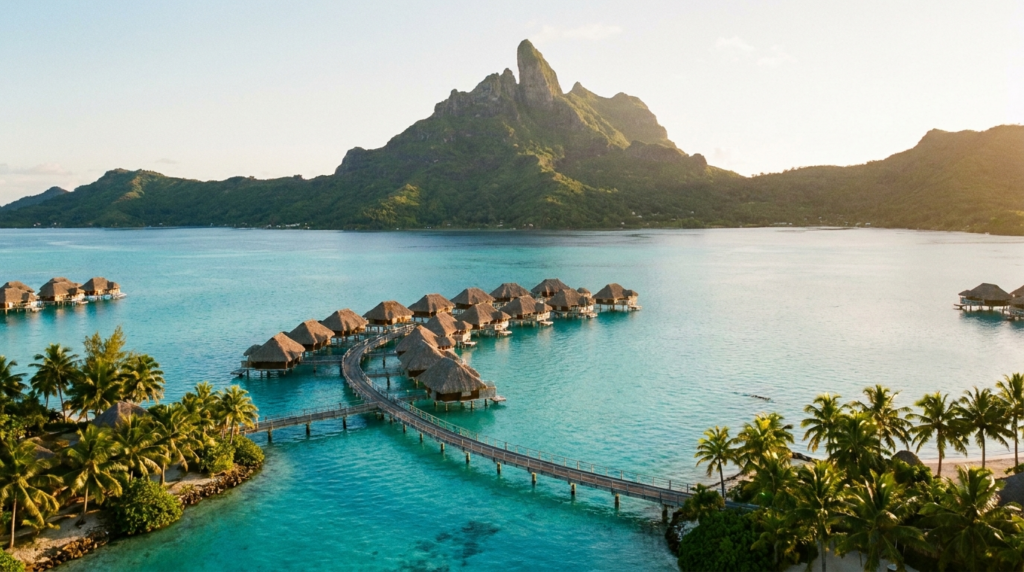
Bora Bora is the rare place that survives its own postcards. At its centre rises the jagged, jungle-clad silhouette of Mount Otemanu, the remnant of an ancient volcano. Around it curls a lagoon in impossible shades of turquoise and jade, ringed by a necklace of sandy islets — the motus — where the overwater bungalows perch on stilts above water clear enough to read by.
It is unapologetically a luxury and honeymoon destination, and it delivers on that promise better than almost anywhere. But there’s more here than a balcony ladder into the lagoon: reef sharks and rays, Polynesian warmth, and some of the most scenic short flights on earth.
Best time to visit — dry vs wet season
The dry season, May to October, is prime: sunny, lower humidity and calm, clear lagoon water ideal for snorkelling and water sports. July and August bring the very best weather but also the highest prices and busiest resorts. For the best balance of conditions and value, target the shoulder months of May–June or September–October.
The wet season, November to April, is warmer and more humid with passing tropical showers, but rates can fall 30–40% — a genuine bargain if you can travel outside the wettest weeks of December and January.
Overwater bungalows & where to stay
The overwater bungalow was practically invented in French Polynesia, and Bora Bora is its spiritual home. Entry-level overwater rooms start around $750–1,200 a night in low season; the flagship motu resorts such as the St. Regis, Four Seasons and Conrad climb to $1,500–3,000+ in peak months. Each bungalow gives you a private ladder straight into the lagoon. If the price tag is steep, consider a night or two in a pension (guesthouse) on the main island to balance the splurge.
Things to do beyond the balcony
Take a lagoon tour to snorkel with reef sharks and stingrays and drift over coral gardens. Circle the island by 4×4 safari for wartime relics and jungle viewpoints. Snorkel the Coral Gardens, paddleboard at dawn, or dive the outer reef with manta rays. For the ultimate splurge, a helicopter flight around Otemanu reveals the full geometry of the lagoon. And simply watching the light change over the peak from your deck is, honestly, half the point.
What it really costs
Bora Bora is a splurge destination and there’s no getting around it: overwater lodging, imported food and inter-island flights add up fast. The currency is the CFP franc (XPF), roughly 100 to the US dollar. To soften the blow, travel in shoulder or low season, mix a luxury motu stay with a night in a pension, and pre-book lagoon tours rather than resort add-ons.
Culture, language & travelling responsibly
French is the official language and Tahitian is widely spoken, with English understood at resorts. A warm “Ia ora na” (hello) goes a long way. Treat the reef gently — reef-safe sunscreen only — and support local pensions, pearl artisans and Polynesian-owned tour operators to keep tourism benefiting the islands themselves.
A perfect island itinerary
Day 1 — Arrive via Tahiti, settle into your motu and swim straight off the deck. Day 2 — Full-day lagoon tour: reef sharks, rays and a beach picnic. Day 3 — 4×4 island safari plus a sunset paddle. Day 4 — Otemanu by helicopter or a lazy last morning in the lagoon before the flight back to Papeete.
Plan your Bora Bora trip
Fly via Tahiti, aim for the dry season (or shoulder months for value), and build your days around the lagoon — a single tour with the reef sharks and rays will out-sparkle any resort brochure.
FFU contains affiliate links. We earn a commission when you book through them — at no extra cost to you.
Plan your trip
- Tours & experiences: browse tours and experiences on Klook.
- Airport pickup: pre-book an airport transfer with GetTransfer.
- Car hire: compare rental cars on GetRentacar.
- Bag storage: store your bags with RadicalStorage.
Disclosure: some links above are affiliate links — booking through them supports Facts From Upstairs at no extra cost to you.
More city guides you might like
Plan your trip to Bora Bora
The booking tools we use ourselves. FFU may earn a commission at no extra cost to you.
Plan & book your trip to Bora Bora
Booking through these searches supports our guides at no extra cost to you.