
Astana Travel Guide — Kazakhstan’s Space-Age Capital Built on Empty Steppe
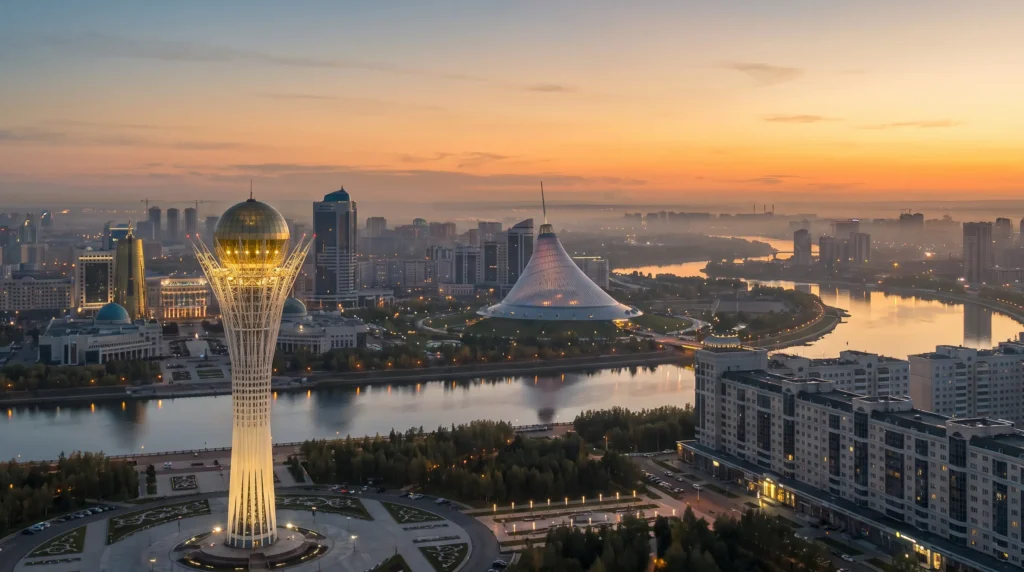
I will say this about Astana up front: it does not look like it should exist. Thirty years ago this was a windswept administrative town on the northern steppe; today it is a skyline of gold-tipped towers, a giant glass tent, and a sphere the size of a stadium, all standing in a landscape so flat you can watch weather arrive from thirty kilometres away. Kazakhstan moved its capital here from Almaty in 1997 and then built almost the entire city you see from scratch. It has been renamed four times in three decades — Akmola, then Astana, then Nur-Sultan in honor of the president who built it, then Astana again in 2022 — and that whiplash tells you everything about how young and how deliberately engineered this place is. The honest catch: Astana is not a city of old-world charm, crooked lanes or centuries of patina — it is closer to a architectural showroom on the steppe, and it is one of the coldest capitals on Earth, so pack for extremes and set your expectations for futurism, not folklore. Do that, and Astana is genuinely one of the strangest, most photogenic capitals I have visited anywhere.
In This Guide
- Overview — Why Astana Is Central Asia’s Strangest Capital
- Capital Day, July 6 — Fireworks Over the Yesil
- Best Time to Visit Astana (Season by Season)
- Getting There — NQZ Airport & the Trans-Kazakhstan Rail
- Getting Around — the Brand-New Light Metro, Buses & Winter Walking
- Neighborhoods — Left Bank, Right Bank & the Old Town
- Culture & People — Steppe Nomad Roots Meet Soviet Legacy
- A Food Lover’s Guide to Astana
- Off the Beaten Path
- Day Trips — Burabay & the Korgalzhyn Steppe
- Practical Information
- Budget Breakdown — What Astana Actually Costs in 2026
- Frequently Asked Questions
Overview — Why Astana Is Central Asia’s Strangest Capital
Astana sits on the Ishim (Yesil) River in the north-central steppe, roughly 1,000 kilometres from Kazakhstan’s larger, older former capital Almaty. The settlement began life in 1830 as the fortress town of Akmoly, spent the Soviet era as Tselinograd — the administrative heart of Khrushchev’s “Virgin Lands” farming campaign — and was tapped in December 1997 to become Kazakhstan’s capital, taking the name Astana (“capital” in Kazakh) the following year. What followed was one of the fastest planned-city builds anywhere: a new government district designed in large part by Japanese architect Kisho Kurokawa, populated with landmarks that look like nothing else in the region — the gold-globed Baiterek tower, the tent-shaped Khan Shatyr mall, the world’s largest spherical building at Nur Alem, and Central Asia’s largest mosque.
The city’s population has swelled past 1.6 million as Kazakhstan funnelled people, ministries and money north to fill it out. In 2017 Astana hosted a specialized World Expo under the theme “Future Energy,” drawing more than four million visitors and leaving behind the Nur Alem sphere as its centerpiece museum. None of this is an accident of organic growth — Astana is a statement, built to prove a young, oil-and-mineral-rich country could conjure a 21st-century capital out of open steppe in a single generation. Whether you find that inspiring or a little uncanny is part of the fun of visiting.
Capital Day, July 6 — Fireworks Over the Yesil
If you can time a trip around one date, make it July 6, Capital City Day (also called Astana Day), an official holiday established in 2009 that marks the anniversary of the 1994 decision to relocate the capital north. The city throws its biggest annual party for it: the Astana Samaly international brass band festival, the Eskeri Kernei military tattoo, open-air concerts, laser shows and fireworks over the Yesil River and the central park. It also happens to fall in the single most pleasant weather window of the year, which is not a coincidence — plan an early-July trip and you get the city at its most alive, with hotel rates that spike accordingly, so book ahead.
Best Time to Visit Astana (Season by Season)
May – September · The only sane window
Astana’s extreme continental climate means the entire tourist season is really this five-month stretch, with the most comfortable temperatures in May, June, August and early September. July can push past 35°C in the shade, so shoulder months are genuinely more pleasant than midsummer.
Late September – November · Shoulder
Cooling fast, fewer crowds, and the steppe light turns gold. Pack layers — the swing from a warm afternoon to a cold evening can be dramatic.
December – March · Extreme winter
This is the reason Astana is sometimes ranked the world’s second-coldest national capital after Ulaanbaatar, with winter lows regularly hitting −30°C to −35°C. It is genuinely striking to see Baiterek and Khan Shatyr glowing against a frozen white steppe, and Kazakhstanis handle it with heated walkways and good coats — but this is a trip for cold-weather enthusiasts only, not a casual add-on to a Central Asia itinerary.
Getting There — NQZ Airport & the Trans-Kazakhstan Rail
Nursultan Nazarbayev International Airport (NQZ), about 12 kilometres southeast of the city centre, is Astana’s gateway and Kazakhstan’s second-busiest airport. National carrier Air Astana runs the widest network from here, with direct or one-stop connections toward Frankfurt, Istanbul, Dubai, Beijing, London Heathrow and Paris, alongside routes across the Caucasus, the Middle East, Russia and the rest of Central Asia. From North America or Western Europe, expect at least one connection, most commonly through Istanbul, Dubai or Frankfurt.
Overland, Astana sits on Kazakhstan’s main north–south rail corridor, with long-distance trains linking it to Almaty (roughly a day’s ride) and on to Russia. The new Nūrly Jol railway station, opened alongside the city’s light metro, is now the main long-distance rail hub on the city’s east side.
Getting Around — the Brand-New Light Metro, Buses & Winter Walking
Astana just became a genuinely different city to navigate: President Tokayev opened the driverless Astana Light Metro’s first line on 16 May 2026, a 22.4-kilometre, fully automated route running from the airport through the Botanical Garden, Abu Dhabi Plaza, Astana Arena, the House of Ministries and the Grand Mosque out to Nūrly Jol station. It is brand new as of this writing, so expect some teething pains and evolving schedules, but it finally links the airport to the government district without a taxi.
Bus routes cover the rest of the city cheaply, and ride-hailing apps like Yandex Go are the easiest way to get around for visitors who don’t read Cyrillic bus signage — fares are low by Western standards. Astana’s Left Bank government core is walkable and increasingly built with covered, heated pedestrian crossings to survive the winter, but the city overall is spread out and low-density by design, so budget for rides rather than assuming you’ll walk everywhere the way you might in a compact old-world capital.
Neighborhoods — Left Bank, Right Bank & the Old Town
Left Bank (Yesil district)
The futuristic government and Expo core, and the reason most people come. This is where you’ll find the 105-metre Baiterek observation tower, the Khan Shatyr tent-shaped entertainment centre, the Palace of Independence, the ministries strip, the Astana Grand Mosque — the largest mosque in Central Asia — and the Nur Alem sphere left over from Expo 2017. It is showpiece architecture at a scale that photographs better than it necessarily feels to walk through on foot in January.
Right Bank & the Old Town
Across the river, the older, denser city retains the Soviet-era Tselinograd bones — apartment blocks, the original train station area, and the everyday Astana of markets and modest cafés. It’s a useful counterweight to the Left Bank’s showroom feel and generally where you’ll find cheaper food.
Nūrly Jol / East Astana
Built around the new railway station and light metro terminus, this district is Astana’s newest expansion and a preview of where the city is still growing.
University & Expo quarter
Home to Nazarbayev University’s striking modern campus and the Barys ice hockey arena, this stretch blends academic architecture with Astana’s love of oversized, statement buildings.
Zhassyl Bazar area
Astana’s big produce and dried-fruit market sits closer to the older grid — worth a wander for kymyz, nuts, spices and a much less curated slice of daily life than the government district offers.
Culture & People — Steppe Nomad Roots Meet Soviet Legacy
Kazakh and Russian are both official languages, and in Astana — a city populated largely through Soviet-era resettlement and post-independence internal migration — Russian is heard at least as often as Kazakh on the street, while English stays limited to hotels, higher-end restaurants and younger residents. Learning a few Kazakh or Russian greetings goes a long way and is genuinely appreciated.
Beneath the glass towers, Kazakhstan’s nomadic heritage is still very present: eagle hunting traditions, felt yurts and textiles, dombra (two-stringed lute) music, and steppe hospitality customs that treat guests as something close to sacred. Museums on the Left Bank — the National Museum of Kazakhstan chief among them — cover this history at a scale that matches the rest of the district. Expect a genuinely multi-ethnic city too: decades of Soviet deportations sent large Korean, German, Chechen and other communities to Kazakhstan, and their food and culture are now part of the local fabric, especially visible in the food scene below.
A Food Lover’s Guide to Astana
The dish to know is beshbarmak — boiled meat (usually horse or lamb) over flat pasta squares, traditionally eaten by hand and served at celebrations. Alongside it you’ll find kazy (horse sausage), kymyz and shubat (fermented mare’s and camel’s milk, an acquired taste worth trying once), and baursak, puffy fried dough served with tea, jam or honey at almost every breakfast table.
Because so much of Astana’s population arrived from elsewhere in the Soviet Union, the food scene is unusually layered: look for Uzbek-style plov, Korean dishes like kuksi cold noodles and the carrot salad known locally as morkovcha (a Central Asian invention now exported worldwide), and Russian staples like pelmeni and borscht sitting on the same street as Kazakh steppe cooking. The Zhassyl Bazar market is the best single stop for dried fruit, nuts, kymyz and produce, and it’s a far more affordable way to eat than the polished restaurants clustered around Khan Shatyr and the Left Bank hotel strip.
Off the Beaten Path
Nur Alem & the old Expo grounds
Most visitors snap a photo of the sphere from outside; fewer go inside to the Museum of Future Energy that now occupies it, a leftover of the 2017 World Expo that drew over four million visitors and is now a quieter, oddly futuristic museum experience.
Right Bank residential streets
Wander away from the government district into the older grid for Soviet mosaics, unpolished courtyards and a version of the city that looks nothing like the postcards.
Nazarbayev University campus
An architecturally striking modern campus that most tourists never think to visit, and a good window into how Kazakhstan is investing in its next generation.
Astana Grand Mosque at prayer time
Central Asia’s largest mosque is at its most atmospheric — and least crowded with tourists — around the calls to prayer rather than mid-afternoon photo hours.
Day Trips — Burabay & the Korgalzhyn Steppe
Burabay (Borovoye) National Park
Nicknamed “the Switzerland of Kazakhstan,” Burabay is granite cliffs, pine forest and turquoise lakes roughly 250 kilometres north of Astana — a genuinely startling landscape shift after days of flat steppe. It’s the most popular day or overnight trip from the capital, reachable by tour bus, train or shared taxi in three to four hours each way, so an early departure is essential if you’re doing it as a single day.
Korgalzhyn State Nature Reserve
About 130 kilometres south of Astana, Korgalzhyn is one half of the Saryarka – Steppe and Lakes of Northern Kazakhstan UNESCO World Heritage site, inscribed in 2008 for wetlands that host an estimated 15–16 million migratory birds a year, including flamingos, Dalmatian pelicans and the critically endangered Siberian white crane. It’s a serious detour best arranged through a local guide or tour operator, but it’s one of the more remarkable birdwatching sites in Central Asia and sees a fraction of the visitors Burabay does.
Practical Information
Money. The Kazakhstani tenge floats freely and traded around 470 to the US dollar in early July 2026 — check a current rate before you go, as it moves. Cards are widely accepted in Astana’s hotels, malls and restaurants; carry cash for markets, marshrutkas and smaller cafés.
Safety. The US State Department rates Kazakhstan Level 1, “Exercise Normal Precautions,” as of its most recent update, with common issues limited to occasional pickpocketing and ATM skimming rather than violent crime; demonstrations do occur and can turn unpredictable, so avoid them, and carry your passport or a certified copy since police can ask for ID. The UK FCDO similarly advises normal vigilance while noting, as of a July 2026 update, new rules requiring IMEI registration for locally used SIM cards — worth checking before you land.
Health. The CDC recommends being up to date on routine vaccines plus Hepatitis A for most travelers and Hepatitis B for extended stays; rabies pre-exposure vaccination is worth considering given the presence of infected stray dogs, and anyone hiking or camping near Burabay should take tick precautions against tick-borne encephalitis.
Connectivity. An eSIM or a registered local SIM covers most needs; hotel and mall Wi-Fi is generally solid. Plugs: European-style two-pin (Type C/F), 220V. Time zone: UTC+5, no daylight saving.
Budget Breakdown — What Astana Actually Costs in 2026
Astana runs cheaper than Western European capitals but pricier than much of the rest of Central Asia, especially on the Left Bank.
Budget (US$40–70/day): Hostel or budget guesthouse, bus and light metro fares, market food and cafeteria-style Kazakh diners, free landmarks viewed from outside.
Mid-range (US$100–180/day): Three- or four-star hotel, sit-down restaurant meals, the Baiterek observation deck and Khan Shatyr’s indoor beach, a half-day Burabay tour add-on.
Luxury (US$300+/day): Left Bank five-star hotels near the government district, private driver, fine dining, a guided Korgalzhyn birdwatching expedition.
Tipping 10% is appreciated but not obligatory in most restaurants; rounding up is common for taxis and casual meals.
Planning Your First Trip to Astana
Two to three days covers the Left Bank landmarks, the National Museum, a Right Bank wander and a market visit at a comfortable pace. Add a fourth or fifth day for Burabay if you want the granite-and-lake scenery, or Korgalzhyn if birdwatching is the draw. Astana pairs naturally with a wider Central Asia loop — many travelers combine it with Uzbekistan’s Silk Road cities or Kyrgyzstan’s mountains for a broader regional trip, and Air Astana’s route network makes onward connections toward the Caucasus city of Tbilisi straightforward as well.
Frequently Asked Questions
Is Astana safe for tourists in 2026?
Yes, generally — the US State Department rates Kazakhstan Level 1, its lowest advisory tier, with petty crime rare and serious violent crime uncommon in the capital. Avoid demonstrations, carry ID, and use registered taxis or ride-hailing apps rather than unmarked cabs.
Do I need a visa?
US, UK, EU and Canadian passport holders can enter visa-free for up to 30 days per visit, with a cap of 90 days within any 180-day period — no advance application needed for a standard tourist stay.
How cold does Astana actually get?
Winter lows regularly reach −30°C to −35°C, which is part of why it’s counted among the world’s coldest national capitals. Visit May through September unless extreme cold is specifically the appeal.
Is two or three days enough in Astana?
For the landmark-heavy Left Bank, yes. Add extra nights only if you’re layering on Burabay or Korgalzhyn as day or overnight trips.
Astana or Almaty?
Choose Astana for futuristic architecture, government-district scale and the new light metro; choose Almaty for mountain backdrops, a more organic old-city feel and Kazakhstan’s traditional cultural capital. Many itineraries do both, connected by an easy domestic flight or overnight train.
Will I get by with English?
In hotels and upscale restaurants, mostly. Elsewhere, English is limited, and Kazakh or Russian phrases (or a translation app) will serve you far better than in most capitals.
Ready to Explore Astana?
A gold-globed tower rising out of empty steppe, a driverless train that only started running this spring, flamingos an hour south and granite lake country a few hours north — Astana rewards travelers who come for the strangeness of a capital built almost overnight rather than for old-world charm. Go in the warm months, brace for the cold ones, and let the scale of it surprise you.
Explore More
- Uzbekistan Travel Guide — Silk Road cities further south
- Kyrgyzstan Travel Guide — mountains and nomadic culture next door
- Tbilisi City Guide — a former-Soviet capital with the opposite vibe
- Ulaanbaatar City Guide — the only national capital colder than Astana
How this guide was built
Published as part of Facts From Upstairs’ city guide series. Built from authoritative sources — Wikipedia entity pages for Astana, Nursultan Nazarbayev International Airport, the Astana Light Metro and Kazakhstan’s visa policy and Capital City Day; UNESCO’s Saryarka – Steppe and Lakes of Northern Kazakhstan inscription; the National Bank of Kazakhstan and Trading Economics for currency data; the US State Department and UK FCDO Kazakhstan advisory pages; the US CDC traveler page for Kazakhstan; Railway Gazette International’s coverage of the Astana Light Metro opening; and Wikivoyage’s Astana travel page for practical language and season notes. Numeric and checkable claims carry inline citations.
Sources cited on this page
- Wikipedia — Astana
- Wikipedia — Nursultan Nazarbayev International Airport
- Wikipedia — Astana Light Metro
- Wikipedia — Visa policy of Kazakhstan
- Wikipedia — Capital City Day (Kazakhstan)
- UNESCO — Saryarka, Steppe and Lakes of Northern Kazakhstan
- National Bank of Kazakhstan
- Trading Economics — Kazakhstani Tenge
- US State Department — Kazakhstan
- UK FCDO — Kazakhstan
- US CDC — Kazakhstan traveler page
- Railway Gazette International — Astana LRT opening
- Wikivoyage — Astana
More city guides you might like
Plan your trip to Astana
The booking tools we use ourselves. FFU may earn a commission at no extra cost to you.
Plan & book your trip to Astana
Booking through these searches supports our guides at no extra cost to you.