
Languages of Uzbekistan
All languages of Central Asia →fluent beta classical · classes by phone with Maya at ranas.ai/maya
Uzbekistan Travel Guide — Silk Road Blue Domes, Tamerlane’s Capital & the Heart of Central Asia
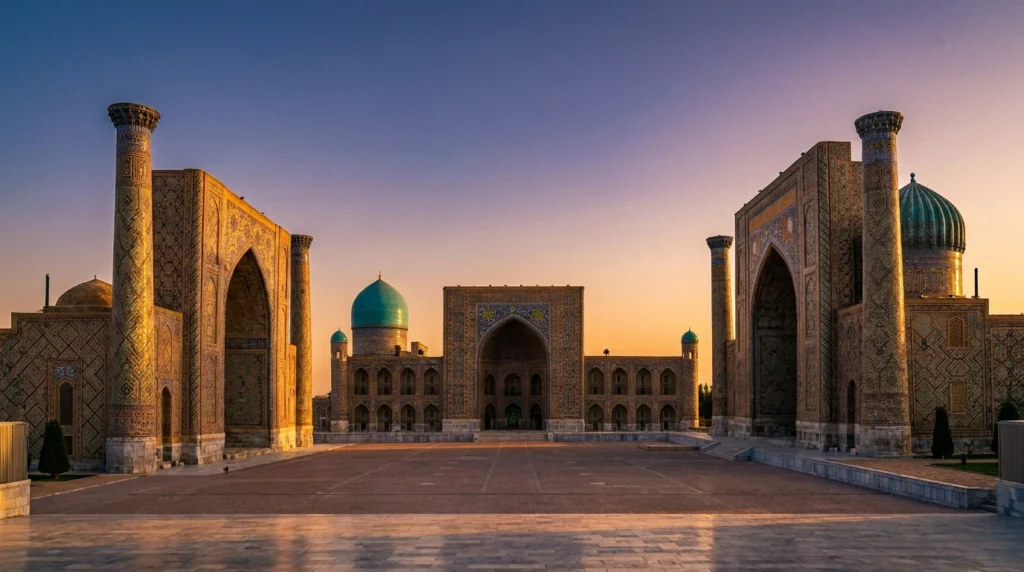
I have been telling everyone who will listen that Uzbekistan is the trip of the decade, and the first time I stood in the Registan in Samarkand at dawn I understood why. Three madrasahs face each other across a square, their cobalt and turquoise tilework catching the low light, and there is almost nobody there — this is the architectural equal of anything in Isfahan or Istanbul, and you can have it to yourself before the tour buses arrive. My week ran from Tashkent’s Soviet-era metro mosaics to Bukhara’s mud-walled old town, where a single street has been a covered bazaar for a thousand years, to Khiva, a walled desert city so complete it feels like a film set that forgot to strike. The food was a revelation, the people relentlessly hospitable, the prices a fraction of Europe, and the new high-speed train made the whole Silk Road loop genuinely easy. This guide is the brief I wish I’d had before I flew in.

In This Guide
- Overview — Why Uzbekistan belongs at the top of your 2026 shortlist
- Silk Road, Timur & Independence — A Pocket History of Uzbekistan
- Navruz & the Spring Calendar — Uzbekistan in 2026
- Best Time to Visit Uzbekistan (Season by Season)
- Getting There — Flights, Tashkent Airport & Visas
- Getting Around — The Afrosiyob, Trains & Shared Taxis
- Top Cities & Regions
- Uzbek Culture & Etiquette
- A Food Lover’s Guide to Uzbekistan
- Off the Beaten Path — The Aral Sea, Nukus & the Fergana Valley
- Practical Information
- Budget Breakdown
- Planning Your First Trip to Uzbekistan
- Frequently Asked Questions
Overview — Why Uzbekistan Belongs at the Top of Your 2026 Shortlist
Uzbekistan is the beating heart of Central Asia and the country that holds the greatest concentration of Silk Road monuments left standing anywhere on Earth. It covers 448,978 km² between the Amu Darya and Syr Darya rivers — slightly larger than Sweden, about the size of Morocco — and is one of only two doubly landlocked countries in the world (the other being Liechtenstein), meaning every neighbour is itself landlocked. Roughly 37.5 million people lived here at the start of 2025, making Uzbekistan by far the most populous country in Central Asia — more populous than all four of its Central Asian neighbours combined. Tourism is booming: 8.2 million foreign visitors arrived in 2024, up from 6.6 million in 2023, and tourism-service exports leapt from $2.14 billion to $3.52 billion in a single year.
The first story is the architecture. Uzbekistan has seven UNESCO World Heritage sites, and the headline three — Samarkand (inscribed 2001), the historic centre of Bukhara (1993), and Itchan Kala, the walled inner town of Khiva (1990) — form the densest cluster of intact medieval Islamic architecture in the world. Samarkand’s Registan, with its three facing madrasahs sheathed in cobalt and gold tile, is the single most photographed building complex in Central Asia; Bukhara preserves more than 140 protected monuments in a still-living old town; and Khiva’s Itchan Kala is so complete behind its 10-metre mud walls that it functions as an open-air museum.
The second story is the Silk Road itself. For more than a thousand years the great east-west caravan routes between China and the Mediterranean ran through the oasis cities of Transoxiana — the land “beyond the Oxus” — and Samarkand and Bukhara grew rich as the trading and intellectual capitals of the medieval Islamic world. This was the home of titans of science: the mathematician Al-Khwarizmi (from whom we get the words “algorithm” and “algebra”), the physician Ibn Sina (Avicenna), and the astronomer-king Ulugh Beg, whose 1420s observatory in Samarkand measured the length of the year to within a minute of the modern figure.
The third story is Tamerlane. The conqueror Timur (Tamerlane), born near Shahrisabz in 1336, built an empire stretching from Anatolia to India and made Samarkand its dazzling capital, importing the finest craftsmen from every land he conquered. His Timurid dynasty produced the golden age of Central Asian art and architecture, and Timur remains the founding national hero of modern Uzbekistan — his equestrian statue stands in Tashkent where Karl Marx once stood. The Gur-e-Amir, his turquoise-domed mausoleum in Samarkand, became the model for the great Mughal tombs of India, including the Taj Mahal.
The fourth story is the modern reboot. Since the death of long-time strongman Islam Karimov in 2016, President Shavkat Mirziyoyev has opened the country at remarkable speed: scrapping currency controls, abolishing exit visas for citizens, and — crucially for travellers — introducing 30-day visa-free entry for citizens of more than 90 countries, with the United States added from 1 January 2026. The UN World Tourism Organization named Uzbekistan one of the world’s fastest-growing tourism destinations in 2025, and the country is squarely in its moment.

Silk Road, Timur & Independence — A Pocket History of Uzbekistan
The land between the Amu Darya (the ancient Oxus) and Syr Darya rivers was known to the Greeks as Transoxiana and to the Persians as the region of Sogdia, and its great cities are genuinely ancient: Samarkand was founded as Afrasiab around the 7th century BC and was already a flourishing capital when Alexander the Great captured it in 329 BC. Bukhara and Khwarazm were equally old oasis civilisations, watered by irrigation canals and grown rich on the caravan trade in silk, spices, paper and slaves that linked Tang China to Sasanian Persia and the Mediterranean.
The Arab conquest of the early 8th century brought Islam, and under the Persian Samanid dynasty (819–999) Bukhara became one of the intellectual capitals of the Islamic world — home to the physician Ibn Sina (Avicenna), whose Canon of Medicine was a standard European medical text for six centuries. The 12th-century Kalyan Minaret in Bukhara, 46 metres tall, so impressed Genghis Khan that he ordered it spared when his Mongol armies sacked the city in 1220, levelling almost everything else.
The defining figure is Timur (Tamerlane), born near Shahrisabz in 1336. From a base in Samarkand he built, between 1370 and his death in 1405, the largest empire of his age — reaching from the Volga to the Ganges and from the Tien Shan to Anatolia. Timur deported the finest architects, tilemakers and scholars from every conquered land to beautify Samarkand, and the resulting Timurid style — vast portals, ribbed melon domes, and that signature cobalt-and-turquoise tile — became the template for Islamic architecture from Iran to Mughal India. His grandson Ulugh Beg (ruled 1409–1449) was the astronomer-king who built a three-storey observatory in Samarkand and produced a star catalogue of unprecedented accuracy.
After the Timurids came the Uzbek Shaybanid khans (16th century) and a long period of fragmentation into the rival khanates of Bukhara, Khiva and Kokand, which dominated the region from the 16th to the 19th centuries — the era that gave Khiva its slave market and its present walled form, and Bukhara its emir. In the 19th century the region became the prize of the “Great Game” between the British and Russian empires; Tsarist Russia annexed Tashkent in 1865 and absorbed the khanates as protectorates over the following two decades.
The 20th century was Soviet. The Uzbek Soviet Socialist Republic was created in 1924, Tashkent was rebuilt as a model Soviet city (and again after a devastating earthquake on 26 April 1966 levelled much of the centre), and the USSR turned the country into a vast cotton monoculture — the policy whose thirsty irrigation drained the Amu Darya and Syr Darya and destroyed the Aral Sea. Uzbekistan declared independence on 1 September 1991, with Islam Karimov as first president; he ruled with an iron hand until his death in 2016. His successor Shavkat Mirziyoyev launched the reforms — convertible currency, abolished exit visas, visa-free tourism — that have reopened the country to the world.
Navruz & the Spring Calendar — Uzbekistan in 2026
If you can shape your trip around one event, make it Navruz (Nowruz), the Persian-Central Asian spring new year, celebrated on the spring equinox of 21 March as a national public holiday. Navruz is far older than Islam — a Zoroastrian festival of renewal that UNESCO inscribed on its Intangible Cultural Heritage list — and in Uzbekistan it is the warmest, most communal moment of the year. Cities and villages fill with open-air concerts, folk-music and dance, wrestling (kurash), and giant cauldrons of sumalak, a sweet wheat-germ paste stirred overnight by groups of women who take turns at the paddle and make wishes as they stir.
The biggest public celebrations are in Tashkent’s Navruz Park and on the central squares of Samarkand and Bukhara, with the festivities anchored to the equinox and typically running across the days either side of 21 March. The spectacle is the food and the costume: market stalls heaped with the first spring greens, families in embroidered chapan coats, and the ceremonial plov cooked in cauldrons large enough to feed a neighbourhood.
The reason spring is the sweet spot for visiting goes beyond Navruz. From late March the desert and the foothills of the Chimgan and Nuratau mountains erupt with wildflowers — wild tulips (the ancestors of the garden tulip originate in this region), red poppies and almond blossom — and the daytime temperatures in Samarkand, Bukhara and Tashkent sit in the comfortable low-to-mid 20s°C before the brutal summer heat arrives. The shoulder is short: by late May the lowlands are already pushing 35°C.
The 2026 calendar around spring is loaded. 8 March is International Women’s Day, a major public holiday; 21 March is Navruz; 9 May is the Day of Remembrance and Honour. The two great Islamic festivals move 11 days earlier each year on the lunar calendar: in 2026 Eid al-Fitr (Ramadan Hayit) falls around 20 March — overlapping beautifully with Navruz — and Eid al-Adha (Kurban Hayit) around 27 May, both national holidays when families gather and the plov cauldrons come out. Later in the year, the biennial Sharq Taronalari international music festival fills the Registan in Samarkand with performers from across the Islamic world (next edition expected August 2027).

Best Time to Visit Uzbekistan (Season by Season)
Uzbekistan has a sharply continental desert climate — very hot summers, cold winters, and two glorious shoulder seasons that are the obvious time to visit. The country sits at the same latitude as Spain and Greece but, being doubly landlocked and largely desert, it has none of the maritime moderation: Tashkent swings from a January mean near 0°C to July highs above 35°C, and the desert lowlands around Bukhara and the Kyzylkum routinely exceed 40°C in midsummer. Rainfall is scant and concentrated in winter and spring; summer is bone dry.
Spring (March–May) — The Best Window of the Year
Spring is the optimal season, full stop. From mid-March the wildflowers bloom across the foothills, Navruz (21 March) brings the country’s warmest festival, and daytime temperatures in Samarkand, Bukhara and Tashkent sit in the comfortable low-to-mid 20s°C through April. April and early May are the photographer’s dream — blue skies, green oases, and tilework that glows in the soft light. The catch is that by the second half of May the lowlands are already climbing toward 35°C, so front-load your trip: the earlier in spring, the cooler the cities and the fresher the desert.
Summer (June–August) — Brutal Heat, Empty Monuments
Summer is the off-season for good reason: Bukhara and the Kyzylkum desert regularly hit 40–45°C, and even Tashkent and Samarkand bake at 35–40°C through July and August. The upside is that this is melon and fruit season — Uzbek melons are legendary, and the bazaars overflow — and the monuments are at their emptiest. If you must come in summer, start sightseeing at dawn, retreat indoors from noon to late afternoon, and consider the mountains: the Chimgan and Beldersay resorts above Tashkent and the Nuratau hills offer relief 8–10°C cooler than the plain. The cotton harvest begins in late summer across the Fergana Valley.
Autumn (September–October) — The Second Sweet Spot
Autumn is the equal of spring and arguably better for food. Mid-September to late October brings daytime temperatures back into the pleasant low-to-mid 20s°C, the desert nights turn cool and starry, and the harvest fills the bazaars with grapes, pomegranates, melons and the year’s new nuts and dried fruit. This is the connoisseur’s season: smaller crowds than spring, the kindest light of the year on the tilework, and the plov made with the new rice harvest. November cools quickly and the first frosts arrive by month’s end.
Winter (December–February) — Cold, Quiet & Cheap
Winter is cold but not arctic, and it has its own austere appeal. Tashkent and Samarkand hover around 0–8°C by day and dip below freezing at night; snow dusts the monuments a few times each winter, and the Registan under snow is a rare and beautiful sight. Crowds vanish, hotel prices fall, and the Chimgan slopes above Tashkent open for modest skiing from December to March. Pack a proper coat, and note that some smaller guesthouses in Khiva and Bukhara close or run skeleton heating in the depths of January.
Getting There — Flights, Tashkent Airport & Visas
The default gateway is Tashkent Islam Karimov International Airport (TAS), the busiest airport in the country and the hub of the national flag carrier, Uzbekistan Airways. Uzbekistan Airways flies direct from European hubs including London, Frankfurt, Paris, Istanbul and Milan, and from regional centres across the CIS, the Gulf and Asia; Turkish Airlines (via Istanbul), flydubai (via Dubai) and several others provide the easiest one-stop connections from North America and the rest of the world.
Increasingly, travellers fly straight into Samarkand International Airport (SKD), which reopened in a striking new terminal in 2022 and now handles a growing list of direct international flights — letting you start the Silk Road loop in Samarkand and finish in Tashkent without backtracking. The third option, Bukhara (BHK), takes a handful of international and domestic flights and is useful for ending a trip in the west. All three airports issue visa-on-arrival to eligible nationalities, and Tashkent and Samarkand are the designated visa-on-arrival points.
From TAS the city centre is only about 12 km away; an official metered taxi or a ride-hailing car (Yandex Go works throughout Uzbekistan) reaches central Tashkent in 20–30 minutes for a few dollars. Avoid the unofficial drivers who tout inside the terminal — book through the airport taxi desk or the Yandex app instead.
Visa policy has been transformed. Citizens of more than 90 countries — including the entire EU, the UK, Japan, South Korea, and (from 1 January 2026) the United States — may enter visa-free for 30 days. US citizens specifically gained 30-day visa-free entry for tourism and business from the start of 2026. Nationals not covered by the visa-free list can apply for a straightforward e-visa costing US$20, submitted online at least three working days before travel. Passports should be valid for at least three months beyond your stay. The old requirement to register with authorities within a few days of arrival is now handled automatically by your hotel — keep your registration slips, as border officials can ask for them on departure.
Getting Around — The Afrosiyob, Trains & Shared Taxis
The single best thing about travelling Uzbekistan is the Afrosiyob high-speed train, and it transforms the whole trip. Built by Spain’s Talgo, the Afrosiyob runs at up to 250 km/h and links Tashkent to Samarkand in about 2 hours 10 minutes, continuing on to Bukhara since 2016 for a total run of roughly 600 km in about 3 hours 20 minutes. Introduced in October 2011, it offers Economy, Business and VIP classes, all air-conditioned with tea or coffee service, and it is comfortable, punctual and absurdly cheap by European standards — a Tashkent–Samarkand economy seat runs in the region of $15–30. It is also wildly popular, so book ahead.
The classic Silk Road itinerary therefore writes itself: fly into Tashkent, take the Afrosiyob to Samarkand and Bukhara, and reach Khiva either by the slower overnight or daytime train (the line now extends west toward Khiva) or by a short flight or long desert drive across the Kyzylkum. Beyond the high-speed line, the national operator Uzbekistan Railways (O’zbekiston Temir Yo’llari) runs a wide network of conventional and sleeper trains that are cheap, safe and a fine way to see the country.
- Afrosiyob high-speed train: up to 250 km/h; Tashkent–Samarkand in ~2 h 10 min, on to Bukhara in ~3 h 20 min total.
- Tashkent → Samarkand: ~2 h 10 min by Afrosiyob (344 km).
- Samarkand → Bukhara: ~1 h 30 min by Afrosiyob.
- Bukhara → Khiva: roughly 6–7 hours by road across the Kyzylkum desert, or by the newer rail extension.
Tashkent Metro: the capital’s metro, opened in 1977, was the first in Central Asia and is justly famous for its lavishly decorated stations — chandeliers, marble, and mosaics on themes from cosmonauts to cotton. Photography, once banned for “security,” is now allowed, and a single ride costs a fraction of a dollar. Shared taxis (a long-standing institution) and the Yandex Go app cover everything the trains do not — Yandex gives a fair metered price in every city and removes all haggling.
Apps: Yandex Go for taxis, the Uzbekistan Railways site or app for train tickets, and Maps.me or Google Maps offline for navigation in cities where street signs are in Uzbek Latin and Cyrillic.

Top Cities & Regions
📍 Map of Uzbekistan: Every Place in This Guide
Almost every first trip to Uzbekistan is built around the same golden triangle — Samarkand, Bukhara and Khiva — strung along the old Silk Road and now joined by fast trains and a smooth highway. The three together hold the headline UNESCO sites and can be done comfortably in a week from Tashkent, but the country rewards anyone who lingers: the Fergana Valley craft towns in the east, Timur’s birthplace at Shahrisabz in the south, and the desert west around Nukus and the Aral Sea are all worth their own days. Below are the places that should anchor your route, roughly in the order most travellers visit them.


Samarkand
The jewel in the crown and Timur’s dazzling capital — the most beautiful city in Central Asia and the centrepiece of any trip. Samarkand has been continuously inhabited for some 2,750 years and was inscribed as a UNESCO World Heritage site in 2001 as “Crossroads of Cultures.”
- The Registan, three facing madrasahs in cobalt and gold — the most photographed square in Central Asia, floodlit and unforgettable after dark
- The Gur-e-Amir, Timur’s turquoise-domed mausoleum that inspired the Taj Mahal and the Mughal tombs of India
- Shah-i-Zinda, an avenue of mosaic-tiled mausoleums climbing a hillside, and the ruins of Ulugh Beg’s 1420s observatory
- The vast Bibi-Khanym Mosque and the lively Siab Bazaar beside it
Give Samarkand at least two full days, and stay near the Registan so you can return at night when the tour groups have gone.
Bukhara
The holiest and best-preserved of the Silk Road cities — a living old town of more than 140 protected monuments where a single street has been a covered bazaar for a thousand years. The historic centre was inscribed by UNESCO in 1993.
- The 46-metre Kalyan Minaret (1127), so beautiful that Genghis Khan ordered it spared
- The Po-i-Kalyan complex, the Ark fortress and the shady Lyab-i-Hauz pool square
- The Samanid Mausoleum (10th century), one of the oldest Islamic monuments in Central Asia
- The covered trading domes (Toki) where carpets, knives and ikat are still sold
Bukhara’s old town is small, walkable and made for wandering after dark, when the monuments are lit and the day-trippers have left. Two nights is the sweet spot.
Khiva
A walled desert city so complete it feels unreal — the inner town of Itchan Kala, ringed by 10-metre mud-brick walls, was Uzbekistan’s first UNESCO World Heritage site, inscribed in 1990.
- The stout, fully turquoise-tiled Kalta Minor Minaret, left unfinished in 1855
- The Kunya-Ark fortress and the Juma Mosque with its 200-plus carved wooden columns
- The Islam Khoja minaret, the tallest in Khiva, climbable for views across the desert
Khiva is the furthest west and the smallest of the three; a single packed day inside the walls covers the highlights, but staying a night to see Itchan Kala empty at dawn and dusk is the magic.
Tashkent
The capital and largest city in Central Asia — a green, modern metropolis of broad boulevards, leafy parks and the famous mosaic-clad metro, rebuilt after the 1966 earthquake. It is the natural arrival and departure point and worth two days.
- The Hazrati Imam complex, holding one of the world’s oldest Qurans
- The bustling Chorsu Bazaar under its blue domed roof
- The lavishly decorated Tashkent Metro stations
The Fergana Valley
The fertile, densely populated valley in the east — the cradle of Uzbek crafts, where Margilan still makes hand-woven khan-atlas ikat silk, Rishtan produces blue-glazed ceramics, and Kokand preserves the palace of the last khan.
- Margilan’s Yodgorlik silk factory and the traditional ikat looms
- Rishtan’s centuries-old ceramic workshops
Shahrisabz & the South
Timur’s birthplace, 80 km south of Samarkand over a mountain pass — the historic centre, with the colossal ruined portal of the Ak-Saray Palace, is a UNESCO World Heritage site inscribed in 2000.
- The 38-metre surviving towers of Timur’s Ak-Saray (“White Palace”)
- The Dorut Tilavat and Dorus Saodat memorial complexes
Uzbek Culture & Etiquette — What to Know Before You Go

Uzbekistan is a secular state with a deeply Muslim cultural fabric, and the headline trait every visitor notices is the warmth: hospitality (mehmondo’stlik) is close to a sacred duty, and being invited home for tea and plov is common and genuine. Dress is relaxed in the cities but modest at religious sites; the country is welcoming to visitors of every background, and English is increasingly spoken by younger people in the tourism trade.
Society blends Turkic, Persian and Soviet influences. Most Uzbeks are Sunni Muslims, but decades of Soviet rule produced a relaxed, largely secular practice: alcohol is sold openly, headscarves are a personal choice rather than the norm in cities, and the call to prayer is far quieter than in much of the Muslim world. Family is the centre of life — multi-generational households are common, weddings are enormous (a single celebration may feed several hundred guests), and respect for elders structures social interaction. The arts run deep too, from the maqom classical-music tradition to the intricate crafts — ikat silk, suzani embroidery, ceramics and miniature painting — that survived the Soviet era and are now central to the tourist economy.
The Essentials
- Remove your shoes when entering a home or a mosque prayer hall — follow your host’s lead.
- Dress modestly at mosques and mausoleums: cover shoulders and knees; women may be offered a scarf at some sites.
- Accept tea when offered — refusing outright can seem cold; a host fills your bowl only partly as a sign you are welcome to stay.
- Use your right hand (or both) to give and receive money, food and the bread.
- Ask before photographing people, especially women and at markets; a smile and a gesture go a long way.
Bread & the Dastarkhan
- Non (the round flatbread) is sacred: never place it upside-down, never put it on the ground, and tear it by hand rather than cutting it.
- The dastarkhan (the spread tablecloth and the meal upon it) is the centre of social life; wait to be seated and let elders begin.
- Bring a small gift if invited to a home — sweets, fruit or something from your country are perfect.
- Tea is poured back into the pot two or three times before serving (the “kaytar”) to blend it — a small ritual worth watching for.
A Food Lover’s Guide to Uzbekistan

Uzbek cuisine is one of the great underrated food cultures — hearty, meat-and-rice-forward, shaped by the Silk Road and by a nomadic-and-oasis past. The national dish is plov (osh), so central to identity that UNESCO inscribed Uzbek pilaf culture on its Intangible Cultural Heritage list; every region has its own version, and a master oshpaz can cook for hundreds in a single cauldron. It is always eaten with non bread and washed down with green tea.
Must-Try Dishes
| Dish | Description |
|---|---|
| Plov (Osh) | The national dish: rice slow-cooked with mutton, grated carrots, onions and often chickpeas, raisins, garlic and quail eggs in a wide cast-iron cauldron. |
| Samsa | Flaky pastry parcels of minced lamb, onion and fat (or pumpkin in season), baked stuck to the wall of a clay tandyr oven. |
| Shashlik | Char-grilled skewers of marinated lamb, beef or minced meat (lyulya), the staple of every street grill. |
| Lagman | Hand-pulled noodles in a rich stew of lamb, peppers, tomato and vegetables — a Uyghur-origin Silk Road classic. |
| Manti | Large steamed dumplings filled with minced lamb and onion (or pumpkin), served with yoghurt. |
| Non | The round, stamped flatbread baked in a tandyr — sacred, decorative, and different in every city (Samarkand’s is famously dense and long-keeping). |
Plov is more than a dish here — it is an institution with its own rituals. Traditionally it is a man’s domain, cooked for weddings, funerals and feast days in a wide cast-iron kazan, and many Tashkent families still gather at a dedicated “plov centre” on Thursdays and Sundays, where vast cauldrons are prepared at dawn and sold by the kilo until they run out by early afternoon. Each region guards its own recipe — Samarkand plov layers the ingredients rather than mixing them, Bukhara adds raisins, and the Fergana version is the richest of all — so it is worth trying the local style in every city you visit.
Bazaar & Tea Culture
The bazaar is the heart of Uzbek food life, and the country’s melons, grapes, pomegranates and dried fruit are legendary across the former Silk Road — Soviet-era lore held that the best melons in the whole USSR came from the Uzbek oases, flown to Moscow for the elite. Green tea (kok choy) is the default drink, poured endlessly in the choyxona (teahouse) that anchors every neighbourhood and doubles as the social hub where men gather to talk over a pot and a plate of bread. Black tea (qora choy) is more common in the desert west. Alcohol is available — local Uzbek wine and brandy from the Samarkand region are a Soviet-era legacy — but tea is the true national drink.
- Markets to graze: Chorsu (Tashkent), Siab Bazaar (Samarkand), and the covered trading domes (Toki) of Bukhara
- Sweets to try: halva, navat (crystal sugar), parvarda (caramel sweets) and walnut-stuffed dried fruit
- Signature buys: dried apricots and raisins, Samarkand non, ikat-wrapped spices, saffron and green tea
Off the Beaten Path — The Aral Sea, Nukus & the Fergana Valley

Most visitors never leave the golden triangle, and that is exactly why the rest of Uzbekistan is so rewarding. The desert west — Khwarazm and the autonomous republic of Karakalpakstan — is harsh, empty and strange, holding a banned-art museum in the middle of nowhere and the ghostly skeleton of a vanished sea. The fertile east, the Fergana Valley, is the living workshop where the country’s silk and ceramics are still made by hand. None of it is hard to reach with a day or two extra and a willingness to take a long drive or a domestic flight.
The Aral Sea & Moynaq
Once the world’s fourth-largest lake, the Aral Sea was drained to a fraction of its size by Soviet cotton irrigation — one of the planet’s worst man-made environmental disasters, which left behind a toxic salt desert now called the Aralkum. At Moynaq, a former fishing port that once landed tens of thousands of tonnes of fish a year, rusting trawlers sit stranded on the sand dozens of kilometres from any water — a haunting, unforgettable sight that has become the country’s most sobering attraction and the venue for the experimental Stihia electronic-music festival, which draws a young crowd to the dunes each summer.
Nukus & the Savitsky Museum
The remote capital of Karakalpakstan holds the Savitsky Museum, which preserves the world’s second-largest collection of Russian avant-garde art — banned masterpieces smuggled to the desert for safekeeping under Soviet rule.
The Fergana Valley Crafts Towns
Margilan still hand-weaves khan-atlas ikat silk on traditional looms, and Rishtan has produced its distinctive blue-and-green glazed ceramics for centuries — the living craft heartland of Uzbekistan.
The Nuratau Mountains & Aydarkul Lake
Between Samarkand and the desert, the Nuratau hills offer community-based homestays in mountain villages, where families host travellers for hearty home-cooked meals and walks through orchards and along ancient irrigation channels — the income goes straight to the village and the experience is one of the most authentic in the country. A night in a yurt camp beside the accidental Aydarkul Lake — a huge body of water created by a 1960s reservoir overflow into a desert depression — adds a taste of nomadic Central Asia: a camel ride, a fire under the stars, and silence. The two combine into a classic two-day add-on between Samarkand and Bukhara or Khiva.
Shahrisabz
Timur’s birthplace, with the towering ruined portal of his Ak-Saray Palace, makes a rewarding day trip from Samarkand over a scenic mountain pass — and it is a UNESCO World Heritage site in its own right.
Practical Information
Uzbekistan has modernised fast, and the practicalities are far smoother than they were a decade ago — the currency is convertible, ride-hailing works in every city, and SIM cards are cheap. A few quirks remain: cash still rules outside the big hotels, tap water is off-limits, and you should hang on to your hotel registration slips. The table below gathers the essentials at a glance.
| Currency | Uzbek som (UZS, so’m); roughly 12,700 som ≈ 1 USD (Feb 2026) |
| Cash needs | Cash is king outside upscale hotels; carry som in small notes. The som is now fully convertible after the 2017 reforms. |
| ATMs | Common in cities; many dispense US dollars as well as som. Bring some USD cash as backup for remote areas. |
| Tipping | Not traditional but appreciated; round up or leave 5–10% in tourist restaurants. |
| Language | Uzbek (Latin and Cyrillic script) is official; Russian widely understood; English growing in tourism. Google Translate offline helps. |
| Safety | Low crime; the US rates Uzbekistan a Level 1 “exercise normal precautions” destination. |
| Connectivity | Cheap local SIMs (Beeline, Ucell, Uzmobile) at airports and shops; 4G in cities, patchy in the desert. |
| Power | Type C and F plugs, 220V / 50 Hz |
| Tap water | Not recommended for drinking; bottled water is cheap and ubiquitous. |
| Healthcare | Basic outside Tashkent; carry travel insurance and a personal medical kit. Check CDC vaccine guidance before travel. |
Budget Breakdown — What Uzbekistan Actually Costs
Uzbekistan is one of the best-value destinations in the world right now. The big-ticket cost is your international flight; once you arrive, food, transport and accommodation are remarkably cheap, and even a mid-range trip delivers comfort that would cost three times as much in Western Europe. The Afrosiyob trains, bazaar meals and family-run guesthouses keep daily spending low without any sense of cutting corners.
Budget Traveller
Guesthouses and family-run B&Bs, plov and samsa from street grills and bazaars, and second-class trains keep costs remarkably low. Reckon on USD $25–45 a day all in, less if you stick to dormitories and shared taxis.
Mid-Range
Boutique courtyard hotels in restored merchant houses, restaurant meals, Afrosiyob business-class seats and the occasional private driver land most travellers at $55–110 a day — outstanding value for the comfort.
Luxury
Top heritage hotels in Samarkand and Bukhara, private guides, domestic flights and fine dining push past $250 a day, still a fraction of comparable experiences in Europe or the Gulf.
| Tier | Daily (USD) | Accommodation | Food | Transport |
|---|---|---|---|---|
| Budget | $25–45 | Guesthouse / dorm $8–20 | Bazaar & street $5–10 | 2nd-class trains, shared taxis |
| Mid-Range | $55–110 | Boutique hotel $40–80 | Restaurants $15–30 | Afrosiyob business, Yandex Go |
| Luxury | $250+ | Heritage hotel $150+ | Fine dining $50+ | Private driver, domestic flights |
Planning Your First Trip to Uzbekistan
Uzbekistan is one of the easier countries in the region to organise: the headline sights line up neatly along a single fast-train corridor, the visa rules are now generous, and prices are low enough that you can travel well on a modest budget. The two things to lock in early are your travel dates (aim for a shoulder season) and your Afrosiyob train seats, which sell out faster than the hotels. Everything else can be arranged on the ground. Here is the short checklist.
- Confirm your visa status: 30-day visa-free for 90+ nationalities (US included from 1 Jan 2026); otherwise apply for the $20 e-visa at least three days ahead.
- Pick your season: aim for April–early June or September–October and avoid the July–August desert heat.
- Book the Afrosiyob trains the moment the window opens — they sell out, especially in spring.
- Plan the classic loop: Tashkent → Samarkand → Bukhara → Khiva, then fly or train back to Tashkent.
- Bring cash (USD to exchange) and download Yandex Go and an offline map before you arrive.
Classic 10-Day Itinerary: Tashkent (2 days) → Samarkand (3) → Bukhara (3) → Khiva (2), travelling by Afrosiyob and one desert leg.
Frequently Asked Questions
Is Uzbekistan safe for tourists?
Yes. The US State Department rates Uzbekistan at Level 1 — Exercise Normal Precautions, the lowest tier, and violent crime against foreigners is rare. The main risks are ordinary petty theft in crowded bazaars and the usual taxi-overcharge nuisance, easily avoided with the Yandex Go app. Solo and female travellers generally report Uzbekistan as comfortable and exceptionally welcoming.
Do I need a visa to visit Uzbekistan?
Probably not. Citizens of more than 90 countries — the EU, UK, Japan, South Korea and, from 1 January 2026, the United States — enter visa-free for 30 days. Everyone else can apply online for a $20 e-visa, submitted at least three working days before travel. Passports should be valid for three months beyond your stay.
What currency does Uzbekistan use?
The Uzbek som (UZS), running at roughly 12,700 to the US dollar in early 2026. The som became fully convertible after the 2017 currency reforms, so the black market has vanished. Cash is essential outside upscale hotels; bring small notes, and some US dollars to exchange or as backup.
Is the Afrosiyob train worth it?
Absolutely — it is the backbone of any Uzbekistan trip. The 250 km/h high-speed service links Tashkent, Samarkand and Bukhara in comfort and at a tiny fraction of European rail prices, turning the Silk Road loop into an easy, civilised journey. Just book ahead, because it sells out fast in spring and autumn.
When is the best time to visit Uzbekistan?
Spring (April to early June) and autumn (September to October). Both bring comfortable low-to-mid-20s°C city temperatures, the spring wildflowers and Navruz, and the autumn harvest of melons and pomegranates. Avoid July and August, when the desert lowlands around Bukhara and Khiva routinely exceed 40°C.
Can I get by as a vegetarian or vegan?
It takes effort — Uzbek cuisine is deeply meat-centric, and even plov and soups are usually cooked with mutton or its fat. That said, the bazaars overflow with fruit, nuts, bread and dairy, lagman and manti come in pumpkin versions, and salads, samsa and non are everywhere. In Tashkent and the tourist hubs, modern cafés increasingly offer plant-based options; learn the phrase for “no meat” and you will manage.
Is the tap water safe to drink in Uzbekistan?
No — stick to bottled or filtered water, which is cheap and sold everywhere. The US CDC recommends avoiding tap water for drinking and brushing teeth in Uzbekistan, and being cautious with ice and unpeeled raw produce. Bottled water costs pennies and is universally available.
How many days do I need for Uzbekistan?
A week covers the big three — Samarkand, Bukhara and a quick Tashkent — but ten days is the sweet spot, letting you add Khiva and travel comfortably by Afrosiyob. Two weeks opens up the off-piste west: the Aral Sea at Moynaq, the Savitsky Museum in Nukus, the Fergana craft towns and a yurt night in the Nuratau hills.
What should I know about Navruz?
Navruz, the Persian-Central Asian spring new year on 21 March, is Uzbekistan’s warmest and most communal festival — UNESCO-listed, full of music, dance, kurash wrestling and giant cauldrons of sumalak and plov. It is a wonderful time to visit, but book hotels and trains weeks ahead, as the whole country is on the move.
Ready to Explore Uzbekistan?
If this guide convinced you, the plan is simple: fly into Tashkent in April or October, lock in the Afrosiyob seats to Samarkand and Bukhara, and add two nights in walled Khiva. The country rewards the curious at every turn — a tea offered in a workshop, a melon split open at a bazaar stall, a madrasah courtyard you have entirely to yourself. Save this guide for the practicalities, and we’ll see you on the Registan at dawn.
Explore More — City Guides & Related Reading
City guides to pair with your Silk Road trip
Note: dedicated FFU guides to Samarkand, Bukhara, Khiva and Tashkent are in the works — for now, explore the cities in the Top Cities section above.
Browse more
More country guides you might like
Plan your trip to Uzbekistan
The booking tools we use ourselves. FFU may earn a commission at no extra cost to you.
Plan & book your trip to Uzbekistan
Booking through these searches supports our guides at no extra cost to you.