
Languages of North Korea
All languages of Eastern Asia →fluent beta classical · classes by phone with Maya at ranas.ai/maya
North Korea Travel Guide — Inside the Democratic People’s Republic of Korea, and Why It Isn’t Currently a Trip
Every guide I write for this site ends with “go, here’s how.” This one doesn’t, and I want to be upfront about that before you read another word. North Korea — officially the Democratic People’s Republic of Korea, DPRK — is one of the most isolated, tightly controlled countries on Earth, with a capital of monumental Stalinist architecture, a sacred volcanic mountain shared with China, and a version of Korean culture frozen and reshaped by 75 years of separation from the South. It’s also, as of this writing, a country that foreign governments actively warn against visiting, and one where independent, no-strings tourism for most nationalities has been suspended since 2020. What follows is a genuine, respectful portrait of the place — its geography, its two UNESCO sites, its food, its history — written for understanding, not for booking.
In This Guide
- Overview — A Closed Country on an Open Peninsula
- Day of the Sun and the Mass Games
- Best Time to Visit North Korea (Climate, Season by Season)
- Getting There — Beijing, Air Koryo and the Only Real Route In
- Getting Around — Minders, Fixed Itineraries and No Freelancing
- Top Regions — Pyongyang, Kaesong, the DMZ and Beyond
- Culture & People — Juche, Family Lines and a Divided Peninsula
- A Food Lover’s Guide to North Korea
- Off the Beaten Path
- Practical Information
- Budget Breakdown — Why “Cost Per Day” Doesn’t Really Apply Right Now
- Frequently Asked Questions
Overview — A Closed Country on an Open Peninsula
North Korea occupies the northern half of the Korean Peninsula, bordered by China and Russia to the north and separated from South Korea by the Korean Demilitarized Zone (DMZ), established after the 1953 Korean Armistice Agreement ended active fighting in the Korean War without a peace treaty — meaning the two Koreas remain technically at war to this day. With a population of roughly 26 million and Pyongyang as its capital and only true metropolis, the country is governed as a one-party state under the Workers’ Party of Korea, commonly described by outside analysts as a totalitarian, hereditary dictatorship now in its third generation of leadership from the same family.
The travel reality has always been unusual here, even compared to other tightly controlled destinations: for the decades tourism operated at all, it was never independent. Every foreign visitor moved on a fixed, pre-approved itinerary with government-assigned guides for the entire trip, no exceptions, no wandering off on your own down a Pyongyang side street. Since January 2020, even that narrow model has been effectively shut down — first by North Korea’s own extreme, years-long COVID border closure, and since then by a patchwork of brief, partial reopenings (a handful of tours to Rason in early 2025, then a short-lived reopening of Pyongyang to some Western groups in spring 2025) that were themselves reversed within weeks. As of 2026, regular tourism to North Korea remains suspended for almost all nationalities, with organized access reported as limited mainly to Russian passport holders.
What that leaves is a country worth understanding on its own terms — its Koguryo-era royal tombs, its Koryo Dynasty capital at Kaesong, a volcanic crater lake sacred to Korean identity on both sides of the border, and a culture that split from a shared Korean past just 75-odd years ago and grew in a radically different direction. This guide covers that country honestly, alongside the very real reasons it isn’t a current travel option.
Day of the Sun and the Mass Games
The single biggest date on the North Korean calendar is 15 April, the Day of the Sun, marking the birthday of the state’s founder, Kim Il Sung — the closest thing the country has to a national holiday, marked with mass rallies, fireworks, floral tributes at monuments, and military displays in Pyongyang. In years when foreign tour groups were operating, this week (along with the Pyongyang Marathon, historically run around the same dates) was one of the few times independent travelers could realistically join organized tours, since itineraries were built specifically around it.
The other headline spectacle is the Arirang Mass Games (also staged in recent years as other large-scale gymnastic and artistic festivals), a stadium performance combining tens of thousands of gymnasts, dancers and card-stunt performers into a single synchronized show — routinely described as one of the largest choreographed human performances on the planet. Scheduling has been irregular for years, often tied to political anniversaries rather than a fixed annual date, and like everything else covered here, attendance depends entirely on whether organized tourism is running at all, which it currently is not for most travelers.
Best Time to Visit North Korea (Climate, Season by Season)
This section is a climate reference, included for completeness and for the day tourism meaningfully reopens — it is not a recommendation to travel now. The Korean Peninsula has a continental climate with four distinct seasons, and North Korea’s more mountainous, northern geography pushes those extremes further than in the South.
April – May · Spring
Mild, dry and generally considered the most comfortable stretch of the year — this is also when the Day of the Sun and (historically) the Pyongyang Marathon fall, so it was traditionally the busiest window for the small number of foreign tour groups.
June – August · Summer
Hot and humid, with a distinct monsoon-influenced rainy season concentrated in July and August that can bring heavy downpours and localized flooding, particularly along rivers.
September – October · Autumn
Widely regarded as the pick of the year climate-wise — clear skies, comfortable temperatures, and the season historically favored for Mass Games performances and harvest-related events when they were staged.
November – March · Winter
Long, cold, and often bitterly so in the north and at altitude around Mount Paektu, with heavy snow; Pyongyang itself sees a proper continental winter with sub-zero temperatures common.
Getting There — Beijing, Air Koryo and the Only Real Route In
Under the tourism model that operated for decades before the 2020 closure, there was essentially one practical route in for foreign visitors: fly or take the train from Beijing to Pyongyang, on either Air Koryo (North Korea’s state carrier) or Air China, as part of a pre-booked, government-licensed tour package — never independently. A smaller number of tours also crossed overland from the Chinese border city of Dandong, or entered through the Rason Special Economic Zone in the far northeast, which has at times operated under slightly different, more commercially-oriented rules than the rest of the country.
All of this ran through licensed foreign tour operators such as Koryo Tours, Young Pioneer Tours and Uri Tours, who handled visa paperwork, itineraries and government minders as a package — there has never been a scenario in which a foreign tourist simply booked a flight and a hotel independently. As of 2026, that entire pipeline is suspended for nearly all nationalities; a handful of tour operators report Russian-passport-only tourism continuing on a limited basis, and Western operators have reported no confirmed future tour dates. Anyone actually researching current entry should go directly to a licensed operator’s current status page and their own government’s advisory, not general travel content.
Getting Around — Minders, Fixed Itineraries and No Freelancing
Even at the height of North Korean tourism, “getting around” meant something different here than almost anywhere else on this site: visitors moved exclusively by tour bus or, for cross-country legs, domestic Air Koryo flights or a specially arranged train, always accompanied by government-assigned guides for the entire trip. There was no concept of a rental car, a solo taxi ride, or an unscheduled stop — itineraries were fixed in advance, approved by the relevant state tourism authority, and guides remained with the group throughout, including inside hotels.
Photography was, and would be again, tightly restricted around anything military, industrial or deemed politically sensitive, and guides had (and would again have) the final say on what could be photographed at any given stop. This isn’t a logistics quirk to plan around — it’s the defining structural fact of how North Korean tourism has always worked, on the rare occasions it has been running at all.
Top Regions — Pyongyang, Kaesong, the DMZ and Beyond
Pyongyang
The capital and only true metropolis, rebuilt almost entirely after being flattened during the Korean War, resulting in a city of wide boulevards, monumental Stalinist and Korean-nationalist architecture, and landmarks like the Juche Tower, Kim Il Sung Square, and the pyramid-shaped, still-unopened Ryugyong Hotel that has dominated skyline photos of the city for decades. Nearly every tour, historically, was built around Pyongyang as its base.
Kaesong
The former capital of the Koryo Dynasty (10th–14th centuries) and home to Historic Monuments and Sites in Kaesong, a UNESCO World Heritage Site since 2013 comprising twelve separate components — palaces, defensive walls, gates and a royal tomb complex reflecting the city’s geomantically planned layout and its role as a center of political, philosophical and spiritual life for the era. Kaesong sits close to the DMZ and has historically been paired on itineraries with a visit to Panmunjom.
Panmunjom & the DMZ
The Joint Security Area straddling the armistice line, and the single most famous set-piece of any North Korean itinerary: blue conference huts sitting directly on the border, with soldiers from both Koreas facing off a few meters apart. Access has always run through the North Korean side under separate, additional rules from the rest of a trip, mirroring the more famous approach most travelers know from the South Korean side.
Mount Paektu (Samjiyon)
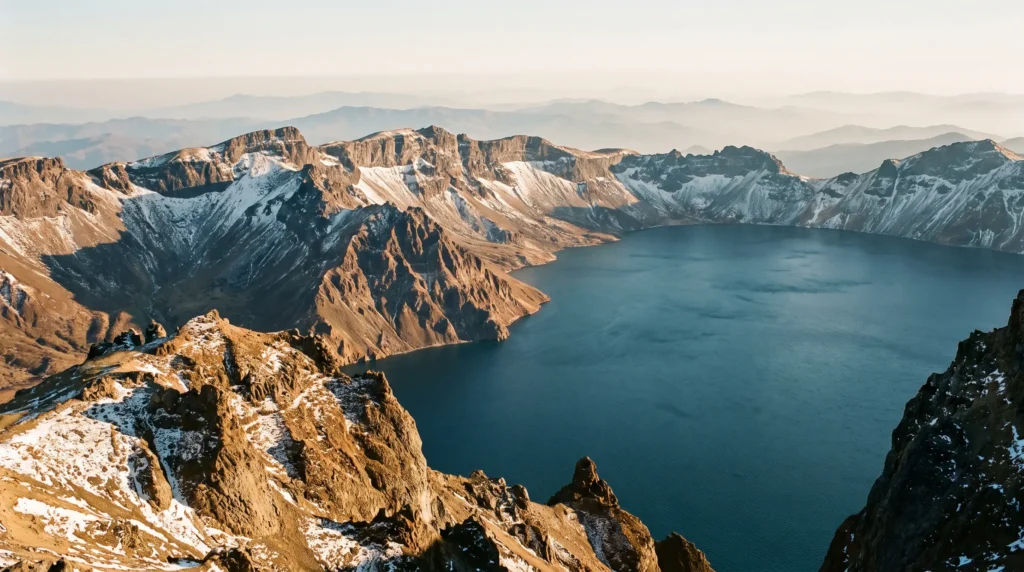
An active volcano straddling the China–North Korea border and, at 2,744 metres, the highest peak on the Korean Peninsula — mythologized in Korean folklore as the birthplace of the Korean nation and, in North Korean state narrative, tied closely to the ruling family’s origin story. Its crater holds Lake Chon, a striking blue caldera lake that, on the Chinese side (as Changbai Mountain), draws far more visitors than the North Korean approach ever has.
Mount Myohyang
A scenic mountain range northeast of Pyongyang, historically visited for its temples and for the International Friendship Exhibition, a purpose-built complex housing gifts presented to the country’s leaders by foreign dignitaries over the decades.
Wonsan & the Kalma Coast
An east-coast port city that North Korea has invested heavily in as a domestic and, aspirationally, international beach-resort zone in recent years, alongside the nearby Masikryong Ski Resort — both built as flagship tourism projects, though foreign access has followed the same on-again, off-again pattern as the rest of the country’s tourism sector.
Rason Special Economic Zone
A northeastern port zone bordering both China and Russia, run under distinct economic rules from the rest of the country and, at various points, one of the more accessible entry points for foreign visitors and businesspeople, including some of the very last organized tours before the most recent closures.
Culture & People — Juche, Family Lines and a Divided Peninsula
North Korea shares its deep cultural and linguistic roots entirely with South Korea — the same alphabet (Hangul, called Chosŏn’gŭl in the North), the same core cuisine and family structures, the same history prior to the peninsula’s division after World War II. What has diverged sharply since 1948 is everything shaped by state ideology: North Korea’s guiding philosophy of Juche (self-reliance) permeates education, media, art and public life, and the ruling Kim family’s hereditary leadership is embedded into public monuments, portraits and rituals in a way with few parallels anywhere else in the world.
For the visitors who have toured the country, day-to-day interaction with ordinary North Koreans outside the guiding staff has always been minimal and closely managed — a defining and, for many travelers, unsettling feature of the experience rather than an incidental one. Respectful conduct around statues, portraits and monuments of the leadership has always been strictly required of foreign visitors, including specific etiquette for photographing them (generally full-figure, never partial or mocking), and this has been treated as a serious matter rather than a minor cultural nicety.
A Food Lover’s Guide to North Korea
North Korean cuisine shares its foundation with the South — rice, kimchi, soy and chili-based seasoning — but leans somewhat plainer and less spicy in everyday cooking, shaped in part by a harder climate and historically scarcer resources. The signature dish most associated with Pyongyang specifically is naengmyeon, a bowl of thin, chewy buckwheat noodles served in a cold, tangy broth (or with a spicy sauce, in the “bibim” style), traditionally eaten even in the depths of winter — Pyongyang-style naengmyeon is considered a point of regional pride and is often the meal foreign visitors are served on arrival.
Kimchi remains a daily staple as in the South, and state banquet-style meals presented to foreign tour groups have historically featured a rotating spread of grilled meats, seafood and rice dishes, often with a formal, multi-course presentation. Alcohol options for visiting groups have typically included local beer (Taedonggang, brewed in Pyongyang) and a range of local spirits.
Off the Beaten Path
The Complex of Koguryo Tombs
North Korea’s other UNESCO World Heritage Site, inscribed in 2004: a set of royal and noble burial chambers from the Koguryo Kingdom (1st century BC to 7th century AD), scattered mainly around Pyongyang and Nampho, prized for elaborate stone-chamber wall paintings depicting daily life, mythology and religious ritual from a civilization that held off powerful neighbors for over seven centuries.
Rason
Already covered above as a region, but worth repeating here: its distinct economic status and China/Russia border position has repeatedly made it one of the more experimental corners of the country for limited foreign engagement, well off the standard Pyongyang-Kaesong-DMZ circuit.
Samjiyon & Lake Chon
The remote approach to Mount Paektu from the North Korean side sees a fraction of the visitors that the Chinese “Changbai Mountain” side receives, despite looking out over the same volcanic crater lake considered sacred across the whole peninsula.
Practical Information
Safety. This bears repeating outside the advisory box above: current guidance from the US State Department (Level 4, Do Not Travel) and UK FCDO (advises against all but essential travel) applies to the entire country, driven primarily by the risk of wrongful detention and the near-absence of consular or emergency support for foreign nationals. Check your own government’s current advisory page before making any decision.
Money. The North Korean won (KPW) is the domestic currency, but foreign visitors have never routinely used it — reporting indicates stores serving tourists and foreign residents have long preferred US dollars, euros or Chinese yuan, with change often returned in yuan or dollars rather than won. International card networks and ATMs are not usable by foreign visitors; when tourism has operated, cash brought from home covered the entire trip, since almost everything (including the tour itself) was pre-paid.
Health. The CDC recommends routine vaccinations be current plus Hepatitis A and B and typhoid for most visitors, Japanese encephalitis for extended rural stays, and pre-exposure rabies vaccination — the agency specifically flags that rabies-infected dogs are commonly found in the country. Malaria prophylaxis is advised for travel to southern provinces, and the CDC strongly recommends medical evacuation insurance, since trauma care is uncommon outside urban centers and treatment options are otherwise very limited.
Connectivity. Internet and mobile network access for foreign visitors has historically been almost nonexistent outside a small number of hotels and, per the FCDO, remains “almost impossible” as a way to communicate with the outside world if a problem arises — plan on being effectively unreachable for the length of any trip, whenever trips resume.
Budget Breakdown — Why “Cost Per Day” Doesn’t Really Apply Right Now
Every other guide on this site gives you budget, mid-range and luxury daily costs. North Korea has never fit that model even when tourism was operating, and it fits it even less now that organized tourism itself is suspended for almost all nationalities. There has never been an independent, book-it-yourself tourism economy here — no hostels, no backpacker trail, no visa-on-arrival system — because independent travel has simply never been permitted.
In the years tourism did run, foreign visitors booked all-inclusive packages through licensed operators covering the visa, guides, transport, hotels and meals as a single bundled price, with costs varying by trip length, group size and whether the itinerary included harder-to-reach regions like Mount Paektu or Rason. Those numbers are historical rather than current, and quoting them here as if they applied today would be more misleading than useful. If and when organized tourism meaningfully reopens for a broad range of nationalities, this is the section we’ll rewrite first, with real, current figures from licensed operators.
Planning Your First Trip to North Korea
Right now, the honest planning advice is: this isn’t a trip to plan independently, and for the vast majority of nationalities it currently isn’t bookable at all through any licensed operator. For everyone else, the most useful thing this guide can do is point you toward the parts of the region you can actually visit today. South Korea shares the same peninsula, the same deep cultural roots, and — from the southern side of the DMZ at Panmunjom — a version of the same extraordinary border experience, fully open and well set up for visitors. China lets you see Mount Paektu’s crater lake from the Changbai Mountain side, plus the Dandong border area where North Korea is visible across the river. Further into the region, Mongolia and Vietnam both offer a version of the “socialist-history-meets-open-tourism” experience North Korea might one day become, without the current restrictions. Bookmark this guide; we’ll revisit it if the advisory and closure picture changes.
Frequently Asked Questions
Is it safe to travel to North Korea in 2026?
According to current guidance, no government considers it safe for ordinary tourism. The US State Department rates it Level 4, Do Not Travel — its highest level, citing wrongful detention risk above all — and the UK FCDO advises against all but essential travel to the entire country. Always check your own government’s current page rather than relying on any single source, including this one.
Can Americans even legally visit North Korea?
No, not under normal circumstances. US passports are not valid for travel to, in, or through North Korea unless specially validated by the Secretary of State, and such validations are granted only in very limited circumstances such as journalism or specific humanitarian work.
Is North Korea even open to tourists right now?
Largely no. Regular foreign tourism has been suspended since January 2020, and while a small number of tours to Rason and Pyongyang ran briefly in early 2025, the country closed again shortly after. As of 2026, reporting from licensed tour operators indicates organized access remains limited mainly to Russian passport holders, with no confirmed resumption date for most other nationalities.
Can you travel independently in North Korea?
No — this has never been an option, even in years when tourism was fully operating. Every foreign visitor has always traveled on a fixed, pre-approved itinerary with government-assigned guides for the entire trip.
What currency do visitors use?
Not the North Korean won in practice — foreign visitors and stores serving them have long dealt primarily in US dollars, euros or Chinese yuan rather than local won.
How many UNESCO World Heritage Sites does North Korea have?
Two: the Complex of Koguryo Tombs, inscribed in 2004, and Historic Monuments and Sites in Kaesong, a twelve-component listing inscribed in 2013.
A Guide for Understanding, Not Booking — For Now
North Korea holds a sacred volcanic crater lake, a UNESCO-listed medieval capital, and a version of Korean culture that split from its southern twin only a few generations ago and grew into something the rest of the world still struggles to read clearly. It also holds, right now, a Level 4 Do Not Travel advisory, an FCDO warning against all but essential travel, and a tourism industry that is effectively closed to almost everyone. We’ll keep this guide updated as that picture changes. Until then, treat it as a window into the country, not an itinerary.
Explore More
- South Korea Travel Guide — the same peninsula and roots, fully open, including the DMZ from the southern side
- China Travel Guide — see Mount Paektu’s crater lake from the Changbai Mountain side, plus the Dandong border area
- Mongolia Travel Guide — East Asian history and wide-open steppe, no restrictions
- Vietnam Travel Guide — a socialist-history destination that fully reopened to the world
How this guide was built
Published . Because North Korea currently carries the highest-level travel advisories from multiple governments and its tourism industry is itself largely suspended, this guide was built with an explicit safety-first brief: verify the advisory and closure status first, from primary government sources, and write every other section honestly around that reality rather than around a typical destination-guide template. Sources consulted include the US State Department’s North Korea travel advisory, the UK FCDO’s North Korea travel advice, the US CDC traveler health page for North Korea, UNESCO’s listing for Historic Monuments and Sites in Kaesong, and Wikipedia entity pages for North Korea, the North Korean won, tourism in North Korea, and the list of North Korea’s UNESCO World Heritage Sites. Numeric and checkable claims carry inline citations.
Sources cited on this page
- US State Department — North Korea Travel Advisory
- UK FCDO — North Korea Travel Advice
- US CDC — North Korea traveler page
- UNESCO — Historic Monuments and Sites in Kaesong
- Wikipedia — North Korea
- Wikipedia — North Korean Won
- Wikipedia — Tourism in North Korea
- Wikipedia — List of World Heritage Sites in North Korea
More country guides you might like
Plan your trip to North Korea
The booking tools we use ourselves. FFU may earn a commission at no extra cost to you.
Plan & book your trip to North Korea
Booking through these searches supports our guides at no extra cost to you.