
Languages of Central African Republic
All languages of Middle Africa →fluent beta classical · classes by phone with Maya at ranas.ai/maya
Central African Republic Travel Guide — An Honest Look at a Country You Should Not Be Visiting Right Now
I’ve written well over a hundred of these guides, and this is the first one where my honest advice is not “go, just time it right” — it’s “don’t, not right now.” Central African Republic is a landlocked nation of roughly 5.5 million people at the literal geographic center of the continent, home to rainforest gorillas, savanna elephants, one of Africa’s most striking megalithic sites, and a genuinely fascinating, tangled colonial history. It is also, right now, a country under active Level 4 “Do Not Travel” advisory from the US State Department and a near-total “advise against all travel” notice from the UK Foreign Office. So this guide is not a pitch. It’s the guide I’d want if I were trying to actually understand this country — its geography, its people, what’s there, why it matters — while being straight with you about why almost none of it is currently visitable. Alex is honest, not reckless, and this is the one guide on the site written entirely in that spirit.
In This Guide
- Overview — Geography, People and a Country in Crisis
- National Days & the Dry-Season Window
- Best Time to Visit, If and When That Changes
- Getting There — Bangui M’Poko & Why Overland Isn’t an Option
- Getting Around — Air, River and Security Escort
- Regions — Bangui, the Rainforest South & the Savanna North
- Culture & People — 80 Groups, Two Official Languages
- A Food Lover’s Guide to Central African Republic
- Off the Beaten Path (Mostly Off-Limits)
- Practical Information
- Budget — Why the Usual Tiers Don’t Apply
- Frequently Asked Questions
Overview — Geography, People and a Country in Crisis
Central African Republic sits, more or less literally, at the center of the African continent: landlocked, bordered by Chad to the north, Sudan to the northeast, South Sudan to the east, the Democratic Republic of the Congo to the south, the Republic of the Congo to the southwest, and Cameroon to the west. It covers roughly 623,000 square kilometers — bigger than France — for a population of only about 5.5 million, one of the lowest population densities in Africa. The capital and only large city is Bangui, on the Ubangi River, home to roughly 812,000 people, sitting right where a series of rapids historically blocked commercial river traffic further upstream.
The country was French Equatorial Africa’s “Oubangui-Chari” territory before gaining independence from France on 13 August 1960. Roughly 80 distinct ethnic groups share the territory — Baggara Arabs, Banda, Gbaya, Zande, Yakoma and Fula communities among the larger ones — with Christianity practiced by about 73% of the population, Islam by about 14%, and traditional faiths by around 12%. French and Sango are both official languages, and Sango — originally a Ubangi River trade language — functions as the genuine lingua franca that unites the country’s ethnic and linguistic patchwork.
None of that history is abstract right now. A 2012–2013 rebellion and coup tipped the country into a civil conflict that has never fully resolved, drawing in a UN peacekeeping mission that remains deployed today, alongside recurring waves of displacement, armed group control of large rural areas, and the landmine contamination that follows any protracted conflict. That’s the context behind every “Do Not Travel” and “advise against all travel” notice referenced throughout this guide — it isn’t boilerplate caution, it reflects a country still working through an active crisis.
National Days & the Dry-Season Window
If you’re reading this for background rather than booking purposes — which, given the advisories above, should be most readers — two dates anchor the Central African calendar. Boganda Day, on 29 March, commemorates Barthélemy Boganda, the country’s founding nationalist figure and first prime minister, who died in a plane crash in 1959, a year before independence he never lived to see. Independence Day falls on 13 August, marking the 1960 break from France.
Weather-wise, the country runs on a fairly typical Central African wet/dry pattern: a longer, more reliable dry season roughly from December through February, especially in the south around Bangui, with the north’s dry season stretching further into the year and the rainy season concentrated from around May through October. Under normal circumstances that December–February window would be the obvious travel-planning answer. Under current circumstances, it’s simply the more useful season for aid organizations and peacekeeping logistics that already operate on the ground — not a signal to plan a personal trip around.
Best Time to Visit, If and When That Changes
December – February · Dry season
The most reliable weather window, drier roads (where roads exist), and the season in which most current humanitarian and diplomatic travel is concentrated. If advisories ever ease meaningfully, this is the stretch a future version of this guide would likely recommend first.
March – May · Transitional
Rains build through the south first; heat and humidity climb ahead of the wet season proper.
June – October · Rainy season
The core of the wet season across most of the country, with the heaviest rainfall in Bangui typically falling between roughly July and October. Unpaved roads — which is most of them outside Bangui — become significantly harder to move on, compounding the security-driven access limits already in place.
November · Short transition
Rains taper off heading into the December–February dry stretch.
None of these seasonal notes override the advisory framing at the top of this guide. Weather is one variable among several; the security and safety picture is the one that actually determines whether travel is advisable at all, and that’s the one to check immediately before any real plan.
Getting There — Bangui M’Poko & Why Overland Isn’t an Option
The country’s only real international gateway is Bangui M’Poko International Airport (BGF), about seven kilometers northwest of the capital. There are no direct flights from North America or Europe — access runs through regional hub carriers, with Ethiopian Airlines connecting via Addis Ababa, ASKY Airlines via Douala and Lomé, Royal Air Maroc via Casablanca, RwandAir via Kigali, and AfriJet via Libreville and Yaoundé. The UK FCDO’s advisory explicitly extends “all but essential travel” caution to the airport itself, not just the wider city.
Overland entry is a non-starter under current conditions. Every land border — with Chad, Sudan, South Sudan, DRC, Republic of Congo and Cameroon — crosses through regions the US and UK advisories flag as under partial armed-group control or landmine risk, particularly the tri-border zones with Chad and Sudan and the area near Bambari in the east. Anyone with an organizational reason to travel here arrives by air into Bangui and moves under that organization’s own security arrangements from there — not as an independent traveler crossing a border on their own initiative.
Getting Around — Air, River and Security Escort
Road infrastructure outside Bangui is limited and largely unpaved, which was already a constraint before the conflict-driven access restrictions layered on top of it. In practice, the people currently moving around the country beyond the capital — UN peacekeepers, aid convoys, occasional journalists — do so via light aircraft charters, the Ubangi River where navigable, or organized road convoys with security coordination, not independent car hire or public transport.
Within Bangui itself, taxis and motorbike-taxis operate, but the FCDO’s own guidance for the capital already sits at “all but essential travel,” which tells you what the baseline expectation should be even inside the safer part of the country. This isn’t a guide encouraging independent movement through Central African Republic under current conditions — it’s a description of how the country’s logistics actually function for the people who do have a legitimate reason to be here.
Regions — Bangui, the Rainforest South & the Savanna North
Framed purely as geography — not as an itinerary — here’s what the country actually contains, and what its status is.
Bangui
The capital and the only part of the country where the FCDO advisory softens even slightly, from “advise against all travel” to “advise against all but essential travel.” It’s a river city on the Ubangi with colonial-era wide boulevards, Notre-Dame Cathedral, the Boganda Museum’s collection of traditional instruments and tools, and the University of Bangui, founded in 1970. This is where nearly all current non-military foreign presence — diplomatic, NGO, journalistic — is based, under curfews and security protocols rather than tourist freedom of movement.
Dzanga-Sangha & the Sangha Trinational (southwest)
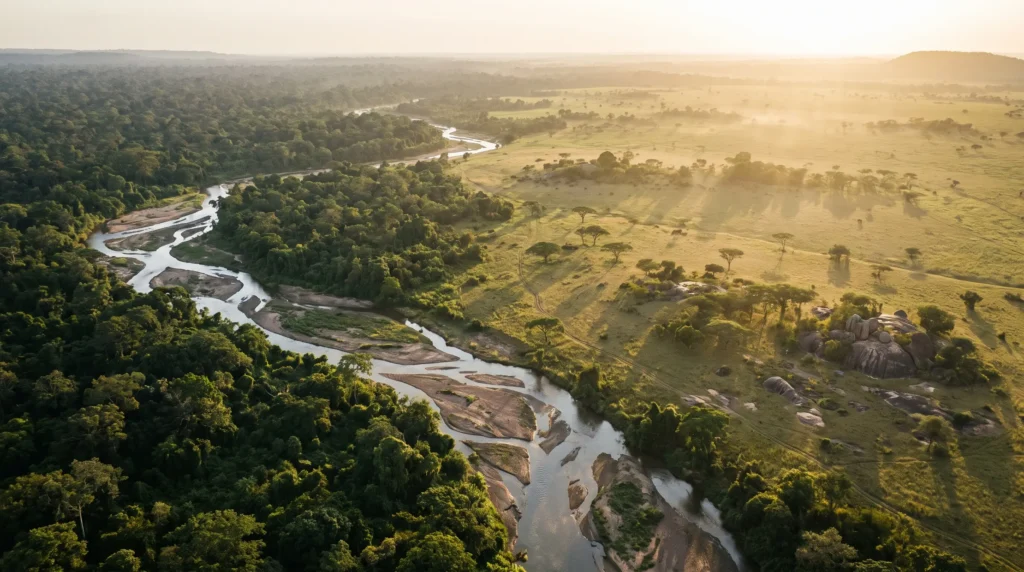
The country’s most ecologically famous corner: dense equatorial rainforest forming part of the Sangha Trinational UNESCO World Heritage site, shared with Cameroon and the Republic of Congo, covering roughly 750,000 hectares and sheltering forest elephants, critically endangered western lowland gorillas and chimpanzees. Before the conflict, the Dzanga-Sangha Reserve ran small-scale, high-cost gorilla-trekking eco-tourism comparable to programs in Rwanda or Uganda. Its current accessibility is a separate and much stricter question from its ecological importance — treat any historical write-up about visiting it as outdated until an official source says otherwise.
Manovo-Gounda St Floris National Park (north)
The largest protected savanna landscape in the Central African region, inscribed as a UNESCO World Heritage Site in 1988 for its elephant, lion, hippo and (once) black rhino populations. Poaching, cross-border livestock incursions and the instability that began in 2012 gutted its wildlife management, and it has sat on UNESCO’s List of World Heritage in Danger since 1997 — one of the starkest examples worldwide of what conflict does to conservation. It also sits in the country’s least secure northern border region.
Bouar (west)
Home to the Bouar megaliths, a field of carved stone monuments (locally “tazunu”) among the more significant and least-known archaeological sites in Central Africa — a genuine curiosity for anyone interested in the continent’s deep history, currently as inaccessible to casual visitors as everywhere else outside Bangui.
The Ubangi River south
The country’s agricultural and forested southern belt, drained by the Ubangi and Chari river systems, historically the most stable and populated part of the country outside the capital.
Culture & People — 80 Groups, Two Official Languages
For a country of only 5.5 million people, Central African Republic’s ethnic diversity is remarkable: roughly 80 distinct groups, with Baggara Arab, Banda, Gbaya, Zande, Yakoma and Fula communities among the larger populations, plus long-standing Christian and Muslim communities and pockets of traditional belief systems that predate both. French remains the language of government and formal education, a colonial-era holdover, while Sango — a Ubangi trade language that predates French colonization — is spoken and understood almost universally and functions as the country’s genuine unifying tongue.
Barthélemy Boganda, the founding nationalist leader commemorated every 29 March, remains the closest thing the country has to a unifying historical figure — a Catholic priest turned politician who pushed for a broader Central African federation and died before independence arrived. The decades since have been a difficult story of coups, brief democratic openings, and the current protracted conflict — worth understanding on its own terms rather than reducing to a single news-cycle headline.
A Food Lover’s Guide to Central African Republic
The staple of Central African cooking is cassava (manioc), processed into gozo — dried, ground cassava flour worked into a dense, dough-like paste, the Sango-language cousin of dishes known elsewhere in Central Africa as sakasaka or mpondu. It’s typically served alongside a meat, fish or vegetable sauce — the base of most everyday meals in Bangui and beyond. Rice, plantains, squash and pumpkin round out the everyday plate, usually with grilled meat where it’s available.
Cassava leaves themselves — distinct from the root — are pounded and cooked into a spinach-like green that shows up across the wider Congo Basin under different names. Freshwater fish from the Ubangi and Chari rivers is a mainstay wherever river access allows, and palm wine is the traditional local drink in rural communities. This is simple, hearty, cassava-and-sauce cooking rather than a globally exported cuisine — but it’s the real, everyday food of one of the least-documented culinary traditions on the continent.
Off the Beaten Path (Mostly Off-Limits)
Dzanga Bai — “the village of elephants”
A famous forest clearing within the Dzanga-Sangha rainforest where dozens of forest elephants gather at once to drink mineral-rich water, historically one of the most extraordinary wildlife-viewing sites in Africa and a centerpiece of the pre-crisis Sangha Trinational eco-tourism program. Its current accessibility to visitors is not something this guide can responsibly assert either way — check directly with conservation organizations operating in the reserve, not a travel blog, before assuming anything about a visit.
Bouar megaliths
Carved monolithic stones scattered across the western highlands near Bouar, among Central Africa’s most significant and least-studied archaeological remains — a genuinely unique site that gets almost no international attention, conflict or no conflict.
Manovo-Gounda St Floris
Covered above under Top Regions: the largest savanna park in the region, in UNESCO’s “in Danger” category since 1997 and sitting in the country’s least secure northern zone. Its long-term recovery, if it comes, will depend entirely on the security situation resolving first.
Practical Information
Money. The Central African CFA franc (XAF) is fixed at €1 = 655.957 XAF, shared across six CEMAC countries — Cameroon, Chad, Republic of Congo, Equatorial Guinea, Gabon and Central African Republic itself. This is overwhelmingly a cash economy outside a small circle of Bangui hotels and offices; card acceptance is minimal to nonexistent.
Safety. Repeating it because it’s the single most important line in this guide: US Level 4 “Do Not Travel,” UK FCDO “advise against all travel” outside Bangui and “all but essential travel” within it, no British embassy on the ground, and documented landmine risk in specific border zones. Check both advisories directly before any travel, not a summary of them from mid-2026.
Health. Yellow fever vaccination is required for all arriving travelers aged nine months and up. Malaria prophylaxis is strongly recommended countrywide against chloroquine-resistant strains, alongside hepatitis A and B, typhoid and meningococcal vaccination depending on season and itinerary, plus routine vaccines kept current. The CDC also currently flags a Level 2 global polio notice relevant to travelers here. Medical facilities outside Bangui are extremely limited; evacuation insurance is non-negotiable for anyone traveling for work.
Connectivity. Mobile and internet infrastructure is thin and concentrated in Bangui; expect it to be unreliable elsewhere. Time zone: UTC+1, no daylight saving.
Budget — Why the Usual Tiers Don’t Apply
Every other FFU country guide breaks costs into budget, mid-range and luxury daily tiers. That framework assumes an actual tourism market — hostels competing with guesthouses competing with resorts — and Central African Republic simply doesn’t have one right now. There’s no meaningful backpacker circuit, no boutique-hotel scene, no dive shops or tour operators pricing packages for independent travelers.
The costs that do exist here are driven by an entirely different logic: charter flight fees for reaching areas beyond Bangui, security details and armored transport for anyone moving overland, and NGO- or diplomatic-rate lodging in the capital that has nothing to do with tourist pricing. Anyone traveling here for legitimate work purposes should be budgeting against their organization’s security and logistics plan, not a per-day tourist estimate — and if you’re not traveling under that kind of organizational structure, the honest answer is that cost isn’t actually the question you should be asking yet. Safety clearance is.
Planning — If You Genuinely Have to Travel
If you have a legitimate professional reason to be in Central African Republic — humanitarian work, diplomacy, journalism, a UN-affiliated role — plan through that organization’s security office, not independently, and register with your embassy’s nearest equivalent presence (bearing in mind several governments, including the UK, have no embassy in-country). Re-check travel.state.gov and gov.uk/foreign-travel-advice the week before departure, since conditions can shift quickly. For anyone drawn to this region for the rainforest wildlife or gorilla trekking that Dzanga-Sangha is known for, the safer and currently accessible way to have that experience is next door: our Rwanda guide and Uganda guide cover established, well-regulated gorilla-trekking programs, and our Chad guide covers CAR’s northern neighbor, itself under its own advisories worth checking independently.
Frequently Asked Questions
Is Central African Republic safe to visit in 2026?
No — not by the standard of a normal tourist trip. The US State Department rates it Level 4, “Do Not Travel,” and the UK FCDO advises against all travel to the whole country except Bangui, where it still advises against all but essential travel. Check both directly before making any decision.
Do I need a visa?
Yes, for nearly every nationality, and there is no visa-on-arrival system. CAR has very few diplomatic missions abroad, so anyone with a genuine reason to travel should apply well in advance through the nearest available mission and confirm current requirements directly, since they can change with little notice.
What vaccinations do I need?
Yellow fever vaccination is mandatory for entry for travelers nine months and older. Malaria prophylaxis, hepatitis A/B, typhoid and meningococcal vaccination are all strongly recommended depending on your itinerary and timing — check the CDC’s country page directly and talk to a travel clinic.
Can I still do gorilla trekking at Dzanga-Sangha?
It existed as a small, well-regarded eco-tourism program before the crisis, and the reserve remains ecologically significant as part of the Sangha Trinational UNESCO World Heritage site. Whether it currently operates for outside visitors is not something to guess at — confirm directly with the conservation organizations on the ground, and treat “currently accessible” as false until an official, current source says otherwise.
Why do people still go there at all?
Almost everyone currently in-country beyond Central African citizens themselves is there for a specific institutional reason — UN peacekeeping (a mission has been deployed since the 2012–2013 crisis), humanitarian aid work, diplomacy or journalism — operating under organizational security protocols, not as independent tourists.
When will it be safe to visit as a tourist?
Nobody can responsibly predict that, including us. The honest answer is to monitor the US State Department and UK FCDO advisory pages over time; if and when either meaningfully downgrades, that’s the real signal, not anything in this guide.
A Country Worth Understanding — Even If You Can’t Visit Yet
Central African Republic isn’t a “someday” bucket-list entry in the usual FFU sense — it’s a country going through something real, with people living through it who deserve more than a passing headline. If any of this stuck with you, the most useful thing you can do right now isn’t book a flight — it’s keep half an eye on how the situation develops, and if you’re drawn to what Dzanga-Sangha or Manovo-Gounda St Floris represent, go see their well-managed equivalents in Rwanda, Uganda or Tanzania while this country works toward the point where a guide like this can be rewritten with a “Best Time to Visit” section that actually means it.
Explore More
- Chad Travel Guide — CAR’s northern neighbor, its own advisories worth checking
- Rwanda Travel Guide — established, regulated gorilla trekking
- Uganda Travel Guide — more gorilla trekking and rainforest wildlife
- Kenya Travel Guide — East Africa’s most established safari infrastructure
How this guide was built
Published . Built from authoritative sources — the US State Department’s Central African Republic travel advisory, the UK FCDO’s foreign travel advice page, the US CDC’s traveler health page for Central African Republic, UNESCO’s World Heritage state-party listing and State of Conservation report for Manovo-Gounda St Floris National Park, UNESCO’s Sangha Trinational listing, and Wikipedia entity pages covering the country’s geography and history, Bangui, Bangui M’Poko International Airport, the Central African CFA franc, national cuisine, and public holidays. Given the current advisory situation, this guide deliberately avoids typical “best time to book” and per-day budget framing where no honest, verifiable data exists to support it. Numeric and checkable claims carry inline citations.
Sources cited on this page
- US State Department — Central African Republic Travel Advisory
- UK FCDO — Central African Republic Travel Advice
- US CDC — Central African Republic Traveler Page
- UNESCO — Central African Republic States Parties Page
- UNESCO — State of Conservation, Manovo-Gounda St Floris National Park
- UNESCO — Sangha Trinational World Heritage Listing
- Wikipedia — Central African Republic
- Wikipedia — Bangui
- Wikipedia — Bangui M’Poko International Airport
- Wikipedia — Central African CFA Franc
- Wikipedia — Cuisine of the Central African Republic
- Wikipedia — Public Holidays in the Central African Republic
- Wikipedia — List of World Heritage Sites in Central African Republic
More country guides you might like
Plan your trip to Central African Republic
The booking tools we use ourselves. FFU may earn a commission at no extra cost to you.
Plan & book your trip to Central African Republic
Booking through these searches supports our guides at no extra cost to you.
Curated multi-day tours to Central African Republic — Exoticca →