
Saint Kitts and Nevis Travel Guide — Two Volcanoes, One Narrow Strait, and the Caribbean’s Original Small Country
Saint Kitts and Nevis is the smallest sovereign nation in the Western Hemisphere, both by land and by people, and it wears that in a way that feels less like a footnote and more like a flex. Two volcanic islands, separated by a strait you can practically swim across on a calm day, share one government, one currency and roughly zero pretension. St Kitts does the heavy lifting — capital, cruise pier, casino, the fortress that got the whole country onto UNESCO’s list — while Nevis, three kilometres across The Narrows, is the quiet sibling who’d rather you hike the volcano and leave by six. I’ve spent time on both, and the split personality is the whole appeal: you get a proper Caribbean fortress-and-plantation history lesson in the morning and a beach with nobody else on it by afternoon. It isn’t flashy, it isn’t cheap, and it doesn’t try to be either of those things — which is exactly why it’s stayed this good.
In This Guide
- Overview — Two Islands, One Federation
- Sugar Mas — The Caribbean’s Christmas Carnival
- Best Time to Visit Saint Kitts and Nevis
- Getting There — SKB, Ferries & the Narrows
- Getting Around — Taxis, the Sugar Train & the Ferry
- Top Regions — St Kitts & Nevis, Side by Side
- Culture & People
- A Food Lover’s Guide to Saint Kitts and Nevis
- Off the Beaten Path
- Practical Information
- Budget Breakdown — What Saint Kitts and Nevis Actually Costs in 2026
- Frequently Asked Questions
Overview — Two Islands, One Federation
Saint Kitts and Nevis is a federal parliamentary state under King Charles III, made up of two volcanic islands totalling just 261 square kilometres — which makes it the smallest sovereign country in the Americas by both area and population. It gained full independence from Britain on 19 September 1983, the last British colony in the Eastern Caribbean to do so, and the Union Jack legacy shows up everywhere from left-hand traffic to afternoon tea menus.
St Kitts is the senior partner: the capital Basseterre, the international airport, the cruise terminal and most of the resort development sit here, wrapped around a dormant volcano, Mount Liamuiga, that tops out at 1,156 metres. Nevis, its own volcanic cone rising to 985 metres and visible from almost anywhere on St Kitts, sits three kilometres away across a channel called The Narrows — close enough that the two islands functionally share a bus schedule, a currency and a government, but far enough that Nevis has kept its own unhurried identity.
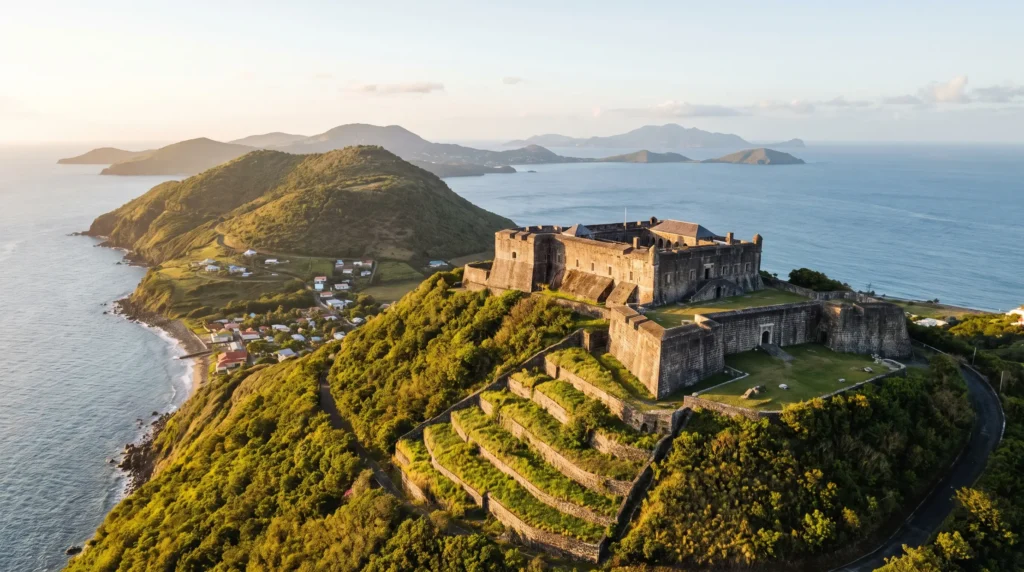
The headline sight is Brimstone Hill Fortress National Park on St Kitts’s northwest coast, a UNESCO World Heritage Site since 1999 and one of the best-preserved 17th- and 18th-century fortifications in the Americas — built by enslaved African labourers to a British military design, perched 230 metres above the Caribbean Sea. It’s the country’s only UNESCO listing, but it earns the trip on its own. Beyond the fortress, this is a sugar-and-rum island turned quiet luxury outpost: no mass all-inclusive strip, no traffic jams, and a Nevis side that has spent decades deliberately capping its own growth in favour of a handful of restored plantation inns.
Sugar Mas — The Caribbean’s Christmas Carnival
Most Caribbean carnivals happen around Lent. St Kitts and Nevis flipped the calendar: Sugar Mas runs across the Christmas and New Year period, spanning roughly four weeks from early/mid-December and culminating in a full street-parade finale on 2 January — the only major carnival in the region built around the holidays rather than pre-Easter. J’ouvert kicks things off on Boxing Day, followed by costumed troupe parades, Moko Jumbi stilt walkers, calypso and soca competitions, and steel pan bands through the first days of January. Book accommodation early if your trip lands in this window — it’s the one time of year Basseterre genuinely fills up.
If you’re planning further out, the other date worth ringing is late June, when the St Kitts Music Festival brings a three-night lineup of reggae, soca and R&B headliners to Warner Park Stadium in Basseterre — now in its late twenties as an annual event and the island’s other unmissable calendar fixture.
Best Time to Visit Saint Kitts and Nevis (Season by Season)
Mid-December – April · Dry season (peak)
The classic Caribbean high season: lower humidity, minimal rain, the best hiking conditions on Mount Liamuiga and Nevis Peak, and the Sugar Mas carnival period at the very start of it. Prices peak around Christmas, New Year and Sugar Mas — book resorts and Nevis plantation inns two to three months ahead.
May – June · Shoulder season
Warmer, drier than you’d expect, noticeably quieter, and rates drop meaningfully before the summer crowds and before the rains build. The St Kitts Music Festival lands right at the end of this window in late June.
July – November · Green season
Lush, hot, and the wettest stretch of the year, with short daily downpours more typical than all-day washouts. This is also Atlantic hurricane season, running officially 1 June through 30 November, with the statistical peak in August–October — travel insurance with hurricane/interruption coverage is genuinely worth the cost here, not just a box to tick. It’s also the cheapest and least crowded time to visit if you’re comfortable with that trade-off.
Getting There — SKB, Ferries & the Narrows
Robert L. Bradshaw International Airport (SKB), a few kilometres northeast of Basseterre, is the country’s only international gateway, with nonstops or seasonal service from Miami, New York-JFK, Newark, Atlanta, Charlotte and Toronto, plus regional connections from British Airways and smaller Caribbean carriers to Antigua, Barbados, Sint Maarten, Dominica and Tortola. Cruise ships dock directly in Basseterre, which handles a heavy share of the island’s total visitor traffic.
Nevis has its own airstrip, Vance W. Amory International Airport near Charlestown, used mainly for inter-island hops rather than direct international flights — most visitors headed to Nevis fly into St Kitts and cross by sea. Passenger ferries link Basseterre and Charlestown multiple times a day, with crossings typically taking 30 to 45 minutes depending on conditions; timetables shift by day of the week, so check the current schedule before you plan around it rather than assuming a fixed hourly service. Private water taxis make the same crossing faster, for a price.
Getting Around — Taxis, the Sugar Train & the Ferry
There’s no public transport system in the North American sense, but a network of privately run buses (“conductor vans”) loops the ring road on both islands for a few EC dollars a ride, and licensed taxis — with government-set fixed fares — cover everything else. Rental cars are widely available on St Kitts and Nevis alike, but remember traffic drives on the left, a colonial-era holdover the CDC specifically flags for visiting drivers used to the right.
The one genuinely unique way to see St Kitts is the St. Kitts Scenic Railway, built between 1912 and 1926 to haul sugar cane to the Basseterre mill and run purely for tourists since 2003, after the last sugar harvest run in 2005 — it circles roughly half the island on narrow-gauge track with an open-air upper deck. Between the two islands, it’s the ferry or a short flight; on Nevis itself, everything worth seeing is a short taxi ride from Charlestown.
Top Regions — St Kitts & Nevis, Side by Side
Basseterre & the Southeast Peninsula (St Kitts)
The capital’s Georgian-era Circus and Independence Square anchor the historic core, with the cruise pier, duty-free shopping and government offices close by. South of town, the Southeast Peninsula road threads past salt ponds where green vervet monkeys — reputedly outnumbering people on the island — are a regular roadside sighting, ending at Frigate Bay’s twin beaches: a calmer Caribbean-side strip of resorts and an Atlantic side favoured for its beach bars and kitesurfing wind.
Northwest Coast & Brimstone Hill (St Kitts)
Home to the fortress itself, plus Romney Manor’s batik workshop set in old plantation gardens and a run of black- and grey-sand beaches along the Caribbean shore. This stretch is where the island’s sugar-plantation history is most visible — old great houses, stone chimneys and cane-field terraces climbing toward the rainforest.
Central Rainforest & Mount Liamuiga (St Kitts)
The dormant volcano’s crater rim is reachable on a guided half-day hike through rainforest thick with vervet monkeys and birdlife; on a clear day the crater floor and, further out, Saba and Sint Eustatius are visible from the top. This is also scenic-railway and zipline territory.
Charlestown & South Nevis
Nevis’s tidy Georgian capital, birthplace of Alexander Hamilton, holds the Museum of Nevis History in a reconstruction of his childhood home and a noticeably slower pace than anything on St Kitts. Pinney’s Beach runs for miles along the calm western shore, and Bath Spring’s volcanic hot springs, just south of town, have been drawing visitors since the island’s 18th-century spa-resort heyday.
Nevis Peak & the Windward Coast
The interior climb up Nevis Peak is steeper and muddier than its St Kitts counterpart, rewarding hikers with cloud-forest views over both islands. The east coast is where Nevis keeps its restored sugar-plantation inns — quiet, low-key, and largely untouched by cruise-ship day-trippers, since ships dock on St Kitts, not here.
Culture & People
English is the sole official language, though St Kitts Creole is the everyday voice of the street, church and market. The population — roughly 48,000 across both islands, with Nevis home to a little over 13,000 of them — traces mostly to the descendants of enslaved West Africans brought to work the sugar plantations that defined the islands for nearly 300 years.
Cricket and football dominate local sport, church attendance runs high on Sundays island-wide, and Sugar Mas is unambiguously the cultural high point of the year — Moko Jumbi stilt dancing, calypso monarchs and troupe costuming all trace back to the same African and Caribbean carnival traditions found across the region, transplanted here onto a Christmas calendar. One quirk worth knowing before you pack: camouflage-pattern clothing is illegal for visitors to wear, a law enforced with real fines, so leave it at home.
A Food Lover’s Guide to Saint Kitts and Nevis
The national dish is goat water, a thick, clove-and-thyme-spiced goat stew that shows up at weddings, wakes and Sugar Mas street stalls alike — order it once and you’ll understand why locals argue over whose grandmother’s version is definitive. Saltfish and dumplings, spicy conch, and breadfruit prepared a dozen ways (boiled, roasted, fried, in a pie) round out the everyday plate, alongside stewed or curried mutton.
The islands are also a rum destination in their own right, built on the same sugar-cane heritage as the Scenic Railway — cane spirit distilled locally is a common souvenir, and rum shops (small roadside bars, not liquor stores) are where a lot of the real socialising happens on both islands. On Nevis, plantation-inn dining leans toward elegant, slow, candlelit dinners in restored great houses — a very different pace from a Basseterre lunch counter, and worth doing at least once.
Off the Beaten Path
Bath Spring Hot Springs
Nevis’s volcanic hot spring near Charlestown once anchored an 18th-century spa hotel that drew planters and colonial society from across the region — today it’s a low-key, largely local spot rather than a polished attraction, which is most of its charm.
Old Road Town Petroglyphs
Pre-Columbian Kalinago (Carib) rock carvings sit on boulders near St Kitts’s original 1623 British settlement site — a five-minute stop most rental-car itineraries skip entirely on the way to Brimstone Hill.
Southeast Peninsula Salt Ponds
Beyond Frigate Bay, the peninsula road runs past hypersaline salt ponds and scrubby dry forest that couldn’t feel further from the cruise pier twenty minutes back — bring binoculars for the wading birds and the monkeys.
Nevis’s East Coast Plantation Inns
A handful of restored 18th-century sugar estates on Nevis’s windward side operate as small inns rather than resorts — no beach out front, no crowds, just cane-field views and a genuinely different register of “quiet Caribbean” than the beach-bar version most visitors picture.
Practical Information
Money. The East Caribbean dollar has been pegged at EC$2.70 to US$1 since 1976, and US cash is accepted almost everywhere — confirm which dollar a price is quoted in before you pay. Cards work at hotels, resorts and most restaurants; carry small EC bills for rum shops, conductor vans and roadside food stalls.
Safety. Tourist zones on both islands are generally calm, but both the US State Department and UK FCDO flag real incidents of serious crime — armed robbery, assault, and occasional violence linked to gang activity — concentrated away from resort areas; avoid isolated beaches and large gatherings after dark, use marked taxis, and don’t carry valuables visibly.
Health. No unusual vaccination requirements beyond routine and standard travel precautions; bring your own medications since options are limited outside Basseterre and Charlestown, and remember traffic runs on the left when you’re crossing roads on foot. Medical treatment is expensive and evacuation insurance is genuinely worth carrying.
Connectivity. An eSIM or local prepaid SIM covers most of both islands with decent 4G; plantation inns on Nevis’s interior can lag. Plugs: mostly US-style type A/B sockets, but running at 230V rather than North America’s 120V — check your device is dual-voltage before plugging in. Time zone: Atlantic Standard Time, UTC-4, no daylight saving.
Budget Breakdown — What Saint Kitts and Nevis Actually Costs in 2026
This is upscale-Caribbean pricing, closer to Barbados or Antigua than to bargain destinations in the region — Nevis in particular skews toward small luxury inns rather than budget guesthouses.
Budget (US$70–130/day): Basseterre guesthouse or budget hotel, conductor vans and rum-shop meals, self-guided beach days, the scenic railway or Brimstone Hill as your one paid activity.
Mid-range (US$180–320/day): A Frigate Bay or Charlestown hotel, restaurant dinners, a rental car, the Mount Liamuiga or Nevis Peak guided hike (roughly US$65–90 with transport), and the inter-island ferry rather than a private water taxi.
Luxury (US$500+/day): A restored Nevis plantation-inn suite or St Kitts beachfront resort, private snorkel or sailing charters around the Southeast Peninsula, chef-led dinners, private water-taxi transfers between islands.
Fixed costs to plan for: the roughly US$17 eTA every visitor files before arrival, and site-entry fees at Brimstone Hill and the Museum of Nevis History. Tipping 10–15% is standard where a service charge isn’t already added to the bill.
Planning Your First Trip to Saint Kitts and Nevis
The natural first-timer split is fortress + ferry: fly into SKB, spend three or four nights on St Kitts covering Brimstone Hill, the Scenic Railway, Frigate Bay and a Mount Liamuiga hike, then take the 30–45 minute ferry across The Narrows for two or three nights of Charlestown, Pinney’s Beach and a plantation-inn dinner on Nevis. A week covers both islands comfortably without rushing either one. If you want to keep island-hopping, our Antigua and Barbuda guide covers the nearest neighbor a short flight away, our Saint Lucia guide and Barbados guide cover two of the region’s other upscale Eastern Caribbean options, and our Dominica guide is the pick for travelers who want the volcanic-rainforest side of this trip taken even further.
Frequently Asked Questions
Is Saint Kitts and Nevis safe for tourists in 2026?
Resort areas, Frigate Bay, Basseterre’s tourist core and Nevis overall are generally calm, but both the US State Department and UK FCDO note real incidents of serious crime concentrated away from those zones. Use licensed taxis, avoid isolated beaches after dark, don’t display valuables, and check current government advisories before you travel.
Do I need a visa?
US, UK, EU, Canadian and most Commonwealth passport holders get visa-free entry — up to 90 days for US citizens — but every single visitor arriving by air or sea must complete an Electronic Travel Authorization (eTA) online before travel, currently around US$17.
How do I get between St Kitts and Nevis?
Passenger ferries run multiple times daily between Basseterre and Charlestown, taking roughly 30–45 minutes depending on sea conditions; schedules vary by day of the week, so check the current timetable rather than assuming a fixed hourly service. Private water taxis and short inter-island flights via Vance W. Amory International Airport on Nevis are faster, pricier alternatives.
What’s the deal with the “citizenship by investment” program?
Saint Kitts and Nevis runs the world’s oldest citizenship-by-investment program, established under a 1984 law and still active today — it’s a genuine part of the national economy and comes up constantly in local conversation, but it has zero bearing on ordinary tourist visits or entry requirements.
Saint Kitts and Nevis or Antigua and Barbuda?
Choose Saint Kitts and Nevis for a single fortress-and-volcano history trip with an easy day-trip second island; choose Antigua and Barbuda for more beaches (famously “365, one for every day of the year”) spread across a bigger single island plus a genuinely wild second island in Barbuda.
What’s the cheapest way to see both islands?
Base yourself in Basseterre, ride the conductor vans rather than taxis, do Brimstone Hill and a Liamuiga hike as your paid activities on St Kitts, then take the passenger ferry (not a private water taxi) to Nevis for a single long day of Pinney’s Beach and Bath Spring.
Ready to Explore Saint Kitts and Nevis?
A UNESCO fortress above a turquoise coastline, a sugar train that used to haul cane and now just hauls tourists, a carnival that happens at Christmas instead of Lent, and a second island three kilometres away that still feels like a different world. Saint Kitts and Nevis doesn’t try to be the biggest name in the Caribbean — it’s just quietly one of the best-run small countries you’ll ever visit.
Explore More
- Antigua and Barbuda Travel Guide — the nearest neighbor, famous for its 365 beaches
- Saint Lucia Travel Guide — the Eastern Caribbean’s other volcanic showstopper
- Barbados Travel Guide — more upscale Eastern Caribbean beach time
- Dominica Travel Guide — for travelers who want the rainforest-volcano side taken further
How this guide was built
Published as part of Facts From Upstairs’ country guide series. Built from authoritative sources — Wikipedia’s entity pages for Saint Kitts and Nevis, Nevis, the Eastern Caribbean dollar, Robert L. Bradshaw International Airport, the St. Kitts Scenic Railway and the St. Kitts Music Festival; UNESCO’s Brimstone Hill Fortress National Park inscription; the Eastern Caribbean Central Bank’s currency page; the US State Department and UK FCDO Saint Kitts and Nevis pages; the US CDC traveler page for the country; the official Nevis Tourism Authority ferry-schedule page; the official St Kitts and Nevis Citizenship by Investment Unit; the official St Kitts tourism board’s Sugar Mas Carnival page; NOAA’s National Hurricane Center for Atlantic hurricane season dates; and World Standards’ plug and voltage reference. Numeric and checkable claims carry inline citations.
Sources cited on this page
- Wikipedia — Saint Kitts and Nevis
- Wikipedia — Nevis
- UNESCO — Brimstone Hill Fortress National Park
- Wikipedia — Brimstone Hill Fortress National Park
- Eastern Caribbean Central Bank — Currency
- Wikipedia — Eastern Caribbean dollar
- Wikipedia — Robert L. Bradshaw International Airport
- Wikipedia — St. Kitts Scenic Railway
- Wikipedia — St. Kitts Music Festival
- St Kitts Tourism Authority — Sugar Mas Carnival
- Nevis Tourism Authority — Ferry Services
- St Kitts and Nevis Citizenship by Investment Unit
- US State Department — Saint Kitts and Nevis
- UK FCDO — Saint Kitts and Nevis travel advice
- US CDC — Saint Kitts and Nevis traveler page
- NOAA — National Hurricane Center
- World Standards — Saint Kitts and Nevis plug & voltage
More country guides you might like
Plan your trip to Saint Kitts and Nevis
The booking tools we use ourselves. FFU may earn a commission at no extra cost to you.
Plan & book your trip to Saint Kitts and Nevis
Booking through these searches supports our guides at no extra cost to you.
Curated multi-day tours to Saint Kitts and Nevis — Exoticca →