
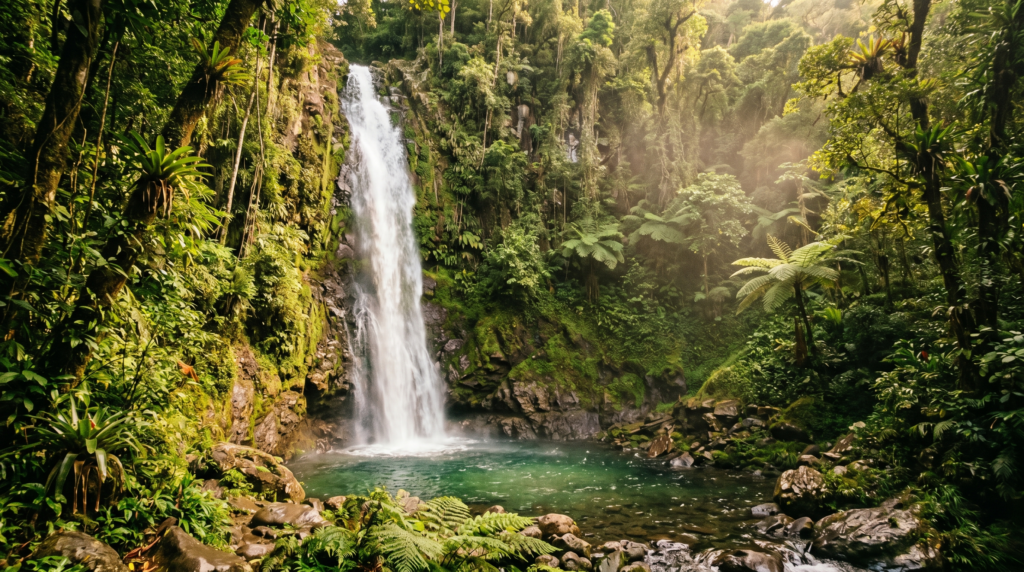
Dominica Travel Guide — The Caribbean’s Wild Nature Island: Rainforest, Whales & a Boiling Lake
Dominica (don’t confuse it with the Dominican Republic) is the Caribbean’s last great wilderness — the “Nature Island.” Forget manicured resorts and white-sand strips: this rugged, volcanic green giant is all rainforest-cloaked peaks, hidden waterfalls, hot springs, world-class diving and a literal boiling lake. It’s one of the only places on Earth to see sperm whales year-round, home to the Caribbean’s last Indigenous people, and a paradise for hikers, divers and anyone who wants nature over nightlife.
📋 In This Guide
- Overview — The anti-resort Caribbean island
- The Boiling Lake & Morne Trois Pitons
- Best time to visit (season by season)
- Getting there & entry
- Getting around
- Where to go — Roseau, the park, the coast & the Kalinago
- Culture & people
- A food lover’s guide to Dominica
- Off the beaten path
- Practical information
- Budget breakdown — what Dominica costs in 2026
- Planning your first trip
- Frequently asked questions
Overview — The Anti-Resort Caribbean Island
Tucked between Guadeloupe and Martinique in the Eastern Caribbean, Dominica is the region’s wildest, greenest and least-developed island — a young, mountainous land of dormant volcanoes, rainforest, rivers (reputedly 365 of them, one for every day) and a coastline of black-sand coves and dramatic drop-offs. There are no mega-resorts and few beaches of the postcard kind; the draw is raw nature, and lots of it.
This is an island for the active and the curious: hike to a boiling lake, dive volcanic reefs that fizz like champagne, swim up a gorge to a waterfall, soak in hot springs, and watch sperm whales offshore. Dominica was hit hard by Hurricane Maria in 2017 and has rebuilt with a bold ambition — to become the world’s first climate-resilient nation — while keeping its eco-soul firmly intact.
The Boiling Lake & Morne Trois Pitons
Dominica’s signature adventure sits inside the UNESCO-listed Morne Trois Pitons National Park: the Boiling Lake, the second-largest hot lake on Earth — a grey, churning, steaming flooded volcanic vent reached by a rigorous 6–8 hour round-trip trek past the smoking, sulphur-streaked Valley of Desolation. It’s one of the Caribbean’s great hikes (an accredited local guide is required). The same park holds the twin Trafalgar Falls, the swimmable Emerald Pool and Titou Gorge — a concentration of volcanic wonders found nowhere else in the islands. The dry season (roughly February to May) gives the firmest, safest trails. For exactly how hard the trek is, current guide fees and the park pass, see our complete Boiling Lake hike guide.
Best Time to Visit Dominica (Season by Season)
December–April — Dry season (best)
The driest, sunniest stretch and the prime window for hiking the muddy mountain trails, with February–May often the firmest. It overlaps the best whale-watching months (November–March) and the cooler, more comfortable weather.
May — Shoulder
Still relatively dry with thinner crowds and good trail conditions — a fine value window before the rains build.
June–November — Wet/hurricane season
Hot, humid and the rainiest, with a real hurricane risk — the rainforest is at its most lush and prices lowest, but trails get slippery and some are impassable. October brings the World Creole Music Festival.
Getting There & Entry
Dominica is reached via Douglas-Charles Airport (DOM) in the north-east, usually on regional connections through hubs like San Juan, Antigua, Barbados or Sint Maarten; a new international airport is in development. Ferries also link it with neighbouring Guadeloupe, Martinique and Saint Lucia. For the full flight, ferry and new-airport breakdown, see our guide to getting to Dominica.
- Visa: US citizens don’t need a visa for stays under six months; bring a passport with a blank page, proof of onward travel, accommodation and funds.
- ED Card: complete the online Embarkation/Disembarkation card before arrival.
- Cruise: ships dock at Roseau and Portsmouth.
Getting Around
- Rental car: the best way to explore at your own pace — driving is on the left, and the mountain roads are steep, winding and scenic (allow extra time).
- Taxis & tours: plentiful, with set rates; guided hiking and diving tours are easy to arrange and often the simplest option.
- Public minibuses: cheap shared vans connect Roseau with the main villages for budget travellers.
- Guides: required for the Boiling Lake and recommended for the tougher trails — always hire accredited local guides.
Where to Go — Roseau, the Park, the Coast & the Kalinago
Roseau & the South
The compact, colourful capital, gateway to Morne Trois Pitons, Trafalgar Falls, Titou Gorge, the Sulphur Springs at Wotten Waven, and the diving hotspots of Champagne Reef, Soufrière and Scotts Head.
Morne Trois Pitons National Park
The UNESCO heart of the island: the Boiling Lake, the Valley of Desolation, the Emerald Pool, Boeri and Freshwater Lakes, and a tangle of waterfalls and trails.
The North & Portsmouth
Cabrits National Park and the restored Fort Shirley, the tranquil Indian River boat trip (a Pirates of the Caribbean location), and quieter beaches and dive sites.
The Kalinago Territory
On the wild east coast, the home of the Kalinago — the Caribbean’s last surviving Indigenous people — with cultural villages, craft traditions and the Kalinago Barana Auté.
Culture & People
Dominica’s culture is warm, rooted and proudly Creole, blending African, French, British and Indigenous heritage. Crucially, it is the only Caribbean island where a significant population of the region’s original people — the Kalinago — still lives on ancestral land, keeping canoe-building, basketry and oral traditions alive. English is official, but everyday life runs on Dominican Creole (Kwéyòl), reflecting the island’s French-and-British past.
The vibe is unhurried, friendly and deeply tied to the land. Music — bouyon, cadence-lypso and the October World Creole Music Festival — is central, and so is a strong environmental ethic. Visitors who come curious, low-key and ready to hike are met with genuine warmth.
A Food Lover’s Guide to Dominica
- Mountain chicken & callaloo — the national dish historically featured the “mountain chicken” (a frog, now protected), so today expect rich callaloo soup and creole stews instead.
- Provisions & fresh fish — dasheen, breadfruit, green banana and yam with grilled or stewed fish and chicken, Creole-seasoned.
- Bush teas, cocoa & fruit — herbal “bush” teas, local cocoa, and an abundance of mango, guava, passion fruit and citrus.
- Rum & the river — local rums and the famous bottled spring water; eat at roadside stalls and village cook-shops for the best value.
Off the Beaten Path
- Champagne Reef — snorkel or dive over volcanic vents that release streams of warm bubbles, like swimming through champagne.
- Whale watching — Dominica is one of the only places on Earth to see resident sperm whales year-round (best November–March).
- The Waitukubuli National Trail — the Caribbean’s longest hiking trail, 14 segments traversing the whole island.
- Wotten Waven hot springs — soak in natural sulphur pools after a day on the trails.
- Scotts Head & Soufrière Bay — snorkel a flooded volcanic crater at the island’s southern tip.
Practical Information
- Money: the East Caribbean dollar is fixed at US$1 = EC$2.70 and US dollars are widely accepted (change may come in EC dollars). Carry cash for villages, guides and stalls; cards work in Roseau.
- Driving: on the left; roads are steep and winding — a sturdy vehicle and patience help.
- Guides: required for the Boiling Lake and wise for tough trails; always use accredited local guides.
- Power: 230V, mostly UK-style three-pin plugs — US travellers need an adapter.
- Safety: Dominica is one of the safest Caribbean islands (US Level 1); the main risks are natural — weather, currents and rugged terrain.
- Pack: hiking boots, rain layers, reef-safe sunscreen and a dry bag — this is an outdoors-first island.
Budget Breakdown — What Dominica Costs in 2026
Dominica is mid-priced for the Caribbean, with great-value guesthouses and eco-lodges. Rough per-person, per-day estimates in USD:
| Style | Accommodation | Food | Total / day |
|---|---|---|---|
| Budget | $40–80 guesthouse | $20–35 (local) | $70–120 |
| Mid-range | $90–180 hotel/eco-lodge | $35–60 | $150–250 |
| Eco-luxury | $250–600+ | $60–120+ | $350–700+ |
The Boiling Lake guided trek runs about $100–150 per person, and a national-park site pass is inexpensive. Diving and whale-watching are the bigger splurges; hiking, river spots and village food keep costs down. For how these numbers compare to a resort-island alternative, see our Dominica vs St Lucia cost comparison.
Planning Your First Trip
A great week mixes the south — Roseau, Trafalgar Falls, Titou Gorge, Champagne Reef diving and the Boiling Lake trek — with a couple of days in the north (Cabrits, the Indian River) and a visit to the Kalinago Territory in the east. Travel in the December–April dry season for the firmest trails (and add whale watching November–March), rent a car or book guided tours, complete your ED Card before flying, and pack for an active, outdoors trip rather than a beach holiday.
Frequently Asked Questions
Is Dominica the same as the Dominican Republic?
No — they’re two different countries. Dominica (the “Nature Island”) is a small, rugged, English-speaking island in the Eastern Caribbean; the Dominican Republic is a larger, Spanish-speaking nation on Hispaniola.
Do US citizens need a visa for Dominica?
No visa is required for stays under six months. Bring a passport with a blank page, proof of onward travel, accommodation and funds, and complete the online ED Card before arrival.
When is the best time to visit?
December to April (dry season) for the best hiking and weather, with February–May often the firmest trails; November to March is prime whale-watching time.
Is Dominica safe to visit?
Yes — it’s one of the safest Caribbean islands (US Level 1). The real hazards are natural: weather, strong currents and rugged trails — hire accredited guides and respect the terrain.
Is Dominica good for a beach holiday?
Not really — it’s an outdoors-and-adventure island of rainforest, waterfalls, diving and hiking, with mostly small black-sand coves rather than white-sand resorts. Choose it for nature, not lounging. If beach resorts matter more to you, see how Dominica stacks up in our Dominica vs St Lucia comparison.
How difficult is the Boiling Lake hike, really?
It’s one of the hardest single-day hikes in the Caribbean — a 6–8 hour, guide-required round trip with roughly 3,000 ft of climbing through the Valley of Desolation. Casual walkers should stick to Trafalgar Falls or the Emerald Pool. See our full Boiling Lake hike guide for difficulty, guide costs and what to pack.
Is Dominica cheaper to visit than St Lucia?
Entry-level costs are similar, but a typical Dominica trip (guesthouses, guided hikes) usually runs less than a typical St Lucia trip, since St Lucia’s tourism industry leans heavily on pricier resort stays. See our full Dominica vs St Lucia comparison for a side-by-side cost breakdown.
Can I fly direct to Dominica from the United States?
Yes — American Airlines flies nonstop from Miami to Douglas-Charles Airport several times a week, the island’s only direct US route. Everyone else typically connects through San Juan, Antigua or Barbados. See our full guide to getting to Dominica for flights, ferries and the new airport’s status.
Ready to Explore Dominica?
A boiling lake, year-round whales and the wildest rainforest in the Caribbean — the Nature Island is for travellers who want adventure over sun-loungers. Tell us your dates and travel style and we’ll help you plan it. Plan your trip →
Explore More
How This Guide Was Built
Researched and written by the Facts From Upstairs team, last updated . Prices and entry rules change — always confirm current details with official sources before you travel.
More country guides you might like
Plan your trip to Dominica
The booking tools we use ourselves. FFU may earn a commission at no extra cost to you.
Plan & book your trip to Dominica
Booking through these searches supports our guides at no extra cost to you.