
Languages of Eswatini
All languages of Southern Africa →fluent beta classical · classes by phone with Maya at ranas.ai/maya
Eswatini Travel Guide — Africa’s Last Absolute Monarchy, Rhino Safaris & the Reed Dance
Most people I talk to still call this place Swaziland, if they’ve heard of it at all, and that’s kind of the point of writing this guide. Eswatini renamed itself back in 2018, it’s the last absolute monarchy left standing in Africa, and it packs black rhino, free-roaming lion, a UNESCO-recognized reed ceremony with tens of thousands of dancers, and mountain scenery that shames places charging three times the entry fee — into a country you can drive across in under three hours. It sits tucked between South Africa and Mozambique, which means almost everyone visits as an add-on to a Kruger or Cape Town trip, and almost everyone who does it says the same thing afterward: they wish they’d given it more than a day. I’m not going to pretend it’s undiscovered — the Bushfire festival sells out every year — but it is still one of the least-crowded, most personal safari-and-culture combinations in southern Africa, and it deserves better than being an afterthought on someone else’s itinerary.
In This Guide
- Overview — The Last Absolute Monarchy in Africa
- The Umhlanga Reed Dance & Bushfire Festival
- Best Time to Visit Eswatini (Season by Season)
- Getting There — SHO Airport & the South Africa Land Route
- Getting Around — Self-Drive, Transfers & Kombis
- Top Regions — Ezulwini, Lowveld & the Highveld
- Culture & People — Swazi Kingship, Craft & Ceremony
- A Food Lover’s Guide to Eswatini
- Off the Beaten Path
- Practical Information
- Budget Breakdown — What Eswatini Actually Costs in 2026
- Frequently Asked Questions
Overview — The Last Absolute Monarchy in Africa
Eswatini is one of Africa’s smallest countries by land area, roughly 17,364 square kilometers, wedged between South Africa on three sides and Mozambique to the east, with a population of around 1.24 million. It gained independence from Britain on 6 September 1968, and it is governed today as an absolute monarchy under King Mswati III, who has ruled since 1986 alongside the Queen Mother — the only country in Africa still run this way. Unusually, it has two capitals: Mbabane, the administrative seat and largest city, and Lobamba, the royal and legislative capital where the biggest ceremonies happen.
The country reads like a compressed cross-section of southern Africa: cool pine-forested Highveld around Mbabane gives way to the populous Middleveld, then drops into the hot, dry Lowveld savanna where the Big Five roam, before rising again onto the Lubombo plateau along the Mozambique border. You can eat breakfast in mountain fog and be watching rhino graze thornveld by lunch, all inside a country you could drive end to end in three or four hours.
What Eswatini does not have is the tourism infrastructure or global name recognition of its neighbors — no direct long-haul flights, no big-name hotel chains lining a coast, because it has no coast. What it does have is the Big Game Parks system of community-linked reserves, one of the most photogenic annual cultural ceremonies on the continent, and a sense that you are seeing a place still mostly running on its own terms rather than a package-tour version of itself.
The Umhlanga Reed Dance & Bushfire Festival
Plan an August/September trip around the Umhlanga (Reed Dance), Eswatini’s largest cultural event: a week-long ceremony in which tens of thousands of unmarried women and girls cut reeds and present them to the Queen Mother at Ludzidzini, near Lobamba, culminating in a public “main day” of singing and dancing in full traditional dress. The main day in 2026 is provisionally set for Monday, 31 August, running into the first week of September, though the exact dates are only confirmed close to the event because timing follows royal astrological observation. Visitors are welcome to watch from designated public areas — dress modestly, book a local guide, and don’t expect to wander in unannounced.
If music is more your speed, aim for late May instead: the MTN Bushfire Festival at the House on Fire amphitheater in Malkerns runs a three-day, multi-stage lineup of African and international acts and has sold out every year for over a decade — book tickets and accommodation months ahead.
Best Time to Visit Eswatini (Season by Season)
May – September · Dry season (peak for wildlife)
Cool, clear, and close to rainless — the Highveld can get genuinely cold at night, especially June and July, so pack layers. This is the best window for game viewing in the Lowveld reserves, since thinner bush and animals clustering at waterholes make sightings easier. It’s also festival season: Bushfire in late May, Reed Dance in late August/early September.
October – November · Shoulder
Building heat, the first rains, green shoots returning to the Lowveld, and noticeably thinner crowds and lower lodge rates than winter peak.
December – March · Wet, hot season
Most of the year’s rain falls December through March, heaviest on the Highveld (which sees 700–1,550mm annually versus the Lowveld’s 200–550mm), with afternoon thunderstorms rather than all-day washouts. Lush scenery and birding are at their best, but the Lowveld gets genuinely hot and malaria risk in the eastern regions is highest.
Getting There — SHO Airport & the South Africa Land Route
King Mswati III International Airport (SHO), about 50 kilometers from Manzini, is the country’s only commercial international airport, having replaced the old Matsapha Airport in 2014. It runs a modest schedule of regional flights, mainly connecting through Johannesburg, and the drive from the terminal to Manzini or Mbabane takes roughly 45–90 minutes.
In practice, most travelers fly into O.R. Tambo International in Johannesburg and cross overland — it’s a 4–5 hour drive or shuttle-bus ride to the Ngwenya/Oshoek border post, the main crossing on the Mbabane side. Multiple other land borders connect to South Africa and Mozambique for those combining Eswatini with a Kruger National Park safari or a Maputo detour. Note that travelers transiting South Africa need at least two consecutive blank visa pages in their passport or risk being denied entry.
Getting Around — Self-Drive, Transfers & Kombis
Eswatini is small enough that self-driving is the easiest way to see it — main roads between Mbabane, Ezulwini, Manzini and the Lowveld parks are sealed and well-signed, and driving is on the left, mirroring South Africa. Rental cars are readily available in Manzini and Mbabane; a 4×4 isn’t essential on the main routes but helps for reserve tracks and rural roads after rain.
Shared minibus taxis (“kombis”) link every town cheaply but run on a fill-up-and-go schedule rather than a timetable, and aren’t the most comfortable option with luggage. Most lodges and reserves — Hlane, Mkhaya, Mlilwane — can arrange direct transfers, and this is the simplest route for visitors without a rental car, especially since Mkhaya only admits guests via pre-arranged pickup rather than self-drive entry.
Top Regions — Ezulwini, Lowveld & the Highveld
Ezulwini Valley
The “Valley of Heaven,” just south of Mbabane, is Eswatini’s cultural and tourism heartland: the royal residence, Mlilwane Wildlife Sanctuary, Mantenga Cultural Village, and the country’s densest cluster of hotels, craft markets and restaurants. It’s the natural first-timer base — everything else is a day trip from here.
Mlilwane Wildlife Sanctuary
Eswatini’s oldest conservation area, proclaimed in 1961, sits right in Ezulwini and is the country’s most-visited eco-destination — zebra, giraffe, hippo and antelope roam a fenced sanctuary you can explore on foot, mountain bike or horseback, no ranger required.
Mantenga Cultural Village & Falls
A recreated 19th-century Swazi homestead set against Nyonyane Mountain, with twice-daily sibhaca dance performances and a short trail to Mantenga Falls — the most accessible cultural experience in the country.
Hlane Royal National Park
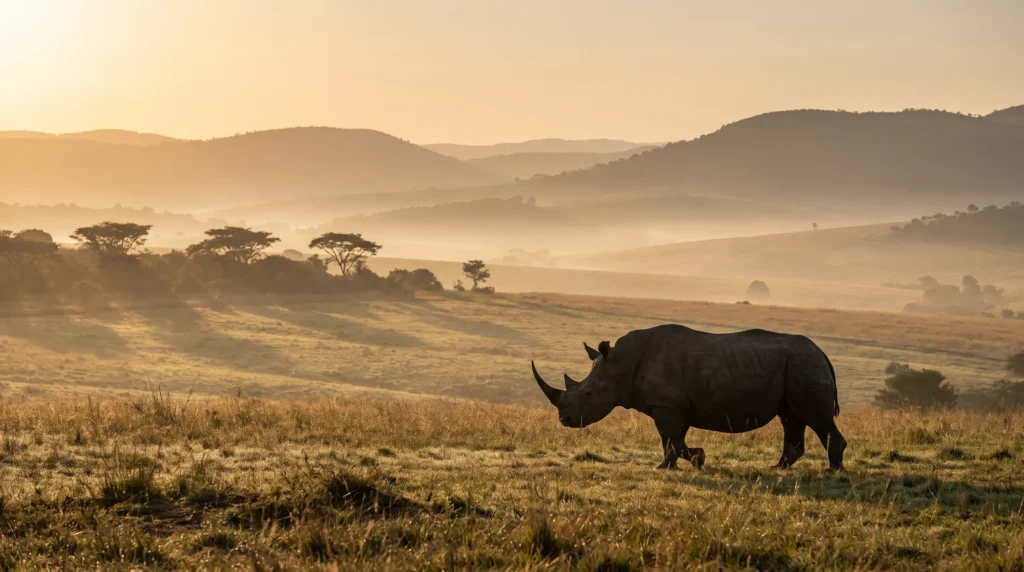
The country’s largest protected area and biggest game concentration — lion, elephant, both black and white rhino, giraffe and hippo, plus healthy herds of kudu, zebra, wildebeest and impala. It’s also one of the few places in Africa where you can walk (with an armed guide) close to white rhino on foot.
Mkhaya Game Reserve
Known as Eswatini’s “Refuge for Endangered Species,” Mkhaya holds the kingdom’s largest black rhino population, boosted by a landmark 1995 translocation of six black rhino from South Africa. Access is by pre-arranged transfer only — no self-drive, no day-trippers wandering in — which keeps it exclusive and the game sightings exceptional.
Malolotja Nature Reserve
A rugged Highveld wilderness of grassland, cliffs and waterfalls in the country’s northwest, home to Eswatini’s original canopy tour: eleven forest platforms, ten zip-lines and a 50-metre suspension bridge over the Majolomba River. Multi-day hiking trails here rival anything in the region and see a fraction of the visitors.
Malkerns Valley
Craft breweries, cheese farms, roadside markets and the House on Fire amphitheater that hosts Bushfire — the artsy, agricultural counterpoint to Ezulwini’s tourism polish.
Culture & People — Swazi Kingship, Craft & Ceremony
Eswatini is one of Africa’s most ethnically homogeneous nations, with the vast majority of the population identifying as Swazi and both siSwati and English holding official status. Traditional kingship structures run alongside a modern parliament, and the monarchy’s ceremonial calendar — Umhlanga in late August/September and the sacred Incwala kingship ritual around December/January — still shapes national life more visibly than in almost anywhere else on the continent.
Craft is a genuine economic backbone here, not a tourist prop: Ngwenya Glass recycles bottle glass into handblown art near Malolotja, Swazi Candles’ workshop in the Malkerns Valley exports globally, and Tintsaba and Gone Rural weave grass and sisal into homeware sold worldwide. Handwoven mohair, batik textiles and wire-and-bead work fill the Ezulwini and Manzini markets — bargain gently, and buy direct from co-operatives where you can.
A Food Lover’s Guide to Eswatini
Home cooking centers on sishwala (a thick maize porridge) or rice, served with sitfubi (a sour milk relish), stewed meat, and leafy greens like imifino. Grilled meat looms large everywhere — beef, chicken and goat over open coals — and roadside stalls sell roasted maize and peanuts alongside seasonal fruit from the fertile Middleveld.
Because South Africa’s braai culture and supermarket chains cross the border freely, Mbabane and Ezulwini restaurants mix Swazi staples with South African-style steakhouses, Portuguese-Mozambican peri-peri chicken, and Indian curry houses left over from the country’s trading history. In Malkerns, sample Eswatini’s small but real craft-beverage scene: Sondzela and other local breweries, plus cheese and charcuterie from small Highveld farms sold at weekend markets.
Off the Beaten Path
Phophonyane Falls Nature Reserve
A private reserve in the far north around a cascading waterfall, with forest trails and a small lodge that sees a fraction of the visitors of the bigger southern parks.
Mlawula Nature Reserve
Lowveld bush and the Lubombo escarpment along the Mozambique border — antelope, birding, and hiking trails with almost nobody else on them, a quiet counterpart to Hlane just up the road.
Ngwenya Mine
Reputed to be among the world’s oldest known mines, worked for iron ore pigment tens of thousands of years ago — a genuinely obscure stop for anyone into deep history, paired easily with the nearby glass factory.
Sibebe Rock
A colossal granite dome outside Mbabane, sometimes called one of the world’s largest monoliths — a serious, largely unmarked hike with sweeping Highveld views and none of the infrastructure (or crowds) of famous rock formations elsewhere.
Practical Information
Money. The lilangeni is pegged 1:1 to the South African rand, and rand notes are accepted everywhere as legal tender — you’ll rarely need to convert at all if arriving with rand from South Africa. Cards work in Mbabane, Manzini and tourist lodges; carry cash for rural areas and markets.
Safety. The US State Department rates Eswatini Level 2, “exercise increased caution,” citing sporadic armed robbery, carjacking and occasional civil unrest; the advice is to avoid public gatherings and demonstrations entirely, as they can turn volatile with little warning. Tourist areas — Ezulwini, the game reserves, Malkerns — are generally calm; keep a low profile in urban centers after dark and check current advisories before you go.
Health. Malaria risk is concentrated in the eastern Lowveld regions (Lubombo and parts of Hhohho, Manzini and Shiselweni) — talk to a travel clinic about prophylaxis if you’re visiting Hlane, Mkhaya or Mlawula, and bring repellent regardless. Yellow fever vaccination proof is required if arriving from a yellow-fever-endemic country.
Connectivity. A South African or regional eSIM generally covers Eswatini’s networks; coverage is solid in towns and reserves, patchier in the far north. Plugs: South African-style (Type M, large round three-pin), 220–230V. Time zone: UTC+2 year-round, no daylight saving.
Budget Breakdown — What Eswatini Actually Costs in 2026
Eswatini undercuts South Africa and Botswana on almost everything except dedicated luxury safari lodges, which price close to regional norms.
Budget (US$40–75/day): Backpacker lodge or guesthouse in Ezulwini or Mbabane, self-catering or local eateries, kombi transport, Mlilwane self-guided walks and horseback trails.
Mid-range (US$100–200/day): Comfortable lodge or B&B, restaurant meals, a rental car, guided game drives at Hlane, entry to Mantenga Cultural Village and the Malolotja canopy tour.
Luxury (US$300+/day): All-inclusive stays at Mkhaya or a top Hlane camp with rhino tracking on foot, private transfers throughout, and festival-season packages timed to Bushfire or the Reed Dance.
Because the lilangeni is pegged to the rand, prices are predictable and immune to the currency swings that complicate budgeting elsewhere in the region. Tipping 10% is appreciated at restaurants and on guided activities, though not always automatically added.
Planning Your First Trip to Eswatini
The classic itinerary is a 3–4 day add-on to a South Africa trip: cross overland from Johannesburg or the Kruger area, base in Ezulwini for a night (Mlilwane, Mantenga), then transfer to Hlane or Mkhaya for one or two nights of Big Five game viewing, before looping back across the border. A week lets you add Malolotja’s canopy tour and hiking in the north, or time your visit around Bushfire (late May) or the Reed Dance (late August/September) for the cultural headline event. Pair it naturally with our South Africa travel guide for Kruger and the Panorama Route, our Botswana guide for the Okavango Delta, or our Cape Town city guide if you’re bookending a longer southern Africa loop.
Frequently Asked Questions
Is Eswatini safe for tourists in 2026?
The US State Department rates it Level 2 — exercise increased caution — mainly for sporadic armed robbery, carjacking and the risk that demonstrations could turn volatile without warning. Tourist zones like Ezulwini and the game reserves are calm day to day; avoid any public gatherings, keep valuables low-key, and check current advisories before departure.
Do I need a visa?
US, UK, EU, Canadian and Australian passport holders don’t need a visa for tourism — entry is granted for up to 30 days, with a further 30-day extension available from the Ministry of Home Affairs. Make sure your passport has at least three months’ validity and two blank pages, and note you’ll also need two blank visa pages if transiting South Africa.
Is Eswatini still called Swaziland?
No — King Mswati III renamed the country Eswatini in 2018, meaning “land of the Swazi,” to distinguish it from Switzerland and mark 50 years of independence. You’ll still hear “Swaziland” used casually and on some older maps and menus.
Can I combine Eswatini with a Kruger National Park safari?
Yes — it’s the most common way people visit. Several land borders connect directly to Mpumalanga, making it a natural 3–5 day extension to a Kruger or Panorama Route itinerary rather than a standalone flight destination.
Is malaria a concern?
Only in the eastern Lowveld reserves — Hlane, Mkhaya and Mlawula sit in a risk zone, while Mbabane, Ezulwini and the Highveld are low-risk. Talk to a travel clinic about prophylaxis if your itinerary includes the Lowveld parks.
What currency should I bring?
None specifically — South African rand is accepted everywhere at par with the local lilangeni, so if you’re arriving from South Africa there’s no need to change money at all.
Ready to Explore Eswatini?
Walking rhino trails at dawn, a reed ceremony tens of thousands strong, zip-lines over a mountain river, and a currency you may never need to change — Eswatini punches enormously above its tiny footprint. It’s not undiscovered anymore, but it’s still uncrowded, and that combination doesn’t last forever in southern Africa.
Explore More
- South Africa Travel Guide — Kruger, the Panorama Route and the classic overland gateway
- Botswana Travel Guide — the Okavango Delta and Chobe’s elephant herds
- Namibia Travel Guide — desert dunes and another quiet corner of the region
- Cape Town City Guide — bookend a longer southern Africa loop
How this guide was built
Published . Built from authoritative sources — the Eswatini Tourism Authority (thekingdomofeswatini.com), Big Game Parks’ official reserve pages for Hlane, Mkhaya and Mlilwane, the Central Bank of Eswatini’s currency page, the US State Department’s Eswatini travel advisory, the US CDC traveler page for Eswatini, Wikipedia’s Eswatini and King Mswati III International Airport entity pages, and event pages for the Umhlanga Reed Dance and MTN Bushfire Festival. Numeric claims carry inline citations.
Sources cited on this page
- Wikipedia — Eswatini
- Wikipedia — King Mswati III International Airport
- Eswatini Tourism Authority — Visa Guide
- Eswatini Tourism Authority — Umhlanga Reed Dance
- Eswatini Tourism Authority — Mantenga Reserve, Village & Falls
- Time and Date — Umhlanga Reed Dance 2026
- MTN Bushfire Festival — Tickets
- Central Bank of Eswatini — Currency
- Big Game Parks — Hlane Royal National Park
- Big Game Parks — Mkhaya Game Reserve
- Big Game Parks — Mlilwane Wildlife Sanctuary
- Africa Tour Operators — Malolotja Canopy Tour
- Africa Tour Operators — Ezulwini Valley
- US State Department — Eswatini
- US CDC — Eswatini traveler page
More country guides you might like
Plan your trip to Eswatini
The booking tools we use ourselves. FFU may earn a commission at no extra cost to you.
Plan & book your trip to Eswatini
Booking through these searches supports our guides at no extra cost to you.