
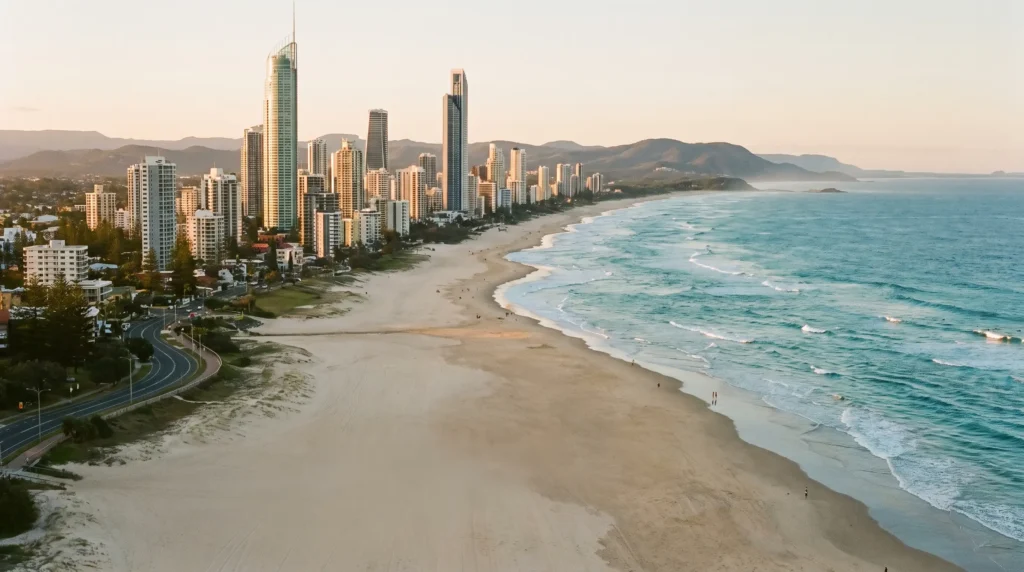
Gold Coast Travel Guide — Surf, Skyscrapers & the Hinterland Rainforest Behind It
Everyone pictures the Gold Coast the same way before they’ve been: a wall of high-rises behind a surf break, theme-park billboards, schoolies chaos. That version exists, and it’s fun for about two days. What surprised me was everything twenty minutes inland — ancient Gondwana rainforest thick enough to get genuinely lost in, waterfalls with nobody else at them, a hinterland that feels more Tasmania than Queensland. The Gold Coast is Australia’s sixth-largest city and its biggest that isn’t a state capital, which is a strange kind of fame — huge, but still somehow underrated by international visitors who fly straight past it to Sydney or the reef. It shouldn’t work as a single trip: surf town, entertainment strip, and UNESCO rainforest, all within the same hour’s drive. It does, and that’s the whole pitch.
In This Guide
- Overview — Why the Gold Coast Is More Than a Skyline
- Marathon Weekend & the City’s Event Calendar
- Best Time to Visit the Gold Coast
- Getting There — OOL Airport & Getting In From Brisbane
- Getting Around — Light Rail, Buses & Beach Walking
- Neighborhoods — Surfers, Broadbeach, Burleigh & Coolangatta
- Culture & People
- A Food Lover’s Guide to the Gold Coast
- Off the Beaten Path
- Day Trips — Hinterland, Byron Bay & Beyond
- Practical Information
- Budget Breakdown — What the Gold Coast Actually Costs
- Frequently Asked Questions
Overview — Why the Gold Coast Is More Than a Skyline
The Gold Coast sits in southeastern Queensland, about 66 kilometres south-southeast of Brisbane, and stretches roughly 60–70 kilometres along the coast from the Logan River down to the New South Wales border at Coolangatta. With a population around 681,000 in the city proper — and closer to 751,000 across the wider metro area — it’s Australia’s sixth most populous city and by far its largest that isn’t a state or territory capital.
The headline image is Surfers Paradise: a dense strip of high-rises, including the 322.5-metre Q1 Tower, which held the title of the world’s tallest residential building from 2005 to 2011 and remains the tallest building in Australia. That’s the postcard. The reality is bigger and more varied: 70 kilometres of coastline and roughly 42 kilometres of unbroken beach, four theme parks that make this “Australia’s theme park capital,” a genuine café-and-brewery scene in the central suburbs, and a Great Dividing Range hinterland thick with rainforest most day-trippers never learn is there.
What it doesn’t have is Sydney’s harbour drama or Melbourne’s laneway culture — the Gold Coast is unapologetically a beach-and-leisure city, built for surfing before breakfast and eating well after dark. That’s not a knock. It’s a city designed around exactly the things most people actually go on holiday for.
Marathon Weekend & the City’s Event Calendar
If you’re reading this in early July: the 46th ASICS Gold Coast Marathon runs 4–5 July 2026, closing streets from Southport down to Surfers Paradise and Broadbeach with more than 42,000 registered entries across the marathon, half-marathon and shorter events — Australia’s largest running weekend and the country’s only World Athletics Label race. The course is famously flat and fast, and the city leans into it hard — expect packed beachfront cafés, a genuine buzz on the boardwalk, and hotel rates a notch above normal shoulder-season pricing.
Outside marathon week, the Gold Coast’s calendar runs Cooly Rocks On (a 1950s/60s rock-and-roll festival in Coolangatta, usually June), Bleach* Festival’s arts and light installations along the beachfront, and the school-holiday crush around Christmas and Easter when Surfers Paradise gets loud in the specific way beach cities get loud. Time your visit around or away from these depending on which version of the city you want.
Best Time to Visit the Gold Coast
May – October · Dry season (the sweet spot)
Warm days, cool nights, minimal rain, and ocean temperatures still swimmable in the low 20s°C even in winter. This is genuinely the best window: fewer humid afternoons, clearer hinterland views, and none of the marine stingers that show up further north. July brings marathon-weekend energy; September–October brings whale-watching season as humpbacks migrate south past the coast.
November – April · Summer, wet season
Hot, humid, and prone to short, heavy downpours plus the occasional ex-tropical cyclone remnant sweeping down from further north — this stretch overlaps with the Australian cyclone season, so travel insurance is worth having even though direct hits this far south are uncommon. Beaches are at their busiest and warmest (ocean temps peak near 27°C in February), and this is also peak Australian school-holiday season around Christmas–January and Easter, when Surfers Paradise prices and crowds both climb.
Queensland does not observe daylight saving, so the Gold Coast sits at a fixed UTC+10 year-round — useful to know if you’re coordinating with Sydney or Melbourne, which shift an hour in summer.
Getting There — OOL Airport & Getting In From Brisbane
Gold Coast Airport (OOL), in Bilinga right at the Queensland/New South Wales border, handles over 380 flights a week and around six million passengers a year, with direct international routes to Auckland, Christchurch and Wellington (New Zealand), Denpasar/Bali, Nadi (Fiji) and Kuala Lumpur, alongside dense domestic links to every Australian capital.
Most long-haul international travelers, though, still land in Brisbane and connect overland — Brisbane Airport is roughly 90 kilometres north, about 60–90 minutes by car or Airtrain-plus-transfer depending on traffic and where on the coast you’re headed. Direct coaches (Con-x-ion and similar operators) run regularly from Brisbane Airport straight to Surfers Paradise and Broadbeach hotels, which is the easiest no-car option. If you’re flying OOL direct from New Zealand or Bali, you’ll skip the transfer entirely and land twenty minutes from Coolangatta’s beaches.
Getting Around — Light Rail, Buses & Beach Walking
The G:link light rail is the backbone of the tourist strip, running from Helensvale in the north through Southport, Surfers Paradise and Broadbeach down to Burleigh Heads — trams every few minutes at peak times, and genuinely the easiest way to hop between the theme-park train connections and the beach suburbs without a car. Translink’s go card (a tap-on-tap-off smartcard shared with Brisbane’s network) covers light rail and the extensive TransLink bus network, which reaches Coolangatta, the hinterland fringe towns and most theme parks.
A car opens up the hinterland — Lamington and Springbrook National Parks aren’t realistically reachable by public transport — and rental rates are reasonable by Australian standards. Within Surfers Paradise, Broadbeach and Burleigh, though, everything worth reaching is walkable along the beachfront path, and that’s the nicest way to see it: Australians here treat the beach promenade the way other cities treat a high street.
Neighborhoods — Surfers, Broadbeach, Burleigh & Coolangatta
Surfers Paradise
The commercial heart and the image most people have in their head: high-rises, the Q1 Tower and its SkyPoint observation deck, nightlife, and a long, genuinely excellent beach right behind the strip. It’s touristy and knows it — treat it as the entertainment base, not the whole trip.
Southport
The Gold Coast’s administrative and commercial CBD, less glamorous than Surfers but home to the light rail’s northern hub, Australia Fair shopping centre, and easy access to The Spit and Sea World.
Broadbeach
Quieter, leafier and increasingly the food-and-shopping heart of the coast — Pacific Fair mall, Kurrawa Beach, and a restaurant strip that’s arguably stronger than Surfers’ these days. A short light-rail hop from the noise, without losing the beach.
Burleigh Heads
A genuinely world-class point break wraps around Burleigh’s headland, and the village behind it has the coast’s best café-and-brewery cluster. This is where a lot of Gold Coasters themselves would send you — laid-back, walkable, and still on the light-rail line.
Currumbin & Palm Beach
Home to Currumbin Wildlife Sanctuary and a quieter, more residential stretch of beach between Burleigh and Coolangatta — good for travelers who want proximity to the action without the density.
Coolangatta & Tweed Heads
The southern terminus, sitting right on the Queensland/New South Wales border (Tweed Heads is technically NSW, one street over) with a mellower, old-school beach-town feel and Gold Coast Airport a few minutes away.
Northern Gold Coast — Theme Park Country
Oxenford, Coomera and Helensvale hold the big four theme parks — Dreamworld, Warner Bros. Movie World, Sea World and Wet’n’Wild — clustered close enough together that a rental car or theme-park shuttle can hit two in a day.
Culture & People
The Gold Coast’s identity is younger and more manufactured than most Australian cities — it grew explosively from a string of small beach towns and dairy country into a tourism and lifestyle magnet through the mid-to-late 20th century, and that boom-town energy is still part of its character. It’s also one of the country’s most multicultural regional cities, with large populations drawn originally from interstate migration (it’s long been Australians’ favourite internal relocation destination) plus significant New Zealand, British and, increasingly, Asian communities, visible in everything from the Asian grocery strips around Southport to the sheer number of Kiwi accents on the light rail.
Surf culture runs underneath everything, genuinely rather than as branding — this coastline produced world-championship surfers, and dawn patrol at Burleigh or Snapper Rocks is a real local ritual, not a tourist photo op. The Gold Coast is also Bundjalung and Yugambeh Country; Currumbin Wildlife Sanctuary and several hinterland operators run Indigenous cultural experiences and guided walks that go beyond the theme-park version of Australia.
A Food Lover’s Guide to the Gold Coast
This is a seafood coast first — expect excellent fish and chips at almost any beachside kiosk, plus Moreton Bay bugs and mud crab on nicer menus. Burleigh Heads and Broadbeach carry the coast’s strongest café culture: smashed-avo breakfasts and genuinely serious flat whites are the baseline, not the exception, reflecting the broader Australian café standard.
The hinterland behind the beaches supports a real food-and-wine scene of its own — Tamborine Mountain’s fudge shops, wineries and distilleries make an easy pairing with a rainforest walk, and farmgate stalls along the Scenic Rim sell mangoes, macadamias and stone fruit in season. HOTA (Home of the Arts) in Surfers Paradise anchors a growing fine-dining cluster, including chef-hatted restaurants that would hold their own in Sydney or Melbourne. For a local classic, order anything with “Moreton Bay bug” on the menu at a Burleigh or Broadbeach seafood restaurant, and don’t skip a pie from a proper Aussie bakery — it’s still the default road-trip lunch here.
Off the Beaten Path
Lamington & Springbrook National Parks
Part of the Gondwana Rainforests of Australia, a UNESCO World Heritage property first inscribed in 1986 (New South Wales sections) and extended in 1994 to cover the Queensland parks, including Lamington and Springbrook in the Gold Coast hinterland — ancient subtropical rainforest with waterfalls, glow-worm caves and canopy walks less than an hour from Surfers Paradise. Most visitors never make it up here, which is the entire appeal.
Natural Bridge, Springbrook
A short rainforest walk to a rock arch with a waterfall pouring through it into a cave lit at night by thousands of glow-worms — genuinely one of the best free things to do on the entire coast, and almost unknown outside Australia.
The Spit & Federation Walk
A quiet coastal reserve at the northern tip of the Gold Coast, sandwiched between the Broadwater and the ocean, with koala habitat and none of the high-rise density a few kilometres south.
Currumbin Rock Pools
A freshwater swimming spot inland from Currumbin Beach — locals-only knowledge that most theme-park-focused itineraries skip entirely.
Day Trips — Hinterland, Byron Bay & Beyond
Byron Bay sits just over the New South Wales border, roughly an hour to an hour and a half’s drive south of the Gold Coast depending on traffic through Tweed Heads — an easy, genuinely different-flavoured day trip: lighthouse walk, hippie-market energy, and a completely different beach-town personality than Surfers Paradise.
Brisbane is about 60–90 minutes north by car or train (the Gold Coast’s light rail connects into Queensland Rail services at Helensvale), making a South Bank/CBD day trip or a Brisbane stopover easy to bolt onto either end of a Gold Coast stay. Inland, Tamborine Mountain and the wider Scenic Rim make a full-day loop of wineries, rainforest boardwalks and lookout points over the coastal plain — bring a jacket even in summer, it’s noticeably cooler up top.
Practical Information
Money. The Australian Dollar (AUD) is legal tender and Australia is close to cashless in practice — cards, tap-and-pay and phone wallets work almost everywhere, including taxis and market stalls; tipping is not expected, though rounding up for great service is appreciated.
Visa. US and Canadian passport holders apply online for an Electronic Travel Authority (subclass 601) via the official app, AUD $20, processed in minutes; UK and most EU passport holders use the free eVisitor (subclass 651) — both typically permit stays up to three months per visit. Apply well before departure and carry proof of onward travel.
Safety. The US State Department rates Australia at Level 1, “Exercise Normal Precautions” — its lowest risk tier. The real everyday risks here are ocean-related, not crime: always swim between the red-and-yellow flags on patrolled beaches, respect rip currents, and check for marine stinger warnings if you’re heading further north along the Queensland coast.
Health. No special vaccinations are required for entry; the CDC recommends routine vaccines be current (including MMR and a Tdap/diphtheria booster, given a diphtheria outbreak reported in parts of Australia) and strong sun protection — Queensland’s UV index is brutal even on overcast days.
Connectivity & plugs. Coverage is strong across the coast; a local prepaid SIM or eSIM (Telstra has the best regional reach) is cheap and easy at the airport. Plugs are the Australian type I, 230V. Time zone: UTC+10 (AEST) year-round — Queensland does not observe daylight saving.
Budget Breakdown — What the Gold Coast Actually Costs
The Gold Coast runs at typical Australian city prices — noticeably more than Southeast Asia, roughly comparable to a US or UK beach destination.
Budget (AUD $110–170 / USD $70–110 per day): hostel dorm or budget motel, self-catering or food-court/bakery meals, light rail and bus passes, free beaches and hinterland walks instead of paid theme parks.
Mid-range (AUD $260–450 / USD $170–290 per day): a mid-tier Broadbeach or Burleigh hotel, restaurant dinners, one theme park day (single-park tickets typically run AUD $100–140), a hinterland day tour or rental car day.
Luxury (AUD $700+ / USD $460+ per day): beachfront apartment-hotel with ocean views, chef-hatted dining, multi-park passes, private hinterland or whale-watching charters.
Factor in theme park tickets as the single biggest variable cost — multi-park passes bought online in advance are meaningfully cheaper than gate prices — and remember tipping isn’t the norm, which softens restaurant bills compared with the US.
Planning Your First Trip to the Gold Coast
Five nights covers the essentials without rushing: two based in Surfers Paradise or Broadbeach for the beach, light rail and a theme park day; one for a hinterland loop through Springbrook or Lamington; and a final night or two in Burleigh or Coolangatta for a slower finish near the airport. Add a Brisbane stopover on either end, or extend south into New South Wales for Byron Bay if you have a car and an extra day or two. Pair this trip with our Sydney guide or New Zealand — both are a short direct flight from Gold Coast Airport itself.
Frequently Asked Questions
Is the Gold Coast worth visiting, or just a theme-park stopover?
It’s worth a proper stay in its own right — the beaches and hinterland alone justify three or four nights, and the theme parks are a bonus rather than the whole reason to come. Skip it entirely, though, if you want a big-city arts-and-food scene; that’s Sydney or Melbourne’s job.
Do I need a visa for Australia?
Yes — there’s no visa-free entry to Australia for any nationality. US and Canadian passport holders apply for an Electronic Travel Authority (subclass 601) online, AUD $20; UK and most EU citizens use the free eVisitor (subclass 651). Both are usually approved within minutes to days.
Is the Gold Coast safe?
Yes — Australia carries the US State Department’s lowest advisory level, “Exercise Normal Precautions.” The main hazards for visitors are ocean-related — rips and sunburn — not crime; swim at patrolled beaches between the flags.
Gold Coast or Sunshine Coast?
Gold Coast for theme parks, nightlife, light rail and a bigger, denser beach city; Sunshine Coast (north of Brisbane) for a quieter, more low-rise coastal vibe. Both are easy add-ons to a Brisbane trip, and neither excludes the other if you have the time.
Can I visit the Gold Coast as a day trip from Brisbane?
Yes, technically — it’s about 60–90 minutes by car or train — but it sells the destination short. The hinterland and the better beach suburbs need at least an overnight to do properly.
What’s the best month to avoid crowds and heat?
May or October — outside the summer school holidays and cyclone-season humidity, but still comfortably warm with clear hinterland skies.
Ready to Explore the Gold Coast?
Surf at dawn in Burleigh, ride a rollercoaster by lunch, and stand under a glow-worm-lit waterfall by evening — the Gold Coast’s whole trick is how much distance it packs into so little of it. Go for the beach, stay for the rainforest you didn’t know was twenty minutes away.
Explore More
- Sydney City Guide — Australia’s harbour city, a short flight or long drive south
- Melbourne City Guide — laneways, coffee and culture further south
- Australia Travel Guide — the full country overview
- New Zealand Travel Guide — a direct hop from Gold Coast Airport
How this guide was built
Published as part of Facts From Upstairs’ city guide series. Built from authoritative sources — Wikipedia’s Gold Coast, Gold Coast Airport, Q1 (building) and Gondwana Rainforests of Australia entity pages, Experience Gold Coast (the official regional tourism board), Australia’s Department of Home Affairs visa pages, the Reserve Bank of Australia, the US State Department’s Australia country page, the US CDC traveler page for Australia, and the official ASICS Gold Coast Marathon site. Numeric claims carry inline citations.
Sources cited on this page
- Wikipedia — Gold Coast, Queensland
- Wikipedia — Gold Coast Airport
- Wikipedia — Q1 (building)
- Wikipedia — Gondwana Rainforests of Australia
- Wikipedia — Gold Coast Marathon
- Experience Gold Coast — official tourism board
- Australian Department of Home Affairs — Electronic Travel Authority (601)
- Reserve Bank of Australia
- US State Department — Australia
- US CDC — Australia traveler page
- ASICS Gold Coast Marathon — official site
More city guides you might like
Plan your trip to Gold Coast
The booking tools we use ourselves. FFU may earn a commission at no extra cost to you.
Plan & book your trip to Gold Coast
Booking through these searches supports our guides at no extra cost to you.