
Languages of Côte d’Ivoire
All languages of Western Africa →fluent beta classical · classes by phone with Maya at ranas.ai/maya
Ivory Coast Travel Guide — Cocoa Coast, Cathedral of the Forest & West Africa’s Most Underrated Stop
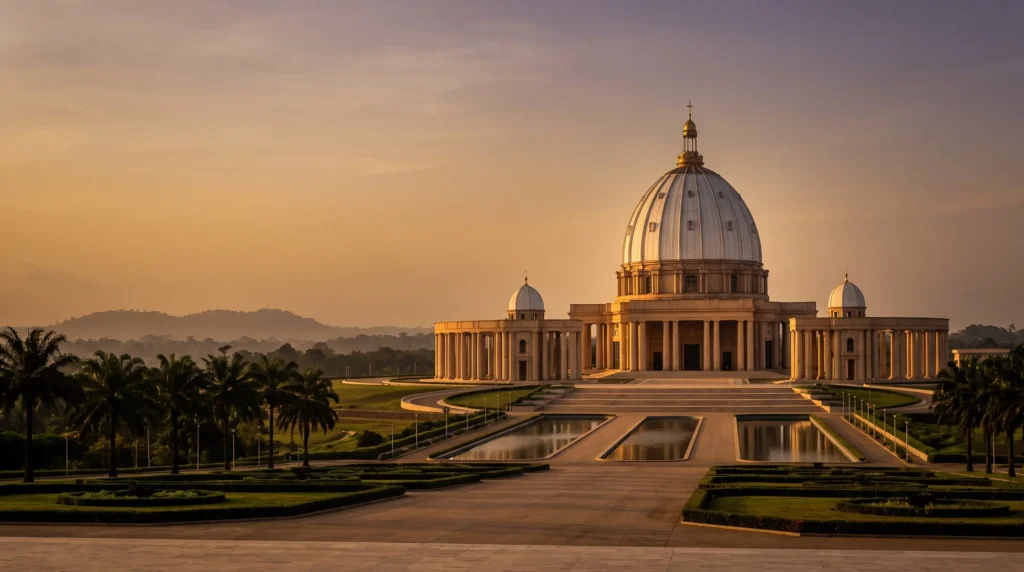
I’ll say the quiet part first: most people can’t place Ivory Coast on a map, and that’s exactly what makes it good to visit. This is the world’s largest cocoa producer and a country that quietly rebuilt itself into one of West Africa’s most dynamic economies after two rough civil wars, and almost none of that shows up in its tourism numbers yet. You can stand under a basilica dome taller than St. Peter’s, built in the middle of the rainforest by a president who wanted his hometown remembered , then drive an hour to a crumbling French colonial capital with the Atlantic breaking on one side and a lagoon on the other. I won’t pretend this is an easy trip — the visa takes real planning, French will get you much further than English, and there’s a northern border zone I’ll tell you plainly to skip — but the parts that work here (the food, the masks, the cocoa, the coast) work in a way few countries this size can match.
In This Guide
- Overview — Why Ivory Coast Deserves a Second Look
- Abissa Festival — Grand-Bassam’s October Reckoning
- Best Time to Visit Ivory Coast (Season by Season)
- Getting There — ABJ, the e-Visa & Air Routes
- Getting Around — Gbakas, Woro-Woros & Private Drivers
- Top Regions — Coast, Cocoa Capital & the Forested West
- Culture & People — Akan, Mandé, Krou & Senufo
- A Food Lover’s Guide to Ivory Coast
- Off the Beaten Path
- Practical Information
- Budget Breakdown — What Ivory Coast Actually Costs in 2026
- Frequently Asked Questions
Overview — Why Ivory Coast Deserves a Second Look
Côte d’Ivoire — the government asks that the French name be used in all languages, though “Ivory Coast” remains common in English — sits on the Gulf of Guinea between Liberia, Guinea, Mali, Burkina Faso and Ghana, with a population of roughly 31.5 million as of 2024. It’s a country of two capitals: Yamoussoukro is the official political capital, while Abidjan, a lagoon-side skyline of glass towers sometimes called the “Manhattan of West Africa,” is the real economic engine and where most visitors actually land and stay. Independence from France came on 7 August 1960 under Félix Houphouët-Boigny, whose three-decade rule shaped much of the country’s infrastructure and its outsized capital city monuments.
Economically, this is cocoa country in the most literal sense — Ivory Coast is the world’s largest producer and exporter of cocoa beans, and that single crop shapes everything from the roadside markets to the interior’s plantation landscapes. The country carries five UNESCO World Heritage Sites: two ancient rainforest and savanna reserves (Taï and Comoé national parks), the transboundary Mont Nimba nature reserve shared with Guinea, the colonial-era Historic Town of Grand-Bassam, and a 2021-listed group of Sudanese-style mudbrick mosques in the north.
What Ivory Coast doesn’t have, yet, is a developed tourist trail. That’s the honest trade-off: fewer English speakers, patchier infrastructure outside Abidjan, and a genuine visa hoop to jump through. What you get in return is a West African capital with real nightlife and restaurant culture, one of the most photographed churches on the continent, and coastline and rainforest that see a fraction of the visitors similar sites in East or Southern Africa do.
Abissa Festival — Grand-Bassam’s October Reckoning
Time an October trip around the Abissa Festival in Grand-Bassam, the week-long celebration of the Abouré (N’zima) people that is one of the most striking cultural events in the country. The premise is remarkable: for one week, ordinary people are permitted to publicly call out and mock the misdeeds of chiefs, elites and each other from the previous year, drummed on by masked dancers and street processions, before order and hierarchy are symbolically restored. It plays out against the backdrop of Grand-Bassam’s UNESCO-listed colonial waterfront, making it one of the rare festivals where the setting is as historic as the ceremony itself.
If Abissa doesn’t line up with your dates, the western Man region runs its own tradition of village mask-dance competitions through the year, rooted in Dan and Guéré culture, where elaborately costumed dancers compete to honor forest spirits — ask locally in Man for the current schedule, since dates shift village to village and aren’t centrally published.
Best Time to Visit Ivory Coast (Season by Season)
Mid-November – March · Dry season (peak)
The most comfortable window for most travelers, though December through February brings the harmattan — a dusty, hazy wind blowing down from the Sahara that can mute the skies and coat everything in fine dust, especially in the north. Coastal humidity stays high year-round, but rainfall drops off sharply, making this the best stretch for Comoé’s savanna wildlife and for Abidjan sightseeing without downpours.
April – July · Main rains build
Abidjan and the south see their heaviest rain in May and June, part of a rainy season that technically runs March through November on the coast. The rainforest interior (Taï, the west around Man) is lush and green but trails get muddy; expect intense, short afternoon downpours rather than all-day washouts.
August · The short dry spell
A noticeable lull in rainfall hits the southern coast in August — a locally known “little dry season” — before rain picks back up. It’s an under-the-radar value window with green scenery and thinner rain than the surrounding months.
September – November · Second rains, then Abissa
Rain returns lightly on the coast through September and October before the dry season resumes around mid-November. The north, by contrast, runs on a single wet season from roughly April to October, so plan Comoé and Korhogo trips around the dry months either side of that. October also brings Abissa in Grand-Bassam — worth planning a rain jacket around, not avoiding the month for.
Getting There — ABJ, the e-Visa & Air Routes
Félix-Houphouët-Boigny International Airport (ABJ), also known as Port-Bouët Airport, sits about 16 kilometres from central Abidjan and is essentially the only realistic international gateway. Air France runs direct flights from Paris, and there are strong connections via Brussels, Casablanca (Royal Air Maroc), Addis Ababa (Ethiopian Airlines) and Istanbul (Turkish Airlines) for travelers coming from North America — there are no nonstop flights from the US, so budget for one stop.
The visa is the part to sort out early. US, UK, EU and Canadian citizens all need a visa; nearly everyone now applies for the e-Visa online in advance rather than at an embassy. Expect roughly 73 euros, a passport valid at least six months, a passport photo, and proof of onward travel and accommodation; processing typically runs about 48 hours but build in a buffer. Crucially, e-Visa holders are generally required to enter through Abidjan’s airport specifically — don’t plan an overland entry on this visa type. Land borders exist with Ghana, Mali, Burkina Faso, Guinea and Liberia, but check current conditions carefully; the State Department flags the northern border zone for terrorism and crime risk and advises against travel there entirely.
Getting Around — Gbakas, Woro-Woros & Private Drivers
Abidjan runs on shared minibuses called gbakas and shared taxis known as woro-woros (typically identifiable by color per commune), both cheap and thoroughly local — fine for the adventurous, but most first-time visitors are better off booking a private driver for a few dollars more, especially after dark. Ride-hailing apps operate in Abidjan and take the guesswork out of fares.
Between cities, a toll motorway connects Abidjan and Yamoussoukro, making that leg a comfortable two-to-three-hour drive; a hired car and driver is the standard way most tourists handle Yamoussoukro, Grand-Bassam and multi-day loops toward Man or the north, since self-driving involves unfamiliar road conditions, checkpoints and limited signage. Domestic flights connect Abidjan with San-Pédro, Korhogo and a handful of regional airports and are worth it for the longer hops north; for shorter runs like Abidjan–Grand-Bassam (about 40 kilometres), road is simplest.
Top Regions — Coast, Cocoa Capital & the Forested West
Abidjan
The undisputed hub — Africa’s sixth most populous city proper, with roughly 6.3 million people as of the 2021 census. Le Plateau’s skyline, Cocody’s leafy embassy district, Treichville’s markets and nightlife, and St. Paul’s Cathedral are the standard first stops; Banco National Park, a pocket of primary rainforest inside the city limits, is a genuinely strange and worthwhile half-day trip.
Yamoussoukro
The political capital and Houphouët-Boigny’s hometown, built around the Basilica of Our Lady of Peace — at 158 metres tall and roughly 30,000 square metres, recognized by Guinness World Records as the largest church on Earth, modeled on St. Peter’s Basilica and consecrated by Pope John Paul II in 1990. It’s a genuinely surreal sight rising out of a modest city, with an esplanade built for crowds far larger than the town ever sees on an ordinary Sunday. The nearby crocodile-filled lake at the presidential palace is a curious, if slightly uneasy, add-on stop.
Grand-Bassam
Ivory Coast’s first colonial capital (1893–1896), UNESCO-listed since 2012 for its late 19th- and early 20th-century French colonial architecture set beside an indigenous Nzema fishing quarter. An easy day trip from Abidjan, with crumbling colonial facades, a national costume museum, artisan markets and beach clubs strung along the Atlantic side of a narrow spit between ocean and lagoon.
Man & the Western Highlands
Ivory Coast’s most dramatic scenery — misty mountains, waterfalls, and villages built around Dan and Guéré mask culture. The “Dents de Man” peaks and rope-and-plank monkey bridges strung between hillsides are the signature sights; this is also the region where mask-dance competitions are most deeply rooted in daily and ceremonial life.
Comoé National Park
West Africa’s largest protected area at roughly 11,500 square kilometres, straddling savanna and gallery forest along the Comoé River, UNESCO-listed since 1983. It was placed on UNESCO’s danger list after the country’s civil conflict but has since recovered; wildlife and infrastructure are rebuilding, so go with a specialist operator and current local knowledge rather than assuming East Africa-style safari infrastructure.
Taï National Park & the Southwest
One of the last remaining stretches of primary tropical rainforest in West Africa, UNESCO-listed since 1982, and home to long-running chimpanzee research and rare species including the pygmy hippopotamus. Remote and logistically demanding to reach, which is precisely why the forest cover here has survived intact.
Korhogo & the North
Senufo heartland — weaving and wood-carving villages, and (with advance planning) access to the Sudano-Sahelian mudbrick mosques inscribed by UNESCO in 2021, built between the 17th and 19th centuries with distinctive projecting wooden frameworks. Given current advisories on the northern border zone, check conditions carefully and travel with a knowledgeable local operator rather than independently.
San-Pédro & the Cocoa Coast
Ivory Coast’s second port and the export point for much of that world-leading cocoa crop, with a laid-back beach town feel and plantation visits inland. Less visited than Abidjan or Grand-Bassam, and better for travelers who want coastline without the capital’s traffic.
Culture & People — Akan, Mandé, Krou & Senufo
Ivory Coast’s roughly 31.5 million people break down into over five broad ethnic groupings and dozens of languages: Akan peoples in the east and center (about 38% of the population per the 2021 census), Northern Mandé and Voltaic/Gur groups each around 22%, plus Krou peoples in the southwest and significant Lebanese, French and other West African immigrant communities in Abidjan. Religiously, the country splits fairly evenly — roughly 42.5% Muslim, 39.8% Christian, and a smaller share practicing traditional or animist faiths, with Islam concentrated in the north and Christianity stronger in the south.
French is the language of government, schools and most signage, but Dioula functions as an everyday trade language across ethnic lines, especially in markets. Mask traditions run deep and vary by region — Dan and Guéré masks in the west, Senufo masks in the north — and are treated as living ceremonial objects, not museum pieces, so ask permission before photographing any mask performance. Abidjan is also the birthplace of two major West African music genres, zouglou and coupé-décalé, both still dominating dance floors from Dakar to Paris.
A Food Lover’s Guide to Ivory Coast
The everyday staple is attiéké — grated, fermented cassava steamed into a couscous-like side — served with grilled fish or chicken and a fiery pepper sauce. Street stalls sell garba, a beloved Abidjan lunch of fried tuna over attiéké, and alloco, sweet fried plantain often eaten alongside grilled fish or a hard-boiled egg. For something heartier, seek out kedjenou: chicken or guinea fowl slow-simmered in a sealed clay pot with tomatoes, onions and peppers, traditionally cooked over embers without opening the lid.
Eat where locals eat: a maquis — an open-air grill restaurant, often plastic chairs and a charcoal fire — is the classic Ivorian night out, built around grilled fish, chicken and attiéké shared over cold beer. Given the country’s cocoa dominance, look for small-batch Ivorian chocolate makers in Abidjan turning the country’s biggest export into a rare finished product you can actually taste at the source, rather than exported as raw beans.
Off the Beaten Path
Taï Chimpanzee Project
Decades of long-running primatology research inside Taï National Park’s primary rainforest — remote, permit-dependent, and one of the few places on the continent to see wild West African chimpanzees in genuinely undisturbed forest.
Man’s monkey bridges
Rope-and-plank suspension bridges strung between hillside villages in the Western Highlands, still used by locals daily and open to visitors willing to wobble across for the view.
Sudano-Sahelian mosques of the north
Eight mudbrick mosques built from the 17th to 19th centuries in a distinctive style with projecting wooden beams, added to UNESCO’s list in 2021 — architecturally unlike anything else on the coast, and rarely visited by outsiders.
Grand Lahou & the lagoon towns
A stretch of lagoon and sandbar coastline west of Abidjan, popular with a small circle of in-the-know locals for weekend fishing-village escapes — no resorts, no crowds.
Practical Information
Money. The West African CFA franc (XOF) is pegged to the euro at 655.957 and floats against the US dollar — plan on roughly 570–600 XOF per US$1, and check a current rate before you go rather than assuming a fixed dollar peg. This is still largely a cash economy outside Abidjan’s better hotels and restaurants; carry XOF for markets, gbakas and rural stops.
Safety. The US State Department currently rates Ivory Coast Level 2 — Exercise Increased Caution, citing crime, terrorism, civil unrest and health concerns, and explicitly advises against travel to the northern border region due to cross-border terrorism and crime risk. Certain Abidjan neighborhoods (Abobo, Adjamé, Angré, Koumassi, Marcory, Yopougon) warrant extra caution after dark, and carjacking/home invasion are cited as recurring concerns; check current advisories before you travel and avoid demonstrations.
Health. Yellow fever vaccination is mandatory for all arriving travelers aged nine months and up, and CDC recommends antimalarial medication for the entire country given year-round transmission risk — start your prescription before you fly. Avoid swimming in untreated freshwater due to schistosomiasis risk, drink bottled or treated water, and make sure routine vaccines are current.
Connectivity. Orange, MTN and Moov all sell tourist SIMs at the airport or in Abidjan; an eSIM is the easier route if your phone supports one. Plugs: European-style Type C/E, 220V. Time zone: GMT (UTC+0), no daylight saving.
Budget Breakdown — What Ivory Coast Actually Costs in 2026
Abidjan runs noticeably pricier than the rest of the country — think regional business-hub pricing in the capital and much cheaper costs the moment you’re in Grand-Bassam, Yamoussoukro or the interior.
Budget (US$40–70/day): Simple guesthouse, garba or maquis street food, gbaka and woro-woro transport, free or low-cost sights like Grand-Bassam’s beaches and museums.
Mid-range (US$100–180/day): Comfortable Abidjan or Yamoussoukro hotel, maquis and sit-down restaurant dinners, a private driver for day trips to Grand-Bassam or Yamoussoukro, domestic flight to San-Pédro or Korhogo.
Luxury (US$300+/day): International-standard hotels in Cocody or Le Plateau, private guided trips into Comoé or Taï with a specialist operator, chartered transport and English-speaking guides throughout.
Build in the e-Visa fee (roughly 73 euros) and yellow fever vaccination cost as fixed pre-trip expenses most other West African comparisons don’t require. Tipping isn’t as deeply embedded as in some regions but is increasingly expected in Abidjan’s higher-end restaurants — 5-10% is generous.
Planning Your First Trip to Ivory Coast
The straightforward first-timer loop is capital + coast + cathedral: land in Abidjan and spend two or three nights exploring Le Plateau, Cocody and the maquis scene, day-trip to Grand-Bassam for the UNESCO waterfront and beach, then drive the toll road to Yamoussoukro for a night to see the basilica up close. A week covers that comfortably; ten days to two weeks lets you push west to Man for mask culture and mountain scenery, or north toward Korhogo and Comoé in the dry season. Pair it with our Ghana guide for the neighboring coastline and Accra’s own West African energy, or continue the Francophone thread through our Senegal guide.
Frequently Asked Questions
Is Ivory Coast safe to visit in 2026?
Abidjan, Grand-Bassam and Yamoussoukro are visited regularly and generally manageable with normal precautions. The US State Department rates the country Level 2 — Exercise Increased Caution overall, and specifically advises against travel to the northern border region due to terrorism and crime risk; check current government advisories before you book and avoid demonstrations.
Do I need a visa?
Yes — US, UK, EU and Canadian citizens all need a visa, and nearly everyone applies online for the e-Visa in advance rather than at an embassy. Expect a fee around 73 euros, roughly 48-hour processing (build in buffer time), and entry generally restricted to Abidjan’s airport on this visa type.
Do I need vaccinations before I go?
Yellow fever vaccination is mandatory for entry for travelers nine months and older, and malaria prophylaxis is strongly recommended for the entire country given year-round risk — start your antimalarial prescription before departure and talk to a travel clinic well ahead of your trip.
Will I be okay without speaking French?
It’s workable in upscale Abidjan hotels and with tour operators, but genuinely easier with at least basic French — menus, signage, taxi drivers and rural areas run almost entirely in French or local languages. This isn’t a country where English gets you by the way it does in, say, Ghana next door.
Ivory Coast or Ghana for a first West Africa trip?
Choose Ghana for easier English-language logistics, a more built-out tourist circuit and Cape Coast’s slave-trade history sites; choose Ivory Coast for the basilica, francophone cocoa culture, and a capital with genuinely fewer other tourists in it. Many travelers reasonably combine both given the shared land border.
What’s a realistic first stop if I only have a week?
Abidjan (2-3 nights), Grand-Bassam as a day trip, then Yamoussoukro for a night to see the basilica before flying home from Abidjan. It’s compact, doesn’t require the domestic flight network, and covers the country’s three signature sights.
Ready to Explore Ivory Coast?
A basilica dome rising out of the rainforest canopy, a colonial capital slowly returning to the sea, and a plate of garba eaten standing up at a roadside stall in Abidjan — Ivory Coast rewards travelers willing to do the visa paperwork and lean into French. Go now, while the tourist trail here is still mostly empty.
Explore More
- Ghana Travel Guide — the neighboring coast and Accra’s energy next door
- Accra City Guide — West Africa’s other big capital, a short hop east
- Senegal Travel Guide — more Francophone West Africa and Atlantic coastline
- Morocco Travel Guide — a common air-route gateway between Europe and West Africa
How this guide was built
Published as part of Facts From Upstairs’ country guide series. Built from authoritative sources — Wikipedia’s entity pages for Ivory Coast, Abidjan, Félix-Houphouët-Boigny International Airport, the West African CFA franc, the Basilica of Our Lady of Peace and the visa policy of Ivory Coast; the UNESCO-sourced List of World Heritage Sites in Côte d’Ivoire; the US State Department’s Côte d’Ivoire international travel information page; the US CDC traveler page for Ivory Coast; and Britannica’s climate entry for Côte d’Ivoire. Numeric and checkable claims carry inline citations.
Sources cited on this page
- Wikipedia — Ivory Coast
- Wikipedia — List of World Heritage Sites in Côte d’Ivoire
- US State Department — Côte d’Ivoire
- Wikipedia — Visa policy of Ivory Coast
- US CDC — Ivory Coast traveler page
- Wikipedia — West African CFA franc
- Wikipedia — Abidjan
- Wikipedia — Félix-Houphouët-Boigny International Airport
- Wikipedia — Basilica of Our Lady of Peace
- Britannica — Côte d’Ivoire Climate
More country guides you might like
Plan your trip to Ivory Coast
The booking tools we use ourselves. FFU may earn a commission at no extra cost to you.
Plan & book your trip to Ivory Coast
Booking through these searches supports our guides at no extra cost to you.