
Jeju Travel Guide — Volcanoes, Haenyeo Divers & South Korea’s Island Escape
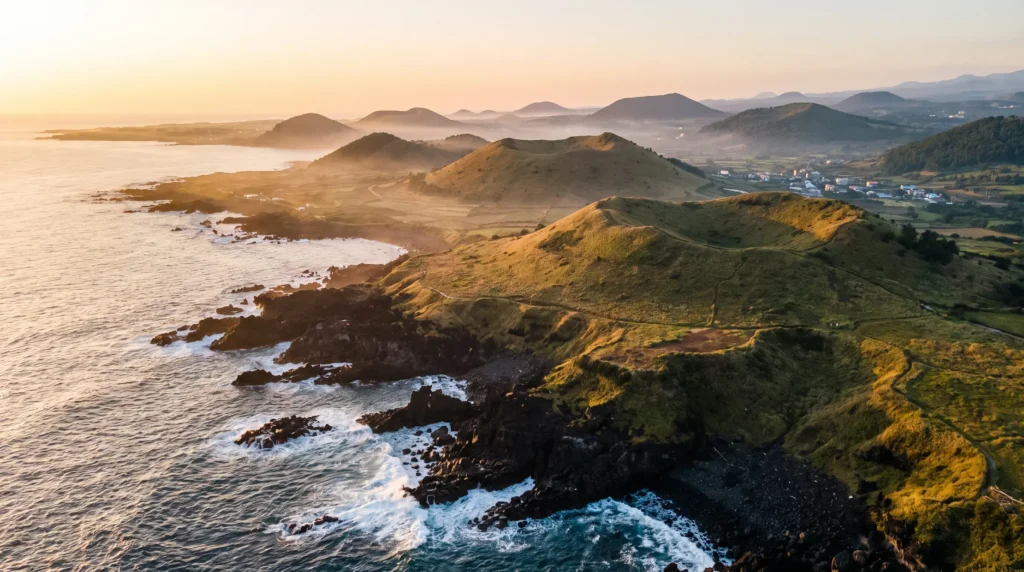
Jeju is the island Koreans go to when they want to feel like they’ve left the country without actually leaving. It sits an hour’s flight south of Seoul, yet it runs on its own weather, its own dialect, and its own volcanic geology — a shield volcano rising 1,947 metres out of the sea, ringed by roughly 360 smaller cones locals call oreum. I’ve hiked that summit in fog so thick I couldn’t see my own boots, then descended into a lava tube cave with carbonate stalactites glowing under headlamp light, and eaten dinner beside a harbor where women in their seventies still free-dive for abalone the way their grandmothers did. Jeju packs beaches, mountains, waterfalls, and a genuinely distinct culture into an island you can drive around in a single day — and because the domestic Seoul–Jeju route is the busiest air corridor on the planet, getting there has never been the hard part. The catch: everyone else in Korea has the same idea, especially around national holidays, so timing your visit matters more here than almost anywhere else in the country.
In This Guide
- Overview — Why Jeju Is South Korea’s Favorite Escape
- The Jeju Fire Festival & Spring Bloom
- Best Time to Visit Jeju (Season by Season)
- Getting There — CJU Airport & Mainland Ferries
- Getting Around — Buses, Rental Cars & Olle Trails
- Jeju’s Key Areas — City, Coast & Countryside
- Culture & People — Haenyeo, Dol Hareubang & Jejueo
- A Food Lover’s Guide to Jeju
- Off the Beaten Path
- Day Trips & Islands Nearby
- Practical Information
- Budget Breakdown — What Jeju Actually Costs in 2026
- Frequently Asked Questions
Overview — Why Jeju Is South Korea’s Favorite Escape
Jeju is South Korea’s largest island, sitting in the Korea Strait south of the mainland, and its own self-governing province — a status that gives it lighter entry rules and a distinct administrative identity from the rest of the country. The island is built entirely of volcanic rock, dominated by Hallasan, a shield volcano and South Korea’s tallest mountain at 1,947 metres, with a lake-filled crater at its summit and roughly 360 smaller parasitic cones (oreum) scattered across the landscape.
That volcanic geology is also Jeju’s headline credential: UNESCO inscribed “Jeju Volcanic Island and Lava Tubes” as a World Heritage Site, a property spanning 18,846 hectares across three components — the Geomunoreum lava tube system, widely regarded as the finest lava-cave network in the world; the dramatic Seongsan Ilchulbong tuff cone rising straight out of the ocean; and Hallasan itself. Hallasan was separately designated a UNESCO Biosphere Reserve in 2002 before the wider World Heritage listing followed in 2007.
What makes Jeju different from a typical beach island is the culture layered on top of the geology: the haenyeo women divers, black-pig barbecue, dry-stone walls, and a dialect distinct enough that mainland Koreans often can’t follow it. It’s touristy in the way a country’s own favorite domestic getaway is touristy — well-built infrastructure, huge weekend crowds from Seoul, and increasingly, resorts and golf courses — but the wild coastline and volcanic backcountry are still very much intact if you get off the main loop road.
The Jeju Fire Festival & Spring Bloom
Time a late-winter trip around the Jeju Fire Festival (Jeju Jeongwol Daeboreum Fire Festival), held annually on the slopes of Saebyeol Oreum to mark Jeongwol Daeboreum, the first full moon of the lunar calendar — usually falling in late February or early March. The festival descends from the old practice of burning off dead winter grass on oreum used as cattle pasture, and now draws crowds for torch parades, drumming, and the ceremonial mass burning of an entire hillside after dark — genuinely one of the more dramatic planned fires you’ll ever watch from a safe distance.
A few weeks later, from late March into early April, Jeju turns pink and yellow at once: cherry blossoms line the roads around Jeju City and Seogwipo just as the island’s famous canola (rapeseed) fields come into bloom near Seongsan and along the coast — the two-color combination is a genuine Jeju specialty you won’t see paired quite the same way on the mainland.
Best Time to Visit Jeju (Season by Season)
April – May · Spring (recommended)
Mild temperatures, cherry blossoms and canola fields blooming together, and the greenest the island gets. This is the sweet spot most repeat visitors aim for, though it overlaps with school trip season on weekdays.
June – August · Summer
Hot, humid, and the busiest season for beaches and Hallasan hikers, since this is peak domestic vacation time in Korea. Late June through July brings a monsoon-like wet spell, and typhoon season runs roughly July through September — check forecasts before booking outdoor-heavy days.
September – November · Autumn (recommended)
Warm days, cooler nights, clearer air for Hallasan summit views, and Chuseok (Korean Thanksgiving) travel spikes in late September or early October depending on the lunar calendar. This is arguably Jeju’s best all-round window.
December – February · Winter
Cold coastal wind, occasional snow dusting Hallasan’s upper slopes, tangerine-picking season, and the lowest hotel rates of the year — plus the Fire Festival as a genuine draw.
Getting There — CJU Airport & Mainland Ferries
Jeju International Airport (CJU), on the northwest edge of Jeju City, is South Korea’s second-busiest airport after Incheon and the home base of Jeju Air. The Seoul–Jeju corridor is the single busiest air route in the world by seat volume, with flights roughly every few minutes at peak times from both Gimpo and Incheon, plus direct domestic connections from Busan, Daegu and other regional cities; flight time from Seoul is about an hour. The airport also handles a growing number of international routes from China, Hong Kong, Japan, Taiwan and Southeast Asia.
There’s no bridge or tunnel to the mainland, so the alternative is ferry: car ferries run from Mokpo (roughly 4.5 hours), Wando (the fastest crossing, around 2 hours 40 minutes), and an overnight service from Busan (departing evening, arriving the following morning). Ferries make sense mainly if you’re bringing a car over from the mainland or prefer slow travel; almost everyone else flies, since domestic fares are often cheaper than the ferry once you factor in time.
Getting Around — Buses, Rental Cars & Olle Trails
Jeju is compact — you can drive the coastal ring road around the whole island in a day — but public transit, while decent, is built around infrequent long-haul buses rather than dense local networks. A rental car (international driving permit required for most foreign visitors) is genuinely the easiest way to see the interior oreum, waterfalls and beaches on your own schedule, and it’s how most independent travelers get around.
If you’re not driving, express intercity buses connect Jeju City, Seogwipo and the main coastal towns reasonably often, and local buses reach most major attractions with some patience and a transit app. Taxis are metered and affordable for short island hops. For a slower approach, the Jeju Olle Trail network — 27 signed coastal and inland routes covering about 437 kilometres in total — lets you walk the island in day-length sections, with guesthouses spaced along the main loop.
Jeju’s Key Areas — City, Coast & Countryside
Jeju City
The island’s administrative and transport hub, home to the airport, the main ferry terminals, and the bulk of budget-to-midrange hotels. Base here for convenience and nightlife around the Jungangno shopping streets and Dongmun Market, even if you spend your days elsewhere.
Seogwipo
The southern coast’s main city, quieter and greener than Jeju City, and the better base for waterfalls (Jeongbang, Cheonjiyeon), the Oedolgae sea stack, and access to Hallasan’s southern trailheads. Olle Market here is a genuinely good food stop.
Seongsan & the East Coast
Anchored by Seongsan Ilchulbong, the UNESCO-listed tuff cone you climb before sunrise for the classic Jeju photograph, this stretch also holds canola fields, Woljeong-ri’s cafe-lined beach, and the ferry jump-off for Udo island.
Aewol & the Northwest Coast
Jeju’s coolest cafe strip: a scenic coastal road strung with design-forward coffee shops and ocean views, popular with Seoul day-trippers and a good gauge of how much the island’s tourism economy has modernized in the last decade.
Jungmun & the South Coast Resort Belt
The island’s purpose-built resort zone near Seogwipo — beach clubs, golf courses, a large-scale hotel strip, and family attractions clustered together. Convenient if you want a resort-style stay; skip it if you came for the volcanic backcountry.
Hallasan & the Interior
The mountain itself and the surrounding national park, plus the mid-island oreum country where most of Jeju’s dry-stone-walled farmland and horse pastures sit. This is where the island stops looking like a resort and starts looking like the volcanic landscape UNESCO actually inscribed.
Hallim & the West Coast
Home to Hyeopjae and Geumneung beaches — some of Jeju’s whitest sand and calmest water — plus Hallim Park’s gardens and lava-tube caves, a quieter alternative to the crowds further east.
Culture & People — Haenyeo, Dol Hareubang & Jejueo
Jeju’s most distinctive cultural export is the haenyeo — free-diving women who harvest abalone, sea urchin and other shellfish by holding their breath, without oxygen tanks, some into their seventies and eighties. UNESCO inscribed the culture of the Jeju haenyeo on its Representative List of Intangible Cultural Heritage in 2016, recognizing not just the diving itself but the surrounding traditions: the mother-to-daughter transmission of technique, communal shore-fires called bulteok, and the shamanistic rituals performed for the goddess of the sea. Numbers have fallen sharply from an estimated 15,000–20,000 haenyeo in the mid-20th century to roughly 3,200–3,300 today, and the Haenyeo Museum near Seongsan is the best place to understand what’s being lost.
You’ll also notice dol hareubang — squat, big-eyed volcanic stone statues believed to have originated as guardian figures — standing outside gates, museums and even convenience stores island-wide, now as much a mascot as a folk-religious object. Jejueo, the island’s traditional dialect, is different enough from standard Korean that linguists treat it as a distinct language; it survives mainly among older residents in rural villages, and most day-to-day interaction on the island happens in standard Korean.
A Food Lover’s Guide to Jeju
The island’s signature dish is heuk dwaeji — Jeju black pork, from a native black-haired pig breed, grilled tabletop-style as thick-cut ogyeopsal (five-layer belly, skin left on) rather than the mainland’s three-layer samgyeopsal. It’s smokier and chewier than standard Korean BBQ pork, and every restaurant on the island seems to have an opinion on whose black pork is the real deal.
Beyond pork, look for galchi jorim (braised hairtail fish in spicy sauce), jeonbokjuk (abalone porridge, often the haenyeo’s own catch), fresh raw seafood at Seogwipo’s Olle Market or Jeju City’s Dongmun Market, and the island’s famous hallabong citrus — a sweeter, easier-to-peel tangerine hybrid grown almost exclusively here, sold everywhere from roadside stalls to convenience stores. Coffee culture is also a genuine Jeju thing now, especially along the Aewol coast, where ocean-view cafes have become an attraction in their own right.
Off the Beaten Path
Manjanggul Lava Tube
Part of the UNESCO-listed Geomunoreum system, this is one of the longest lava tubes in the world at 8.9 kilometres, though only about a kilometre is open to visitors — ending at a 7.6-metre lava column considered the largest of its kind anywhere. Bring a layer; it’s a steady chill underground even in summer.
Gotjawal Forests
Jeju’s volcanic gotjawal woodland — jumbled lava-rock terrain where trees, vines and moss grow directly over uneven basalt — is unlike any forest type elsewhere in Korea, and several sections have boardwalk trails open to the public well away from the main tour-bus routes.
Sangumburi Crater
A perfectly round volcanic crater in the island’s midsection, less visited than Seongsan Ilchulbong but arguably just as striking, especially when the silver grass turns gold in autumn.
Small Fishing Villages of the South Coast
Beyond Seogwipo’s main sights, villages like Beopwhan-dong and stretches of the Olle Trail’s southern routes still run on haenyeo diving and small-scale fishing, with almost no tour buses.
Day Trips & Islands Nearby
Udo (“Cow Island”) is Jeju’s most popular satellite island, a short ferry ride from Seongsan, known for peanut ice cream, a lighthouse coastal walk, and turquoise-tinted water that looks more Southeast Asian than Korean. Rent a bike or scooter to loop the island in a couple of hours.
Marado, South Korea’s southernmost point, is a wind-scoured speck reachable by boat from Moseulpo, popular for the bragging rights and a bowl of jjajangmyeon at the noodle shop that claims fame from a soft-drink commercial. Gapado, flatter and greener, is known for its barley fields and an easy walking loop, with regular ferries from Moseulpo alongside Marado’s.
Practical Information
Money. The South Korean won floats freely against other currencies and is managed by the Bank of Korea; cards are accepted almost everywhere, including small restaurants and taxis, but keep some cash for markets and rural guesthouses.
Safety. The US State Department rates South Korea at its lowest advisory tier, Level 1 (Exercise Normal Precautions), and Jeju itself is considered very low-crime even by Korean standards. The main hazards are natural: strong rip currents at some beaches and slippery volcanic-rock trails after rain.
Health. Tap water is generally safe, and the CDC’s routine travel-health guidance for South Korea covers standard vaccinations plus awareness of insect-borne illness in rural and wooded areas — check the current recommendations before you go.
Connectivity. An eSIM or airport pocket Wi-Fi rental covers the whole island reliably; Korea’s mobile networks are excellent even in rural areas. Plugs: Type C/F, 220V, 60Hz — bring an adapter if you’re coming from a 110–120V country. Time zone: Korea Standard Time, UTC+9, no daylight saving.
Budget Breakdown — What Jeju Actually Costs in 2026
Jeju runs slightly above mainland Korean prices for accommodation, since it’s Korea’s own premium domestic destination, but food and transport stay reasonable.
Budget (US$50–90/day): Guesthouse dorm or budget motel, convenience-store and market meals, local buses or a shared rental car split with others.
Mid-range (US$120–220/day): Business hotel or nicer guesthouse, black-pork dinners and cafe stops, a rental car for full flexibility, entry to Seongsan Ilchulbong and Manjanggul.
Luxury (US$350+/day): Jungmun resort stay, golf, private tours to Udo and the interior oreum, higher-end seafood dining.
Domestic flights from Seoul are often the single cheapest leg of the trip if booked ahead; the bigger cost driver is accommodation during Korean holiday weeks (Seollal, Chuseok, summer vacation), when prices spike and availability tightens fast.
Planning Your First Trip to Jeju
Four to five days is enough to cover the island’s greatest hits without rushing: a day for Seongsan Ilchulbong, canola fields and Udo on the east side; a day for Hallasan (start early, weather turns fast); a day split between Manjanggul and the gotjawal forests; and a day for Seogwipo’s waterfalls and the south coast. Rent a car if you can — it turns Jeju from a checklist into a proper road trip. Many visitors pair Jeju with a few days in Seoul or a stop in Busan before or after, and our full South Korea guide covers how to stitch a mainland-plus-island itinerary together.
Frequently Asked Questions
Is Jeju safe for tourists in 2026?
Yes — South Korea sits at the US State Department’s lowest advisory tier, Level 1, and Jeju is low-crime even by Korean standards. Watch for rip currents at open beaches and slick volcanic trails after rain rather than crime.
Do I need a visa to visit Jeju?
Jeju follows South Korea’s national entry rules: US, UK, EU, Canadian, Australian and many other passport holders can enter visa-free for stays up to 90 days, and a temporary K-ETA exemption currently covers dozens of nationalities through the end of 2026 — check current requirements before booking, since rules are set to change in 2027.
Do I need a car on Jeju?
Not strictly, but it makes a huge difference — public buses cover the main towns and sights with patience, while a rental car unlocks the interior oreum, back-road waterfalls and cafe coastline on your own schedule. An international driving permit is required for most foreign visitors.
How many days do I need in Jeju?
Four to five days covers the highlights comfortably; a week lets you add Udo, Marado/Gapado, and a slower pace through the Olle Trail sections without feeling rushed.
Can I see the haenyeo divers?
Yes — several fishing villages and the Haenyeo Museum near Seongsan offer scheduled diving demonstrations, though the practice itself is a genuine, dwindling livelihood rather than a staged show, so treat it with the same respect you’d want for any working tradition.
Jeju or the Korean mainland?
Choose Jeju for volcanic scenery, beaches and a slower island pace within easy reach of Seoul; choose the mainland for palaces, big-city energy and the DMZ. Most Korea itineraries do both — Jeju is the easy add-on, not an either/or.
Ready to Explore Jeju?
Volcanic summits above cloud level, cherry blossoms next to canola fields, black-pork barbecue smoking on tabletop grills, and haenyeo divers surfacing with the day’s abalone catch. Jeju delivers an entire country’s worth of variety on one island — just book around Korean holiday weeks if you want it without the crowds.
Explore More
- Seoul City Guide — pair Jeju with Korea’s capital
- Busan City Guide — Korea’s other great coastal city, and a ferry gateway to Jeju
- South Korea Travel Guide — the full country picture
- Tokyo City Guide — continue on to Japan
How this guide was built
Published as part of Facts From Upstairs’ city guide series. Built from authoritative sources — Wikipedia entity pages for Jeju Island, Jeju Province, Jeju International Airport, the Jeju Olle Trail, Manjanggul and the South Korean won; UNESCO’s World Heritage listing for Jeju Volcanic Island and Lava Tubes and its Biosphere Reserve page; UNESCO’s Intangible Cultural Heritage listing for the Culture of Jeju Haenyeo; the official Korea Tourism Organization (VisitKorea) page for the Jeju Fire Festival; the US State Department’s South Korea travel advisory; the US CDC traveler page for South Korea; and a plug/voltage reference for South Korea. Numeric claims carry inline citations.
Sources cited on this page
- Wikipedia — Jeju Island
- Wikipedia — Jeju Province
- Wikipedia — Jeju International Airport
- Wikipedia — Hallasan National Park
- Wikipedia — Jeju Olle Trail
- Wikipedia — Manjanggul
- Wikipedia — South Korean won
- Wikipedia — Visa policy of South Korea
- UNESCO — Jeju Volcanic Island and Lava Tubes
- UNESCO — Jeju Island Biosphere Reserve
- UNESCO ICH — Culture of Jeju Haenyeo (women divers)
- Korea Tourism Organization — Jeju Fire Festival
- US State Department — South Korea Travel Advisory
- US CDC — South Korea traveler page
- Direct Ferries — Jeju Island ferry routes
- Wise — South Korea plug & voltage type
More city guides you might like
Plan your trip to Jeju
The booking tools we use ourselves. FFU may earn a commission at no extra cost to you.
Plan & book your trip to Jeju
Booking through these searches supports our guides at no extra cost to you.