
Languages of Liberia
All languages of Western Africa →fluent beta classical · classes by phone with Maya at ranas.ai/maya
Liberia Travel Guide — West Africa’s Founding Republic, a Wild Surf Coast & the Rainforest Few Ever See
Liberia is the strangest founding story on the map, and almost nobody outside West Africa knows it. In 1822, freed and formerly enslaved African Americans landed on a mangrove islet at the mouth of the Mesurado River and built a nation whose flag still salutes the one they’d left behind — eleven stripes, a single star, a blue field standing in for a continent instead of a union of states. Independence came in 1847, making Liberia one of Africa’s oldest republics, yet I’d be lying if I said the last four decades have been kind: back-to-back civil wars from 1989 to 2003 and the world’s worst Ebola epidemic in 2014–2016 emptied the tourism ledger almost to zero. What’s left, if you’re willing to travel it on its own terms, is remarkable: some of the last intact Upper Guinea rainforest in West Africa, pygmy hippos nobody photographed until 2008, and a left-hand point break at Robertsport that surfers now cross oceans for. This is not a polished guide to a polished country — it’s an honest one to a real, recovering, quietly extraordinary place.
In This Guide
- Overview — Africa’s Oldest Republic, Rebuilding
- July 26 — Independence Day and Liberia’s Festival Calendar
- Best Time to Visit Liberia (Season by Season)
- Getting There — Roberts International & the Land Borders
- Getting Around — Shared Taxis, Pen-Pens & Rough Roads
- Top Regions — Coast, Capital & Rainforest Interior
- Culture & People — Sixteen Peoples, One Founding Story
- A Food Lover’s Guide to Liberia
- Off the Beaten Path
- Practical Information
- Budget Breakdown — What Liberia Actually Costs in 2026
- Frequently Asked Questions
Overview — Africa’s Oldest Republic, Rebuilding
Liberia sits on the Atlantic coast of West Africa, bordered by Sierra Leone to the northwest, Guinea to the north and Côte d’Ivoire to the east, with a population of roughly 5.4 million spread across a country a little larger than Ohio. Its origin story is unlike anywhere else on the continent: the American Colonization Society landed the first group of freed and formerly enslaved African Americans on Providence Island at the mouth of the Mesurado River in 1822, founding a settlement first called Christopolis before it was renamed Monrovia in 1824 in honor of US President James Monroe. Independence followed on 26 July 1847, and that history is stitched directly into the flag — eleven red and white stripes for the eleven signers of the declaration, a blue canton where the American field of stars would be, and one lone white star standing in for the Republic of Liberia itself.
The country’s more recent chapters are harder. Two civil wars between 1989 and 2003 killed an estimated 150,000–250,000 people and displaced more than half the population, and just as Liberia was stabilizing, the 2014–2016 West African Ebola epidemic hit here hardest of all three affected countries, with the CDC deploying response teams to Monrovia through 2015. I mention this not to dwell on it but because it explains everything about what traveling here today feels like: minimal tourist infrastructure, roads that wash out every rainy season, and a population that is, almost without exception, warm and startled that you came at all.
What draws the small but growing trickle of visitors is what the war years inadvertently protected: vast stretches of Upper Guinea rainforest, one of West Africa’s last strongholds for forest elephants and the elusive pygmy hippo, plus a stretch of Atlantic coastline at Robertsport now recognized as one of the best and least crowded surf breaks on the continent. This is frontier travel in the true sense — bring patience, cash, and a sense of humor about slow roads, and Liberia gives back in kind.
July 26 — Independence Day and Liberia’s Festival Calendar
If you’re reading this in Liberia’s namesake month: 26 July marks Independence Day, the country’s biggest civic holiday, commemorating the 1847 declaration and celebrated with parades, marching bands, church services and speeches in Monrovia’s Antoinette Tubman Stadium and in county capitals nationwide. Expect flag-draped streets, school and community groups performing in the parade route, and a genuinely festive, patriotic mood — this is also one of the few weeks of the year when domestic flights and county-capital guesthouses can fill up, so book ahead if your trip lands in late July.
Beyond Independence Day, Liberia’s calendar includes Decoration Day (second Wednesday in March, when families tend graves and picnic at cemeteries), Flag Day (24 August, marking the 1847 adoption of the flag), and county fairs held through the dry season that showcase local produce, drumming and traditional dance — worth asking your guesthouse or a local fixer about, since they rarely make it onto any English-language events calendar.
Best Time to Visit Liberia (Season by Season)
Late November – March · Dry season (best overall)
The most comfortable window for road travel, rainforest hikes and beach time, though expect the hazy, dust-laden harmattan winds blowing down from the Sahara, especially December through February. This is also when Sapo National Park and Nimba’s forest trails are most accessible, since unpaved roads that turn to mud in the wet months are passable.
April – June · Shoulder season, surf building
Rain starts returning by May, but this is when Robertsport’s swells begin to build toward their peak, with reliable south-southwest ground swells running from the South Atlantic. Fewer travelers, lush green landscapes, and lower guesthouse rates.
July – October · The heavy rains
Monrovia is regularly cited as the wettest capital city on Earth, averaging around 4,600mm (182 inches) of rain a year, with June typically the single wettest month. Unpaved roads outside Monrovia can become genuinely impassable in this stretch, so interior travel (Sapo, Nimba, Gbarnga) gets difficult to impossible. On the upside, October brings some of Robertsport’s most consistent surf of the year, and the rain itself eases toward month’s end.
Getting There — Roberts International & the Land Borders
Roberts International Airport (ROB), also called Robertsfield, sits about 56km (35 miles) southeast of central Monrovia in Margibi County and is Liberia’s only scheduled international gateway. Brussels Airlines runs the only nonstop service from Europe; otherwise you’re routing through regional hubs — Accra, Addis Ababa, Abidjan and Casablanca between them account for most arrivals via Ethiopian Airlines, Kenya Airways, Royal Air Maroc, Air Côte d’Ivoire and ASKY. Budget the better part of an hour for the drive into Monrovia, longer in rain.
Overland crossings exist from Sierra Leone (near Robertsport, in the northwest) and Guinea and Côte d’Ivoire further inland, but roads are rough, paperwork is manual, and these routes suit overlanders with time and flexibility rather than a first visit. Almost everyone arriving for tourism flies into ROB.
Getting Around — Shared Taxis, Pen-Pens & Rough Roads
Liberia has very little tourism transport infrastructure, so getting around means adopting how Liberians actually move: shared yellow taxis and minibuses along fixed routes in Monrovia, and motorcycle taxis — universally called “pen-pens” — for shorter hops and anywhere buses don’t reach. Agree fares before you get in; nothing is metered.
Outside the capital, a hired 4×4 with a driver is the realistic option for reaching Robertsport, Sapo National Park or Nimba County, particularly once rains start. Paved roads connect Monrovia to a handful of county capitals, but many secondary roads are laterite dirt that becomes deeply rutted or briefly unpassable in the wet season — build slack into any itinerary that leaves the capital. There’s no domestic airline network to fall back on, so plan road time generously: what looks like 100km on a map can be a three- to four-hour drive.
Top Regions — Coast, Capital & Rainforest Interior
Monrovia & Montserrado County
Home to roughly a third of the national population, with the city proper counting around 1.76 million residents. See the Freeport, the fishing beaches of West Point, the Ducor Hotel ruins overlooking the bay, and the National Museum for a compressed history lesson before heading anywhere else.
Robertsport & Grand Cape Mount County
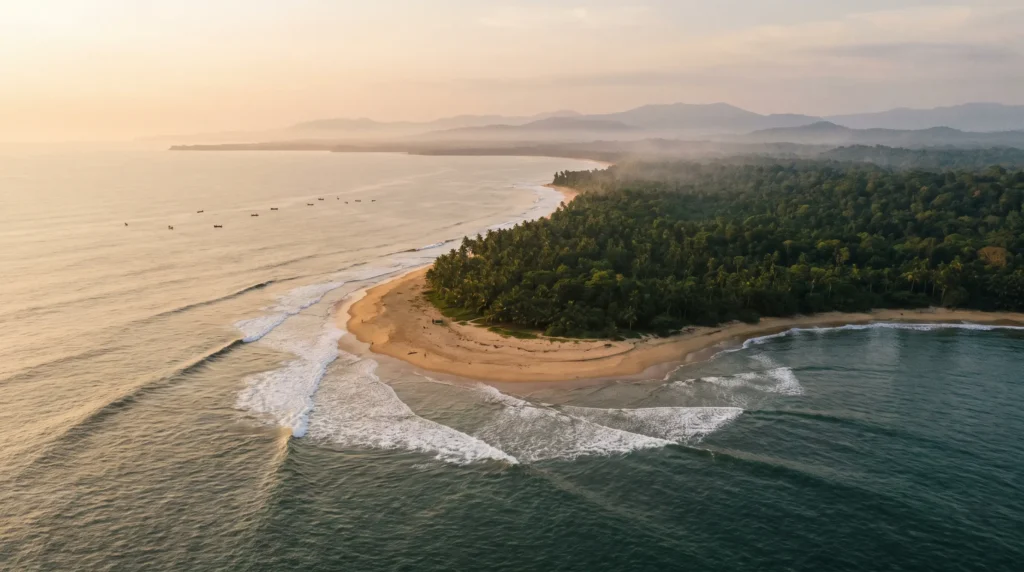
Liberia’s breakout tourism story: a sleepy fishing town on Cape Mount peninsula, about 80km (50 miles) northwest of Monrovia near the Sierra Leone border, wrapped around a string of internationally recognized left-hand point breaks — Fisherman’s Point, Cotton Trees, Cassava Point among them. A handful of surf camps and guesthouses rent boards and run lessons; Lake Piso sits just behind town for calmer paddling and birdlife.
Sinoe County & Sapo National Park
Liberia’s largest protected rainforest and the second-largest block of primary tropical rainforest left in West Africa after Côte d’Ivoire’s Taï National Park, spanning roughly 180,363 hectares of swamp forest, dryland forest and riverine habitat. This is the country’s best shot at forest elephants, chimpanzees and the shy, nocturnal pygmy hippo, first photographed here by camera trap only in 2008. Access requires a guide, a 4×4 and dry-season timing.
Nimba County
Mountainous, forested and mineral-rich, bordering Guinea’s Mount Nimba massif, with hiking, waterfalls (Kpatawee Waterfall’s terraced pools are the most photographed) and Liberia’s iron-ore heritage towns. Nimba is also one of the counties currently flagged for a Lassa fever outbreak — check current advisories before planning remote travel here.
Buchanan & Grand Bassa County
A quieter port city with decent beaches and easier access than Sinoe for a taste of the coast beyond Monrovia, plus rubber-plantation country stretching inland.
Bong & Gbarnga
Central highland country, cooler and greener, with Cuttington University’s campus and easy access to Kpatawee Waterfall’s forested trails.
Maryland County & Harper
The far southeastern tip near Côte d’Ivoire, home to Harper’s crumbling but atmospheric colonial-era Americo-Liberian architecture — a genuine off-the-map detour for the patient traveler.
Culture & People — Sixteen Peoples, One Founding Story
Liberia’s population blends indigenous ethnic groups — including Kpelle, Bassa, Gio, Kru, Grebo, Mano, Krahn, Gola, Kissi, Vai and Mandingo communities — with the descendants of the Americo-Liberian settlers who founded Monrovia in 1822, plus Congo people resettled from intercepted slave ships in the 19th century. English is the sole official language, a legacy of that founding, while more than 20 indigenous languages carry daily life in villages and county towns.
Poro and Sande initiation societies remain significant in parts of rural Liberia, particularly among Kpelle, Gola and Vai communities, though as an outside visitor you’ll encounter their influence indirectly — in mask carving traditions and community structure — rather than through any ceremony open to tourists. Church life is central in Monrovia and beyond; Sunday mornings shape the rhythm of most towns. Ask before photographing people, ceremonies, or anywhere near government and security installations, which remains a genuinely sensitive area left over from the war years.
A Food Lover’s Guide to Liberia
Rice anchors nearly every Liberian meal, most famously under cassava leaf — cassava leaves pounded fine and stewed with palm oil, meat or fish and hot pepper into a thick, deeply savory sauce. Its close cousin palm butter swaps in oil-palm pulp for a rich, orange-red sauce, again served over rice. Dumboy, pounded cassava worked into a smooth, stretchy dough, is the traditional accompaniment for soups and stews and arguably Liberia’s most iconic dish alongside its cousin fufu.
Liberian jollof rice holds its own against Ghana’s and Nigeria’s more famous versions, and coastal towns turn out excellent grilled fish and fresh seafood. Look for Liberica coffee and Liberian craft chocolate — both promoted by the national tourism board as souvenir-worthy specialties — grown inland where cacao and coffee plantations survived the war years. Street food in Monrovia runs to roasted plantain, fried fish, and “check rice” (a mixed rice dish), best eaten hot and fresh from a roadside stand rather than left sitting.
Off the Beaten Path
Providence Island
The literal starting point of Liberia, where the first Americo-Liberian settlers landed in 1822 — a small, quiet historic site in central Monrovia now under consideration for UNESCO World Heritage status, part of Liberia’s first properties added to the UNESCO tentative list in recent years. Liberia currently has zero sites inscribed on the full UNESCO World Heritage List, which only makes visiting this quiet, under-visited piece of Atlantic history feel more like a discovery than a checkbox.
Kpatawee Waterfall
A terraced, multi-tiered waterfall in Bong County reachable on a half-day trip from Gbarnga, with natural pools for swimming and a genuinely dramatic setting that Liberia’s tourism board features as a top-ten attraction.
Sapo National Park’s deep interior
Beyond the park’s edge trails, multi-day guided treks reach deeper rainforest with real odds of forest elephant sign and primate sightings few outsiders ever witness — this is expedition-grade travel, not a day trip.
Harper’s Americo-Liberian ruins
A long, rough drive to Liberia’s southeastern tip rewards with crumbling colonial-era mansions and a coastline that essentially no foreign tourists reach in a given year.
Practical Information
Visa. Nearly all visitors need a visa; Liberia’s Immigration Service runs an official online Visa on Arrival pre-approval portal, and applying well ahead of travel — rather than assuming visa-free or true walk-up arrival — is the safe approach.
Money. Liberia runs a dual-currency system: the Liberian dollar (LRD) floats against the US dollar, which also circulates freely and is generally preferred for larger purchases, hotels and flights — confirm which “dollar” any quoted price means. This remains a heavily cash-based society; cards are accepted at only a few upscale hotels and are not something to rely on. Bring clean, newer US bills, since older or damaged notes are often refused.
Safety. The US State Department rates Liberia Level 2 (Exercise Increased Caution) as of mid-2026, citing armed robbery and street crime in urban areas, crowded markets and public beaches, plus periodic large-scale demonstrations that can turn disruptive. Avoid travel outside Monrovia or between counties after dark where possible, and check current advisories before any trip.
Health. Yellow fever vaccination is recommended (and may be required for entry from certain countries), malaria risk is high nationwide so antimalarials and repellent are essential, and as of mid-2026 the UK FCDO was tracking a Lassa fever outbreak concentrated in Bong, Grand Bassa and Nimba counties. Medical facilities fall well short of Western standards outside Monrovia’s better clinics; comprehensive travel insurance with medical evacuation is non-negotiable.
Connectivity & logistics. Mobile data works reasonably well in Monrovia and county capitals, drops off fast in rural areas. Plugs are the UK-style three-pin (230V) in most buildings. Time zone: GMT/UTC+0, no daylight saving.
Budget Breakdown — What Liberia Actually Costs in 2026
Liberia isn’t cheap in the way its neighbors sometimes are — imported goods, fuel and hotel infrastructure carry a real cost premium — but it’s inexpensive relative to a comparable rainforest-and-coast trip almost anywhere else.
Budget (US$40–75/day): guesthouse or surf-camp dorm in Robertsport, local rice-and-sauce meals, shared taxis and pen-pens, self-guided beach and town time.
Mid-range (US$100–180/day): a decent hotel in Monrovia or a private room at a Robertsport surf lodge, hired driver for day trips, a guided Sapo or Kpatawee excursion, restaurant meals.
Higher-end (US$250+/day): Monrovia’s better business hotels, a private 4×4 and driver-guide for a multi-day interior circuit, and the logistics premium of reaching Sapo’s deep interior or Harper.
Fixed costs to expect: the visa application fee, cash for fuel surcharges on any long drive, and modest park or guide fees at Sapo and Kpatawee. Tipping isn’t deeply entrenched but is appreciated for drivers and guides.
Planning Your First Trip to Liberia
The realistic first-timer route is capital + coast: fly into Roberts International, spend two or three days in Monrovia (Providence Island, West Point, the National Museum, the Ducor ruins), then take a hired 4×4 or arranged transfer to Robertsport for three or four nights of surfing, Lake Piso and total decompression. A week covers that comfortably; ten days to two weeks lets you add a guided run to Sapo National Park or Kpatawee Waterfall if you’re traveling in dry season. Pair a Liberia trip with the region’s more established diaspora-heritage circuit — our Ghana guide covers Elmina Castle and the Door of No Return, our Senegal guide covers Gorée Island’s twin history, and our Accra city guide is the easiest regional hub to fly in and out of alongside Monrovia.
Frequently Asked Questions
Is Liberia safe for tourists in 2026?
It’s a Level 2 “Exercise Increased Caution” destination per the US State Department — comparable to many first-time-frontier destinations, not a warzone, but street crime and occasional unrest are real risks, concentrated in Monrovia’s crowded areas and after dark. Travel with a local guide or driver for anything outside the capital, avoid demonstrations, and check the latest advisory before booking.
Do I need a visa?
Yes, nearly all foreign visitors need a visa to enter Liberia. Apply in advance through Liberia’s official Visa on Arrival portal or a Liberian embassy — don’t assume a true no-visa arrival is possible.
What vaccinations do I need?
Yellow fever vaccination is recommended for all travelers and may be required as proof of entry depending on your routing; malaria prevention (pills plus repellent) is essential nationwide. Check the current CDC and FCDO pages closer to your trip, since local disease activity — including Lassa fever in specific counties — shifts through the year.
Is Robertsport worth the trip just for surfing?
If you surf, yes — it’s genuinely one of West Africa’s best and least crowded point-break setups, with reliable swells especially April through October and peak consistency around October. Non-surfers still get a beautiful, sleepy coastal town with Lake Piso alongside it.
Liberia or Ghana for a first West Africa trip?
Choose Ghana for smoother infrastructure, an established diaspora-tourism circuit and easier logistics; choose Liberia if you specifically want frontier travel, rainforest wildlife and a founding story unlike anywhere else on the continent, and you’re comfortable with a rougher trip.
What currency should I bring?
Clean, newer US dollar bills cover hotels, flights and bigger purchases almost everywhere; keep small Liberian dollars on hand for markets, taxis and street food.
Ready to Explore Liberia?
A left-hand point break with your name on the wave list, a rainforest still hiding pygmy hippos from the cameras, and a founding story you genuinely won’t find rehearsed anywhere else in Africa. Liberia isn’t easy, and it isn’t polished — but for travelers who want the real, unfiltered version of West Africa’s Atlantic coast, it’s one of the last places that still delivers exactly that.
Explore More
- Ghana Travel Guide — Elmina, Cape Coast and the region’s established diaspora-heritage circuit
- Senegal Travel Guide — Gorée Island and Dakar’s Atlantic history
- Accra City Guide — the easiest regional hub to combine with Monrovia
- United States Travel Guide — the other end of Liberia’s founding story
How this guide was built
Published as part of Facts From Upstairs’ country guide series. Built from authoritative sources — Wikipedia entity pages for Liberia, Monrovia, the Colony of Liberia, the Flag of Liberia, the Counties of Liberia, the Second Liberian Civil War, Roberts International Airport, Sapo National Park and Robertsport; UNESCO’s World Heritage Convention pages for Liberia’s States Parties status and Providence Island’s tentative listing; the Central Bank of Liberia’s exchange rate page; the US State Department’s Liberia travel advisory; the UK FCDO’s Liberia travel advice; the US CDC’s Liberia traveler page; the CDC’s official MMWR account of its 2014–2016 Ebola response; Liberia’s official Visa on Arrival government portal; and Liberia’s national tourism board site. Numeric and checkable claims carry inline citations.
Sources cited on this page
- Wikipedia — Liberia
- Wikipedia — Monrovia
- Wikipedia — Colony of Liberia
- Wikipedia — Flag of Liberia
- Wikipedia — Counties of Liberia
- Wikipedia — Second Liberian Civil War
- Wikipedia — Roberts International Airport
- Wikipedia — Sapo National Park
- Wikipedia — Robertsport
- UNESCO — Liberia States Parties
- UNESCO — Providence Island Tentative List
- Central Bank of Liberia — Exchange Rates
- US State Department — Liberia Travel Advisory
- UK FCDO — Liberia Travel Advice
- US CDC — Liberia Traveler Page
- CDC MMWR — 2014–2016 Ebola Epidemic Response
- Liberia Immigration Service — Visa on Arrival Portal
- Liberia National Tourism Board
More country guides you might like
Plan your trip to Liberia
The booking tools we use ourselves. FFU may earn a commission at no extra cost to you.
Plan & book your trip to Liberia
Booking through these searches supports our guides at no extra cost to you.