
Languages of Liechtenstein
All languages of Western Europe →fluent beta classical · classes by phone with Maya at ranas.ai/maya
Liechtenstein Travel Guide — How to Do a Whole Country Before Dinner
I’ll be honest about why most people go to Liechtenstein: to say they did. It is the world’s sixth-smallest country, wedged between Switzerland and Austria in the Alps, and one of only two nations on Earth that are “doubly landlocked” — surrounded entirely by countries that are themselves landlocked. You can walk across the whole thing, border to border, in under a day. But treating it as a novelty selfie stop and leaving is the actual tourist trap here, because the country that produces a fifth of the world’s Prince-branded wine and a huge share of the world’s false teeth also happens to have some of the best-kept alpine hiking in Central Europe, a genuinely lovely little capital with more museums per capita than almost anywhere on the continent, and a mountain village you’ve never heard of that locals guard like a secret. Come for the flag-stamp passport gimmick. Stay because it’s actually beautiful.
In This Guide
- Overview — Europe’s Strangest Success Story
- National Day, August 15 — When the Whole Country Shows Up to the Castle
- Best Time to Visit Liechtenstein (Season by Season)
- Getting There — No Airport, No Problem
- Getting Around — Buses, Trails & E-Bikes
- Top Regions — Vaduz, Malbun & the Two Halves of a Tiny Country
- Culture & People — Princes, Walsers & Direct Democracy
- A Food Lover’s Guide to Liechtenstein
- Off the Beaten Path
- Practical Information
- Budget Breakdown — What Liechtenstein Actually Costs in 2026
- Frequently Asked Questions
Overview — Europe’s Strangest Success Story
Liechtenstein is a principality of about 41,300 people squeezed into 160 square kilometres of Rhine valley and Alps, ruled by a reigning prince and run day-to-day by his son as regent since 2004, with a 25-seat parliament and a habit of settling big questions by public referendum. It became fully independent in 1866 and has been quietly, extremely rich ever since, running on financial services, precision manufacturing and a customs and currency union with Switzerland so complete that the two countries share a border with barely a checkpoint between them.
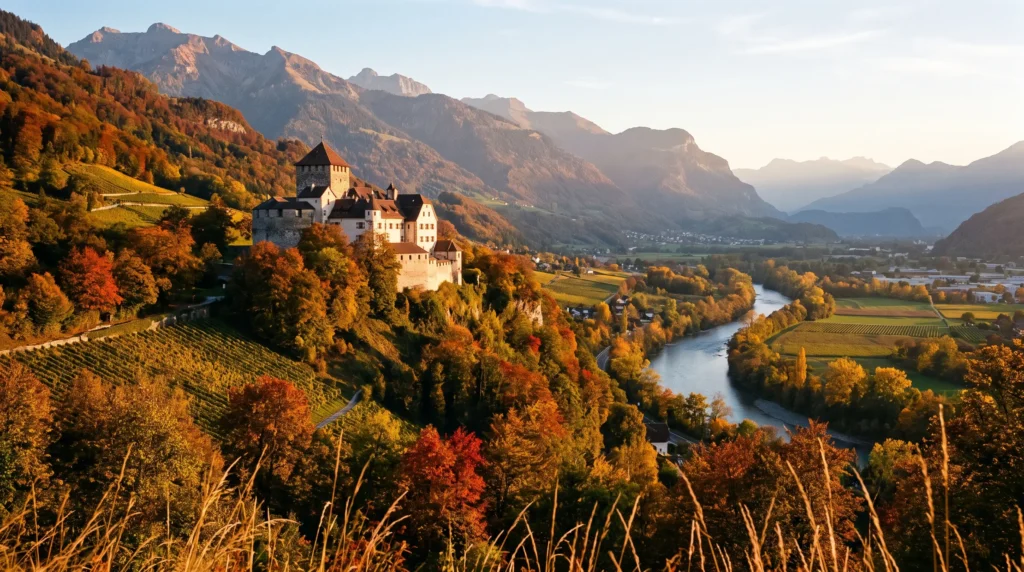
Roughly half the country is mountainous, topping out at Grauspitz (2,599m) on the Austrian border, with the Rhine forming the flatter western edge. Vaduz, the capital, holds Vaduz Castle (still the prince’s actual residence, not open to the public) and a walkable museum row; Malbun, an hour up the valley, is the country’s only ski resort and its best-kept secret for families who want alpine scenery without alpine crowds.
What Liechtenstein doesn’t have is almost as interesting as what it does: no airport, no UNESCO World Heritage sites of its own, and — outside a handful of day-trippers from Zurich cruise-shipping through Vaduz’s Städtle for an hour — remarkably few tourists relative to how photogenic it is. That’s the actual appeal. You get castle views, real hiking, and a genuinely odd little nation-state, minus the crowds you’d find twenty minutes away in Switzerland or Austria.
National Day, August 15 — When the Whole Country Shows Up to the Castle
If you can time a trip around one date, make it 15 August, Staatsfeiertag — Liechtenstein’s National Day, celebrating both the Feast of the Assumption and the country’s independence. Every citizen is invited up to Vaduz Castle grounds for speeches from the prince, fireworks over the Rhine valley, and a beer-and-wine reception that turns the whole event into something closer to a village party than a state occasion. It’s one of the only days of the year the usually private castle grounds open up at all, and Vaduz’s Städtle fills with market stalls and brass bands from midmorning.
August also happens to be peak season for the Liechtenstein Trail (Liechtensteinweg), the signature multi-day hike stitching together all eleven of the country’s municipalities — book accommodation on the trail route well ahead if your visit overlaps National Day weekend.
Best Time to Visit Liechtenstein (Season by Season)
June – September · Hiking high season
Warm days, long light, alpine meadows in full bloom, and the Liechtenstein Trail’s full seven-day route open end to end. This is also when the country’s e-bike routes through the Prince’s vineyards and the family-friendly llama-trekking programs around Malbun run in full swing. Expect the busiest weekends around National Day (15 August).
December – March · Ski season
Malbun, at roughly 1,600m in the Rätikon Alps, is Liechtenstein’s only ski area — small, gentle and deliberately built for families rather than powder-hounds chasing a bigger Austrian resort next door. Cross-country trails and winter hiking routes stay open around Steg and Malbun through the season.
April – May & October – November · Shoulder
Quiet, cool, changeable weather, lower hotel rates in Vaduz, and museums and the Museum Mile largely to yourself — good for a culture-first trip if hiking and skiing aren’t the priority.
Getting There — No Airport, No Problem
Liechtenstein has no international airport of its own; almost everyone arrives via Zurich Airport (ZRH) in Switzerland, roughly 120 kilometres and 1.5–2 hours away by car or a combination of train and bus. From Zurich, take a Swiss Federal Railways (SBB) train to Sargans or Buchs SG, then a short LIEmobil bus into Vaduz — the whole hop typically costs a few Swiss francs and takes 15–25 minutes once you’re off the train.
Liechtenstein does have its own passenger rail stop, Schaan-Vaduz, on the Austrian-run Feldkirch–Buchs line, served by regional S-Bahn trains connecting onward to Zurich in one direction and Feldkirch/Vienna in the other. Driving in from Austria via Feldkirch is just as easy — there’s effectively no hard border to speak of between the three countries, though you’ll still want your passport for random checks.
Getting Around — Buses, Trails & E-Bikes
You genuinely do not need a car. LIEmobil, the national bus network, reaches every municipality — Vaduz, Schaan, Triesenberg, Malbun, Balzers and the northern Unterland villages — and a full-day pass runs around 13 Swiss francs for unlimited travel. Buses from Vaduz up to Malbun take about 30 minutes and run frequently in ski and hiking season alike.
Vaduz itself is entirely walkable — most of its museums and sights sit within a 15-minute radius of the Städtle pedestrian street. For a slower pace, e-bike routes thread through the Unterland’s vineyards and flatlands, and the Liechtenstein Trail itself is the ultimate car-free way to see the whole country on foot, with luggage-transport options for anyone doing the full multi-day version. If you do rent a car for an Austria/Switzerland loop, remember Liechtenstein’s own toll-free roads still connect to Swiss and Austrian highways that require a vignette sticker.
Top Regions — Vaduz, Malbun & the Two Halves of a Tiny Country
Vaduz
The capital and the country’s cultural core, home to around 5,700 people, the Liechtenstein Center (the main tourism office and starting point for passport-stamp souvenirs), the Kunstmuseum Liechtenstein art museum, and the princely Treasury. Vaduz Castle looms on the hillside above town — you can hike up to it for the view, but it remains the prince’s private home and isn’t open inside.
Schaan
Liechtenstein’s largest town by population, more industrial and lived-in than postcard-pretty, but home to the country’s main passenger rail link (Schaan-Vaduz station) and a practical base if Vaduz’s hotels are full.
Malbun & Steg
The alpine half of the country, up in the Rätikon range within Triesenberg municipality. Malbun is the family-oriented ski resort in winter and a hiking-and-llama-trekking base in summer, with the Alpine Heart Trail among its marquee routes. Steg, just below, has cross-country ski trails and quieter guesthouses.
Triesenberg
Perched above Vaduz, this is Liechtenstein’s Walser village — settled by German-speaking alpine migrants centuries ago and still proud of a distinct dialect and folk-costume heritage, with a small Walser heritage museum worth an hour.
Balzers
The southernmost municipality, anchored by Gutenberg Castle on its own rocky outcrop — a smaller, more visitable counterpart to Vaduz Castle, with gardens open to the public and a summer concert series.
The Unterland (Eschen, Mauren, Gamprin, Ruggell, Schellenberg)
The flatter, quieter northern third of the country toward the Austrian border — vineyards, cycling routes, wetland nature reserves along the Rhine, and almost no other travelers. This is where the Prince’s own Court Winery vineyards sit, reachable by the e-bike tours run out of Vaduz.
Culture & People — Princes, Walsers & Direct Democracy
Liechtenstein is a monarchy that also runs on some of the most direct democracy in Europe: citizens can force referendums on legislation, and a 2003 constitutional vote — pushed hard by the princely family itself — actually expanded the prince’s own powers, including a veto and the right to dismiss the government. Hans-Adam II remains head of state, but his son Alois has governed as regent since 15 August 2004.
German is the official language, but daily life runs on an Alemannic dialect close to Swiss German — expect “Grüezi” more than “Guten Tag.” Triesenberg’s Walser community, descended from medieval alpine settlers, keeps its own dialect and traditions distinct even from the rest of the country. The national identity leans on that oddity: a country this small, this rich, and this politically unusual has learned to treat its own eccentricity — the doubly landlocked geography, the family that still runs the place, the tiny population — as the actual brand.
A Food Lover’s Guide to Liechtenstein
Expect Alpine, German-Swiss-Austrian cooking rather than a distinct national cuisine: Käsknöpfle (a cheese-heavy spaetzle cousin, similar to Austrian Kässpätzle), rösti, veal dishes, and hearty mountain-hut fare of cured meats and dark bread after a day on the trail. Cheese and dairy from Alpine pastures around Malbun and Triesenberg show up everywhere, and the país-scale wine industry is a genuine point of pride: the reigning prince’s own Court Winery (Hofkellerei) grows grapes across Vaduz and the Unterland and pours tastings for visitors touring the vineyards by e-bike.
Vaduz’s restaurant scene is small but polished — this is a country with one of the highest GDP-per-capita figures on the planet, and the wine lists and fine-dining rooms in the capital reflect that. For something cheaper, bakeries around the Städtle and mountain-hut menus in Malbun and Steg are where the real everyday food is.
Off the Beaten Path
The full Liechtenstein Trail
Most visitors do a single stretch near Vaduz; the full Liechtensteinweg crosses all eleven municipalities border to border over about seven days, with luggage transfer and packed-lunch options for anyone doing it end to end rather than as a day hike.
Gutenberg Castle, Balzers
Quieter and more atmospheric than the (closed-to-visitors) Vaduz Castle, with public gardens and views south toward Switzerland’s Rhine valley.
The Unterland wetlands
Rhine-side nature reserves in Ruggell and Gamprin draw birdwatchers and cyclists but almost zero conventional tourists — a genuinely undiscovered corner of an already tiny country.
Ivoclar Vivadent’s false-teeth legacy
One of Liechtenstein’s odder claims to fame: the country is home to a major global manufacturer of dental prosthetics and materials, quietly making it one of the world’s larger sources of false teeth — a strange footnote worth knowing before you spot the company’s name on signage around Schaan.
The Postage Stamp Museum, Vaduz
Liechtenstein has issued its own postage stamps since 1912, and philately became a genuine national industry; this small two-room museum on Vaduz’s Städtle covers the whole design history.
Practical Information
Money. Liechtenstein uses the Swiss franc (CHF) under a full monetary union with Switzerland — there’s no separate Liechtenstein currency or central bank, and cards are widely accepted in Vaduz, though smaller mountain guesthouses and bus fares often want cash.
Safety. The US State Department rates Liechtenstein at its lowest advisory level, “exercise normal precautions” — the main flagged risk is romance and money-transfer scams rather than street crime, plus the usual caution around any public demonstrations.
Health. Liechtenstein is a wealthy, industrialized country with food and water standards on par with the US; CDC guidance focuses on routine vaccines, tick-borne encephalitis if you’ll be doing serious hiking, and standard outdoor precautions like insect repellent and sun protection at altitude.
Connectivity. Swiss mobile networks cover the country reliably; a regional eSIM saves roaming costs. Plugs: Type C/J, 230V. Time zone: Central European Time (UTC+1), CEST in summer.
Budget Breakdown — What Liechtenstein Actually Costs in 2026
Liechtenstein prices like Switzerland, because it effectively runs on Swiss retail and wage economics — this is not a cheap country to visit, but a day trip keeps costs contained.
Budget (US$75–110/day): a hostel or budget guesthouse bed (roughly $37–95/night), grocery-store meals or bakery lunches, and a LIEmobil day pass (~13 CHF) instead of taxis.
Mid-range (US$150–260/day): a Vaduz hotel room ($145–200/night average), sit-down restaurant meals (Swiss-franc mains around 25–35 CHF), and a Malbun lift ticket or Liechtenstein Trail day-hike with a hut lunch.
Luxury (US$350+/day): Vaduz’s best hotels and restaurants, private Court Winery tastings, and a guided multi-day Liechtenstein Trail package with luggage transfer.
Because most visitors day-trip in from Zurich or Austria, don’t forget to budget the train/bus connection itself — figure another $30–70 round trip depending on how you route it.
Planning Your First Trip to Liechtenstein
Most first-timers do Liechtenstein as a day trip bolted onto a longer Switzerland or Austria itinerary — and honestly, one full day covers Vaduz’s museum row, a hike up toward the castle viewpoint, and a bus up to Malbun for the alpine views. If you want more, stay two to three nights: one in Vaduz for the city and Städtle, one up in Malbun or Steg for hiking or skiing, with the Liechtenstein Trail as the reason to linger. Pair it naturally with our Austria guide if you’re routing in via Feldkirch, or our Zurich city guide if Zurich Airport is your gateway — Bern and the rest of Switzerland extend easily from either direction, and Munich makes a solid onward stop if you’re continuing north into Germany.
Frequently Asked Questions
Is Liechtenstein safe for tourists in 2026?
Yes — it carries the US State Department’s lowest advisory tier, “exercise normal precautions,” with the main flagged concern being financial scams (romance and wire-transfer cons) rather than street crime.
Do I need a visa?
Liechtenstein is a Schengen Area member, and its visa policy mirrors Switzerland’s exactly — US, UK, EU and Canadian passport holders get visa-free entry for up to 90 days within any 180-day period, with a passport valid at least three months beyond departure.
Does Liechtenstein have an airport?
No — there’s no international airport in the country. Everyone flies into Zurich (or drives via Austria/Switzerland) and connects onward by train and bus, a journey of roughly 1.5–2 hours from ZRH to Vaduz.
Can I really see the whole country in one day?
You can hit the highlights — Vaduz’s museums, the castle viewpoint hike, and a bus up to Malbun — in a single long day trip from Zurich or Feldkirch. Seeing it properly, with a real hike on the Liechtenstein Trail or a day of skiing, wants at least two nights.
What currency does Liechtenstein use?
The Swiss franc (CHF) — Liechtenstein is in a full currency and customs union with Switzerland and has no currency of its own.
Liechtenstein or a quick stop in Switzerland instead?
If you’re already routing through the Rhine valley between Zurich and Innsbruck or Feldkirch, Liechtenstein costs you almost no extra time and gives you a genuinely odd little country, a castle, and a mountain village most travelers never hear about. It’s not a detour big enough to build a whole separate trip around, but it’s an easy, worthwhile add-on.
Ready to Explore Liechtenstein?
A castle you can only admire from below, a village worth of alpine hiking most people skip, and the novelty of standing in a country you can walk across before lunch — Liechtenstein rewards travelers who treat it as more than a passport stamp. Bolt it onto your Switzerland or Austria trip, give it a real day or two, and go before everyone else figures out Malbun is actually worth the bus ride.
Explore More
- Switzerland Travel Guide — the Alps, the trains, and Liechtenstein’s currency-union neighbor
- Austria Travel Guide — Feldkirch, Vienna and the eastern border crossing
- Zurich City Guide — the gateway airport most visitors fly into
- Munich City Guide — an easy onward stop heading north into Germany
How this guide was built
Published as part of Facts From Upstairs’ country guide series. Built from authoritative sources — Liechtenstein’s official tourism board (tourismus.li), the Liechtenstein Postal Museum’s stamp history, the US State Department and UK FCDO Liechtenstein pages, the US CDC traveler page for Liechtenstein, Wikipedia entity pages for Liechtenstein’s geography, government, National Day and rail infrastructure, and travel-cost aggregators for current hostel, hotel and transport pricing. Numeric claims carry inline citations.
Sources cited on this page
- Official Tourism Website of the Principality of Liechtenstein
- Wikipedia — Liechtenstein
- Wikipedia — Alois, Hereditary Prince of Liechtenstein
- Wikipedia — Liechtenstein National Day
- Wikipedia — Schaan-Vaduz railway station
- US State Department — Liechtenstein Travel Advisory
- UK FCDO — Liechtenstein Entry Requirements
- US CDC — Liechtenstein Traveler Page
- Liechtenstein Postal Museum — Postal History
- Schengen Traveler — Liechtenstein Entry Info
- Liechtenstein Travel Guide — Vaduz, Malbun & regional practicalities
- Rome2Rio — Zurich Airport to Liechtenstein routing
- Hostelz — Liechtenstein hostel pricing
- Budget Your Trip — Liechtenstein hotel pricing
More country guides you might like
Plan your trip to Liechtenstein
The booking tools we use ourselves. FFU may earn a commission at no extra cost to you.
Plan & book your trip to Liechtenstein
Booking through these searches supports our guides at no extra cost to you.