
Languages of Malawi
All languages of Eastern Africa →fluent beta classical · classes by phone with Maya at ranas.ai/maya
Malawi Travel Guide — The Warm Heart of Africa, One Lake at a Time
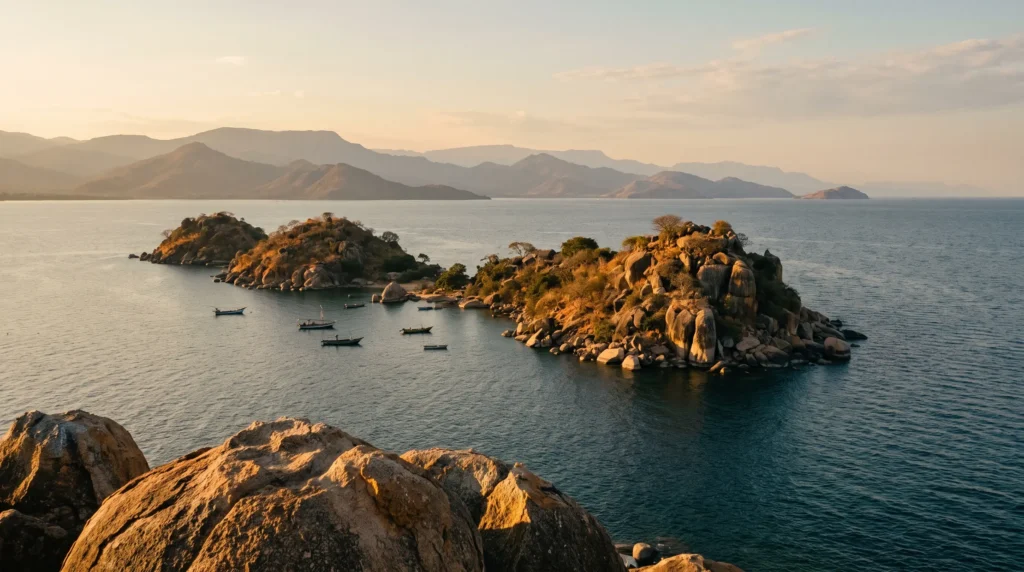
I keep telling people that Malawi ruined lake vacations for me — in a good way. It has no coastline, no ocean, nothing salty for a thousand kilometres in any direction, and yet it has a body of water so large you cannot see the far shore, so warm you swim at sunrise without flinching, and so biologically strange that scientists study its fish the way they study Darwin’s finches. Lake Malawi runs the length of the country like a spine, and everything else — the tea-green Shire Highlands, the misty Nyika Plateau where zebra graze at 2,600 metres, the Big Five reserves clawed back from decades of poaching — hangs off it. Malawians call this “the Warm Heart of Africa,” and it is not just tourism-board flattery: this is one of the friendliest, safest-feeling countries I have travelled in on the continent, even as the World Heritage sites, safari camps and lakeside chalets stay genuinely uncrowded. It is also poor, under-resourced, and going through a real reset on visas and entry rules in 2026 — so read the practical section before you book, not after.
In This Guide
- Overview — Why Malawi Is Africa’s Most Underrated Lake Country
- Lake of Stars — Malawi’s Beachfront Music Festival
- Best Time to Visit Malawi (Season by Season)
- Getting There — Kamuzu International & Overland Routes
- Getting Around — Minibuses, Matolas & Domestic Flights
- Top Regions — Lakeshore, Highlands & Reserves
- Culture & People — Chichewa, Gule Wamkulu & the Warm Heart
- A Food Lover’s Guide to Malawi
- Off the Beaten Path
- Practical Information
- Budget Breakdown — What Malawi Actually Costs in 2026
- Frequently Asked Questions
Overview — Why Malawi Is Africa’s Most Underrated Lake Country
Malawi is a narrow, landlocked sliver of southeastern Africa, squeezed between Zambia, Tanzania and Mozambique, running roughly 900 kilometres north to south along the Great Rift Valley. Independence from Britain came on 6 July 1964, and English remains the official language alongside Chichewa, the national language spoken by the majority of the population. With around 22.2 million people as of 2025, it is one of the more densely populated countries in the region — and one of the poorest by GDP per capita — but that economic reality rarely shows up as hassle for visitors; it shows up as some of the most consistently warm, unhurried hospitality you’ll find on the continent.
The headline is Lake Malawi (also known as Lake Nyasa), which forms most of the country’s eastern border and stretches roughly 580 kilometres long — one of the largest and deepest lakes in the world, and home to more freshwater fish species than almost anywhere on Earth. The southern end of the lake became a UNESCO World Heritage Site in 1984, prized for cichlid diversity that scientists compare to the Galápagos finches for what it reveals about evolution. Inland, the country climbs into cool, pine-scented highlands — the Nyika and Zomba plateaus, the sheer granite walls of the Mulanje Massif — and drops into Big Five reserves that were, within living memory, emptied by poaching and have since been rebuilt almost from scratch.
What Malawi doesn’t have is crowds. There is no equivalent of the Serengeti convoy or the Amalfi traffic jam here — you’ll often be one of very few vehicles at a park gate, one of a handful of guests at a lakeshore lodge. What it does have, as of 2026, is a freshly reintroduced visa regime that catches a lot of travellers off guard, so plan that part first.
Lake of Stars — Malawi’s Beachfront Music Festival
If you can time a trip around one date, make it the Lake of Stars Malawi Arts Festival, a beachfront music and arts weekend that has become the country’s best-known cultural export. The 2026 edition runs 2–4 October on the shores of Lake Malawi at Nkhotakota, mixing Malawian and international musicians, DJs and artists over three days of lakeside stages. It lands right at the tail end of the dry season — cool nights, no rain, and some of the best lake visibility of the year — which makes early October arguably the single best week to be in the country if music and swimming both appeal.
The festival has run in various forms since the mid-2000s and has become a genuine draw for younger travellers who might otherwise skip Malawi for bigger East African safari circuits; book lakeside accommodation around Nkhotakota well ahead if you’re coming for it, since rooms are limited and demand spikes hard for festival weekend.
Best Time to Visit Malawi (Season by Season)
May – October · Dry season (peak)
This is Malawi’s best window for almost everything: clear skies, cooler temperatures (especially June–August, when highland nights can get genuinely cold), thinner vegetation that makes wildlife easier to spot in Majete and Liwonde, and calm, clear lake water for snorkeling and diving. It’s also peak season for lodges and safari camps, so book ahead for July and August.
November – April · Rainy season
Hot, humid, and prone to heavy afternoon downpours, especially December through March. Roads in remote areas can become difficult, and some lakeshore and highland lodges close or reduce services. The upside: everything turns intensely green, birding is at its best, and rates drop. Malaria risk is present year-round countrywide but rises with the rains, so prophylaxis matters most in this window.
The shoulder sweet spot
Late April to May and September to early October dodge both the worst rain and the coldest highland nights, while keeping wildlife visibility good and crowds (such as they are in Malawi) thin. Early October adds the Lake of Stars festival into the bargain.
Getting There — Kamuzu International & Overland Routes
Kamuzu International Airport (LLW), just outside Lilongwe, is Malawi’s main international gateway, with regional carriers Ethiopian Airlines, Kenya Airways and Airlink connecting through hubs like Addis Ababa, Nairobi and Johannesburg — there are no direct long-haul flights from North America or Europe, so expect at least one connection. Blantyre’s Chileka Airport is the secondary gateway in the south, useful if your itinerary centres on Majete, Mulanje or the southern lakeshore, with roughly a dozen weekly domestic connections to Lilongwe.
Overland, Malawi borders Zambia, Tanzania and Mozambique, and popular routes link it into wider East and Southern Africa circuits: the Songwe border crossing from Tanzania (often paired with a Zanzibar or Kilimanjaro trip), the Mchinji or Chipata crossings to/from Zambia (linking to South Luangwa National Park), and multiple Mozambique crossings feeding onto the coast. Bus and shared-taxi networks connect major towns to these borders, though schedules are informal and journeys can run long.
Getting Around — Minibuses, Matolas & Domestic Flights
Malawi is compact enough to cross by road in a long day but poor enough in transport infrastructure that “long day” is doing a lot of work in that sentence. Shared minibuses run between all major towns cheaply and frequently, though they leave only once full and pack in more passengers than seats suggest — budget travellers use them constantly, but patience is part of the ticket price. In rural areas, open-backed pickup trucks called matolas fill the gaps where minibuses don’t reach.
For visitors short on time, self-drive (with a 4×4 for reserve and highland roads) or a private transfer/driver is the practical option — car hire runs roughly US$60–120/day depending on vehicle and insurance. Charter flights link Lilongwe, Blantyre, Club Makokola and several lakeshore and safari airstrips, cutting what would be a full day of driving into under an hour, and are worth the splurge on a two-week itinerary that spans lake, highlands and reserves. Roads outside the main N1 corridor can be rough and poorly lit; avoid night driving.
Top Regions — Lakeshore, Highlands & Reserves
Lilongwe
The capital since the mid-1970s, when the government relocated from Zomba, Lilongwe is a spread-out, low-key city that most visitors use as an arrival/departure hub rather than a destination — though Lilongwe Wildlife Sanctuary, a genuine rescue-and-rehabilitation reserve inside the city, is worth an afternoon.
Lake Malawi — Cape Maclear & Nkhata Bay
The lake is the main event. Cape Maclear, inside Lake Malawi National Park, is the easiest base for snorkeling among hundreds of colourful cichlid species in clear, bilharzia-managed swimming areas, with backpacker lodges and upscale retreats side by side. Further north, Nkhata Bay has a laid-back, almost Southeast-Asian backpacker energy, with dive operators, kayaking, and boat trips to Likoma Island.
Likoma & Chizumulu Islands
Malawian territory deep inside Mozambican waters, these lake islands are reached by the venerable Ilala ferry or small charter flights, and reward the effort with some of the clearest water on the lake and a slower pace than even Nkhata Bay.
Majete Wildlife Reserve
In the southwest near Blantyre, Majete was decimated by poaching through the 1980s, then rebuilt from 2003 under a public-private partnership between the NGO African Parks and Malawi’s wildlife department — it became the country’s first Big Five reserve after lions were reintroduced in 2012, and now holds more than 12,000 animals across all Big Five species.
Liwonde National Park
Along the Shire River, Liwonde holds Malawi’s largest elephant population and one of its two black rhino populations, plus reintroduced lion, cheetah and wild dog under African Parks management since 2015 — river cruises here rival anywhere in Southern Africa for hippo and crocodile sightings plus over 400 recorded bird species.
Nyika National Park
Malawi’s largest park at roughly 3,200 square kilometres, Nyika covers a rolling, misty highland plateau averaging 1,800 metres, topped by Nganda Hill at 2,600 metres — genuinely unlike anywhere else in the safari world, with Crawshay’s zebra and roan antelope grazing open, English-countryside-like grassland instead of savanna bush.
Zomba Plateau & the Southern Highlands
Zomba, the colonial and post-independence capital until the mid-1970s (parliament stayed until 1994), sits beneath its namesake plateau — a cool, forested tableland around 1,800 metres with waterfalls, trout streams and sweeping views over the Shire Valley. Nearby Mount Mulanje, a granite massif rising sharply from the plains, culminates at Sapitwa Peak (3,002m), Malawi’s highest point, first summited in 1894 and now the country’s premier multi-day hiking destination.
Culture & People — Chichewa, Gule Wamkulu & the Warm Heart
Malawi’s population spans several major groups — Chewa, Yao, Tumbuka and others — with Chichewa serving as the national language alongside official English, and Tumbuka, Yao and several other languages spoken regionally. “The Warm Heart of Africa” isn’t just a slogan the tourism board coined; ask most travellers who’ve done a Southern Africa loop and Malawi usually comes up as the friendliest leg of it — greetings matter, unhurried conversation is the norm, and a genuine smile goes a long way in rural areas where tourism is still a novelty rather than an industry.
Among the Chewa people, the Gule Wamkulu masked dance tradition — performed at initiations, funerals and important occasions — is recognised by UNESCO as an Intangible Cultural Heritage practice shared across Malawi, Zambia and Mozambique; encountering a performance (respectfully, and ideally with a local guide’s introduction) is one of the more striking cultural experiences on offer. Village stays and community tourism initiatives around Lake Malawi and the Shire Highlands offer a more grounded alternative to lodge-only itineraries, and Dr. David Livingstone’s 19th-century travels along the lake and Shire River left a historical throughline that shows up in place names and mission-era architecture across the country.
A Food Lover’s Guide to Malawi
The national staple is nsima — a stiff, thick maize porridge eaten with your hands, served alongside a relish (ndiwo) of vegetables, beans or meat. It shows up at nearly every local meal, from roadside stalls to family tables, and is the closest thing Malawi has to a national dish.
From the lake comes chambo, a bream/tilapia species netted from Lake Malawi and grilled, fried or stewed — order it lakeside and it will usually be the freshest fish you eat all trip. Inland, look for goat curry, dried Lake Malawi fish (usipa and matemba), and tea and coffee grown on the Thyolo and Mulanje estates in the south, some of which run tasting tours. Malawi Gin, distilled locally, and Kuche Kuche or Carlsberg Malawi lager are the standard drinks; tap water should generally be avoided in favour of bottled or treated water outside major hotels.
Off the Beaten Path
Mount Mulanje Cultural Landscape
Newly inscribed as Malawi’s third UNESCO World Heritage Site in 2025, the Mulanje massif combines dramatic granite scenery with a living cultural landscape of forest spirits and sacred sites still honoured locally — multi-day hut-to-hut treks here see a fraction of the visitors that Kilimanjaro does.
Chongoni Rock-Art Area
A UNESCO World Heritage Site since 2006, this Central Region site holds the densest concentration of rock art in Central Africa, painted over centuries by both hunter-gatherer BaTwa and later farming communities — a quiet, deeply under-visited counterpart to better-known rock art sites elsewhere on the continent.
Nkhotakota Wildlife Reserve
One of Africa’s largest and oldest protected areas on paper, Nkhotakota received one of the biggest elephant translocations in conservation history — around 500 elephants moved in from Liwonde and Majete in 2016–17 — and is now emerging as a serious, still-quiet safari destination in its own right.
Likoma Island’s Cathedral
An improbably enormous Anglican cathedral, built in the early 1900s in the middle of a small Lake Malawi island — a genuinely odd and photogenic detour reached by ferry or charter flight, with barely another tourist in sight most days of the year.
Practical Information
Visas. Malawi reintroduced visa requirements for nearly all nationalities, including the US and UK, effective January 2026, reversing an earlier visa-free arrangement. Apply in advance through the official e-visa portal, or on arrival for many nationalities; fees run around US$50 for a single-entry visa (3-month validity), up to US$150–250 for longer multiple-entry visas, payable in cash US dollars if applying on arrival. Your passport needs at least 6 months’ validity beyond your arrival date, and a yellow fever certificate is required if you’re arriving from a country with yellow fever transmission risk.
Safety. The US State Department rates Malawi Level 2 — Exercise Increased Caution — citing common theft, burglary and occasional violent crime, plus stretched police capacity; demonstrations occur periodically around political and economic issues. Standard precautions apply: avoid walking alone at night, use registered tour operators and transfers rather than unmarked taxis, and be wary of unsolicited “stranded traveller” scams that specifically target tourists in Malawi.
Health. Malaria transmission occurs countrywide, and prescription antimalarial medication is recommended for all travellers; routine vaccines plus Hepatitis A and Typhoid are also advised, and freshwater swimming outside recognised safe zones carries schistosomiasis (bilharzia) risk. Drink bottled or treated water.
Connectivity & practicalities. Type G plugs, 230V/50Hz — bring an adapter if you’re coming from North America. Malawi runs on Central Africa Time (UTC+2) with no daylight saving. Mobile data coverage is decent in towns and along the lakeshore, patchier in the highlands and reserves; a local SIM is cheap and easy to pick up on arrival.
Budget Breakdown — What Malawi Actually Costs in 2026
Malawi is one of the more affordable countries in Southern/East Africa outside of organised safari packages, where prices climb quickly.
Budget (US$35–70/day): Lakeshore backpacker lodges or guesthouses, local minibus travel, nsima-and-relish meals from local eateries, self-guided snorkeling at Cape Maclear.
Mid-range (US$120–250/day): Comfortable lakeshore or highland lodges, a hired driver or self-drive 4×4, entry-level guided safari days in Majete or Liwonde (park fees plus activity costs typically run US$30–60/day per park), domestic charter flight between regions.
Premium (US$350+/day): All-inclusive safari lodges in Liwonde or Majete with guided game drives and boat cruises, private charter flights linking lake, highlands and reserves, top-end lakeshore resorts like those around Cape Maclear and Club Makokola.
Factor in park entry fees (paid separately from lodge rates at most reserves), the e-visa or on-arrival visa fee, and tipping of roughly 10% at restaurants and for guides where not already included.
Planning Your First Trip to Malawi
The classic first-timer route is lake plus reserve plus highlands: fly into Lilongwe, spend two or three nights at Liwonde National Park for elephants, hippos and river cruises, then head to Cape Maclear or Nkhata Bay on Lake Malawi for four or five nights of snorkeling and downtime, finishing with a night or two on the cool Zomba Plateau or a shorter Mulanje trek before flying home via Blantyre. Ten to fourteen days covers it comfortably without feeling rushed. Malawi pairs naturally with wider Southern and East Africa circuits — many travellers combine it with a Zambia safari across the western border, a Tanzania extension via the Songwe crossing for Zanzibar or Kilimanjaro, or a longer loop through South Africa and Botswana further south.
Frequently Asked Questions
Is Malawi safe for tourists in 2026?
Broadly yes by regional standards — Malawi is rated Level 2, “Exercise Increased Caution,” by the US State Department, mainly for common theft and occasional violent crime rather than anything targeted at tourists specifically. Use standard precautions: avoid walking alone after dark, book transfers and safaris through registered operators, and check current advisories before you travel.
Do I need a visa for Malawi?
As of January 2026, yes — Malawi reintroduced visa requirements for almost all nationalities, including US and UK passport holders, after a brief visa-free period. Apply online through the official e-visa portal ahead of travel, or plan to pay on arrival in cash US dollars if your nationality allows it — check the current list before flying, since arrangements have changed more than once recently.
What’s the best way to see the Big Five in Malawi?
Majete Wildlife Reserve, rebuilt by African Parks since 2003, became Malawi’s first Big Five reserve when lions were reintroduced in 2012 and now supports over 12,000 animals across all five species. Liwonde National Park is the stronger choice if elephants and river-based game viewing (hippo, crocodile, birdlife) are the priority.
Is it safe to swim in Lake Malawi?
Yes, in recognised swimming areas — Cape Maclear and most lodge beaches are managed and considered low-risk for bilharzia (schistosomiasis), and the water is warm and clear year-round. Ask locally about specific spots, and avoid swimming in stagnant shoreline vegetation elsewhere on the lake.
Malawi or a bigger East Africa safari circuit?
Choose Malawi if you want a genuinely uncrowded, budget-friendlier mix of freshwater lake time and rebuilding-but-real Big Five reserves, plus a rare highland-plateau safari experience at Nyika. Choose Kenya or Tanzania if sheer wildlife density and the Great Migration are the priority — Malawi’s reserves are recovering success stories, not the Serengeti’s volume.
What’s the cheapest way to experience Lake Malawi?
Take a shared minibus to Cape Maclear or Nkhata Bay, stay in a backpacker lakeshore lodge, and snorkel straight off the beach — no boat or dive package required to see the cichlids that make the lake famous.
Ready to Explore Malawi?
A freshwater lake you can’t see across, elephants wading the Shire River at sunset, zebra grazing a highland plateau colder than anywhere else in the safari world — Malawi packs an outsized range of landscapes into one narrow, welcoming country. The visa rules just got more complicated, but the reward on the other side hasn’t changed: this is still one of the warmest, least-crowded corners of Southern Africa left to discover.
Explore More
- Zambia Travel Guide — South Luangwa safaris across the western border
- Tanzania Travel Guide — continue north via the Songwe border crossing
- South Africa Travel Guide — pair with a longer Southern Africa loop
- Botswana Travel Guide — the Okavango Delta further south
How this guide was built
Published as part of Facts From Upstairs’ country guide series. Built from authoritative sources — Wikipedia’s Malawi and List of World Heritage Sites in Malawi entity pages, UNESCO’s Lake Malawi National Park inscription, the Malawi Tourism Board’s visa guide and official e-visa portal, the US State Department’s Malawi travel advisory, the UK FCDO’s Malawi entry requirements page, the US CDC traveler page for Malawi, Trading Economics’ Malawi kwacha exchange data, and Wikipedia pages for Majete Wildlife Reserve, Liwonde National Park, Nyika National Park, the Mulanje Massif, Zomba, and Kamuzu International Airport, plus the Lake of Stars Festival’s official site and African Parks’ Liwonde programme page. Numeric claims carry inline citations.
Sources cited on this page
- Wikipedia — Malawi
- Wikipedia — List of World Heritage Sites in Malawi
- UNESCO — Lake Malawi National Park
- Wikipedia — Mulanje Massif
- Malawi e-Visa Portal
- Malawi Tourism Board — Visa Guide
- UK FCDO — Malawi Entry Requirements
- US State Department — Malawi
- US CDC — Malawi traveler page
- Trading Economics — Malawian Kwacha
- World Standards — Malawi Power Plug & Voltage
- Wikipedia — Kamuzu International Airport
- Lake of Stars Malawi Arts Festival
- Wikipedia — Majete Wildlife Reserve
- Wikipedia — Liwonde National Park
- African Parks — Liwonde
- Wikipedia — Nyika National Park
- Wikipedia — Zomba, Malawi
More country guides you might like
Plan your trip to Malawi
The booking tools we use ourselves. FFU may earn a commission at no extra cost to you.
Plan & book your trip to Malawi
Booking through these searches supports our guides at no extra cost to you.