
Nha Trang Travel Guide — Vietnam’s Sea Festival City, Cham Towers & the World’s Longest Overwater Cable Car
Nha Trang is the city Vietnam built for the beach, and it shows the moment you land: a four-kilometre municipal boardwalk, a bay repeatedly named one of the world’s most beautiful, and a skyline of towers that would look at home in Miami if you swapped the palm trees for, well, more palm trees. I’ll be honest about what that means — this is Vietnam at its most resort-polished, not its most authentic, and some stretches of the front feel more Cancún than Kauthara. But climb five minutes inland and you’re at Po Nagar, a working Cham temple complex older than most European cathedrals, still burning incense for a goddess with ten hands. Ride a cable car out to a private island, dive one of only four IUCN-recognized marine protected areas ever admitted worldwide, then come back for grilled squid and a $2 iced coffee on a plastic stool. Nha Trang doesn’t ask you to choose between package-holiday ease and real Vietnam — it just makes you walk a few blocks between them.
In This Guide
- Overview — Why Nha Trang Is Vietnam’s Beach Capital
- The Nha Trang Sea Festival — July 2026
- Best Time to Visit Nha Trang (Season by Season)
- Getting There — Cam Ranh Airport & the Coast Road
- Getting Around — Cable Cars, Cyclos & Grab
- Neighborhoods — Tran Phu, the Old Quarter & the Islands
- Culture & People — Cham Roots, Kinh City
- A Food Lover’s Guide to Nha Trang
- Off the Beaten Path
- Day Trips From Nha Trang
- Practical Information
- Budget Breakdown — What Nha Trang Actually Costs in 2026
- Planning Your First Trip
- Frequently Asked Questions
Overview — Why Nha Trang Is Vietnam’s Beach Capital
Nha Trang sits on Vietnam’s south-central coast in Khánh Hòa Province, wrapped around a bay that Travel + Leisure named one of the world’s most beautiful in back-to-back years. The name itself is a Vietnamese rendering of the old Cham phrase “Ea Dran,” meaning reed river — a reminder that long before package tourists and Russian charter flights, this coast was Kauthara, a heartland of the Champa kingdom. The city itself is young by comparison: it was only formally established as a townlet in 1924 and didn’t reach city status until 1977.
What put Nha Trang on the modern map is the water. Offshore lie Hon Tre, Hon Mun, Hon Mieu and a scatter of smaller islands, and the waters around Hon Mun were named one of the first four marine protected areas in the world admitted by the IUCN. That’s the pitch in one sentence: internationally significant diving and snorkeling a short boat ride from a city with 24-hour pho, a night market, and direct flights from Seoul.
The catch — and I’d rather tell you now than let you find out on the ground — is that Nha Trang’s tourist strip can feel like it was built for a very specific visitor: mid-range package tourism, heavy on big resorts, seafood buffets and karaoke bars along Tran Phu. If you want the moped-and-street-food chaos people picture when they say “Vietnam,” you’ll find more of it in Hoi An or Hanoi. Nha Trang’s trade is convenience, reliable sun, and genuinely excellent value diving — not grit.
The Nha Trang Sea Festival — July 2026
Time it right and you’ll land in the middle of one of Vietnam’s biggest coastal celebrations. The biennial Nha Trang–Khánh Hòa Sea Festival, running since 2003, typically falls between April and June — but the 2026 edition has shifted to 17–19 July, with supporting events stretching from 10 July to 10 August. Expect fireworks over the bay, folk dance and traditional music performances, beach volleyball and swimming competitions, a street carnival with dozens of decorated floats, and night markets selling local crafts and food — organizers have pitched the 2026 edition as a genuinely national-scale event with close to 30 combined cultural, sports and arts activities.
The honest trade-off: hotel rates spike and Tran Phu’s beachfront gets genuinely crowded during festival weekends, so book well ahead if you want to be near the action — or deliberately avoid those dates if you’re after a quiet beach week instead.
Best Time to Visit Nha Trang (Season by Season)
January – August · Dry season (peak, especially Feb–Jun)
Nha Trang runs on a tropical savanna climate with the dry season stretching January through August. February to June is the sweet spot: consistent sun, calm seas, and the best underwater visibility for diving Hon Mun and the outer islands. July brings the Sea Festival crowds and the hottest, muggiest stretch of the year.
September – December · Wet season
The rains arrive September through December, and this stretch of the central coast sits inside the broader central-Vietnam storm-risk window — the US State Department flags ocean and weather conditions as changeable and advises checking forecasts closely during this period. October and November see the heaviest rain; some dive operators reduce trips and seas can be too rough for outer-island boats.
The shoulder move
Late August into early September often threads the needle: festival crowds have cleared, rain hasn’t properly set in, and hotel rates soften before the wet-season discount really kicks in.
Getting There — Cam Ranh Airport & the Coast Road
Cam Ranh International Airport (CXR) sits about 28–30 kilometres south of downtown Nha Trang and is Vietnam’s fourth-busiest airport, notable as the only one in the country where international passengers outnumber domestic ones. A dedicated international terminal, opened in 2018 with a “swallow’s nest” roofline, handles flights from Korean Air, Asiana, VietJet, Vietnam Airlines and a long roster of budget carriers connecting Seoul, Russia, and Central Asian hubs, alongside domestic links to Hanoi and Ho Chi Minh City.
From the airport, metered taxis and prepaid airport-counter cars take 40–50 minutes to reach downtown along the coast road; Grab (Vietnam’s dominant ride-hailing app) usually works out cheaper if you have local data or airport wifi to book one. Overland, Nha Trang sits on Vietnam’s main north–south rail line and highway, with the Reunification Express connecting it to Hanoi (roughly 24+ hours) and Ho Chi Minh City (around 7–9 hours) — most visitors fly one or both legs and use the train, if at all, for a single scenic overnight hop rather than the full spine of the country.
Getting Around — Cable Cars, Cyclos & Grab
Central Nha Trang — Tran Phu beachfront, the Old Quarter, the market district — is flat and very walkable, and a rented bicycle or scooter covers it easily. For anything further, Grab is the default: cheap, metered in-app, and it sidesteps the fare haggling that comes with flagging a street taxi.
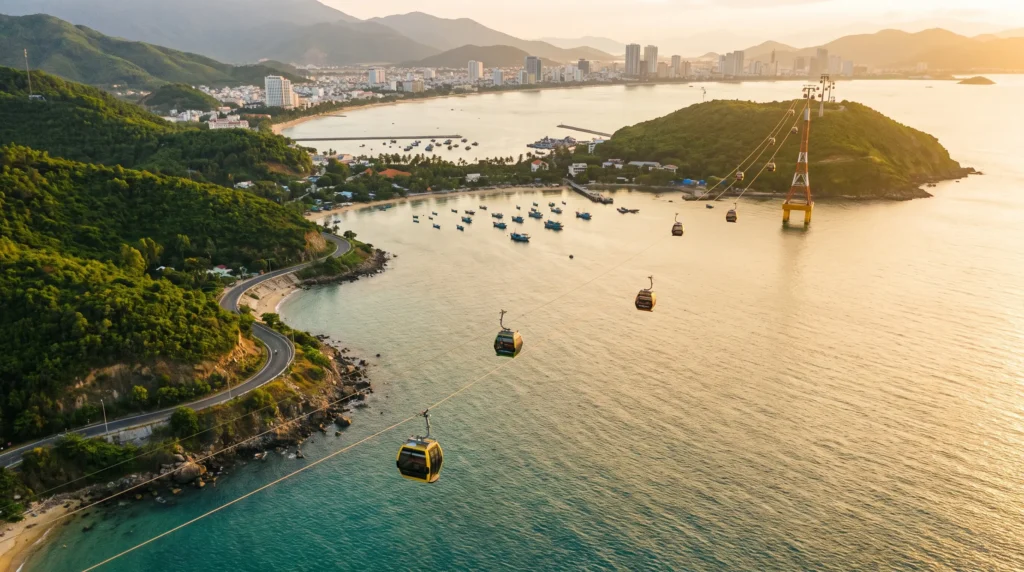
The signature ride is the Vinpearl cable car, which links downtown to Hon Tre Island in a gondola strung out over open water — officially recognized as the world’s longest sea-crossing cable car route, supported by seven offshore towers, the tallest reaching 115 metres with 40 metres of that below the waterline. A 2024 redevelopment of the mainland terminal shortened the route from its original span to just over 2.6 kilometres, but it still runs daily and remains one of the most photographed rides in the country. Boats to the outer islands (Hon Mun, Hon Mieu, Hon Tam) leave from Cau Da pier and are usually bundled into half-day snorkeling or diving trips rather than run as public ferries.
Neighborhoods — Tran Phu, the Old Quarter & the Islands
Tran Phu Beachfront
The main event: a long municipal beach backed by high-rise hotels, seafood restaurants and the city’s densest concentration of tour-desk touts. Central, convenient, and unmistakably resort-town — book here for beach-out-your-door ease, not local character.
The Old Quarter & Central Market
A few blocks inland, the streets around Cho Dam (Dam Market) are where Nha Trang actually lives: motorbike repair shops, wet markets, family-run com binh dan (rice-and-side-dish) stalls, and prices that drop noticeably once you’re off Tran Phu.
Hon Tre Island / Vinpearl
A private island resort-and-theme-park complex reached by the cable car, with an amusement park, water park, aquarium and multiple beaches. It’s a full day out on its own and effectively a separate universe from mainland Nha Trang — go if you want the theme-park version of a beach day, skip it if you’d rather spend that time in the Old Quarter.
Hon Mun, Hon Mieu & Hon Tam
The dive-and-snorkel islands, reached by day-trip boat from Cau Da pier. Hon Mun anchors the marine protected area; Hon Mieu (Tri Nguyen) has a long-running aquarium/fish-farm attraction; Hon Tam leans toward beach clubs and water sports.
Bai Dai (Long Beach)
A long, quieter stretch south toward Cam Ranh, increasingly lined with large-format resorts precisely because it’s close to the airport and has more room to build than the tight central strip.
Thap Ba & the Po Nagar Area
North of downtown along the Cai River mouth, home to the Po Nagar Cham towers and the Thap Ba mineral mud-bath complex — a genuinely different pace from the beachfront, worth a half-day on its own.
Culture & People — Cham Roots, Kinh City
Modern Nha Trang is overwhelmingly ethnic Kinh Vietnamese, but the region’s cultural bedrock is Cham. Po Nagar, on Cù Lao hill at the mouth of the Cai River, was founded before 781 CE as a Hindu temple complex dedicated to the goddess Yan Po Nagar; a stele from that year records King Satyavarman restoring the sanctuary after it was damaged by raiders, and further towers were added through the 10th to 13th centuries. The main tower still stands about 25 metres tall, and the central statue depicts the goddess with ten arms, syncretized with Hindu deities including Durga. When Vietnamese settlers absorbed the region in the 17th century, they folded the site into local worship as Thiên Y Thánh Mẫu — it’s a functioning place of devotion today, not a museum piece, so dress modestly and expect incense smoke and real worshippers alongside the tour groups.
Long Son Pagoda, a working Buddhist temple crowned by a large hilltop Buddha statue visible across the city, is the other major devotional site and a good counterpoint to Po Nagar’s Cham Hindu roots on the same afternoon.
A Food Lover’s Guide to Nha Trang
Seafood is the headline, unsurprisingly — grilled squid, clams, and the local specialty bún cá (fish cake noodle soup), a lighter, more citrusy cousin of the pho you’ll find further north. Look for it at the stalls around Dam Market, where a bowl runs a fraction of what the same dish costs on Tran Phu.
Nha Trang is also known for nem nướng (grilled pork skewers wrapped in rice paper with herbs and a distinctive peanut-and-liver dipping sauce) and for bird’s nest — the region’s swiftlet caves supply a large share of Vietnam’s edible bird’s nest industry, sold everywhere from pharmacies to airport gift shops as a health tonic. Wash it down with cà phê sữa đá (iced milk coffee) from any plastic-stool sidewalk stand, or a cold Saigon Beer on the beach at sunset. For a splurge, the seafood markets near Cau Da let you pick your own catch and have it grilled to order streetside.
Off the Beaten Path
Thap Ba Hot Spring Mud Baths
Mineral mud pools and hot spring soaking tanks a short ride north of downtown — a genuinely relaxing half-day that most visitors skip in favor of the beach, which is exactly why it’s worth the detour.
Bai Tru & the Northern Beaches
Quieter sand north of the Po Nagar towers, largely free of the Tran Phu resort wall and popular with local families rather than tour groups.
Nha Trang Oceanography Institute
One of Vietnam’s oldest marine research institutions, with an aquarium and preserved-specimen museum that’s more substantive than it sounds — a good rainy-day fallback.
Diving Beyond Hon Mun
Most day-trippers snorkel the closer islands; asking a dive shop about sites further out toward the marine protected area’s edges gets you healthier coral and fewer boats for a modest price bump.
Day Trips From Nha Trang
Doc Let Beach — roughly an hour north, a long, undeveloped white-sand beach that shows what Nha Trang’s coastline looked like before the high-rises.
Ba Ho Waterfalls — a jungle hike to a series of granite-pool cascades north of the city, popular with locals on weekends and largely overlooked by package tours.
Cam Ranh Bay & Bai Dai — south toward the airport, a deep natural harbor with a complicated military history and, today, a fast-growing resort strip along Long Beach.
Dalat — a scenic but long overland ride (4–5 hours by bus or car up into the Central Highlands) for cooler air, pine forests and French colonial architecture; doable as a long day trip but better as an overnight add-on.
Practical Information
Money. The Vietnamese đồng floats freely and currently trades around 26,000 VND to the US dollar. This is a cash-forward economy — ATMs are everywhere in the tourist zone, but small vendors, market stalls and cyclos expect notes. Cards work at hotels, larger restaurants and malls.
Visa. Vietnam issues a 90-day e-visa (single or multiple entry, roughly US$25–50) to citizens of every country through the official government e-visa portal, while a growing list of nationalities — including the UK, France, Germany, Italy, Spain, Japan and South Korea — get 45 days visa-free for tourism. Apply for the e-visa well ahead of travel rather than at the border, and make sure your passport has at least six months’ validity left.
Safety. The US State Department rates Vietnam Level 1 — Exercise Normal Precautions — with petty crime (bag-snatching, phone theft) the main concern in tourist areas rather than violent crime. Beach safety is the bigger practical risk in Nha Trang specifically: ocean conditions can change quickly, riptides and sharp coral are real hazards, and many stretches of beach have no lifeguards, so treat red-flag days seriously.
Health. The CDC recommends being current on routine vaccines plus hepatitis A and B and typhoid before travel, and advises malaria precautions for rural areas (major cities including Nha Trang are considered malaria-free). Stick to bottled or filtered water, use a strong DEET repellent, and avoid swimming in unchlorinated fresh water because of leptospirosis risk.
Connectivity & practicalities. A local SIM or regional eSIM is cheap and gives you Grab, maps and translation apps on the go. Plugs: mostly two-pin (types A/C), 220V. Time zone: UTC+7, no daylight saving.
Budget Breakdown — What Nha Trang Actually Costs in 2026
Nha Trang is one of Vietnam’s better travel-dollar destinations — noticeably cheaper than Hoi An’s boutique strip or Ho Chi Minh City’s business hotels, especially once you step off Tran Phu.
Budget (US$25–45/day): Guesthouse or hostel dorm near the Old Quarter, market noodle bowls and street coffee, Grab bikes, self-guided beach days.
Mid-range (US$60–130/day): Three-star beachfront hotel, restaurant seafood dinners, a half-day snorkel or two-tank dive trip (roughly US$40–70), Vinpearl cable car and theme park combo ticket.
Luxury (US$200+/day): Beachfront resort suite on Tran Phu or Bai Dai, private island day at Vinpearl with premium add-ons, chartered dive boats to the outer marine-protected-area sites.
Fixed costs to expect: small entry fees at Po Nagar and the Oceanography Institute, marine-park fees bundled into most diving/snorkeling trips, and a mandatory tourism e-visa fee if your nationality isn’t on the exemption list. Tipping isn’t obligatory but is increasingly appreciated in tourist restaurants and on tours.
Planning Your First Trip to Nha Trang
Three to four nights covers Nha Trang comfortably: one day for Po Nagar, Long Son Pagoda and the Old Quarter market, one full day on Vinpearl or the outer islands diving/snorkeling, and a spare day for Thap Ba’s mud baths or a Doc Let Beach escape. Most itineraries pair it with a longer Vietnam loop — fly into Hanoi or Ho Chi Minh City, add a few days each in Hoi An‘s lantern-lit old town and Ho Chi Minh City, then finish (or start) on the coast in Nha Trang. See our full Vietnam travel guide for the country-wide itinerary planning, or continue the Southeast Asia beach-and-temple circuit with our Hanoi city guide.
Frequently Asked Questions
Is Nha Trang safe for tourists in 2026?
Yes, broadly — Vietnam sits at the US State Department’s lowest advisory level, and violent crime against tourists is rare. Petty theft (snatched phones and bags on scooters) is the main risk in busy tourist areas, and beach conditions — riptides, sharp coral, few lifeguards — deserve more caution than the crime rate does.
Do I need a visa for Vietnam?
Most nationalities can now get a 90-day e-visa online for about US$25–50, and a growing list of countries — the UK, France, Germany, Japan and South Korea among them — get 45 days visa-free for tourism. Apply through the official government e-visa portal well before your trip.
How many days do I need in Nha Trang?
Three to four nights hits the highlights — Po Nagar, the cable car and Vinpearl, a day of diving or snorkeling. Add a couple more if you want to fold in Doc Let Beach, the Ba Ho waterfalls or a Dalat overnight.
Is Nha Trang better for beaches or Hoi An better for culture?
Fair split: come to Nha Trang for beach resort ease, cable cars and diving; go to Hoi An for lantern-lit old-town streets, tailoring and river-town atmosphere. Most Vietnam itineraries do both rather than choosing.
What’s the water like — can beginners dive?
Yes — Hon Mun and the nearer islands are approachable for first-time divers and strong for snorkeling, with plenty of PADI-certified shops offering intro dives. Visibility and calm seas are best February through June.
Is Nha Trang walkable, or do I need a scooter?
The Tran Phu beachfront and Old Quarter are easily walkable, but Grab (cheap, metered, app-based) is the practical way to reach Po Nagar, Thap Ba or the boat piers without haggling over taxi fares.
Ready to Explore Nha Trang?
A cable car strung over open water, a goddess with ten hands still receiving incense after twelve centuries, and a bay that keeps landing on “most beautiful” lists for a reason — Nha Trang packs a genuinely rare combination of beach-holiday ease and real Cham history into one manageable coastline. Go for the diving, stay for the mud baths, and budget an extra afternoon for the Old Quarter market once the resort strip starts to feel a little too polished.
Explore More
- Vietnam Travel Guide — the full country-wide planning guide
- Hoi An City Guide — lantern-lit old town, a few hours up the coast
- Ho Chi Minh City Guide — Vietnam’s largest city, a short flight south
- Hanoi City Guide — the capital, old quarter and jump-off for Ha Long Bay
How this guide was built
Published as part of Facts From Upstairs’ city guide series. Built from authoritative sources — Wikipedia entity pages for Nha Trang, Po Nagar, Cam Ranh International Airport, Vietnam, the Vinpearl Cable Car and Vietnam’s visa policy, the US State Department’s Vietnam country page, the US CDC traveler page for Vietnam, and the InterContinental Nha Trang’s coverage of the 2026 Nha Trang Sea Festival dates. Numeric and factual claims carry inline citations.
Sources cited on this page
More city guides you might like
Plan your trip to Nha Trang
The booking tools we use ourselves. FFU may earn a commission at no extra cost to you.
Plan & book your trip to Nha Trang
Booking through these searches supports our guides at no extra cost to you.